Climate
Change & the
Health of our
Children
Prof. Dulanie Gunasekera
University of Sri Jayawardenapura
Climate Change
“A change of climate that is attributed directly or indirectly to
human activity, that alters the composition of the global
atmosphere and that is in addition to natural climate variability
observed over comparable periods of time.”*
* Article 1 United Nations Framework Convention on
Climate Change, 1992
** Lancet series
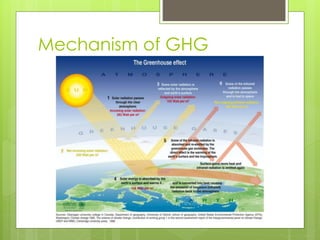
Mechanism of GHG
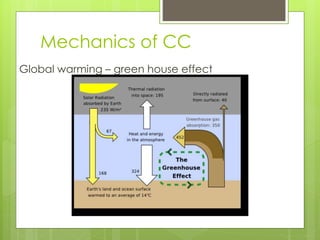
Mechanics of CC
Global warming – green house effect
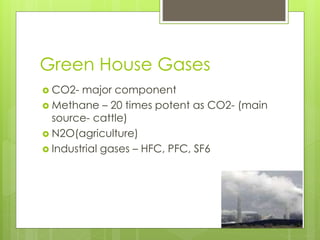
Green House Gases
 CO2- major component
 Methane – 20 times potent as CO2- (main
source- cattle)
 N2O(agriculture)
 Industrial gases – HFC, PFC, SF6
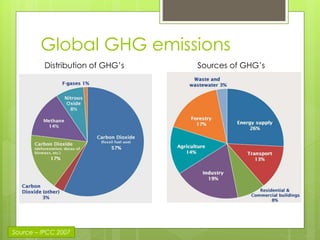
Global GHG emissions
Source – IPCC 2007
Distribution of GHG’s Sources of GHG’s
Changes
 Global warming: Ambient Temp. rise
 Melting ice cap: Sea level rise/coastal
flooding
 Extreme Weather events – cyclones
floods
droughts
 Poor air quality
 Ozone layer destruction –solar
irradiation(UV)
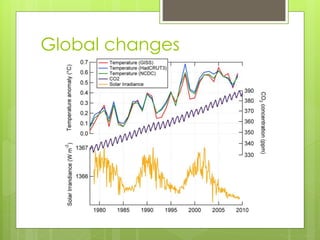
Global changes
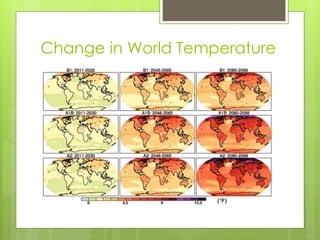
Change in World Temperature
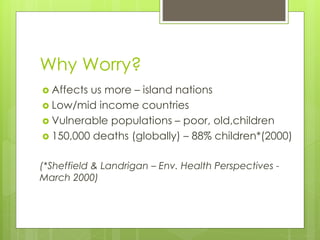
Why Worry?
 Affects us more – island nations
 Low/mid income countries
 Vulnerable populations – poor, old,children
 150,000 deaths (globally) – 88% children*(2000)
(*Sheffield & Landrigan – Env. Health Perspectives -
March 2000)
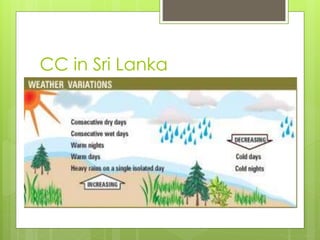
CC in Sri Lanka
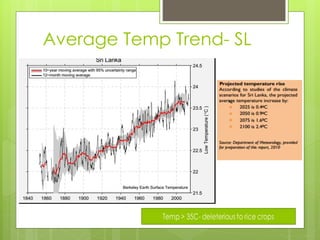
Average Temp Trend- SL
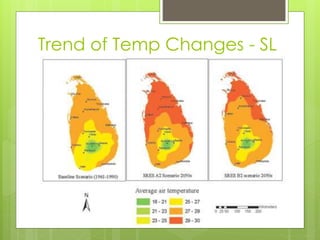
Trend of Temp Changes - SL
 Projected increases
Rainfall-Sri Lanka
 Rainfall Variability
 Increasing Dry Days – dry zone
 Single Day High Rainfall – wet zone
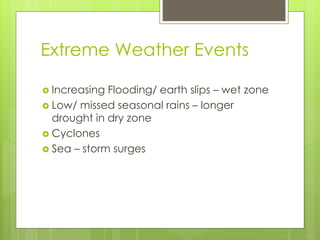
Extreme Weather Events
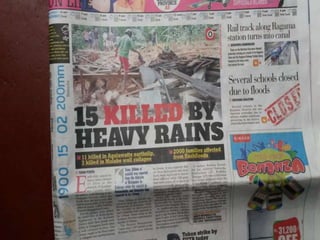
 Increasing Flooding/ earth slips – wet zone
 Low/ missed seasonal rains – longer
drought in dry zone
 Cyclones
 Sea – storm surges
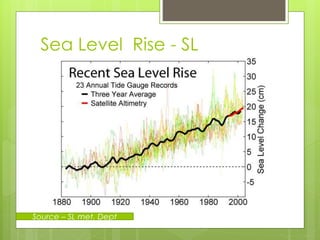
Sea Level Rise - SL
Source – SL met. Dept
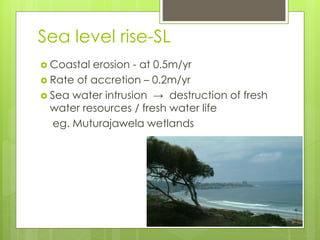
Sea level rise-SL
 Coastal erosion - at 0.5m/yr
 Rate of accretion – 0.2m/yr
 Sea water intrusion → destruction of fresh
water resources / fresh water life
eg. Muturajawela wetlands
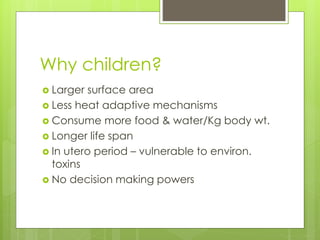
Why children?
 Larger surface area
 Less heat adaptive mechanisms
 Consume more food & water/Kg body wt.
 Longer life span
 In utero period – vulnerable to environ.
toxins
 No decision making powers
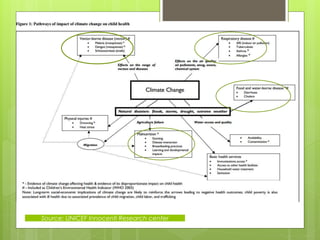
Effects of CC on children
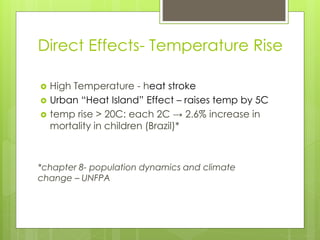
Direct Effects- Temperature Rise
 High Temperature - heat stroke
 Urban “Heat Island” Effect – raises temp by 5C
 temp rise > 20C: each 2C → 2.6% increase in
mortality in children (Brazil)*
*chapter 8- population dynamics and climate
change – UNFPA
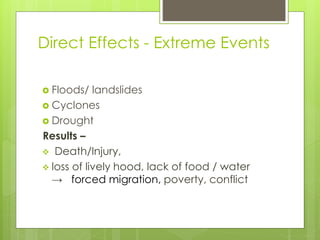
Direct Effects - Extreme Events
 Floods/ landslides
 Cyclones
 Drought
Results –
 Death/Injury,
 loss of lively hood, lack of food / water
→ forced migration, poverty, conflict
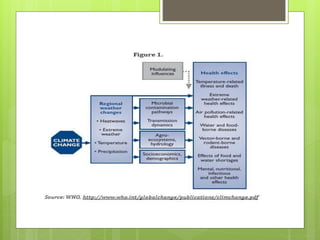
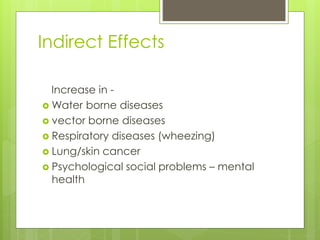
Indirect Effects
Increase in -
 Water borne diseases
 vector borne diseases
 Respiratory diseases (wheezing)
 Lung/skin cancer
 Psychological social problems – mental
health
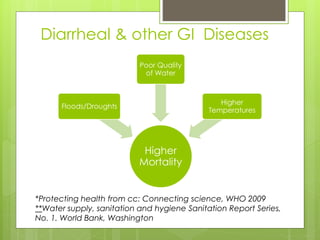
Diarrheal & other GI Diseases
Higher
Mortality
Floods/Droughts
Poor Quality
of Water
Higher
Temperatures
*Protecting health from cc: Connecting science, WHO 2009
**Water supply, sanitation and hygiene Sanitation Report Series,
No. 1. World Bank, Washington
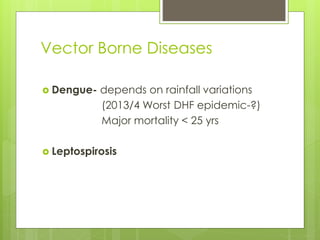
Vector Borne Diseases
 Dengue- depends on rainfall variations
(2013/4 Worst DHF epidemic-?)
Major mortality < 25 yrs
 Leptospirosis
Poor Air Quality- Air pollution
High temperatures – increased aero
allergens → ↑ resp problems eg. BA
 Study @ LRH:
↑ particulate matter (PM10) in air* :↑Wheezing
*Senanayake MP et al: SL Journal of Child Health, 2001; 30: 66-8
Indoor Air Pollution
 Reduced/costly fossil fuel → increase use of biofuel →
indoor & outdoor air pollution
 Biofuel burning → indoor air pollution → inc. in wheezing
 50% deaths from ALRI (U-5 age) → due to indoor air
pollution*
 Study: Galle: Chandhigar **:
kerosene: gas cooking → wheezing X2 more in Galle
* WHO fact sheet 292(2009)
**Mistry R, wickremasinghe N et al:Eur J Pediatr 2004, 163(3):145-147
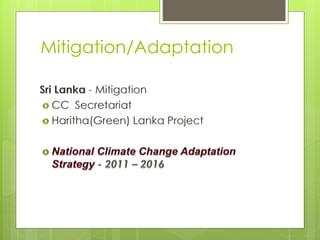
Mitigation/Adaptation - SL
 The National CC Policy of Sri Lanka
Goal – mitigation/adaptation to CC
 The Research Program on CC-
Agriculture and Food Security (CGIAR)
- influence the CC policy in Sri Lanka
- Raised awareness about the implications
cc
(source : www.unhabitat.lk/downloads)
Mitigation/Adaptation - SL
 The Ministry of Environment
“ Sri Lanka Climate Change Adaptation
Strategy 2011-2016”
 Disaster Management Centre (DMC)
 Mitigation, Research and Development
division
 Emergency Operation Centre (EOC) - Early
Warning Dissemination for natural disasters
 “Climatenet” - Institute of Policy Studies, Sri
Lanka – networking CC Policy in Sri Lanka
(source: http://www.ips.lk/climatenet/index.html)
Adaptation – need to
 Disaster preparedness & management - DMC
 Disease surveillance /Mx– diarrhoea
resp diseases
vector borne diseases
 strengthen epidemic management – DHF
 Improve nutrition – routine supplementation
emergency food supply
control food prices – in disasters
Source: UNICEF Innocenti Research center
Mitigation/Adaptation
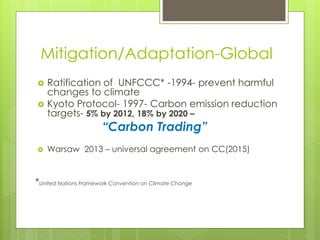
Mitigation/Adaptation-Global
 Ratification of UNFCCC* -1994- prevent harmful
changes to climate
 Kyoto Protocol- 1997- Carbon emission reduction
targets- 5% by 2012, 18% by 2020 –
“Carbon Trading”
 Warsaw 2013 – universal agreement on CC(2015)
*United Nations Framework Convention on Climate Change
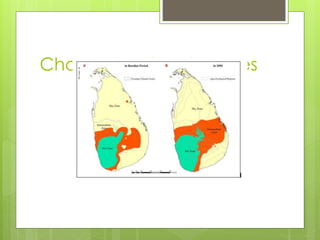
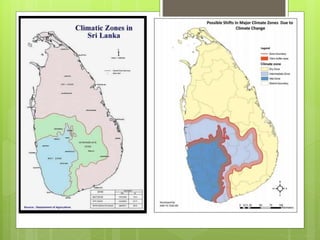
Change in climatic zones
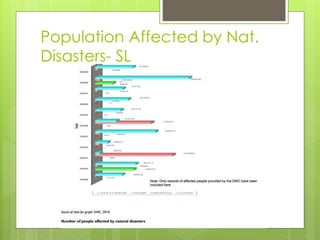
Population Affected by Nat.
Disasters- SL

Climate Change & Children's Health

  • 1.
    Climate Change & the Healthof our Children Prof. Dulanie Gunasekera University of Sri Jayawardenapura
  • 2.
    Climate Change “A changeof climate that is attributed directly or indirectly to human activity, that alters the composition of the global atmosphere and that is in addition to natural climate variability observed over comparable periods of time.”* * Article 1 United Nations Framework Convention on Climate Change, 1992 ** Lancet series
  • 3.
  • 4.
    Mechanics of CC Globalwarming – green house effect
  • 5.
    Green House Gases CO2- major component  Methane – 20 times potent as CO2- (main source- cattle)  N2O(agriculture)  Industrial gases – HFC, PFC, SF6
  • 6.
    Global GHG emissions Source– IPCC 2007 Distribution of GHG’s Sources of GHG’s
  • 7.
    Changes  Global warming:Ambient Temp. rise  Melting ice cap: Sea level rise/coastal flooding  Extreme Weather events – cyclones floods droughts  Poor air quality  Ozone layer destruction –solar irradiation(UV)
  • 8.
  • 9.
    Change in WorldTemperature
  • 10.
    Why Worry?  Affectsus more – island nations  Low/mid income countries  Vulnerable populations – poor, old,children  150,000 deaths (globally) – 88% children*(2000) (*Sheffield & Landrigan – Env. Health Perspectives - March 2000)
  • 12.
    CC in SriLanka
  • 13.
  • 14.
    Trend of TempChanges - SL  Projected increases
  • 15.
    Rainfall-Sri Lanka  RainfallVariability  Increasing Dry Days – dry zone  Single Day High Rainfall – wet zone
  • 16.
    Extreme Weather Events Increasing Flooding/ earth slips – wet zone  Low/ missed seasonal rains – longer drought in dry zone  Cyclones  Sea – storm surges
  • 18.
    Sea Level Rise- SL Source – SL met. Dept
  • 19.
    Sea level rise-SL Coastal erosion - at 0.5m/yr  Rate of accretion – 0.2m/yr  Sea water intrusion → destruction of fresh water resources / fresh water life eg. Muturajawela wetlands
  • 20.
    Why children?  Largersurface area  Less heat adaptive mechanisms  Consume more food & water/Kg body wt.  Longer life span  In utero period – vulnerable to environ. toxins  No decision making powers
  • 22.
    Effects of CCon children
  • 23.
    Direct Effects- TemperatureRise  High Temperature - heat stroke  Urban “Heat Island” Effect – raises temp by 5C  temp rise > 20C: each 2C → 2.6% increase in mortality in children (Brazil)* *chapter 8- population dynamics and climate change – UNFPA
  • 24.
    Direct Effects -Extreme Events  Floods/ landslides  Cyclones  Drought Results –  Death/Injury,  loss of lively hood, lack of food / water → forced migration, poverty, conflict
  • 25.
    Indirect Effects Increase in-  Water borne diseases  vector borne diseases  Respiratory diseases (wheezing)  Lung/skin cancer  Psychological social problems – mental health
  • 26.
    Diarrheal & otherGI Diseases Higher Mortality Floods/Droughts Poor Quality of Water Higher Temperatures *Protecting health from cc: Connecting science, WHO 2009 **Water supply, sanitation and hygiene Sanitation Report Series, No. 1. World Bank, Washington
  • 27.
    Vector Borne Diseases Dengue- depends on rainfall variations (2013/4 Worst DHF epidemic-?) Major mortality < 25 yrs  Leptospirosis
  • 28.
    Poor Air Quality-Air pollution High temperatures – increased aero allergens → ↑ resp problems eg. BA  Study @ LRH: ↑ particulate matter (PM10) in air* :↑Wheezing *Senanayake MP et al: SL Journal of Child Health, 2001; 30: 66-8
  • 29.
    Indoor Air Pollution Reduced/costly fossil fuel → increase use of biofuel → indoor & outdoor air pollution  Biofuel burning → indoor air pollution → inc. in wheezing  50% deaths from ALRI (U-5 age) → due to indoor air pollution*  Study: Galle: Chandhigar **: kerosene: gas cooking → wheezing X2 more in Galle * WHO fact sheet 292(2009) **Mistry R, wickremasinghe N et al:Eur J Pediatr 2004, 163(3):145-147
  • 31.
    Mitigation/Adaptation - SL The National CC Policy of Sri Lanka Goal – mitigation/adaptation to CC  The Research Program on CC- Agriculture and Food Security (CGIAR) - influence the CC policy in Sri Lanka - Raised awareness about the implications cc (source : www.unhabitat.lk/downloads)
  • 32.
    Mitigation/Adaptation - SL The Ministry of Environment “ Sri Lanka Climate Change Adaptation Strategy 2011-2016”  Disaster Management Centre (DMC)  Mitigation, Research and Development division  Emergency Operation Centre (EOC) - Early Warning Dissemination for natural disasters  “Climatenet” - Institute of Policy Studies, Sri Lanka – networking CC Policy in Sri Lanka (source: http://www.ips.lk/climatenet/index.html)
  • 33.
    Adaptation – needto  Disaster preparedness & management - DMC  Disease surveillance /Mx– diarrhoea resp diseases vector borne diseases  strengthen epidemic management – DHF  Improve nutrition – routine supplementation emergency food supply control food prices – in disasters
  • 35.
    Source: UNICEF InnocentiResearch center
  • 36.
  • 37.
    Mitigation/Adaptation-Global  Ratification ofUNFCCC* -1994- prevent harmful changes to climate  Kyoto Protocol- 1997- Carbon emission reduction targets- 5% by 2012, 18% by 2020 – “Carbon Trading”  Warsaw 2013 – universal agreement on CC(2015) *United Nations Framework Convention on Climate Change
  • 39.
  • 40.
    Population Affected byNat. Disasters- SL