Local Climate Solutions for Africa 2011
Cape Town, 27th February - 3rd March
Session C1: Resilient Cities


             Climate Change and African Cities:
            vulnerability, poverty and the role of
                community-
                community-based adaptation


                              Dr David Dodman
                             david.dodman@iied.org

            International Institute for Environment and Development
                                   www.iied.org
Climate Change Impacts and Vulnerability in Urban Areas


[Source: Parry et al (2009). ‘Overshoot, adapt and recover’. Nature 458, 30 April 2009.]
Vulnerability to Climate Change
The degree to which a system is susceptible to, and
unable to cope with, adverse effects of climate change,
including climate variability and extremes. Vulnerability is
a function of the character, magnitude, and rate of
climate change and variation to which a system is
exposed, sensitivity,
exposed, its sensitivity, and its adaptive capacity.
                                           capacity.
Cities at Risk: what makes cities vulnerable?
 UNFCCC commits developed countries “to assist
 developing countries that are particularly vulnerable to
 the adverse effects of climate change in meeting costs of
 adaptation to those adverse effects” – but what is
 “particularly vulnerable”?
 • No agreed measure of vulnerability (or adaptation)
 • ‘Exposure’ does not take social / economic
   characteristics into account
 • LDCs or low HDI do not take biogeographical
   characteristics into account
 • Technical and Political challenge
Cities at Risk: what makes cities vulnerable?
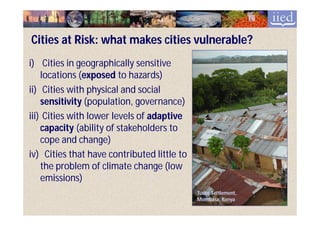
i) Cities in geographically sensitive
    locations (exposed to hazards)
               (exposed
ii) Cities with physical and social
    sensitivity (population, governance)
iii) Cities with lower levels of adaptive
    capacity (ability of stakeholders to
    cope and change)
iv) Cities that have contributed little to
    the problem of climate change (low
    emissions)
                                             Tudor Settlement,
                                             Mombasa, Kenya
Major Case Studies on Urban Climate Change Impacts


[Source: Hunt A, Watkiss P (2011). ‘Climate change impacts and adaptation in cities: a
review of the literature’ Climatic Change 104: 13-49]
“... tools for urban climate impact assessment are
    lacking... most existing analyses investigate only
    the physical vulnerability of cities to the direct
    impacts of weather and climate events”

    Hallegatte and Corfee-Morlot (2011, p5)
                   Corfee-


[Source: Hunt A, Watkiss P (2011). ‘Climate change impacts and adaptation in cities: a
review of the literature’ Climatic Change 104: 13-49]
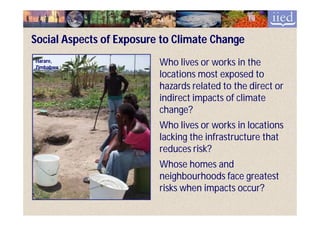
Social Aspects of Exposure to Climate Change
Harare,
Zimbabwe
                          Who lives or works in the
                          locations most exposed to
                          hazards related to the direct or
                          indirect impacts of climate
                          change?
                          Who lives or works in locations
                          lacking the infrastructure that
                          reduces risk?
                          Whose homes and
                          neighbourhoods face greatest
                          risks when impacts occur?
Gender, Age and Vulnerability
•    damage to homes and neighbourhoods often
     affects women’s incomes more (income-
                                       (income-
     earning activities often undertaken at home)
•    vulnerability from child-rearing and domestic
                         child-
     responsibilities (access to food, water, sanitation)
•    vulnerability from relocation: lack of safety and
     security in temporary accommodation
•    very young and elderly more affected by water-
                                                water-
     borne / water-washed diseases, malnutrition, lack
             water-
     of mobility, psychological impacts
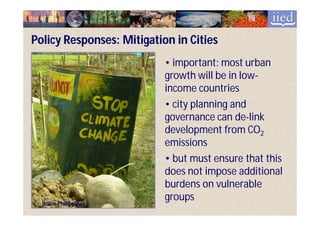
Policy Responses: Mitigation in Cities
                           • important: most urban
                           growth will be in low-
                                             low-
                           income countries
                           • city planning and
                           governance can de-link
                                            de-
                           development from CO2
                           emissions
                           • but must ensure that this
                           does not impose additional
                           burdens on vulnerable
                           groups
  Iloilo, Philippines
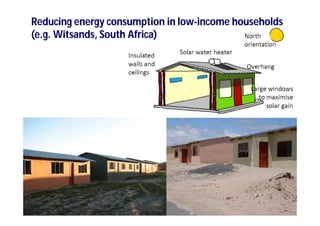
Reducing energy consumption in low-income households
                               low-
(e.g. Witsands, South Africa)
      Witsands,
Adaptation to Climate Change
“Adaptation can significantly reduce many potentially
dangerous impacts of climate change and reduce the risk of
many key vulnerabilities. However, the technical, financial
and institutional capacity, and the actual planning and
implementation of effective adaptation, is currently quite
limited in many regions”

IPCC Fourth Assessment
Chapter 19: Assessing Key Vulnerabilities and the Risks from Climate Change
Adaptation to Climate Change: Improving Infrastructure
 [Source: Tiempo (2006)]
Adaptation to Climate Change: Improving Infrastructure


[Source: Jabeen et al. (2009)]
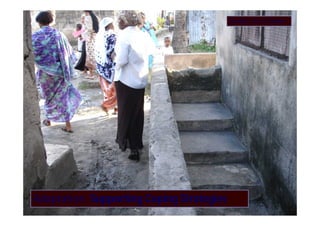
Tandale,
                                           Tandale, Dar es Salaam


Adaptation: Supporting Coping Strategies
Community Based Adaptation
•    based on the premise that local communities have
     the skills, experience, knowledge and networks to
     undertake locally appropriate activities to increase
     resilience
•    generates adaptation strategies through
     participatory processes involving local stakeholders
•    builds on existing cultural norms and addresses
     local development issues that underlie vulnerability
•    potential in urban areas:
     both under-stated and over-stressed
Social and Political Implications of Adaptation
•     cannot separate adaptation to ‘climate change’
      from adaptation to other environmental hazards
•     NAPAs (National Adaptation Programmes of
      Action): often have little focus on urban areas
•     rigorous building and infrastructure standards:
      potentially costly and inappropriate?
•     vulnerability and risk mapping:
      legitimating removal of informal settlements?
Addressing Vulnerability and Risk
Key Responses: building adaptive capacity
•         in tens of thousands of towns and cities around
          Africa and the world
•         working with reduction of risks to other
          environmental hazards and building on
          experiences of reducing disaster risk
•         developing strong local knowledge base of climate
          variability and change
•         encouraging actions that reduce risks now, while
                                                now,
          recognizing importance of measures for long-term
                                                   long-
•         with a strong pro-poor orientation
                         pro-
Addressing Vulnerability and Risk
Key Responses: institutions and governance
•        supporting adaptation in rural areas
•        integrating (where appropriate) with mitigation
•        building competence and accountability of local
         authorities and changing their relationship to low-
                                                        low-
         income urban residents
•        recognizing complementary roles of higher levels
         of government and international agencies
•        encouraging and supporting contributions of
         individuals, households, community organizations,
         private sector
Local Climate Solutions for Africa 2011
Cape Town, 27th February - 3rd March
Session C1: Resilient Cities


             Climate Change and African Cities:
            vulnerability, poverty and the role of
                community-
                community-based adaptation


                              Dr David Dodman
                             david.dodman@iied.org

            International Institute for Environment and Development
                                   www.iied.org

Climate and cities

  • 1.
    Local Climate Solutionsfor Africa 2011 Cape Town, 27th February - 3rd March Session C1: Resilient Cities Climate Change and African Cities: vulnerability, poverty and the role of community- community-based adaptation Dr David Dodman david.dodman@iied.org International Institute for Environment and Development www.iied.org
  • 2.
    Climate Change Impactsand Vulnerability in Urban Areas [Source: Parry et al (2009). ‘Overshoot, adapt and recover’. Nature 458, 30 April 2009.]
  • 3.
    Vulnerability to ClimateChange The degree to which a system is susceptible to, and unable to cope with, adverse effects of climate change, including climate variability and extremes. Vulnerability is a function of the character, magnitude, and rate of climate change and variation to which a system is exposed, sensitivity, exposed, its sensitivity, and its adaptive capacity. capacity.
  • 4.
    Cities at Risk:what makes cities vulnerable? UNFCCC commits developed countries “to assist developing countries that are particularly vulnerable to the adverse effects of climate change in meeting costs of adaptation to those adverse effects” – but what is “particularly vulnerable”? • No agreed measure of vulnerability (or adaptation) • ‘Exposure’ does not take social / economic characteristics into account • LDCs or low HDI do not take biogeographical characteristics into account • Technical and Political challenge
  • 5.
    Cities at Risk:what makes cities vulnerable? i) Cities in geographically sensitive locations (exposed to hazards) (exposed ii) Cities with physical and social sensitivity (population, governance) iii) Cities with lower levels of adaptive capacity (ability of stakeholders to cope and change) iv) Cities that have contributed little to the problem of climate change (low emissions) Tudor Settlement, Mombasa, Kenya
  • 6.
    Major Case Studieson Urban Climate Change Impacts [Source: Hunt A, Watkiss P (2011). ‘Climate change impacts and adaptation in cities: a review of the literature’ Climatic Change 104: 13-49]
  • 7.
    “... tools forurban climate impact assessment are lacking... most existing analyses investigate only the physical vulnerability of cities to the direct impacts of weather and climate events” Hallegatte and Corfee-Morlot (2011, p5) Corfee- [Source: Hunt A, Watkiss P (2011). ‘Climate change impacts and adaptation in cities: a review of the literature’ Climatic Change 104: 13-49]
  • 8.
    Social Aspects ofExposure to Climate Change Harare, Zimbabwe Who lives or works in the locations most exposed to hazards related to the direct or indirect impacts of climate change? Who lives or works in locations lacking the infrastructure that reduces risk? Whose homes and neighbourhoods face greatest risks when impacts occur?
  • 9.
    Gender, Age andVulnerability • damage to homes and neighbourhoods often affects women’s incomes more (income- (income- earning activities often undertaken at home) • vulnerability from child-rearing and domestic child- responsibilities (access to food, water, sanitation) • vulnerability from relocation: lack of safety and security in temporary accommodation • very young and elderly more affected by water- water- borne / water-washed diseases, malnutrition, lack water- of mobility, psychological impacts
  • 10.
    Policy Responses: Mitigationin Cities • important: most urban growth will be in low- low- income countries • city planning and governance can de-link de- development from CO2 emissions • but must ensure that this does not impose additional burdens on vulnerable groups Iloilo, Philippines
  • 11.
    Reducing energy consumptionin low-income households low- (e.g. Witsands, South Africa) Witsands,
  • 12.
    Adaptation to ClimateChange “Adaptation can significantly reduce many potentially dangerous impacts of climate change and reduce the risk of many key vulnerabilities. However, the technical, financial and institutional capacity, and the actual planning and implementation of effective adaptation, is currently quite limited in many regions” IPCC Fourth Assessment Chapter 19: Assessing Key Vulnerabilities and the Risks from Climate Change
  • 13.
    Adaptation to ClimateChange: Improving Infrastructure [Source: Tiempo (2006)]
  • 14.
    Adaptation to ClimateChange: Improving Infrastructure [Source: Jabeen et al. (2009)]
  • 15.
    Tandale, Tandale, Dar es Salaam Adaptation: Supporting Coping Strategies
  • 16.
    Community Based Adaptation • based on the premise that local communities have the skills, experience, knowledge and networks to undertake locally appropriate activities to increase resilience • generates adaptation strategies through participatory processes involving local stakeholders • builds on existing cultural norms and addresses local development issues that underlie vulnerability • potential in urban areas: both under-stated and over-stressed
  • 17.
    Social and PoliticalImplications of Adaptation • cannot separate adaptation to ‘climate change’ from adaptation to other environmental hazards • NAPAs (National Adaptation Programmes of Action): often have little focus on urban areas • rigorous building and infrastructure standards: potentially costly and inappropriate? • vulnerability and risk mapping: legitimating removal of informal settlements?
  • 18.
    Addressing Vulnerability andRisk Key Responses: building adaptive capacity • in tens of thousands of towns and cities around Africa and the world • working with reduction of risks to other environmental hazards and building on experiences of reducing disaster risk • developing strong local knowledge base of climate variability and change • encouraging actions that reduce risks now, while now, recognizing importance of measures for long-term long- • with a strong pro-poor orientation pro-
  • 19.
    Addressing Vulnerability andRisk Key Responses: institutions and governance • supporting adaptation in rural areas • integrating (where appropriate) with mitigation • building competence and accountability of local authorities and changing their relationship to low- low- income urban residents • recognizing complementary roles of higher levels of government and international agencies • encouraging and supporting contributions of individuals, households, community organizations, private sector
  • 20.
    Local Climate Solutionsfor Africa 2011 Cape Town, 27th February - 3rd March Session C1: Resilient Cities Climate Change and African Cities: vulnerability, poverty and the role of community- community-based adaptation Dr David Dodman david.dodman@iied.org International Institute for Environment and Development www.iied.org