CITIES AND CLIMATE CHANGE INITIATIVE
POLICY NOTE 1

Adaptation Finance:
Are Cities in Developing Countries
Slipping Through the Cracks?
Much of the investment required to
adapt to climate change must take
place in urban areas.

Two points are becoming clear regard-
ing the challenge of adapting to cli-
mate change: the total bill is going to
be enormous, and much of the invest-
ment required will have to occur in ur-
ban areas. The World Bank recently put
the global costs of adaptation at US$70
to 100 billion a year for 2010 – 2050
(World Bank 2010c).

World Bank economists esti-
mate that more than 80 per
cent of adaptation costs will
be borne by urban areas.
                                                  Flooding in Kalerwe, Kampala, Uganda ©UN-Habitat/Nicholas Kajoba
While it is hard to gauge accurately the
portion of those needs that correspond to         tergovernmental Panel on Climate Change        in the urban context” (McGray et al 2007).
cities, economists recently estimated that        concludes, such communities “can be es-        This general pro-rural finding holds true in
urban areas will need to absorb “more             pecially vulnerable…. The poor tend to live    the specific case of National Adaptation
than 80 per cent” of total adaptation in-         in informal settlements, with… substand-       Programmes of Action (NAPAs), the most
vestments (World Bank 2010b). Engineers           ard houses, lacking adequate water, drain-     concerted attempt to date to help least
will need to ‘climate-proof’ vital urban          age and other public services and often
infrastructure, while local authorities and       situated in risk-prone areas” (IPCC 2007).     “We need to adapt….
others must build the resilience of ur-
ban households. In particular strategies          To date, however, adaptation finance           Funding needs to be a lot
must assist the urban poor in developing          has largely overlooked urban areas.            more accessible…. Not all
countries who live in areas that are sensi-
tive to climate change impacts. In 2000,          Although the brunt of adaptation require-      cities are aware of funding
for example, some 229 million (mostly             ments will fall on urban settlements, to       opportunities, and have
poor) persons lived in urban areas in low         date relatively few adaptation projects
elevation coastal zones in low- and lower-        have occurred in those areas. For example,     access to it.”
middle income countries that were at risk         in 2007 the World Resources Institute re-      – Elana Keef, Nelson
of sea level rise; their numbers are grow-        viewed 135 adaptation activities in devel-
ing (McGranahan et al 2007). Other poor           oping countries. The authors found: “By        Mandela Bay Metropolitan
families cling to steep hillsides along rivers,   far the majority of cases [reviewed] had a     Municipality, South Africa
or live in areas threatened by water scarcity     rural focus”. They concluded: “Little atten-
or other climate change impacts. As the In-       tion has been paid thus far to adaptation      (ICLEI 2010).
POLICY NOTE 1: ADAPTATION FINANCE

developed countries (Least Developed          It is unfortunate if cities indeed are slip-   ment them effectively will be necessary
Countries Fund, or LCDF) to identify and      ping through the cracks of adaptation          to allow local authorities to more fully
mobilise funding for adaptation priorities.   finance – and not only because so much         harvest these low-hanging fruit.
A review of the initial batch found that      needs to be done in urban areas. As
“few NAPA projects have an urban focus”       the closest and most responsive level of       “As local governments, we
(Satterthwaite et al 2007). To update this    government, local authorities possess
finding, in 2011 UN-Habitat reviewed a        both the incentive and the local knowl-        are often ready to act but
sample of a quarter of all submitted NA-      edge needed to find cost-effective solu-       need funding. With more
PAs (12 of 45). We found that only around     tions that respond to the needs of their
14 per cent of the resources called for by    constituencies. ICLEI argues that, in the      direct access to resources
those NAPAs were for projects that largely    same way that local authorities have           for climate mitigation and
or exclusively targeted urban areas.          been able to reduce greenhouse gas
                                              emissions at a substantially lower cost        adaptation actions we
To date, relatively few of                    than initial top-down models indicated,        could relieve the planet
                                              so they should be able to find the most
the adaptation projects                       cost-effective means to increase climate       from stress and help gov-
undertaken globally have                      resilience (ICLEI 2011). And indeed,           ernments meet their na-
                                              some of the means for adapting to cli-
had an urban focus.                           mate change that promise the greatest          tional targets.”
                                              net benefits lie within the purview of ur-     – David Cadman, President
Why this relative lack of funding for         ban policy-makers..
adaptation projects in those areas that                                                      of ICLEI
need it most? Two organisations have          Amongst such measures are improved
come up with strikingly similar expla-        building codes and community early             There are some encouraging signs
nations for this mismatch. According          warning systems – both of which can            that the international community is
to ICLEI – Local Governments for Sus-         help to strengthen resilience in urban         beginning to heed the needs of cities.
tainability: “At present, the ability of      areas (ECA 2009). Another important            In 2010, for example, the first project
local governments to leverage funding         means to increase climate resilience in        approved by the newly-established Ad-
is largely affected by their interaction      cities is through improved basic land use      aptation Fund targeted mostly urban
with national governments vis-à-vis in-       planning. The World Bank advises: “Be-         areas (in Senegal). And at the close of
ternational funds…. The architecture of       cause the majority of the capital stock in     the 2010 Conference of Parties to the
available funds privileges the national       2050 remains to be installed, land use         UN Framework Convention on Climate
level” (ICLEI 2010). The World Bank con-      planning that channels investment into         Change (UNFCCC) in Cancún (COP-
curs: “All of this international climate      lower risk locations can substantially         16), States recognized local authorities
funding will be channelled through na-        reduce risk at low cost” (World Bank           as key “governmental stakeholders”
tional governments, and city access to        2010c). Other measures such as slum            in global climate change efforts. Much
funding remains uncertain, especially         upgrading also may yield important             more, however, needs to be done.
as climate change activities are usually      benefits. Of course capacity-building to
assigned to Ministries of Environment,        empower local officials so that they can       Empowered local leaders
which do not traditionally focus on ur-       select the most cost-effective actions,
ban issues” (World Bank 2010c).               optimize their sequencing and imple-           can take effective action.

“Funds at the international
level are difficult to access,
because normally
[implementing institutions]
hardly give loans to local
government. They should
change the rules of the
international game, give
more credit to local
authorities.”
– Queretaro, Mexico
(ICLEI 2010)

                                              Construction in the coastal area of Maputo, Mozambique ©UN-Habitat/Ricardo Rangel
POLICY NOTE 1: ADAPTATION FINANCE

What we should do about it.

The Green Climate Fund should pro-
vide cities (with the support of national
governments) with access to a portion
of the adaptation resources channelled
through this facility. Greater access for
cities to these resources would promote
greater financial autonomy for local gov-
ernments per the decentralization poli-
cies of a number of countries. It would
also provide for the development of
cost-effective solutions in a ‘bottom-up’
manner that responds to local needs and
reflects local conditions.

Greater access for cities could occur in
one of two ways. Firstly a special win-
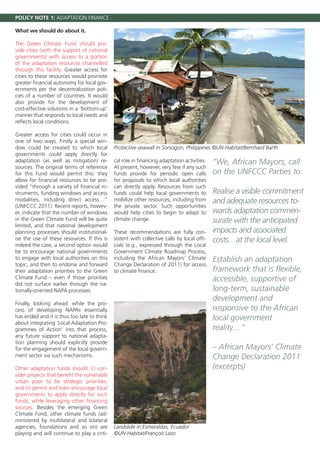
dow could be created to which local          Protective seawall in Sorsogon, Philippines ©UN-Habitat/Bernhard Barth
governments could apply directly for
adaptation (as well as mitigation) re-       cal role in financing adaptation activities.   “We, African Mayors, call
sources. The original terms of reference     At present, however, very few if any such
for this Fund would permit this: they        funds provide for periodic open calls          on the UNFCCC Parties to:
allow for financial resources to be pro-     for proposals to which local authorities
vided “through a variety of financial in-    can directly apply. Resources from such
struments, funding windows and access        funds could help local governments to          Realise a visible commitment
modalities, including direct access…”        mobilize other resources, including from       and adequate resources to-
(UNFCCC 2011). Recent reports, howev-        the private sector. Such opportunities
er, indicate that the number of windows      would help cities to begin to adapt to         wards adaptation commen-
in the Green Climate Fund will be quite      climate change.                                surate with the anticipated
limited, and that national development
planning processes should institutional-     These recommendations are fully con-           impacts and associated
ise the use of these resources. If this is   sistent with collective calls by local offi-   costs…at the local level.
indeed the case, a second option would       cials (e.g., expressed through the Local
be to encourage national governments         Government Climate Roadmap Process,
to engage with local authorities on this     including the African Mayors’ Climate          Establish an adaptation
topic, and then to endorse and forward       Change Declaration of 2011) for access
their adaptation priorities to the Green     to climate finance.                            framework that is flexible,
Climate Fund – even if those priorities                                                     accessible, supportive of
did not surface earlier through the na-
tionally-oriented NAPA processes.                                                           long-term, sustainable
                                                                                            development and
Finally, looking ahead: while the pro-
cess of developing NAPAs essentially                                                        responsive to the African
has ended and it is thus too late to think                                                  local government
about integrating ‘Local Adaptation Pro-
grammes of Action’ into that process,                                                       reality…”
any future support to national adapta-
tion planning should explicitly provide
for the engagement of the local govern-                                                     – African Mayors’ Climate
ment sector via such mechanisms.                                                            Change Declaration 2011
Other adaptation funds should: (i) con-                                                     (excerpts)
sider projects that benefit the vulnerable
urban poor to be strategic priorities,
and (ii) permit and even encourage local
governments to apply directly for such
funds, while leveraging other financing
sources. Besides the emerging Green
Climate Fund, other climate funds (ad-
ministered by multilateral and bilateral
agencies, foundations and so on) are         Landslide in Esmeraldas, Ecuador
playing and will continue to play a criti-   ©UN-Habitat/François Laso
POLICY NOTE 1: ADAPTATION FINANCE

“We, Mayors of the                           “We, representatives of                   This Policy Note was developed by the
                                                                                       UN-Habitat Cities and Climate Change
World, coming from 35                        cities from all regions of                Initiative (CCCI), generously financed
cities in 30 countries…                      the world gathered in                     by the Government of Norway and
                                                                                       other sources. It was prepared by Rob-
recognise the need for                       Gwangju commit to ... find                ert Kehew, with inputs and comments
financial institutions to                    ways and means of better                  from Raf Tuts, Bernhard Barth and De-
                                                                                       bashish Bhattacharjee (UN-Habitat),
fund locally relevant and                    access to finance mecha-                  Monali Ranade (World Bank) and Yu-
appropriate development,                     nisms such as the Clean                   nus Arikan (ICLEI).

rather than conventional                     Development Mechanism.”
global financing mecha-
nisms determining which                      – Gwangju (Korea) Cities’
local projects are eligible                  Declaration (2011)
for funding…. We further
advocate for… developing
specialized financial instru-
ments for comprehensive
local adaptation and resil-
ience upgrading projects
in urban areas and sys-
tems known to be highly
vulnerable”.

– Bonn Declaration of
Mayors 2011 (excerpts)


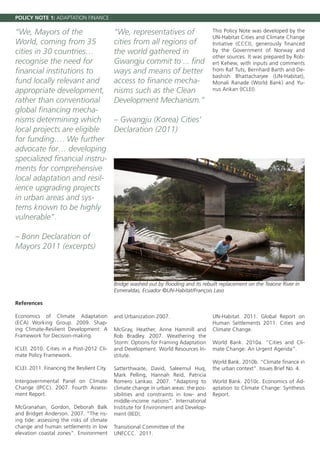
                                             Bridge washed out by flooding and its rebuilt replacement on the Teaone River in
                                             Esmeraldas, Ecuador ©UN-Habitat/François Laso

References

Economics of Climate Adaptation              and Urbanization 2007.                    UN-Habitat. 2011. Global Report on
(ECA) Working Group. 2009. Shap-                                                       Human Settlements 2011: Cities and
ing Climate-Resilient Development: A         McGray, Heather, Anne Hammill and         Climate Change.
Framework for Decision-making.               Rob Bradley. 2007. Weathering the
                                             Storm: Options for Framing Adaptation     World Bank. 2010a. “Cities and Cli-
ICLEI. 2010. Cities in a Post-2012 Cli-      and Development. World Resources In-      mate Change: An Urgent Agenda”.
mate Policy Framework.                       stitute.
                                                                                       World Bank. 2010b. “Climate finance in
ICLEI. 2011. Financing the Resilient City.   Satterthwaite, David, Saleemul Huq,       the urban context”. Issues Brief No. 4.
                                             Mark Pelling, Hannah Reid, Patricia
Intergovernmental Panel on Climate           Romero Lankao. 2007. “Adapting to         World Bank. 2010c. Economics of Ad-
Change (IPCC). 2007. Fourth Assess-          climate change in urban areas: the pos-   aptation to Climate Change: Synthesis
ment Report.                                 sibilities and constraints in low- and    Report.
                                             middle-income nations”. International
McGranahan, Gordon, Deborah Balk             Institute for Environment and Develop-
and Bridget Anderson. 2007. “The ris-        ment (IIED).
ing tide: assessing the risks of climate
change and human settlements in low          Transitional Committee of the
elevation coastal zones”. Environment        UNFCCC. 2011.

3238 alt

  • 1.
    CITIES AND CLIMATECHANGE INITIATIVE POLICY NOTE 1 Adaptation Finance: Are Cities in Developing Countries Slipping Through the Cracks? Much of the investment required to adapt to climate change must take place in urban areas. Two points are becoming clear regard- ing the challenge of adapting to cli- mate change: the total bill is going to be enormous, and much of the invest- ment required will have to occur in ur- ban areas. The World Bank recently put the global costs of adaptation at US$70 to 100 billion a year for 2010 – 2050 (World Bank 2010c). World Bank economists esti- mate that more than 80 per cent of adaptation costs will be borne by urban areas. Flooding in Kalerwe, Kampala, Uganda ©UN-Habitat/Nicholas Kajoba While it is hard to gauge accurately the portion of those needs that correspond to tergovernmental Panel on Climate Change in the urban context” (McGray et al 2007). cities, economists recently estimated that concludes, such communities “can be es- This general pro-rural finding holds true in urban areas will need to absorb “more pecially vulnerable…. The poor tend to live the specific case of National Adaptation than 80 per cent” of total adaptation in- in informal settlements, with… substand- Programmes of Action (NAPAs), the most vestments (World Bank 2010b). Engineers ard houses, lacking adequate water, drain- concerted attempt to date to help least will need to ‘climate-proof’ vital urban age and other public services and often infrastructure, while local authorities and situated in risk-prone areas” (IPCC 2007). “We need to adapt…. others must build the resilience of ur- ban households. In particular strategies To date, however, adaptation finance Funding needs to be a lot must assist the urban poor in developing has largely overlooked urban areas. more accessible…. Not all countries who live in areas that are sensi- tive to climate change impacts. In 2000, Although the brunt of adaptation require- cities are aware of funding for example, some 229 million (mostly ments will fall on urban settlements, to opportunities, and have poor) persons lived in urban areas in low date relatively few adaptation projects elevation coastal zones in low- and lower- have occurred in those areas. For example, access to it.” middle income countries that were at risk in 2007 the World Resources Institute re- – Elana Keef, Nelson of sea level rise; their numbers are grow- viewed 135 adaptation activities in devel- ing (McGranahan et al 2007). Other poor oping countries. The authors found: “By Mandela Bay Metropolitan families cling to steep hillsides along rivers, far the majority of cases [reviewed] had a Municipality, South Africa or live in areas threatened by water scarcity rural focus”. They concluded: “Little atten- or other climate change impacts. As the In- tion has been paid thus far to adaptation (ICLEI 2010).
  • 2.
    POLICY NOTE 1:ADAPTATION FINANCE developed countries (Least Developed It is unfortunate if cities indeed are slip- ment them effectively will be necessary Countries Fund, or LCDF) to identify and ping through the cracks of adaptation to allow local authorities to more fully mobilise funding for adaptation priorities. finance – and not only because so much harvest these low-hanging fruit. A review of the initial batch found that needs to be done in urban areas. As “few NAPA projects have an urban focus” the closest and most responsive level of “As local governments, we (Satterthwaite et al 2007). To update this government, local authorities possess finding, in 2011 UN-Habitat reviewed a both the incentive and the local knowl- are often ready to act but sample of a quarter of all submitted NA- edge needed to find cost-effective solu- need funding. With more PAs (12 of 45). We found that only around tions that respond to the needs of their 14 per cent of the resources called for by constituencies. ICLEI argues that, in the direct access to resources those NAPAs were for projects that largely same way that local authorities have for climate mitigation and or exclusively targeted urban areas. been able to reduce greenhouse gas emissions at a substantially lower cost adaptation actions we To date, relatively few of than initial top-down models indicated, could relieve the planet so they should be able to find the most the adaptation projects cost-effective means to increase climate from stress and help gov- undertaken globally have resilience (ICLEI 2011). And indeed, ernments meet their na- some of the means for adapting to cli- had an urban focus. mate change that promise the greatest tional targets.” net benefits lie within the purview of ur- – David Cadman, President Why this relative lack of funding for ban policy-makers.. adaptation projects in those areas that of ICLEI need it most? Two organisations have Amongst such measures are improved come up with strikingly similar expla- building codes and community early There are some encouraging signs nations for this mismatch. According warning systems – both of which can that the international community is to ICLEI – Local Governments for Sus- help to strengthen resilience in urban beginning to heed the needs of cities. tainability: “At present, the ability of areas (ECA 2009). Another important In 2010, for example, the first project local governments to leverage funding means to increase climate resilience in approved by the newly-established Ad- is largely affected by their interaction cities is through improved basic land use aptation Fund targeted mostly urban with national governments vis-à-vis in- planning. The World Bank advises: “Be- areas (in Senegal). And at the close of ternational funds…. The architecture of cause the majority of the capital stock in the 2010 Conference of Parties to the available funds privileges the national 2050 remains to be installed, land use UN Framework Convention on Climate level” (ICLEI 2010). The World Bank con- planning that channels investment into Change (UNFCCC) in Cancún (COP- curs: “All of this international climate lower risk locations can substantially 16), States recognized local authorities funding will be channelled through na- reduce risk at low cost” (World Bank as key “governmental stakeholders” tional governments, and city access to 2010c). Other measures such as slum in global climate change efforts. Much funding remains uncertain, especially upgrading also may yield important more, however, needs to be done. as climate change activities are usually benefits. Of course capacity-building to assigned to Ministries of Environment, empower local officials so that they can Empowered local leaders which do not traditionally focus on ur- select the most cost-effective actions, ban issues” (World Bank 2010c). optimize their sequencing and imple- can take effective action. “Funds at the international level are difficult to access, because normally [implementing institutions] hardly give loans to local government. They should change the rules of the international game, give more credit to local authorities.” – Queretaro, Mexico (ICLEI 2010) Construction in the coastal area of Maputo, Mozambique ©UN-Habitat/Ricardo Rangel
  • 3.
    POLICY NOTE 1:ADAPTATION FINANCE What we should do about it. The Green Climate Fund should pro- vide cities (with the support of national governments) with access to a portion of the adaptation resources channelled through this facility. Greater access for cities to these resources would promote greater financial autonomy for local gov- ernments per the decentralization poli- cies of a number of countries. It would also provide for the development of cost-effective solutions in a ‘bottom-up’ manner that responds to local needs and reflects local conditions. Greater access for cities could occur in one of two ways. Firstly a special win- dow could be created to which local Protective seawall in Sorsogon, Philippines ©UN-Habitat/Bernhard Barth governments could apply directly for adaptation (as well as mitigation) re- cal role in financing adaptation activities. “We, African Mayors, call sources. The original terms of reference At present, however, very few if any such for this Fund would permit this: they funds provide for periodic open calls on the UNFCCC Parties to: allow for financial resources to be pro- for proposals to which local authorities vided “through a variety of financial in- can directly apply. Resources from such struments, funding windows and access funds could help local governments to Realise a visible commitment modalities, including direct access…” mobilize other resources, including from and adequate resources to- (UNFCCC 2011). Recent reports, howev- the private sector. Such opportunities er, indicate that the number of windows would help cities to begin to adapt to wards adaptation commen- in the Green Climate Fund will be quite climate change. surate with the anticipated limited, and that national development planning processes should institutional- These recommendations are fully con- impacts and associated ise the use of these resources. If this is sistent with collective calls by local offi- costs…at the local level. indeed the case, a second option would cials (e.g., expressed through the Local be to encourage national governments Government Climate Roadmap Process, to engage with local authorities on this including the African Mayors’ Climate Establish an adaptation topic, and then to endorse and forward Change Declaration of 2011) for access their adaptation priorities to the Green to climate finance. framework that is flexible, Climate Fund – even if those priorities accessible, supportive of did not surface earlier through the na- tionally-oriented NAPA processes. long-term, sustainable development and Finally, looking ahead: while the pro- cess of developing NAPAs essentially responsive to the African has ended and it is thus too late to think local government about integrating ‘Local Adaptation Pro- grammes of Action’ into that process, reality…” any future support to national adapta- tion planning should explicitly provide for the engagement of the local govern- – African Mayors’ Climate ment sector via such mechanisms. Change Declaration 2011 Other adaptation funds should: (i) con- (excerpts) sider projects that benefit the vulnerable urban poor to be strategic priorities, and (ii) permit and even encourage local governments to apply directly for such funds, while leveraging other financing sources. Besides the emerging Green Climate Fund, other climate funds (ad- ministered by multilateral and bilateral agencies, foundations and so on) are Landslide in Esmeraldas, Ecuador playing and will continue to play a criti- ©UN-Habitat/François Laso
  • 4.
    POLICY NOTE 1:ADAPTATION FINANCE “We, Mayors of the “We, representatives of This Policy Note was developed by the UN-Habitat Cities and Climate Change World, coming from 35 cities from all regions of Initiative (CCCI), generously financed cities in 30 countries… the world gathered in by the Government of Norway and other sources. It was prepared by Rob- recognise the need for Gwangju commit to ... find ert Kehew, with inputs and comments financial institutions to ways and means of better from Raf Tuts, Bernhard Barth and De- bashish Bhattacharjee (UN-Habitat), fund locally relevant and access to finance mecha- Monali Ranade (World Bank) and Yu- appropriate development, nisms such as the Clean nus Arikan (ICLEI). rather than conventional Development Mechanism.” global financing mecha- nisms determining which – Gwangju (Korea) Cities’ local projects are eligible Declaration (2011) for funding…. We further advocate for… developing specialized financial instru- ments for comprehensive local adaptation and resil- ience upgrading projects in urban areas and sys- tems known to be highly vulnerable”. – Bonn Declaration of Mayors 2011 (excerpts) Bridge washed out by flooding and its rebuilt replacement on the Teaone River in Esmeraldas, Ecuador ©UN-Habitat/François Laso References Economics of Climate Adaptation and Urbanization 2007. UN-Habitat. 2011. Global Report on (ECA) Working Group. 2009. Shap- Human Settlements 2011: Cities and ing Climate-Resilient Development: A McGray, Heather, Anne Hammill and Climate Change. Framework for Decision-making. Rob Bradley. 2007. Weathering the Storm: Options for Framing Adaptation World Bank. 2010a. “Cities and Cli- ICLEI. 2010. Cities in a Post-2012 Cli- and Development. World Resources In- mate Change: An Urgent Agenda”. mate Policy Framework. stitute. World Bank. 2010b. “Climate finance in ICLEI. 2011. Financing the Resilient City. Satterthwaite, David, Saleemul Huq, the urban context”. Issues Brief No. 4. Mark Pelling, Hannah Reid, Patricia Intergovernmental Panel on Climate Romero Lankao. 2007. “Adapting to World Bank. 2010c. Economics of Ad- Change (IPCC). 2007. Fourth Assess- climate change in urban areas: the pos- aptation to Climate Change: Synthesis ment Report. sibilities and constraints in low- and Report. middle-income nations”. International McGranahan, Gordon, Deborah Balk Institute for Environment and Develop- and Bridget Anderson. 2007. “The ris- ment (IIED). ing tide: assessing the risks of climate change and human settlements in low Transitional Committee of the elevation coastal zones”. Environment UNFCCC. 2011.