Milling and Mills
Represented by:-ketaki patil
Contents
• Introduction
• What is milling
• Types of mills
• Details of routine mill maintenance
schedule
• Checking the operation of a mill
• How to improve efficiency
• Saftey at work
Introduction
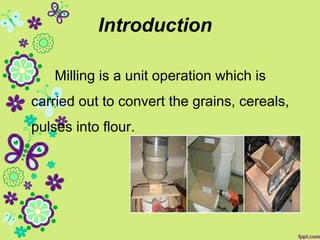
Milling is a unit operation which is
carried out to convert the grains, cereals,
pulses into flour.
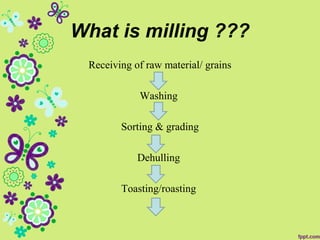
What is milling ???
Receiving of raw material/ grains
Washing
Sorting & grading
Dehulling
Toasting/roasting
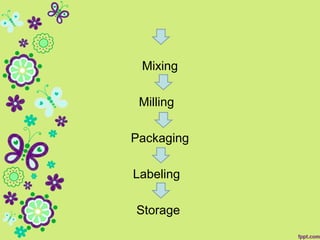
Mixing
Milling
Packaging
Labeling
Storage
How flour is milled
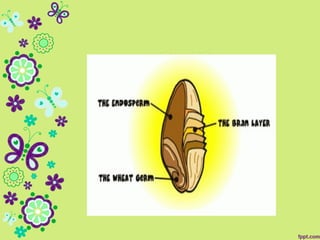
• During the milling process, different parts of the wheat
grain are used to make different types of flour. White
flour is made from the endosperm only.
• Whole meal flour uses all parts of the grain: the
endosperm, the wheat germ and the bran layer. Brown
flour contains about 85% of the original grain, but
some bran and germ have been removed
Types of milling
• In grain milling there are two basic
methods i.e. dry & wet grinding the
moisture content of the grains is
about 16%, while in wet milling it is
higher
• Dry milling Wet milling
• Advantages Advantages
• Better efficiency No dust problem
Easier milling
• Disdvantage Disdvantage
• Danger of explosion Formation of lumps
• if moisture is too high
Types of mills
• Traditional mill
• Hammer mill
• Roller mill
• Pan mill
• Colloidal mill
• Fixed head mill
• Ball mill
• The edge runner mill
• Disc beater mill
• Milling we mean that reduction of
grain to fine particles so that it is
more adaptable to culinary
manipulation.
• The first mills of either mortar &
pestle in the simplest form in
concavity in a stone which held grain
in place while it was poured with the
smaller rock.
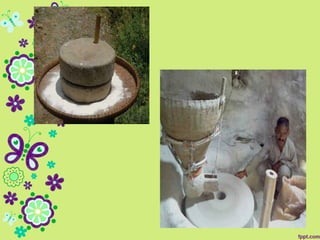
Traditional mill
• Consist of two circular stones
placed on each other which is
rotated by manually i.e. by hands or
animals or slaves in ancient time.
• Lower stone is stationary and upper
one is moving.
• The material is fed from hole of
upper stone
• The ground material was collected
from outer edges of lower stone.
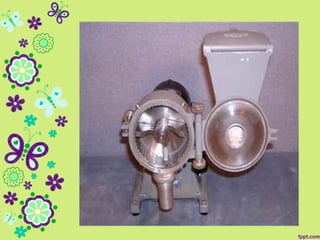
Hammer mill
• It is most widely used equipment for
food size reduction by impact forces.
• It is used to produce wide range of
particles like from medium to fine.
• Hammers or beaters are provided for
size reduction, so it called as hammer
mill.
• It is based on impact and shear force
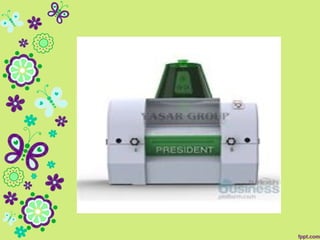
Roll mill
• It is the main type of milling equipment
used for fine grinding of cereals
• They consist counter rotating rolls pair
• Grinding in the roll mill depend upon kind,
consistency, and texture, dimension of roll
i.e. length & diameter of product.
• It is based on compression and shear force
Pan mill
• Consists of two to four heavy rolls
rotating around an axis the centre
of pan in which product to be
ground is fed.
• They are used in crushing &
grinding products such as olives
and other oil containing seeds.
Colloidal mill
• This consist of
various flat disks.
• This will help in
increase in efficiency
of product.
• Mostly this mill is
used for oilseeds.
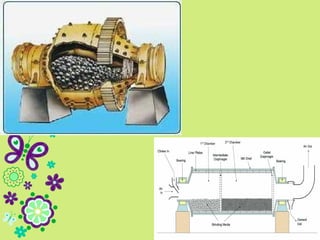
Ball mill
• Material to be ground is enclosed in
a horizontal cylinder or cone and
tumbled with a large number of steel
balls or artificial stones, which crush
and break material .
• It is having limited application in
food industry but they are using
grinding food colors
• Based on impact and shear force
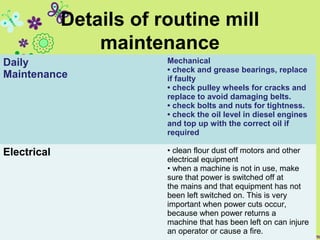
Details of routine mill
maintenance
Daily
Maintenance
Mechanical
• check and grease bearings, replace
if faulty
• check pulley wheels for cracks and
replace to avoid damaging belts.
• check bolts and nuts for tightness.
• check the oil level in diesel engines
and top up with the correct oil if
required
Electrical • clean flour dust off motors and other
electrical equipment
• when a machine is not in use, make
sure that power is switched off at
the mains and that equipment has not
been left switched on. This is very
important when power cuts occur,
because when power returns a
machine that has been left on can injure
an operator or cause a fire.
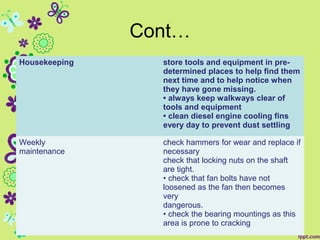
Cont…
Housekeeping store tools and equipment in pre-
determined places to help find them
next time and to help notice when
they have gone missing.
• always keep walkways clear of
tools and equipment
• clean diesel engine cooling fins
every day to prevent dust settling
Weekly
maintenance
check hammers for wear and replace if
necessary
check that locking nuts on the shaft
are tight.
• check that fan bolts have not
loosened as the fan then becomes
very
dangerous.
• check the bearing mountings as this
area is prone to cracking
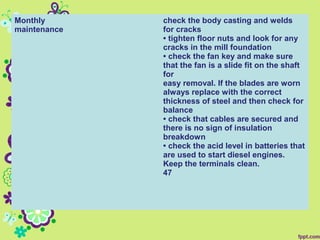
Monthly
maintenance
check the body casting and welds
for cracks
• tighten floor nuts and look for any
cracks in the mill foundation
• check the fan key and make sure
that the fan is a slide fit on the shaft
for
easy removal. If the blades are worn
always replace with the correct
thickness of steel and then check for
balance
• check that cables are secured and
there is no sign of insulation
breakdown
• check the acid level in batteries that
are used to start diesel engines.
Keep the terminals clean.
47
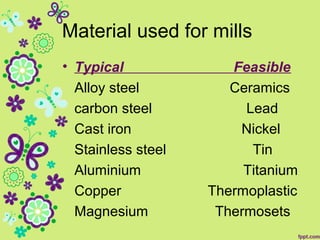
Material used for mills
• Typical Feasible
Alloy steel Ceramics
carbon steel Lead
Cast iron Nickel
Stainless steel Tin
Aluminium Titanium
Copper Thermoplastic
Magnesium Thermosets
Saftey should be carried
out…
• 1) personal protective equipments-
PPE’S :-
– it consist of goggles, hand gloves,
safety shoes, lab coat, mask etc…
2) Do not wear any ornaments, jewelry,
bangles etc..
3) Do not wear loose clothes e.g sari..
4) Should apply IP (iso propyl alcohol) or
sanitizer before working
How to improve Efficiency
Operators should maintain following
things i.e. process cycle :-
1)Load /unload time
2) cut time
3) Idle time
4) Tool replacement time
5)Feed rate
6)Spindle speed
“Our work is never so
important that we can not
take the time to do it
safely”
- Cadbury pvt ltd
Milling and milling equipments

Milling and milling equipments

  • 2.
  • 3.
    Contents • Introduction • Whatis milling • Types of mills • Details of routine mill maintenance schedule • Checking the operation of a mill • How to improve efficiency • Saftey at work
  • 4.
    Introduction Milling is aunit operation which is carried out to convert the grains, cereals, pulses into flour.
  • 5.
    What is milling??? Receiving of raw material/ grains Washing Sorting & grading Dehulling Toasting/roasting
  • 6.
  • 7.
    How flour ismilled • During the milling process, different parts of the wheat grain are used to make different types of flour. White flour is made from the endosperm only. • Whole meal flour uses all parts of the grain: the endosperm, the wheat germ and the bran layer. Brown flour contains about 85% of the original grain, but some bran and germ have been removed
  • 9.
    Types of milling •In grain milling there are two basic methods i.e. dry & wet grinding the moisture content of the grains is about 16%, while in wet milling it is higher
  • 10.
    • Dry millingWet milling • Advantages Advantages • Better efficiency No dust problem Easier milling • Disdvantage Disdvantage • Danger of explosion Formation of lumps • if moisture is too high
  • 11.
    Types of mills •Traditional mill • Hammer mill • Roller mill • Pan mill • Colloidal mill • Fixed head mill • Ball mill • The edge runner mill • Disc beater mill
  • 12.
    • Milling wemean that reduction of grain to fine particles so that it is more adaptable to culinary manipulation. • The first mills of either mortar & pestle in the simplest form in concavity in a stone which held grain in place while it was poured with the smaller rock.
  • 13.
    Traditional mill • Consistof two circular stones placed on each other which is rotated by manually i.e. by hands or animals or slaves in ancient time. • Lower stone is stationary and upper one is moving. • The material is fed from hole of upper stone • The ground material was collected from outer edges of lower stone.
  • 15.
    Hammer mill • Itis most widely used equipment for food size reduction by impact forces. • It is used to produce wide range of particles like from medium to fine. • Hammers or beaters are provided for size reduction, so it called as hammer mill. • It is based on impact and shear force
  • 17.
    Roll mill • Itis the main type of milling equipment used for fine grinding of cereals • They consist counter rotating rolls pair • Grinding in the roll mill depend upon kind, consistency, and texture, dimension of roll i.e. length & diameter of product. • It is based on compression and shear force
  • 19.
    Pan mill • Consistsof two to four heavy rolls rotating around an axis the centre of pan in which product to be ground is fed. • They are used in crushing & grinding products such as olives and other oil containing seeds.
  • 21.
    Colloidal mill • Thisconsist of various flat disks. • This will help in increase in efficiency of product. • Mostly this mill is used for oilseeds.
  • 22.
    Ball mill • Materialto be ground is enclosed in a horizontal cylinder or cone and tumbled with a large number of steel balls or artificial stones, which crush and break material . • It is having limited application in food industry but they are using grinding food colors • Based on impact and shear force
  • 24.
    Details of routinemill maintenance Daily Maintenance Mechanical • check and grease bearings, replace if faulty • check pulley wheels for cracks and replace to avoid damaging belts. • check bolts and nuts for tightness. • check the oil level in diesel engines and top up with the correct oil if required Electrical • clean flour dust off motors and other electrical equipment • when a machine is not in use, make sure that power is switched off at the mains and that equipment has not been left switched on. This is very important when power cuts occur, because when power returns a machine that has been left on can injure an operator or cause a fire.
  • 25.
    Cont… Housekeeping store toolsand equipment in pre- determined places to help find them next time and to help notice when they have gone missing. • always keep walkways clear of tools and equipment • clean diesel engine cooling fins every day to prevent dust settling Weekly maintenance check hammers for wear and replace if necessary check that locking nuts on the shaft are tight. • check that fan bolts have not loosened as the fan then becomes very dangerous. • check the bearing mountings as this area is prone to cracking
  • 26.
    Monthly maintenance check the bodycasting and welds for cracks • tighten floor nuts and look for any cracks in the mill foundation • check the fan key and make sure that the fan is a slide fit on the shaft for easy removal. If the blades are worn always replace with the correct thickness of steel and then check for balance • check that cables are secured and there is no sign of insulation breakdown • check the acid level in batteries that are used to start diesel engines. Keep the terminals clean. 47
  • 27.
    Material used formills • Typical Feasible Alloy steel Ceramics carbon steel Lead Cast iron Nickel Stainless steel Tin Aluminium Titanium Copper Thermoplastic Magnesium Thermosets
  • 28.
    Saftey should becarried out… • 1) personal protective equipments- PPE’S :- – it consist of goggles, hand gloves, safety shoes, lab coat, mask etc… 2) Do not wear any ornaments, jewelry, bangles etc.. 3) Do not wear loose clothes e.g sari.. 4) Should apply IP (iso propyl alcohol) or sanitizer before working
  • 29.
    How to improveEfficiency Operators should maintain following things i.e. process cycle :- 1)Load /unload time 2) cut time 3) Idle time 4) Tool replacement time 5)Feed rate 6)Spindle speed
  • 30.
    “Our work isnever so important that we can not take the time to do it safely” - Cadbury pvt ltd