ALL ABOUT
CLEANROOMS
www.unikelvin.com© UniKelvin 2019
1. INTRODUCTION TO CLEANROOMS -HISTORY, CONCEPTS AND STANDARDS
www.unikelvin.com© UniKelvin 2019
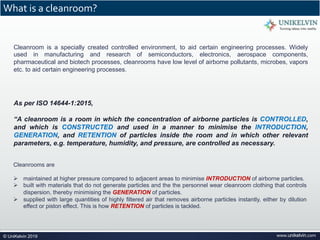
What is a cleanroom?
Cleanroom is a specially created controlled environment, to aid certain engineering processes. Widely
used in manufacturing and research of semiconductors, electronics, aerospace components,
pharmaceutical and biotech processes, cleanrooms have low level of airborne pollutants, microbes, vapors
etc. to aid certain engineering processes.
As per ISO 14644-1:2015,
“A cleanroom is a room in which the concentration of airborne particles is CONTROLLED,
and which is CONSTRUCTED and used in a manner to minimise the INTRODUCTION,
GENERATION, and RETENTION of particles inside the room and in which other relevant
parameters, e.g. temperature, humidity, and pressure, are controlled as necessary.
Cleanrooms are
Ø maintained at higher pressure compared to adjacent areas to minimise INTRODUCTION of airborne particles.
Ø built with materials that do not generate particles and the the personnel wear cleanroom clothing that controls
dispersion, thereby minimising the GENERATION of particles.
Ø supplied with large quantities of highly filtered air that removes airborne particles instantly, either by dilution
effect or piston effect. This is how RETENTION of particles is tackled.
www.unikelvin.com© UniKelvin 2019
Why are cleanrooms required?
Cleanrooms are required
Ø Airborne particles or contaminants affect the quality of products.
Ø Cleanroom personnel, machinery, building structure, adjacent areas produce particles or contaminants.
Ø Cleanrooms continuously filter these particles out to maintain cleanliness in the production zone.
Sources of contaminants
Ø Facilities
• Walls, floors, and ceilings
• Paint and coatings
• Construction materials
• Debris
• air and vapours
• Spills and leaks
Ø Personnel
• Skin flakes, oil, and particles
• Cosmetics and perfumes
• Clothing debris
• Hair & Water vapor
• Other particles of sneezing and
breathing
Ø Tools
• Non cleanroom materials
• wear and tear particles
• Machinery vibration
• Lubricants and emissions
• Brooms, mops, and dusters
• Raw-material bags and
containers
Ø Fluids
• Particulates floating in air
• Bacteria, organics, and
moisture
• Floor finishes or coatings
• Cleaning chemicals
• Plasticizers (off-gasses)
• Deionized water
Ø Products
• Silicon chips
• Quartz flakes
• Clean room debris
• Metal particles
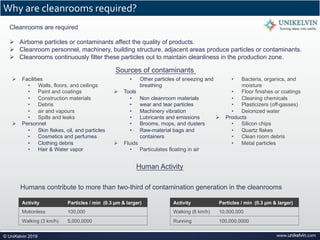
Human Activity
Activity Particles / min (0.3 µm & larger)
Motionless 100,000
Walking (3 km/h) 5,000,0000
Activity Particles / min (0.3 µm & larger)
Walking (8 km/h) 10,000,000
Running 100,000,0000
Humans contribute to more than two-third of contamination generation in the cleanrooms
www.unikelvin.com© UniKelvin 2019
Usage Industries
• Pharmaceuticals
• Biotechnology
• Laboratories
• Hospitals
• Electronics
• Semiconductors
• Automotive
• Aerospace
• Medical devices
• Food & beverages
• R&D Facilities
• Electronic components
• Optical products
• Sterile products
• Integrated circuits
Cleanrooms are used in many industries such as
Cleanroom industry is very fast growing as
many of the companies are moving towards
cleaner and stringent manufacturing process to
provide with better quality products.
Food 7.9%
Hospitals
9.7%
Pharmaceutical
19.0%
Semiconduct
or 12.8%
Electronics
11.9%
Medical
Devices 5.6%
Others 27.5%
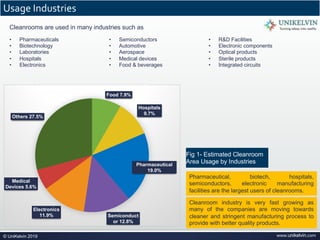
Fig 1- Estimated Cleanroom
Area Usage by Industries
Pharmaceutical, biotech, hospitals,
semiconductors, electronic manufacturing
facilities are the largest users of cleanrooms.
www.unikelvin.com© UniKelvin 2019
History of Cleanrooms
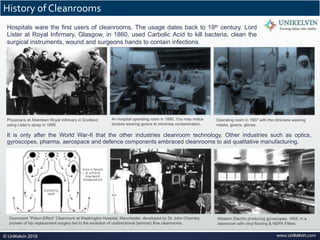
Hospitals ware the first users of cleanrooms. The usage dates back to 19th century. Lord
Lister at Royal Infirmary, Glasgow, in 1860, used Carbolic Acid to kill bacteria, clean the
surgical instruments, wound and surgeons hands to contain infections.
Physicians at Aberdeen Royal Infirmary in Scotland
using Lister’s spray in 1889.
An hospital operating room in 1890. You may notice
doctors wearing gowns to minimise contamination.
Operating room in 1907 with the clinicians wearing
masks, gowns, gloves.
It is only after the World War-II that the other industries cleanroom technology. Other industries such as optics,
gyroscopes, pharma, aerospace and defence components embraced cleanrooms to aid qualitative manufacturing.
Downward ”Piston-Effect” Cleanroom at Washington Hospital, Manchester, developed by Sir John Charnley,
pioneer of hip replacement surgery led to the evolution of unidirectional (laminar) flow cleanrooms.
Western Electric producing gyroscopes, 1955, in a
cleanroom with vinyl flooring & HEPA Filters
www.unikelvin.com© UniKelvin 2019
History of Cleanrooms
Invention of unidirectional or laminar flow cleanrooms
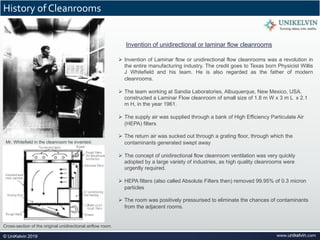
Mr. Whitefield in the cleanroom he invented.
Ø Invention of Laminar flow or unidirectional flow cleanrooms was a revolution in
the entire manufacturing industry. The credit goes to Texas born Physicist Willis
J Whitefield and his team. He is also regarded as the father of modern
cleanrooms.
Ø The team working at Sandia Laboratories, Albuquerque, New Mexico, USA,
constructed a Laminar Flow cleanroom of small size of 1.8 m W x 3 m L x 2.1
m H, in the year 1961.
Ø The supply air was supplied through a bank of High Efficiency Particulate Air
(HEPA) filters
Ø The return air was sucked out through a grating floor, through which the
contaminants generated swept away
Ø The concept of unidirectional flow cleanroom ventilation was very quickly
adopted by a large variety of industries, as high quality cleanrooms were
urgently required.
Ø HEPA filters (also called Absolute Filters then) removed 99.95% of 0.3 micron
particles
Ø The room was positively pressurised to eliminate the chances of contaminants
from the adjacent rooms.
Cross-section of the original unidirectional airflow room.
www.unikelvin.com© UniKelvin 2019
Types of Cleanrooms
The cleanrooms are classified based on the method employed for ventilating the room. There are
three types of cleanrooms, Unidirectional, Non-Unidirectional & Mixed Airflow Cleanrooms
1. Unidirectional Cleanrooms
• Unidirectional are also called as Laminar Airflow Cleanrooms.
• These cleanrooms use more air volume and provide superior cleanliness
• HEPA or ULPA filters are installed in the ceiling or wall that allow the air to
pass through the cross-section of the room, either vertically or horizontally.
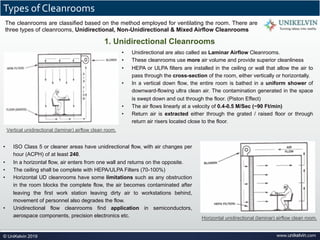
• In a vertical down flow, the entire room is bathed in a uniform shower of
downward-flowing ultra clean air. The contamination generated in the space
is swept down and out through the floor. (Piston Effect)
• The air flows linearly at a velocity of 0.4-0.5 M/Sec (~90 Ft/min)
• Return air is extracted either through the grated / raised floor or through
return air risers located close to the floor.
Horizontal unidirectional (laminar) airflow clean room.
Vertical unidirectional (laminar) airflow clean room.
• ISO Class 5 or cleaner areas have unidirectional flow, with air changes per
hour (ACPH) of at least 240.
• In a horizontal flow, air enters from one wall and returns on the opposite.
• The ceiling shall be complete with HEPA/ULPA Filters (70-100%)
• Horizontal UD cleanrooms have some limitations such as any obstruction
in the room blocks the complete flow, the air becomes contaminated after
leaving the first work station leaving dirty air to workstations behind,
movement of personnel also degrades the flow.
• Unidirectional flow cleanrooms find application in semiconductors,
aerospace components, precision electronics etc.
www.unikelvin.com© UniKelvin 2019
Types of Cleanrooms
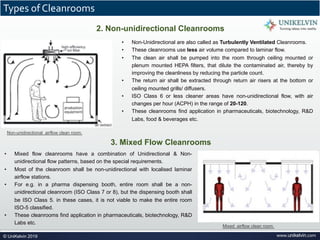
2. Non-unidirectional Cleanrooms
• Non-Unidirectional are also called as Turbulently Ventilated Cleanrooms.
• These cleanrooms use less air volume compared to laminar flow.
• The clean air shall be pumped into the room through ceiling mounted or
plenum mounted HEPA filters, that dilute the contaminated air, thereby by
improving the cleanliness by reducing the particle count.
• The return air shall be extracted through return air risers at the bottom or
ceiling mounted grills/ diffusers.
• ISO Class 6 or less cleaner areas have non-unidirectional flow, with air
changes per hour (ACPH) in the range of 20-120.
• These cleanrooms find application in pharmaceuticals, biotechnology, R&D
Labs, food & beverages etc.
3. Mixed Flow Cleanrooms
Non-unidirectional airflow clean room.
Mixed airflow clean room.
• Mixed flow cleanrooms have a combination of Unidirectional & Non-
unidirectional flow patterns, based on the special requirements.
• Most of the cleanroom shall be non-unidirectional with localised laminar
airflow stations.
• For e.g. in a pharma dispensing booth, entire room shall be a non-
unidirectional cleanroom (ISO Class 7 or 8), but the dispensing booth shall
be ISO Class 5. in these cases, it is not viable to make the entire room
ISO-5 classified.
• These cleanrooms find application in pharmaceuticals, biotechnology, R&D
Labs etc.
www.unikelvin.com© UniKelvin 2019
Cleanroom Classification Standards
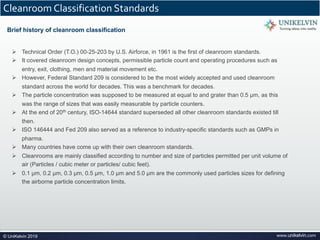
Ø Technical Order (T.O.) 00-25-203 by U.S. Airforce, in 1961 is the first of cleanroom standards.
Ø It covered cleanroom design concepts, permissible particle count and operating procedures such as
entry, exit, clothing, men and material movement etc.
Ø However, Federal Standard 209 is considered to be the most widely accepted and used cleanroom
standard across the world for decades. This was a benchmark for decades.
Ø The particle concentration was supposed to be measured at equal to and grater than 0.5 μm, as this
was the range of sizes that was easily measurable by particle counters.
Ø At the end of 20th century, ISO-14644 standard superseded all other cleanroom standards existed till
then.
Ø ISO 146444 and Fed 209 also served as a reference to industry-specific standards such as GMPs in
pharma.
Ø Many countries have come up with their own cleanroom standards.
Ø Cleanrooms are mainly classified according to number and size of particles permitted per unit volume of
air (Particles / cubic meter or particles/ cubic feet).
Ø 0.1 μm, 0.2 μm, 0.3 μm, 0.5 μm, 1.0 μm and 5.0 μm are the commonly used particles sizes for defining
the airborne particle concentration limits.
Brief history of cleanroom classification
www.unikelvin.com© UniKelvin 2019
Cleanroom Classification Standards
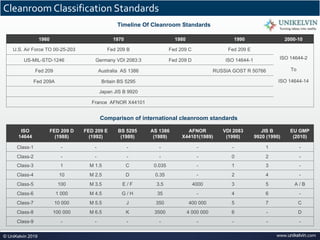
Comparison of international cleanroom standards
ISO
14644
FED 209 D
(1988)
FED 209 E
(1992)
BS 5295
(1989)
AS 1386
(1989)
AFNOR
X44101(1989)
VDI 2083
(1990)
JIS B
9920 (1990)
EU GMP
(2010)
Class-1 - - - - - - 1 -
Class-2 - - - - - 0 2 -
Class-3 1 M 1.5 C 0.035 - 1 3 -
Class-4 10 M 2.5 D 0.35 - 2 4 -
Class-5 100 M 3.5 E / F 3.5 4000 3 5 A / B
Class-6 1 000 M 4.5 G / H 35 - 4 6 -
Class-7 10 000 M 5.5 J 350 400 000 5 7 C
Class-8 100 000 M 6.5 K 3500 4 000 000 6 - D
Class-9 - - - - - - - -
1960 1970 1980 1990 2000-10
U.S. Air Force TO 00-25-203 Fed 209 B Fed 209 C Fed 209 E
ISO 14644-2
To
ISO 14644-14
US-MIL-STD-1246 Germany VDI 2083:3 Fed 209 D ISO 14644-1
Fed 209 Australia AS 1386 RUSSIA GOST R 50766
Fed 209A Britain BS 5295
Japan JIS B 9920
France AFNOR X44101
Timeline Of Cleanroom Standards
www.unikelvin.com© UniKelvin 2019
Cleanroom Classification Standards
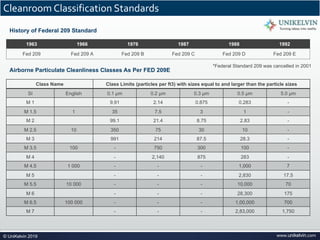
History of Federal 209 Standard
1963 1966 1976 1987 1988 1992
Fed 209 Fed 209 A Fed 209 B Fed 209 C Fed 209 D Fed 209 E
*Federal Standard 209 was cancelled in 2001
Class Name Class Limits (particles per ft3) with sizes equal to and larger than the particle sizes
SI English 0.1 μm 0.2 μm 0.3 μm 0.5 μm 5.0 μm
M 1 9.91 2.14 0.875 0.283 -
M 1.5 1 35 7.5 3 1 -
M 2 99.1 21.4 8.75 2.83 -
M 2.5 10 350 75 30 10 -
M 3 991 214 87.5 28.3 -
M 3.5 100 - 750 300 100 -
M 4 - 2,140 875 283 -
M 4.5 1 000 - - - 1,000 7
M 5 - - - 2,830 17.5
M 5.5 10 000 - - - 10,000 70
M 6 - - - 28,300 175
M 6.5 100 000 - - - 1,00,000 700
M 7 - - - 2,83,000 1,750
Airborne Particulate Cleanliness Classes As Per FED 209E
www.unikelvin.com© UniKelvin 2019
Cleanroom Classification Standards
International Standard ISO 14644
Parts of ISO 14644 Standard
§ ISO 14644 and parts are the most widely used cleanroom standards across the world. Federal standard is
also still used alongside ISO 14644 in some parts of the world and still acceptable to use Fed 209E.
§ ISO 14644 (Cleanrooms and associated controlled environments) and its parts from 1 through 16 cover all
aspects of cleanrooms right from air cleanliness classifications, testing, construction and designing of
cleanrooms, cleanroom operations, separative devices, energy efficiency, nanoscale and chemical particle
concentration etc.
Part Description
ISO 14644-1 Classification of air cleanliness
ISO 14644-2 Specifications for testing and monitoring
ISO 14644-3 Test Methods
ISO 14644-4 Design, construction and start-up
ISO 14644-5 Operations
ISO 14644-6 Vocabulary
ISO 14644-7
Separative devices (clean air hoods,
gloveboxes, isolators and minienvironments)
ISO 14644-8
Classification of airborne molecular
contamination
ISO 14644-9
Classification of surface cleanliness by particle
concentration
ISO 14644-10
Classification of surface cleanliness by
chemical concentration
Part Description
ISO 14644-11 -
ISO 14644-12
Specifications for monitoring air cleanliness by
nanoscale particle concentration
ISO 14644-13
Cleaning of surfaces to achieve defined levels
of cleanliness in terms of particle and chemical
classifications
ISO 14644-14
Assessment of suitability for use of equipment
by airborne particle concentration
ISO 14644-15
Assessment of suitability for use of equipment
and materials by airborne chemical
concentration
ISO 14644-16
Energy efficiency in cleanrooms and
separative devices
ISO 14644-17
Particle deposition rate applications (under
development as on 1st Apr, 2019)
www.unikelvin.com© UniKelvin 2019
References
§ International Standard ISO 14644-1:2015(E), Cleanrooms and associated controlled environments Part 1:
Classification of air cleanliness by particle concentration, ©ISO 2015.
§ Cleanroom Technology: Fundamentals of Design, Testing and Operation by W. Whyte © 2001, published by
John Wiley & Sons Ltd.
§ ASHRAE Design Guide for Cleanrooms: Fundamentals, Systems, and Performance, © 2017
For more articles on Cleanrooms and HVAC, please visit the link below
https://www.unikelvin.com/downloads
#60/A, 2nd Floor, Next to Karnataka Bank,
Bommasandra Main Road, Bommasandra Industrial
Area, Bangalore. PIN- 560099, Ph: +91-80-4377 8866
E-Mail: info@unikelvin.com, Web: www.unikelvin.com
• Cleanroom
• Commercial HVAC
• Modular Panels
• Interiors & Flooring
• Chilled Water Systems
• Electrical Systems
• Integrated BMS
• Laboratory Furniture
• Cleanroom Equipment
• HVAC Maintenance
Services
www.unikelvin.com© UniKelvin 2019

Introduction to cleanrooms

  • 1.
    ALL ABOUT CLEANROOMS www.unikelvin.com© UniKelvin2019 1. INTRODUCTION TO CLEANROOMS -HISTORY, CONCEPTS AND STANDARDS
  • 2.
    www.unikelvin.com© UniKelvin 2019 Whatis a cleanroom? Cleanroom is a specially created controlled environment, to aid certain engineering processes. Widely used in manufacturing and research of semiconductors, electronics, aerospace components, pharmaceutical and biotech processes, cleanrooms have low level of airborne pollutants, microbes, vapors etc. to aid certain engineering processes. As per ISO 14644-1:2015, “A cleanroom is a room in which the concentration of airborne particles is CONTROLLED, and which is CONSTRUCTED and used in a manner to minimise the INTRODUCTION, GENERATION, and RETENTION of particles inside the room and in which other relevant parameters, e.g. temperature, humidity, and pressure, are controlled as necessary. Cleanrooms are Ø maintained at higher pressure compared to adjacent areas to minimise INTRODUCTION of airborne particles. Ø built with materials that do not generate particles and the the personnel wear cleanroom clothing that controls dispersion, thereby minimising the GENERATION of particles. Ø supplied with large quantities of highly filtered air that removes airborne particles instantly, either by dilution effect or piston effect. This is how RETENTION of particles is tackled.
  • 3.
    www.unikelvin.com© UniKelvin 2019 Whyare cleanrooms required? Cleanrooms are required Ø Airborne particles or contaminants affect the quality of products. Ø Cleanroom personnel, machinery, building structure, adjacent areas produce particles or contaminants. Ø Cleanrooms continuously filter these particles out to maintain cleanliness in the production zone. Sources of contaminants Ø Facilities • Walls, floors, and ceilings • Paint and coatings • Construction materials • Debris • air and vapours • Spills and leaks Ø Personnel • Skin flakes, oil, and particles • Cosmetics and perfumes • Clothing debris • Hair & Water vapor • Other particles of sneezing and breathing Ø Tools • Non cleanroom materials • wear and tear particles • Machinery vibration • Lubricants and emissions • Brooms, mops, and dusters • Raw-material bags and containers Ø Fluids • Particulates floating in air • Bacteria, organics, and moisture • Floor finishes or coatings • Cleaning chemicals • Plasticizers (off-gasses) • Deionized water Ø Products • Silicon chips • Quartz flakes • Clean room debris • Metal particles Human Activity Activity Particles / min (0.3 µm & larger) Motionless 100,000 Walking (3 km/h) 5,000,0000 Activity Particles / min (0.3 µm & larger) Walking (8 km/h) 10,000,000 Running 100,000,0000 Humans contribute to more than two-third of contamination generation in the cleanrooms
  • 4.
    www.unikelvin.com© UniKelvin 2019 UsageIndustries • Pharmaceuticals • Biotechnology • Laboratories • Hospitals • Electronics • Semiconductors • Automotive • Aerospace • Medical devices • Food & beverages • R&D Facilities • Electronic components • Optical products • Sterile products • Integrated circuits Cleanrooms are used in many industries such as Cleanroom industry is very fast growing as many of the companies are moving towards cleaner and stringent manufacturing process to provide with better quality products. Food 7.9% Hospitals 9.7% Pharmaceutical 19.0% Semiconduct or 12.8% Electronics 11.9% Medical Devices 5.6% Others 27.5% Fig 1- Estimated Cleanroom Area Usage by Industries Pharmaceutical, biotech, hospitals, semiconductors, electronic manufacturing facilities are the largest users of cleanrooms.
  • 5.
    www.unikelvin.com© UniKelvin 2019 Historyof Cleanrooms Hospitals ware the first users of cleanrooms. The usage dates back to 19th century. Lord Lister at Royal Infirmary, Glasgow, in 1860, used Carbolic Acid to kill bacteria, clean the surgical instruments, wound and surgeons hands to contain infections. Physicians at Aberdeen Royal Infirmary in Scotland using Lister’s spray in 1889. An hospital operating room in 1890. You may notice doctors wearing gowns to minimise contamination. Operating room in 1907 with the clinicians wearing masks, gowns, gloves. It is only after the World War-II that the other industries cleanroom technology. Other industries such as optics, gyroscopes, pharma, aerospace and defence components embraced cleanrooms to aid qualitative manufacturing. Downward ”Piston-Effect” Cleanroom at Washington Hospital, Manchester, developed by Sir John Charnley, pioneer of hip replacement surgery led to the evolution of unidirectional (laminar) flow cleanrooms. Western Electric producing gyroscopes, 1955, in a cleanroom with vinyl flooring & HEPA Filters
  • 6.
    www.unikelvin.com© UniKelvin 2019 Historyof Cleanrooms Invention of unidirectional or laminar flow cleanrooms Mr. Whitefield in the cleanroom he invented. Ø Invention of Laminar flow or unidirectional flow cleanrooms was a revolution in the entire manufacturing industry. The credit goes to Texas born Physicist Willis J Whitefield and his team. He is also regarded as the father of modern cleanrooms. Ø The team working at Sandia Laboratories, Albuquerque, New Mexico, USA, constructed a Laminar Flow cleanroom of small size of 1.8 m W x 3 m L x 2.1 m H, in the year 1961. Ø The supply air was supplied through a bank of High Efficiency Particulate Air (HEPA) filters Ø The return air was sucked out through a grating floor, through which the contaminants generated swept away Ø The concept of unidirectional flow cleanroom ventilation was very quickly adopted by a large variety of industries, as high quality cleanrooms were urgently required. Ø HEPA filters (also called Absolute Filters then) removed 99.95% of 0.3 micron particles Ø The room was positively pressurised to eliminate the chances of contaminants from the adjacent rooms. Cross-section of the original unidirectional airflow room.
  • 7.
    www.unikelvin.com© UniKelvin 2019 Typesof Cleanrooms The cleanrooms are classified based on the method employed for ventilating the room. There are three types of cleanrooms, Unidirectional, Non-Unidirectional & Mixed Airflow Cleanrooms 1. Unidirectional Cleanrooms • Unidirectional are also called as Laminar Airflow Cleanrooms. • These cleanrooms use more air volume and provide superior cleanliness • HEPA or ULPA filters are installed in the ceiling or wall that allow the air to pass through the cross-section of the room, either vertically or horizontally. • In a vertical down flow, the entire room is bathed in a uniform shower of downward-flowing ultra clean air. The contamination generated in the space is swept down and out through the floor. (Piston Effect) • The air flows linearly at a velocity of 0.4-0.5 M/Sec (~90 Ft/min) • Return air is extracted either through the grated / raised floor or through return air risers located close to the floor. Horizontal unidirectional (laminar) airflow clean room. Vertical unidirectional (laminar) airflow clean room. • ISO Class 5 or cleaner areas have unidirectional flow, with air changes per hour (ACPH) of at least 240. • In a horizontal flow, air enters from one wall and returns on the opposite. • The ceiling shall be complete with HEPA/ULPA Filters (70-100%) • Horizontal UD cleanrooms have some limitations such as any obstruction in the room blocks the complete flow, the air becomes contaminated after leaving the first work station leaving dirty air to workstations behind, movement of personnel also degrades the flow. • Unidirectional flow cleanrooms find application in semiconductors, aerospace components, precision electronics etc.
  • 8.
    www.unikelvin.com© UniKelvin 2019 Typesof Cleanrooms 2. Non-unidirectional Cleanrooms • Non-Unidirectional are also called as Turbulently Ventilated Cleanrooms. • These cleanrooms use less air volume compared to laminar flow. • The clean air shall be pumped into the room through ceiling mounted or plenum mounted HEPA filters, that dilute the contaminated air, thereby by improving the cleanliness by reducing the particle count. • The return air shall be extracted through return air risers at the bottom or ceiling mounted grills/ diffusers. • ISO Class 6 or less cleaner areas have non-unidirectional flow, with air changes per hour (ACPH) in the range of 20-120. • These cleanrooms find application in pharmaceuticals, biotechnology, R&D Labs, food & beverages etc. 3. Mixed Flow Cleanrooms Non-unidirectional airflow clean room. Mixed airflow clean room. • Mixed flow cleanrooms have a combination of Unidirectional & Non- unidirectional flow patterns, based on the special requirements. • Most of the cleanroom shall be non-unidirectional with localised laminar airflow stations. • For e.g. in a pharma dispensing booth, entire room shall be a non- unidirectional cleanroom (ISO Class 7 or 8), but the dispensing booth shall be ISO Class 5. in these cases, it is not viable to make the entire room ISO-5 classified. • These cleanrooms find application in pharmaceuticals, biotechnology, R&D Labs etc.
  • 9.
    www.unikelvin.com© UniKelvin 2019 CleanroomClassification Standards Ø Technical Order (T.O.) 00-25-203 by U.S. Airforce, in 1961 is the first of cleanroom standards. Ø It covered cleanroom design concepts, permissible particle count and operating procedures such as entry, exit, clothing, men and material movement etc. Ø However, Federal Standard 209 is considered to be the most widely accepted and used cleanroom standard across the world for decades. This was a benchmark for decades. Ø The particle concentration was supposed to be measured at equal to and grater than 0.5 μm, as this was the range of sizes that was easily measurable by particle counters. Ø At the end of 20th century, ISO-14644 standard superseded all other cleanroom standards existed till then. Ø ISO 146444 and Fed 209 also served as a reference to industry-specific standards such as GMPs in pharma. Ø Many countries have come up with their own cleanroom standards. Ø Cleanrooms are mainly classified according to number and size of particles permitted per unit volume of air (Particles / cubic meter or particles/ cubic feet). Ø 0.1 μm, 0.2 μm, 0.3 μm, 0.5 μm, 1.0 μm and 5.0 μm are the commonly used particles sizes for defining the airborne particle concentration limits. Brief history of cleanroom classification
  • 10.
    www.unikelvin.com© UniKelvin 2019 CleanroomClassification Standards Comparison of international cleanroom standards ISO 14644 FED 209 D (1988) FED 209 E (1992) BS 5295 (1989) AS 1386 (1989) AFNOR X44101(1989) VDI 2083 (1990) JIS B 9920 (1990) EU GMP (2010) Class-1 - - - - - - 1 - Class-2 - - - - - 0 2 - Class-3 1 M 1.5 C 0.035 - 1 3 - Class-4 10 M 2.5 D 0.35 - 2 4 - Class-5 100 M 3.5 E / F 3.5 4000 3 5 A / B Class-6 1 000 M 4.5 G / H 35 - 4 6 - Class-7 10 000 M 5.5 J 350 400 000 5 7 C Class-8 100 000 M 6.5 K 3500 4 000 000 6 - D Class-9 - - - - - - - - 1960 1970 1980 1990 2000-10 U.S. Air Force TO 00-25-203 Fed 209 B Fed 209 C Fed 209 E ISO 14644-2 To ISO 14644-14 US-MIL-STD-1246 Germany VDI 2083:3 Fed 209 D ISO 14644-1 Fed 209 Australia AS 1386 RUSSIA GOST R 50766 Fed 209A Britain BS 5295 Japan JIS B 9920 France AFNOR X44101 Timeline Of Cleanroom Standards
  • 11.
    www.unikelvin.com© UniKelvin 2019 CleanroomClassification Standards History of Federal 209 Standard 1963 1966 1976 1987 1988 1992 Fed 209 Fed 209 A Fed 209 B Fed 209 C Fed 209 D Fed 209 E *Federal Standard 209 was cancelled in 2001 Class Name Class Limits (particles per ft3) with sizes equal to and larger than the particle sizes SI English 0.1 μm 0.2 μm 0.3 μm 0.5 μm 5.0 μm M 1 9.91 2.14 0.875 0.283 - M 1.5 1 35 7.5 3 1 - M 2 99.1 21.4 8.75 2.83 - M 2.5 10 350 75 30 10 - M 3 991 214 87.5 28.3 - M 3.5 100 - 750 300 100 - M 4 - 2,140 875 283 - M 4.5 1 000 - - - 1,000 7 M 5 - - - 2,830 17.5 M 5.5 10 000 - - - 10,000 70 M 6 - - - 28,300 175 M 6.5 100 000 - - - 1,00,000 700 M 7 - - - 2,83,000 1,750 Airborne Particulate Cleanliness Classes As Per FED 209E
  • 12.
    www.unikelvin.com© UniKelvin 2019 CleanroomClassification Standards International Standard ISO 14644 Parts of ISO 14644 Standard § ISO 14644 and parts are the most widely used cleanroom standards across the world. Federal standard is also still used alongside ISO 14644 in some parts of the world and still acceptable to use Fed 209E. § ISO 14644 (Cleanrooms and associated controlled environments) and its parts from 1 through 16 cover all aspects of cleanrooms right from air cleanliness classifications, testing, construction and designing of cleanrooms, cleanroom operations, separative devices, energy efficiency, nanoscale and chemical particle concentration etc. Part Description ISO 14644-1 Classification of air cleanliness ISO 14644-2 Specifications for testing and monitoring ISO 14644-3 Test Methods ISO 14644-4 Design, construction and start-up ISO 14644-5 Operations ISO 14644-6 Vocabulary ISO 14644-7 Separative devices (clean air hoods, gloveboxes, isolators and minienvironments) ISO 14644-8 Classification of airborne molecular contamination ISO 14644-9 Classification of surface cleanliness by particle concentration ISO 14644-10 Classification of surface cleanliness by chemical concentration Part Description ISO 14644-11 - ISO 14644-12 Specifications for monitoring air cleanliness by nanoscale particle concentration ISO 14644-13 Cleaning of surfaces to achieve defined levels of cleanliness in terms of particle and chemical classifications ISO 14644-14 Assessment of suitability for use of equipment by airborne particle concentration ISO 14644-15 Assessment of suitability for use of equipment and materials by airborne chemical concentration ISO 14644-16 Energy efficiency in cleanrooms and separative devices ISO 14644-17 Particle deposition rate applications (under development as on 1st Apr, 2019)
  • 13.
    www.unikelvin.com© UniKelvin 2019 References §International Standard ISO 14644-1:2015(E), Cleanrooms and associated controlled environments Part 1: Classification of air cleanliness by particle concentration, ©ISO 2015. § Cleanroom Technology: Fundamentals of Design, Testing and Operation by W. Whyte © 2001, published by John Wiley & Sons Ltd. § ASHRAE Design Guide for Cleanrooms: Fundamentals, Systems, and Performance, © 2017 For more articles on Cleanrooms and HVAC, please visit the link below https://www.unikelvin.com/downloads
  • 14.
    #60/A, 2nd Floor,Next to Karnataka Bank, Bommasandra Main Road, Bommasandra Industrial Area, Bangalore. PIN- 560099, Ph: +91-80-4377 8866 E-Mail: info@unikelvin.com, Web: www.unikelvin.com • Cleanroom • Commercial HVAC • Modular Panels • Interiors & Flooring • Chilled Water Systems • Electrical Systems • Integrated BMS • Laboratory Furniture • Cleanroom Equipment • HVAC Maintenance Services www.unikelvin.com© UniKelvin 2019