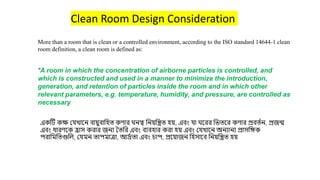
More than a room that is clean or a controlled environment, according to the ISO standard 14644-1 clean
room definition, a clean room is defined as:
“A room in which the concentration of airborne particles is controlled, and
which is constructed and used in a manner to minimize the introduction,
generation, and retention of particles inside the room and in which other
relevant parameters, e.g. temperature, humidity, and pressure, are controlled as
necessary
একটি কক্ষ যেখানে বায়ুবাহিত কণার ঘেত্ব হেযহিত িয, এবং ো ঘনরর হিতনর কণার প্রবততে, প্রজন্ম
এবং ধারণনক হ্রাস করার জেয ততহর এবং বযবিার করা িয এবং যেখানে অেযােয প্রাসহিক
পরাহিহতগুহি, যেিে তাপিাত্রা, আর্দ্ততা এবং চাপ, প্রনযাজে হিসানব হেযহিত িয
Clean Room Design Consideration
Minimizing the introduction, generation and retention of particles in a clean room is done in 3 ways:
•Supplying the room with a large quantity of air filtered with high efficiency filters (HEPA filter or ULPA). The filtered
air will dilute and remove particles, bacteria and chemicals from within the room. The air is also used to pressurize
the room and ensure a non contaminated clean room air circulation
•The clean room itself must be built with materials that do not generate contaminants, particles, or outgas airborne
chemical and must also be easy to clean.
•Clean room operators must wear garments that minimize dispersion of particles and micro-organisms generated
by people such as hair, skin flakes, clothing fibers, etc. In fact, operator base contamination accounts for 70% to
80% of cleanroom contamination. To minimize the risk of contamination, the clean room operators will usually get
dressed in a gowning room, also referred as anteroom. Air showers can also be used.
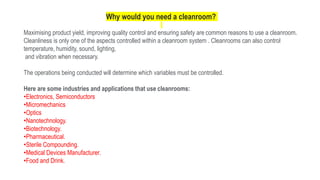
Why would you need a cleanroom?
Maximising product yield, improving quality control and ensuring safety are common reasons to use a cleanroom.
Cleanliness is only one of the aspects controlled within a cleanroom system . Cleanrooms can also control
temperature, humidity, sound, lighting,
and vibration when necessary.
The operations being conducted will determine which variables must be controlled.
Here are some industries and applications that use cleanrooms:
•Electronics, Semiconductors
•Micromechanics
•Optics
•Nanotechnology.
•Biotechnology.
•Pharmaceutical.
•Sterile Compounding.
•Medical Devices Manufacturer.
•Food and Drink.
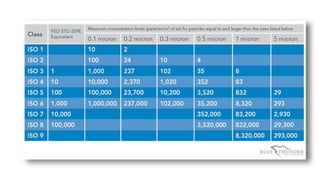
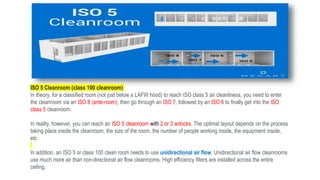
ISO 5 Cleanroom (class 100 cleanroom)
In theory, for a classified room (not just below a LAFW hood) to reach ISO class 5 air cleanliness, you need to enter
the cleanroom via an ISO 8 (ante-room), then go through an ISO 7, followed by an ISO 6 to finally get into the ISO
class 5 cleanroom.
In reality, however, you can reach an ISO 5 cleanroom with 2 or 3 airlocks. The optimal layout depends on the process
taking place inside the cleanroom, the size of the room, the number of people working inside, the equipment inside,
etc.
In addition, an ISO 5 or class 100 clean room needs to use unidirectional air flow. Unidirectional air flow cleanrooms
use much more air than non-directional air flow cleanrooms. High efficiency filters are installed across the entire
ceiling.
The filtered air sweeps down the room in a unidirectional way, at a velocity generally between 0.3 m/s and
0.5 m/s, and exits through the floor, removing the airborne contamination from the room. Cleanrooms using
unidirectional air flow are more expensive than non-unidirectional ones, but can comply with more
stringent classifications, such as ISO 5 or lower.
•ISO 5 zone | 240–360 air changes per hour
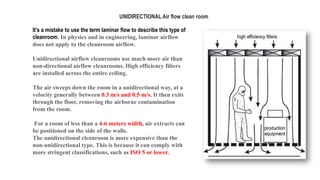
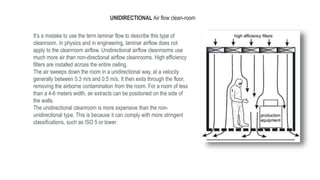
It’s a mistake to use the term laminar flow to describe this type of
cleanroom. In physics and in engineering, laminar airflow
does not apply to the cleanroom airflow.
Unidirectional airflow cleanrooms use much more air than
non-directional airflow cleanrooms. High efficiency filters
are installed across the entire ceiling.
The air sweeps down the room in a unidirectional way, at a
velocity generally between 0.3 m/s and 0.5 m/s. It then exits
through the floor, removing the airborne contamination
from the room.
For a room of less than a 4-6 meters width, air extracts can
be positioned on the side of the walls.
The unidirectional cleanroom is more expensive than the
non-unidirectional type. This is because it can comply with
more stringent classifications, such as ISO 5 or lower.
UNIDIRECTIONAL Air flow clean room
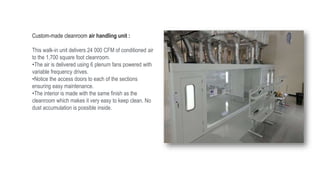
Custom-made cleanroom air handling unit :
This walk-in unit delivers 24 000 CFM of conditioned air
to the 1,700 square foot cleanroom.
•The air is delivered using 6 plenum fans powered with
variable frequency drives.
•Notice the access doors to each of the sections
ensuring easy maintenance.
•The interior is made with the same finish as the
cleanroom which makes it very easy to keep clean. No
dust accumulation is possible inside.
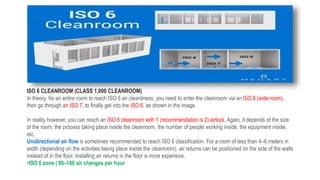
ISO 6 CLEANROOM (CLASS 1,000 CLEANROOM)
In theory, for an entire room to reach ISO 6 air cleanliness, you need to enter the cleanroom via an ISO 8 (ante-room),
then go through an ISO 7, to finally get into the ISO 6, as shown in the image.
In reality however, you can reach an ISO 6 cleanroom with 1 (recommendation is 2) airlock. Again, it depends of the size
of the room, the process taking place inside the cleanroom, the number of people working inside, the equipment inside,
etc.
Unidirectional air flow is sometimes recommended to reach ISO 6 classification. For a room of less than 4–6 meters in
width (depending on the activities taking place inside the cleanroom), air returns can be positioned on the side of the walls
instead of in the floor. Installing air returns in the floor is more expensive.
•ISO 6 zone | 90–180 air changes per hour
It’s a mistake to use the term laminar flow to describe this type of
cleanroom. In physics and in engineering, laminar airflow does not
apply to the cleanroom airflow. Unidirectional airflow cleanrooms use
much more air than non-directional airflow cleanrooms. High efficiency
filters are installed across the entire ceiling.
The air sweeps down the room in a unidirectional way, at a velocity
generally between 0.3 m/s and 0.5 m/s. It then exits through the floor,
removing the airborne contamination from the room. For a room of less
than a 4-6 meters width, air extracts can be positioned on the side of
the walls.
The unidirectional cleanroom is more expensive than the non-
unidirectional type. This is because it can comply with more stringent
classifications, such as ISO 5 or lower.
UNIDIRECTIONAL Air flow clean-room
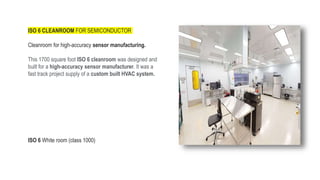
ISO 6 CLEANROOM FOR SEMICONDUCTOR
LOCCLEANROOM CLASSO 6
Cleanroom for high-accuracy sensor manufacturing.
This 1700 square foot ISO 6 cleanroom was designed and
built for a high-accuracy sensor manufacturer. It was a
fast track project supply of a custom built HVAC system.
ISO 6 White room (class 1000)
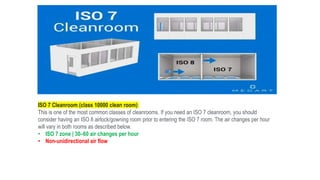
ISO 7 Cleanroom (class 10000 clean room)
This is one of the most common classes of cleanrooms. If you need an ISO 7 cleanroom, you should
consider having an ISO 8 airlock/gowning room prior to entering the ISO 7 room. The air changes per hour
will vary in both rooms as described below.
• ISO 7 zone | 30–60 air changes per hour
• Non-unidirectional air flow
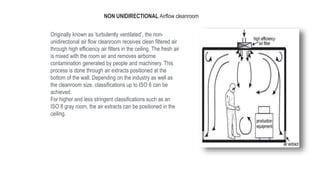
Originally known as ‘turbulently ventilated’, the non-
unidirectional air flow cleanroom receives clean filtered air
through high efficiency air filters in the ceiling. The fresh air
is mixed with the room air and removes airborne
contamination generated by people and machinery. This
process is done through air extracts positioned at the
bottom of the wall. Depending on the industry as well as
the cleanroom size, classifications up to ISO 6 can be
achieved.
For higher and less stringent classifications such as an
ISO 8 gray room, the air extracts can be positioned in the
ceiling.
NON UNIDIRECTIONAL Airflow cleanroom
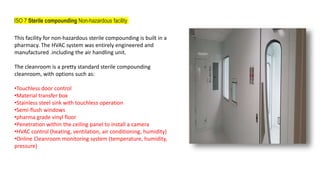
ISO 7 Sterile compounding Non-hazardous facility
This facility for non-hazardous sterile compounding is built in a
pharmacy. The HVAC system was entirely engineered and
manufactured .including the air handling unit.
The cleanroom is a pretty standard sterile compounding
cleanroom, with options such as:
•Touchless door control
•Material transfer box
•Stainless steel sink with touchless operation
•Semi-flush windows
•pharma grade vinyl floor
•Penetration within the ceiling panel to install a camera
•HVAC control (heating, ventilation, air conditioning, humidity)
•Online Cleanroom monitoring system (temperature, humidity,
pressure)
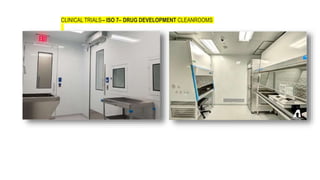
CLINICAL TRIALS-- ISO 7– DRUG DEVELOPMENT CLEANROOMS
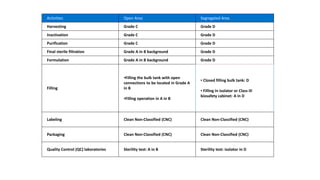
Activities Open Area Segregated Area
Harvesting Grade C Grade D
Inactivation Grade C Grade D
Purification Grade C Grade D
Final sterile filtration Grade A in B background Grade D
Formulation Grade A in B background Grade D
Filling
▪Filling the bulk tank with open
connections to be located in Grade A
in B
▪Filling operation in A in B
▪ Closed filling bulk tank: D
▪ Filling in isolator or Class III
biosafety cabinet: A in D
Labeling Clean Non-Classified (CNC) Clean Non-Classified (CNC)
Packaging Clean Non-Classified (CNC) Clean Non-Classified (CNC)
Quality Control (QC) laboratories Sterility test: A in B Sterility test: isolator in D
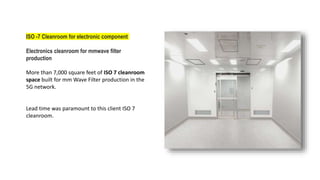
ISO -7 Cleanroom for electronic component
0,000 cleanroom / ISO 7
Electronics cleanroom for mmwave filter
production
More than 7,000 square feet of ISO 7 cleanroom
space built for mm Wave Filter production in the
5G network.
Lead time was paramount to this client ISO 7
cleanroom.
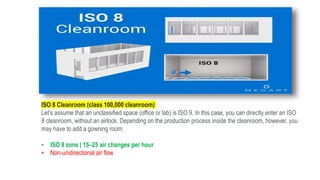
ISO 8 Cleanroom (class 100,000 cleanroom)
Let’s assume that an unclassified space (office or lab) is ISO 9. In this case, you can directly enter an ISO
8 cleanroom, without an airlock. Depending on the production process inside the cleanroom, however, you
may have to add a gowning room.
• ISO 8 zone | 15–25 air changes per hour
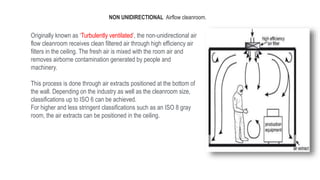
• Non-unidirectional air flow
Originally known as ‘Turbulently ventilated’, the non-unidirectional air
flow cleanroom receives clean filtered air through high efficiency air
filters in the ceiling. The fresh air is mixed with the room air and
removes airborne contamination generated by people and
machinery.
This process is done through air extracts positioned at the bottom of
the wall. Depending on the industry as well as the cleanroom size,
classifications up to ISO 6 can be achieved.
For higher and less stringent classifications such as an ISO 8 gray
room, the air extracts can be positioned in the ceiling.
NON UNIDIRECTIONAL Airflow cleanroom.
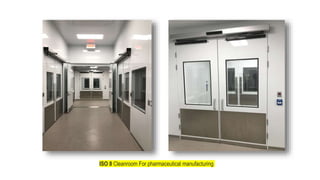
ISO 8 Cleanroom For pharmaceutical manufacturing
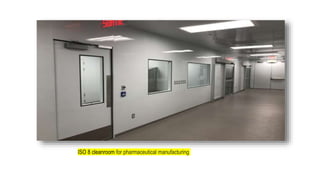
ISO 8 cleanroom for pharmaceutical manufacturing
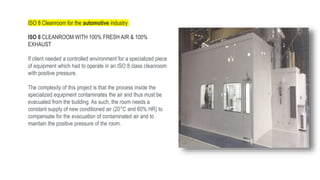
ISO 8 Cleanroom for the automotive industry
ISO 8 CLEANROOM WITH 100% FRESH AIR & 100%
EXHAUST
If client needed a controlled environment for a specialized piece
of equipment which had to operate in an ISO 8 class cleanroom
with positive pressure.
The complexity of this project is that the process inside the
specialized equipment contaminates the air and thus must be
evacuated from the building. As such, the room needs a
constant supply of new conditioned air (20°C and 60% HR) to
compensate for the evacuation of contaminated air and to
maintain the positive pressure of the room.

Clean room design Consideration design .pptx

  • 1.
    More than aroom that is clean or a controlled environment, according to the ISO standard 14644-1 clean room definition, a clean room is defined as: “A room in which the concentration of airborne particles is controlled, and which is constructed and used in a manner to minimize the introduction, generation, and retention of particles inside the room and in which other relevant parameters, e.g. temperature, humidity, and pressure, are controlled as necessary একটি কক্ষ যেখানে বায়ুবাহিত কণার ঘেত্ব হেযহিত িয, এবং ো ঘনরর হিতনর কণার প্রবততে, প্রজন্ম এবং ধারণনক হ্রাস করার জেয ততহর এবং বযবিার করা িয এবং যেখানে অেযােয প্রাসহিক পরাহিহতগুহি, যেিে তাপিাত্রা, আর্দ্ততা এবং চাপ, প্রনযাজে হিসানব হেযহিত িয Clean Room Design Consideration
  • 2.
    Minimizing the introduction,generation and retention of particles in a clean room is done in 3 ways: •Supplying the room with a large quantity of air filtered with high efficiency filters (HEPA filter or ULPA). The filtered air will dilute and remove particles, bacteria and chemicals from within the room. The air is also used to pressurize the room and ensure a non contaminated clean room air circulation •The clean room itself must be built with materials that do not generate contaminants, particles, or outgas airborne chemical and must also be easy to clean. •Clean room operators must wear garments that minimize dispersion of particles and micro-organisms generated by people such as hair, skin flakes, clothing fibers, etc. In fact, operator base contamination accounts for 70% to 80% of cleanroom contamination. To minimize the risk of contamination, the clean room operators will usually get dressed in a gowning room, also referred as anteroom. Air showers can also be used.
  • 3.
    Why would youneed a cleanroom? Maximising product yield, improving quality control and ensuring safety are common reasons to use a cleanroom. Cleanliness is only one of the aspects controlled within a cleanroom system . Cleanrooms can also control temperature, humidity, sound, lighting, and vibration when necessary. The operations being conducted will determine which variables must be controlled. Here are some industries and applications that use cleanrooms: •Electronics, Semiconductors •Micromechanics •Optics •Nanotechnology. •Biotechnology. •Pharmaceutical. •Sterile Compounding. •Medical Devices Manufacturer. •Food and Drink.
  • 5.
    ISO 5 Cleanroom(class 100 cleanroom) In theory, for a classified room (not just below a LAFW hood) to reach ISO class 5 air cleanliness, you need to enter the cleanroom via an ISO 8 (ante-room), then go through an ISO 7, followed by an ISO 6 to finally get into the ISO class 5 cleanroom. In reality, however, you can reach an ISO 5 cleanroom with 2 or 3 airlocks. The optimal layout depends on the process taking place inside the cleanroom, the size of the room, the number of people working inside, the equipment inside, etc. In addition, an ISO 5 or class 100 clean room needs to use unidirectional air flow. Unidirectional air flow cleanrooms use much more air than non-directional air flow cleanrooms. High efficiency filters are installed across the entire ceiling.
  • 6.
    The filtered airsweeps down the room in a unidirectional way, at a velocity generally between 0.3 m/s and 0.5 m/s, and exits through the floor, removing the airborne contamination from the room. Cleanrooms using unidirectional air flow are more expensive than non-unidirectional ones, but can comply with more stringent classifications, such as ISO 5 or lower. •ISO 5 zone | 240–360 air changes per hour
  • 7.
    It’s a mistaketo use the term laminar flow to describe this type of cleanroom. In physics and in engineering, laminar airflow does not apply to the cleanroom airflow. Unidirectional airflow cleanrooms use much more air than non-directional airflow cleanrooms. High efficiency filters are installed across the entire ceiling. The air sweeps down the room in a unidirectional way, at a velocity generally between 0.3 m/s and 0.5 m/s. It then exits through the floor, removing the airborne contamination from the room. For a room of less than a 4-6 meters width, air extracts can be positioned on the side of the walls. The unidirectional cleanroom is more expensive than the non-unidirectional type. This is because it can comply with more stringent classifications, such as ISO 5 or lower. UNIDIRECTIONAL Air flow clean room
  • 8.
    Custom-made cleanroom airhandling unit : This walk-in unit delivers 24 000 CFM of conditioned air to the 1,700 square foot cleanroom. •The air is delivered using 6 plenum fans powered with variable frequency drives. •Notice the access doors to each of the sections ensuring easy maintenance. •The interior is made with the same finish as the cleanroom which makes it very easy to keep clean. No dust accumulation is possible inside.
  • 9.
    ISO 6 CLEANROOM(CLASS 1,000 CLEANROOM) In theory, for an entire room to reach ISO 6 air cleanliness, you need to enter the cleanroom via an ISO 8 (ante-room), then go through an ISO 7, to finally get into the ISO 6, as shown in the image. In reality however, you can reach an ISO 6 cleanroom with 1 (recommendation is 2) airlock. Again, it depends of the size of the room, the process taking place inside the cleanroom, the number of people working inside, the equipment inside, etc. Unidirectional air flow is sometimes recommended to reach ISO 6 classification. For a room of less than 4–6 meters in width (depending on the activities taking place inside the cleanroom), air returns can be positioned on the side of the walls instead of in the floor. Installing air returns in the floor is more expensive. •ISO 6 zone | 90–180 air changes per hour
  • 10.
    It’s a mistaketo use the term laminar flow to describe this type of cleanroom. In physics and in engineering, laminar airflow does not apply to the cleanroom airflow. Unidirectional airflow cleanrooms use much more air than non-directional airflow cleanrooms. High efficiency filters are installed across the entire ceiling. The air sweeps down the room in a unidirectional way, at a velocity generally between 0.3 m/s and 0.5 m/s. It then exits through the floor, removing the airborne contamination from the room. For a room of less than a 4-6 meters width, air extracts can be positioned on the side of the walls. The unidirectional cleanroom is more expensive than the non- unidirectional type. This is because it can comply with more stringent classifications, such as ISO 5 or lower. UNIDIRECTIONAL Air flow clean-room
  • 11.
    ISO 6 CLEANROOMFOR SEMICONDUCTOR LOCCLEANROOM CLASSO 6 Cleanroom for high-accuracy sensor manufacturing. This 1700 square foot ISO 6 cleanroom was designed and built for a high-accuracy sensor manufacturer. It was a fast track project supply of a custom built HVAC system. ISO 6 White room (class 1000)
  • 12.
    ISO 7 Cleanroom(class 10000 clean room) This is one of the most common classes of cleanrooms. If you need an ISO 7 cleanroom, you should consider having an ISO 8 airlock/gowning room prior to entering the ISO 7 room. The air changes per hour will vary in both rooms as described below. • ISO 7 zone | 30–60 air changes per hour • Non-unidirectional air flow
  • 13.
    Originally known as‘turbulently ventilated’, the non- unidirectional air flow cleanroom receives clean filtered air through high efficiency air filters in the ceiling. The fresh air is mixed with the room air and removes airborne contamination generated by people and machinery. This process is done through air extracts positioned at the bottom of the wall. Depending on the industry as well as the cleanroom size, classifications up to ISO 6 can be achieved. For higher and less stringent classifications such as an ISO 8 gray room, the air extracts can be positioned in the ceiling. NON UNIDIRECTIONAL Airflow cleanroom
  • 14.
    ISO 7 Sterilecompounding Non-hazardous facility This facility for non-hazardous sterile compounding is built in a pharmacy. The HVAC system was entirely engineered and manufactured .including the air handling unit. The cleanroom is a pretty standard sterile compounding cleanroom, with options such as: •Touchless door control •Material transfer box •Stainless steel sink with touchless operation •Semi-flush windows •pharma grade vinyl floor •Penetration within the ceiling panel to install a camera •HVAC control (heating, ventilation, air conditioning, humidity) •Online Cleanroom monitoring system (temperature, humidity, pressure)
  • 15.
    CLINICAL TRIALS-- ISO7– DRUG DEVELOPMENT CLEANROOMS
  • 17.
    Activities Open AreaSegregated Area Harvesting Grade C Grade D Inactivation Grade C Grade D Purification Grade C Grade D Final sterile filtration Grade A in B background Grade D Formulation Grade A in B background Grade D Filling ▪Filling the bulk tank with open connections to be located in Grade A in B ▪Filling operation in A in B ▪ Closed filling bulk tank: D ▪ Filling in isolator or Class III biosafety cabinet: A in D Labeling Clean Non-Classified (CNC) Clean Non-Classified (CNC) Packaging Clean Non-Classified (CNC) Clean Non-Classified (CNC) Quality Control (QC) laboratories Sterility test: A in B Sterility test: isolator in D
  • 18.
    ISO -7 Cleanroomfor electronic component 0,000 cleanroom / ISO 7 Electronics cleanroom for mmwave filter production More than 7,000 square feet of ISO 7 cleanroom space built for mm Wave Filter production in the 5G network. Lead time was paramount to this client ISO 7 cleanroom.
  • 19.
    ISO 8 Cleanroom(class 100,000 cleanroom) Let’s assume that an unclassified space (office or lab) is ISO 9. In this case, you can directly enter an ISO 8 cleanroom, without an airlock. Depending on the production process inside the cleanroom, however, you may have to add a gowning room. • ISO 8 zone | 15–25 air changes per hour • Non-unidirectional air flow
  • 20.
    Originally known as‘Turbulently ventilated’, the non-unidirectional air flow cleanroom receives clean filtered air through high efficiency air filters in the ceiling. The fresh air is mixed with the room air and removes airborne contamination generated by people and machinery. This process is done through air extracts positioned at the bottom of the wall. Depending on the industry as well as the cleanroom size, classifications up to ISO 6 can be achieved. For higher and less stringent classifications such as an ISO 8 gray room, the air extracts can be positioned in the ceiling. NON UNIDIRECTIONAL Airflow cleanroom.
  • 21.
    ISO 8 CleanroomFor pharmaceutical manufacturing
  • 22.
    ISO 8 cleanroomfor pharmaceutical manufacturing
  • 23.
    ISO 8 Cleanroomfor the automotive industry ISO 8 CLEANROOM WITH 100% FRESH AIR & 100% EXHAUST If client needed a controlled environment for a specialized piece of equipment which had to operate in an ISO 8 class cleanroom with positive pressure. The complexity of this project is that the process inside the specialized equipment contaminates the air and thus must be evacuated from the building. As such, the room needs a constant supply of new conditioned air (20°C and 60% HR) to compensate for the evacuation of contaminated air and to maintain the positive pressure of the room.