Team: Nancy Coria Adame
Jorge Agustín Suastegui Paredes
Daniela Rivera Javier
Andrea Balderrama
Subject: Syntax
Semester: 2° Group: «I»
How can we identify clauses?
 Each clause contains a finite verb
Finite verb: Are traditionally marked for tense, person
and number.
Tense: Has to do wheter the speaker or writer uses a
tense.
Person: Has to do with wheter an action is assigned to
the speaker.
Number: Has to do wheter the speaker or writer refers
to one person or more than one person.
 In each clause, the finite verb is accompained by its
complements and adjuncts.
 Each clause is marked for aspect, and the aspect canbe
changed. Example: Compare Wickham was eloping with Lydia as
opposed to Wickham eloped with Lydia.
 Each clause has to do with mood. Has todo wth two sets of
distinctions.
Distinctions between making statements, asking
questions, issuing commands.
And distinctions wheter the speaker or writer
presents an event as possible, or necessary, or as a
fact.
 These both distnctions allow certain changes of syntax to
reflect changes of focus or emphasis.
 Clauses descirbe situations the participants of them and the
circunstances in which they take place.
 Both can be the first contribution to a discourse, wheter
spoken or written.
We can recognize clauses by which phrases modify
which verb.
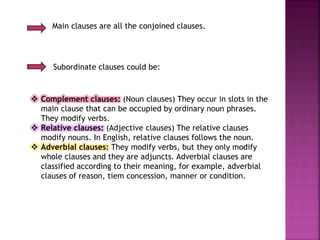
Main clauses are all the conjoined clauses.
Subordinate clauses could be:
 Complement clauses: (Noun clauses) They occur in slots in the
main clause that can be occupied by ordinary noun phrases.
They modify verbs.
 Relative clauses: (Adjective clauses) The relative clauses
modify nouns. In English, relative clauses follows the noun.
 Adverbial clauses: They modify verbs, but they only modify
whole clauses and they are adjuncts. Adverbial clauses are
classified according to their meaning, for example, adverbial
clauses of reason, tiem concession, manner or condition.

Clauses and sentences

  • 1.
    Team: Nancy CoriaAdame Jorge Agustín Suastegui Paredes Daniela Rivera Javier Andrea Balderrama Subject: Syntax Semester: 2° Group: «I»
  • 2.
    How can weidentify clauses?  Each clause contains a finite verb Finite verb: Are traditionally marked for tense, person and number. Tense: Has to do wheter the speaker or writer uses a tense. Person: Has to do with wheter an action is assigned to the speaker. Number: Has to do wheter the speaker or writer refers to one person or more than one person.
  • 3.
     In eachclause, the finite verb is accompained by its complements and adjuncts.  Each clause is marked for aspect, and the aspect canbe changed. Example: Compare Wickham was eloping with Lydia as opposed to Wickham eloped with Lydia.  Each clause has to do with mood. Has todo wth two sets of distinctions. Distinctions between making statements, asking questions, issuing commands. And distinctions wheter the speaker or writer presents an event as possible, or necessary, or as a fact.
  • 4.
     These bothdistnctions allow certain changes of syntax to reflect changes of focus or emphasis.  Clauses descirbe situations the participants of them and the circunstances in which they take place.  Both can be the first contribution to a discourse, wheter spoken or written. We can recognize clauses by which phrases modify which verb.
  • 5.
    Main clauses areall the conjoined clauses. Subordinate clauses could be:  Complement clauses: (Noun clauses) They occur in slots in the main clause that can be occupied by ordinary noun phrases. They modify verbs.  Relative clauses: (Adjective clauses) The relative clauses modify nouns. In English, relative clauses follows the noun.  Adverbial clauses: They modify verbs, but they only modify whole clauses and they are adjuncts. Adverbial clauses are classified according to their meaning, for example, adverbial clauses of reason, tiem concession, manner or condition.