Introduction to Linguistics
Part Four- Meaning (Semantics)
(Study of Meaning)
Definition
 Semantics is a study of the meaning of lexical items and other parts
of language. It deals with the study of meanings of words, changes in
meaning, and the principles that govern the relationship between
sentences or words and their meanings.
 The term semantics (from the Greek for "sign") was coined by French
linguist Michel Bréal in ‘An essay on semantics’, 1897 who is commonly
regarded as a founder of modern semantics.
Basic Divisions
"Based on the distinction between the meanings of words and the
meanings of sentences, we can recognize two main divisions in the
study of semantics:
1- Lexical semantics; the study of word meaning,
2- Phrasal semantics; the study of the principles which govern the
construction of the meaning of phrases and of sentence meaning out
of compositional combinations of individual lexemes.
Semantic relationships between words
Semantic relationships are the associations that exist;
1. Between the meanings of words
(semantic relationships at lexical/word level).
1. Between the meanings of phrases, or between the meanings of sentences
(semantic relationships at phrase or sentence level).
Note: In this lecture we will discuss only Semantic relationships at word level.
Semantic relationships at word level
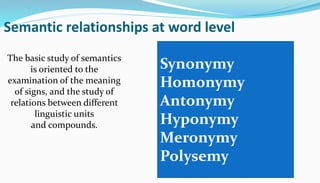
The basic study of semantics
is oriented to the
examination of the meaning
of signs, and the study of
relations between different
linguistic units
and compounds.
Synonymy
Homonymy
Antonymy
Hyponymy
Meronymy
Polysemy
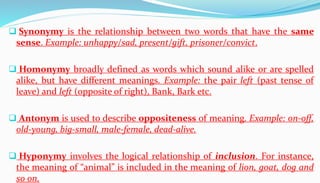
 Synonymy is the relationship between two words that have the same
sense. Example: unhappy/sad, present/gift, prisoner/convict.
 Homonymy broadly defined as words which sound alike or are spelled
alike, but have different meanings. Example: the pair left (past tense of
leave) and left (opposite of right), Bank, Bark etc.
 Antonym is used to describe oppositeness of meaning. Example: on-off,
old-young, big-small, male-female, dead-alive.
 Hyponymy involves the logical relationship of inclusion. For instance,
the meaning of “animal” is included in the meaning of lion, goat, dog and
so on.
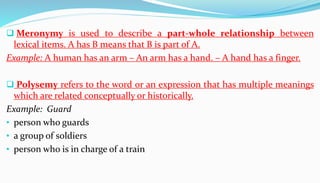
 Meronymy is used to describe a part-whole relationship between
lexical items. A has B means that B is part of A.
Example: A human has an arm – An arm has a hand. – A hand has a finger.
 Polysemy refers to the word or an expression that has multiple meanings
which are related conceptually or historically.
Example: Guard
• person who guards
• a group of soldiers
• person who is in charge of a train

Semantics introduction

  • 1.
    Introduction to Linguistics PartFour- Meaning (Semantics) (Study of Meaning)
  • 2.
    Definition  Semantics isa study of the meaning of lexical items and other parts of language. It deals with the study of meanings of words, changes in meaning, and the principles that govern the relationship between sentences or words and their meanings.  The term semantics (from the Greek for "sign") was coined by French linguist Michel Bréal in ‘An essay on semantics’, 1897 who is commonly regarded as a founder of modern semantics.
  • 3.
    Basic Divisions "Based onthe distinction between the meanings of words and the meanings of sentences, we can recognize two main divisions in the study of semantics: 1- Lexical semantics; the study of word meaning, 2- Phrasal semantics; the study of the principles which govern the construction of the meaning of phrases and of sentence meaning out of compositional combinations of individual lexemes.
  • 4.
    Semantic relationships betweenwords Semantic relationships are the associations that exist; 1. Between the meanings of words (semantic relationships at lexical/word level). 1. Between the meanings of phrases, or between the meanings of sentences (semantic relationships at phrase or sentence level). Note: In this lecture we will discuss only Semantic relationships at word level.
  • 5.
    Semantic relationships atword level The basic study of semantics is oriented to the examination of the meaning of signs, and the study of relations between different linguistic units and compounds. Synonymy Homonymy Antonymy Hyponymy Meronymy Polysemy
  • 6.
     Synonymy isthe relationship between two words that have the same sense. Example: unhappy/sad, present/gift, prisoner/convict.  Homonymy broadly defined as words which sound alike or are spelled alike, but have different meanings. Example: the pair left (past tense of leave) and left (opposite of right), Bank, Bark etc.  Antonym is used to describe oppositeness of meaning. Example: on-off, old-young, big-small, male-female, dead-alive.  Hyponymy involves the logical relationship of inclusion. For instance, the meaning of “animal” is included in the meaning of lion, goat, dog and so on.
  • 7.
     Meronymy isused to describe a part-whole relationship between lexical items. A has B means that B is part of A. Example: A human has an arm – An arm has a hand. – A hand has a finger.  Polysemy refers to the word or an expression that has multiple meanings which are related conceptually or historically. Example: Guard • person who guards • a group of soldiers • person who is in charge of a train