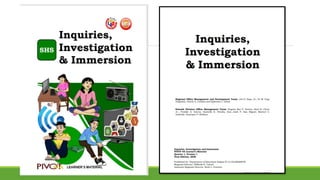
INQUIRIES, INVESTIGATION AND IMMERSION
Pivot 4A Learners’ Material
PREPARED BY:
GERALD O. PANO, SST-II, IREEN MACASAET-MARASIGAN , MT-II, LOIDA O. REYES,
MT-II
SUBJECT TEACHERS
Lesson : Describing Research Design,
Methodology and Preparing the
Instrument (pp32-45)
CONTENT:
IV. Understanding Ways to
Collect Data
LEARNER’S OUTPUT/S:
1. Research Design
2. Population
3. Sampling Method
4. Data Collection Procedure
MELC/S:
The learners are expected to
1. describe adequately the research design
(either quantitative or qualitative), data gathering
instrument, sample, data collection and analysis
procedures, and;
2. Prepare data gathering instrument.
LEARNING OBJECTIVES:
At the end of the lesson, the learners will be able to:
1. Gain better understanding and skills in describing and carrying
out a research design applicable and appropriate for their research.
2. Gain technical orientation in preparing and developing data-
gathering instruments, choosing samples and respondents, and
collecting and analyzing data procedures.
3. Determine the structuring techniques and strategies to solve the
problems and answer your research questions
TOPIC
Describing Research Design,
Methodology, and Preparing
the Instrument
FROM OUR
PREVIOUS
SESSION
INTRODUCTION
Gathering data and information is a serious procedure that
requires organized and systematic structuring and strategies. Just
like how doctors prepare for a major operation, including exact
information about the disease, the processes that needs to be
performed, and the treatment that should be given to patients, a
researcher should also plan things out before the actual conduct of
the research. He should be aware of the specific details about the
entire execution of the research, such as the participants, the
instruments, and how the data will be gathered and treated.
INTRODUCTION
Recall: What are the different research
methods that you have learned in Practical
Research 1 and 2?
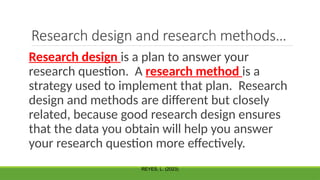
Research design and research methods…
Research design is a plan to answer your
research question. A research method is a
strategy used to implement that plan. Research
design and methods are different but closely
related, because good research design ensures
that the data you obtain will help you answer
your research question more effectively.
REYES, L. (2023)
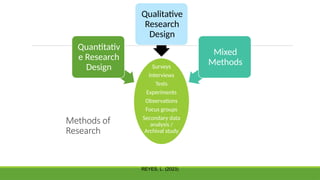
Methods of
Research
REYES, L. (2023)
Surveys
Interviews
Tests
Experiments
Observations
Focus groups
Secondary data
analysis /
Archival study
Quantitativ
e Research
Design
Qualitative
Research
Design
Mixed
Methods
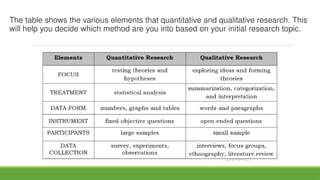
The table shows the various elements that quantitative and qualitative research. This
will help you decide which method are you into based on your initial research topic.
DEVELOPMENT:
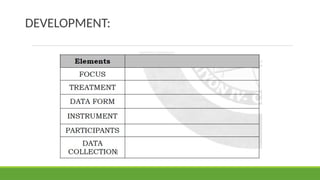
Learning Task 1: Study your initial research
problem. Copy the table on your notebook and
supply the necessary information in each row.
Later on, decide which method of research are
you going to utilize in your study. Then, answer
the questions that follow. Do this in your
notebook.
DEVELOPMENT:
DEVELOPMENT:
Guide Questions: Do this in your notebook.
1. Explain the research method that you chose for your research?
2. Why did you choose such method for your research? Explain its
appropriateness for the course of your study.
3. What specific steps do you anticipate/expect in this research
method?
4. What possible problems/challenges do you look forward to in the
conduct of the method?
5. How will you prevent such problems/challenges to happen? Or if
they happen, what solutions do you intend to do?
DEVELOPMENT:
Research Design
Research design is the process of structuring techniques
and strategies that help researchers solve their problems or
answer their questions (Clemente, Julaton & Orleans, 2016).
Here are some research designs from the University of
Southern California (2020) to ensure that the elements in the
research work are coherent and logical in order to achieve the
answers to the research problems.
RESEARCH DESIGN:
1. Action Research Design - is a collaborative
and adaptive research design that focuses on
socially and solution-driven outcomes. It has the
potential to increase learning from experience.
Action research mostly is applicable in the
teaching-learning process.
RESEARCH DESIGN:
2. Case Study Design - This design is widely
used by social scientists since it aims to examine
contemporary situations that are happening in
real life. This design can provide the bases for
the application of concepts and theories as well
as detailed descriptions of unusual cases.
RESEARCH DESIGN:
3. Causal Design - This design is commonly used
to measure the impact of a particular change on
existing situation or norm. Typically, causal
explanations are sought to reflect on hypotheses
testing. Causal effect happens when difference in
a phenomenon leads to significant results.
RESEARCH DESIGN:
4. Cross-Sectional Design - Cross-sectional
researches are capable of using data from a
large number of subjects as it primarily use
survey techniques to gather data. This design
can only measure differences between or from
among a diverse set of participants, subjects, or
phenomena.
PERFORMANCE TASK
DIFFERENTIATED ACTIVITIES (by group) to be done for 30-40 minutes
1. ACTION RESEARCH DESIGN- Activity: Reflect and Plan
The group should identify a real-life issue within the school or
community that they would like to address through action
research. In 15 minutes, have them discuss the issue, its
significance, and potential solutions. Then, allocate the remaining
15 minutes for the group to outline a simple action plan, including
data collection methods and potential interventions. Encourage
them to think about how they would implement and assess the
effectiveness of their plan.
PERFORMANCE TASK
DIFFERENTIATED ACTIVITIES (by group) to be done for 30-40 minutes
2. CASE STUDY DESIGN- Activity: Analyze a Case Study
Provide the group with a case study related to a particular field or
industry (e.g., a business scenario, medical case, or historical
event). In the first 10 minutes, they should read and familiarize
themselves with the case study. The next 20 minutes should be
used to analyze the case study, identifying key issues, variables, and
potential solutions. Conclude with a brief class discussion where
each group shares their findings and insights.
PERFORMANCE TASK
DIFFERENTIATED ACTIVITIES (by group) to be done for 30-40 minutes
3. CAUSAL DESIGN- Activity: Establish Cause and Effect
Relationships
Select a simple scenario or event and present it to the class. Ask
students to identify potential independent and dependent
variables, and then speculate about the cause-and-effect
relationships between them. In the first 10 minutes, the group
brainstorms, and in the next 20 minutes, they can discuss their
ideas. The activity concludes with a class discussion where each
group shares their hypotheses and the rationale behind them.
PERFORMANCE TASK
DIFFERENTIATED ACTIVITIES (by group) to be done for 30-40 minutes
4. CROSS-SECTIONAL DESIGN- Activity: Survey and Snapshot
In this activity, the group will design a cross-sectional survey. Begin
by presenting a hypothetical research question or topic (e.g.,
student preferences in extracurricular activities). Allocate the first
10 minutes for brainstorming the key questions and variables. In
the next 15 minutes, have each group design a simple survey
instrument. The final 5 minutes can be used for groups to present
their survey questions and discuss the potential strengths and
weaknesses of their approach.
RUBRIC IN GRADING THE PRESENTATION
1. CONTENT (20pts) – the content of the output illustrates the important
aspects of the research design. The content is relevant to the assigned topic.
2. CREATIVITY/RESOURCEFULNESS (20pts) – the output is presented in
such a way that it is comprehensible and interesting to the learners.
3. WILLINGNESS TO USE L2 (20pts)- presenters are willing to use the L2
spontaneously without resorting to plain reading of the script.
4. LEARNERS’ ENGAGEMENT (20pts)- the presenter/s ensure that all the
learners/listeners are engaged in the discussion. It is evident that the
learners/listerners have understood their presentation.
TOTAL – 80 points
GROUP PRESENTATION IS 3-5 MINUTES ONLY
5-ITEM QUIZ
5-ITEM QUIZ
1. Where is Action Research Design most
commonly applied?
a. Agricultural research
b. Clinical trials
c. Space exploration
d. Teaching-learning processes
2. Why is Case Study Design valuable for social
scientists?
a. It allows for broad generalization of findings
b. It emphasizes statistical analyses
c. It provides detailed descriptions of real-life
situations
d. It focuses on theoretical frameworks
3. What is the primary purpose of Causal Design
in research?
a. Measuring the impact of a change on an
existing situation
b. Conducting large-scale surveys
c. Describing historical events
d. Providing detailed insights into real-life
situations
4. What is a key feature of Cross-Sectional
Design in terms of data collection?
a. Focuses on historical events
b. Gathers data from a large number of subjects
using survey techniques
c. Uses experimental manipulation
d. Examines in-depth insights into a single case
5. What is the primary purpose of Research
Design in the research process?
a. To create research problems
b. To structure techniques and strategies for
problem-solving
c. To gather data randomly
d. To establish historical contexts
RESEARCH DESIGN:
5. Descriptive Design - This designs answers the
questions who, what, when, where, and how of a
research problem. However, it could not provide
reasons or exact answers to the question “why”.
It only intends to describe "what exists" in a
situation and its related variables.
RESEARCH DESIGN:
6. Experimental Design - This design involves an
experimental group and a control group wherein the
independent variable is applied to the experimental group
while maintaining the control group. Later, both groups are
measured on the same target dependent variable. It may
require the use of more groups and measurements over
periods of time to validate the results. This is typically done in
the field of medicine and science.
RESEARCH DESIGN:
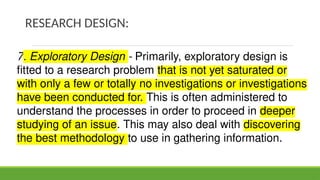
7. Exploratory Design - Primarily, exploratory design is
fitted to a research problem that is not yet saturated or
with only a few or totally no investigations or investigations
have been conducted for. This is often administered to
understand the processes in order to proceed in deeper
studying of an issue. This may also deal with discovering
the best methodology to use in gathering information.
RESEARCH DESIGN:
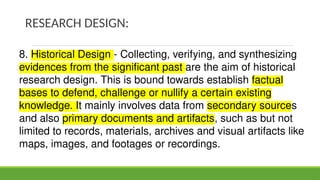
8. Historical Design - Collecting, verifying, and synthesizing
evidences from the significant past are the aim of historical
research design. This is bound towards establish factual
bases to defend, challenge or nullify a certain existing
knowledge. It mainly involves data from secondary sources
and also primary documents and artifacts, such as but not
limited to records, materials, archives and visual artifacts like
maps, images, and footages or recordings.
RESEARCH DESIGN:
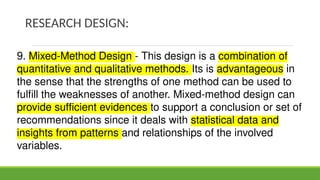
9. Mixed-Method Design - This design is a combination of
quantitative and qualitative methods. Its is advantageous in
the sense that the strengths of one method can be used to
fulfill the weaknesses of another. Mixed-method design can
provide sufficient evidences to support a conclusion or set of
recommendations since it deals with statistical data and
insights from patterns and relationships of the involved
variables.
PERFORMANCE TASK
DIFFERENTIATED ACTIVITIES (by group) to be done for 30-40 minutes
1. Descriptive Design: Activity: Picture This!
Provide the group with a picture or an image. In 10
minutes, ask them to generate a list of descriptive details
about the picture without inferring any meaning.
Afterward, the group presents their findings to the class.
Emphasize the importance of objective observation and
avoiding interpretations.
PERFORMANCE TASK
DIFFERENTIATED ACTIVITIES (by group) to be done for 30-40 minutes
2. Experimental Design: Activity: Design Your Experiment!
Give the group a simple research question (e.g., Does music
improve memory retention?). In 15 minutes, have each
student or group design a simple experiment to test the
hypothesis. They should outline the independent and
dependent variables, the control group, and the
experimental group. Conclude with a brief class discussion
on the diversity of experimental designs created.
PERFORMANCE TASK
DIFFERENTIATED ACTIVITIES (by group) to be done for 30-40 minutes
3. Exploratory Design: Activity: Brainstorming Session
Present the group with a broad topic (e.g., the impact of
technology on daily life). Allow 10 minutes for students to
individually brainstorm various aspects or subtopics related
to the main theme. Then, in small groups, they share their
ideas and discuss potential avenues for exploration.
Encourage creativity and open-ended thinking.
PERFORMANCE TASK
DIFFERENTIATED ACTIVITIES (by group) to be done for 30-40 minutes
4. Historical Design: Activity: "Timeline Exploration"
Provide the group with a list of historical events or a
specific historical period. Ask the group to create a visual
timeline highlighting key events and their chronological
order. Allocate 20 minutes for the timeline creation and 10
minutes for group presentations. Discuss the importance of
organizing historical information chronologically and how
this aligns with the principles of historical research design.
PERFORMANCE TASK
DIFFERENTIATED ACTIVITIES (by group) to be done for 30-40 minutes
5. Mixed-Methods Design: Activity: Survey and Interview Combo
Provide the group with a hypothetical research question (e.g., How
do students experience online learning?). In 15 minutes, have the
group design a mixed-methods approach. They should outline a
survey to gather quantitative data and propose interview questions
for qualitative insights. The activity concludes with a discussion on
the strengths and challenges of combining methods.
RUBRIC IN GRADING THE PRESENTATION
1. CONTENT (20pts) – the content of the output illustrates the important
aspects of the research design. The content is relevant to the assigned topic.
2. CREATIVITY/RESOURCEFULNESS (20pts) – the output is presented in
such a way that it is comprehensible and interesting to the learners.
3. WILLINGNESS TO USE L2 (20pts)- presenters are willing to use the L2
spontaneously without resorting to plain reading of the script.
4. LEARNERS’ ENGAGEMENT (20pts)- the presenter/s ensure that all the
learners/listeners are engaged in the discussion. It is evident that the
learners/listerners have understood their presentation.
TOTAL – 80 points
GROUP PRESENTATION IS 3-5 MINUTES ONLY
5-ITEM formative quiz
1. What is the primary focus of Descriptive Design in
research?
a. Providing reasons and explanations
b. Answering the question "why"
c. Describing "what exists" in a situation
d. Conducting experiments
2. Why is Experimental Design commonly used in
fields like medicine and science?
a. To manipulate variables for a desired outcome
b. To describe characteristics of observed situations
c. To answer questions about "what exists" in a
situation
d. To provide reasons and explanations for
phenomena
3. When is Exploratory Design typically employed in
research?
a. When there is a need for experimental manipulation
b. When a research problem has been extensively studied
c. When the goal is to answer specific questions about
"what exists“
d. When a research problem is not yet saturated or lacks
investigations
4. Which types of sources are commonly used in Historical
Design?
a. Only primary documents and artifacts
b. Only secondary sources and records
c. A mix of primary documents, artifacts, and secondary
sources
d. Only visual artifacts like maps and images
5. Why is Mixed-Method Design advantageous in research?
a. Because it exclusively relies on statistical data
b. Because it can use the strengths of one method to
overcome the weaknesses of another
c. Because it ignores patterns and relationships in variables
d. Because it avoids dealing with conclusions or
recommendations
HOMEWORK
Learning Task 2 (P35) : Read carefully, understand and answer the following
questions. Write your answers on your notebook.
1. Which design are you interested to deal with? Why?
2. Which of these designs is the most appropriate for your initial research interest?
Explain your answer.
3. How do you plan to execute the research design that you chose?
4. Provide a detailed procedure or process on how you will execute the design.
5. What problems do you expect as you carry out the research design in terms of:
a. resources
b. time
6. How will you solve the problems that you anticipate?
TO GOD BE THE GLORY!!!

3Is_Q3_Module_Describing_Research_Design_Methodlogy_and_Preparing_Instrument_PPT1.pptx

  • 1.
    INQUIRIES, INVESTIGATION ANDIMMERSION Pivot 4A Learners’ Material PREPARED BY: GERALD O. PANO, SST-II, IREEN MACASAET-MARASIGAN , MT-II, LOIDA O. REYES, MT-II SUBJECT TEACHERS Lesson : Describing Research Design, Methodology and Preparing the Instrument (pp32-45)
  • 2.
  • 3.
    LEARNER’S OUTPUT/S: 1. ResearchDesign 2. Population 3. Sampling Method 4. Data Collection Procedure
  • 4.
    MELC/S: The learners areexpected to 1. describe adequately the research design (either quantitative or qualitative), data gathering instrument, sample, data collection and analysis procedures, and; 2. Prepare data gathering instrument.
  • 5.
    LEARNING OBJECTIVES: At theend of the lesson, the learners will be able to: 1. Gain better understanding and skills in describing and carrying out a research design applicable and appropriate for their research. 2. Gain technical orientation in preparing and developing data- gathering instruments, choosing samples and respondents, and collecting and analyzing data procedures. 3. Determine the structuring techniques and strategies to solve the problems and answer your research questions
  • 8.
  • 9.
  • 10.
    INTRODUCTION Gathering data andinformation is a serious procedure that requires organized and systematic structuring and strategies. Just like how doctors prepare for a major operation, including exact information about the disease, the processes that needs to be performed, and the treatment that should be given to patients, a researcher should also plan things out before the actual conduct of the research. He should be aware of the specific details about the entire execution of the research, such as the participants, the instruments, and how the data will be gathered and treated.
  • 11.
    INTRODUCTION Recall: What arethe different research methods that you have learned in Practical Research 1 and 2?
  • 12.
    Research design andresearch methods… Research design is a plan to answer your research question. A research method is a strategy used to implement that plan. Research design and methods are different but closely related, because good research design ensures that the data you obtain will help you answer your research question more effectively. REYES, L. (2023)
  • 13.
    Methods of Research REYES, L.(2023) Surveys Interviews Tests Experiments Observations Focus groups Secondary data analysis / Archival study Quantitativ e Research Design Qualitative Research Design Mixed Methods
  • 14.
    The table showsthe various elements that quantitative and qualitative research. This will help you decide which method are you into based on your initial research topic.
  • 15.
    DEVELOPMENT: Learning Task 1:Study your initial research problem. Copy the table on your notebook and supply the necessary information in each row. Later on, decide which method of research are you going to utilize in your study. Then, answer the questions that follow. Do this in your notebook.
  • 16.
  • 17.
    DEVELOPMENT: Guide Questions: Dothis in your notebook. 1. Explain the research method that you chose for your research? 2. Why did you choose such method for your research? Explain its appropriateness for the course of your study. 3. What specific steps do you anticipate/expect in this research method? 4. What possible problems/challenges do you look forward to in the conduct of the method? 5. How will you prevent such problems/challenges to happen? Or if they happen, what solutions do you intend to do?
  • 18.
    DEVELOPMENT: Research Design Research designis the process of structuring techniques and strategies that help researchers solve their problems or answer their questions (Clemente, Julaton & Orleans, 2016). Here are some research designs from the University of Southern California (2020) to ensure that the elements in the research work are coherent and logical in order to achieve the answers to the research problems.
  • 19.
    RESEARCH DESIGN: 1. ActionResearch Design - is a collaborative and adaptive research design that focuses on socially and solution-driven outcomes. It has the potential to increase learning from experience. Action research mostly is applicable in the teaching-learning process.
  • 20.
    RESEARCH DESIGN: 2. CaseStudy Design - This design is widely used by social scientists since it aims to examine contemporary situations that are happening in real life. This design can provide the bases for the application of concepts and theories as well as detailed descriptions of unusual cases.
  • 21.
    RESEARCH DESIGN: 3. CausalDesign - This design is commonly used to measure the impact of a particular change on existing situation or norm. Typically, causal explanations are sought to reflect on hypotheses testing. Causal effect happens when difference in a phenomenon leads to significant results.
  • 22.
    RESEARCH DESIGN: 4. Cross-SectionalDesign - Cross-sectional researches are capable of using data from a large number of subjects as it primarily use survey techniques to gather data. This design can only measure differences between or from among a diverse set of participants, subjects, or phenomena.
  • 23.
    PERFORMANCE TASK DIFFERENTIATED ACTIVITIES(by group) to be done for 30-40 minutes 1. ACTION RESEARCH DESIGN- Activity: Reflect and Plan The group should identify a real-life issue within the school or community that they would like to address through action research. In 15 minutes, have them discuss the issue, its significance, and potential solutions. Then, allocate the remaining 15 minutes for the group to outline a simple action plan, including data collection methods and potential interventions. Encourage them to think about how they would implement and assess the effectiveness of their plan.
  • 24.
    PERFORMANCE TASK DIFFERENTIATED ACTIVITIES(by group) to be done for 30-40 minutes 2. CASE STUDY DESIGN- Activity: Analyze a Case Study Provide the group with a case study related to a particular field or industry (e.g., a business scenario, medical case, or historical event). In the first 10 minutes, they should read and familiarize themselves with the case study. The next 20 minutes should be used to analyze the case study, identifying key issues, variables, and potential solutions. Conclude with a brief class discussion where each group shares their findings and insights.
  • 25.
    PERFORMANCE TASK DIFFERENTIATED ACTIVITIES(by group) to be done for 30-40 minutes 3. CAUSAL DESIGN- Activity: Establish Cause and Effect Relationships Select a simple scenario or event and present it to the class. Ask students to identify potential independent and dependent variables, and then speculate about the cause-and-effect relationships between them. In the first 10 minutes, the group brainstorms, and in the next 20 minutes, they can discuss their ideas. The activity concludes with a class discussion where each group shares their hypotheses and the rationale behind them.
  • 26.
    PERFORMANCE TASK DIFFERENTIATED ACTIVITIES(by group) to be done for 30-40 minutes 4. CROSS-SECTIONAL DESIGN- Activity: Survey and Snapshot In this activity, the group will design a cross-sectional survey. Begin by presenting a hypothetical research question or topic (e.g., student preferences in extracurricular activities). Allocate the first 10 minutes for brainstorming the key questions and variables. In the next 15 minutes, have each group design a simple survey instrument. The final 5 minutes can be used for groups to present their survey questions and discuss the potential strengths and weaknesses of their approach.
  • 27.
    RUBRIC IN GRADINGTHE PRESENTATION 1. CONTENT (20pts) – the content of the output illustrates the important aspects of the research design. The content is relevant to the assigned topic. 2. CREATIVITY/RESOURCEFULNESS (20pts) – the output is presented in such a way that it is comprehensible and interesting to the learners. 3. WILLINGNESS TO USE L2 (20pts)- presenters are willing to use the L2 spontaneously without resorting to plain reading of the script. 4. LEARNERS’ ENGAGEMENT (20pts)- the presenter/s ensure that all the learners/listeners are engaged in the discussion. It is evident that the learners/listerners have understood their presentation. TOTAL – 80 points GROUP PRESENTATION IS 3-5 MINUTES ONLY
  • 28.
  • 29.
    5-ITEM QUIZ 1. Whereis Action Research Design most commonly applied? a. Agricultural research b. Clinical trials c. Space exploration d. Teaching-learning processes
  • 30.
    2. Why isCase Study Design valuable for social scientists? a. It allows for broad generalization of findings b. It emphasizes statistical analyses c. It provides detailed descriptions of real-life situations d. It focuses on theoretical frameworks
  • 31.
    3. What isthe primary purpose of Causal Design in research? a. Measuring the impact of a change on an existing situation b. Conducting large-scale surveys c. Describing historical events d. Providing detailed insights into real-life situations
  • 32.
    4. What isa key feature of Cross-Sectional Design in terms of data collection? a. Focuses on historical events b. Gathers data from a large number of subjects using survey techniques c. Uses experimental manipulation d. Examines in-depth insights into a single case
  • 33.
    5. What isthe primary purpose of Research Design in the research process? a. To create research problems b. To structure techniques and strategies for problem-solving c. To gather data randomly d. To establish historical contexts
  • 34.
    RESEARCH DESIGN: 5. DescriptiveDesign - This designs answers the questions who, what, when, where, and how of a research problem. However, it could not provide reasons or exact answers to the question “why”. It only intends to describe "what exists" in a situation and its related variables.
  • 35.
    RESEARCH DESIGN: 6. ExperimentalDesign - This design involves an experimental group and a control group wherein the independent variable is applied to the experimental group while maintaining the control group. Later, both groups are measured on the same target dependent variable. It may require the use of more groups and measurements over periods of time to validate the results. This is typically done in the field of medicine and science.
  • 36.
    RESEARCH DESIGN: 7. ExploratoryDesign - Primarily, exploratory design is fitted to a research problem that is not yet saturated or with only a few or totally no investigations or investigations have been conducted for. This is often administered to understand the processes in order to proceed in deeper studying of an issue. This may also deal with discovering the best methodology to use in gathering information.
  • 37.
    RESEARCH DESIGN: 8. HistoricalDesign - Collecting, verifying, and synthesizing evidences from the significant past are the aim of historical research design. This is bound towards establish factual bases to defend, challenge or nullify a certain existing knowledge. It mainly involves data from secondary sources and also primary documents and artifacts, such as but not limited to records, materials, archives and visual artifacts like maps, images, and footages or recordings.
  • 38.
    RESEARCH DESIGN: 9. Mixed-MethodDesign - This design is a combination of quantitative and qualitative methods. Its is advantageous in the sense that the strengths of one method can be used to fulfill the weaknesses of another. Mixed-method design can provide sufficient evidences to support a conclusion or set of recommendations since it deals with statistical data and insights from patterns and relationships of the involved variables.
  • 39.
    PERFORMANCE TASK DIFFERENTIATED ACTIVITIES(by group) to be done for 30-40 minutes 1. Descriptive Design: Activity: Picture This! Provide the group with a picture or an image. In 10 minutes, ask them to generate a list of descriptive details about the picture without inferring any meaning. Afterward, the group presents their findings to the class. Emphasize the importance of objective observation and avoiding interpretations.
  • 40.
    PERFORMANCE TASK DIFFERENTIATED ACTIVITIES(by group) to be done for 30-40 minutes 2. Experimental Design: Activity: Design Your Experiment! Give the group a simple research question (e.g., Does music improve memory retention?). In 15 minutes, have each student or group design a simple experiment to test the hypothesis. They should outline the independent and dependent variables, the control group, and the experimental group. Conclude with a brief class discussion on the diversity of experimental designs created.
  • 41.
    PERFORMANCE TASK DIFFERENTIATED ACTIVITIES(by group) to be done for 30-40 minutes 3. Exploratory Design: Activity: Brainstorming Session Present the group with a broad topic (e.g., the impact of technology on daily life). Allow 10 minutes for students to individually brainstorm various aspects or subtopics related to the main theme. Then, in small groups, they share their ideas and discuss potential avenues for exploration. Encourage creativity and open-ended thinking.
  • 42.
    PERFORMANCE TASK DIFFERENTIATED ACTIVITIES(by group) to be done for 30-40 minutes 4. Historical Design: Activity: "Timeline Exploration" Provide the group with a list of historical events or a specific historical period. Ask the group to create a visual timeline highlighting key events and their chronological order. Allocate 20 minutes for the timeline creation and 10 minutes for group presentations. Discuss the importance of organizing historical information chronologically and how this aligns with the principles of historical research design.
  • 43.
    PERFORMANCE TASK DIFFERENTIATED ACTIVITIES(by group) to be done for 30-40 minutes 5. Mixed-Methods Design: Activity: Survey and Interview Combo Provide the group with a hypothetical research question (e.g., How do students experience online learning?). In 15 minutes, have the group design a mixed-methods approach. They should outline a survey to gather quantitative data and propose interview questions for qualitative insights. The activity concludes with a discussion on the strengths and challenges of combining methods.
  • 44.
    RUBRIC IN GRADINGTHE PRESENTATION 1. CONTENT (20pts) – the content of the output illustrates the important aspects of the research design. The content is relevant to the assigned topic. 2. CREATIVITY/RESOURCEFULNESS (20pts) – the output is presented in such a way that it is comprehensible and interesting to the learners. 3. WILLINGNESS TO USE L2 (20pts)- presenters are willing to use the L2 spontaneously without resorting to plain reading of the script. 4. LEARNERS’ ENGAGEMENT (20pts)- the presenter/s ensure that all the learners/listeners are engaged in the discussion. It is evident that the learners/listerners have understood their presentation. TOTAL – 80 points GROUP PRESENTATION IS 3-5 MINUTES ONLY
  • 45.
    5-ITEM formative quiz 1.What is the primary focus of Descriptive Design in research? a. Providing reasons and explanations b. Answering the question "why" c. Describing "what exists" in a situation d. Conducting experiments
  • 46.
    2. Why isExperimental Design commonly used in fields like medicine and science? a. To manipulate variables for a desired outcome b. To describe characteristics of observed situations c. To answer questions about "what exists" in a situation d. To provide reasons and explanations for phenomena
  • 47.
    3. When isExploratory Design typically employed in research? a. When there is a need for experimental manipulation b. When a research problem has been extensively studied c. When the goal is to answer specific questions about "what exists“ d. When a research problem is not yet saturated or lacks investigations
  • 48.
    4. Which typesof sources are commonly used in Historical Design? a. Only primary documents and artifacts b. Only secondary sources and records c. A mix of primary documents, artifacts, and secondary sources d. Only visual artifacts like maps and images
  • 49.
    5. Why isMixed-Method Design advantageous in research? a. Because it exclusively relies on statistical data b. Because it can use the strengths of one method to overcome the weaknesses of another c. Because it ignores patterns and relationships in variables d. Because it avoids dealing with conclusions or recommendations
  • 50.
    HOMEWORK Learning Task 2(P35) : Read carefully, understand and answer the following questions. Write your answers on your notebook. 1. Which design are you interested to deal with? Why? 2. Which of these designs is the most appropriate for your initial research interest? Explain your answer. 3. How do you plan to execute the research design that you chose? 4. Provide a detailed procedure or process on how you will execute the design. 5. What problems do you expect as you carry out the research design in terms of: a. resources b. time 6. How will you solve the problems that you anticipate?
  • 52.
    TO GOD BETHE GLORY!!!

Editor's Notes