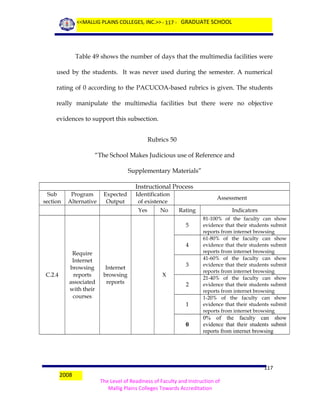
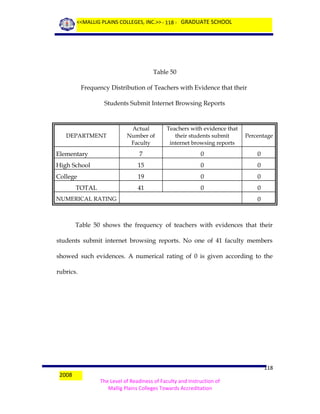
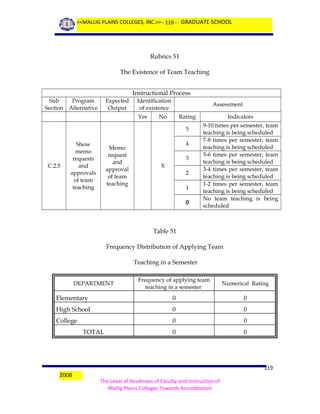
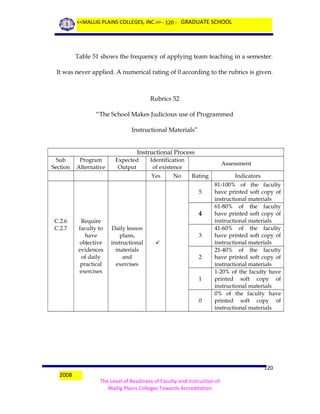
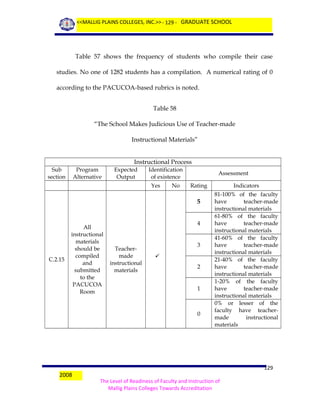
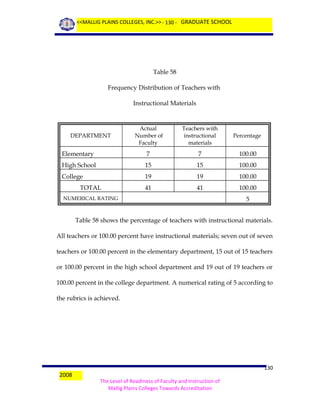
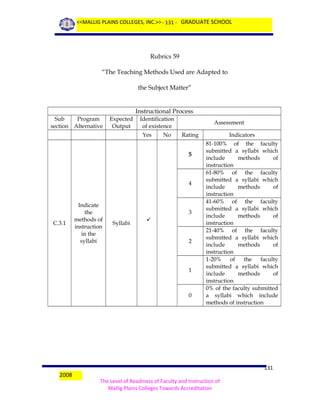
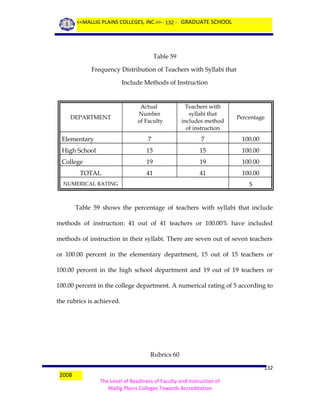
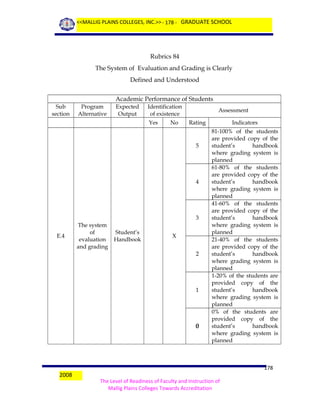
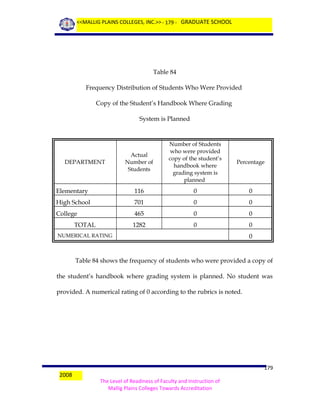
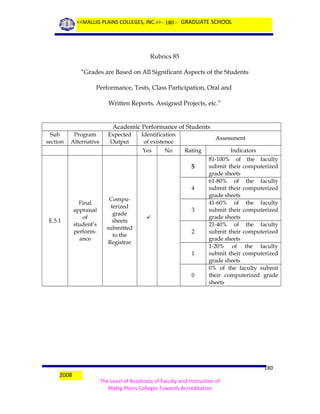
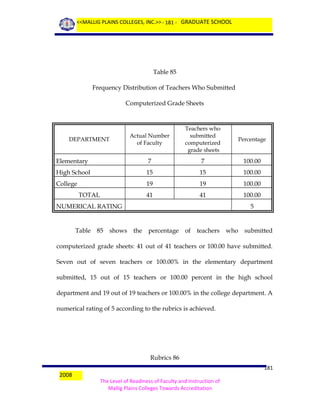
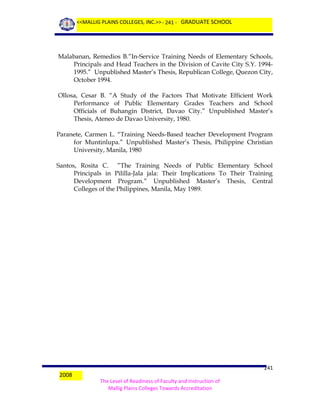
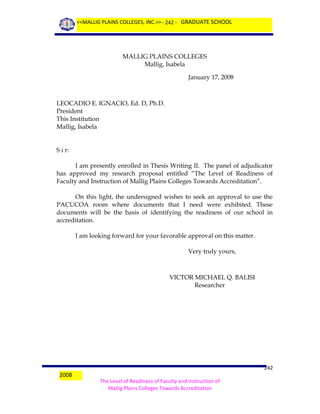
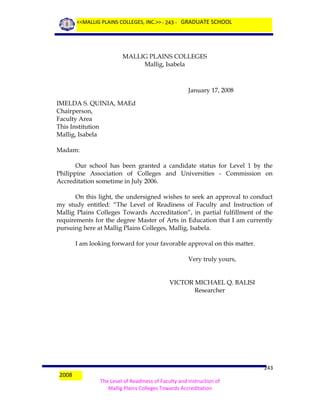
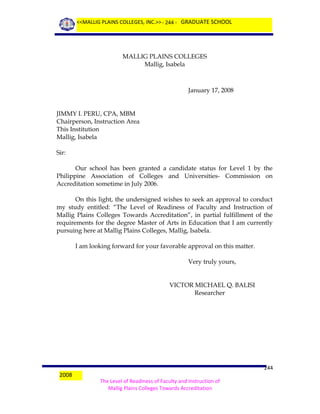
<<MALLIG PLAINS COLLEGES, INC.>> - 1 -

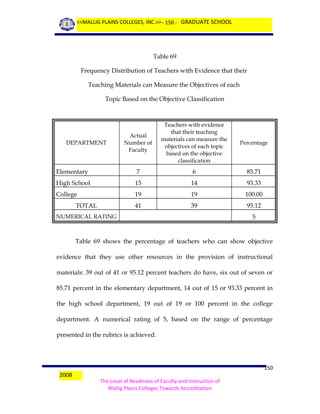
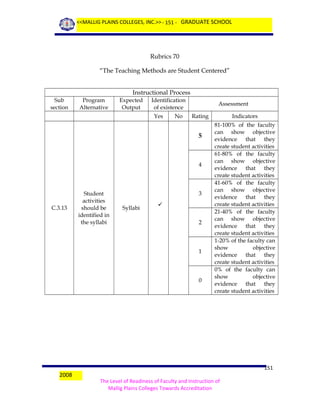
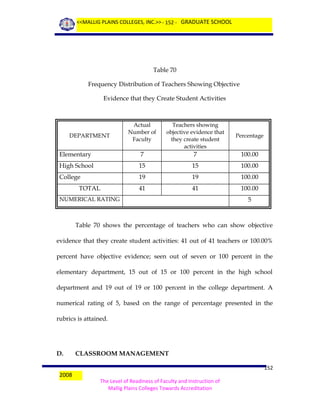
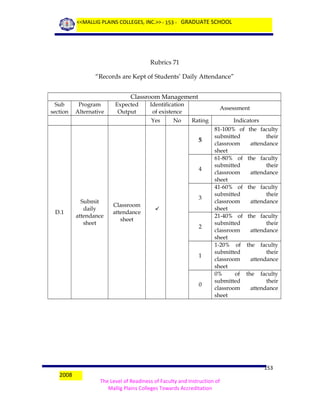
GRADUATE SCHOOL

Chapter 1
THE PROBLEM AND ITS BACKGROUND
Introduction
Every school dreams to be transformed with a better atmosphere
which will open its gate to learners who will soon be the leaders of change.
The learners will spearhead innovations into different fields of endeavor. The
educational setting in our country today seems like a zooming jet in the sky
that keeps on accelerating until it reaches its maximum speed. The
educational struggle of every learner becomes even more complex this time
because of the standards set by different accrediting agencies in pursuit of
quality education which will serve as the gatepass of learners in creating a
formidable image towards global competitiveness.
Accreditation is the formal recognition of an educational program that
possesses high level of quality or excellence based on the analysis of the
merits of its educational operations in attaining its objectives and its role in
the community that it serves.
In 1970, The Presidential Commission to Survey Philippine Education
(PCSPE) submitted the policy recommendation to improve and strengthen
higher education. One of the recommendations encourages schools to join or
2008

1
The Level of Readiness of Faculty and Instruction of
Mallig Plains Colleges Towards Accreditation
<<MALLIG PLAINS COLLEGES, INC.>> - 2 -

GRADUATE SCHOOL

organize accrediting agencies and that a federation of accreditation agencies
be established. This recommendation was referred to as the Integrated
Reorganization Plan (IRP). Presidential Decree No. 1 approved and adopted
the IRP. Presidential Decree No. 1 and PD No. 1200 (NEDA Five-Year Plan)
both provided that the accreditation program shall be one of the strategies to
achieve educational and manpower development goals1.
Different colleges in the country exert a lot of efforts to be able to
acquire an accreditation status. Undergoing the process requires a lot of
undertakings since there are guidelines and indicators to be complied with to
quality accreditation. The nine areas identified as the qualifying criteria for
accreditation are: Purposes and Objectives, Faculty, Instruction, Library,
Laboratories, Physical Plant and Facilities, Student-Personnel Services, Social
Orientation

and

Community

Involvement

and

Organization

and

Administration. These are set by the Philippine Association of Colleges and
Universities Commission on Accreditation (PACUCOA).
Faculty and Instruction are definitely the key factors in achieving
quality education, obviously since the two factors speak of the performance
and qualifications of teachers and the quality of instruction given by them.

1

Manual of Accreditation, Philippine Association of Colleges and Universities
Commission on Accreditation.

2008

2
The Level of Readiness of Faculty and Instruction of
Mallig Plains Colleges Towards Accreditation
<<MALLIG PLAINS COLLEGES, INC.>> - 3 -

GRADUATE SCHOOL

These two impalpable dimensions in a school should be given utmost regard
because the academic reputation of the institution depends on them.
Faculty, as one of the major concerns in the academe, makes the school
function. In every organization, human resources come first as a priority,
precisely because if there are no teachers in the school, there would be no
stewards of learning who transform learners into responsible citizens. An
individual who works for an organization or institution is normally evaluated
by his superior on the basis of at least four phases. These four phases are
effectiveness, productivity, efficiency and character. If the job performance of
an individual is rated high in any one or all of the four dimensions, the
institution is expected to recognize the individual by means of either intrinsic
or extrinsic rewards, or both.
Instruction, on the other hand, is the instrument for metamorphosis of
the teachers. In simple language, it speaks of the effectiveness of both the
administrators and faculty members. Definitely, when the teachers desire to
uplift the performance of the students, they should be aware of the tools that
contribute to quality of instruction. This will motivate the learners in their
pursuit of excellence.
Instruction plays a vital role with regards to instructional competence
of teachers. The methods used in teaching are employed with a view of
2008

3
The Level of Readiness of Faculty and Instruction of
Mallig Plains Colleges Towards Accreditation
<<MALLIG PLAINS COLLEGES, INC.>> - 4 -

GRADUATE SCHOOL

guiding the students’ self-realization through the development of their
analytical and critical thinking.

These methods are adapted to subject

matters, situational needs and individual differences. A variety of
instructional procedures are to be expected too, such as lecture, team teaching
and group dynamics. The school should make use of a number of teaching
devices

such

as

audio-visual

aids

and

modern

information

and

communications technology to cope with highly sophisticated gadgets. 2
With a certificate of appreciation awarded by PACU, Mallig Plains
Colleges was recently dubbed as the Most Improved College in Cagayan
Valley. Like any other institution, it carries and promotes its philosophy,
mission, vision, objectives and core values. Mallig Plains Colleges is proud of
its existence and envisions continuing its delivery of quality education to its
learners. The administration, faculty and staff exert more effort to come up
with a worthy aspiration—to be a center of academic excellence in Region 2
and in the country at large.
MPC has 59 teaching personnel. This covers the basic education
teachers, instructors and professors. Expectedly it should have a pool of
competent teachers, not to mention, with talents and skills.

2

Rubelyn Lizardo, ‘The Instructional Competencies
(Unpublished Master’s Thesis, MPC, Isabela, March 2000).

2008

of

Teachers

in

WIPC,”

4
The Level of Readiness of Faculty and Instruction of
Mallig Plains Colleges Towards Accreditation
<<MALLIG PLAINS COLLEGES, INC.>> - 5 -

GRADUATE SCHOOL

In addition, the institution should have several comprehensive,
accurate and up-to-date instructional materials present in the school to give
platforms to the students to foray into a well designed and sound education
process.
It is for this reason that the researcher has embarked on an assessment
of the Faculty and Instruction readiness of Mallig Plains Colleges towards
Accreditation. Identifying the criteria and indicators would be an initial step
to decipher the actual standing of two areas in relation to accreditation. The
findings will be beneficial for administrators and faculty members since these
will be an immense reference point in discovering the strengths and
weaknesses of both faculty and instruction. If these will emerge as the good
points for accreditation, then the institution as a whole shall cherish and
continue questing for excellence.
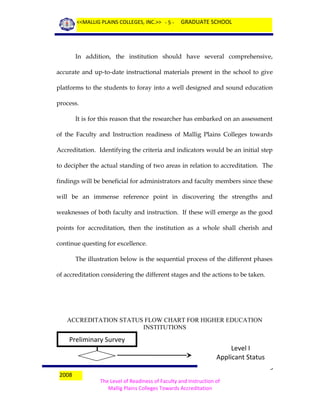
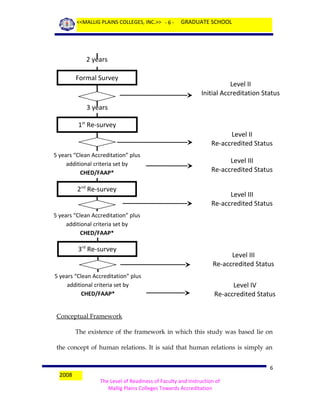
The illustration below is the sequential process of the different phases
of accreditation considering the different stages and the actions to be taken.

ACCREDITATION STATUS FLOW CHART FOR HIGHER EDUCATION
INSTITUTIONS

Preliminary Survey

2008

Level I
Applicant Status
5

The Level of Readiness of Faculty and Instruction of
Mallig Plains Colleges Towards Accreditation
<<MALLIG PLAINS COLLEGES, INC.>> - 6 -

GRADUATE SCHOOL

2 years
Formal Survey

Level II
Initial Accreditation Status

3 years
1st Re-survey
Level II
Re-accredited Status
5 years “Clean Accreditation” plus
additional criteria set by
CHED/FAAP*

2nd Re-survey

Level III
Re-accredited Status
Level III
Re-accredited Status

5 years “Clean Accreditation” plus
additional criteria set by
CHED/FAAP*

3rd Re-survey

5 years “Clean Accreditation” plus
additional criteria set
Conceptual Framework by
CHED/FAAP*

Level III
Re-accredited Status
Level IV
Re-accredited Status

Conceptual Framework
The existence of the framework in which this study was based lie on
the concept of human relations. It is said that human relations is simply an

2008

6
The Level of Readiness of Faculty and Instruction of
Mallig Plains Colleges Towards Accreditation
<<MALLIG PLAINS COLLEGES, INC.>> - 7 -

GRADUATE SCHOOL

interaction among people. In the context of an organization, human relation is
the interaction among employers and their employees, and employees among
co-workers, and in most cases among clients. The relationship maybe among
individuals, among groups or in organization at large. Lussier 3 opines that
the goal of human relations is to create a “win-win” situation by satisfying
employee needs while achieving organizational objectives. A win-win
situation according to Lussier, occurs when the organization and employees
get what they want. In some instances, Labor group sometimes express their
grievances because they feel and observe that organizations exploit their
employees, and that they are often perceived to be profit-focused. In this case,
the organization wins and employees lose. In other situations, employees go
slowly on their productivity because of the organizations rigidity or stringent
policies. This particular event causes the employees to win, and a loss for the
organization.
In the context of this study therefore, an organization is expected to
exercise fair treatment and practices. A win-win situation is a state whereby
harmonious and smooth interpersonal relationship is central to the
organization’s management principles. Being aware of what an employee
needs, and providing these needs will motivate the workers to work with
Robert N. Lussier, Human Relations: A Skills Building Approach, 2nd ed. (U.S.A:
Irwing Publishing, Co;,1989.), pp. 4-7.
3

2008

7
The Level of Readiness of Faculty and Instruction of
Mallig Plains Colleges Towards Accreditation
<<MALLIG PLAINS COLLEGES, INC.>> - 8 -

GRADUATE SCHOOL

efficiency and productivity. It is believed that organizations are responsible
for the behavior of its employees. Success, peace and goodwill inside and
within the organization will depend on the human relations exhibited inside
the organization.
In the light of this undertaking, the researcher intended to scrutinize
the real stand of faculty and instruction in response to the standards set by
PACUCOA.

It helped the researcher determine the extent to which these

needs are wanted. Awareness of the real stand of Faculty and Instruction will
allow the administration to formulate programs that will contribute to their
career growth and development.

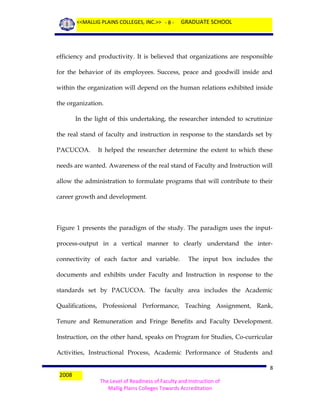
Figure 1 presents the paradigm of the study. The paradigm uses the inputprocess-output in a vertical manner to clearly understand the interconnectivity of each factor and variable.

The input box includes the

documents and exhibits under Faculty and Instruction in response to the
standards set by PACUCOA. The faculty area includes the Academic
Qualifications, Professional Performance, Teaching Assignment, Rank,
Tenure and Remuneration and Fringe Benefits and Faculty Development.
Instruction, on the other hand, speaks on Program for Studies, Co-curricular
Activities, Instructional Process, Academic Performance of Students and
2008

8
The Level of Readiness of Faculty and Instruction of
Mallig Plains Colleges Towards Accreditation
<<MALLIG PLAINS COLLEGES, INC.>> - 9 -

GRADUATE SCHOOL

Administrative measures for Effective Instruction. The process box contains
the Comparative Analysis of the Faculty and Instruction of Mallig Plains
Colleges vis-a-vis the Criteria set by PACUCOA. The output expects an
objective assessment of the level of readiness of Faculty and Instruction for
Accreditation.

2008

9
The Level of Readiness of Faculty and Instruction of
Mallig Plains Colleges Towards Accreditation
<<MALLIG PLAINS COLLEGES, INC.>> - 10 - GRADUATE SCHOOL

Figure 1
RESEARCH PARADIGM
INPUT

PROCESS

Documents
Exhibits under Faculty and
Instruction in response to
the standards set by
PACUCOA
Rating of the following areas
based on rubrics
Faculty
Academic
qualifications
Professional
Performance
Teaching Assignment
Rank, Tenure and
Remuneration and
Fringe Benefits
Faculty Development
Instruction
Program for Studies
Co-curricular
activities
Instructional Process
Classroom
Management
Academic
Performance of
Students
Administrative
Measures for
Effective
Instruction

OUTPUT

Analysis of the Status
of the Faculty and
Instruction of Mallig
Plains Colleges

An Objective
Assessment of the
Level of Readiness of

Vis-a-vis

Faculty and

Criteria set by
PACUCOA

Instruction for
Accreditation

FEEDBACK MECHANISM

2008

10
The Level of Readiness of Faculty and Instruction of
Mallig Plains Colleges Towards Accreditation
<<MALLIG PLAINS COLLEGES, INC.>> - 11 - GRADUATE SCHOOL

Statement of the Problem
The study sought to identify The Level of Readiness of Faculty and
Instruction of Mallig Plains Colleges Towards Accreditation.
Specifically, it addressed issues that concern:
1. Faculty
a. Academic qualifications
b. Professional Performance
c. Teaching Assignment
d. Rank, Tenure, Remuneration and Fringe Benefits
e. Faculty Development
2. Instruction
a. Program of Studies
b. Co-curricular Activities
c. Instructional Process
d. Classroom management
e. Academic Performance of Students
f. Administrative Measures for Effective Instruction

2008

11
The Level of Readiness of Faculty and Instruction of
Mallig Plains Colleges Towards Accreditation
<<MALLIG PLAINS COLLEGES, INC.>> - 12 - GRADUATE SCHOOL

Significance of the Study
The study is perceived to be of significance and relevance to the
following:
Policy-Making Body/School Administrators. Through the study, the
school administrators will be able to identify the level of readiness of faculty
and instruction. The result of this study will help the administrators to
develop ideas to improve skills of staff for better performance.
Faculty. With the findings of this study, the faculty members will be
guided with the most comprehensive and accurate methods, techniques,
styles and approaches to use in the teaching-learning process.
Students. The students through the result of this study will be
provided with the best instruction to become well guided learners in their
psychomotor, affective and cognitive phases.
Researcher. The researcher being a member of the Mallig Plains
Colleges Family maybe able to identify the level of readiness of faculty and
instruction and therefore be able to address issues in a proper manner.
Furthermore, he may be able to suggest ways to improve the deficiencies of
the employees and further assist them to develop their strengths in order to
provide quality performance in their respective fields.

2008

12
The Level of Readiness of Faculty and Instruction of
Mallig Plains Colleges Towards Accreditation
<<MALLIG PLAINS COLLEGES, INC.>> - 13 - GRADUATE SCHOOL

Future Researchers. The study may serve as a frame of reference for
researchers who would like to dwell on investigating similar institutional
situations in the academic field.
Scope and Delimitation
The study focused mainly on the level of readiness of Faculty and
Instruction of Mallig Plains Colleges towards Accreditation.
This included an analytical assessment of some factors that affect
Faculty, such as: Academic Qualifications, Professional Performance,
Teaching Assignments, Rank, Tenure, Remuneration and Fringe Benefits and
Faculty Development.
Instruction analysis covered different factors such as: Program of
Studies,

Co-curricular

Activities,

Instructional

Process,

Classroom

Management, Academic Performance of Students and Administrative
Measures for Effective Instruction.
Definition of Terms
The terms used in this study are operationally defined for better
understanding of the study by the readers.
Academic Qualification. This refers to the highest degree obtained by
the faculty members.
2008

13
The Level of Readiness of Faculty and Instruction of
Mallig Plains Colleges Towards Accreditation
<<MALLIG PLAINS COLLEGES, INC.>> - 14 - GRADUATE SCHOOL

Academic Performance. This refers to the performance made by the
faculty members based on the standards set by Institutional Committee on
performance appraisal.
Academic Rank. This specifies the designation of the faculty member
as Professor I,II, III, IV and V, Associate Professor I, II, III, IV and V, Assistant
Professor I, II, III, IV and V and Instructor I, II and III in the tertiary level. For
basic education, this specifies whether one is a Senior Teacher I, II and III and
Junior Teacher I, II and III.
Accreditation. It is a process towards achieving formal recognition of
an educational program as possessing high level of quality or excellence
based on the analysis of the merits of its educational operations in attaining
its objectives and its role in the community that it serves by an accrediting
authority.
Administrators. These are school authorities who take care of the
implementation of an institution’s standards.
Character.

It

pertains

to

the

teacher’s

attitude, behavior and values.
Commission on Higher Education (CHED). This is a governmentcreated educational agency which monitors and supervises Higher Education

2008

14
The Level of Readiness of Faculty and Instruction of
Mallig Plains Colleges Towards Accreditation
<<MALLIG PLAINS COLLEGES, INC.>> - 15 - GRADUATE SCHOOL

Institutions to ensure that they are follow the established standards of
Philippine Higher Education Institutions (PHEI’s).
Classroom Management. This pertains to the proper administration
and management of classroom activities by the faculty members in holding
their classes.
Competence. This refers to someone’s capabilities, skills, abilities and
aptitude for any undertaking.
Co-Curricular Activities. These are activities related to different
subjects. These are considered supplementary to learning because these
provide avenues for the learners to be exposed in response with the
application of the theories and principles discussed by teachers.
Effectiveness. A term for accomplishing work in an earlier expected
time with minimal flaws.
Efficiency. It as a term for finishing work with an outstanding output
and in an earlier possible time.
Faculty. This refers to the professionally-trained and licensed persons
who are teaching academic subjects in a school.
Faculty Development. This pertains to the activities planned and
implemented by the school administration for the upgrading and acceleration
of the faculty members towards quality academic performance.
2008

15
The Level of Readiness of Faculty and Instruction of
Mallig Plains Colleges Towards Accreditation
<<MALLIG PLAINS COLLEGES, INC.>> - 16 - GRADUATE SCHOOL

Fringe benefits. This refers to an employee’s personal benefits received
in addition to wage or salary.
Instructional Process. This pertains to the entire methodology used in
imparting instruction which are employed with a view to guiding the
student’s self-realization through the development of the students’ analytical
and critical judgment.
Instruction. A process of emphasizing a mission to provide leadership,
service and support for the development and implementation of a researchbased curriculum to ensure that all learners achieve at high levels.
Management. It is partly an art and partly a science. This recognizes
the innovative, intuitive and subjective skills that lead towards success of
every endeavor taken.
PACUCOA. Philippine Association of Colleges and Universities –
Commission on Accreditation. It is an agency which assesses an institution’s
performance using a set of standards and requirements.
Productivity. It pertains to someone’s efficiency, effectiveness and
proficiency.
Professional Performance. It refers to performance revealed by the
faculty in administering and holding classes and addressing the problems
that exist.
2008

16
The Level of Readiness of Faculty and Instruction of
Mallig Plains Colleges Towards Accreditation
<<MALLIG PLAINS COLLEGES, INC.>> - 17 - GRADUATE SCHOOL

Program of Studies. It is a plan of education with clear cut academic
goals for regional and national development and for practical experience
directly related to the professional role for which the students are being
prepared.
Readiness. It refers to the numerical score that MPC must have in
response to the standards set by PACUCOA. MPC must have a rating of 90%
in order to achieve level 1 status, based on the standardized transmutation
table of average and rating.
Remuneration. It pertains to the pay for service rendered.
Rubrics. A measuring tool with empirical basis. It is made more
credible to rate a certain endeavor since every action has a counterpart based
on a designed scale and range.
Teaching Assignment. This presents the matrix of subjects to be taught
by the faculty members.
Tenure. The time frame or period where a certain employee has
rendered service.
Training. It refers to the seminars, conferences and workshops
attended by faculty members to increase professional efficiencies and skills.

2008

17
The Level of Readiness of Faculty and Instruction of
Mallig Plains Colleges Towards Accreditation
<<MALLIG PLAINS COLLEGES, INC.>> - 18 - GRADUATE SCHOOL

Chapter 2
REVIEW OF RELATED LITERATURE
AND STUDIES
This chapter includes summaries and cited works from both local and
foreign researches on Instructional Competencies of teachers. The researcher
perceived the findings of various authors appropriate and relevant in the
study about the Faculty and Instruction findings in response to the standards
set by PACUCOA.
Related Literature
Foreign:
One of the most important and necessary factors in the academic
system is the human resource. For this, it is the duty of the administration to
hire qualified and competent faculty who will spearhead effective learning
transmission.

2008

18
The Level of Readiness of Faculty and Instruction of
Mallig Plains Colleges Towards Accreditation
<<MALLIG PLAINS COLLEGES, INC.>> - 19 - GRADUATE SCHOOL

Katz4 identified administrative and supervisory skills as conceptual,
technical, and human skills in order to carry out effectively the duties and
responsibility of a principal. These skills are further described by Hersey and
Blanchard5 as follows:
Technical skill is the ability to use knowledge, methods, techniques
and equipments necessary for the performance of specific tasks acquired from
experience education and training. Human skills, on the other hand, are the
ability and judgment in working with and through people including an
understanding of motivation and an application of effective leadership. The
ability to understand the complexities of the over-all organization is referred
to as conceptual skills. This knowledge permits one to act according to the
objectives of the total organization rather than only on the basis of the goals
and needs of one’s immediate group.
The conceptual skills include the setting of goals, objectives and targets
of the school, development of organization, coordinating and integrating all
the organizational interests and activities of the school, solving problems at
the shortest possible time, recognizing and analyzing school problems,

Robert L. Katz, “Skills of an Effective Administrator,” Harvard Business Review, Vol.
33, No. 1(Jan-Feb. 1995), pp. 34-42.
4

Hersey and Blanchard K., Management of Organization Behavior, 2nd edition (New
Jersey: Prentice-Hall, Inc.), p. 19.
5

2008

19
The Level of Readiness of Faculty and Instruction of
Mallig Plains Colleges Towards Accreditation
<<MALLIG PLAINS COLLEGES, INC.>> - 20 - GRADUATE SCHOOL

participation of social, civic and cultural activities and cooperation in the
implementation.
Lawler6 explains that employees prefer offices, which have suitable
working conditions such as good heating, illumination, ventilation and
isolation. At the same time, the implication of salary on job satisfaction had
been proved. However, the employee should believe that he deserves the pay
for job satisfaction based on salary. He also emphasized that high degree of
job satisfaction is related to colleagues. He stated that: “harmony, in small
working teams increases job satisfaction but incompatible employees cause
dissatisfaction at the office.”
Mc Gehee and Thayer7 defined training as the formal procedure which
a company utilizes to facilitate learning so that the resultant behavior
contributes to the attainment of the company’s goals and objectives. The
definition implies that training is only one of the tools used by management
to enhance organizational efficiency. There are various human resource
functions which are utilized by organizations to be productive and effective.
They are as follows:
1. Salary and Benefit Administration
Lawler,
E.E.
A
http//www.pdffactory.com
6

Journal

on

Pay:

An

Organization

Development.

W. Mc Gehee and P.W. Thayer, Training in Business and Industry (New York: J.
Wiley and Sons).
7

2008

20
The Level of Readiness of Faculty and Instruction of
Mallig Plains Colleges Towards Accreditation
<<MALLIG PLAINS COLLEGES, INC.>> - 21 - GRADUATE SCHOOL

Salary and Benefit administration is the function of the
personnel involved in seeing to it that employees are compensated
fairly and they are receiving the wages and other benefits intended
to motivate and maintain them.
A training program like orientation or induction program is
the best avenue where newly-hired employees are told of their
basic salary, the probability of overtime and its corresponding pay,
and fringe benefits that the company gives to its employees.
2. Employees discipline.
Training programs which are involved in the development of
positive attitude towards self, others and work lessen disciplinary
problems among the employees.
Abella8 on the other hand defines training needs analysis as
the process of finding out about the people to be trained and the
type of training they need. He further adds that training needs
analysis also provides the information one need in order to decide
on the objectives, content and format of a training program.

K.T. Abella, Building Successful Training Program: Step by Step Guide (New York:
Addison-Wesley)
8

2008

21
The Level of Readiness of Faculty and Instruction of
Mallig Plains Colleges Towards Accreditation
<<MALLIG PLAINS COLLEGES, INC.>> - 22 - GRADUATE SCHOOL

Moorehead and Griffin9 suggest at least 12 key ingredients that would
give an organization a well planned career management program. These are:
1. Top Management support
2. Activities with other human resource activities
3. Involvement of supervisors
4. Use of human resource managers as consultant
5. Periodic skill assessment
6. Realistic feedback about career programs
7. Equal access and open enrolment
8. Focus on psychological success rather than advancement
9. Flexibility for individual needs
10. Climate setting for career development
11. Small pilot programs
12. Periodic program assessment

To quote Robbins10 opinion, he said that
“The essence of a progressive career development
program is built on providing support for employees to
continually add their skills, abilities, and knowledge.
This support includes clearly communicating the
organization’s goals and future strategies, creating
9

Ibid., p. 593.

10

Robbins, Loc.cit.

2008

22
The Level of Readiness of Faculty and Instruction of
Mallig Plains Colleges Towards Accreditation
<<MALLIG PLAINS COLLEGES, INC.>> - 23 - GRADUATE SCHOOL

growth opportunities, offering financial assistance, and
providing the time for employees to learn.”
Local:
While the preceding text handled occupational needs and training
needs in the context of foreign point of view, the following discussions focus
purely on the Philippine setting.
The need for conceptual, technical, and human relations skills or
professional improvement of the principals has been recognized by the
principals themselves as pointed out in the following observations: 11
The principal, like any other position in the teaching service, is a
developing position. However, no matter how adequate the preparation of a
principal is, he will find it necessary to improve professionally after being
appointed to the job. Problems and issues will continue to crop up and proper
solution for such can be attained through study and constant consultation
with his peers as well as with teachers and other school officials.
According to Villamar,12 the fundamental qualities of an efficient
educational manager are intelligence, honesty, industry, courage, unusual

11

A Hand Book for Philippine Public Elementary School Principals, 1968, pp.119-120.

Fortunata C. Villamar, “The Role of an Educational Management”, The Modern
teacher, XXVI: 8(November, 1970), pp.291-293.
12

2008

23
The Level of Readiness of Faculty and Instruction of
Mallig Plains Colleges Towards Accreditation
<<MALLIG PLAINS COLLEGES, INC.>> - 24 - GRADUATE SCHOOL

foresight, knowledge of human conduct beyond mere book knowledge and a
good attitude toward work.
Sison13 stated that, the study of the training needs is the first
prerequisite in establishing a systematic training program. He further states
that the immediate and specific need of a company is the determining factor
in the selection of the training courses and materials.
Related Studies
Foreign:
Riipinen14 findings in his study entitled “The Relation of Work

P.S. Sison, Personnel and Human Resource Management, 6th Edition (Manila; Rex
Book Store).
13

M. Riipinen, The Relation of Work Involvement to Occupational needs, Need
Satisfaction, Locus of Control and Affect (Department of Psychology, University of Helsinki,
Finland) http//www.ericdigest.com (ud43194210).
14

2008

24
The Level of Readiness of Faculty and Instruction of
Mallig Plains Colleges Towards Accreditation
<<MALLIG PLAINS COLLEGES, INC.>> - 25 - GRADUATE SCHOOL

Involvement to Occupational Needs, Needs Satisfaction, Locus of Control
and Affect” states that “Work involvement was generally independent of
need satisfaction, although both negative and positive correlation with need
satisfaction were found, depending upon occupational group and sex.
Basini and Buckley15 found out that from the 259 respondent voluntary
organizations compared with private sector populations, indicate significant
differences in employees work value, reward expectations and job
involvement in their study entitled employee needs and expectations in the
Irish voluntary sector.
Venables and Allender16 in their study on the occupational health
needs of universities enumerated 15 trainings needed. These are: accounting
skills, communication skills, writing skills, career development, conflict
management, customer service, leadership, financial skills, interview skills,
stress management, supervisory skills, report writing, team building, time
management and work place safety.

Serge Basini and Finian Buckley, Employee Needs and Expectations in the Irish
Voluntary sector. Email(basini@dcu.ic), and Email (Buckley@dcu.ic)
15

K.M. Venables and S. Allender, Occupational Health Needs of Universities (A
Review with an Emphasis on the United Kingdom. University of Oxford, UK.).
16

2008

25
The Level of Readiness of Faculty and Instruction of
Mallig Plains Colleges Towards Accreditation
<<MALLIG PLAINS COLLEGES, INC.>> - 26 - GRADUATE SCHOOL

Local:
Paranete17 pointed out in her study that there are four areas of possible
training

needs

to

be

considered

namely:

professional

competence,

professional growth, personal-social growth and personal development
which include physical end spiritual aspects.
The perceptions of respondents on the training needs for teachers
were determined in the four areas.18
a.

Personal Competence
In the study, there is a need to emphasize the development of
instructional materials, especially since there is much use for such
materials that will appeal and interest the child learner.

b.

Professional growth
There were, however, four important training needs that were
noted which include: need to attend seminars, conferences for
professional

growth,

observe

class

demonstrations,

update

knowledge and skills in teaching, adopting new trends in
education.
c.

Personal Development

Carmen L. Paranete, “Training Needs-Based Teacher Development program for
Muntinlupa 1,” (Unpublished Masters Thesis, Philippine Christian University, Manila, 1980).
17

18

2008

Ibid.

26
The Level of Readiness of Faculty and Instruction of
Mallig Plains Colleges Towards Accreditation
<<MALLIG PLAINS COLLEGES, INC.>> - 27 - GRADUATE SCHOOL

Stressed by teachers was the need for minimization of stress
which will in fact deal with the concept of stress management due
to the stress subjected on people because of the nature of their
work.
d. Personal-Social growth
Another training need isolated based on their perception was to
have understanding of one’s personality.
In a similar study made by Santos,19 she made the following
conclusions: The principals perceived that most important training are on
planning and introducing educational innovations, special programs and
project, good setting, development of organizational action or work plan,
understanding proficiency in the process, procedure and methods in
improving teaching-learning situations: possession of good working
relationship among personnel and community service.
Santos20 further concluded that the principal with low educational
background showed higher percentage of training needs than those with
higher educational attainment.
Rosita C. Santos, “The Training Needs of Public Elementary School Principals in
Pililla-Jala Jala: Their Implications to their Training Development Program,” (Unpublished
Masters Thesis, Central Colleges of the Philippines, Manila, May 1989).
19

20

2008

Ibid.

27
The Level of Readiness of Faculty and Instruction of
Mallig Plains Colleges Towards Accreditation
<<MALLIG PLAINS COLLEGES, INC.>> - 28 - GRADUATE SCHOOL

The study of Santos is similar with the present study which dwelt also
on the training needs of elementary school principals. Both studies focused
on identifying training needs as bases for coming up with a program and
training to address the identified needs. However, the Santos study involved
only school administrators, teaching and non-teaching personnel down to
utility workers. In terms of settings, though both are educational institutions,
Santos’ is public while the locale of the present study is a private school.
Malabanan21 in her research found out that of the 13 skills listed in her
questionnaire under technical, the skills found to be developed further or
strengthened for head teachers were: Guiding teachers in innovative
techniques and procedures of teaching subjects and co-curricular activities,
developing entrepreneurial skills among pupils and providing opportunities
to learn, earn and invest. Planning and conducting in service training of
teachers and non-teaching personnel were also included and conducting
research aimed at improving quality instruction.
The study of Malabanan runs parallel with the present study. She
investigated the training needs of elementary school principals and school
heads. In like manner, the present study also considered the in-service

Remedios B. Malabanan, “The In-Service Training Needs of Elementary Schools
Principals and Head Teachers in the Division of Cavite City S.Y. 1994-1995,” (Unpublished
Masters Thesis, Republican College, Quezon City, Oct. 1994).
21

2008

28
The Level of Readiness of Faculty and Instruction of
Mallig Plains Colleges Towards Accreditation
<<MALLIG PLAINS COLLEGES, INC.>> - 29 - GRADUATE SCHOOL

training needs of the employees of Mallig Plains Colleges. Nonetheless, the
study differ in terms of respondents. Malabanan considered public
elementary school administrators while the respondents of the presently
conducted study considered all the employees of the school under study.
Ollosa22 divided his topic into two categories and his findings are the
following: for the internal needs, he enumerated sense of duty, love of work,
self-realization and fulfillment and recognition of accomplishments were
frequent and powerful motivators of efficient work performance to
elementary grades teachers; and to school officials, the desire for promotion,
fear of failure and fair disciplinary action.
On external needs, he found out that belonging and acceptance by the
school, job security, working facilities, community support for education,
salary increase and interpersonal relations with co-workers were frequent
stimulators of efficient job accomplishment to elementary grades teachers
than the kind of leadership.23
The study of Ollosa was centered upon the factors that motivate
efficient work performance among public elementary grades teachers and
22

Cesar B. Ollosa, “A Study of the Factors That Motivate Efficient Work Performance of
Public Elementary Grades Teachers and School Officials of Buhangin District, Davao
City,”(Unpublished Masters Thesis, Ateneo de Davao University, 1980).
23
Ibid.

2008

29
The Level of Readiness of Faculty and Instruction of
Mallig Plains Colleges Towards Accreditation
<<MALLIG PLAINS COLLEGES, INC.>> - 30 - GRADUATE SCHOOL

school officials in Davao City. While the present study unearthed the
occupational needs of employees of Mallig Plains Colleges, Mallig, Isabela;
the researcher saw a vein of similarity as his study is also anchored on the
motivational needs of employees.
In June 1980, Flores24 conducted a study on teacher’s morale and she
made the following conclusions; high morale is an indicator of favorable
condition that would lend to satisfaction of work. A teacher generally is
influenced by the conditions prevailing in the environment where she
performs her work. In like manner, she maintained that teacher salary play an
important role in teachers attitude toward the service.
There is dissatisfaction among rural teachers with regard to inadequate
salary and teaching overload. She also included that more experienced
teachers exhibit high morale possibly because of the administrators’ ability to
recognize and utilize their special talents thus giving them a sense of
leadership.
On the same plane, there lies the present study and of Flores since both
dwell on factors affecting employees’ performance. It was the concern of
both researchers to address needs of employees to improve their
performance. The study of Flores identified the level of morale of teachers
Corazon K. Flores, “Teachers Morale in the Division Of Cotabato, Malybalay
Bukidnon,” (Unpublished Masters Thesis, Bukidnon State University, Bukidnon, June, 1980).
24

2008

30
The Level of Readiness of Faculty and Instruction of
Mallig Plains Colleges Towards Accreditation
<<MALLIG PLAINS COLLEGES, INC.>> - 31 - GRADUATE SCHOOL

and its affect to performance while the present study focused on the faculty
and instruction readiness.

Chapter 3
RESEARCH METHODOLOGY AND PROCEDURE
This chapter presents the methodology used in the study. It includes
the discussion of the following: Research design, data gathering, procedure,
instruments to be used in the analyses of the data.
Research Design
The documentary analysis was used in the study. It deals on
documentary process which is rubrics-based against the documents that are
2008

31
The Level of Readiness of Faculty and Instruction of
Mallig Plains Colleges Towards Accreditation
<<MALLIG PLAINS COLLEGES, INC.>> - 32 - GRADUATE SCHOOL

available. The researcher opines that since his study dealt on identifying and
describing the readiness of faculty and instruction towards accreditation, this
is the most fitting research design to bring out the real state of faculty and
instruction in the institution as key areas in PACUCOA accreditation
standards to be addressed.
Data Gathering Instruments
The study was designed to assess the readiness of faculty and
instruction towards accreditation using rubrics supported by documents
which are available at the accreditation room.
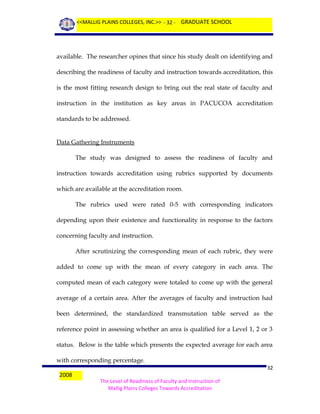
The rubrics used were rated 0-5 with corresponding indicators
depending upon their existence and functionality in response to the factors
concerning faculty and instruction.
After scrutinizing the corresponding mean of each rubric, they were
added to come up with the mean of every category in each area. The
computed mean of each category were totaled to come up with the general
average of a certain area. After the averages of faculty and instruction had
been determined, the standardized transmutation table served as the
reference point in assessing whether an area is qualified for a Level 1, 2 or 3
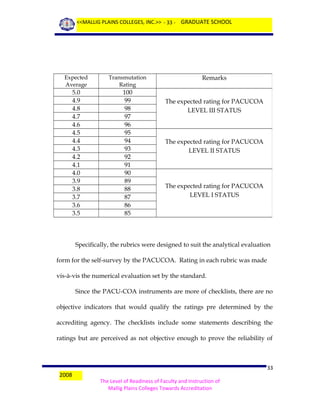
status. Below is the table which presents the expected average for each area
with corresponding percentage.
2008

32
The Level of Readiness of Faculty and Instruction of
Mallig Plains Colleges Towards Accreditation
<<MALLIG PLAINS COLLEGES, INC.>> - 33 - GRADUATE SCHOOL

Expected
Average

Transmutation
Rating

5.0
4.9
4.8
4.7
4.6
4.5
4.4
4.3
4.2
4.1
4.0
3.9
3.8
3.7
3.6
3.5

100
99
98
97
96
95
94
93
92
91
90
89
88
87
86
85

Remarks

The expected rating for PACUCOA
LEVEL III STATUS

The expected rating for PACUCOA
LEVEL II STATUS

The expected rating for PACUCOA
LEVEL I STATUS

Specifically, the rubrics were designed to suit the analytical evaluation
form for the self-survey by the PACUCOA. Rating in each rubric was made
vis-à-vis the numerical evaluation set by the standard.
Since the PACU-COA instruments are more of checklists, there are no
objective indicators that would qualify the ratings pre determined by the
accrediting agency. The checklists include some statements describing the
ratings but are perceived as not objective enough to prove the reliability of

2008

33
The Level of Readiness of Faculty and Instruction of
Mallig Plains Colleges Towards Accreditation
<<MALLIG PLAINS COLLEGES, INC.>> - 34 - GRADUATE SCHOOL

the ratings assigned by the respondents. The use of rubrics, somehow
lessened if not totally eliminated subjectivity.
The presence of a document is not enough evidence of the
functionality of a program requirement.

With the use of rubrics, the

researcher was able to explicitly narrow down the biases that the respondents
accrued in their ratings.
Data Gathering Procedure
The researcher sought the permission of the President of Mallig Plains
Colleges to conduct the study and to use the accomplished documents
available in the accreditation room.

After permission was granted, the

researcher consulted with the Dean of the Graduate Studies for her
suggestions and insights. After such, the researcher approached the Research
Director to request for the available documents needed in this study. The
researcher identified the appropriate indicators which served as bases to
identify the objective evidences to support the PACUCOA standards.
Data Analysis Procedure
The data gathered was first organized by the researcher according to
the requirements set by PACUCOA together with the available documents in
the accreditation room. Assessment of documents followed. The following
2008

34
The Level of Readiness of Faculty and Instruction of
Mallig Plains Colleges Towards Accreditation
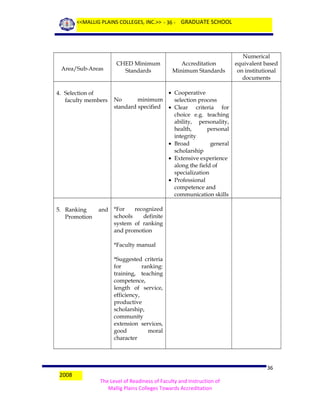
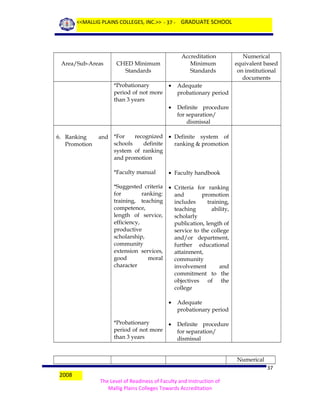
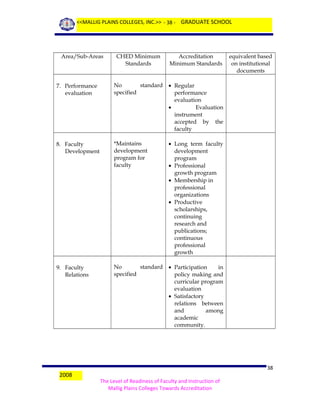
<<MALLIG PLAINS COLLEGES, INC.>> - 35 - GRADUATE SCHOOL

standards set by CHED and PACUCOA served as benchmarks or references
to determine the level of readiness of Faculty and Instruction areas of MPC
towards Accreditation.
MINIMUM STANDARDS FOR ACCREDITATION

Area/Sub-Areas

CHED Minimum
Standards

Accreditation
Minimum
Standards

Numerical
equivalent based
on institutional
documents

FACULTY
1. Academic
Qualifications

25% of
undergraduate
subjects should be
taught by faculty
with appropriate
Masters and/or Law
degrees

2. Teaching Load

Maximum teaching
load of 30 units/hrs
per week

3. ]Educational/
Professional
Experience and
Length of Service

2008

30% with MA
degree

• Maximum
teaching load of
24 units
hrs/week
• Assignment
should be in
one’s field of
study or
specialization

No
minimum • 3 years of college
standard specified
teaching
• 3
years
of
successful
practice in one’s
profession

35
The Level of Readiness of Faculty and Instruction of
Mallig Plains Colleges Towards Accreditation
<<MALLIG PLAINS COLLEGES, INC.>> - 36 - GRADUATE SCHOOL

Area/Sub-Areas

4. Selection of
faculty members

5. Ranking
Promotion

CHED Minimum
Standards

Accreditation
Minimum Standards

Numerical
equivalent based
on institutional
documents

• Cooperative
No
minimum
selection process
standard specified • Clear criteria for
choice e.g. teaching
ability, personality,
health,
personal
integrity
• Broad
general
scholarship
• Extensive experience
along the field of
specialization
• Professional
competence and
communication skills

recognized
and *For
schools
definite
system of ranking
and promotion
*Faculty manual
*Suggested criteria
for
ranking:
training, teaching
competence,
length of service,
efficiency,
productive
scholarship,
community
extension services,
good
moral
character

2008

36
The Level of Readiness of Faculty and Instruction of
Mallig Plains Colleges Towards Accreditation
<<MALLIG PLAINS COLLEGES, INC.>> - 37 - GRADUATE SCHOOL

Area/Sub-Areas

Accreditation
Minimum
Standards

CHED Minimum
Standards
*Probationary
period of not more
than 3 years

Adequate
probationary period

•

6. Ranking
Promotion

•

Numerical
equivalent based
on institutional
documents

Definite procedure
for separation/
dismissal

recognized • Definite system of
and *For
schools
definite
ranking & promotion
system of ranking
and promotion
*Faculty manual

• Faculty handbook

*Suggested criteria • Criteria for ranking
for
ranking:
and
promotion
training, teaching
includes
training,
competence,
teaching
ability,
length of service,
scholarly
efficiency,
publication, length of
productive
service to the college
scholarship,
and/or department,
community
further educational
extension services,
attainment,
good
moral
community
character
involvement
and
commitment to the
objectives of the
college
•
*Probationary
period of not more
than 3 years

Adequate
probationary period

•

Definite procedure
for separation/
dismissal
Numerical

2008

37
The Level of Readiness of Faculty and Instruction of
Mallig Plains Colleges Towards Accreditation
<<MALLIG PLAINS COLLEGES, INC.>> - 38 - GRADUATE SCHOOL

Area/Sub-Areas

CHED Minimum
Standards

Accreditation
Minimum Standards

7. Performance
evaluation

No
standard • Regular
specified
performance
evaluation
•
Evaluation
instrument
accepted by the
faculty

8. Faculty
Development

*Maintains
development
program for
faculty

• Long term faculty
development
program
• Professional
growth program
• Membership in
professional
organizations
• Productive
scholarships,
continuing
research and
publications;
continuous
professional
growth

9. Faculty
Relations

No
standard
specified

equivalent based
on institutional
documents

• Participation
in
policy making and
curricular program
evaluation
• Satisfactory
relations between
and
among
academic
community.

2008

38
The Level of Readiness of Faculty and Instruction of
Mallig Plains Colleges Towards Accreditation
<<MALLIG PLAINS COLLEGES, INC.>> - 39 - GRADUATE SCHOOL

Area/Sub-Areas

CHED Minimum
Standards

Accreditation
Minimum Standards

Numerical
equivalent based
on institutional
documents

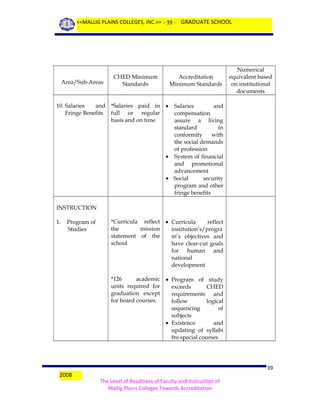
10. Salaries
and *Salaries paid in •
Fringe Benefits full or regular
basis and on time

Salaries
and
compensation
assure a living
standard
in
conformity
with
the social demands
of profession
• System of financial
and promotional
advancement
• Social
security
program and other
fringe benefits

INSTRUCTION
1.

Program of
Studies

*Curricula reflect • Curricula
reflect
the
mission
institution’s/progra
statement of the
m’s objectives and
school
have clear-cut goals
for human and
national
development
*126
academic • Program of study
units required for
exceeds
CHED
graduation except
requirements and
for board courses.
follow
logical
sequencing
of
subjects
• Existence
and
updating of syllabi
fro special courses

2008

39
The Level of Readiness of Faculty and Instruction of
Mallig Plains Colleges Towards Accreditation
<<MALLIG PLAINS COLLEGES, INC.>> - 40 - GRADUATE SCHOOL

Area/Sub-Areas

2. Instructional
Procedures

3. Classroom
Management

CHED Minimum
Standards

Accreditation
Minimum Standards

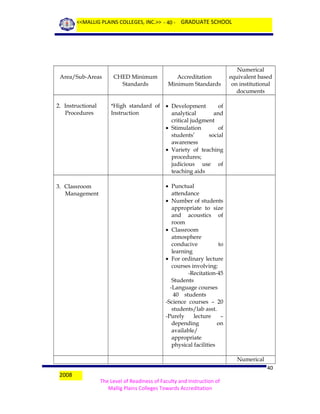
*High standard of
Instruction

Numerical
equivalent based
on institutional
documents

• Development
of
analytical
and
critical judgment
• Stimulation
of
students’
social
awareness
• Variety of teaching
procedures;
judicious use of
teaching aids
• Punctual
attendance
• Number of students
appropriate to size
and acoustics of
room
• Classroom
atmosphere
conducive
to
learning
• For ordinary lecture
courses involving:
-Recitation-45
Students
-Language courses
40 students
-Science courses – 20
students/lab asst.
-Purely
lecture
–
depending
on
available/
appropriate
physical facilities
Numerical

2008

40
The Level of Readiness of Faculty and Instruction of
Mallig Plains Colleges Towards Accreditation
<<MALLIG PLAINS COLLEGES, INC.>> - 41 - GRADUATE SCHOOL

Area/Sub-Areas

CHED Minimum
Standards

Accreditation
Minimum Standards

equivalent based
on institutional
documents

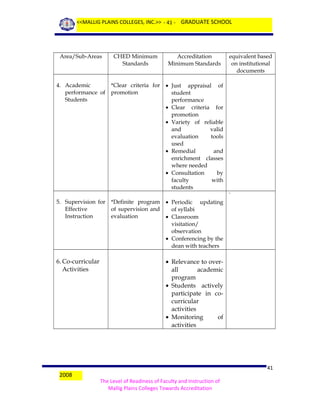
4. Academic
*Clear criteria for • Just appraisal of
performance of promotion
student
Students
performance
• Clear criteria for
promotion
• Variety of reliable
and
valid
evaluation
tools
used
• Remedial
and
enrichment classes
where needed
• Consultation
by
faculty
with
students
5. Supervision for *Definite program
Effective
of supervision and
Instruction
evaluation

• Periodic updating
of syllabi
• Classroom
visitation/
observation
• Conferencing by the
dean with teachers

6. Co-curricular
Activities

`

• Relevance to overall
academic
program
• Students actively
participate in cocurricular
activities
• Monitoring
of
activities

2008

41
The Level of Readiness of Faculty and Instruction of
Mallig Plains Colleges Towards Accreditation
<<MALLIG PLAINS COLLEGES, INC.>> - 42 - GRADUATE SCHOOL

Area/Sub-Areas

CHED Minimum
Standards

Accreditation
Minimum Standards

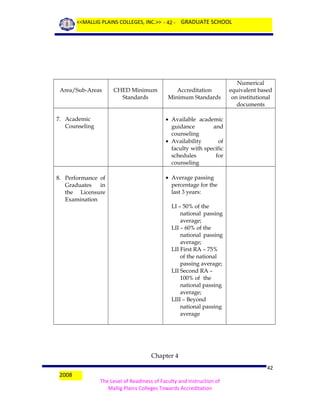
7. Academic
Counseling

• Available academic
guidance
and
counseling
• Availability
of
faculty with specific
schedules
for
counseling

8. Performance of
Graduates
in
the Licensure
Examination

Numerical
equivalent based
on institutional
documents

• Average passing
percentage for the
last 3 years:
LI – 50% of the
national passing
average;
LII – 60% of the
national passing
average;
LII First RA – 75%
of the national
passing average;
LII Second RA –
100% of the
national passing
average;
LIII – Beyond
national passing
average

Chapter 4
2008

42
The Level of Readiness of Faculty and Instruction of
Mallig Plains Colleges Towards Accreditation
<<MALLIG PLAINS COLLEGES, INC.>> - 43 - GRADUATE SCHOOL

PRESENTATION, ANALYSIS AND INTERPRETATION
OF DATA
This chapter presents the documentary analysis and interpretation of
the institutional documents available specifically on the areas of faculty and
instruction.
This study further analyzes the readiness of two areas as responded by
the exhibits and documents available.
A.

FACULTY
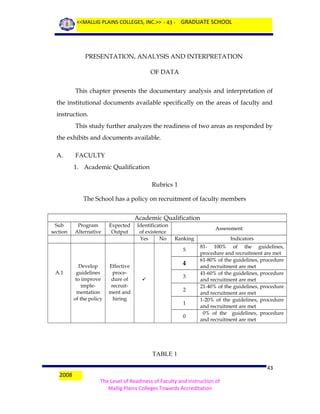
1. Academic Qualification
Rubrics 1
The School has a policy on recruitment of faculty members
Academic Qualification

Sub
section

Program
Alternative

Expected
Output

Identification
of existence
Yes
No

Assessment
Ranking
5

A.1

Develop
guidelines
to improve
implementation
of the policy

Effective
procedure of
recruitment and
hiring

4
3



2
1
0

Indicators
81- 100% of the guidelines,
procedure and recruitment are met
61-80% of the guidelines, procedure
and recruitment are met
41-60% of the guidelines, procedure
and recruitment are met
21-40% of the guidelines, procedure
and recruitment are met
1-20% of the guidelines, procedure
and recruitment are met
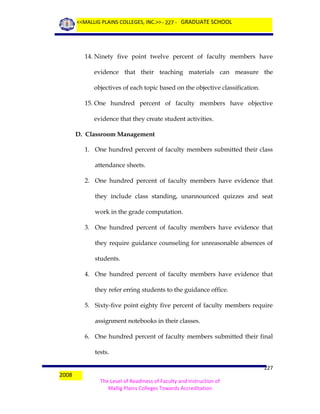
0% of the guidelines, procedure
and recruitment are met

TABLE 1
2008

43
The Level of Readiness of Faculty and Instruction of
Mallig Plains Colleges Towards Accreditation
<<MALLIG PLAINS COLLEGES, INC.>> - 44 - GRADUATE SCHOOL

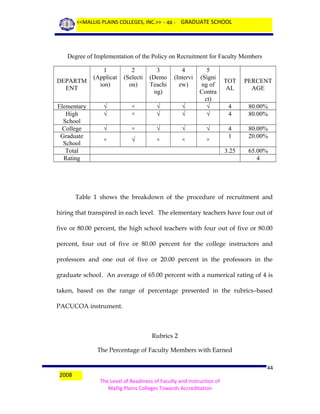
Degree of Implementation of the Policy on Recruitment for Faculty Members

DEPARTM
ENT
Elementary
High
School
College
Graduate
School
Total
Rating

1
(Applicat
ion)

2
(Selecti
on)

3
(Demo
Teachi
ng)

4
(Intervi
ew)

√
√

×
×

√
√

√
√

5
(Signi
ng of
Contra
ct)
√
√

√

×

√

√

√

×

√

×

×

×

TOT
AL

PERCENT
AGE

4
4

80.00%
80.00%

4
1

80.00%
20.00%

3.25

65.00%
4

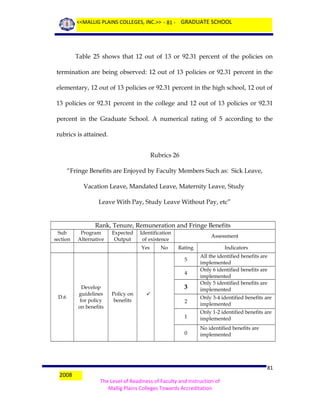
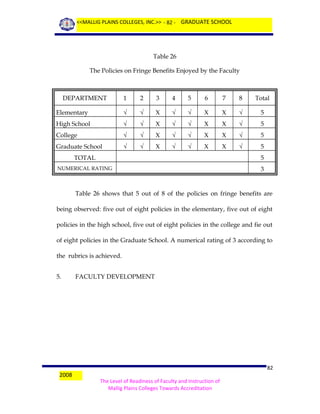
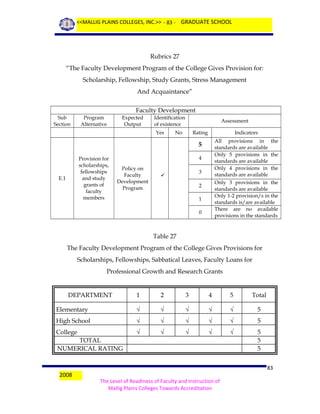
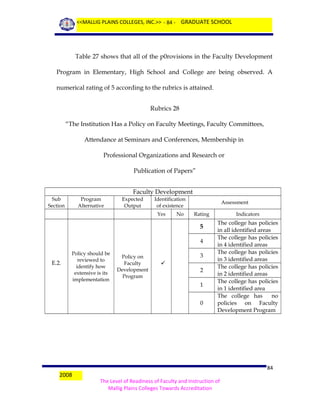
Table 1 shows the breakdown of the procedure of recruitment and
hiring that transpired in each level. The elementary teachers have four out of
five or 80.00 percent, the high school teachers with four out of five or 80.00
percent, four out of five or 80.00 percent for the college instructors and
professors and one out of five or 20.00 percent in the professors in the
graduate school. An average of 65.00 percent with a numerical rating of 4 is
taken, based on the range of percentage presented in the rubrics–based
PACUCOA instrument.

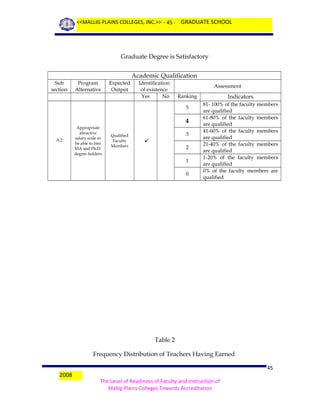
Rubrics 2
The Percentage of Faculty Members with Earned

2008

44
The Level of Readiness of Faculty and Instruction of
Mallig Plains Colleges Towards Accreditation
<<MALLIG PLAINS COLLEGES, INC.>> - 45 - GRADUATE SCHOOL

Graduate Degree is Satisfactory
Academic Qualification
Sub
section

Program
Alternative

Expected
Output

Identification
of existence
Yes
No

Assessment
Ranking
5

4
A.2

Appropriate
attractive
salary scale to
be able to hire
MA and Ph.D.
degree holders

Qualified
Faculty
Members

3



2
1
0

Indicators
81- 100% of the faculty members
are qualified
61-80% of the faculty members
are qualified
41-60% of the faculty members
are qualified
21-40% of the faculty members
are qualified
1-20% of the faculty members
are qualified
0% of the faculty members are
qualified

Table 2
Frequency Distribution of Teachers Having Earned
2008

45
The Level of Readiness of Faculty and Instruction of
Mallig Plains Colleges Towards Accreditation
<<MALLIG PLAINS COLLEGES, INC.>> - 46 - GRADUATE SCHOOL

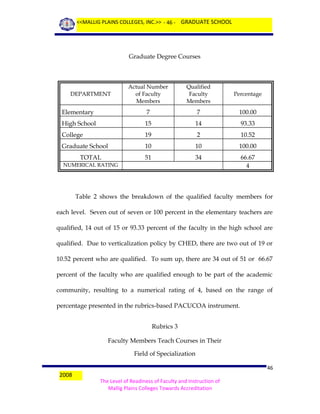
Graduate Degree Courses

Actual Number
of Faculty
Members

Qualified
Faculty
Members

Percentage

Elementary

7

7

100.00

High School

15

14

93.33

College

19

2

10.52

Graduate School

10

10

100.00

51

34

66.67
4

DEPARTMENT

TOTAL
NUMERICAL RATING

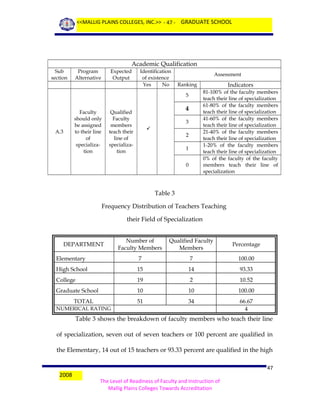
Table 2 shows the breakdown of the qualified faculty members for
each level. Seven out of seven or 100 percent in the elementary teachers are
qualified, 14 out of 15 or 93.33 percent of the faculty in the high school are
qualified. Due to verticalization policy by CHED, there are two out of 19 or
10.52 percent who are qualified. To sum up, there are 34 out of 51 or 66.67
percent of the faculty who are qualified enough to be part of the academic
community, resulting to a numerical rating of 4, based on the range of
percentage presented in the rubrics-based PACUCOA instrument.
Rubrics 3
Faculty Members Teach Courses in Their
Field of Specialization
2008

46
The Level of Readiness of Faculty and Instruction of
Mallig Plains Colleges Towards Accreditation
<<MALLIG PLAINS COLLEGES, INC.>> - 47 - GRADUATE SCHOOL

Academic Qualification
Sub
section

Program
Alternative

Expected
Output

Identification
of existence
Yes
No

Assessment
81-100% of the faculty members
teach their line of specialization
61-80% of the faculty members
teach their line of specialization
41-60% of the faculty members
teach their line of specialization
21-40% of the faculty members
teach their line of specialization
1-20% of the faculty members
teach their line of specialization
0% of the faculty of the faculty
members teach their line of
specialization

5
Faculty
should only
be assigned
to their line
of
specialization

A.3

4

Qualified
Faculty
members
teach their
line of
specialization

Indicators

Ranking

3

2
1
0

Table 3
Frequency Distribution of Teachers Teaching
their Field of Specialization
Number of
Faculty Members

Qualified Faculty
Members

Percentage

Elementary

7

7

100.00

High School

15

14

93.33

College

19

2

10.52

Graduate School

10

10

100.00

51

34

66.67
4

DEPARTMENT

TOTAL
NUMERICAL RATING

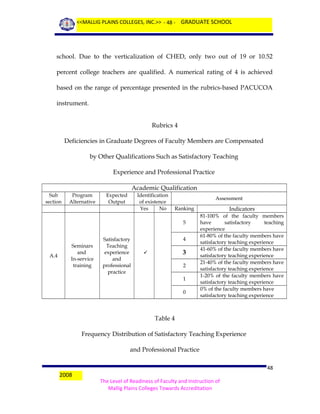
Table 3 shows the breakdown of faculty members who teach their line
of specialization, seven out of seven teachers or 100 percent are qualified in
the Elementary, 14 out of 15 teachers or 93.33 percent are qualified in the high

2008

47
The Level of Readiness of Faculty and Instruction of
Mallig Plains Colleges Towards Accreditation
<<MALLIG PLAINS COLLEGES, INC.>> - 48 - GRADUATE SCHOOL

school. Due to the verticalization of CHED, only two out of 19 or 10.52
percent college teachers are qualified. A numerical rating of 4 is achieved
based on the range of percentage presented in the rubrics-based PACUCOA
instrument.
Rubrics 4
Deficiencies in Graduate Degrees of Faculty Members are Compensated
by Other Qualifications Such as Satisfactory Teaching
Experience and Professional Practice
Academic Qualification
Sub
section

Program
Alternative

Expected
Output

Identification
of existence
Yes
No

Assessment
Ranking
5

A.4

Seminars
and
In-service
training

Satisfactory
Teaching
experience
and
professional
practice

4

3



2
1
0

Indicators
81-100% of the faculty members
have
satisfactory
teaching
experience
61-80% of the faculty members have
satisfactory teaching experience
41-60% of the faculty members have
satisfactory teaching experience
21-40% of the faculty members have
satisfactory teaching experience
1-20% of the faculty members have
satisfactory teaching experience
0% of the faculty members have
satisfactory teaching experience

Table 4
Frequency Distribution of Satisfactory Teaching Experience
and Professional Practice

2008

48
The Level of Readiness of Faculty and Instruction of
Mallig Plains Colleges Towards Accreditation
<<MALLIG PLAINS COLLEGES, INC.>> - 49 - GRADUATE SCHOOL

Actual Number of
Faculty Members

Faculty with at
least 3 years of
experience

Percentage

Elementary

7

5

71.43

High School

15

6

40.00

College

19

13

68.42

41

24

58.54

DEPARTMENT

TOTAL
NUMERICAL RATING

3

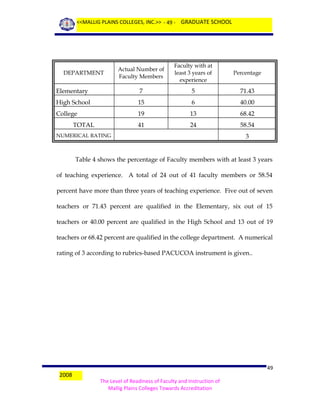
Table 4 shows the percentage of Faculty members with at least 3 years
of teaching experience. A total of 24 out of 41 faculty members or 58.54
percent have more than three years of teaching experience. Five out of seven
teachers or 71.43 percent are qualified in the Elementary, six out of 15
teachers or 40.00 percent are qualified in the High School and 13 out of 19
teachers or 68.42 percent are qualified in the college department. A numerical
rating of 3 according to rubrics-based PACUCOA instrument is given..

2008

49
The Level of Readiness of Faculty and Instruction of
Mallig Plains Colleges Towards Accreditation
<<MALLIG PLAINS COLLEGES, INC.>> - 50 - GRADUATE SCHOOL

Rubrics 5
Faculty Members Assigned to Practicum Courses Have at Least Three
Years of Experience in Their Specialized Field of Study
Academic Qualification
Sub
section

Program
Alternative

Expected
Output

Identification
of existence
Yes

No

Assessment
Rating
5

A.5

Only faculty
having 3
years and
above
experience in
their field of
specialization
should be
hired

4
Practicum
subjects to
be handled
by the
Faculty

3



2
1
0

Indicators
81-100% of the faculty members have
satisfactory teaching experience
61-80% of the faculty members have
satisfactory teaching experience
41-60% of the faculty members have
satisfactory teaching experience
21-40% of the faculty members have
satisfactory teaching experience
1-20% of the faculty members have
satisfactory teaching experience
0% of the faculty members have
satisfactory teaching experience

Table 5
Frequency Distribution of the Number of Years of Experience
of the Faculty Assigned to Practicum Courses

Elementary
High School
College
TOTAL

Actual Number
of Faculty
Members

Faculty that handles
Practicum subjects with at
least 3 years of experience

Percentage

7
15
19
41

DEPARTMENT

5
10
17
32

71.43
66.67
89.47
78.05

NUMERICAL RATING

2008

4

50
The Level of Readiness of Faculty and Instruction of
Mallig Plains Colleges Towards Accreditation
<<MALLIG PLAINS COLLEGES, INC.>> - 51 - GRADUATE SCHOOL

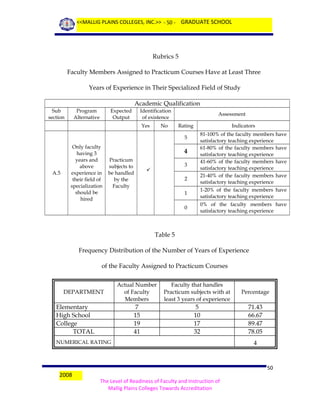
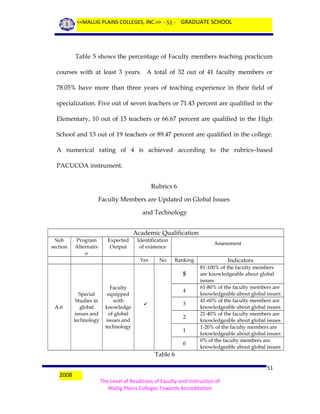
Table 5 shows the percentage of Faculty members teaching practicum
courses with at least 3 years. A total of 32 out of 41 faculty members or
78.05% have more than three years of teaching experience in their field of
specialization. Five out of seven teachers or 71.43 percent are qualified in the
Elementary, 10 out of 15 teachers or 66.67 percent are qualified in the High
School and 13 out of 19 teachers or 89.47 percent are qualified in the college.
A numerical rating of 4 is achieved according to the rubrics–based
PACUCOA instrument.
Rubrics 6
Faculty Members are Updated on Global Issues
and Technology
Academic Qualification
Sub
section

Program
Alternativ
e

Expected
Output

Identification
of existence
Yes

No

Assessment

5

A.6

Special
Studies in
global
issues and
technology

Faculty
equipped
with
knowledge
of global
issues and
technology

Indicators

Ranking

4
3



2
1
0

81-100% of the faculty members
are knowledgeable about global
issues
61-80% of the faculty members are
knowledgeable about global issues
41-60% of the faculty members are
knowledgeable about global issues
21-40% of the faculty members are
knowledgeable about global issues
1-20% of the faculty members are
knowledgeable about global issues
0% of the faculty members are
knowledgeable about global issues

Table 6
2008

51
The Level of Readiness of Faculty and Instruction of
Mallig Plains Colleges Towards Accreditation
<<MALLIG PLAINS COLLEGES, INC.>> - 52 - GRADUATE SCHOOL

Frequency Distribution of the Faculty Members Equipped with
Knowledge on Global Issues and Technology

Actual
Number of
Faculty

Faculty Equipped with
Knowledge of Global
Issues and Technology

Percentage

Elementary

7

5

71.43

High School

15

14

93.33

College

19

19

100.00

Graduate School

10

10

100.00

51

48

94.12

DEPARTMENT

TOTAL
NUMERICAL RATING

5

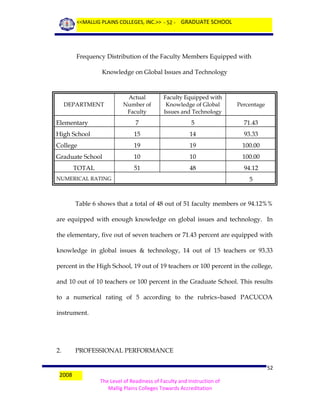
Table 6 shows that a total of 48 out of 51 faculty members or 94.12%%
are equipped with enough knowledge on global issues and technology. In
the elementary, five out of seven teachers or 71.43 percent are equipped with
knowledge in global issues & technology, 14 out of 15 teachers or 93.33
percent in the High School, 19 out of 19 teachers or 100 percent in the college,
and 10 out of 10 teachers or 100 percent in the Graduate School. This results
to a numerical rating of 5 according to the rubrics–based PACUCOA
instrument.

2.

2008

PROFESSIONAL PERFORMANCE
52
The Level of Readiness of Faculty and Instruction of
Mallig Plains Colleges Towards Accreditation
<<MALLIG PLAINS COLLEGES, INC.>> - 53 - GRADUATE SCHOOL

Rubrics 7
Faculty Members Endeavor to Implement the Purposes and Objectives
of the Institution and the Specific Objectives of
the College Under Survey

Professional Performance
Sub
section

Program
Alternative

Expected
Output

Identification
of existence
Yes

No

Assessment
Rating
5

4

B.1

Include this
in the
syllabi and
introduction
to every
class
orientation

Vision and
Mission in
each of the
syllabus

3
X
2

1

0

2008

Indicators
81-100% of the syllabus of the
faculty include mission and
vision of MPC
61-80% of the syllabus of the
faculty include mission and
vision of MPC
41-60% of the syllabus of the
faculty include mission and
vision of MPC
21-40% of the syllabus of the
faculty include mission and
vision of MPC
1-20% of the syllabus of the
faculty include mission and
vision of MPC
0% of the syllabus of the faculty
include mission and vision of
MPC

53
The Level of Readiness of Faculty and Instruction of
Mallig Plains Colleges Towards Accreditation
<<MALLIG PLAINS COLLEGES, INC.>> - 54 - GRADUATE SCHOOL

Table 7
Frequency Distribution of Teachers who Include Vision, Mission, Goals
and Objectives of the Institution in Their Syllabi

Actual
Number of
Faculty

Teachers who include
vision, mission, goals and
objectives of the
institution in their syllabi

Percentage

Elementary

7

0

0

High School

15

0

0

College

19

0

0

Graduate School

10

0

0

51

0

0

DEPARTMENT

TOTAL
NUMERICAL RATING

0

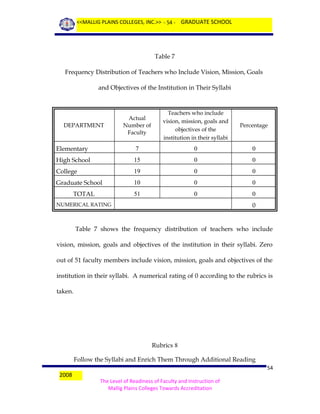
Table 7 shows the frequency distribution of teachers who include
vision, mission, goals and objectives of the institution in their syllabi. Zero
out of 51 faculty members include vision, mission, goals and objectives of the
institution in their syllabi. A numerical rating of 0 according to the rubrics is
taken.

Rubrics 8
Follow the Syllabi and Enrich Them Through Additional Reading
2008

54
The Level of Readiness of Faculty and Instruction of
Mallig Plains Colleges Towards Accreditation
<<MALLIG PLAINS COLLEGES, INC.>> - 55 - GRADUATE SCHOOL

Professional Performance
Sub
section

Program
Alternative

Expected
Output

Identification
of existence
Yes

No

Assessment
Rating
5

B.2

Require
students to
submit
book
reports and
current
issues
reports

4
Student
book
reports

3



2
1
0

Indicators
81-100%
of the faculty have
compilation of students’ book reports
61-80%
of the faculty have
compilation of students’ book reports
41-60%
of the faculty have
compilation of students’ book reports
21-40%
of the faculty have
compilation of students’ book reports
1-20% of the faculty have compilation
of students’ book reports
0% of the faculty have compilation of
students’ book reports

Table 8
Frequency Distribution of Faculty with Compilation
of Student’s Book Reports
Actual
Number of
faculty

Faculty with
compilation of student’s
book reports

Percentage

Elementary

7

0

0

High School

15

0

0

College

19

3

15.79

Graduate School

10

10

100.00

51

13

25.49

DEPARTMENT

TOTAL
NUMERICAL RATING

2

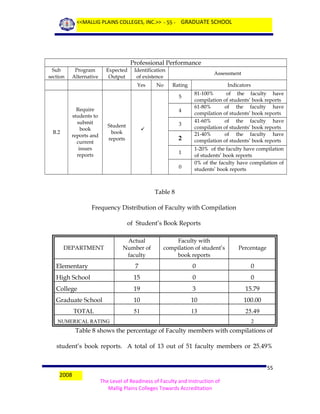
Table 8 shows the percentage of Faculty members with compilations of
student’s book reports. A total of 13 out of 51 faculty members or 25.49%

2008

55
The Level of Readiness of Faculty and Instruction of
Mallig Plains Colleges Towards Accreditation
<<MALLIG PLAINS COLLEGES, INC.>> - 56 - GRADUATE SCHOOL

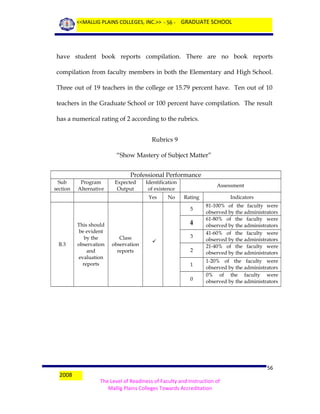
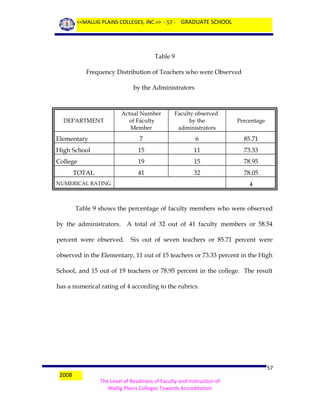
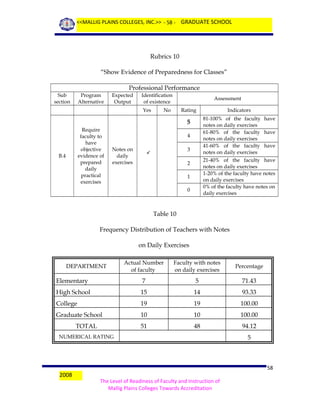
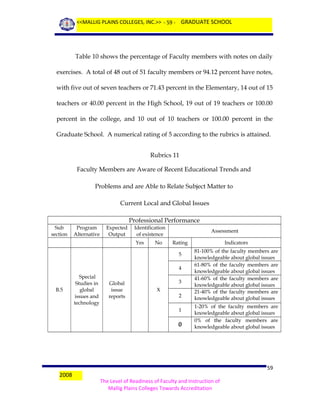
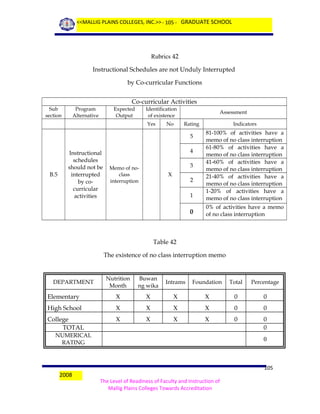
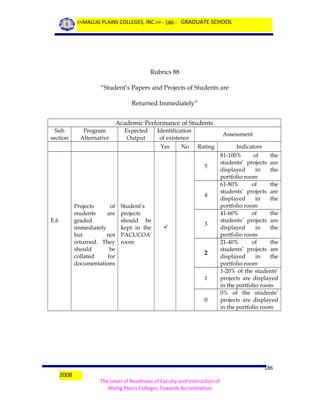
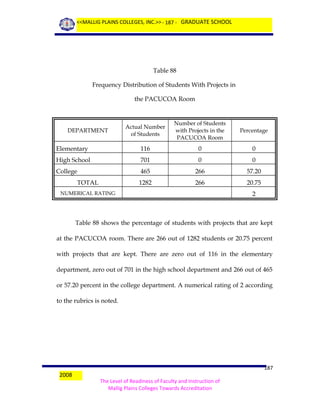
have student book reports compilation. There are no book reports
compilation from faculty members in both the Elementary and High School.
Three out of 19 teachers in the college or 15.79 percent have. Ten out of 10
teachers in the Graduate School or 100 percent have compilation. The result
has a numerical rating of 2 according to the rubrics.
Rubrics 9
“Show Mastery of Subject Matter”
Professional Performance
Sub
section

Program
Alternative

Expected
Output

Identification
of existence
Yes

No

Assessment
Rating
5

B.3

This should
be evident
by the
observation
and
evaluation
reports

4
Class
observation
reports



3
2
1
0

2008

Indicators
81-100% of the faculty were
observed by the administrators
61-80% of the faculty were
observed by the administrators
41-60% of the faculty were
observed by the administrators
21-40% of the faculty were
observed by the administrators
1-20% of the faculty were
observed by the administrators
0% of the faculty were
observed by the administrators

56
The Level of Readiness of Faculty and Instruction of
Mallig Plains Colleges Towards Accreditation
<<MALLIG PLAINS COLLEGES, INC.>> - 57 - GRADUATE SCHOOL

Table 9
Frequency Distribution of Teachers who were Observed
by the Administrators

Actual Number
of Faculty
Member

Faculty observed
by the
administrators

Percentage

Elementary

7

6

85.71

High School

15

11

73.33

College

19

15

78.95

41

32

78.05

DEPARTMENT

TOTAL

4

NUMERICAL RATING

Table 9 shows the percentage of faculty members who were observed
by the administrators. A total of 32 out of 41 faculty members or 58.54
percent were observed.

Six out of seven teachers or 85.71 percent were

observed in the Elementary, 11 out of 15 teachers or 73.33 percent in the High
School, and 15 out of 19 teachers or 78.95 percent in the college. The result
has a numerical rating of 4 according to the rubrics.

2008

57
The Level of Readiness of Faculty and Instruction of
Mallig Plains Colleges Towards Accreditation
<<MALLIG PLAINS COLLEGES, INC.>> - 58 - GRADUATE SCHOOL

Rubrics 10
“Show Evidence of Preparedness for Classes”
Professional Performance
Sub
section

Program
Alternative

Expected
Output

Identification
of existence
Yes

Assessment

No

Rating

81-100% of the faculty have
notes on daily exercises
61-80% of the faculty have
notes on daily exercises
41-60% of the faculty have
notes on daily exercises
21-40% of the faculty have
notes on daily exercises
1-20% of the faculty have notes
on daily exercises
0% of the faculty have notes on
daily exercises

5
Require
faculty to
have
objective
evidence of
prepared
daily
practical
exercises

B.4

4
Notes on
daily
exercises

3



Indicators

2
1
0

Table 10
Frequency Distribution of Teachers with Notes
on Daily Exercises
Actual Number
of faculty

Faculty with notes
on daily exercises

Percentage

Elementary

7

5

71.43

High School

15

14

93.33

College

19

19

100.00

Graduate School

10

10

100.00

51

48

94.12

DEPARTMENT

TOTAL
NUMERICAL RATING

2008

5

58
The Level of Readiness of Faculty and Instruction of
Mallig Plains Colleges Towards Accreditation
<<MALLIG PLAINS COLLEGES, INC.>> - 59 - GRADUATE SCHOOL

Table 10 shows the percentage of Faculty members with notes on daily
exercises. A total of 48 out of 51 faculty members or 94.12 percent have notes,
with five out of seven teachers or 71.43 percent in the Elementary, 14 out of 15
teachers or 40.00 percent in the High School, 19 out of 19 teachers or 100.00
percent in the college, and 10 out of 10 teachers or 100.00 percent in the
Graduate School. A numerical rating of 5 according to the rubrics is attained.
Rubrics 11
Faculty Members are Aware of Recent Educational Trends and
Problems and are Able to Relate Subject Matter to
Current Local and Global Issues
Professional Performance
Sub
section

Program
Alternative

Expected
Output

Identification
of existence
Yes

No

Assessment
Rating
5
4

B.5

Special
Studies in
global
issues and
technology

Global
issue
reports

3
X

2
1

0

2008

Indicators
81-100% of the faculty members are
knowledgeable about global issues
61-80% of the faculty members are
knowledgeable about global issues
41-60% of the faculty members are
knowledgeable about global issues
21-40% of the faculty members are
knowledgeable about global issues
1-20% of the faculty members are
knowledgeable about global issues
0% of the faculty members are
knowledgeable about global issues

59
The Level of Readiness of Faculty and Instruction of
Mallig Plains Colleges Towards Accreditation
<<MALLIG PLAINS COLLEGES, INC.>> - 60 - GRADUATE SCHOOL

Table 11
Frequency Distribution of Faculty Members who are Aware of Recent
Educational Trends and Problems and are Able to Relate Subject
Matter to Current Local and Global Issues

Actual Number
of Faculty

Teachers who are
knowledgeable
about global issues

Percentage

Elementary

7

0

0

High School

15

0

0

College

19

0

0

TOTAL

41

0

0

DEPARTMENT

NUMERICAL RATING

0

Table 11 shows the frequency distribution of teachers who are
knowledgeable about global issues. Zero out of 41 faculty members are
knowledgeable on the said issue. A numerical rank of 0 according to the
PACUCOA-based rubrics is taken.

2008

60
The Level of Readiness of Faculty and Instruction of
Mallig Plains Colleges Towards Accreditation
<<MALLIG PLAINS COLLEGES, INC.>> - 61 - GRADUATE SCHOOL

RUBRICS 12
Evidence of Effective Use of Library, Internet, Instructional
Media and Other Instructional Devices
Professional Performance
Sub
section

Program
Alternative

Expected
Output

Identification
of existence
Yes

No

Assessment
Rating

Indicators

3

81-100% of the faculty use
internet
and
multi-media
resources
61-80% of the faculty use internet
and multi-media resources
41-60% of the faculty use internet
and multi-media resources

2

21-40% of the faculty use internet
and multi-media resources

1

1-20% of the faculty use internet
and multi-media resources

0

0% of the faculty use internet and
multi-media resources

5
Present
logbook of
internet
access and
multimedia
usage in
classroom

B.6

4
Logbook
for internet
and
multimedia
usage



Table12
Frequency Distribution of Teachers with Logbook for
Internet and Multi-Media Usage

Elementary
High School
College
Graduate School
TOTAL

Actual Number
of Faculty
Member

Faculty with logbook
for internet and
multimedia usage

7
15
19
10
51

DEPARTMENT

2
4
11
4
21

NUMERICAL RATING

2008

Percentage

28.57
26.67
57.89
40.00
41.18
3

61
The Level of Readiness of Faculty and Instruction of
Mallig Plains Colleges Towards Accreditation
<<MALLIG PLAINS COLLEGES, INC.>> - 62 - GRADUATE SCHOOL

Table 12 shows the percentage of faculty members with logbook for
internet and multimedia usage. A total of 21 out of 51 faculty members or
41.18 percent do have logbooks. Two out of seven teachers or 28.57 percent in
the Elementary, four out of 15 teachers or 26.67 percent in the High School, 11
out of 19 teachers or 57.89 percent in the college and 10 out of 10 teachers or
100 percent in the Graduate School have logbook.

This feature has a

numerical rating of 3 according to the rubrics.
Rubrics 13
“Show Evidences of Professional Growth Through Research Activity
and Publication and/or Membership in Recognized
Educational Organization and Association”
Professional Performance
Sub
section

Program
Alternative

Expected
Output

Identification
of existence
Yes

No

Assessment
Rating

5

B.7

Require
faculty to
engage in
group
research and
encourage
them to join
Research
Organizations

Compilati
on of
researches
and actual
uploading
of
membership

4
3


2

1
0

Indicators
81-100% of the faculty submitted
their compiled action researches
61-80% of the faculty submitted
their compiled action researches
41-60% of the faculty submitted
their compiled action researches
21-40% of the faculty submitted
their compiled action researches

1-20%
of
the
faculty
submitted their compiled
action researches
0% of the faculty submitted
their
compiled
action
researches

Table 13
2008

62
The Level of Readiness of Faculty and Instruction of
Mallig Plains Colleges Towards Accreditation
<<MALLIG PLAINS COLLEGES, INC.>> - 63 - GRADUATE SCHOOL

Frequency Distribution of Teachers with Compiled
Action Researches
Actual Number
of Faculty
Member

Faculty with
compilation of
action researches

Percentage

Elementary

7

7

100.00

High School

15

15

100.00

College

19

19

100.00

Graduate School

10

10

100.00

51

51

100.00

DEPARTMENT

TOTAL
NUMERICAL RATING

5

Table 13 shows the percentage of faculty members with compilation of
action researches. A total of 51 out of 51 faculty members or 100.00 percent
submit action researches to help the administration in overseeing problems
within the school. Seven out of seven teachers or 100.00 percent in the
Elementary, 154 out of 15 teachers or 100.00 percent in the High School, 19
out of 19 teachers or 100.00 percent in the college, and 10 out of 10 teachers or
100 percent in the Graduate School. A numerical rating of 5 according to the
rubrics is achieved.

3.

2008

TEACHING ASSIGNMENT
63
The Level of Readiness of Faculty and Instruction of
Mallig Plains Colleges Towards Accreditation
<<MALLIG PLAINS COLLEGES, INC.>> - 64 - GRADUATE SCHOOL

Rubrics 14
“A Policy of Determining Teaching Assignments is
Adopted and Followed”
Teaching Assignment
Sub
section

Program
Alternative

Expected
Output

Identification
of existence
Yes
No

Assessment
Rating
5
4

C.1

Adoption of
determining
teacher’s
assignment

Policy on
teaching
assignment

3



2
1
0

Indicators
81-100% of the faculty have 24
maximum loads with 3 preparations
61-80% of the faculty have 24
maximum loads with 4 preparations
41-60% of the faculty have 24
maximum loads with 5 preparations
21-40% of the faculty have 24
maximum loads with 6 preparations
1-20% of the faculty have 24 maximum
loads with 7 preparations
None of the above

Table 14
Frequency Distribution of Teachers with Maximum
Load of 24 units
Actual Number
of faculty

Faculty with maximum
load of 24 units

Percentage

Elementary

7

0

0

High School

15

3

20.00

College
TOTAL

19
41

15
18

78.95
43.90
3

DEPARTMENT

NUMERICAL RATING

Table 14 shows the percentage of faculty members with maximum
load of 24 units. A total of 18 out of 41 faculty members or 43.90 percent do
2008

64
The Level of Readiness of Faculty and Instruction of
Mallig Plains Colleges Towards Accreditation
<<MALLIG PLAINS COLLEGES, INC.>> - 65 - GRADUATE SCHOOL

have a maximum load; zero out of seven teachers or zero percent in the
Elementary, three out of 15 teachers or 20.00 percent in the High School, and
15 out of 19 teachers or 78.95 percent in the college. A numerical rating of 3
according to the rubrics is taken.
Rubrics 15
“The Percentage of Faculty Members Employed on a Full-time Basis
Meets Accreditation Requirements”

Teaching Assignment
Sub
section

Program
Alternative

Expected
Output

Identification
of existence

Yes

No

Assessment
Rating

5
4

C.2

percentage
of full time
instructors
against
part time

percentage
of full time
instructors
against
part time

3



2
1
0

Indicators
81-100%
of
the
faculty
members
are
full-time
instructors
61-80%
of
the
faculty
members
are
full-time
instructors
41-60%
of
the
faculty
members
are
full-time
instructors
21-40%
of
the
faculty
members
are
full-time
instructors
1-20% of the faculty members
are full-time instructors
0% of the faculty members are
full-time instructors

Table 15
Frequency Distribution of Full Time Faculty Instructors

2008

65
The Level of Readiness of Faculty and Instruction of
Mallig Plains Colleges Towards Accreditation
<<MALLIG PLAINS COLLEGES, INC.>> - 66 - GRADUATE SCHOOL

Actual Number
of faculty

Full Time Faculty
Instructors

Percentage

Elementary

7

7

100.00

High School

15

15

100.00

College

19

19

100.00

Graduate School

10

4

40.00

51

45

88.24

DEPARTMENT

TOTAL
NUMERICAL RATING

5

Table 15 shows the percentage of Full time faculty members. A total of
45 out of 51 faculty members or 88.24 percent are full time instructors. Seven
out of seven teachers or 100.00 in the Elementary, 15 out of 15 teachers or
100.00 percent in the High School, 19 out of 19 teachers or 100.00 percent in
the college, and four out of 10 teachers or 40.00 percent in the Graduate
School. A numerical rating of 5 according to the rubrics is achieved.

2008

66
The Level of Readiness of Faculty and Instruction of
Mallig Plains Colleges Towards Accreditation
<<MALLIG PLAINS COLLEGES, INC.>> - 67 - GRADUATE SCHOOL

Rubrics 16
“Faculty Members are Given Teaching Assignment Only
In Their Major Fields of Specialization”
Teaching Assignment
Sub
section

Program
Alternative

Expected
Output

Identification
of existence
Yes

No

Assessment
Rating

Indicators

3

81-100% of the faculty members
teach their field of specialization
61-80% of the faculty members
teach their field of specialization
41-60% of the faculty members
teach their field of specialization

2

21-40% of the faculty members
teach their field of specialization

1

1-20% of the faculty members
teach their field of specialization

0

0% of the faculty members teach
their field of specialization

5
4

C.3

Teacher’s
schedule
showing
qualification

Teacher’s
schedule
showing
qualification



Table 16
Frequency Distribution of Teachers who Teach their
Field of Specialization

DEPARTMENT

Actual
Number of
faculty

Faculty members who
teach their field of
specialization

Elementary
High School
College
Graduate School
TOTAL

7
15
19
10
51

7
14
2
10
34

NUMERICAL RATING

2008

Percentage

100.00
93.33
10.52
100.00
66.67
5

67
The Level of Readiness of Faculty and Instruction of
Mallig Plains Colleges Towards Accreditation
<<MALLIG PLAINS COLLEGES, INC.>> - 68 - GRADUATE SCHOOL

Table 16 shows the breakdown of faculty members who teach their line
of specialization. Seven out of seven teachers or 100 percent are qualified in
the Elementary, 14 out of 15 teachers or 93.33 percent are qualified in the high
school. Due to the verticalization of CHED, only two out of 19 or 10.52
percent college teachers are qualified. A numerical rating of 4 is achieved
based on the range of percentage presented in the rubrics-based PACUCOA
instrument.
Rubrics 17
“Teaching Loads of Faculty Members (Both Full-time and Part-time)
Allow Sufficient Time for Preparation of Classes and
Adequate Evaluation of Student Achievement”
Teaching Assignment
Sub
section

Program
Alternative

Expected
Output

Identification
of existence
Yes

C.4

There
should be
no three
consecutive
lecture
classes
assigned to
each faculty
+ B.4

2008

Class
schedule
showing
that
teachers
have no 3
consecutive
hours
lecturing in
his classes

No

Assessment
Rating

5
4


3
2
1
0

Indicators
81-100% of the faculty do not
teach 3 consecutive hours
61-80% of the faculty do not
teach 3 consecutive hours
41-60% of the faculty do not
teach 3 consecutive hours
21-40% of the faculty do not
teach 3 consecutive hours
1-20% of the faculty do not
teach 3 consecutive hours
0% of the faculty do not teach
3 consecutive hours

68
The Level of Readiness of Faculty and Instruction of
Mallig Plains Colleges Towards Accreditation
<<MALLIG PLAINS COLLEGES, INC.>> - 69 - GRADUATE SCHOOL

Table 17
Frequency Distribution of Teachers with No
3 Consecutive Teaching Hours

Actual Number
of faculty

Teachers with no 3
consecutive
teaching hours

Percentage

Elementary

7

7

100.00

High School

15

15

100.00

College

19

14

73.68

41

36

87.80

DEPARTMENT

TOTAL
NUMERICAL RATING

5

Table 17 shows the percentage of faculty members with no three
consecutive teaching hours. A total of 36 out of 51 faculty members or 87.80
percent do not have three consecutive teaching hours. Seven out of seven
teachers or 100.00 percent in the Elementary, 15 out of 15 teachers or 100.00
percent in the High School and 14 out of 19 teachers or 73.68 percent in the
college do not engage themselves teaching for three consecutive hours. A
numerical rating of 5 according to rubrics is noted.

2008

69
The Level of Readiness of Faculty and Instruction of
Mallig Plains Colleges Towards Accreditation
<<MALLIG PLAINS COLLEGES, INC.>> - 70 - GRADUATE SCHOOL

Rubrics 18
“The Quality of Teacher Performance is Considered
When Assigning Faculty Load”
Teaching Assignment
Sub
section

Program
Alternative

Expected
Output

Identification
of existence
Yes

No

Assessment
Rating

5
4

C.5

The
quality of
instruction
a teacher
has

Policy on
teaching
assignment

3



2
1
0

Indicators
81-100% of the faculty
satisfactory performance
61-80% of the faculty
satisfactory performance
41-60% of the faculty
satisfactory performance
21-40% of the faculty
satisfactory performance

have
have
have
have

1-20% of the faculty have
satisfactory performance
0% of the faculty have teaching
assignment

Table 18
Frequency Distribution of Teachers with Satisfactory Performance
Actual Number
of faculty

Faculty with
satisfactory
performance

Percentage

Elementary

7

5

71.43

High School

15

12

80.00

College

19

18

94.74

Graduate School

10

10

100.00

51

45

88.24

DEPARTMENT

TOTAL
NUMERICAL RATING

2008

5
70

The Level of Readiness of Faculty and Instruction of
Mallig Plains Colleges Towards Accreditation
<<MALLIG PLAINS COLLEGES, INC.>> - 71 - GRADUATE SCHOOL

Table 18 shows the percentage of faculty members with satisfactory
performance. A total of 45 out of 51 faculty members or 88.24percent have
satisfactory performance, five out of seven teachers or 71.43 percent in the
Elementary, 12 out of 15 teachers or 80.00 percent in the High School, 18 out
of 19 teachers or 94.74 percent in the college and 10 out of 10 teachers or 100
percent in the Graduate School. A numerical rating of 5 according to the
rubrics is achieved.
This performance rating of teachers is based on the records without
having verified the objectivity of the instrument used in the evaluation.
Rubrics 19
“Provision is Made for the Distribution of Extra Class
Responsibilities of Faculty Members”
Teaching Assignment
Sub
section

Program
Alternative

Expected
Output

Identification
of existence
Yes

No

Assessment
Rating

3

81-100% of the faculty have extra
class assignment
61-80% of the faculty have extra
class assignment
41-60% of the faculty have extra
class assignment

2

21-40% of the faculty have extra
class assignment

5
4

C.6

A
responsibility
checklist
showing
extra class
assignments

Policy on
extra class
assignment

Indicators



1
0

1-20% of the faculty have
extra class assignment
0% of the faculty have extra
class assignment

Table 19
2008

71
The Level of Readiness of Faculty and Instruction of
Mallig Plains Colleges Towards Accreditation
<<MALLIG PLAINS COLLEGES, INC.>> - 72 - GRADUATE SCHOOL

Frequency Distribution of Teachers with
Extra Class Assignment
Number of
faculty

Faculty with Extra
Class Assignment

Percentage

Elementary

7

7

100.00

High School

15

15

100.00

College

19

19

100.00

Graduate School

10

4

40.00

51

45

88.24

DEPARTMENT

TOTAL
NUMERICAL RATING

5

Table 19 shows the percentage of faculty members with extra class
assignment. A total of 45 out of 51 faculty members or 88.24 percent have
extra class assignment,

seven out of 7 teachers or 100.00 percent in the

Elementary, 15 out of 15 teachers or 100.00 percent in the High School, 19 out
of 19 teachers or 100.00 percent in the college and four out of 10 teachers or 40
percent in the Graduate School. A numerical rating of 5 according to the
rubrics is attained.

Rubrics 20

2008

72
The Level of Readiness of Faculty and Instruction of
Mallig Plains Colleges Towards Accreditation
<<MALLIG PLAINS COLLEGES, INC.>> - 73 - GRADUATE SCHOOL

“Student-Faculty Ratio is Generally Satisfactory”
Teaching Assignment
Sub
section

Program
Alternative

Expected
Output

Identification
of existence
Yes

No

Assessment
Rating

5
4

C.7

Enrolmen
t status
per class

Enrolmen
t status
per class

3



2
1
0

Indicators

81-100% of the classes have 35:1
student-teacher ratio
61-80% of the classes have 35:1
student-teacher ratio
41-60% of the classes have 35:1
student-teacher ratio
21-40% of the classes have 35:1
student-teacher ratio
1-20% of the classes have 35:1
student-teacher ratio
0% of the classes have 35:1
student-teacher ratio

Table 20
Frequency Distribution of Classes with 40
Students and below

Actual Number
of Class

Classes with 40
students and below

Percentage

Elementary

7

7

100.00

High School

15

0

0

College

21

17

80.95

43

24

55.81
3

DEPARTMENT

TOTAL
NUMERICAL RATING

2008

73
The Level of Readiness of Faculty and Instruction of
Mallig Plains Colleges Towards Accreditation
<<MALLIG PLAINS COLLEGES, INC.>> - 74 - GRADUATE SCHOOL

Table 20 shows the percentage of classes with 40 students and below.
A total of 24 out of 43 classes or 55.81 percent have 35 and below students.
Seven out of seven classes or 100.00 percent in the Elementary, zero out of 15
classes or 0 percent in the High School and 17 out of 21 classes or 80.95
percent in the college. A numerical rating of 3 according to the rubrics is
noted.
4.

RANK, TENURE RENUMERATION AND FRINGE BENEFITS

Rubrics 21
“Promotion in Rank and Salary Which Includes Teaching Ability, Research
and/or Publication, Community Services, Academic Degrees
and Continuing Professional Education”
Rank, Tenure, Remuneration and Fringe Benefits
Sub
section

Program
Alternative

Expected
Output

Identification
of existence
Yes

2008



All the factors considered
7-8 factors are considered

3

5-6 factors are considered

2

3-4 factors are considered

1

1-2 factor/s is/are
considered

0

Policy on
promotion

Indicators

4

D.1

Rating
5

Provision on
the criteria
for
promotion in
rank and
salary

No

Assessment

No factor is considered

74
The Level of Readiness of Faculty and Instruction of
Mallig Plains Colleges Towards Accreditation
<<MALLIG PLAINS COLLEGES, INC.>> - 75 - GRADUATE SCHOOL

Table 21
The Criteria for Promotion in Rank and Salary
DEPARTMENT

1

2

3

4

5

Total

Percentage

Elementary

√

√

X

√

√

4

80.00

High School

√

√

X

√

√

4

80.00

College

√

√

X

√

√

4

80.00

4

80.00

TOTAL
NUMERICAL RATING

4

Table 21 shows that the 4 out of 5 policies on the promotion of faculty
are being observed. A numerical rating of 4 according to the rubrics is
achieved.

2008

75
The Level of Readiness of Faculty and Instruction of
Mallig Plains Colleges Towards Accreditation
<<MALLIG PLAINS COLLEGES, INC.>> - 76 - GRADUATE SCHOOL

Rubrics 22
“In the Application of the Criteria, the Recommendation of College
Administrators, Department Chairpersons, Students,
Peer Groups and Others”
Rank, Tenure, Remuneration and Fringe Benefits
Sub
section

Program
Alternative

Expected
Output

Identification
of existence
Yes

No

Assessment
Rating
5
4

D.2

Provision
on the
application
of D.1

3
Policy on
promotion


2

1
0

Indicators
All the identified personalities have
a say in the promotion of a faculty
Only
4
of
the
identified
personalities have a say in the
promotion of a faculty
Only
3of
the
identified
personalities have a say in the
promotion of a faculty
Only
2of
the
identified
personalities have a say in the
promotion of a faculty
Only
1of
the
identified
personalities have a say in the
promotion of a faculty
None of the identified personalities
have a say in the promotion of a
faculty

Table 22
The Groups Who are Entitled to Recommend Faculty for Promotion
DEPARTMENT

Elementary
High School
College

College
Administrators

Dep’t
Chairperson

Students

Peer
Groups

Others

TOTAL

Percentage

√
√
√

X
X
X

X
X
X

X
X
X

X
X
X

1
1
1

20.00
20.00
20.00

1

20.00
1

AVERAGE
NUMERICAL
RATING

2008

76
The Level of Readiness of Faculty and Instruction of
Mallig Plains Colleges Towards Accreditation
<<MALLIG PLAINS COLLEGES, INC.>> - 77 - GRADUATE SCHOOL

Table 22 shows that only College administrators have a say on the
policy on promotions of faculty. A numerical rating of 1 according to the
rubrics is taken.
Rubrics 23
“The Salary Rates are Adequate in Meeting the Economic
and Social Demands of the Profession”
Rank, Tenure, Remuneration and Fringe Benefits
Sub
section

Program
Alternative

Expected
Output

Identification
of existence
Yes

No

Assessment
Rating

5

4

D.3

Research
output to
prove
economic
viability
of salaries

Satisfactor
y salary
rates of
faculty

3



2

1

Indicators

81-100% of the faculty
receiving salary above
minimum wage
61-80% of the faculty
receiving salary above
minimum wage
41-80% of the faculty
receiving salary above
minimum wage
21-40% of the faculty
receiving salary above
minimum wage
1-20% of the faculty
receiving salary above
minimum wage

are
the
are
the
are
the
are
the
are
the

0

Table 23
2008

77
The Level of Readiness of Faculty and Instruction of
Mallig Plains Colleges Towards Accreditation
<<MALLIG PLAINS COLLEGES, INC.>> - 78 - GRADUATE SCHOOL

Frequency Distribution of Teachers Receiving
Above Minimum Wage

Actual Number
of faculty

Faculty members
receiving above
minimum wage

Percentage

Elementary

7

2

28.57

High School

15

8

53.33

College

19

18

94.74

41

28

68.29

DEPARTMENT

TOTAL
NUMERICAL RATING

4

Table 23 shows the percentage of faculty members receiving above
minimum wage. There are 28 out of 41 faculty members or 68.29 percent who
receive above minimum wage; two out of seven teachers or 28.57 percent in
the elementary, eight out of 15 teachers or 53.33 percent in the high school
and 18 out of 19 teachers or 94.74 percent in the College. A numerical rank of
4 according to the rubrics is achieved.

Rubrics 24

2008

78
The Level of Readiness of Faculty and Instruction of
Mallig Plains Colleges Towards Accreditation
<<MALLIG PLAINS COLLEGES, INC.>> - 79 - GRADUATE SCHOOL

“The Benefits and Responsibility of Tenure are Clearly
Described in the Faculty Manual or Elsewhere”
Rank, Tenure, Remuneration and Fringe Benefits
Sub
section

Program
Alternative

Expected
Output

Identification
of existence
Yes

No

Assessment
Rating
5

4
Resolve
policy of
tenure

D.4

Policy of
tenure



3
2
1
0

Indicators
81-100% of the policy
are being observed
61-80% of the policy are
being observed
41-60% of the policy are
being observed
21-40% of the policy are
being observed
1-20% of the policy are
being observed
There is no policy on
tenure being made

Table 24
Frequency Distribution of Permanent Teachers
Actual Number
of Faculty

Permanent

Percentage

Elementary

7

6

85.71

High School

15

8

53.33

College

19

12

63.16

Graduate School
TOTAL

10
51

4
30

40.00
58.82
3

DEPARTMENT

NUMERICAL RATING

Table 24 shows the percentage of permanent faculty members. A total
of 30 out of 51 faculty members or 58.82 percent are permanent. Six out of
2008

79
The Level of Readiness of Faculty and Instruction of
Mallig Plains Colleges Towards Accreditation
<<MALLIG PLAINS COLLEGES, INC.>> - 80 - GRADUATE SCHOOL

seven teachers or 85.71 percent in the Elementary, eight out of 15 teachers or
53.33 percent in the High School, 12 out of 19 teachers or 63.16 percent in the
college, and four out of 10 professors or 40 percent in the Graduate School. A
numerical rating of 3 according to the rubrics is achieved.
Rubrics 25
“There are Definite Policies for Termination
of Employment”
Rank, Tenure, Remuneration and Fringe Benefits
Sub
section

Program
Alternative

Expected
Output

Identification
of existence
Yes

No

Assessment
Rating

5
4

D.5

Develop
guidelines
for policy
on
termination

Policy on
termination



3
2
1
0

2008

Indicators

81-100% of the policy are
being observed
61-80% of the policy are
being observed
41-60% of the policy are
being observed
21-60% of the policy are
being observed
1-20% of the policy are
being observed
There is no policy on
termination being made

80
The Level of Readiness of Faculty and Instruction of
Mallig Plains Colleges Towards Accreditation
<<MALLIG PLAINS COLLEGES, INC.>> - 81 - GRADUATE SCHOOL

Table 25 shows that 12 out of 13 or 92.31 percent of the policies on
termination are being observed: 12 out of 13 policies or 92.31 percent in the
elementary, 12 out of 13 policies or 92.31 percent in the high school, 12 out of
13 policies or 92.31 percent in the college and 12 out of 13 policies or 92.31
percent in the Graduate School. A numerical rating of 5 according to the
rubrics is attained.
Rubrics 26
“Fringe Benefits are Enjoyed by Faculty Members Such as: Sick Leave,
Vacation Leave, Mandated Leave, Maternity Leave, Study
Leave With Pay, Study Leave Without Pay, etc”
Rank, Tenure, Remuneration and Fringe Benefits
Sub
section

Program
Alternative

Expected
Output

Identification
of existence
Yes

No

Assessment
Rating

Indicators

3

All the identified benefits are
implemented
Only 6 identified benefits are
implemented
Only 5 identified benefits are
implemented

2

Only 3-4 identified benefits are
implemented

1

Only 1-2 identified benefits are
implemented

0

No identified benefits are
implemented

5
4

D.6

2008

Develop
guidelines
for policy
on benefits

Policy on
benefits



81
The Level of Readiness of Faculty and Instruction of
Mallig Plains Colleges Towards Accreditation
<<MALLIG PLAINS COLLEGES, INC.>> - 82 - GRADUATE SCHOOL

Table 26
The Policies on Fringe Benefits Enjoyed by the Faculty

DEPARTMENT

1

2

3

4

5

6

7

8

Total

Elementary

√

√

X

√

√

X

X

√

5

High School

√

√

X

√

√

X

X

√

5

College

√

√

X

√

√

X

X

√

5

Graduate School

√

√

X

√

√

X

X

√

5

TOTAL

5

NUMERICAL RATING

3

Table 26 shows that 5 out of 8 of the policies on fringe benefits are
being observed: five out of eight policies in the elementary, five out of eight
policies in the high school, five out of eight policies in the college and fie out
of eight policies in the Graduate School. A numerical rating of 3 according to
the rubrics is achieved.
5.

2008

FACULTY DEVELOPMENT

82
The Level of Readiness of Faculty and Instruction of
Mallig Plains Colleges Towards Accreditation
<<MALLIG PLAINS COLLEGES, INC.>> - 83 - GRADUATE SCHOOL

Rubrics 27
“The Faculty Development Program of the College Gives Provision for:
Scholarship, Fellowship, Study Grants, Stress Management
And Acquaintance”
Faculty Development
Sub
Section

Program
Alternative

Expected
Output

Identification
of existence
Yes

Assessment

No

Rating

Indicators
All provisions in the
standards are available
Only 5 provisions in the
standards are available
Only 4 provisions in the
standards are available
Only 3 provisions in the
standards are available
Only 1-2 provision/s in the
standards is/are available
There are no available
provisions in the standards

5
Provision for
scholarships,
fellowships
and study
grants of
faculty
members

E.1

4
Policy on
Faculty
Development
Program

3



2
1
0

Table 27
The Faculty Development Program of the College Gives Provisions for
Scholarships, Fellowships, Sabbatical Leaves, Faculty Loans for
Professional Growth and Research Grants

DEPARTMENT

1

2

3

4

5

Total

Elementary

√

√

√

√

√

5

High School

√

√

√

√

√

5

College

√

√

√

√

√

5
5
5

TOTAL
NUMERICAL RATING

2008

83
The Level of Readiness of Faculty and Instruction of
Mallig Plains Colleges Towards Accreditation
<<MALLIG PLAINS COLLEGES, INC.>> - 84 - GRADUATE SCHOOL

Table 27 shows that all of the p0rovisions in the Faculty Development
Program in Elementary, High School and College are being observed. A
numerical rating of 5 according to the rubrics is attained.
Rubrics 28
“The Institution Has a Policy on Faculty Meetings, Faculty Committees,
Attendance at Seminars and Conferences, Membership in
Professional Organizations and Research or
Publication of Papers”
Faculty Development
Sub
Section

Program
Alternative

Expected
Output

Identification
of existence
Yes

No

Assessment
Rating

5
4

E.2.

Policy should be
reviewed to
identify how
extensive is its
implementation

Policy on
Faculty
Development
Program

3

2
1
0

2008

Indicators

The college has policies
in all identified areas
The college has policies
in 4 identified areas
The college has policies
in 3 identified areas
The college has policies
in 2 identified areas
The college has policies
in 1 identified area
The college has
no
policies on Faculty
Development Program

84
The Level of Readiness of Faculty and Instruction of
Mallig Plains Colleges Towards Accreditation
<<MALLIG PLAINS COLLEGES, INC.>> - 85 - GRADUATE SCHOOL

Table 28
Policy on Faculty Meetings, Faculty Committees, Attendance at
Seminars and Conferences, Membership in Professional
Organizations and Research or Publication
of Papers
DEPARTMENT

1

2

3

4

5

Total

Elementary

√

√

√

√

√

5

High School

√

√

√

√

√

5

College

√

√

√

√

√

5

TOTAL

5

NUMERICAL RATING

5

Table 28 shows that all of the policies in the Faculty Development
Program in Elementary, High School and College are being observed. A
numerical rating of 5 according to the rubrics is given.

2008

85
The Level of Readiness of Faculty and Instruction of
Mallig Plains Colleges Towards Accreditation
<<MALLIG PLAINS COLLEGES, INC.>> - 86 - GRADUATE SCHOOL

Rubrics 29
“Provision for In-Service Development”
Faculty Development
Sub
Section

Program
Alternative

Expected
Output

Identification
of existence
Yes

No

Assessment
Rating

5

E.3

The Deans
should
schedule more
of these
activities. All
activities
should be
documented

4
Logbook
for
activities
and
Pictorial

3



2
1
0

Indicators

81-100% of the activities
are well documented.
61-80% of the activities
are well documented.
41-60% of the activities
are well documented.
21-40% of the activities
are well documented.
1-20% of the activities are
well documented.
0% of the activities are
well documented.

Table 29
Provision for In-Service Development Such as Fellowship,
Environmental Advocacy, Stress Management,
In-Service Training and Team Teaching
Fellowship

Environmental
Advocacy

Stress
Management

In-service
Training

Team
Teaching

Total

%

Elementary

√

√

X

√

X

3

60.00

High School

√

√

X

√

X

3

60.00

College

√

√

X

√

X

3

60.00

3

60.00

DEPARTMENT

TOTAL
NUMERICAL
RATING

2008

3

86
The Level of Readiness of Faculty and Instruction of
Mallig Plains Colleges Towards Accreditation
<<MALLIG PLAINS COLLEGES, INC.>> - 87 - GRADUATE SCHOOL

Table 29 shows that 3 out of 5 activities or 60.00 percent under faculty
development program were being observed: three out of five activities or
60.00 percent in the elementary department, three out of five activities or
60.00 percent in the high school department, three out of five activities or
60.00 percent in the college department. A numerical rating of 3 according to
the rubrics is attained.
B.

INSTRUCTION
1.

Program of Activities
Rubrics 30

“The Program of Studies is Relevant to the Needs of the Community/
Region and/or the Larger Society that the College Serves”
Program for Studies
Sub
section

Program
Alternative

Expected
Output

Identification
of existence
Yes

No

Assessment
Rating

5

A.1

The
program is
approved
and
recognized
by CHED

4
Certificate
of
Recognitio
n by
CHED



3
2
1
0

2008

Indicators

81-100% of the program is
recognized by CHED
61-80% of the program is
recognized by CHED
41-60% of the program is
recognized by CHED
21-40% of the program is
recognized by CHED
1-20% of the program is
recognized by CHED
0% of the program is
recognized by CHED
87

The Level of Readiness of Faculty and Instruction of
Mallig Plains Colleges Towards Accreditation
<<MALLIG PLAINS COLLEGES, INC.>> - 88 - GRADUATE SCHOOL

Table 30
The Existence of Program of Studies in the
Different Departments
GS

Recognized
by CHED

CBA

CE

CCS

CIT

CHRM

CC

HS

Elem

Total

%

√

√

√

√

√

√

√

√

√

9

100

NUMERICAL
RATING

5

Table 30 shows that all of the programs offered by the institution are
recognized by CHED. A numerical rating of 5 according to the PACUCOAbased rubrics is achieved.

Rubrics 31
2008

88
The Level of Readiness of Faculty and Instruction of
Mallig Plains Colleges Towards Accreditation
<<MALLIG PLAINS COLLEGES, INC.>> - 89 - GRADUATE SCHOOL

“The Course Offerings Exceed the CHED Minimum
Curricular Requirements”
Program for Studies
Sub
section

Program
Alternative

Expected
Output

Identification
of existence
Yes

No

Assessment
Rating

81-100% of the departments
offer elective subjects
61-80% of the departments
offer elective subjects
41-60% of the departments
offer elective subjects
21-40% of the departments
offer elective subjects

5
Add and
offer
electives as
institutional
requirements

A.2

4

Apply for
electives to
be
included
in the
curriculum

3



Indicators

2

1-20% of the departments
offer elective subjects
0% of the departments offer
elective subjects

1
0

Table 31
The Existence of Elective Subjects in the Curriculum
CURRICULUM

Elementary

High
School

College

Total

Percentage

Offers elective
subjects

X

X

√

1

33.33

NUMERICAL RATING

2

Table 31 shows the existence of elective subjects in the curriculum: 1
out of 3 departments or 33.33% offers elective subject. A numerical rating of 2
according to the rubrics is noted.

Rubrics 32

2008

89
The Level of Readiness of Faculty and Instruction of
Mallig Plains Colleges Towards Accreditation
<<MALLIG PLAINS COLLEGES, INC.>> - 90 - GRADUATE SCHOOL

“The Inclusion of Research Requirement to Graduating Students”
Program for Studies
Sub
section

Program
Alternative

Expected
Output

Identification
of existence
Yes

A.3

No

Assessment
Rating

Indicators

3

81-100%
of
the
graduating
students submitted their research
output
61-80% of the graduating students
submitted their research output
41-60% of the graduating students
submitted their research output

2

21-40% of the graduating students
submitted their research output

1

1-20% of the graduating students
submitted their research output

0

0% of the graduating students
submitted their research output

5

If there is
no research
subject then
add
research
into the
curriculum.
Compile all
research
undertaken
by students

Include
research
requirement
in the
curriculum

4


Table 32
Frequency Distribution of Graduating Students who
Submitted Their Research
Actual Number of
Graduating
Students

Graduating Students
who submitted their
research

Percentage

Elementary

13

0

0

High School

157

0

0

College

75

33

44.00

Graduate School

42

42

100.00

287

75

26.13

DEPARTMENT

TOTAL
NUMERICAL RATING

2008

2
90

The Level of Readiness of Faculty and Instruction of
Mallig Plains Colleges Towards Accreditation
<<MALLIG PLAINS COLLEGES, INC.>> - 91 - GRADUATE SCHOOL

Table 32 shows the percentage of graduating students with research
requirements in their curriculum. Seventy-five graduating students out of
287 or 26.13 percent submitted their researches. Zero out of 13 graduating
students in the elementary, zero out of 157 graduating students in the high
school, 33 out of 75 graduating students in the college and 42 out of 42
graduating students or 100.00 percent in the Graduate School. A numerical
rating of 2 according to rubrics is taken.

2008

91
The Level of Readiness of Faculty and Instruction of
Mallig Plains Colleges Towards Accreditation
<<MALLIG PLAINS COLLEGES, INC.>> - 92 - GRADUATE SCHOOL

Rubrics 33
Sequence of the Subject is Logical
Program for Studies
Sub
section

Program
Alternative

Expected
Output

Identification
of existence
Yes

No

Assessment
Rating

81-100% of the curriculum
were designed by CHED
61-80% of the curriculum
were designed by CHED
41-60% of the curriculum
were designed by CHED
21-40% of the curriculum
were designed by CHED
1-200% of the curriculum
were designed by CHED
0% of the curriculum was
designed by CHED

5
4
The sequence
of the subject
is logical

A.4

A
curriculum
design
approved
by CHED

3



Indicators

2
1
0

Table 33
Existence of programs approved by CHED

CURRICULUM

Elementary

High
School

College

Total

Percentage

Approved by CHED

√

√

√

3

100.00
5

NUMERICAL RANKING

Table 33 shows that the entire curriculum designs in Elementary, High
School and College are approved by CHED considering that the basic
education which includes the elementary and high school levels fall under the
umbrella of the College of Education as its laboratory schools. A numerical

2008

92
The Level of Readiness of Faculty and Instruction of
Mallig Plains Colleges Towards Accreditation
<<MALLIG PLAINS COLLEGES, INC.>> - 93 - GRADUATE SCHOOL

rating of 5 according to the rubrics is achieved.
Rubrics 34
Pre-requisites are Strictly Complied With
Program for Studies
Sub
section

Program
Alternative

Expected
Output

Identification
of existence
Yes

No

Assessment
Rating

Indicators

5

81-100% of the matrix of
subject areas are with prerequisites

4

A.5

Prerequisites
are strictly
complied with

3

A matrix of
subject areas
with
prerequisites


2

1

0

61-80% of the matrix of
subject areas are with
pre-requisites
41-60% of the matrix of
subject areas are with
pre-requisites
21-40% of the matrix of
subject areas are with
pre-requisites
1-20% of the matrix of
subject areas are with
pre-requisites
0% of the matrix of
subject areas are with
pre-requisites

Table 34
Matrix of Subject Areas with Pre-requisites

Elementary
Matrix of Subject areas
are with pre-requisites
NUMERICAL RATING

2008

High
School

College

Total

Percentage

√

√

√

3

100.00
5

93
The Level of Readiness of Faculty and Instruction of
Mallig Plains Colleges Towards Accreditation
<<MALLIG PLAINS COLLEGES, INC.>> - 94 - GRADUATE SCHOOL

Table 34 shows that the entire matrix of subject areas of the entire
curriculum is with pre-requisites. A numerical rating of 5 according to the
rubrics.
Rubrics 35
“Curriculum Structure Provides for Flexibility
Through a System of Electives”
Program for Studies
Sub
section

Program
Alternative

Expected
Output

Identification
of existence

Yes

No

Assessment

Rating

Indicators

5
4

8-9 approved electives

3

6-7 approved electives

2

4-5 approved electives

1

2-3 approved electives

0

A.6

Add and
offer elective
subjects as
institutional
requirements

Request
written
permission
from
CHED to
offer
elective
subjects

10 or more approved
electives

0-1 approved electives



Table 35
The Existence of Electives in the Curriculum
DEPARTMENT
Elementary
High School
College
TOTAL

2008

Electives
0
0
12
12

Numerical
Ranking
0
0
5
5
94

The Level of Readiness of Faculty and Instruction of
Mallig Plains Colleges Towards Accreditation
<<MALLIG PLAINS COLLEGES, INC.>> - 95 - GRADUATE SCHOOL

Table 35 shows the number of elective subjects the curriculum has.
There are 12 electives being offered. A numerical rating of 5 according to the
rubrics is noted.
RUBRICS 36
“The Faculty members Participate in the Formulation and Re-evaluation
of the Program of Studies through Membership In a
Curriculum Study Committee”

Program for Studies
Sub
section

Program
Alternative

Expected
Output

Identification
of existence
Yes

No

Assessment
Rating
5

A.7
A.8

Provide
objective
evidence
of faculty
consultatio
n and
evaluation
of the
curriculum

4
Logbook
for faculty
meeting
RE:
curriculum
evaluation

3

2

1
0

2008

Indicators
81-100% of the faculty
participate in formulation of
the program of studies
61-80% of the faculty
participate in formulation of
the program of studies
41-60% of the faculty
participate in formulation of
the program of studies
21-40% of the faculty
participate in formulation of
the program of studies
1-20%
of
the
faculty
participate in formulation of
the program of studies
0%
of
the
faculty
participates in formulation
of the program of studies

95
The Level of Readiness of Faculty and Instruction of
Mallig Plains Colleges Towards Accreditation
<<MALLIG PLAINS COLLEGES, INC.>> - 96 - GRADUATE SCHOOL

Table 36
Frequency Distribution of Faculty Members Who Participate
in the Formulation of the Program of Studies

Actual
Number of
faculty

Faculty members that
participate in
formulation of the
program of Studies

Percentage

Elementary

7

0

0

High School

15

0

0

College

19

6

31.58

TOTAL/AVERAGE

41

6

14.63
1

DEPARTMENT

NUMERICAL RATING

Table 36 shows the percentage of faculty members who participate in
the formulation of the Program of Studies. Six out of 41 faculty members are
participating in the formulation: 0 out of 7 teachers in the elementary, 0 out of
15 teachers in the high school and 6 out of 19 teachers or 31.58% in the
college. A numerical rating of 1 according to the rubrics is achieved.

B.

2008

Co-Curricular Activities

96
The Level of Readiness of Faculty and Instruction of
Mallig Plains Colleges Towards Accreditation
<<MALLIG PLAINS COLLEGES, INC.>> - 97 - GRADUATE SCHOOL

Rubrics 37
Co-curricular Activities are Given a Proportionate Role
in the Overall Academic Program
Co-curricular Activities
Sub
section

Program
Alternative

Expected
Output

Identification
of existence
Yes

No

Assessment
Rating

5

4

B.1

Pictorial
compilation
and
summary of
activities

Weights of
activities in a
given
computation
of grades in a
particular
subject
where Cocurricular
activities are
considered

3
X
2

1

0

2008

Indicators
81-100% of the students
who want to join cocurricular
activities
should
undergo
academic qualification
61-80% of the students
who want to join cocurricular
activities
should
undergo
academic qualification
41-60% of the students
who want to join cocurricular
activities
should
undergo
academic qualification
21-40% of the students
who want to join cocurricular
activities
should
undergo
academic qualification
1-20% of the students
who want to join cocurricular
activities
should
undergo
academic qualification
0% of the students who
want to join co- the
curricular
activities
should
undergo
academic qualification

97
The Level of Readiness of Faculty and Instruction of
Mallig Plains Colleges Towards Accreditation
<<MALLIG PLAINS COLLEGES, INC.>> - 98 - GRADUATE SCHOOL

TABLE 37
Frequency Distribution of Students who Join Co-curricular
Activities with a Proportionate Role in the Overall
Academic Program

Actual
Number of
Students

Students who join cocurricular activities
with a proportionate
role in the over-all
academic program

Percentage

Elementary

116

0

0

High School

701

0

0

College

465

0

0

1282

0

0

DEPARTMENT

TOTAL/AVERAGE
NUMERICAL RATING

0

Table 37 shows the frequency distribution of students who join cocurricular activities with a proportionate role in the over-all academic
program. No one out of 1282 students in the elementary, high school and
college departments join in said co-curricular activities. A numerical rating of
0 according to the rubrics is given.

2008

98
The Level of Readiness of Faculty and Instruction of
Mallig Plains Colleges Towards Accreditation
<<MALLIG PLAINS COLLEGES, INC.>> - 99 - GRADUATE SCHOOL

Rubrics 38
Policy Regarding Academic Qualifications for Student
Participation in Co-curricular Activities

Sub
Section

Program
Alternative

Co-curricular Activities
Expected
Identification
Output
of existence
Yes

No

Assessment

Rating
5

4

B.2

Develop
policy and
guidelines

Policy
identifying
students’
qualifications
in cocurricular
activities

3
X
2

1

0

2008

Indicators
81-100% of the members
of organization passed
the qualifications set by
administration
61-80% of the members
of organization passed
the qualifications set by
administration
41-60% of the members
of organization passed
the qualifications set by
administration
21-40% of the members
of organization passed
the qualifications set by
administration
1-20% of the members of
organization passed the
qualifications set by
administration
0% of the members of
organization passed the
qualifications set by
administration

99
The Level of Readiness of Faculty and Instruction of
Mallig Plains Colleges Towards Accreditation
<<MALLIG PLAINS COLLEGES, INC.>> - 100 - GRADUATE SCHOOL

Table 38
Frequency Distribution of Students Who Join Organization and
Underwent Qualifications Set by Administration

Actual
Number of
Students

Students who join
organization who
underwent qualifications
set by administration

Percentage

Elementary

116

0

0

High School

701

0

0

College

465

0

0

1282

0

0
0

DEPARTMENT

TOTAL
NUMERICAL RATING

Table 38 shows the frequency distribution of students who join
organization and underwent qualifications set by the administration. No one
out of 1282 students from the elementary, high school and college department
joined and underwent such qualifications. A numerical rating of 0 according
to the rubrics is given.

2008

100
The Level of Readiness of Faculty and Instruction of
Mallig Plains Colleges Towards Accreditation
<<MALLIG PLAINS COLLEGES, INC.>> - 101 - GRADUATE SCHOOL

Rubrics 39
“Enrichment Activities in Major/Specialization Fields”
Co-curricular Activities
Sub
Section

Program
Alternative

Expected
Output

Identification
of existence
Yes

No

Assessment
Rating

81-100% of the students
submit book reports
61-80% of the students
submit book reports
41-60% of the students
submit book reports
21-40% of the students
submit book reports
1-20% of the students
submit book reports
0% of the students
submit book reports

5
Require
students to
submit book
reports and
internet
researches
and reports

B.3.1

4
Book
reports of
students



Indicators

3
2

1
0

Table 39
Frequency Distribution of Students Who Submitted Their Book Reports

Actual
Number of
Students

Students who
submitted their
book reports

Percentage

Elementary

116

0

0

High School

701

0

0

College

465

212

45.60

Graduate School

42

42

100.00

1324

254

19.18
1

DEPARTMENT

TOTAL
NUMERICAL RATING

2008

101
The Level of Readiness of Faculty and Instruction of
Mallig Plains Colleges Towards Accreditation
<<MALLIG PLAINS COLLEGES, INC.>> - 102 - GRADUATE SCHOOL

Table 39 shows the percentage of students who submitted their book
reports:

There are 254 students out of 1324 or 19.18 percent who have

submitted their book reports. No one out of 116 students in the elementary
and of 701 students in the high school, 212 out of 465 students or 45.60
percent in the college and 42 out of 42 students or 100.00 percent in the
Graduate School submitted book reports. A numerical rating of 1 according to
the rubrics is given.
Rubrics 40
“Community Immersion/Exposure”
Co-curricular Activities
Sub
section

Program
Alternative

Expected
Output

Identification
of existence
Yes

No

Assessment
Rating
5
4

B.3.2

Prepare
logbook of
community
services

Logbook
for
community
services

3

2

1
0

2008

Indicators
81-100% of the students
participate in community
services
61-80% of the students
participate in community
services
41-60% of the students
participate in community
services
21-40% of the students
participate in community
services
1-20% of the students
participate in community
services
0%
of
the
students
participate in community
services

102
The Level of Readiness of Faculty and Instruction of
Mallig Plains Colleges Towards Accreditation
<<MALLIG PLAINS COLLEGES, INC.>> - 103 - GRADUATE SCHOOL

Table 40
Frequency Distribution of Students Who Participate
in Community Services
Actual Number of
Students

Students Who Participates on
community Services

Percentage

Numerical
Rating

1324

76

5.74

1

Table 40 shows the percentage of students who participate in
community services: Out of 1324 students, 76 or 5.74 percent are participating
in community services. A numerical rating of 1 according to the rubrics is
noted.
Rubrics 41
Academic Requirements are not Relaxed in Favor of
Participation of Co-curricular Activities
Co-curricular Activities
Sub
section

Program
Alternative

Expected
Output

Identification
of existence
Yes

No

Assessment
Rating
5
4

B.4

Academic
requirements
in favor of
co-curricular
activities

Memo of
no-class
interruption

3
X

2
1

0

2008

Indicators
81-100% of activities have a
memo of no class interruption
61-80% of activities have a
memo of no class interruption
41-60% of activities have a
memo of no class interruption
21-40% of activities have a
memo of no class interruption

1-20% of activities have a
memo of no class interruption
0% of activities have a memo
of no class interruption
103

The Level of Readiness of Faculty and Instruction of
Mallig Plains Colleges Towards Accreditation
<<MALLIG PLAINS COLLEGES, INC.>> - 104 - GRADUATE SCHOOL

Table 41
The Existence of No Class Interruption Memo

Nutrition
Month

Buwan
ng wika

Intrams

Foundation

Total

Percent

Elementary

X

X

X

X

0

0

High School

X

X

X

X

0

0

College

X

X

X

X

0

0

DEPARTMENT

TOTAL

0

NUMERICAL
RATING

0

Table 41 shows the frequency distribution of no-class interruption
memo being implemented during co-curricular activity programs. No memo
was distributed during the co-curricular activity programs during Nutrition
Month, Buwan ng Wika, Intramurals and Foundation. A numerical rating of
0 according to the rubrics is given.

2008

104
The Level of Readiness of Faculty and Instruction of
Mallig Plains Colleges Towards Accreditation
<<MALLIG PLAINS COLLEGES, INC.>> - 105 - GRADUATE SCHOOL

Rubrics 42
Instructional Schedules are not Unduly Interrupted
by Co-curricular Functions
Co-curricular Activities
Sub
section

Program
Alternative

Expected
Output

Identification
of existence
Yes

No

Assessment
Rating

5

B.5

Instructional
schedules
should not be
interrupted
by cocurricular
activities

4
3

Memo of noclass
interruption

X

2
1

0

Indicators

81-100% of activities have a
memo of no class interruption
61-80% of activities have a
memo of no class interruption
41-60% of activities have a
memo of no class interruption
21-40% of activities have a
memo of no class interruption
1-20% of activities have a
memo of no class interruption
0% of activities have a memo
of no class interruption

Table 42
The existence of no class interruption memo

Nutrition
Month

Buwan
ng wika

Intrams

Foundation

Total

Percentage

Elementary

X

X

X

X

0

0

High School

X

X

X

X

0

0

College
TOTAL

X

X

X

X

0

0
0

DEPARTMENT

NUMERICAL
RATING

2008

0

105
The Level of Readiness of Faculty and Instruction of
Mallig Plains Colleges Towards Accreditation
<<MALLIG PLAINS COLLEGES, INC.>> - 106 - GRADUATE SCHOOL

Table 42 shows the frequency distribution of no-class interruption
memo being implemented during co-curricular activity programs. No memo
was distributed during the co-curricular activity programs during Nutrition
Month, Buwan ng Wika, Intramurals and Foundation. A numerical rating of
0 according to the PACUCOA-based rubrics is given.
Rubrics 43
“Co-curricular Activities are Regularly Evaluated to Ensure Their Worth and
Relevance to Student Needs and to the Attainment of the Objectives
of the Academic Program”

Sub
section

Program
Alternative

Co-Curricular Activities
Expected
Identification
Output
of existence
Yes

B.6

2008

Require
students to
submit their
reaction
papers on the
co-curricular
activities
assigned to
them
identifying
the values
they have
acquired

No

Assessment

Rating
5
4

Reaction
papers of
students on
activities
participated
in

3

2
1

0

Indicators
81-100% of the students
submit
reaction
and
evaluation papers
61-80% of the students
submit
reaction
and
evaluation papers
41-60% of the students
submit
reaction
and
evaluation papers
21-40% of the students
submit
reaction
and
evaluation papers
1-20% of the students
submit
reaction
and
evaluation papers
0% of the students submit
reaction and evaluation
papers

106
The Level of Readiness of Faculty and Instruction of
Mallig Plains Colleges Towards Accreditation
<<MALLIG PLAINS COLLEGES, INC.>> - 107 - GRADUATE SCHOOL

Table 43
Frequency Distribution of Students Who Submitted
Their Reaction Papers

Actual
Number of
Students

Students who
submitted their
reaction papers

Percentage

Elementary

116

0

0

High School

701

215

30.67

College

465

136

29.24

1282

351

27.38

DEPARTMENT

TOTAL
NUMERICAL
RATING

2

Table 43 shows the percentage of students who submitted their
reaction papers on the activities they have participated in. A total of 351
students out of 1282 or 27.38 percent have submitted reaction papers, zero
out of 116 students in the elementary department, 215 out of 701 students or
30.67 percent in the high school department and 136 out of 465 students or
29.24 percent in the college department. A numerical rating of 2 according to
the rubrics is given.

2008

107
The Level of Readiness of Faculty and Instruction of
Mallig Plains Colleges Towards Accreditation
<<MALLIG PLAINS COLLEGES, INC.>> - 108 - GRADUATE SCHOOL

C.

Instructional Process
Rubrics 44
“The Instructional Process as a Whole is Directed Towards the Total
Development of the Student Through Analytical
and Critical Judgment
Instructional Process

Sub
section

Program
Alternative

Expected
Output

Identification
of existence
Yes

No

Assessment
Rating

5

4

C.1.1

Show class
records of
teachers to
prove
participation
of students
in class
recitation

Class
record
RE: class
recitation
and
group
work

3


2

1

0

Indicators
81-100% of the faculty
reflect the recitation
grade in their class
records
61-80% of the faculty
reflect the recitation
grade in their class
records
41-60% of the faculty
reflect the recitation
grade in their class
records
21-40% of the faculty
reflect the recitation
grade in their class
records
1-20% of the faculty
reflect the recitation
grade in their class
records
0% of the faculty reflect
the recitation grade in
their class records

Tab le 44
2008

108
The Level of Readiness of Faculty and Instruction of
Mallig Plains Colleges Towards Accreditation
<<MALLIG PLAINS COLLEGES, INC.>> - 109 - GRADUATE SCHOOL

Frequency Distribution of Teachers with Records of
Student’s Recitation and Group Works

Actual Number
of Faculty

Teachers with records of
student’s recitation and
group work

Percentage

Elementary

7

7

100.00

High School

15

15

100.00

College

19

19

100.00

41

41

100.00
5

DEPARTMENT

TOTAL
NUMERICAL
RATING

Table 44 shows the percentage of teachers with records of their
students’ recitation and group work.

All of the faculty members in the

different departments have their records of students’ recitation and group
work; 41 out of 41 or 100.00 percent. Seven out of seven in the elementary
department, 15 out of 15 in the high school department and 19 out 19 in the
college department. A numerical rank of 5 according to the rubrics is
achieved.

2008

109
The Level of Readiness of Faculty and Instruction of
Mallig Plains Colleges Towards Accreditation
<<MALLIG PLAINS COLLEGES, INC.>> - 110 - GRADUATE SCHOOL

Rubrics 45
“Promotion of Scholarly Effort”

Instructional Process
Sub
section

Program
Alternative

Expected
Output

Identification
of existence
Yes

No

Assessment
Rating

5
4

C.1.2

Show
evidence of
group
discussions

3



Pictorial

2
1
0

Indicators
81-100% of the pictorials
show group discussion
61-80% of the pictorials
show group discussion
41-60% of the pictorials
show group discussion
21-40% of the pictorials
show group discussion
1-20% of the pictorials show
group discussion
0% of the pictorials show
group discussion

Table 45
The Existence of Group Discussion in Class

GS
Evidences of
Group
Discussion

CBA

CE

CCS

CIT

CHRM

CC

HS

Elem

Total

%

√

√

√

√

√

√

√

√

√

9

100

NUMERICAL
RANKING

5

Table 45 shows the departments with evidences of group discussions
in their classes.

2008

Nine out of nine departments or 100.00 percent have
110

The Level of Readiness of Faculty and Instruction of
Mallig Plains Colleges Towards Accreditation
<<MALLIG PLAINS COLLEGES, INC.>> - 111 - GRADUATE SCHOOL

evidences of group discussion. A numerical rating of 5 according to the
rubrics is attained.
Rubrics 46
The Instructional Process as a Whole is Directed Towards
the Total Development of Students
Instructional Process
Sub
section

Program
Alternative

Expected
Output

Identification
of existence
Yes

No

Assessment
Rating
5

C.1.3
C.1.4
C.1.5
C.1.6
C.1.7
C.1.8

Require
students to
submit their
reaction
papers on the
co-curricular
activities
assigned to
them
identifying
the values
they have
acquired

4

Reaction
papers on
curricular
activities
participated
in

3
X
2

1

0

2008

Indicators
81-100%
of
students
submit reaction papers on
co-curricular
activities
they participated in.
61-80%
of
students
submit reaction papers on
co-curricular
activities
they participated in.
41-60%
of
students
submit reaction papers on
co-curricular
activities
they participated in.
21-40%
of
students
submit reaction papers on
co-curricular
activities
they participated in.
1-20% of students submit
reaction papers on cocurricular activities they
participated in.
0% of students submit
reaction papers on cocurricular activities they
participated in.

111
The Level of Readiness of Faculty and Instruction of
Mallig Plains Colleges Towards Accreditation
<<MALLIG PLAINS COLLEGES, INC.>> - 112 - GRADUATE SCHOOL

Table 46
Frequency Distribution of Students Who Submitted their
Reaction Paper on Co-curricular Activities

DEPARTMENT

Actual Number
of Students

Number of Students
who submitted their
reaction paper on cocurricular activities
they participated in.

Percentage

Elementary

116

0

0

High School

701

0

0

College

465

0

0

1282

0

0

TOTAL
NUMERICAL
RATING

0

Table 46 shows the frequency distribution of students who submitted
their reaction papers on the co-curricular activities they participated in. No
one out of total 1282 students from elementary, high school and college
departments submitted any reaction papers. A numerical rating of 0
according to the rubrics is given.

2008

112
The Level of Readiness of Faculty and Instruction of
Mallig Plains Colleges Towards Accreditation
<<MALLIG PLAINS COLLEGES, INC.>> - 113 - GRADUATE SCHOOL

Rubrics 47
“The School Makes Judicious Use of Textbooks”
Instructional Process
Sub
Section

Program
Alternative

Expected
Output

Identification
of existence
Yes

No

Assessment
Rating
5
4

C.2.1

Provide
Logbook for
Library use

Logbook
for Library
use



3
2

1
0

Indicators
81-100% of the students
visit regularly the library
61-80% of the students
visit regularly the library
41-60% of the students
visit regularly the library
21-40% of the students
visit regularly the library
1-20% of the students
visit regularly the library
0% of the students visit
regularly the library

Table 47
Frequency Distribution of Students Who Visits the Library
*Single visit a day; Number of students x Number of School Days from June 2007January 2008
Total Expected
Actual Number of
Number of Visits in Student visits in the
DEPARTMENT
Percentage
the library from
library from
June-January*
June-January

Elementary
High School
College
Graduate School
TOTAL

18758
116366
77190
6972
219286

0
484
10534
56
11074

NUMERICAL RATING

2008

0
0.42
13.65
0.80
5.05
1
113

The Level of Readiness of Faculty and Instruction of
Mallig Plains Colleges Towards Accreditation
<<MALLIG PLAINS COLLEGES, INC.>> - 114 - GRADUATE SCHOOL

Table 47 shows the percentage of the actual number of student visits in
the library from the month of June 2007 to January 2008. There are 11074
visits out of 219286 or only 5.05% possible visits by total students to the
library from June 2007-January 2008; Of a possible 18758 visits, not one was
made from the elementary department, 484 out of 116366 expected visits or
0.42% from the high school department, 10534 out of 77190 or 13.65% from
the college department and only 56 out 6972 or 0.80% from the Graduate
School. A numerical rating of 1 according to the rubrics is given.
Rubrics 48
References and Supplementary Materials
Instructional Process
Sub
section

Program
Alternative

Expected
Output

Identification
of existence
Yes

No

Assessment
Rating
5
4

C.2.2

Require book
reports

Book
reports of
students



3
2

1
0

2008

Indicators
81-100% of the students
submit book reports
61-80% of the students
submit book reports
41-60% of the students
submit book reports
21-40% of the students
submit book reports
1-20% of the students
submit book reports
0% of the students
submit book reports

114
The Level of Readiness of Faculty and Instruction of
Mallig Plains Colleges Towards Accreditation
<<MALLIG PLAINS COLLEGES, INC.>> - 115 - GRADUATE SCHOOL

Table 48
Frequency Distribution of Students Who
Submitted their Book Reports

Actual
Number of
Students

Students who
submitted their
book reports

Percentage

Elementary

116

0

0

High School

701

0

0

College

465

212

45.60

Graduate School

42

42

100.00

1324

254

19.18

DEPARTMENT

TOTAL
NUMERICAL RATING

1

Table 48 shows the percentage of students who submitted their book
reports: Out of 1324 students, 254 or 19.18 percent have submitted their book
reports. No one out of 116 students in the elementary and of 701 students in
the high school, 212 out of 465 students or 45.60 percent in the college and 42
out of 42 students or 100.00 percent in the Graduate School submitted book
reports. A numerical rating of 1 according to the rubrics is given.

2008

115
The Level of Readiness of Faculty and Instruction of
Mallig Plains Colleges Towards Accreditation
<<MALLIG PLAINS COLLEGES, INC.>> - 116 - GRADUATE SCHOOL

Rubrics 49
The School Makes Judicious Use of Audio-Visual Materials
Instructional Process
Sub
Program
section Alternative

Expected
Output

Identification
of existence
Yes

No

Assessment
Rating

Indicators

1

21-25 days use of multi
facilities in a semester
16-20 days use of multi
facilities in a semester
11-15 days use of multi
facilities in a semester
6-10 days use of multi
facilities in a semester
1-5 days use of multi
facilities in a semester

0

No proof of using multi media
facilities in a semester

5
4

C.2.3

Prepare
Logbook
for multimedia
usage

Logbook
for the
use of
multimedia

3
X

2

media
media
media
media
media

Table 49
The Number of Days that the Multimedia Facilities
were Used by the Students
Number of days that the
multimedia facilities were
used by the students

Numerical Rating

Elementary

0

0

High School

0

0

College

0

0

0

0

DEPARTMENT

TOTAL

2008

116
The Level of Readiness of Faculty and Instruction of
Mallig Plains Colleges Towards Accreditation
<<MALLIG PLAINS COLLEGES, INC.>> - 117 - GRADUATE SCHOOL

Table 49 shows the number of days that the multimedia facilities were
used by the students. It was never used during the semester. A numerical
rating of 0 according to the PACUCOA-based rubrics is given. The students
really manipulate the multimedia facilities but there were no objective
evidences to support this subsection.
Rubrics 50
“The School Makes Judicious use of Reference and
Supplementary Materials”
Instructional Process
Sub
section

Program
Alternative

Expected
Output

Identification
of existence
Yes

No

Assessment
Rating
5
4

C.2.4

Require
Internet
browsing
reports
associated
with their
courses

Internet
browsing
reports

3
X
2
1

0

2008

Indicators
81-100% of the faculty can show
evidence that their students submit
reports from internet browsing
61-80% of the faculty can show
evidence that their students submit
reports from internet browsing
41-60% of the faculty can show
evidence that their students submit
reports from internet browsing
21-40% of the faculty can show
evidence that their students submit
reports from internet browsing
1-20% of the faculty can show
evidence that their students submit
reports from internet browsing

0% of the faculty can show
evidence that their students submit
reports from internet browsing

117
The Level of Readiness of Faculty and Instruction of
Mallig Plains Colleges Towards Accreditation
<<MALLIG PLAINS COLLEGES, INC.>> - 118 - GRADUATE SCHOOL

Table 50
Frequency Distribution of Teachers with Evidence that their
Students Submit Internet Browsing Reports

Actual
Number of
Faculty

Teachers with evidence that
their students submit
internet browsing reports

Percentage

Elementary

7

0

0

High School

15

0

0

College

19

0

0

41

0

0

DEPARTMENT

TOTAL
NUMERICAL RATING

0

Table 50 shows the frequency of teachers with evidences that their
students submit internet browsing reports. No one of 41 faculty members
showed such evidences. A numerical rating of 0 is given according to the
rubrics.

2008

118
The Level of Readiness of Faculty and Instruction of
Mallig Plains Colleges Towards Accreditation
<<MALLIG PLAINS COLLEGES, INC.>> - 119 - GRADUATE SCHOOL

Rubrics 51
The Existence of Team Teaching
Instructional Process
Sub
Program
Section Alternative

Expected
Output

Identification
of existence
Yes

Assessment

No

Rating
5

C.2.5

Show
memo
requests
and
approvals
of team
teaching

Memo
request
and
approval
of team
teaching

4
3
X

2
1

0

Indicators
9-10 times per semester, team
teaching is being scheduled
7-8 times per semester, team
teaching is being scheduled
5-6 times per semester, team
teaching is being scheduled
3-4 times per semester, team
teaching is being scheduled
1-2 times per semester, team
teaching is being scheduled
No team teaching is being
scheduled

Table 51
Frequency Distribution of Applying Team
Teaching in a Semester
Frequency of applying team
teaching in a semester

Numerical Rating

Elementary

0

0

High School

0

0

College

0

0

0

0

DEPARTMENT

TOTAL

2008

119
The Level of Readiness of Faculty and Instruction of
Mallig Plains Colleges Towards Accreditation
<<MALLIG PLAINS COLLEGES, INC.>> - 120 - GRADUATE SCHOOL

Table 51 shows the frequency of applying team teaching in a semester.
It was never applied. A numerical rating of 0 according to the rubrics is given.

Rubrics 52
“The School Makes Judicious use of Programmed
Instructional Materials”
Instructional Process
Sub
Section

Program
Alternative

Expected
Output

Identification
of existence
Yes

No

Assessment
Rating
5

4
C.2.6
C.2.7

Require
faculty to
have
objective
evidences
of daily
practical
exercises

Daily lesson
plans,
instructional
materials
and
exercises

3

2

1

0

2008

Indicators
81-100% of the faculty
have printed soft copy of
instructional materials
61-80% of the faculty
have printed soft copy of
instructional materials
41-60% of the faculty
have printed soft copy of
instructional materials
21-40% of the faculty
have printed soft copy of
instructional materials
1-20% of the faculty have
printed soft copy of
instructional materials
0% of the faculty have
printed soft copy of
instructional materials

120
The Level of Readiness of Faculty and Instruction of
Mallig Plains Colleges Towards Accreditation
<<MALLIG PLAINS COLLEGES, INC.>> - 121 - GRADUATE SCHOOL

Table 52
Frequency Distribution of Teachers with Printed and
Soft Copy of Instructional Materials
Actual
Number of
Faculty

Teachers with printed
and soft copy of
instructional material

Percentage

Elementary

7

4

57.14

High School

15

9

60.00

College

19

13

68.42

41

26

63.41

DEPARTMENT

TOTAL
NUMERICAL RATING

4

Table 52 shows the percentage of teachers with printed and soft copy
of their instructional materials. There were 26 out of 41 teachers or 63.41
percent who have these; four out of seven teachers or 57.41 percent in the
elementary department, nine out of 15 or 60.00 percent in the high school
department and 13 out of 19 teachers or 68.42 percent in the college
department. A numerical rating of 4 according to the rubrics is achieved.

2008

121
The Level of Readiness of Faculty and Instruction of
Mallig Plains Colleges Towards Accreditation
<<MALLIG PLAINS COLLEGES, INC.>> - 122 - GRADUATE SCHOOL

Rubrics 53
“The School Makes Judicious Use of Field Trips”
Instructional Process
Sub
section

Program
Alternative

Expected
Output

Identification
of existence
Yes

No

Assessment
Rating
5

4

C.2.8

Evidence
with letter
requests,
approval and
reaction
reports

Letter
requests
and
approval
for field
trips and
reaction
papers
submitted
by students

3

2

1

0

2008

Indicators
81-100% of the students
who attended field trips
submitted their reaction
papers about their trip
61-80% of the students
who attended field trips
submitted their reaction
papers about their trip
41-60% of the students
who attended field trips
submitted their reaction
papers about their trip
21-40% of the students
who attended field trips
submitted their reaction
papers about their trip
1-20% of the students
who attended field trips
submitted their reaction
papers about their trip
0% or less of the
students who attended
field trips submitted
their reaction papers
about their trip

122
The Level of Readiness of Faculty and Instruction of
Mallig Plains Colleges Towards Accreditation
<<MALLIG PLAINS COLLEGES, INC.>> - 123 - GRADUATE SCHOOL

Table 53
Frequency Distribution of Students Who Attended Field
Trips and Submitted their Book Reports

Actual Number
of Students

Number of Students
who attended field trips
and submitted their
book reports

Percentage

Elementary

116

0

0

High School

701

0

0

College

465

97

20.86

1282

97

7.57

DEPARTMENT

TOTAL
NUMERICAL RATING

1

Table 53 shows the percentage of students who attended field trips and
submitted their book reports. 97 out 1282 students or 7.57% have attended
and submitted. Not one of 116 students submitted in the elementary
department, No one of the 701 students in the high school department did
and 97 out of 465 students in the college department did the requirement. A
numerical rating of 1 according to the rubrics is given.

2008

123
The Level of Readiness of Faculty and Instruction of
Mallig Plains Colleges Towards Accreditation
<<MALLIG PLAINS COLLEGES, INC.>> - 124 - GRADUATE SCHOOL

Rubrics 54
“The School Makes Judicious use of Convocations
and Assemblies”
Instructional Process
Sub
section

Program
Alternative

Expected
Output

Identification
of existence
Yes

No

Assessment
Rating

5
4

C.2.9

Show
schedules of
convocations
and
assemblies

Planned
Schedules of
convocations
, assemblies
and
pictorials

3

2

1

0

Indicators
81-100% of the planned
schedules of convocations
were accomplished
61-80% of the planned
schedules of convocations
were accomplished
41-60% of the planned
schedules of convocations
were accomplished
21-40% of the planned
schedules of convocations
were accomplished
1-20% of the planned
schedules of convocations
were accomplished
0% of the planned
schedules of convocations
were accomplished

Table 54
The Existence of Convocations and Assemblies
Nutrition
Month

Elementary
High School
College
TOTAL

Buwan
ng wika

Intrams

Foundation

Total

%

√
√
√

DEPARTMENT

√
√
√

√
√
√

√
√
√

4
4
4

100.00
100.00
100.00
100.00
5

NUMERICAL RATING

2008

124
The Level of Readiness of Faculty and Instruction of
Mallig Plains Colleges Towards Accreditation
<<MALLIG PLAINS COLLEGES, INC.>> - 125 - GRADUATE SCHOOL

Table 54 shows the planned convocations and assemblies that were
accomplished.

All or 100.00 percent of the four planned assemblies and

convocations in the elementary, high school and college departments were
accomplished. A numerical rating of 5 according to the rubrics is achieved.
Rubrics 55
“The School Makes Judicious Use of Community Activities”
Instructional Process
Sub
section

Program
Alternative

Expected
Output

Identification
of existence
Yes

No

Assessment
Rating
5

C.2.10

Require
students to
involve
into
community
activities

Photocopy
of letter
inviting
students to
attend
community
activities
with
pictorials

4

3

2

1
0

2008

Indicators
81-100% of the students
participate
in
the
community activities
61-80% of the students
participate
in
the
community activities
41-60% of the students
participate
in
the
community activities
21-40% of the students
participate
in
the
community activities
1-20% of the students
participate
in
the
community activities
0% of the students
participate
in
the
community activities

125
The Level of Readiness of Faculty and Instruction of
Mallig Plains Colleges Towards Accreditation
<<MALLIG PLAINS COLLEGES, INC.>> - 126 - GRADUATE SCHOOL

Table 55
Frequency Distribution of Students Who Participate
in Community Services
Actual Number of
Students

Students Who Participates on
community Services

Percentage

Numerical
Rating

1324

76

5.74

1

Table 55 shows the percentage of students who participate in
community services, 76 out of 1324 students or 5.74 percent are participating
in community services. A numerical rating of 1 according to the rubrics is
achieved.
Rubrics 56
“The School Makes Judicious Use of Community Activities”
Instructional Process
Sub
section

Program
Alternative

Expected
Output

Identification
of existence
Yes

No

Assessment
Rating

5
4

C.2.12

Provision
about on and
off campus
practicum

Require
practicum
compilation
reports by
students



3
2
1
0

2008

Indicators
81-100% of the interns
compile their portfolio
61-80% of the interns
compile their portfolio
41-60% of the interns
compile their portfolio
21-40% of the interns
compile their portfolio
1-20% of the interns
compile their portfolio
0% of the interns
compile their portfolio
126

The Level of Readiness of Faculty and Instruction of
Mallig Plains Colleges Towards Accreditation
<<MALLIG PLAINS COLLEGES, INC.>> - 127 - GRADUATE SCHOOL

Table 56
Frequency Distribution of Interns with
Compilations of Portfolio

Actual
Number of
Interns

Interns with
Compilation of
Portfolio

Percentage

Education

7

7

100.00

Criminology

10

8

80.00

Computer Science

12

8

66.67

Business Administration

25

25

100.00

Computer Secretarial

17

12

70.59

71

60

84.51

DEPARTMENT

TOTAL
NUMERICAL RATING

5

Table 56 shows the percentage of interns with compilation of portfolio.
There are 60 out of 71 or 84.51percent interns who have compilations of their
portfolio: seven out of seven or 100.00 percent interns from the Education,
eight out of 10 interns or 80.00 percent from the Criminology Department,
eight out of 12 interns or 66.67 percent from the Computer Science
Department, 25 out of 25 interns or 100.00 percent from the Business
Administration Department and 12 out of 17 interns or 70.59 percent from the
Computer Secretarial Department. A numerical rating of 5 according to the
rubrics is achieved.

2008

127
The Level of Readiness of Faculty and Instruction of
Mallig Plains Colleges Towards Accreditation
<<MALLIG PLAINS COLLEGES, INC.>> - 128 - GRADUATE SCHOOL

Rubrics 57
The School Makes Judicious Use of Problem Solving/Case Studies
Instructional Process
Sub
section

Program
Alternative

Expected
Output

Identification
of existence
Yes

No

Assessment
Rating

81-100% of the students
compile their case studies
61-80% of the students
compile their case studies
41-60% of the students
compile their case studies
21-40% of the students
compile their case studies
1-20% of the students
compile their case studies
0% of the students compile
their case studies

5
4

C.2.13

There are
case studies
included in
the syllabi

Require
compilation
of case
studies

3
X

Indicators

2
1
0

Table 57
Frequency Distribution of Students Who Compile
their Case Studies
Actual Number
of Students

Number of Students who
compile their case studies

Percentage

Elementary

116

0

0

High School

701

0

0

College

465

0

0

1282

0

0

DEPARTMENT

TOTAL
NUMERICAL RATING

2008

0

128
The Level of Readiness of Faculty and Instruction of
Mallig Plains Colleges Towards Accreditation
<<MALLIG PLAINS COLLEGES, INC.>> - 129 - GRADUATE SCHOOL

Table 57 shows the frequency of students who compile their case
studies. No one of 1282 students has a compilation. A numerical rating of 0
according to the PACUCOA-based rubrics is noted.
Table 58
“The School Makes Judicious Use of Teacher-made
Instructional Materials”
Instructional Process
Sub
section

Program
Alternative

Expected
Output

Identification
of existence
Yes

No

Assessment
Rating

5

C.2.15

All
instructional
materials
should be
compiled
and
submitted
to the
PACUCOA
Room

4

Teachermade
instructional
materials

3

2

1

0

2008

Indicators
81-100% of the faculty
have
teacher-made
instructional materials
61-80% of the faculty
have
teacher-made
instructional materials
41-60% of the faculty
have
teacher-made
instructional materials
21-40% of the faculty
have
teacher-made
instructional materials
1-20% of the faculty
have
teacher-made
instructional materials
0% or lesser of the
faculty have teachermade
instructional
materials

129
The Level of Readiness of Faculty and Instruction of
Mallig Plains Colleges Towards Accreditation
<<MALLIG PLAINS COLLEGES, INC.>> - 130 - GRADUATE SCHOOL

Table 58
Frequency Distribution of Teachers with
Instructional Materials

Actual
Number of
Faculty

Teachers with
instructional
materials

Percentage

Elementary

7

7

100.00

High School

15

15

100.00

College

19

19

100.00

41

41

100.00

DEPARTMENT

TOTAL
NUMERICAL RATING

5

Table 58 shows the percentage of teachers with instructional materials.
All teachers or 100.00 percent have instructional materials; seven out of seven
teachers or 100.00 percent in the elementary department, 15 out of 15 teachers
or 100.00 percent in the high school department and 19 out of 19 teachers or
100.00 percent in the college department. A numerical rating of 5 according to
the rubrics is achieved.

2008

130
The Level of Readiness of Faculty and Instruction of
Mallig Plains Colleges Towards Accreditation
<<MALLIG PLAINS COLLEGES, INC.>> - 131 - GRADUATE SCHOOL

Rubrics 59
“The Teaching Methods Used are Adapted to
the Subject Matter”

Instructional Process
Sub
Program
section Alternative

Expected
Output

Identification
of existence
Yes

No

Assessment
Rating

5

4

C.3.1

Indicate
the
methods of
instruction
in the
syllabi

3
Syllabi



2

1

0

2008

Indicators
81-100% of the faculty
submitted a syllabi which
include
methods
of
instruction
61-80% of the faculty
submitted a syllabi which
include
methods
of
instruction
41-60% of the faculty
submitted a syllabi which
include
methods
of
instruction
21-40% of the faculty
submitted a syllabi which
include
methods
of
instruction
1-20%
of
the
faculty
submitted a syllabi which
include
methods
of
instruction
0% of the faculty submitted
a syllabi which include
methods of instruction

131
The Level of Readiness of Faculty and Instruction of
Mallig Plains Colleges Towards Accreditation
<<MALLIG PLAINS COLLEGES, INC.>> - 132 - GRADUATE SCHOOL

Table 59
Frequency Distribution of Teachers with Syllabi that
Include Methods of Instruction

Actual
Number
of Faculty

Teachers with
syllabi that
includes method
of instruction

Percentage

Elementary

7

7

100.00

High School

15

15

100.00

College

19

19

100.00

41

41

100.00

DEPARTMENT

TOTAL

5

NUMERICAL RATING

Table 59 shows the percentage of teachers with syllabi that include
methods of instruction: 41 out of 41 teachers or 100.00% have included
methods of instruction in their syllabi. There are seven out of seven teachers
or 100.00 percent in the elementary department, 15 out of 15 teachers or
100.00 percent in the high school department and 19 out of 19 teachers or
100.00 percent in the college department. A numerical rating of 5 according to
the rubrics is achieved.

Rubrics 60
2008

132
The Level of Readiness of Faculty and Instruction of
Mallig Plains Colleges Towards Accreditation
<<MALLIG PLAINS COLLEGES, INC.>> - 133 - GRADUATE SCHOOL

“The Teaching Methods Used Stipulate Students to Think”
Instructional Process
Sub
section

Program
Alternative

Expected
Output

Identification
of existence
Yes

No

Assessment
Rating

Indicators
81-100% of the faculty have in
their class record a column
for recitation
61-80% of the faculty have in
their class record a column
for recitation
41-60% of the faculty have in
their class record a column
for recitation
21-40% of the faculty have in
their class record a column
for recitation
1-20% of the faculty have
their class record
0% of the faculty have in their
class record a column for
recitation

5
4
Proof of
recitation
in the class
record

C.3.2

Class
record
showing
column for
recitation

3
2
1
0

Table 60
Frequency Distribution of Teachers with Class Records
Showing Column for Recitation

DEPARTMENT

Elementary
High School
College
TOTAL
NUMERICAL RATING

2008

Actual
Number of
Faculty

Teachers with class
records showing
column for recitation

7
15
19
41

7
15
19
41

Percentage

100.00
100.00
100.00
100.00
5

133
The Level of Readiness of Faculty and Instruction of
Mallig Plains Colleges Towards Accreditation
<<MALLIG PLAINS COLLEGES, INC.>> - 134 - GRADUATE SCHOOL

Table 60 shows the percentage of teachers with class records showing a
column for recitation: 41 out of 41 teachers or 100.00 percent have class
records showing a column for recitation. There are seven out of seven
teachers or 100.00 percent in the elementary department, 15 out of 15 teachers
or 100.00 percent in the high school department and 19 out of 19 teachers or
100.00 percent in the college department. A numerical rating of 5 according to
the rubrics is attained.
Rubrics 61
“The Teaching Method Used Encourage Participation
in Group Work”
Instructional Process
Sub
section

Program
Alternative

Expected
Output

Identification
of existence

Yes

No

Assessment

Rating

5

C.3.3

Show
evidence of
group
discussions

Class
records
and
pictorials
showing
grade
column
for group
work

4
3
2

1
0

2008

Indicators
81-100% of the faculty have in
their class record a column for
group work grade
61-80% of the faculty have in
their class record a column for
group work grade
41-60% of the faculty have in
their class record a column for
group work grade
21-40% of the faculty have in
their class record a column for
group work grade
1-20% of the faculty have in their
class record a column for group
work grade
0% of the faculty have in their class
record a column for group work
grade

134
The Level of Readiness of Faculty and Instruction of
Mallig Plains Colleges Towards Accreditation
<<MALLIG PLAINS COLLEGES, INC.>> - 135 - GRADUATE SCHOOL

Table 61
Frequency Distribution of Teachers with Class Records
Showing Column for Group Work
Actual
Number of
Faculty

Teachers with class
records showing column
for group work

Percentage

Elementary

7

7

100.00

High School

15

15

100.00

College

19

19

100.00

41

41

100.00

DEPARTMENT

TOTAL
NUMERICAL RATING

5

Table 61 shows the percentage of teachers with class records showing
column for group work. All 41 teachers or 100.00% have class records
showing a column for group works. There are 7 out of 7 teachers or 100.00%
in the elementary department, 15 out of 15 teachers or 100.00% in the high
school department and 19 out of 19 teachers or 100.00% in the college
department. A numerical rating of 5 according to the rubrics is taken.

.

2008

135
The Level of Readiness of Faculty and Instruction of
Mallig Plains Colleges Towards Accreditation
<<MALLIG PLAINS COLLEGES, INC.>> - 136 - GRADUATE SCHOOL

Rubrics 62
“The Teaching Methods Arouse the Spirit of Inquiry”
Instructional Process
Sub
section

Program
Alternative

Expected
Output

Identification
of existence
Yes

No

Assessment
Rating

5

4

C.3.4

Graded
inquiry to
be added in
the class
record

Class
record
showing
grade
column for
questioning

3

2

1

0

2008

Indicators
81-100% of the faculty
have in their class
record a column for
grade in questioning
61-80% of the faculty
have in their class
record a column for
grade in questioning
41-60% of the faculty
have in their class
record a column for
grade in questioning
21-40% of the faculty
have in their class
record a column for
grade in questioning
1-20% of the faculty
have in their class
record a column for
grade in questioning
0% of the faculty have
in their class record a
column for grade in
questioning

136
The Level of Readiness of Faculty and Instruction of
Mallig Plains Colleges Towards Accreditation
<<MALLIG PLAINS COLLEGES, INC.>> - 137 - GRADUATE SCHOOL

Table 62
Frequency Distribution of Teachers with Class Record
Showing Column for Questioning

Actual
Number of
Faculty

Teachers with class
records showing column
for questioning

Percentage

Elementary

7

7

100.00

High School

15

15

100.00

College

19

19

100.00

41

41

100.00

DEPARTMENT

TOTAL
NUMERICAL RATING

5

Table 62 shows the percentage of teachers with class records showing a
grade column for questioning. There are 41 out of 41 teachers or 100.00
percent who have class records showing a grade column for questioning,
seven out of seven teachers or 100.00 percent in the elementary department,
15 out of 15 teachers or 100.00 percent in the high school department and 19
out of 19 teachers or 100.00 percent in the college department. A numerical
rating of 5 according to the rubrics is achieved.

2008

137
The Level of Readiness of Faculty and Instruction of
Mallig Plains Colleges Towards Accreditation
<<MALLIG PLAINS COLLEGES, INC.>> - 138 - GRADUATE SCHOOL

Rubrics 63
“The Teaching Methods are Conducive to Independent Study”
Instructional Process
Sub
Program
section Alternative

Expected
Output

Identification
of existence
Yes

No

Assessment
Rating
5

4
Show
memo
requests
and
approvals
of team
teaching

C.3.5

Memo
request
and
approval
of team
teaching

3
X
2

1

0

Indicators
81-100% of the faculty apply
team teaching included in
their syllabi
61-80% of the faculty apply
team teaching included in
their syllabi
41-60% of the faculty apply
team teaching included in
their syllabi
21-40% of the faculty apply
team teaching included in
their syllabi
1-20% of the faculty apply
team teaching included in
their syllabi
0% of the faculty apply team
teaching included in their
syllabi

Table 63
The Existence of Team Teaching
Frequency of applying team
teaching in a semester

Numerical Rating

Elementary

0

0

High School

0

0

College

0

0

0

0

DEPARTMENT

TOTAL

2008

138
The Level of Readiness of Faculty and Instruction of
Mallig Plains Colleges Towards Accreditation
<<MALLIG PLAINS COLLEGES, INC.>> - 139 - GRADUATE SCHOOL

Table 63 shows the frequency of applying team teaching in a semester.
It was never applied. A numerical rating of 0 according to the rubrics is
noted.
Rubrics 64
The Teaching Methods Used are Conducive to Independent Study

Instructional Process
Sub
section

Program
Alternative

Expected
Output

Identification
of existence
Yes

No

Assessment
Rating
5

4

C.3.7

Require
students to
submit a
notebook
separate for
assignments

3
Assignment
notebooks


2

1

0

2008

Indicators
81-100% of the faculty
require
assignment
notebooks to students
61-80% of the faculty
require
assignment
notebooks to students
41-60% of the faculty
require
assignment
notebooks to students
21-40% of the faculty
require
assignment
notebooks to students
1-20% of the faculty
require students to
have
assignment
notebooks
0%
of the faculty
require students to
have their assignment
notebooks

139
The Level of Readiness of Faculty and Instruction of
Mallig Plains Colleges Towards Accreditation
<<MALLIG PLAINS COLLEGES, INC.>> - 140 - GRADUATE SCHOOL

Table 64
Frequency Distribution of Teachers Requiring Assignment
Notebooks As a Proof of Independent Study

Actual
Number of
Faculty

Teachers requiring
Assignment
Notebooks

Percentage

Elementary

7

7

100.00

High School

15

12

80.00

College

19

8

42.11

41

27

65.85

DEPARTMENT

TOTAL
NUMERICAL RATING

4

Table 64 shows the number of teachers requiring assignment
notebooks in their classes. There are 27 out of 41 teachers or 65.85 percent
who are requiring assignment notebooks in their classes. Seven out of seven
teachers or 100.00 percent in the elementary department, 12 out of 15 teachers
or 80.00 percent in the high school department and 8 out of 19 teachers or
42.11 percent in the college department. A numerical rating of 4 according to
the rubrics is achieved.

2008

140
The Level of Readiness of Faculty and Instruction of
Mallig Plains Colleges Towards Accreditation
<<MALLIG PLAINS COLLEGES, INC.>> - 141 - GRADUATE SCHOOL

Rubrics 65
“The Teaching Methods Require a Reasonable
Amount of Library Work”
Instructional Process
Sub
section

Program
Alternative

Expected
Output

Identification
of existence
Yes

No

Assessment
Rating
5

4

C.3.8

Book
reports

Require
book
reports

3

2

1

0

2008

Indicators
81-100% of the faculty
can show evidence that
their
students
have
enough library work
61-80% of the faculty can
show evidence that their
students have enough
library work
41-60% of the faculty can
show evidence that their
students have enough
library work
21-40% of the faculty can
show evidence that their
students have enough
library work
1-20% of the faculty can
show evidence that their
students have enough
library work
0% of the faculty can
show evidence that their
students have enough
library work

141
The Level of Readiness of Faculty and Instruction of
Mallig Plains Colleges Towards Accreditation
<<MALLIG PLAINS COLLEGES, INC.>> - 142 - GRADUATE SCHOOL

Table 65
Frequency Distribution of Teachers with Evidence that
their Students have Enough Library Work

Actual
Number of
Faculty

Teachers with evidence
that their students have
enough library works

Percentage

Elementary

7

0

00.00

High School

15

9

60.00

College

19

10

52.63

41

19

46.34

DEPARTMENT

TOTAL
NUMERICAL RATING

3

Table 65 shows the percentage of teachers with evidence that their
students have enough library works. There are 19 out of 41 teachers or 46.34
percent with evidences that their students have enough library work. No one
of seven teachers in the elementary department has, nine out of 15 teachers or
60.00 percent in the high school department and 19 out of 19 teachers or
100.00 percent in the college department. A numerical rating of 5 according to
the rubrics is noted.

Rubrics 66
2008

142
The Level of Readiness of Faculty and Instruction of
Mallig Plains Colleges Towards Accreditation
<<MALLIG PLAINS COLLEGES, INC.>> - 143 - GRADUATE SCHOOL

Teaching Methods are Relevant and Adapted to Existing Conditions or
Situations and Thereby Develop Social Consciousness
Instructional Process
Sub
section

Program
Alternative

Expected
Output

Identification
of existence
Yes

No

Assessment
Rating
5

C.3.9

Require
students to
submit their
reaction
papers on
the cocurricular
activities
assigned to
them
identifying
the values
they have
acquired

4

Reaction
papers on
cocurricular
activities

3
X
2

1

0

Indicators
81-100% of the faculty can
show objective evidence that
their students have submitted
reaction papers/ evaluation
on co-curricular activities
61-80% of the faculty can
show objective evidence that
their students have submitted
reaction papers/ evaluation
on co-curricular activities
41-60% of the faculty can
show objective evidence that
their students have submitted
reaction papers/ evaluation
on co-curricular activities
21-40% of the faculty can
show objective evidence that
their students have submitted
reaction papers/ evaluation
on co-curricular activities
1-20% of the faculty can show
objective evidence that their
students have submitted
reaction papers/ evaluation
on co-curricular activities
0% of the faculty can show
objective evidence that their
students have submitted
reaction papers/ evaluation
on co-curricular activities

Table 66
Frequency Distribution of Teachers Who can Show Objective

2008

143
The Level of Readiness of Faculty and Instruction of
Mallig Plains Colleges Towards Accreditation
<<MALLIG PLAINS COLLEGES, INC.>> - 144 - GRADUATE SCHOOL

Evidence that their Students have Submitted Reaction
Papers/evaluation on Co-curricular Activities

Actual
Number of
Faculty

Number of teachers who
can show objective
evidence that their
students have submitted
reaction
papers/evaluation on
co-curricular activities

Percentage

Elementary

7

0

0

High School

15

0

0

College

19

0

0

41

0

0

DEPARTMENT

TOTAL
NUMERICAL RATING

0

Table 66 shows the frequency of teachers who can show objective
evidence that their students have submitted reaction papers/evaluation on
co-curricular activities. None of the teachers have objective evidence. A
numerical rating of 0 according to the rubrics is given.

2008

144
The Level of Readiness of Faculty and Instruction of
Mallig Plains Colleges Towards Accreditation
<<MALLIG PLAINS COLLEGES, INC.>> - 145 - GRADUATE SCHOOL

Rubrics 67
“The Teaching Methods Conform to College
Instructional Standards”
Instructional Process
Sub
section

Program
Alternative

Expected
Output

Identification
of existence
Yes

No

Assessment
Rating

5

4

C.3.10

Provision
on college
instructional
standards

3
Syllabi


2

1

0

2008

Indicators
81-100% of the faculty
submitted a syllabi
which include method
of instruction
61-80% of the faculty
submitted a syllabi
which include method
of instruction
41-60% of the faculty
submitted a syllabi
which include method
of instruction
21-40% of the faculty
submitted a syllabi
which include method
of instruction
1-20% of the faculty
submitted a syllabi
with
method
of
instruction
0%
of the faculty
submitted a syllabi
with instruction

145
The Level of Readiness of Faculty and Instruction of
Mallig Plains Colleges Towards Accreditation
<<MALLIG PLAINS COLLEGES, INC.>> - 146 - GRADUATE SCHOOL

Table 67
Frequency Distribution of Teachers with Syllabi that
Include Methods of Instruction

Actual
Number of
Faculty

Teachers with syllabi
that includes method of
instruction

Percentage

Elementary

7

7

100.00

High School

15

15

100.00

College

19

19

100.00

41

41

100.00

DEPARTMENT

TOTAL
NUMERICAL RATING

5

Table 67 shows that all the teachers have syllabi that include methods
of instruction: 7 out of 7 or 100% in the elementary, 15 out of 15 or 100% in the
high school, 19 out of 19 or 100% in the college department. A numerical
rating of 5, based on the range of percentage presented in the rubrics is
achieved.

2008

146
The Level of Readiness of Faculty and Instruction of
Mallig Plains Colleges Towards Accreditation
<<MALLIG PLAINS COLLEGES, INC.>> - 147 - GRADUATE SCHOOL

Rubrics 68
“The Teaching Methods Encourage Resourcefulness and Creativity”

Instructional Process
Sub
section

Program
Alternative

Expected
Output

Identification
of existence
Yes

No

Assessment
Rating

5

4

C.3.11

Show
evidence of
resources of
subject
matter and
reflect it in
the syllabi

3
Syllabi


2

1

0

2008

Indicators
81-100% of the faculty can
show objective evidence
that
they
use
other
resources in the provisions
of instructional materials
61-800% of the faculty can
show objective evidence
that
they
use
other
resources in the provisions
of instructional materials
41-60% of the faculty can
show objective evidence
that
they
use
other
resources in the provisions
of instructional materials
21-40% of the faculty can
show objective evidence
that
they
use
other
resources in the provisions
of instructional materials
1-20% of the faculty can
show objective evidence
that
they
use
other
resources in the provisions
of instructional materials
0% of the faculty can show
objective evidence that
they use other resources in
the
provisions
of
instructional materials

147
The Level of Readiness of Faculty and Instruction of
Mallig Plains Colleges Towards Accreditation
<<MALLIG PLAINS COLLEGES, INC.>> - 148 - GRADUATE SCHOOL

Table 68
Frequency Distribution of Teachers Showing Objective Evidence
that they Use Other Resources in the Provision
of Instructional Materials

Actual
Number of
Faculty

Teachers showing
objective evidence that
they use other resources
in the provision of
instructional materials

Percentage

Elementary

7

7

100.00

High School

15

15

100.00

College

19

19

100.00

41

41

100.00

DEPARTMENT

TOTAL
NUMERICAL RATING

5

Table 68 shows that the teachers are able to present objective evidence
that they use other resources in the provision of instructional materials: seven
out of seven or 100 percent in the elementary, 15 out of 15 or 100 percent in
the high school, 19 out of 19 or 100 percent in the college department. A
numerical rating of 5 is achieved, based on the range of percentage presented
in the rubrics.

Rubrics 69
2008

148
The Level of Readiness of Faculty and Instruction of
Mallig Plains Colleges Towards Accreditation
<<MALLIG PLAINS COLLEGES, INC.>> - 149 - GRADUATE SCHOOL

“The Teaching Methods are Congruent with the
Objectives of the Program”
Instructional Process
Sub
section

Program
Alternative

Expected
Output

Identification
of existence
Yes

No

Assessment
Rating

5

4

C.3.12

Provision
for the
teaching
methods
that are
congruent
with the
objectives
of the
program

3
Syllabi


2

1

0

2008

Indicators
81-100% of the faculty can show
evidence that teaching materials
can measure the objectives of each
topic based on the objective
classification identified by them
61-80% of the faculty can show
evidence that teaching materials
can measure the objectives of each
topic based on the objective
classification identified by them
41-60% of the faculty can show
evidence that teaching materials
can measure the objectives of each
topic based on the objective
classification identified by them
21-400% of the faculty can show
evidence that teaching materials
can measure the objectives of each
topic based on the objective
classification identified by them
1-20% of the faculty can show
evidence that teaching materials
can measure the objectives of each
topic based on the objective
classification identified by them
0% of the faculty can show evidence
that teaching materials can measure
the objectives of each topic based on
the objective classification identified
by them

149
The Level of Readiness of Faculty and Instruction of
Mallig Plains Colleges Towards Accreditation
<<MALLIG PLAINS COLLEGES, INC.>> - 150 - GRADUATE SCHOOL

Table 69
Frequency Distribution of Teachers with Evidence that their
Teaching Materials can Measure the Objectives of each
Topic Based on the Objective Classification

Actual
Number of
Faculty

Teachers with evidence
that their teaching
materials can measure the
objectives of each topic
based on the objective
classification

Percentage

Elementary

7

6

85.71

High School

15

14

93.33

College

19

19

100.00

41

39

95.12

DEPARTMENT

TOTAL
NUMERICAL RATING

5

Table 69 shows the percentage of teachers who can show objective
evidence that they use other resources in the provision of instructional
materials: 39 out of 41 or 95.12 percent teachers do have, six out of seven or
85.71 percent in the elementary department, 14 out of 15 or 93.33 percent in
the high school department, 19 out of 19 or 100 percent in the college
department. A numerical rating of 5, based on the range of percentage
presented in the rubrics is achieved.

2008

150
The Level of Readiness of Faculty and Instruction of
Mallig Plains Colleges Towards Accreditation
<<MALLIG PLAINS COLLEGES, INC.>> - 151 - GRADUATE SCHOOL

Rubrics 70
“The Teaching Methods are Student Centered”
Instructional Process
Sub
section

Program
Alternative

Expected
Output

Identification
of existence
Yes

No

Assessment
Rating

5

4

C.3.13

Student
activities
should be
identified in
the syllabi

3
Syllabi


2

1

0

2008

Indicators
81-100% of the faculty
can show objective
evidence that they
create student activities
61-80% of the faculty
can show objective
evidence that they
create student activities
41-60% of the faculty
can show objective
evidence that they
create student activities
21-40% of the faculty
can show objective
evidence that they
create student activities
1-20% of the faculty can
show
objective
evidence that they
create student activities
0% of the faculty can
show
objective
evidence that they
create student activities

151
The Level of Readiness of Faculty and Instruction of
Mallig Plains Colleges Towards Accreditation
<<MALLIG PLAINS COLLEGES, INC.>> - 152 - GRADUATE SCHOOL

Table 70
Frequency Distribution of Teachers Showing Objective
Evidence that they Create Student Activities

Actual
Number of
Faculty

Teachers showing
objective evidence that
they create student
activities

Percentage

Elementary

7

7

100.00

High School

15

15

100.00

College

19

19

100.00

41

41

100.00

DEPARTMENT

TOTAL
NUMERICAL RATING

5

Table 70 shows the percentage of teachers who can show objective
evidence that they create student activities: 41 out of 41 teachers or 100.00%
percent have objective evidence; seen out of seven or 100 percent in the
elementary department, 15 out of 15 or 100 percent in the high school
department and 19 out of 19 or 100 percent in the college department. A
numerical rating of 5, based on the range of percentage presented in the
rubrics is attained.

D.
2008

CLASSROOM MANAGEMENT
152
The Level of Readiness of Faculty and Instruction of
Mallig Plains Colleges Towards Accreditation
<<MALLIG PLAINS COLLEGES, INC.>> - 153 - GRADUATE SCHOOL

Rubrics 71
“Records are Kept of Students’ Daily Attendance”
Classroom Management
Sub
section

Program
Alternative

Expected
Output

Identification
of existence
Yes

No

Assessment
Rating

5

4

D.1

Submit
daily
attendance
sheet

3
Classroom
attendance
sheet


2

1

0

2008

Indicators
81-100% of the faculty
submitted
their
classroom
attendance
sheet
61-80% of the faculty
submitted
their
classroom
attendance
sheet
41-60% of the faculty
submitted
their
classroom
attendance
sheet
21-40% of the faculty
submitted
their
classroom
attendance
sheet
1-20% of the faculty
submitted
their
classroom
attendance
sheet
0%
of the faculty
submitted
their
classroom
attendance
sheet

153
The Level of Readiness of Faculty and Instruction of
Mallig Plains Colleges Towards Accreditation
<<MALLIG PLAINS COLLEGES, INC.>> - 154 - GRADUATE SCHOOL

Table 71
Frequency Distribution of Teachers who Submitted
their Class Attendance Sheet

Actual
Number of
Faculty

Teachers who
submitted their class
attendance sheet

Percentage

Elementary

7

7

100.00

High School

15

15

100.00

College

19

19

100.00

41

41

100.00

DEPARTMENT

TOTAL
NUMERICAL RATING

5

Table 71 shows the percentage of teachers who submitted their class
attendance sheets. 41 out of 41 teachers or 100.00 percent have submitted
showing seven out of seven or 100 percent in the elementary department, 15
out of 15 or 100% in the high school department and 19 out of 19 or 100
percen in the college department. A numerical rating of 5 based on the range
of percentage presented in the rubrics is attained.

Rubrics 72
2008

154
The Level of Readiness of Faculty and Instruction of
Mallig Plains Colleges Towards Accreditation
<<MALLIG PLAINS COLLEGES, INC.>> - 155 - GRADUATE SCHOOL

“Regular Class Attendance is Further Encouraged Through
Class Standing, Unannounced Quizzes and Seat Work”
Classroom Management
Sub
section

Program
Alternative

Expected
Output

Identification
of existence

Yes

No

Assessment

Rating

5

4

D.2

Provide an
academic
policy to
indicate the
percentage of
attendance
included in
the grade
computation

3
Student’s
Handbook


2

1

0

2008

Indicators
81-100% of the faculty can show
objective evidence that they
include
class
standing,
unannounced quizzes and seat
work in the grade computation
61-80% of the faculty can show
objective evidence that they
include
class
standing,
unannounced quizzes and seat
work in the grade computation
41-60% of the faculty can show
objective evidence that they
include
class
standing,
unannounced quizzes and seat
work in the grade computation
21-40% of the faculty can show
objective evidence that they
include
class
standing,
unannounced quizzes and seat
work in the grade computation
1-20% of the faculty can show
objective evidence that they
include
class
standing,
unannounced quizzes and seat
work in the grade computation
0% of the faculty can show
objective evidence that they
include
class
standing,
unannounced quizzes and seat
work in the grade computation

155
The Level of Readiness of Faculty and Instruction of
Mallig Plains Colleges Towards Accreditation
<<MALLIG PLAINS COLLEGES, INC.>> - 156 - GRADUATE SCHOOL

Table 72
Frequency Distribution of Teachers Showing Objective Evidence
that they Include Class Standing, Unannounced Quizzes
and Seat Work in the Grade Computation

Actual
Number of
Faculty

Teachers showing
objective evidence that
they include class
standing, unannounced
quizzes and seat work in
the grade computation

Percentage

Elementary

7

7

100.00

High School

15

15

100.00

College

19

19

100.00

41

41

100.00

DEPARTMENT

TOTAL
NUMERICAL RATING

5

Table 72 shows the percentage of teachers with objective evidence that
they include class standing, unannounced quizzes and seat work in the grade
computation. A total of 41 out of 41 teachers or 100.00 percent have
evidences: seven out of seven or 100 percent in the elementary department, 15
out of 15 or 100 percent in the high school department and 19 out of 19 or 100
percent in the college department. A numerical rating of 5 based on the range
of percentage presented in the rubrics is achieved.

2008

156
The Level of Readiness of Faculty and Instruction of
Mallig Plains Colleges Towards Accreditation
<<MALLIG PLAINS COLLEGES, INC.>> - 157 - GRADUATE SCHOOL

Rubrics 73
“The College Enforces Its Rules Concerning Class Attendance”
Classroom Management
Sub
section

Program
Alternative

Expected
Output

Identification
of existence
Yes

No

Assessment
Rating

5

4

D.3

Provision on
the
enforcement
of the college
in class
attendance

3
Student’s
Handbook



2

1

0

2008

Indicators
81-100% of the faculty
can
show
objective
evidence
that
they
require
guidance
counseling
for
unreasonable absences
61-80% of the faculty can
show objective evidence
that
they
require
guidance counseling for
unreasonable absences
41-60% of the faculty can
show objective evidence
that
they
require
guidance counseling for
unreasonable absences
21-40% of the faculty can
show objective evidence
that
they
require
guidance counseling for
unreasonable absences
1-20% of the faculty can
show objective evidence
that
they
require
guidance counseling for
unreasonable absences
0% of the faculty can show
objective evidence that
they require guidance
counseling
for
unreasonable absences

157
The Level of Readiness of Faculty and Instruction of
Mallig Plains Colleges Towards Accreditation
<<MALLIG PLAINS COLLEGES, INC.>> - 158 - GRADUATE SCHOOL

Table 73
Frequency Distribution of Teachers with Objective Evidence That They
Require Guidance Counseling for Unreasonable Absences

Actual
Number of
Faculty

Teachers with objective
evidence that they require
guidance counseling for
unreasonable absences

Percentage

Elementary

7

7

100.00

High School

15

15

100.00

College

19

19

100.00

41

41

100.00

DEPARTMENT

TOTAL
NUMERICAL RATING

5

Table 73 shows the percentage of teachers with objective evidence that
they require guidance counseling for unreasonable absences. There are 41 out
of 41 teachers or 100.00% who have evidences. seven out of seven or 100
percent in the elementary department, 15 out of 15 or 100 percent in the high
school department and 19 out of 19 or 100 percent in the college department.
A numerical rating of 5 based on the range of percentage presented in the
PACUCOA-based rubrics is achieved.

2008

158
The Level of Readiness of Faculty and Instruction of
Mallig Plains Colleges Towards Accreditation
<<MALLIG PLAINS COLLEGES, INC.>> - 159 - GRADUATE SCHOOL

Rubrics 74
There is One Laboratory Assistant for each Laboratory Class
Classroom Management
Sub
section

Program
Alternative

Expected
Output

Identification
of existence
Yes

No

Assessment
Rating
5

Provision on
the ratio of
one
laboratory
assistant is to
one student

D.4

4

Justification
for a
laboratory
assistant for
each
laboratory
class

3
X
2
1

0

Indicators
81-100% of lab classes
have assistants.
61-80% of lab classes
have assistants.
41-600% of lab classes
have assistants.
21-40% of lab classes
have assistants.
1-20% of lab classes have
assistants.
0% of lab classes have
assistants.

Table 74
The Existence of Laboratory Assistants in a Class

Number of laboratory
assistants in every class

Numerical Rating

Elementary

0

0

High School

0

0

College

0

0

0

0

DEPARTMENT

TOTAL/AVERAGE

2008

159
The Level of Readiness of Faculty and Instruction of
Mallig Plains Colleges Towards Accreditation
<<MALLIG PLAINS COLLEGES, INC.>> - 160 - GRADUATE SCHOOL

Table 74 shows the number of laboratory assistants for each laboratory
class. There are no laboratory assistants in the lab class. A numerical rank of 0
according to the rubrics is noted.
Rubrics 75
“In Purely Lecture Classes the Number of Students is Appropriate
to the Size and Acoustics of the Rooms and Its Facilities”
Classroom Management
Sub
section

Program
Alternative

Expected
Output

Identification
of existence
Yes

No

Assessment
Rating
5

4

D.5

Provisions
on the
number of
students in a
purely
lecture class

List of
class size
by the
registrar

3


2

1
0

2008

Indicators
81-100% of the classes
have a size of 40 and
below
61-80% of the classes
have a size of 40 and
below
41-60% of the classes
have a size of 40 and
below
21-40% of the classes
have a size of 40 and
below
1-20% of the classes
have a size of 40 and
below
0% of the classes have
a size of 40 and below

160
The Level of Readiness of Faculty and Instruction of
Mallig Plains Colleges Towards Accreditation
<<MALLIG PLAINS COLLEGES, INC.>> - 161 - GRADUATE SCHOOL

Table 75
Frequency Distribution of Classes with Size of 40
Students and Below

Actual Number
of Classes

Classes with size of
40 students and
below

Percentage

Elementary

7

7

100.00

High School

15

0

0

College

21

17

80.95

43

24

55.81

DEPARTMENT

TOTAL
NUMERICAL RATING

3

Table 75 shows the percentage of classes with size of 40 students and
below. There are 24 out of 43 classes or 55.81% with 40 and below students
per class: seven out of seven or 100 percent in the elementary department, 0
out of 15 or 0 percent in the high school department and 17 out of 21 or 80.95
percent in the college department. A numerical rating of 3 based on the range
of percentage presented in the rubrics is attained.

2008

161
The Level of Readiness of Faculty and Instruction of
Mallig Plains Colleges Towards Accreditation
<<MALLIG PLAINS COLLEGES, INC.>> - 162 - GRADUATE SCHOOL

Rubrics 76
“Proper Classroom Discipline is Maintained in Consonance
With Sound and Democratic Practice

1

0

2008

students to the guidance
office
1-20% of the faculty can
show objective evidence
of
referring
erring
students to the guidance
office
0% of the faculty can
show objective evidence
of
referring
erring
students to the guidance
office

162
The Level of Readiness of Faculty and Instruction of
Mallig Plains Colleges Towards Accreditation
<<MALLIG PLAINS COLLEGES, INC.>> - 163 - GRADUATE SCHOOL

Table 76
Frequency Distribution of Teachers with Objective Evidence that
they Refer Erring Students to the Guidance Office

Actual
Number of
Faculty

Teachers showing
objective evidence
that they refer erring
students to the
guidance office

Percentage

Elementary

7

7

100.00

High School

15

15

100.00

College

19

19

100.00

41

41

100.00

DEPARTMENT

TOTAL
NUMERICAL RATING

5

Table 76 shows the percentage of teachers with objective evidence that
they refer erring students to the guidance office. There are 41 out of 41
teachers or 100.00 percent who have evidences: seven out of seven teachers
or 100.00 percent in the elementary department, 15 out of 15 teachers or
100.00 percent in the high school department and 19 out of 19 teachers or
100.00 percent in the college department. A numerical rating of 5 according to
the rubrics is achieved.

2008

163
The Level of Readiness of Faculty and Instruction of
Mallig Plains Colleges Towards Accreditation
<<MALLIG PLAINS COLLEGES, INC.>> - 164 - GRADUATE SCHOOL

Rubrics 77
“In Class Using Discussion and Other Interaction Methods of Teaching,
the Number of Students Does Not Exceed Fifty (50).
Classroom Management
Sub
section

Program
Alternative

Expected
Output

Identification
of existence
Yes

No

Assessment
Rating
5

4

D.7

Limit
classes up
to 50
students

List of
class size
by the
registrar



3
2

1

0

2008

Indicators
81-100% of the classes
with discussion method
do not exceed 50 students
61-80% of the classes with
discussion method do not
exceed 50 students
41-60% of the classes with
discussion method do not
exceed 50 students
21-40% of the classes with
discussion method do not
exceed 50 students
1-20% of the classes with
discussion method do not
exceed 50 students
0% of the classes with
discussion method do not
exceed 50 students

164
The Level of Readiness of Faculty and Instruction of
Mallig Plains Colleges Towards Accreditation
<<MALLIG PLAINS COLLEGES, INC.>> - 165 - GRADUATE SCHOOL

TABLE 77
Frequency Distribution of Classes With Size of 40
Students and Below

Actual Number
of Classes

Classes with size
of 40 students
and below

Percentage

Elementary

7

7

100.00

High School

15

0

0

College

21

17

80.95

43

24

55.81

DEPARTMENT

TOTAL
NUMERICAL RATING

3

Table 77 shows the percentage of classes with size of 40 students and
below. There are 24 out of 43 classes or 55.81% with 40 students and below:
seven out of seven or 100 percent in the elementary department, 0 out of 15 or
0 percent in the high school department and 17 out of 21 or 80.95 percent in
the college department. A numerical rating of 3 based on the range of
percentage presented in the rubrics is noted.

Rubrics 78
2008

165
The Level of Readiness of Faculty and Instruction of
Mallig Plains Colleges Towards Accreditation
<<MALLIG PLAINS COLLEGES, INC.>> - 166 - GRADUATE SCHOOL

“Independent Work and Performance are
Encouraged and Monitored”
Classroom Management
Sub
section

Program
Alternative

Expected
Output

Identification
of existence
Yes

No

Assessment
Rating

5

4

3
D.8

Assignment
notebooks

Assignment
notebooks



2

1

0

2008

Indicators
81-100% of the faculty
can show objective
evidence that they
require
assignment
notebooks to students
61-80% of the faculty
can show objective
evidence that they
require
assignment
notebooks to students
41-60% of the faculty
can show objective
evidence that they
require
assignment
notebooks to students
21-40% of the faculty
can show objective
evidence that they
require
assignment
notebooks to students
1-20% of the faculty can
show
objective
evidence that they
require
assignment
notebooks to students
0% of the faculty can
show
objective
evidence that they
require
assignment
notebooks to students

166
The Level of Readiness of Faculty and Instruction of
Mallig Plains Colleges Towards Accreditation
<<MALLIG PLAINS COLLEGES, INC.>> - 167 - GRADUATE SCHOOL

Table 78
Frequency Distribution of Teachers Requiring Assignment Notebooks

Actual
Number of
Faculty

Teachers requiring
Assignment
Notebooks

Percentage

Elementary

7

7

100.00%

High School

15

12

80.00%

College

19

8

42.11%

41

27

65.85%

DEPARTMENT

TOTAL
NUMERICAL RATING

4

Table 78 shows the number of teachers requiring assignment
notebooks in their classes. A total of 27 out of 41 teachers or 65.85 percent are
requiring assignment notebooks in their classes; seven out of seven teachers
or 100.00 percent in the elementary department, 12 out of 15 teachers or 80.00
percent in the high school department and 8 out of 19 teachers or 42.11
percent in the college department. A numerical rating of 4 according to the
rubrics is achieved.

2008

167
The Level of Readiness of Faculty and Instruction of
Mallig Plains Colleges Towards Accreditation
<<MALLIG PLAINS COLLEGES, INC.>> - 168 - GRADUATE SCHOOL

E.

ACADEMIC PERFORMANCE OF STUDENTS

Rubrics 79
“Pencil and Paper/Written Tests”
Academic Performance of Students
Sub
section

Program
Alternative

Expected
Output

Identification
of existence
Yes

No

Assessment
Rating
5

4

E.1.1

Provision
on pencil
and paper
tests


Final test
papers

3

2

1

0

2008

Indicators
81-100% of the faculty
submit their final exams to
their respective deans
61-80% of the faculty
submit their final exams to
their respective deans
41-60% of the faculty
submit their final exams to
their respective deans
21-40% of the faculty
submit their final exams to
their respective deans
1-20% of the faculty
submit their final exams to
their respective deans
0% of the faculty submit
their final exams to their
respective deans

168
The Level of Readiness of Faculty and Instruction of
Mallig Plains Colleges Towards Accreditation
<<MALLIG PLAINS COLLEGES, INC.>> - 169 - GRADUATE SCHOOL

Table 79
Frequency Distribution of Teachers Who Submit
their Final Tests

Actual Number
of Faculty

Teachers who submit
their final tests

Percentage

Elementary

7

7

100.00

High School

15

15

100.00

College

19

19

100.00

41

41

100.00

DEPARTMENT

TOTAL
NUMERICAL RATING

5

Table 79 shows the percentage of teachers who submitted their final
tests. There are 41 out of 41 teachers or 100.00 percent who submit final tests.
Seven out of seven teachers or 100.00 percent in the elementary department,
15 out of 15 teachers or 100.00 percent in the high school department and 19
out of 19 teachers or 100.00 percent in the college department. A numerical
rating of 5 according to the rubrics is noted.

2008

169
The Level of Readiness of Faculty and Instruction of
Mallig Plains Colleges Towards Accreditation
<<MALLIG PLAINS COLLEGES, INC.>> - 170 - GRADUATE SCHOOL

Rubrics 80
“A Variety of Tools and Instruments are Used:
Oral Examination/Reports”
Academic Performance of Students
Sub
Program
section Alternative

Expected
Output

Identification
of existence
Yes

No

Assessment
Rating

5

4

3
E.1.2
E.1.3

Class
Records

Class
Records



2

1

0

2008

Indicators
81-100% of the faculty can
show objective evidence that
they provide grade column
for oral and written exams in
their class record
61-80% of the faculty can
show objective evidence that
they provide grade column
for oral and written exams in
their class record
41-60% of the faculty can
show objective evidence that
they provide grade column
for oral and written exams in
their class record
21-40% of the faculty can
show objective evidence that
they provide grade column
for oral and written exams in
their class record
1-20% of the faculty can show
objective evidence that they
provide grade column for oral
and written exams in their
class record
0% of the faculty can show
objective evidence that they
provide grade column for oral
and written exams in their
class record

170
The Level of Readiness of Faculty and Instruction of
Mallig Plains Colleges Towards Accreditation
<<MALLIG PLAINS COLLEGES, INC.>> - 171 - GRADUATE SCHOOL

Table 80
Frequency Distribution of Teachers Showing Objective Evidence that
they Provide Grade Column for Written and Oral Exams in
Their Class Records

Actual
Number of
Faculty

Teachers showing
objective evidence that
they provide grade
column for written and
oral exams in their
class records

Percentage

Elementary

7

7

100.00

High School

15

15

100.00

College

19

19

100.00

41

41

100.00

DEPARTMENT

TOTAL
NUMERICAL RATING

5

Table 80 shows the percentage of teachers with objective evidence that
they provide grade column for written and oral exams in their class records.
A total of 41 out of 41 teachers or 100.00 percent have evidences: seven out of
seven teachers or 100.00 percent in the elementary department, 15 out of 15
teachers or 100.00 percent in the high school department and 19 out of 19
teachers or 100.00 percent in the college department. A numerical rating of 5
according to the rubrics is achieved.

2008

171
The Level of Readiness of Faculty and Instruction of
Mallig Plains Colleges Towards Accreditation
<<MALLIG PLAINS COLLEGES, INC.>> - 172 - GRADUATE SCHOOL

Rubrics 81
Research as One of Variety of Tools and Instrument Used

Academic Performance of Students
Sub
Section

Program
Alternative

Expected
Output

Identification
of existence
Yes

No

Assessment
Rating

5

4

E.1.4

Evidence
with book
reports or
internet
action
reports
output

Book or
internet
reports

3
X

2

1

0

2008

Indicators
81-100% of the faculty
can
show
objective
evidence
that
they
provide grade column
for research in their class
record
61-80% of the faculty can
show objective evidence
that they provide grade
column for research in
their class record
41-60% of the faculty can
show objective evidence
that they provide grade
column for research in
their class record
21-40% of the faculty can
show objective evidence
that they provide grade
column for research in
their class record
1-20% of the faculty can
show objective evidence
that they provide grade
column for research in
their class record
0% of the faculty can show
objective evidence that
they provide grade column
for research in their class
record

172
The Level of Readiness of Faculty and Instruction of
Mallig Plains Colleges Towards Accreditation
<<MALLIG PLAINS COLLEGES, INC.>> - 173 - GRADUATE SCHOOL

Table 81
Frequency Distribution of Teachers Who Can Show Objective Evidence
That They Provide Grade Column for Research on Their Class Records

Actual
Number of
Faculty

Teachers who can show
objective evidence that
they provide grade
column for research on
their class records

Percentage

Elementary

7

0

0

High School

15

0

0

College

19

0

0

41

0

0

DEPARTMENT

TOTAL
NUMERICAL RATING

0

Table 81 shows the frequency of teachers who can show objective
evidence that they provide grade column for research in their class records.
None of the 41 teachers provided a column for research in their class records.
A numerical rating of 0 according to the rubrics is obtained. Note that
research as a requirement for graduation is not the same with the research
being discussed in this sub-section.

2008

173
The Level of Readiness of Faculty and Instruction of
Mallig Plains Colleges Towards Accreditation
<<MALLIG PLAINS COLLEGES, INC.>> - 174 - GRADUATE SCHOOL

Rubrics 82
“A Variety of Tools and Instruments are Used:
Computer Software Programs”
Academic Performance of Students
Sub
section

Program
Alternative

Expected
Output

Identification
of existence
Yes

No

Assessment
Rating

5

4

3
E.1.5

Logbook for
multi-media
usage

Logbook
for multimedia
usage



2

1

0

2008

Indicators
81-100% of the faculty can
show objective evidence
that they use computer
software program in their
method of instruction
61-80% of the faculty can
show objective evidence
that they use computer
software program in their
method of instruction
41-60% of the faculty can
show objective evidence
that they use computer
software program in their
method of instruction
21-40% of the faculty can
show objective evidence
that they use computer
software program in their
method of instruction
1-20% of the faculty can
show objective evidence
that they use computer
software program in their
method of instruction
0% of the faculty can show
objective evidence that
they
use
computer
software program in their
method of instruction

174
The Level of Readiness of Faculty and Instruction of
Mallig Plains Colleges Towards Accreditation
<<MALLIG PLAINS COLLEGES, INC.>> - 175 - GRADUATE SCHOOL

Table 82
Frequency Distribution of Teachers Showing Objective Evidence
That They Use Computer Software Program in Their
Method of Instruction

Actual
Number of
Faculty

Teachers showing
objective evidence that
they use computer
software program in their
method of instruction

Percentage

Elementary

7

2

28.57

High School

15

1

6.67

College

19

4

21.05

41

7

17.07

DEPARTMENT

TOTAL
NUMERICAL RATING

1

Table 82 shows the percentage of teachers with objective evidence that
they use computer software program in their method of instruction. There
are seven out of 41 teachers or 17.07 percent who have evidences; two out of
seen teachers or 28.57 percent in the elementary department, one out of 15
teachers or 6.67 percent in the high school department and four out of 19
teachers or 100.00 percent in the college department. A numerical rating of 1
according to the rubrics is noted.

2008

175
The Level of Readiness of Faculty and Instruction of
Mallig Plains Colleges Towards Accreditation
<<MALLIG PLAINS COLLEGES, INC.>> - 176 - GRADUATE SCHOOL

Rubrics 83
“Evaluation Tools/Instruments are Reliable”
Academic Performance of Students
Sub
section

Program
Alternative

Expected
Output

Identification
of existence
Yes

No

Assessment
Rating

5

4

E.2
E.3

Evidence
with class
records and Computerized
computer
grades
system
submitted to
design for
the Registrar
grade
computation

3

2

1

0

2008

Indicators
81-100% of the
faculty submit their
computerized grade
sheets
61-80% of the faculty
submit their
computerized grade
sheets
41-60% of the faculty
submit their
computerized grade
sheets
21-40% of the faculty
submit their
computerized grade
sheets
1-20% of the faculty
submit their
computerized grade
sheets
0% or lesser of the
faculty submit their
computerized grade
sheets

176
The Level of Readiness of Faculty and Instruction of
Mallig Plains Colleges Towards Accreditation
<<MALLIG PLAINS COLLEGES, INC.>> - 177 - GRADUATE SCHOOL

Table 83
Frequency Distribution of Teachers Who Submitted
Computerized Grade Sheets

Actual
Number of
Faculty

Teachers who
submitted
computerized grade
sheets

Percentage

Elementary

7

7

100.00

High School

15

15

100.00

College

19

19

100.00

41

41

100.00

DEPARTMENT

TOTAL
NUMERICAL RATING

Table

83

shows

5
the

percentage

of

teachers

who

submitted

computerized grade sheets. There are 41 out of 41 teachers or 100.00 percent
who have submitted: seven out of seven teachers or 100.00 percent in the
elementary department, 15 out of 15 teachers or 100.00 percent in the high
school department and 19 out of 19 teachers or 100.00 percent in the college
department. A numerical rating of 5 according to the rubrics is achieved.

2008

177
The Level of Readiness of Faculty and Instruction of
Mallig Plains Colleges Towards Accreditation
<<MALLIG PLAINS COLLEGES, INC.>> - 178 - GRADUATE SCHOOL

Rubrics 84
The System of Evaluation and Grading is Clearly
Defined and Understood
Academic Performance of Students
Sub
section

Program
Alternative

Expected
Output

Identification
of existence
Yes

No

Assessment
Rating

5

4

3
E.4

The system
of
evaluation
and grading

Student’s
Handbook

X
2

1

0

2008

Indicators
81-100% of the students
are provided copy of the
student’s
handbook
where grading system is
planned
61-80% of the students
are provided copy of the
student’s
handbook
where grading system is
planned
41-60% of the students
are provided copy of the
student’s
handbook
where grading system is
planned
21-40% of the students
are provided copy of the
student’s
handbook
where grading system is
planned
1-20% of the students are
provided copy of the
student’s
handbook
where grading system is
planned
0% of the students are
provided copy of the
student’s
handbook
where grading system is
planned

178
The Level of Readiness of Faculty and Instruction of
Mallig Plains Colleges Towards Accreditation
<<MALLIG PLAINS COLLEGES, INC.>> - 179 - GRADUATE SCHOOL

Table 84
Frequency Distribution of Students Who Were Provided
Copy of the Student’s Handbook Where Grading
System is Planned

Actual
Number of
Students

Number of Students
who were provided
copy of the student’s
handbook where
grading system is
planned

Percentage

Elementary

116

0

0

High School

701

0

0

College

465

0

0

1282

0

0

DEPARTMENT

TOTAL
NUMERICAL RATING

0

Table 84 shows the frequency of students who were provided a copy of
the student’s handbook where grading system is planned. No student was
provided. A numerical rating of 0 according to the rubrics is noted.

2008

179
The Level of Readiness of Faculty and Instruction of
Mallig Plains Colleges Towards Accreditation
<<MALLIG PLAINS COLLEGES, INC.>> - 180 - GRADUATE SCHOOL

Rubrics 85
“Grades are Based on All Significant Aspects of the Students
Performance, Tests, Class Participation, Oral and
Written Reports, Assigned Projects, etc.”

Academic Performance of Students
Sub
section

Program
Alternative

Expected
Output

Identification
of existence
Yes

No

Assessment
Rating

5
4

E.5.1

Final
appraisal
of
student’s
performance

Computerized
grade
sheets
submitted
to the
Registrar

3

2

1

0

2008

Indicators
81-100% of the faculty
submit their computerized
grade sheets
61-80% of the faculty
submit their computerized
grade sheets
41-60% of the faculty
submit their computerized
grade sheets
21-40% of the faculty
submit their computerized
grade sheets
1-20% of the faculty
submit their computerized
grade sheets
0% of the faculty submit
their computerized grade
sheets

180
The Level of Readiness of Faculty and Instruction of
Mallig Plains Colleges Towards Accreditation
<<MALLIG PLAINS COLLEGES, INC.>> - 181 - GRADUATE SCHOOL

Table 85
Frequency Distribution of Teachers Who Submitted
Computerized Grade Sheets

Actual Number
of Faculty

Teachers who
submitted
computerized
grade sheets

Percentage

Elementary

7

7

100.00

High School

15

15

100.00

College

19

19

100.00

41

41

100.00

DEPARTMENT

TOTAL
NUMERICAL RATING

Table

85

shows

5

the

percentage

of

teachers

who

submitted

computerized grade sheets: 41 out of 41 teachers or 100.00 have submitted.
Seven out of seven teachers or 100.00% in the elementary department
submitted, 15 out of 15 teachers or 100.00 percent in the high school
department and 19 out of 19 teachers or 100.00% in the college department. A
numerical rating of 5 according to the rubrics is achieved.

Rubrics 86
2008

181
The Level of Readiness of Faculty and Instruction of
Mallig Plains Colleges Towards Accreditation
<<MALLIG PLAINS COLLEGES, INC.>> - 182 - GRADUATE SCHOOL

“The Content Average of Tests/Examinations is Intensive
and Thorough, and Interior-Based”
Academic Performance of Students
Sub
section

Program
Alternative

Expected
Output

Identification
of existence
Yes

No

Assessment
Rating

5

4

E.5.2

Teacher’s
test papers
should have
been
approved
by the Dean

Office file
for
corrected
test papers
and Final
copy of the
test papers



3

2

1

0

2008

Indicators
81-100% of the faculty have
submitted a copy of the draft
with correction and the final
copy of the test papers to
their respective deans
61-80% of the faculty have
submitted a copy of the draft
with correction and the final
copy of the test papers to
their respective deans
41-60% of the faculty have
submitted a copy of the draft
with correction and the final
copy of the test papers to
their respective deans
21-40% of the faculty have
submitted a copy of the draft
with correction and the final
copy of the test papers to
their respective deans
1-20% of the faculty have
submitted a copy of the draft
with correction and the final
copy of the test papers to
their respective deans
0% of the faculty have
submitted a copy of the draft
with correction and the final
copy of the test papers to
their respective deans

182
The Level of Readiness of Faculty and Instruction of
Mallig Plains Colleges Towards Accreditation
<<MALLIG PLAINS COLLEGES, INC.>> - 183 - GRADUATE SCHOOL

Table 86
Frequency Distribution of Teachers Who Submitted a Copy of
the Draft with Correction and the Final Copy of the
Test Papers to their Respective Deans

Actual
Number of
Faculty

Teachers who submitted
a copy of the draft with
correction and the final
copy of the test papers to
their respective deans

Percentage

Elementary

7

7

100.00

High School

15

15

100.00

College

19

19

100.00

41

41

100.00

DEPARTMENT

TOTAL
NUMERICAL RATING

5

Table 86 shows the percentage of teachers who submitted a copy of the
draft with correction and the final copy of the test papers to their respective
deans. There are 41 out of 41 teachers or 100.00 percent who have submitted:
Seven out of seven teachers or 100.00 percent in the elementary department,
15 out of 15 teachers or 100.00 percent in the high school department and 19
out of 19 teachers or 100.00 percent in the college department. A numerical
rating of 5 according to the rubrics is attained.

2008

183
The Level of Readiness of Faculty and Instruction of
Mallig Plains Colleges Towards Accreditation
<<MALLIG PLAINS COLLEGES, INC.>> - 184 - GRADUATE SCHOOL

Rubrics 87
“Students are Informed of the Basis for Rating and Their
Test Results and Periodic Ratings for Each Course”

Academic Performance of Students
Sub
Program
section Alternative

Expected
Output

Identification
of existence
Yes

No

Assessment
Rating

5

4

E.5.3

Provision
for a copy
of review
papers

Test
scoring
and grade
assignment

3

2

1

0

2008

Indicators
81-100% of the faculty show
objective evidence that they
inform their students the
basis of rating for test results
61-80% of the faculty show
objective evidence that they
inform their students the
basis of rating for test results
41-60% of the faculty show
objective evidence that they
inform their students the
basis of rating for test results
21-40% of the faculty show
objective evidence that they
inform their students the
basis of rating for test results
1-20% of the faculty show
objective evidence that they
inform their students the
basis of rating for test results
0% of the faculty show
objective evidence that they
inform their students the
basis of rating for test results

184
The Level of Readiness of Faculty and Instruction of
Mallig Plains Colleges Towards Accreditation
<<MALLIG PLAINS COLLEGES, INC.>> - 185 - GRADUATE SCHOOL

Table 87
Frequency Distribution of Teachers with Objective Evidence That They
Inform their Students the Basis of Rating for Test Results

Actual
Number of
Faculty

Teachers with objective
evidence that they
inform their students
the basis of rating
for test results

Percent

Elementary

7

7

100.00

High School

15

15

100.00

College

19

19

100.00

41

41

100.00

DEPARTMENT

TOTAL
NUMERICAL RATING

5

Table 87 shows the percentage of teachers with objective evidence that
they inform their students the basis of rating for test results. There are 41 out
of 41 teachers or 100.00 percent who have evidences: seven out of seven
teachers or 100.00 percent in the elementary department, 15 out of 15 teachers
or 100.00 percent in the high school department and 19 out of 19 teachers or
100.00% in the college department. A numerical rating of 5 according to the
rubrics is achieved. Although the students were not provided with student’s
handbooks, the grading system is clearly indicated in the syllabi. Every
student was aware of this policy.

2008

185
The Level of Readiness of Faculty and Instruction of
Mallig Plains Colleges Towards Accreditation
<<MALLIG PLAINS COLLEGES, INC.>> - 186 - GRADUATE SCHOOL

Rubrics 88
“Student’s Papers and Projects of Students are
Returned Immediately”
Academic Performance of Students
Sub
section

Program
Alternative

Expected
Output

Identification
of existence
Yes

No

Assessment
Rating
5

4
Projects
of
students
are
graded
immediately
but
not
returned. They
should
be
collated
for
documentations

E.6

Student’s
projects
should be
kept in the
PACUCOA
room



3

2

1

0

2008

Indicators
81-100%
of
the
students’ projects are
displayed
in
the
portfolio room
61-80%
of
the
students’ projects are
displayed
in
the
portfolio room
41-60%
of
the
students’ projects are
displayed
in
the
portfolio room
21-40%
of
the
students’ projects are
displayed
in
the
portfolio room
1-20% of the students’
projects are displayed
in the portfolio room
0% of the students’
projects are displayed
in the portfolio room

186
The Level of Readiness of Faculty and Instruction of
Mallig Plains Colleges Towards Accreditation
<<MALLIG PLAINS COLLEGES, INC.>> - 187 - GRADUATE SCHOOL

Table 88
Frequency Distribution of Students With Projects in
the PACUCOA Room

Actual Number
of Students

Number of Students
with Projects in the
PACUCOA Room

Percentage

Elementary

116

0

0

High School

701

0

0

College

465

266

57.20

1282

266

20.75

DEPARTMENT

TOTAL
NUMERICAL RATING

2

Table 88 shows the percentage of students with projects that are kept
at the PACUCOA room. There are 266 out of 1282 students or 20.75 percent
with projects that are kept. There are zero out of 116 in the elementary
department, zero out of 701 in the high school department and 266 out of 465
or 57.20 percent in the college department. A numerical rating of 2 according
to the rubrics is noted.

2008

187
The Level of Readiness of Faculty and Instruction of
Mallig Plains Colleges Towards Accreditation
<<MALLIG PLAINS COLLEGES, INC.>> - 188 - GRADUATE SCHOOL

F.

ADMINISTRATIVE MEASURES
Rubrics 89
“Adequate Measures are Adopted to Ensure Punctual Attendance
of the Faculty and Students in Their Respective Classes”
Administrative Measures for Effective Instruction

Sub
section

Program
Alternative

Expected
Output

Identification
of existence
Yes

No

Assessment
Rating

5
4

F.1

Adequate
measures to
ensure the
punctuality
of faculty
members

Student’s
Handbook
and
Faculty
Manual

3

2

1

0

2008

Indicators
81-100% of the faculty can
show objective evidence
of punctual attendance
61-80% of the faculty can
show objective evidence
of punctual attendance
41-60% of the faculty can
show objective evidence
of punctual attendance
21-40% of the faculty can
show objective evidence
of punctual attendance
1-20% of the faculty can
show objective evidence
of punctual attendance
0% of the faculty can
show objective evidence
of punctual attendance

188
The Level of Readiness of Faculty and Instruction of
Mallig Plains Colleges Towards Accreditation
<<MALLIG PLAINS COLLEGES, INC.>> - 189 - GRADUATE SCHOOL

Table 89
Frequency Distribution of Teachers Who Show Evidence
of Punctual Attendance

Actual Number
of Faculty

Teachers with
Punctual
attendance

Percentage

Elementary

7

7

100.00

High School

15

15

100.00

College

19

19

100.00

41

41

100.00

DEPARTMENT

TOTAL
NUMERICAL RATING

5

Table 89 shows the percentage of teachers with evidences of punctual
attendance. There are 41 out of 41 teachers or 100.00 percent who have.
Seven out of seven teachers or 100.00% in the elementary department, 15 out
of 15 teachers or 100.00 percent in the high school department and 19 out of
19 teachers or 100.00 percent in the college department. A numerical rating of
5 according to the rubrics is attained.

Rubrics 90
2008

189
The Level of Readiness of Faculty and Instruction of
Mallig Plains Colleges Towards Accreditation
<<MALLIG PLAINS COLLEGES, INC.>> - 190 - GRADUATE SCHOOL

Provisions for Substitution or for Special Arrangements
Whenever Teachers are Absent
Administrative Measures for Effective Instruction
Sub
section

Program
Alternative

Expected
Output

Identification
of existence
Yes

No

Assessment
Rating

5

4

F.2

Guidelines
for
substitution
and prepare
forms for
substitution
requests
and
approvals

Letter
requests for
substitution
by teachers
and approval
of the Dean
of the
department

3
X
2

1

0

2008

Indicators
81-100% of the teachers can
show letter request for
substitution approved by
their respective Deans when
they are in leave or absent
61-80% of the teachers can
show letter request for
substitution approved by
their respective Deans when
they are in leave or absent
41-60% of the teachers can
show letter request for
substitution approved by
their respective Deans when
they are in leave or absent
21-40% of the teachers can
show letter request for
substitution approved by
their respective Deans when
they are in leave or absent
1-20% of the teachers can
show letter request for
substitution approved by
their respective Deans when
they are in leave or absent
0% of the teachers can show
letter
request
for
substitution approved by
their respective Deans when
they are in leave or absent

190
The Level of Readiness of Faculty and Instruction of
Mallig Plains Colleges Towards Accreditation
<<MALLIG PLAINS COLLEGES, INC.>> - 191 - GRADUATE SCHOOL

Table 90
Frequency Distribution of Teachers Who Can Show Letter Request
for Substitution Approved by Their Deans When
They Are on Leave or Absent

Actual
Number of
Faculty

Number of teachers
who can show letter
request for substitution
approved by their
respective deans when
they are on leave or
absent

Percentage

Elementary

7

0

0

High School

15

0

0

College

19

0

0

41

0

0

DEPARTMENT

TOTAL
NUMERICAL RATING

0

Table 90 shows the frequency of teachers who can show letter request
for substitution approved by their respective deans when they are on leave or
absent. Not one of the 41 teachers showed a letter request. A numerical
rating of 0 according to the rubrics is noted.

2008

191
The Level of Readiness of Faculty and Instruction of
Mallig Plains Colleges Towards Accreditation
<<MALLIG PLAINS COLLEGES, INC.>> - 192 - GRADUATE SCHOOL

Rubrics 91
“Quality Instruction is Ensured by Requiring a Syllabus for Each
Subject Approved by the Appropriate Authority
and Providing Copies to Students.
Administrative Measures for Effective Instruction
Sub
section

Program
Alternative

Expected
Output

Identification
of existence
Yes

No

Assessment
Rating

5

4

F.3.1

Indicates the
methods of
instruction in
the syllabi

3
Syllabi


2

1

0

2008

Indicators
81-100% of the faculty
submitted syllabi which
include methods of
instruction
61-80% of the faculty
submitted syllabi which
include methods of
instruction
41-60% of the faculty
submitted syllabi which
include methods of
instruction
21-40% of the faculty
submitted syllabi which
include methods of
instruction
1-20% of the faculty
submitted syllabi which
include methods of
instruction
0% or lesser of the
faculty
submitted
syllabi which include
methods of instruction

192
The Level of Readiness of Faculty and Instruction of
Mallig Plains Colleges Towards Accreditation
<<MALLIG PLAINS COLLEGES, INC.>> - 193 - GRADUATE SCHOOL

Table 91
Frequency Distribution of Teachers Who Submitted Syllabi
Which Includes Methods of Instruction

Actual
Number of
Faculty

Teachers who
submitted syllabi
which include
methods of
instruction

Percentage

Elementary

7

7

100.00

High School

15

15

100.00

College

19

19

100.00

41

41

100.00

DEPARTMENT

TOTAL
NUMERICAL RATING

5

Table 91 shows the percentage of teachers who submitted syllabi
which includes methods of instruction. There 41 out of 41 teachers or 100.00
percent who have submitted. Seven out of seven teachers or 100.00 percent in
the elementary department, 15 out of 15 teachers or 100.00 percent in the high
school department and 19 out of 19 teachers or 100.00 percent in the college
department. A numerical rating of 5 according to the rubrics is noted.

2008

193
The Level of Readiness of Faculty and Instruction of
Mallig Plains Colleges Towards Accreditation
<<MALLIG PLAINS COLLEGES, INC.>> - 194 - GRADUATE SCHOOL

Rubrics 92
Copy of the Draft With Correction and the Final Copy Of The
Test Papers Submitted By The Teachers
Administrative Measures for Effective Instruction
Sub
section

Program
Alternative

Expected
Output

Identification
of existence
Yes

No

Assessment
Rating

5

4


F.3.2

Teacher’s
test papers
should have
been
approved
by the Dean

Office file
for
corrected
test papers
and Final
copy of the
test papers

3

2

1

0

2008

Indicators
81-100% of the faculty have
submitted a copy of the draft
with correction and the final
copy of the test papers to their
respective deans
61-80% of the faculty have
submitted a copy of the draft
with correction and the final
copy of the test papers to their
respective deans
41-60% of the faculty have
submitted a copy of the draft
with correction and the final
copy of the test papers to their
respective deans
21-40% of the faculty have
submitted a copy of the draft
with correction and the final
copy of the test papers to their
respective deans
1-20% of the faculty have
submitted a copy of the draft
with correction and the final
copy of the test papers to their
respective deans
0% of the faculty have
submitted a copy of the draft
with correction and the final
copy of the test papers to their
respective deans

194
The Level of Readiness of Faculty and Instruction of
Mallig Plains Colleges Towards Accreditation
<<MALLIG PLAINS COLLEGES, INC.>> - 195 - GRADUATE SCHOOL

Table 92
Frequency Distribution of Teachers Who Submitted a Copy of
the Draft with Correction and the Final Copy of the
Test Papers to their Respective Deans

Actual
Number of
Faculty

Teachers who Submitted
a Copy of the Draft with
Correction and the Final
Copy of the Test Papers
to their Respective Deans

Percentage

Elementary

7

7

100.00

High School

15

15

100.00

College

19

19

100.00

41

41

100.00

DEPARTMENT

TOTAL
NUMERICAL RATING

5

Table 92 shows the percentage of teachers who submitted a copy of the
draft with correction and the final copy of the test papers to their respective
deans. Forty-one out of 41 teachers or 100.00 percent have submitted. Seven
out of seven teachers or 100.00 percent in the elementary department, 15 out
of 15 teachers or 100.00 percent in the high school department and 19 out of
19 teachers or 100.00 percent in the college department. A numerical rating of
5 according to the rubrics is given.

2008

195
The Level of Readiness of Faculty and Instruction of
Mallig Plains Colleges Towards Accreditation
<<MALLIG PLAINS COLLEGES, INC.>> - 196 - GRADUATE SCHOOL

Rubrics 93
“Regular Faculty Meetings with the Dean”
Administrative Measures for Effective Instruction
Sub
section

Program
Alternative

Expected
Output

Identification
of existence
Yes

No

Assessment
Rating

81-100% of the faculty
attends department meetings
61-80% of the faculty attends
department meetings
41-60% of the faculty attends
department meetings
21-40% of the faculty attends
department meetings
1-200% of the faculty attends
department meetings
0% of the faculty attends
department meetings

5
4
Provide
logbook of
department
meetings

F.3.3

Logbook
of faculty
members

Indicators

3

2
1
0

Table 93
The Existence of Department Meetings
Actual
Number of
Faculty

Number of faculty
members who attend
regular department
meetings

Percentage

Elementary

7

7

100.00

High School

15

15

100.00

College

19

19

100.00

Graduate School

10

10

100.00

51

51

100.00

DEPARTMENT

TOTAL
NUMERICAL RATING

2008

5
196

The Level of Readiness of Faculty and Instruction of
Mallig Plains Colleges Towards Accreditation
<<MALLIG PLAINS COLLEGES, INC.>> - 197 - GRADUATE SCHOOL

Table 93 shows the percentage of faculty members who attend regular
department meetings. There are 51 out of 51 or 100 percent of the faculty
members attend regular department meetings. There are seven out of seven
or 100% in the elementary department, 15 out of 15 or 100 percent in the high
school department, 19 out of 19 or 100 percent in the college department and
10 out of 10 or 100 percent in the graduate school department. A numerical
rating of 5 according to the rubrics is noted.
Rubrics 94
“Periodic Conferences of Department Heads and Faculty”
Administrative Measures for Effective Instruction
Sub
section

Program
Alternative

Expected
Output

Identification
of existence
Yes

No

Assessment
Rating
5

4

F.3.4

Logbook of
Department
meeting
and
compilation
of minutes

Logbook for
Department
meetings/
memo for
meetings
with agenda

3

2

1

0

Indicators
There are regular weekly
meetings being held
There are regular twice a
month meetings being
held
There
are
regular
monthly meetings being
held
There are regular twice a
semester meetings being
held
There are regular once a
semester meetings being
held
There are no meetings
being held

Table 94
2008

197
The Level of Readiness of Faculty and Instruction of
Mallig Plains Colleges Towards Accreditation
<<MALLIG PLAINS COLLEGES, INC.>> - 198 - GRADUATE SCHOOL

Periodic Conferences of Department Heads and the Faculty
Weekly

Twice a
Month

Monthly

Twice a
Semester

Once a
semester

X
X
X

DEPARTMENT

√
√
√

X
X
X

X
X
X

X
X
X
4

Elementary
High School
College
NUMERICAL RATING

Table 94 shows the frequency of department meetings. The entire
departments do have a regular meeting twice a month. A numerical rating of
4 according to the rubrics is obtained.
Rubrics 95
The Existence of Department Meetings
Administrative Measures for Effective Instruction
Sub
section

Program
Alternative

Expected
Output

Identification
of existence
Yes

No

Assessment

5

F.3.5

Compilation
of memo on
meetings of
Department
Head

Logbook
for
Department
meetings/
memo for
meetings
with
agenda

4


3
2
1
0

2008

Indicators

Rating

There are regular weekly
meetings being held
There are regular twice a
month meetings being held
There are regular monthly
meetings being held
There are regular twice a
semester meetings being held
There are regular once a
semester meetings being held
There are no meetings being
held

198
The Level of Readiness of Faculty and Instruction of
Mallig Plains Colleges Towards Accreditation
<<MALLIG PLAINS COLLEGES, INC.>> - 199 - GRADUATE SCHOOL

Table 95
The Existence of Department Meetings

DEPARTMENT

Weekly

Twice a
Month

Monthly

Twice a
Semester

Once a
semester

Elementary

X

√

X

X

X

High School

X

√

X

X

X

College

X

√

X

X

X

NUMERICAL RATING

4

Table 95 shows the frequency of department meetings. The entire
departments do have a regular meeting of twice a month. It has a numerical
rank of 4 according to the PACUCOA-based rubrics.

2008

199
The Level of Readiness of Faculty and Instruction of
Mallig Plains Colleges Towards Accreditation
<<MALLIG PLAINS COLLEGES, INC.>> - 200 - GRADUATE SCHOOL

Rubrics 96
Quality Instruction is Ensured by Informal Dialogues
Between Students and Faculty
Administrative Measures for Effective Instruction
Sub
section

Program
Alternative

Expected
Output

Identification
of existence
Yes

No

Assessment
Rating
5

4

F.3.6

Logbook for
Consultation

Logbook for
consultation
with
students

3
X
2

1

0

2008

Indicators
There is a logbook for a
twice
a
month
consultation
with
students
There is a logbook for a
monthly consultation
with students
There is a logbook for a
twice
a
semester
consultation
with
students
There is a logbook for a
once
a
semester
consultation
with
students
There is a logbook for
once
a
year
consultation
with
students
There is no logbook for
consultation
with
students

200
The Level of Readiness of Faculty and Instruction of
Mallig Plains Colleges Towards Accreditation
<<MALLIG PLAINS COLLEGES, INC.>> - 201 - GRADUATE SCHOOL

Table 96
The Existence of Consultative Meetings to Ensure
Quality of Instruction

1
Twice
a
month

2
Monthly

3
Twice a
Semester

4
Once a
Semester

5
Once
a year

Elementary

X

X

X

X

High School

X

X

X

College

X

X

X

DEPARTMENT

Total

%

X

0

0

X

X

0

0

X

X

0

0

0

0

AVERAGE
RATING

0

Table 96 shows the frequency of consultative meetings with students
during the school year. There are no consultative meetings being held. A
numerical rank of 0 according to the rubrics is noted.

Rubrics 97
2008

201
The Level of Readiness of Faculty and Instruction of
Mallig Plains Colleges Towards Accreditation
<<MALLIG PLAINS COLLEGES, INC.>> - 202 - GRADUATE SCHOOL

“Correlation and Other Studies on Performance”
Administrative Measures for Effective Instruction
Sub
Section

Program
Alternative

Expected
Output

Identification
of existence
Yes

No

Assessment
Rating

5

4

3
F.3.7

Performanc
e Chart for
faculty

Performance
chart for
each faculty



2

1

0

2008

Indicators

81-100% of the Deans can
show objective evidence
that they correlate the
performance of their faculty
with related factors
61-80% of the Deans can
show objective evidence
that they correlate the
performance of their faculty
with related factors
41-60% of the Deans can
show
objective evidence
that they correlate the
performance of their faculty
with related factors
21-40% of the Deans can
show
objective evidence
that they correlate the
performance of their faculty
with related factors
1-20% of the Deans can
show
objective evidence
that they correlate the
performance of their faculty
with related factors
0% of the Deans can show
objective evidence that they
correlate the performance of
their faculty with related
factors

202
The Level of Readiness of Faculty and Instruction of
Mallig Plains Colleges Towards Accreditation
<<MALLIG PLAINS COLLEGES, INC.>> - 203 - GRADUATE SCHOOL

Table 97
Frequency Distribution of Deans/Principal with Performance
Chart of Their Faculty

Actual Number
of
Deans/Principal

Deans/Principal with
performance chart of
their faculty

Percentage

Elementary

1

1

100.00

High School

1

1

100.00

College

6

6

100.00

8

8

100.00

DEPARTMENT

TOTAL
NUMERICAL RATING

5

Table 97 shows the existence of a performance chart for each faculty as
monitored by their respective academic heads. There is one out of one or 100
percent in the elementary department, one out of one or 100 percent in the
High school department, there are six out of six or 100 percent in the college
department which complied with the requirement. A numerical rating of 5
according to the rubrics is achieved.

2008

203
The Level of Readiness of Faculty and Instruction of
Mallig Plains Colleges Towards Accreditation
<<MALLIG PLAINS COLLEGES, INC.>> - 204 - GRADUATE SCHOOL

Rubrics 98
“Supervision is Directed Towards Sufficient Class
Preparation by Faculty Members”

Administrative Measures for Effective Instruction
Sub
section

Program
Alternative

Expected
Output

Identification
of existence
Yes

No

Assessment
Rating

5

4

F.4

Provide
Logbook of
class
supervisions
and commitment forms
signed by the
Dean and the
faculty

Class
supervision
forms
accomplished by
the Dean
and signed
by the
teacher

3

2

1

0

2008

Indicators
81-100% of the Deans show
objective evidence that they have
accomplished observation forms
for the concerned Dean and the
faculty
61-80% of the Deans show
objective evidence that they have
accomplished observation forms
for the concerned Dean and the
faculty
41-60% of the Deans show
objective evidence that they have
accomplished observation forms
for the concerned Dean and the
faculty
21-40% of the Deans show
objective evidence that they have
accomplished observation forms
for the concerned Dean and the
faculty
1-20% of the Deans show
objective evidence that they have
accomplished observation forms
for the concerned Dean and the
faculty
0% of the Deans show objective
evidence that they have
accomplished observation forms
for the concerned Dean and the
faculty

204
The Level of Readiness of Faculty and Instruction of
Mallig Plains Colleges Towards Accreditation
<<MALLIG PLAINS COLLEGES, INC.>> - 205 - GRADUATE SCHOOL

Table 98
Frequency Distribution of Deans/Principals with
Accomplished Observation Forms

Actual Number
of
Deans/Principal

Deans/Principal with
accomplished
observation forms

Percentage

Elementary

1

1

100.00

High School

1

1

100.00

College

6

6

100.00

8

8

100.00

DEPARTMENT

TOTAL
NUMERICAL RATING

5

Table 98 shows accomplishment of class supervision forms of observed
faculty by their respective academic heads: one out of one or 100 percent in
the elementary department, one out of one or 100 percent in the High school
department, six out of six or 100 percent in the college department complied
with it. A numerical rating of 5 according to the rubrics is achieved.

Rubrics 99
2008

205
The Level of Readiness of Faculty and Instruction of
Mallig Plains Colleges Towards Accreditation
<<MALLIG PLAINS COLLEGES, INC.>> - 206 - GRADUATE SCHOOL

“Adequately Equipped Faculty Rooms are Provided
in Order to Facilitate Class Preparation”

Administrative Measures for Effective Instruction
Sub
section

Program
Alternative

Expected
Output

Identification
of existence
Yes

No

Assessment
Rating
5

F.5

Picture of
Faculty room
with facilities

Individual
tables,
conference
table,
lighting
facilities,
electric fan,
cubicle for
student’s
consultation,
filing
cabinets

4
3

2

1

0

2008

Indicators
81-100% of faculty
rooms
have
amenities provided
61-80% of faculty
rooms
have
amenities provided
41-60% of faculty
rooms
have
amenities provided
21-40% of faculty
rooms
have
amenities provided
1-20% of faculty
rooms
have
amenities provided
0% of faculty rooms
have
amenities
provided

206
The Level of Readiness of Faculty and Instruction of
Mallig Plains Colleges Towards Accreditation
<<MALLIG PLAINS COLLEGES, INC.>> - 207 - GRADUATE SCHOOL

Table 99
The Existence of Amenities in the Faculty Room

Individual
Tables

Conference
Table

Lighting
Facilities

Electric
Fan

Cubicle

Filing
Cabinets

Numerical
Rating

Elementary

√

√

√

√

X

√

4

High School

√

√

√

√

X

√

4

College

√

√

√

√

X

√

4

TOTAL

4

Table 99 shows that five out of six amenities were present in the
faculty room. Only cubicle for student’s consultation is not present. A
numerical rating of 4 is noted based on the range of percentage presented in
the rubrics.

2008

207
The Level of Readiness of Faculty and Instruction of
Mallig Plains Colleges Towards Accreditation
<<MALLIG PLAINS COLLEGES, INC.>> - 208 - GRADUATE SCHOOL

Rubrics 100
“There is Periodic Faculty Evaluation by Academic Heads”

Administrative Measures for Effective Instruction
Sub
section

Program
Alternative

Expected
Output

Identification
of existence

Yes

No

Assessment
Rating

5

4

F.6

Class
supervision
forms
Compilation
accomplished
of
by the
evaluation
academic
forms
heads and
signed by the
teacher

3


2

1

0

2008

Indicators
81-100%
of
the
academic heads have
compiled
class
supervision forms of
their faculty
61-80%
of
the
academic heads have
compiled
class
supervision forms of
their faculty
41-60%
of
the
academic heads have
compiled
class
supervision forms of
their faculty
21-40%
of
the
academic heads have
compiled
class
supervision forms of
their faculty
1-20% of the academic
heads have compiled
class
supervision
forms of their faculty
0% of the academic
heads have compiled
class
supervision
forms of their faculty

208
The Level of Readiness of Faculty and Instruction of
Mallig Plains Colleges Towards Accreditation
<<MALLIG PLAINS COLLEGES, INC.>> - 209 - GRADUATE SCHOOL

Table 100
Frequency Distribution of Deans/Principal with Compilations of
Accomplished Observation Forms of their Faculty

Actual Number of
Deans/Principal

Deans/Principal
with compilations of
accomplished
observation forms of
their faculty

Percentage

Elementary

1

1

100.00

High School

1

1

100.00

College

6

6

100.00

8

8

100.00

DEPARTMENT

TOTAL
NUMERICAL RATING

5

Table 100 shows the frequency of academic heads who accomplished
class supervision forms. One out of one or 100 percent in the elementary
department, one out of one or 100 percent in the High school department, six
out of six or 100 percent in the college department complied with the
requirement. A numerical rating of 5 according to the rubrics is attained.

2008

209
The Level of Readiness of Faculty and Instruction of
Mallig Plains Colleges Towards Accreditation
<<MALLIG PLAINS COLLEGES, INC.>> - 210 - GRADUATE SCHOOL

Rubrics 101
Effective Instruction is Further Promoted Through the
Faculty Development Program

Administrative Measures for Effective Instruction
Sub
section

Program
Alternative

Expected
Output

Identification
of existence
Yes

No

Assessment
Rating
5

4

F.7.1

Policy and
graphic
Development
presentation
chart for
of Faculty
each faculty
Development

3
X
2

1

0

2008

Indicators
81-100% of the Deans
have Development chart
for their faculty
61-80% of the Deans have
Development chart for
their faculty
41-60% of the Deans have
Development chart for
their faculty
21-40% of the Deans have
Development chart for
their faculty
1-20% of the Deans have
Development chart for
their faculty
0% of the Deans have
Development chart for
their faculty

210
The Level of Readiness of Faculty and Instruction of
Mallig Plains Colleges Towards Accreditation
<<MALLIG PLAINS COLLEGES, INC.>> - 211 - GRADUATE SCHOOL

Table 101
Frequency Distribution of Academic Heads Who Have
Development Chart for their Faculty

Actual Number
of Academic
Heads

Academic heads who
have development
chart for their faculty

Percentage

Elementary

1

0

0

High School

1

0

0

College

6

0

0

8

0

0

DEPARTMENT

TOTAL
NUMERICAL RATING

0

Table 101 shows the frequency of Academic Heads who have
development charts for their faculty. No Academic Head has a development
chart for their faculty. A numerical rating of 0 according to the rubrics is
noted.

2008

211
The Level of Readiness of Faculty and Instruction of
Mallig Plains Colleges Towards Accreditation
<<MALLIG PLAINS COLLEGES, INC.>> - 212 - GRADUATE SCHOOL

Rubrics 102
Effective Instruction is Further Promoted Through
Personalized Instruction
Administrative Measures for Effective Instruction
Sub
section

Program
Alternative

Expected
Output

Identification
of existence
Yes

No

Assessment
Rating
5

4

F.7.2

Prepare
modules for
individual
instruction

Modules for
personalized
instruction

√

3

2

1

0

2008

Indicators
81-100% of the faculty
have
modules
for
personalized instruction
61-80% of the faculty
have
modules
for
personalized instruction
41-60% of the faculty
have
modules
for
personalized instruction
21-40% of the faculty
have
modules
for
personalized instruction
1-20% of the faculty have
modules for personalized
instruction
0% or less of the faculty
have modules for
personalized instruction

212
The Level of Readiness of Faculty and Instruction of
Mallig Plains Colleges Towards Accreditation
<<MALLIG PLAINS COLLEGES, INC.>> - 213 - GRADUATE SCHOOL

Table 102
Frequency Distribution of Teachers with Modules
for Personalized Instruction

Actual
Number of
Faculty

Teachers with modules
for personalized
instruction

Percentage

Elementary

7

0

0

High School

15

0

0

College

19

1

5.29

41

0

5.29

DEPARTMENT

TOTAL
NUMERICAL RATING

1

Table 102 shows the frequency of teachers with modules for
personalized instruction. Only one professor in the college level has a
personalized instruction out of the 41 teachers. A numerical rating of 1
according to the rubrics is given.

2008

213
The Level of Readiness of Faculty and Instruction of
Mallig Plains Colleges Towards Accreditation
<<MALLIG PLAINS COLLEGES, INC.>> - 214 - GRADUATE SCHOOL

Rubrics 103
“Effective Instruction is Further Promoted
Through Teacher Awards”
Administrative Measures for Effective Instruction
Sub
section

Program
Alternative

Expected
Output

Identification
of existence
Yes

No

Assessment
Rating

5

4

F.7.3

Compilation
of certificates
of award
plus policy
on merit
rating

Photocopy
of
certificates
of award
and Policy
on Merit
rating

3


2

1

0

2008

Indicators
81-100% of the faculty
perform on an average of
85% and above for merit
ratings as an evidence of
recognition
61-80% of the faculty
perform on an average of
85% and above for merit
ratings as an evidence of
recognition
41-60% of the faculty
perform on an average of
85% and above for merit
ratings as an evidence of
recognition
21-40% of the faculty
perform on an average of
85% and above for merit
ratings as an evidence of
recognition
1-20% of the faculty
perform on an average of
85% and above for merit
ratings as an evidence of
recognition
0% of the faculty perform
on an average of 85% and
above for merit ratings as
an evidence of recognition

214
The Level of Readiness of Faculty and Instruction of
Mallig Plains Colleges Towards Accreditation
<<MALLIG PLAINS COLLEGES, INC.>> - 215 - GRADUATE SCHOOL

Table 103
Frequency Distribution of Teachers with Above Average of 85% and
Above for Merit Ratings as an Evidence of Recognition

Actual
Number of
Faculty

Teachers with above
average of 85% for
merit ratings as an
evidence of recognition

Percentage

Elementary

7

7

100.00

High School

15

15

100.00

College

19

19

100.00

41

41

100.00

DEPARTMENT

TOTAL
NUMERICAL RATING

5

Table 103 shows that the teachers have an average of 85% and above
for merit rating as an evidence for recognition. All 41 teachers or 100.00%
obtained an average of 85 percent and above. Seven out of seven teachers or
100.00 percent in the elementary department, 15 out of 15 teachers or 100.00
percent in the high school department and 19 out of 19 teachers or 100.00
percent in the college department. A numerical rating of 5 according to the
rubrics is achieved.

2008

215
The Level of Readiness of Faculty and Instruction of
Mallig Plains Colleges Towards Accreditation
<<MALLIG PLAINS COLLEGES, INC.>> - 216 - GRADUATE SCHOOL

Rubrics 104
“Active Participation in Workshops, Seminars on Methodology
of Instruction and Evaluation”
Administrative Measures for Effective Instruction
Sub
section

Program
Alternative

Expected
Output

Identification
of existence
Yes

No

Assessment
Rating

5

4

F.7.4

Compilation
of
certificates
of
attendance

Photocopy
of
certificates
of
attendance

3

2

1

0

2008

Indicators
81-100% of the faculty
have attended at least 10
seminars and workshops
on
methodology
of
instruction
61-80% of the faculty
have attended at least 10
seminars and workshops
on
methodology
of
instruction
41-60% of the faculty
have attended at least 10
seminars and workshops
on
methodology
of
instruction
21-40% of the faculty
have attended at least 10
seminars and workshops
on
methodology
of
instruction
1-20% of the faculty have
attended at least 10
seminars and workshops
on
methodology
of
instruction
0% of the faculty have
attended at least 10
seminars and workshops
on
methodology
of
instruction

216
The Level of Readiness of Faculty and Instruction of
Mallig Plains Colleges Towards Accreditation
<<MALLIG PLAINS COLLEGES, INC.>> - 217 - GRADUATE SCHOOL

Table 104
Frequency of Teachers Who Actively Participate in Workshops
and Seminars in Methodology of Instruction

Actual Number
of Faculty

Teachers with at least
10 seminars and
workshops attended on
methodology of
instruction

Percentage

Elementary

7

0

0

High School

15

2

13.33

College

19

2

10.53

41

4

9.76

DEPARTMENT

TOTAL
NUMERICAL RATING

1

Table 104 shows the number of teachers with at least 10 seminars and
workshops attended on methodology of instruction. Not one of the seven or
0.00 percent in the elementary, two out of 15 or 13.33 percent in the high
school and two out of 19 or 10.53 percet in the college department did. A
numerical rating of 1 according to the rubric is attained.

Rubrics 105
2008

217
The Level of Readiness of Faculty and Instruction of
Mallig Plains Colleges Towards Accreditation
<<MALLIG PLAINS COLLEGES, INC.>> - 218 - GRADUATE SCHOOL

“Dialogues Involving the Administration, Faculty and
Students are Encouraged”
Administrative Measures for Effective Instruction
Sub
section

Program
Alternative

Expected
Output

Identification
of existence
Yes

No

Assessment
Rating

Indicators

1

10 meetings and above
are
held
during
a
semester.
7-9 meetings are held
during a semester.
5-6 meetings are held
during a semester.
3-4 meetings are held
during a semester.
1-2 meetings are held
during a semester.

0

No meetings are held
during a semester.

5
Logbook of
Department
meeting
and
compilation
of minutes

F.8

Memo for
meetings
and
agenda
plus
minutes
of the
meeting

4
3



2

Table 105
The Existence of Meetings

Number of meetings
in a semester

Numerical Rating

Elementary

12

5

High School

12

5

College

12

5

12

5

DEPARTMENT

TOTAL

2008

218
The Level of Readiness of Faculty and Instruction of
Mallig Plains Colleges Towards Accreditation
<<MALLIG PLAINS COLLEGES, INC.>> - 219 - GRADUATE SCHOOL

Table 105 shows the number of meetings attended during a semester.
All departments met 12 times each during the semester. A numerical rating
of 5 according to the rubrics is achieved.
Rubrics 106
Outstanding Achievement is Recognized and Encouraged
Administrative Measures for Effective Instruction
Sub
section

Program
Alternative

Expected
Output

Identification
of existence
Yes

No

Assessment
Rating
5

4
F.9.1
F.9.2
F.9.3
F.9.4
F.9.5

Policy
awards in
the
Student
handbook

Student’s
Handbook

3



2
1
0

Indicators
No formal complaints
honor roll awards
1 formal complaint
honor roll awards
2 formal complaints
honor roll awards
3 formal complaints
honor roll awards
4 formal complaints
honor roll awards
5 or more complaints
honor roll awards

on
on
on
on
on
on

Table 106
The Existence of Complaints in the Honor Roll
DEPARTMENT
Elementary
High School
College
TOTAL

2008

Number of complaints

Numerical Rating

0
1
0
1

5
4
5
4

219
The Level of Readiness of Faculty and Instruction of
Mallig Plains Colleges Towards Accreditation
<<MALLIG PLAINS COLLEGES, INC.>> - 220 - GRADUATE SCHOOL

Table 106 shows the number of complaints for policy on awards. It was
only in the high school department which had one complaint recorded. A
numerical rating of 4, based on the range of percentage presented in the
rubrics is achieved.
Rubrics 107
Indicators on Performance of Graduates are Evaluated

Administrative Measures for Effective Instruction
Sub
section

Program
Alternative

Expected
Output

Identification
of existence
Yes

No

Assessment
Rating
5

4

F.10

Tracer
Studies on
Graduates

Research
Output
of either
Registrar
or
Alumni
Office

3
X
2

1

0

2008

Indicators
81-100% of the graduates
have a record of their
employment status
61-80% of the graduates
have a record of their
employment status
41-60% of the graduates
have a record of their
employment status
21-40% of the graduates
have a record of their
employment status
1-20% of the graduates
have a record of their
employment status
0% of the graduates have a
record
of
their
employment status

220
The Level of Readiness of Faculty and Instruction of
Mallig Plains Colleges Towards Accreditation
<<MALLIG PLAINS COLLEGES, INC.>> - 221 - GRADUATE SCHOOL

Table 107
The Existence of Trace Studies of Graduates

DEPARTMENT

2003

2004

2005

2006

2007

Total

Percentage

Business
Administration

X

X

X

X

X

0

0

Computer Studies

X

X

X

X

X

0

0

Education

X

X

X

X

X

0

0

HRM

X

X

X

X

X

0

0

Criminology
Industrial
Technology

X

X

X

X

X

0

0

X

X

X

X

X

0

0

NUMERICAL
RATING

0

Table 107 shows the data of records of employment of the graduates
during the past 5 years. There are no records at all. A numerical rating of 0
according to the rubrics is given.

2008

221
The Level of Readiness of Faculty and Instruction of
Mallig Plains Colleges Towards Accreditation
<<MALLIG PLAINS COLLEGES, INC.>> - 222 - GRADUATE SCHOOL

Chapter 5
SUMMARY OF FINDINGS, CONCLUSION, AND
RECOMMENDATIONS
This chapter presents the summary of findings and conclusion
where recommendations are formulated.
Summary of Findings
After having a thorough and comprehensive analysis and assessment
of the documents available vis-à-vis PACUCOA standards, the researcher
came up with a summary of the strengths and weaknesses of the faculty and
instruction areas of Mallig Plains Colleges.
1.

FACULTY
Strength
A. Academic Qualifications
1. Sixty-five percent of the policy on recruitment for faculty
members is met.
2. Sixty-six point sixty seven percent of the faculty members have
earned graduate degree courses.
3. Sixty-six point sixty seven percent of faculty members teach
their line of specialization.

2008

222
The Level of Readiness of Faculty and Instruction of
Mallig Plains Colleges Towards Accreditation
<<MALLIG PLAINS COLLEGES, INC.>> - 223 - GRADUATE SCHOOL

4. Seventy-eight point zero five percent of the faculty members
handle practicum subjects with at least three years experience.
5. Ninety-four point twelve percent of faculty members are
equipped with knowledge on global issues and technology.
B. Professional Performance
1. Seventy-eight point zero five percent of faculty members were
observed by the administrators.
2. Ninety-four point twelve percent faculty members have notes
on daily exercises.
3. One hundred percent of the faculty members have compilation
of action researches.
C. Teaching Assignment
1. Eighty-eight point twenty four percent of the faculty members
are full time by appointment.
2. Sixty-six point sixty seven percent of faculty members teach
their field of specialization.
3. Eighty-eight point seventy percent of faculty members do not
have three consecutive teaching hours.
4. Eighty-eight point twenty four percent of faculty members have
satisfactory performance.
2008

223
The Level of Readiness of Faculty and Instruction of
Mallig Plains Colleges Towards Accreditation
<<MALLIG PLAINS COLLEGES, INC.>> - 224 - GRADUATE SCHOOL

5. Eighty-eight point twenty four percent of faculty members have
extra class assignment.
D. Rank, Tenure, Remuneration, and Fringe Benefits
1. Eighty percent of the criteria for promotion in rank and salary of
faculty members are observed.
2. Sixty-eight point twenty nine percent of faculty members are
receiving above minimum wage.
3. Ninety-two point thirty one percent of the policies for
termination of employment are being observed.
E. Faculty Development
1. All of the provisions for faculty development program are
existing and functional.
2. All of the policies in faculty meetings, faculty committees,
attendance at seminars and conferences, membership in
professional organizations and research or publication papers
are observed.

2008

224
The Level of Readiness of Faculty and Instruction of
Mallig Plains Colleges Towards Accreditation
<<MALLIG PLAINS COLLEGES, INC.>> - 225 - GRADUATE SCHOOL

2.

INSTRUCTION
A. Program of Studies
1. One hundred percent of the programs offered by the institution
are recognized by CHED.
2. One hundred percent of curriculum designs in Elementary,
High School and College are approved by CHED.
3. One hundred percent of the entire matrix of subject areas of the
entire curriculum is with pre-requisites.
4. There are twelve elective or cognate subjects being offered in
consonance with the standards set by CHED.
B. Co-Curricular Activities
C. Instructional Process
1. One hundred percent of the faculty members have records of
their students’ recitation and group work.
2. One hundred percent of all departments have evidences of
group discussions in their classes.
3. Sixty three point forty one percent of faculty members have
printed and soft copy of their instructional materials.
4. One hundred percent of the planned convocations and
assemblies are accomplished.

2008

225
The Level of Readiness of Faculty and Instruction of
Mallig Plains Colleges Towards Accreditation
<<MALLIG PLAINS COLLEGES, INC.>> - 226 - GRADUATE SCHOOL

5. Eighty four point fifty one percent of interns have compilation
of their portfolio.
6. One hundred percent of faculty members have instructional
materials.
7. One hundred percent of faculty members have syllabi that
include methods of instruction.
8. One hundred percent of faculty members have class records
showing a column for recitation.
9. One hundred percent of faculty members have class records
showing a column for group work.
10. One hundred percent of faculty members have class records
showing a column for questioning.
11. Sixty five point eighty five percent of faculty members require
assignment notebooks in their classes as proof of independent
study.
12. One hundred percent of faculty members have syllabi that
include methods of instruction.
13. One hundred percent of faculty members have objective
evidence that they use other resources in the provision of
instructional materials.
2008

226
The Level of Readiness of Faculty and Instruction of
Mallig Plains Colleges Towards Accreditation
<<MALLIG PLAINS COLLEGES, INC.>> - 227 - GRADUATE SCHOOL

14. Ninety five point twelve percent of faculty members have
evidence that their teaching materials can measure the
objectives of each topic based on the objective classification.
15. One hundred percent of faculty members have objective
evidence that they create student activities.
D. Classroom Management
1. One hundred percent of faculty members submitted their class
attendance sheets.
2. One hundred percent of faculty members have evidence that
they include class standing, unannounced quizzes and seat
work in the grade computation.
3. One hundred percent of faculty members have evidence that
they require guidance counseling for unreasonable absences of
students.
4. One hundred percent of faculty members have evidence that
they refer erring students to the guidance office.
5. Sixty-five point eighty five percent of faculty members require
assignment notebooks in their classes.
6. One hundred percent of faculty members submitted their final
tests.
2008

227
The Level of Readiness of Faculty and Instruction of
Mallig Plains Colleges Towards Accreditation
<<MALLIG PLAINS COLLEGES, INC.>> - 228 - GRADUATE SCHOOL

7. One hundred percent of faculty members have evidence that
they provide grade column for written and oral exams in their
class records.
8. One

hundred

percent

of

faculty

members

submitted

of

faculty

members

submitted

computerized grade sheets.
9. One

hundred

percent

computerized grade sheets.
10. One hundred percent of faculty members submitted a copy of
the draft with correction and the final copy of the test papers to
their respective deans.
11. One hundred percent of faculty members inform their students
the basis of rating for test results.
F. Administrative Measures
1. One hundred percent of faculty members are punctual in
coming to school.
2. One hundred percent of faculty members submitted syllabi
which include methods of instruction.
3. One hundred percent of faculty members submitted a copy of
the draft with correction and the final copy of the test papers to
their respective deans.
2008

228
The Level of Readiness of Faculty and Instruction of
Mallig Plains Colleges Towards Accreditation
<<MALLIG PLAINS COLLEGES, INC.>> - 229 - GRADUATE SCHOOL

4. One hundred percent of the faculty members attend regular
department meetings.
5. A regular meeting of twice a month in every department is
observed.
6. One hundred percent of deans/principals have accomplished
observation forms of their faculty.
7. All of the faculty rooms have amenities provided.
8. One hundred percent of academic heads have accomplished
class supervision forms of their faculty.
9. One hundred percent of faculty members have an average of 85
percent and above for merit rating.
10. Twelve meetings are held in a semester in every department.
11. There is only one complaint recorded in the policy on awards.
1.

FACULTY
Weaknesses
A. Academic Qualifications
B. Professional Performance
1. There are no objective evidences that teachers reflect the
school’s Mission, Vision, Goals and Objectives in their syllabi.

2008

229
The Level of Readiness of Faculty and Instruction of
Mallig Plains Colleges Towards Accreditation
<<MALLIG PLAINS COLLEGES, INC.>> - 230 - GRADUATE SCHOOL

2. Only 25.49 percent of the faculty members have compilations of
student’s book reports.
C. Teaching Assignment
D. Rank, Tenure, Remuneration, and Fringe Benefits
1. Only the college administrators have the authority to give
promotion to a certain teacher.
E. Faculty Development
1. Only three of the provisions for the In-Service Development are
present.
2.

INSTRUCTION
Weaknesses:
A. Program of Studies
1. Only 26.13 percent of the graduating students have submitted
their researches.
2. Only 14.63 percent of the faculty members participate in the
formulation of program of studies.
B. Co-Curricular Activities
1. The students may have joined co-curricular programs but
there were no objective evidence to support this claim. It was
rated 0 percent

2008

230
The Level of Readiness of Faculty and Instruction of
Mallig Plains Colleges Towards Accreditation
<<MALLIG PLAINS COLLEGES, INC.>> - 231 - GRADUATE SCHOOL

2. The students joined a lot of co-curricular activities but they
were not able to undergo organization qualifications set by the
administration. Likewise, there were no qualifications set by
the administration.
3. Only 19.18 percent of the total population of the students have
submitted book reports.
4. Only 5. 74 percent of the total population of students have
participated in the community services.
5. There were no memoranda of no-class interruption during cocurricular activities.
6. Only 27.38 percent of the actual number of students have
submitted reaction papers.
C.

INSTRUCTIONAL PROCESS
1. Of the actual number

of students, none of them have

submitted their reaction paper on co-curricular activities they
participated in.
2.

There were only 5.05 percent of the actual visits of the students in
the library from June 2007-January 2008.

3.

There was no objective evidence that the students are using the
multimedia facilities.

2008

231
The Level of Readiness of Faculty and Instruction of
Mallig Plains Colleges Towards Accreditation
<<MALLIG PLAINS COLLEGES, INC.>> - 232 - GRADUATE SCHOOL

4.

There is no objective evidence that faculty members require
their students to submit INTERNET browsing reports.

5. Team teaching is not evident
6.

Only 7.57 percent of the total number of students who attended
field trips have submitted book reports.

7. There were no compilation of case studies.
8. None of the teachers can show objective evidence that their
students have submitted reaction papers/evaluation on cocurricular activities.
D.

Classroom Management
1. There were no laboratory assistants in every class.

E.

Academic Performance of Students
1.

Teachers cannot show objective evidence that they provide
grade column for research on their class records.

2.

Only 17.07 percent of the faculty members can show objective
evidence that they use computer software program in their
method of instruction.

3.

No one of the students is provided a copy of student’s
handbook, where grading system is planned.

2008

232
The Level of Readiness of Faculty and Instruction of
Mallig Plains Colleges Towards Accreditation
<<MALLIG PLAINS COLLEGES, INC.>> - 233 - GRADUATE SCHOOL

4.

Only 20.75 percent of the total number of students have projects
and displayed in the PACUCOA room.

F.

Administrative Measures
1.

No one of the teachers can show letter request for substitution
approved by their respective deans when they are on leave or
absent.

2.

There were no consultative meetings with the students. There
might have but they are not well-documented.

3.

Academic heads do not have development charts for their faculty
members.

4.

Only 5.26 percent of the total number of faculty members have
modules for personalized instruction.

5.

Only 9.76 percent of the teachers have at least 10 seminars and
workshops attended on methodology of instruction.

6.

There was no tracer studies of graduates in the past 5 years.

Conclusions
Based on the computed mean of the numerical rating of each rubric,
Faculty obtained 3.76 while Instruction has 2.91.
Based on the transmutation table for the standardized ratings, both
areas are not ready for accreditation.
2008

233
The Level of Readiness of Faculty and Instruction of
Mallig Plains Colleges Towards Accreditation
<<MALLIG PLAINS COLLEGES, INC.>> - 234 - GRADUATE SCHOOL

There are a number of identified rubrics to be improved to come up
with the set standards.
Administration should take serious concern of the identified
weaknesses of the respective areas.
Based on the transmutation figures from PACUCOA, the Faculty area
has 3.76 with 87.40 percent average rating which means that the area remains
in the candidate status for level 1.
On the other hand, Instruction garnered a mean of 2.91 with 78.66
percent numerical as rating which means that this area is not yet ready for
accreditation. Unless this is given immediate and appropriate action the goal
to reach an accredited level would not be achieved.
An assessment of the two areas with a transmutation of 87.40 percent
and 78.66 percent, respectively, would have an average of 83.03 percent
which means that these areas are not ready for accreditation.

2008

234
The Level of Readiness of Faculty and Instruction of
Mallig Plains Colleges Towards Accreditation
<<MALLIG PLAINS COLLEGES, INC.>> - 235 - GRADUATE SCHOOL

Recommendations
1. The Vision, Mission, Goals, Objectives and Core Values of the
school should be properly integrated in the syllabi of the faculty
members.
2. Faculty members should continue updating themselves with global
issues so that they can integrate important topics to discuss with
their students who will also become aware of world events.
3. There should be a policy for academic qualifications to observe for
students who intend to join co-curricular activities. With this
policy, the administration would be more selective in choosing
students who will participate in co-curricular activities.
4. The students should be required to submit book and INTERNET
researches. This will be supplementary resources for knowledge
acquired by the students. Moreover, the trend in today’s learning is
the use of technological gadgets. This will motivate the learners to
be technologically updated.
5. The practice of using comprehensive memoranda for minimum
disruption of classes will enhance learners to be centered in their
study habits.

2008

235
The Level of Readiness of Faculty and Instruction of
Mallig Plains Colleges Towards Accreditation
<<MALLIG PLAINS COLLEGES, INC.>> - 236 - GRADUATE SCHOOL

6. The students should be required to submit reaction papers on the
co-curricular activities they participate in. This will intensify their
skills and knowledge in preparation of different educational
requirements.
7. The use of a logbook to monitor activities in the multimedia/audiovisual room to justify that students are really using the multimedia
facilities in consonance with their subject matter is an identified
need.
8. The presence of INTERNET is very beneficial for the learners.
Therefore, students should be advised to use the INTERNET and
require them submit INTERNET browsing reports for authenticity
of activity done.
9. Students should be able to make decisions for practical situations.
The task of the teacher is to be able to give them case studies. and
require them to submit well-prepared outputs.
10. Integrative and collaborative teaching can be done if the faculty
members work cooperatively. Faculty members should practice
team teaching to strengthen and enhance the instructional process.

2008

236
The Level of Readiness of Faculty and Instruction of
Mallig Plains Colleges Towards Accreditation
<<MALLIG PLAINS COLLEGES, INC.>> - 237 - GRADUATE SCHOOL

11. Full-time laboratory assistants are required to take charge of the
different laboratories the school has and make laboratory
instruction satisfactory and productive.
12. Provide students with individual copies of Student’s Handbook so
that they will be aware of the rules and regulations of the school
and make them more law-abiding in the school community.
13. Proper communications for faculty members who plan to file leave,
whether study leave, maternity leave, vacation leave or the like
must be required. Requests for substitution should also be properly
made. Basically, the students are much-affected when teachers fail
to communicate their absences.
14. There must be a logbook for monthly consultation of students as
this will manifest a teacher’s total concern for his words.
15. The school must strengthen the Faculty Development Program.
Although these are existing policies, these should be wellimplemented as provided by the school.
16. The development of modules for personalized instruction to speed
up of the competencies of the faculty members is necessary for
enhanced instruction.

2008

237
The Level of Readiness of Faculty and Instruction of
Mallig Plains Colleges Towards Accreditation
<<MALLIG PLAINS COLLEGES, INC.>> - 238 - GRADUATE SCHOOL

17. Tracer Studies of the graduates should be made. This policy must
be regularly monitored in order to know the employability of
graduates and be able to assess the productivity of successful
professionals of the school.

2008

238
The Level of Readiness of Faculty and Instruction of
Mallig Plains Colleges Towards Accreditation
<<MALLIG PLAINS COLLEGES, INC.>> - 239 - GRADUATE SCHOOL

BIBLIOGRAPHY
A. Books
A Handbook for Philippine Public Elementary School Principles, 1968.
Abella, K.T. Building Successful Training Program: Step by Step Guide.
New York: Addison-Wesley.
Allender, S. Occupational Health Needs of Universities. A Review with
emphasis on the United Kingdom, University of Oxford, UK.
Blanchard, K. Management of Organizational Behavior. 2nd Edition, New
Jersey: Prentice Hall, Inc.
Hersey. Management of Organizational Behavior. 2nd Edition. New Jersey:
Prentice Hall, Inc.
Katz, Robert L. ”Skills of Effective Administrator.“ Harvard Business
Review, Vol. 33, No.1 (January-February 1995.
Lussier, Robert N. Human Relations: A Skills Building Approach.
Edition. USA: Irwing Publishing Co., 1989.

2nd

McGehee, W. Training in Business and Industry. New York: J. Wiley and
Sons.
Sison, P. S. Personnel and Human Resource Management. 6th Edition, Manila,
Rex Bookstore.
Venables, K.M. “Occupational Health Needs of Universities: A Review with
emphasis on the United Kingdom, University of Oxford, UK.

2008

239
The Level of Readiness of Faculty and Instruction of
Mallig Plains Colleges Towards Accreditation
<<MALLIG PLAINS COLLEGES, INC.>> - 240 - GRADUATE SCHOOL

B. Journals/Magazines
Manual of Accreditation, Philippine Association of Colleges and Universities
Commission on Accreditation.
Villamar, Fortunata C. “The Role of an Education Management.” The
Modern Teacher. XXVI: 8 (November 1970).
C. Internet
Basini, Serge. “Employee Needs and Expectations in the Irish Voluntary
Sector. Email (basini@dcu.ic)
Buckley, Finian. “Employee Needs and Expectations in the Irish Voluntary
Sector. Email (buckley@dcu.ic)
Lawler, E.E.” A Journal on Play An
http//www.pdffactory@yahoo.com

Organization

Development.

Riipinen, M. “The Relation of Work Involvement to Occupational Needs,
Need Satisfaction, Locus of Control and Affect (Department of
Psychology,
University
of
Helsinki,
Finland)
http//www.ericdigest.com
D. Unpublished Materials
Flores, Corazon K. “Teachers Morale in the Division of Cotobato: Malaybalay,
Bukidnon.” Unpublished Master’s Thesis, Bukidnon State University,
Bukidnon, June 1980.
Lizardo, Rubelyn M. “The Instructional Competence of Teachers in WIPC.”
Unpublished Master’s Thesis, Mallig Plains Colleges, Mallig, Isabela,
March 2000.

2008

240
The Level of Readiness of Faculty and Instruction of
Mallig Plains Colleges Towards Accreditation
<<MALLIG PLAINS COLLEGES, INC.>> - 241 - GRADUATE SCHOOL

Malabanan, Remedios B.”In-Service Training Needs of Elementary Schools,
Principals and Head Teachers in the Division of Cavite City S.Y. 19941995.” Unpublished Master’s Thesis, Republican College, Quezon City,
October 1994.
Ollosa, Cesar B. “A Study of the Factors That Motivate Efficient Work
Performance of Public Elementary Grades Teachers and School
Officials of Buhangin District, Davao City.” Unpublished Master’s
Thesis, Ateneo de Davao University, 1980.
Paranete, Carmen L. “Training Needs-Based teacher Development Program
for Muntinlupa.” Unpublished Master’s Thesis, Philippine Christian
University, Manila, 1980
Santos, Rosita C. ”The Training Needs of Public Elementary School
Principals in Pililla-Jala jala: Their Implications To Their Training
Development Program.” Unpublished Master’s Thesis, Central
Colleges of the Philippines, Manila, May 1989.

2008

241
The Level of Readiness of Faculty and Instruction of
Mallig Plains Colleges Towards Accreditation
<<MALLIG PLAINS COLLEGES, INC.>> - 242 - GRADUATE SCHOOL

MALLIG PLAINS COLLEGES
Mallig, Isabela
January 17, 2008

LEOCADIO E. IGNACIO, Ed. D, Ph.D.
President
This Institution
Mallig, Isabela
S i r:
I am presently enrolled in Thesis Writing II. The panel of adjudicator
has approved my research proposal entitled “The Level of Readiness of
Faculty and Instruction of Mallig Plains Colleges Towards Accreditation”.
On this light, the undersigned wishes to seek an approval to use the
PACUCOA room where documents that I need were exhibited. These
documents will be the basis of identifying the readiness of our school in
accreditation.
I am looking forward for your favorable approval on this matter.
Very truly yours,

VICTOR MICHAEL Q. BALISI
Researcher

2008

242
The Level of Readiness of Faculty and Instruction of
Mallig Plains Colleges Towards Accreditation
<<MALLIG PLAINS COLLEGES, INC.>> - 243 - GRADUATE SCHOOL

MALLIG PLAINS COLLEGES
Mallig, Isabela

January 17, 2008
IMELDA S. QUINIA, MAEd
Chairperson,
Faculty Area
This Institution
Mallig, Isabela
Madam:
Our school has been granted a candidate status for Level 1 by the
Philippine Association of Colleges and Universities - Commission on
Accreditation sometime in July 2006.
On this light, the undersigned wishes to seek an approval to conduct
my study entitled: “The Level of Readiness of Faculty and Instruction of
Mallig Plains Colleges Towards Accreditation”, in partial fulfillment of the
requirements for the degree Master of Arts in Education that I am currently
pursuing here at Mallig Plains Colleges, Mallig, Isabela.
I am looking forward for your favorable approval on this matter.
Very truly yours,
VICTOR MICHAEL Q. BALISI
Researcher

2008

243
The Level of Readiness of Faculty and Instruction of
Mallig Plains Colleges Towards Accreditation
<<MALLIG PLAINS COLLEGES, INC.>> - 244 - GRADUATE SCHOOL

MALLIG PLAINS COLLEGES
Mallig, Isabela

January 17, 2008
JIMMY I. PERU, CPA, MBM
Chairperson, Instruction Area
This Institution
Mallig, Isabela
Sir:
Our school has been granted a candidate status for Level 1 by the
Philippine Association of Colleges and Universities- Commission on
Accreditation sometime in July 2006.
On this light, the undersigned wishes to seek an approval to conduct
my study entitled: “The Level of Readiness of Faculty and Instruction of
Mallig Plains Colleges Towards Accreditation”, in partial fulfillment of the
requirements for the degree Master of Arts in Education that I am currently
pursuing here at Mallig Plains Colleges, Mallig, Isabela.
I am looking forward for your favorable approval on this matter.
Very truly yours,
VICTOR MICHAEL Q. BALISI
Researcher

2008

244
The Level of Readiness of Faculty and Instruction of
Mallig Plains Colleges Towards Accreditation
<<MALLIG PLAINS COLLEGES, INC.>> - 245 - GRADUATE SCHOOL

APPENDIX B
SUMMARY OF FINDINGS
A. Faculty
CATEGORY

AVERAGE

1. Academic Qualification
2. Professional Performance
3. Teaching Assignment
4. Rank, Tenure, Remuneration
5. Faculty Development
TOTAL
General Average

RATING

4.00
2.71
4.28
3.50
4.33
18.82
3.76

90
77
92
85
93
437.0
87.40

B. INSTRUCTION
CATEGORY
1. Program for Studies
2. Co-curricular Activities
3. Instructional Process
4. Classroom Management
5. Academic Performance
6. Administrative Measures
TOTAL
GENERAL AVERAGE

AVERAGE
3.57
0.57
2.96
3.75
3.30
3.31
17.46
2.91

RATING
85
55
79
87
83
83
472
78.66

TALLY PRESENTATION
AREA
Faculty
Instruction
TOTAL
AVERAGE
INTERPRETATION

2008

AVERAGE
RATING
3.76
87.40
2.91
78.66
6.67
166.06
3.35
83.03
NOT QUALIFIED FOR ACCREDITATION
245

The Level of Readiness of Faculty and Instruction of
Mallig Plains Colleges Towards Accreditation
<<MALLIG PLAINS COLLEGES, INC.>> - 246 - GRADUATE SCHOOL

CURRICULUM VITAE

Name

:

VICTOR MICHAEL Q. BALISI

Address

:

CASILI, MALLIG, ISABELA

Date of Birth

:

OCTOBER 27, 1981

Place of Birth

:

ILAGAN, ISABELA

Father

:

QUIRINO C. BALISI (deceased)

Mother

:

VICTORIA Q. BALISI

Occupation

: PUBLIC SERVANT

EDUCATIONAL BACKGROUND
Elementary :

VICTORIA ELEMENTARY SCHOOL
Victoria, Mallig, Isabela
(2ND Honorable Mention and Leadership Award)

Secondary

:

WESTERN ISABELA POLYTECHNIC COLLEGE
(Now MALLIG PLAINS COLLEGES)
Casili, Mallig, Isabela
4th Honorable Mention, Performing Artist of the Year and
Journalist of the Year)

College

:

ST. FERDINAND COLLEGE
Ilagan, Isabela
BACHELOR OF SECONDARY EDUCATION
Majors in English and Literature
Performing Artist of the Year
Most Outstanding Red Cross Youth- Isabela Chapter
Most Outstanding Peer Counselor of the Year
Journalist of the Year

2008

246
The Level of Readiness of Faculty and Instruction of
Mallig Plains Colleges Towards Accreditation
<<MALLIG PLAINS COLLEGES, INC.>> - 247 - GRADUATE SCHOOL

Recipient, Isabela Historical and Cultural Council for
Excellence in Culture and Performing Arts
TEACHING/WORK EXPERIENCE
Mallig National High School-Main
Olango, Mallig, Isabela
2002-2004
Mallig National High School- Annex
San Jose Norte,Mallig, Isabela
2004-2006
Mallig Plains Colleges
Casili, Mallig, Isabela
2006- present
PROFESSIONAL ORGANIZATIONS
•
•

Special Program of Education for Language and Literature (SPELL)

•

Philippine Association for Teacher Education (PAFTE)

•

Philippine Association for Teacher Educational Foundations
(PATEF)

•

Regional Higher Education Paper Advisers Association (RHEPAARegion 2)

•

2008

National Organization of Professional Teachers Inc. (NOPTI)

Philippine Association of Deans and Directors for Student Affairs
and Services (PADDSAS)

247
The Level of Readiness of Faculty and Instruction of
Mallig Plains Colleges Towards Accreditation
<<MALLIG PLAINS COLLEGES, INC.>> - 248 - GRADUATE SCHOOL

2008

248
The Level of Readiness of Faculty and Instruction of
Mallig Plains Colleges Towards Accreditation
<<MALLIG PLAINS COLLEGES, INC.>> - 249 - GRADUATE SCHOOL

THE LEVEL OF READINESS OF FACULTY AND INSTRUCTION OF
MALLIG PLAINS COLLEGES TOWARDS ACCREDITATION
________________

A Thesis
Presented to
the Faculty of the Graduate School
Mallig Plains Colleges
Mallig, Isabela
________________

In Partial Fulfillment
of the Requirements for the Degree
Master of Arts in Education

________________

By:
VICTOR MICHAEL Q. BALISI
March 2008

2008

249
The Level of Readiness of Faculty and Instruction of
Mallig Plains Colleges Towards Accreditation
<<MALLIG PLAINS COLLEGES, INC.>> - 250 - GRADUATE SCHOOL

APPROVAL SHEET
In partial fulfillment of the requirements for the degree in Master of
Arts in Education, this thesis entitled The Level of Readiness of Faculty and
Instruction of Mallig Plains Colleges Towards Accreditation has been
prepared and submitted by Victor Michael Q. Balisi who is hereby
recommended for Oral Examination.
ARNOLD C. COLLADO, Ph.D.
Adviser
Approved by the Tribunal at the Oral Examination with a grade of
PASSED.
AUREA A. SIMON, Ed.D.
Chairman
FELONILA L. CATUIZA, Ph.D.
Member

METHODIA B. LAGADI, Ph.D.
Member

RECOMMENDED BY:
AURORA V. ADAYA, Ph. D.
Consultant, Graduate School
Accepted as partial fulfillment of the requirements for the degree in
Master of Arts in Education.
LEOCADIO E. IGNACIO, Ph.D., Ed. D.
President

2008

250
The Level of Readiness of Faculty and Instruction of
Mallig Plains Colleges Towards Accreditation
<<MALLIG PLAINS COLLEGES, INC.>> - 251 - GRADUATE SCHOOL

ACKNOWLEDGMENT
The writer wishes to express his profound gratitude to the following
concerned people who through their sincere encouragement, guidance, and
support made possible the realization of this study:
To Dr. Leocadio E. Ignacio, President of Mallig Plains Colleges, who
have been very generous in spearheading scholarship grant which made the
researcher to possibly finish this study;
To Dr. Praxedes A. Ignacio, Vice President, Mallig Plains Colleges, for
being an epitome of a supportive mother and for her words of wisdom and
encouragement to forge ahead with this study;
To Dr. Aurora V. Adaya, Graduate School Consultant, for her
guidance and inspiration in transforming the researcher to realize the
immense values of education;
To Dr. Arnold C. Collado, Research Director, Thesis Adviser and
Statistician, for patiently checking the manuscript of the researcher and for
giving worthy suggestions in the realization of this study. He had exposed
the researcher in the real workforce scenario;

2008

251
The Level of Readiness of Faculty and Instruction of
Mallig Plains Colleges Towards Accreditation
<<MALLIG PLAINS COLLEGES, INC.>> - 252 - GRADUATE SCHOOL

To Dr. Aurea A. Simon, Dean, College of Education, Mallig Plains
Colleges, for her supplementary insights regarding the completion of this
study. She had been a mentor, a mother, a counselor, a friend, and buddy.
To Dr. Violeta S. Directo, President Emeritus, St. Ferdinand College,
for patiently and constantly editing the manuscript which transformed the
output into a better one.
To Mrs. Lorvie Macutay, for her immeasurable guidance and inputs as
the technical adviser and in modifying tables and rubrics of this output and
for her painstaking pieces of advice on the standards as needed.
To Mr. John B. David, Assistant to the President for Administration,
Mallig Plains Colleges, for being supportive in providing some of the
references which were in cognizance with the study;
To Sir Andy and Ma’am Charry Salazar, for being the technical
consultants in comprehensive editing of manuscript amid their busy time;
To all the PC members, Allan, Lea, Jaycel, Glen, Edward, Pax, Andy,
Charry, Eric, Diana, Edison, Loreto, George and MPC family, for their warm
company, making the researcher well-motivated all the time;
To Hillary, Beyonce, Paris, Drew, and Cameroon, for their utmost
support in encoding, data analysis, and table drawing, motivation, and
prayers;
2008

252
The Level of Readiness of Faculty and Instruction of
Mallig Plains Colleges Towards Accreditation
<<MALLIG PLAINS COLLEGES, INC.>> - 253 - GRADUATE SCHOOL

To his mother, Portia, for her immeasurable guidance, prayer,
motivation, and for making me a tangible person;
Above all, to God Almighty, for His bountiful blessings and graces
that gave him courage, wisdom, strength, patience, and determination in the
successful completion of this piece of work.

The Researcher

2008

253
The Level of Readiness of Faculty and Instruction of
Mallig Plains Colleges Towards Accreditation
<<MALLIG PLAINS COLLEGES, INC.>> - 254 - GRADUATE SCHOOL

DEDICATION

I
Dedicate
This piece of work
to my loving mother, PORTIA;
my brothers, JASON, and VICE LLOYD;
my family members, CINDY, KING, and ANNAVIE;

my special friends, Hillary, Beyonce, Paris, JR and Jeff;
professors, who gave me
the encouragement and
invaluable inspiration
in writing this
piece of work;
To my Dad and brother, Ian Quinn,
they were called by the Creator
earlier, but this is indeed, for them.

2008

254
The Level of Readiness of Faculty and Instruction of
Mallig Plains Colleges Towards Accreditation
<<MALLIG PLAINS COLLEGES, INC.>> - 255 - GRADUATE SCHOOL

TABLE OF CONTENTS
Page
TITLE PAGE.................................................................................………...

i

APPROVAL SHEET.....................................................................………..

ii

ACKNOWLEDGMENT………………………………………………….

iii

DEDICATION…………………………………………………………….

v

TABLE OF CONTENTS.................................................................………

vi

LIST OF TABLES…………………………………………………………

viii

ABSTRACT………………………………………………………………
Chapter

x

1

1

Introduction...............................................................………

1

Theoretical .Framework …………………………………..

5

Research Paradigm………………………………………...

9

Statement of the Problem.........................................……...

10

Hypotheses……….…………………………………………

11

Significance of the Study…………………………………..

12

Scope and Delimitation of the Study.…………………….

13

Definition of Terms..................................................………..
2

THE PROBLEM AND ITS BACKGROUND......…….………

14

REVIEW OF RELATED LITERATURE AND
STUDIES........................................................................…………

19

Related Literature....................................................………..

19

Related Studies........................................................…………

36

Chapter

2008

Page
255
The Level of Readiness of Faculty and Instruction of
Mallig Plains Colleges Towards Accreditation
<<MALLIG PLAINS COLLEGES, INC.>> - 256 - GRADUATE SCHOOL

3

RESEARCH METHODOLOGY AND PROCEDURE.………

45

Research Design..............................................................…..
Research Locale and Respondents of the Study...………

45

Source of Data………………………………………………

46

Data Gathering Procedure.....................................……….

47

Interpreting Scores…………………………………………

49

Statistical Treatment Used in the Study.…………………

50

Data Analysis Procedure…………………………………..
4

45

68

PRESENTATION, ANALYSIS, AND INTERPRETATION
OF DATA………………………………………………………..

5

55

SUMMARY, FINDINGS, CONCLUSIONS, AND
RECOMMENDATIONS………………………………………

73

Summary …………………………………………………..

73

Findings…………………………………………………….

75

Conclusions…………………………………………………

80

Recommendations………………………………………….

83

BIBLIOGRAPHY……………………………………………………………

86

APPENDICES………………………………………………………………

89

CURRICULUM VITAE……………………………………………………

121

2008

256
The Level of Readiness of Faculty and Instruction of
Mallig Plains Colleges Towards Accreditation
<<MALLIG PLAINS COLLEGES, INC.>> - 257 - GRADUATE SCHOOL

LIST OF TABLES
Table

Page
1. Distribution of Respondents of the Study..…………………

46

2. Frequency and Percentage Distribution of Respondents
in Terms of Sex…..……………………………………………..

55

3. Frequency and Percentage Distribution of Respondents
in Terms of Age.……………………………….………………

56

4. Frequency and Percentage Distribution of Respondents
In Terms of the Educational Attainment of their Parents....

57

5. Frequency and Percentage Distribution of Respondents
in the Pre-Test and Post-Test in Reading as to Word
Recognition……………………………………….……………

58

6. Frequency and Percentage Distribution of Respondents
in the Pre-Test and Post-Test in English as to Level
of Comprehension.……………………………….……………

59

7. Weighted Means and Qualitative Descriptions of Physical
Factors Affecting the Respondents’ Competency in
Reading as Perceived by Themselves………………………..

60

8. Weighted Means of Reading Habits Affecting Reading
Competency in English………………………………………..

61

9. Weighted Means on the Reading Skills that Affect
The Reading Competency of the Pupils……………………..

63

10. Weighted Means on the Vocabulary Skills that Affect
the Reading Competency of t he Pupils..……………………

64

11. T-test Analysis of Difference Between the Pre-Test and
Post-Test in Word Recognition.……………………………..
Table
2008

65
Page
257

The Level of Readiness of Faculty and Instruction of
Mallig Plains Colleges Towards Accreditation
<<MALLIG PLAINS COLLEGES, INC.>> - 258 - GRADUATE SCHOOL

12. T-test Analysis of Difference Between the Pre-Test and
Post-Test in Reading Comprehension./……………………..
13. T-test Analysis on the Difference in the Reading Ability
of Pupils as to Sex………………..……………………………..

67

14. T-test Analysis on the Difference in the Reading Ability
of Pupils as to Age………………..……………………………..

68

15. T-test Analysis on the Difference in the Reading Ability
of Pupils as to Educational Attainment of Parents…………..

69

16. Chi-square Test on the Relationship Between Reading
Ability of Pupils and their Personal Profile on Sex…………..

70

17. Chi-square Test on the Relationship Between Reading
Ability of Pupils and their Personal Profile on Age…………..

71

18. Chi-square Test on the Relationship Between Reading
Ability of Pupils and their Personal Profile on
Educational Attainment of Parents……………………………..

2008

66

72

258
The Level of Readiness of Faculty and Instruction of
Mallig Plains Colleges Towards Accreditation
<<MALLIG PLAINS COLLEGES, INC.>> - 259 - GRADUATE SCHOOL

Thesis Abstract

THE LEVEL OF READINESS OF FACULTY AND INSTRUCTION OF
MALLIG PLAINS COLLEGES TOWARDS ACCREDITATION
(Victor Michael Q. Balisi)

Summary
The study sought to identify The Level of Readiness of Faculty and
Instruction of Mallig Plains Colleges Towards Accreditation.
Specifically, it addressed issues that concern:
1.

Faculty
a. Academic qualifications
b. Professional Performance
c. Teaching Assignment
d. Rank, Tenure, Remuneration and Fringe Benefits
e. Faculty Development

2. Instruction
a. Program of Studies
b. Co-curricular Activities
c. Instructional Process
d. Classroom management
2008

259
The Level of Readiness of Faculty and Instruction of
Mallig Plains Colleges Towards Accreditation
<<MALLIG PLAINS COLLEGES, INC.>> - 260 - GRADUATE SCHOOL

e. Academic Performance of Students
f. Administrative Measures for Effective Instruction
The documentary analysis was used in the study. It deals on
documentary process which is rubrics-based against the documents that are
available. The researcher opines that since his study dealt on identifying and
describing the readiness of faculty and instruction towards accreditation, this
is the most fitting research design to bring out the real state of faculty and
instruction in the institution as key areas in PACUCOA accreditation
standards to be addressed.
The rubrics used were rated 0-5 with corresponding indicators
depending upon their existence and functionality in response to the factors
concerning faculty and instruction.
After scrutinizing the corresponding mean of each rubric, they were
added to come up with the mean of every category in each area. The
computed mean of each category were totaled to come up with the general
average of a certain area. After the averages of faculty and instruction had
been determined, the standardized transmutation table served as the
reference point in assessing whether an area is qualified for a Level 1, 2 or 3
status.
Findings
2008

260
The Level of Readiness of Faculty and Instruction of
Mallig Plains Colleges Towards Accreditation
<<MALLIG PLAINS COLLEGES, INC.>> - 261 - GRADUATE SCHOOL

1.

FACULTY
Strength
A. Academic Qualifications
1. Sixty-five percent of the policy on recruitment for faculty
members is met.
2. Sixty-six point sixty seven percent of the faculty members have
earned graduate degree courses.
3. Sixty-six point sixty seven percent of faculty members teach
their line of specialization.
4. Seventy-eight point zero five percent of the faculty members
handle practicum subjects with at least three years experience.
5. Ninety-four point twelve percent of faculty members are
equipped with knowledge on global issues and technology.
B. Professional Performance
1. Seventy-eight point zero five percent of faculty members were
observed by the administrators.
2. Ninety-four point twelve percent faculty members have notes
on daily exercises.
3. One hundred percent of the faculty members have compilation
of action researches.

2008

261
The Level of Readiness of Faculty and Instruction of
Mallig Plains Colleges Towards Accreditation
<<MALLIG PLAINS COLLEGES, INC.>> - 262 - GRADUATE SCHOOL

C. Teaching Assignment
1. Eighty-eight point twenty four percent of the faculty members
are full time by appointment.
2. Sixty-six point sixty seven percent of faculty members teach
their field of specialization.
3. Eighty-eight point seventy percent of faculty members do not
have three consecutive teaching hours.
4. Eighty-eight point twenty four percent of faculty members have
satisfactory performance.
5. Eighty-eight point twenty four percent of faculty members have
extra class assignment.
D. Rank, Tenure, Remuneration, and Fringe Benefits
1. Eighty percent of the criteria for promotion in rank and salary of
faculty members are observed.
2. Sixty-eight point twenty nine percent of faculty members are
receiving above minimum wage.
3. Ninety-two point thirty one percent of the policies for
termination of employment are being observed.
E. Faculty Development

2008

262
The Level of Readiness of Faculty and Instruction of
Mallig Plains Colleges Towards Accreditation
<<MALLIG PLAINS COLLEGES, INC.>> - 263 - GRADUATE SCHOOL

1. All of the provisions for faculty development program are
existing and functional.
2. All of the policies in faculty meetings, faculty committees,
attendance at seminars and conferences, membership in
professional organizations and research or publication papers
are observed.
2.

INSTRUCTION
A. Program of Studies
1. One hundred percent of the programs offered by the institution
are recognized by CHED.
2. One hundred percent of curriculum designs in Elementary,
High School and College are approved by CHED.
3. One hundred percent of the entire matrix of subject areas of the
entire curriculum is with pre-requisites.
4. There are twelve elective or cognate subjects being offered in
consonance with the standards set by CHED.
B. Co-Curricular Activities

2008

263
The Level of Readiness of Faculty and Instruction of
Mallig Plains Colleges Towards Accreditation
<<MALLIG PLAINS COLLEGES, INC.>> - 264 - GRADUATE SCHOOL

C. Instructional Process
1. One hundred percent of the faculty members have records of
their students’ recitation and group work.
2. One hundred percent of all departments have evidences of
group discussions in their classes.
3. Sixty three point forty one percent of faculty members have
printed and soft copy of their instructional materials.
4. One hundred percent of the planned convocations and
assemblies are accomplished.
5. Eighty four point fifty one percent of interns have compilation
of their portfolio.
6. One hundred percent of faculty members have instructional
materials.
7. One hundred percent of faculty members have syllabi that
include methods of instruction.
8. One hundred percent of faculty members have class records
showing a column for recitation.
9. One hundred percent of faculty members have class records
showing a column for group work.

2008

264
The Level of Readiness of Faculty and Instruction of
Mallig Plains Colleges Towards Accreditation
<<MALLIG PLAINS COLLEGES, INC.>> - 265 - GRADUATE SCHOOL

10. One hundred percent of faculty members have class records
showing a column for questioning.
11. Sixty five point eighty five percent of faculty members require
assignment notebooks in their classes as proof of independent
study.
12. One hundred percent of faculty members have syllabi that
include methods of instruction.
13. One hundred percent of faculty members have objective
evidence that they use other resources in the provision of
instructional materials.
14. Ninety five point twelve percent of faculty members have
evidence that their teaching materials can measure the
objectives of each topic based on the objective classification.
15. One hundred percent of faculty members have objective
evidence that they create student activities.
D. Classroom Management
1. One hundred percent of faculty members submitted their class
attendance sheets.

2008

265
The Level of Readiness of Faculty and Instruction of
Mallig Plains Colleges Towards Accreditation
<<MALLIG PLAINS COLLEGES, INC.>> - 266 - GRADUATE SCHOOL

2. One hundred percent of faculty members have evidence that
they include class standing, unannounced quizzes and seat
work in the grade computation.
3. One hundred percent of faculty members have evidence that
they require guidance counseling for unreasonable absences of
students.
4. One hundred percent of faculty members have evidence that
they refer erring students to the guidance office.
5. Sixty-five point eighty five percent of faculty members require
assignment notebooks in their classes.
6. One hundred percent of faculty members submitted their final
tests.
7. One hundred percent of faculty members have evidence that
they provide grade column for written and oral exams in their
class records.
8. One

hundred

percent

of

faculty

members

submitted

of

faculty

members

submitted

computerized grade sheets.
9. One

hundred

percent

computerized grade sheets.

2008

266
The Level of Readiness of Faculty and Instruction of
Mallig Plains Colleges Towards Accreditation
<<MALLIG PLAINS COLLEGES, INC.>> - 267 - GRADUATE SCHOOL

10. One hundred percent of faculty members submitted a copy of
the draft with correction and the final copy of the test papers to
their respective deans.
11. One hundred percent of faculty members inform their students
the basis of rating for test results.
F. Administrative Measures
1. One hundred percent of faculty members are punctual in
coming to school.
2. One hundred percent of faculty members submitted syllabi
which include methods of instruction.
3. One hundred percent of faculty members submitted a copy of
the draft with correction and the final copy of the test papers to
their respective deans.
4. One hundred percent of the faculty members attend regular
department meetings.
5. A regular meeting of twice a month in every department is
observed.
6. One hundred percent of deans/principals have accomplished
observation forms of their faculty.
7. All of the faculty rooms have amenities provided.
2008

267
The Level of Readiness of Faculty and Instruction of
Mallig Plains Colleges Towards Accreditation
<<MALLIG PLAINS COLLEGES, INC.>> - 268 - GRADUATE SCHOOL

8. One hundred percent of academic heads have accomplished
class supervision forms of their faculty.
9. One hundred percent of faculty members have an average of 85
percent and above for merit rating.
10. Twelve meetings are held in a semester in every department.
11. There is only one complaint recorded in the policy on awards.
1.

FACULTY
Weaknesses
A. Academic Qualifications
B. Professional Performance
1. There are no objective evidences that teachers reflect the
school’s Mission, Vision, Goals and Objectives in their syllabi.
2. Only 25.49 percent of the faculty members have compilations of
student’s book reports.
C. Teaching Assignment
D. Rank, Tenure, Remuneration, and Fringe Benefits
1. Only the college administrators have the authority to give
promotion to a certain teacher.
E. Faculty Development

2008

268
The Level of Readiness of Faculty and Instruction of
Mallig Plains Colleges Towards Accreditation
<<MALLIG PLAINS COLLEGES, INC.>> - 269 - GRADUATE SCHOOL

1. Only three of the provisions for the In-Service Development are
present.
2.

INSTRUCTION
Weaknesses:
A. Program of Studies
1. Only 26.13 percent of the graduating students have submitted
their researches.
2. Only 14.63 percent of the faculty members participate in the
formulation of program of studies.
B. Co-Curricular Activities
1. The students may have joined co-curricular programs but
there were no objective evidence to support this claim. It was
rated 0 percent
2. The students joined a lot of co-curricular activities but they
were not able to undergo organization qualifications set by the
administration. Likewise, there were no qualifications set by
the administration.
3. Only 19.18 percent of the total population of the students have
submitted book reports.

2008

269
The Level of Readiness of Faculty and Instruction of
Mallig Plains Colleges Towards Accreditation
<<MALLIG PLAINS COLLEGES, INC.>> - 270 - GRADUATE SCHOOL

4. Only 5. 74 percent of the total population of students have
participated in the community services.
5. There were no memoranda of no-class interruption during cocurricular activities.
6. Only 27.38 percent of the actual number of students have
submitted reaction papers.
C.

INSTRUCTIONAL PROCESS
1. Of the actual number

of students, none of them have

submitted their reaction paper on co-curricular activities they
participated in.
2.

There were only 5.05 percent of the actual visits of the students in
the library from June 2007-January 2008.

3.

There was no objective evidence that the students are using the
multimedia facilities.

4.

There is no objective evidence that faculty members require
their students to submit INTERNET browsing reports.

5. Team teaching is not evident
6.

Only 7.57 percent of the total number of students who attended
field trips have submitted book reports.

7. There were no compilation of case studies.
2008

270
The Level of Readiness of Faculty and Instruction of
Mallig Plains Colleges Towards Accreditation
<<MALLIG PLAINS COLLEGES, INC.>> - 271 - GRADUATE SCHOOL

8. None of the teachers can show objective evidence that their
students have submitted reaction papers/evaluation on cocurricular activities.
D.

Classroom Management
1. There were no laboratory assistants in every class.

E.

Academic Performance of Students
1.

Teachers cannot show objective evidence that they provide
grade column for research on their class records.

2.

Only 17.07 percent of the faculty members can show objective
evidence that they use computer software program in their
method of instruction.

3.

No one of the students is provided a copy of student’s
handbook, where grading system is planned.

4.

Only 20.75 percent of the total number of students have projects
and displayed in the PACUCOA room.

F.

Administrative Measures
1.

No one of the teachers can show letter request for substitution
approved by their respective deans when they are on leave or
absent.

2008

271
The Level of Readiness of Faculty and Instruction of
Mallig Plains Colleges Towards Accreditation
<<MALLIG PLAINS COLLEGES, INC.>> - 272 - GRADUATE SCHOOL

2.

There were no consultative meetings with the students. There
might have but they are not well-documented.

3.

Academic heads do not have development charts for their faculty
members.

4.

Only 5.26 percent of the total number of faculty members have
modules for personalized instruction.

5.

Only 9.76 percent of the teachers have at least 10 seminars and
workshops attended on methodology of instruction.

6.

There was no tracer studies of graduates in the past 5 years.

Conclusions
Based on the computed mean of the numerical rating of each rubric,
Faculty obtained 3.76 while Instruction has 2.91.
Based on the transmutation table for the standardized ratings, both
areas are not ready for accreditation.
There are a number of identified rubrics to be improved to come up
with the set standards.
Administration should take serious concern of the identified
weaknesses of the respective areas.

2008

272
The Level of Readiness of Faculty and Instruction of
Mallig Plains Colleges Towards Accreditation
<<MALLIG PLAINS COLLEGES, INC.>> - 273 - GRADUATE SCHOOL

Based on the transmutation figures from PACUCOA, the Faculty area
has 3.76 with 87.40 percent average rating which means that the area remains
in the candidate status for level 1.
On the other hand, Instruction garnered a mean of 2.91 with 78.66
percent numerical as rating which means that this area is not yet ready for
accreditation. Unless this is given immediate and appropriate action the goal
to reach an accredited level would not be achieved.
An assessment of the two areas with a transmutation of 87.40 percent
and 78.66 percent, respectively, would have an average of 83.03 percent
which means that these areas are not ready for accreditation.

Recommendations
1. The Vision, Mission, Goals, Objectives and Core Values of the
school should be properly integrated in the syllabi of the faculty
members.
2. Faculty members should continue updating themselves with global
issues so that they can integrate important topics to discuss with
their students who will also become aware of world events.
3. There should be a policy for academic qualifications to observe for
students who intend to join co-curricular activities. With this

2008

273
The Level of Readiness of Faculty and Instruction of
Mallig Plains Colleges Towards Accreditation
<<MALLIG PLAINS COLLEGES, INC.>> - 274 - GRADUATE SCHOOL

policy, the administration would be more selective in choosing
students who will participate in co-curricular activities.
4. The students should be required to submit book and INTERNET
researches. This will be supplementary resources for knowledge
acquired by the students. Moreover, the trend in today’s learning is
the use of technological gadgets. This will motivate the learners to
be technologically updated.
5. The practice of using comprehensive memoranda for minimum
disruption of classes will enhance learners to be centered in their
study habits.
6. The students should be required to submit reaction papers on the
co-curricular activities they participate in. This will intensify their
skills and knowledge in preparation of different educational
requirements.
7. The use of a logbook to monitor activities in the multimedia/audiovisual room to justify that students are really using the multimedia
facilities in consonance with their subject matter is an identified
need.
8. The presence of INTERNET is very beneficial for the learners.
Therefore, students should be advised to use the INTERNET and
2008

274
The Level of Readiness of Faculty and Instruction of
Mallig Plains Colleges Towards Accreditation
<<MALLIG PLAINS COLLEGES, INC.>> - 275 - GRADUATE SCHOOL

require them submit INTERNET browsing reports for authenticity
of activity done.
9. Students should be able to make decisions for practical situations.
The task of the teacher is to be able to give them case studies. and
require them to submit well-prepared outputs.
10. Integrative and collaborative teaching can be done if the faculty
members work cooperatively. Faculty members should practice
team teaching to strengthen and enhance the instructional process.
11. Full-time laboratory assistants are required to take charge of the
different laboratories the school has and make laboratory
instruction satisfactory and productive.
12. Provide students with individual copies of Student’s Handbook so
that they will be aware of the rules and regulations of the school
and make them more law-abiding in the school community.
13. Proper communications for faculty members who plan to file leave,
whether study leave, maternity leave, vacation leave or the like
must be required. Requests for substitution should also be properly
made. Basically, the students are much-affected when teachers fail
to communicate their absences.

2008

275
The Level of Readiness of Faculty and Instruction of
Mallig Plains Colleges Towards Accreditation
<<MALLIG PLAINS COLLEGES, INC.>> - 276 - GRADUATE SCHOOL

14. There must be a logbook for monthly consultation of students as
this will manifest a teacher’s total concern for his words.
15. The school must strengthen the Faculty Development Program.
Although these are existing policies, these should be wellimplemented as provided by the school.
16. The development of modules for personalized instruction to speed
up of the competencies of the faculty members is necessary for
enhanced instruction.
17. Tracer Studies of the graduates should be made. This policy must
be regularly monitored in order to know the employability of
graduates and be able to assess the productivity of successful
professionals of the school.

2008

276
The Level of Readiness of Faculty and Instruction of
Mallig Plains Colleges Towards Accreditation

Thesis final copy

  • 1.
    <<MALLIG PLAINS COLLEGES,INC.>> - 1 - GRADUATE SCHOOL Chapter 1 THE PROBLEM AND ITS BACKGROUND Introduction Every school dreams to be transformed with a better atmosphere which will open its gate to learners who will soon be the leaders of change. The learners will spearhead innovations into different fields of endeavor. The educational setting in our country today seems like a zooming jet in the sky that keeps on accelerating until it reaches its maximum speed. The educational struggle of every learner becomes even more complex this time because of the standards set by different accrediting agencies in pursuit of quality education which will serve as the gatepass of learners in creating a formidable image towards global competitiveness. Accreditation is the formal recognition of an educational program that possesses high level of quality or excellence based on the analysis of the merits of its educational operations in attaining its objectives and its role in the community that it serves. In 1970, The Presidential Commission to Survey Philippine Education (PCSPE) submitted the policy recommendation to improve and strengthen higher education. One of the recommendations encourages schools to join or 2008 1 The Level of Readiness of Faculty and Instruction of Mallig Plains Colleges Towards Accreditation
  • 2.
    <<MALLIG PLAINS COLLEGES,INC.>> - 2 - GRADUATE SCHOOL organize accrediting agencies and that a federation of accreditation agencies be established. This recommendation was referred to as the Integrated Reorganization Plan (IRP). Presidential Decree No. 1 approved and adopted the IRP. Presidential Decree No. 1 and PD No. 1200 (NEDA Five-Year Plan) both provided that the accreditation program shall be one of the strategies to achieve educational and manpower development goals1. Different colleges in the country exert a lot of efforts to be able to acquire an accreditation status. Undergoing the process requires a lot of undertakings since there are guidelines and indicators to be complied with to quality accreditation. The nine areas identified as the qualifying criteria for accreditation are: Purposes and Objectives, Faculty, Instruction, Library, Laboratories, Physical Plant and Facilities, Student-Personnel Services, Social Orientation and Community Involvement and Organization and Administration. These are set by the Philippine Association of Colleges and Universities Commission on Accreditation (PACUCOA). Faculty and Instruction are definitely the key factors in achieving quality education, obviously since the two factors speak of the performance and qualifications of teachers and the quality of instruction given by them. 1 Manual of Accreditation, Philippine Association of Colleges and Universities Commission on Accreditation. 2008 2 The Level of Readiness of Faculty and Instruction of Mallig Plains Colleges Towards Accreditation
  • 3.
    <<MALLIG PLAINS COLLEGES,INC.>> - 3 - GRADUATE SCHOOL These two impalpable dimensions in a school should be given utmost regard because the academic reputation of the institution depends on them. Faculty, as one of the major concerns in the academe, makes the school function. In every organization, human resources come first as a priority, precisely because if there are no teachers in the school, there would be no stewards of learning who transform learners into responsible citizens. An individual who works for an organization or institution is normally evaluated by his superior on the basis of at least four phases. These four phases are effectiveness, productivity, efficiency and character. If the job performance of an individual is rated high in any one or all of the four dimensions, the institution is expected to recognize the individual by means of either intrinsic or extrinsic rewards, or both. Instruction, on the other hand, is the instrument for metamorphosis of the teachers. In simple language, it speaks of the effectiveness of both the administrators and faculty members. Definitely, when the teachers desire to uplift the performance of the students, they should be aware of the tools that contribute to quality of instruction. This will motivate the learners in their pursuit of excellence. Instruction plays a vital role with regards to instructional competence of teachers. The methods used in teaching are employed with a view of 2008 3 The Level of Readiness of Faculty and Instruction of Mallig Plains Colleges Towards Accreditation
  • 4.
    <<MALLIG PLAINS COLLEGES,INC.>> - 4 - GRADUATE SCHOOL guiding the students’ self-realization through the development of their analytical and critical thinking. These methods are adapted to subject matters, situational needs and individual differences. A variety of instructional procedures are to be expected too, such as lecture, team teaching and group dynamics. The school should make use of a number of teaching devices such as audio-visual aids and modern information and communications technology to cope with highly sophisticated gadgets. 2 With a certificate of appreciation awarded by PACU, Mallig Plains Colleges was recently dubbed as the Most Improved College in Cagayan Valley. Like any other institution, it carries and promotes its philosophy, mission, vision, objectives and core values. Mallig Plains Colleges is proud of its existence and envisions continuing its delivery of quality education to its learners. The administration, faculty and staff exert more effort to come up with a worthy aspiration—to be a center of academic excellence in Region 2 and in the country at large. MPC has 59 teaching personnel. This covers the basic education teachers, instructors and professors. Expectedly it should have a pool of competent teachers, not to mention, with talents and skills. 2 Rubelyn Lizardo, ‘The Instructional Competencies (Unpublished Master’s Thesis, MPC, Isabela, March 2000). 2008 of Teachers in WIPC,” 4 The Level of Readiness of Faculty and Instruction of Mallig Plains Colleges Towards Accreditation
  • 5.
    <<MALLIG PLAINS COLLEGES,INC.>> - 5 - GRADUATE SCHOOL In addition, the institution should have several comprehensive, accurate and up-to-date instructional materials present in the school to give platforms to the students to foray into a well designed and sound education process. It is for this reason that the researcher has embarked on an assessment of the Faculty and Instruction readiness of Mallig Plains Colleges towards Accreditation. Identifying the criteria and indicators would be an initial step to decipher the actual standing of two areas in relation to accreditation. The findings will be beneficial for administrators and faculty members since these will be an immense reference point in discovering the strengths and weaknesses of both faculty and instruction. If these will emerge as the good points for accreditation, then the institution as a whole shall cherish and continue questing for excellence. The illustration below is the sequential process of the different phases of accreditation considering the different stages and the actions to be taken. ACCREDITATION STATUS FLOW CHART FOR HIGHER EDUCATION INSTITUTIONS Preliminary Survey 2008 Level I Applicant Status 5 The Level of Readiness of Faculty and Instruction of Mallig Plains Colleges Towards Accreditation
  • 6.
    <<MALLIG PLAINS COLLEGES,INC.>> - 6 - GRADUATE SCHOOL 2 years Formal Survey Level II Initial Accreditation Status 3 years 1st Re-survey Level II Re-accredited Status 5 years “Clean Accreditation” plus additional criteria set by CHED/FAAP* 2nd Re-survey Level III Re-accredited Status Level III Re-accredited Status 5 years “Clean Accreditation” plus additional criteria set by CHED/FAAP* 3rd Re-survey 5 years “Clean Accreditation” plus additional criteria set Conceptual Framework by CHED/FAAP* Level III Re-accredited Status Level IV Re-accredited Status Conceptual Framework The existence of the framework in which this study was based lie on the concept of human relations. It is said that human relations is simply an 2008 6 The Level of Readiness of Faculty and Instruction of Mallig Plains Colleges Towards Accreditation
  • 7.
    <<MALLIG PLAINS COLLEGES,INC.>> - 7 - GRADUATE SCHOOL interaction among people. In the context of an organization, human relation is the interaction among employers and their employees, and employees among co-workers, and in most cases among clients. The relationship maybe among individuals, among groups or in organization at large. Lussier 3 opines that the goal of human relations is to create a “win-win” situation by satisfying employee needs while achieving organizational objectives. A win-win situation according to Lussier, occurs when the organization and employees get what they want. In some instances, Labor group sometimes express their grievances because they feel and observe that organizations exploit their employees, and that they are often perceived to be profit-focused. In this case, the organization wins and employees lose. In other situations, employees go slowly on their productivity because of the organizations rigidity or stringent policies. This particular event causes the employees to win, and a loss for the organization. In the context of this study therefore, an organization is expected to exercise fair treatment and practices. A win-win situation is a state whereby harmonious and smooth interpersonal relationship is central to the organization’s management principles. Being aware of what an employee needs, and providing these needs will motivate the workers to work with Robert N. Lussier, Human Relations: A Skills Building Approach, 2nd ed. (U.S.A: Irwing Publishing, Co;,1989.), pp. 4-7. 3 2008 7 The Level of Readiness of Faculty and Instruction of Mallig Plains Colleges Towards Accreditation
  • 8.
    <<MALLIG PLAINS COLLEGES,INC.>> - 8 - GRADUATE SCHOOL efficiency and productivity. It is believed that organizations are responsible for the behavior of its employees. Success, peace and goodwill inside and within the organization will depend on the human relations exhibited inside the organization. In the light of this undertaking, the researcher intended to scrutinize the real stand of faculty and instruction in response to the standards set by PACUCOA. It helped the researcher determine the extent to which these needs are wanted. Awareness of the real stand of Faculty and Instruction will allow the administration to formulate programs that will contribute to their career growth and development. Figure 1 presents the paradigm of the study. The paradigm uses the inputprocess-output in a vertical manner to clearly understand the interconnectivity of each factor and variable. The input box includes the documents and exhibits under Faculty and Instruction in response to the standards set by PACUCOA. The faculty area includes the Academic Qualifications, Professional Performance, Teaching Assignment, Rank, Tenure and Remuneration and Fringe Benefits and Faculty Development. Instruction, on the other hand, speaks on Program for Studies, Co-curricular Activities, Instructional Process, Academic Performance of Students and 2008 8 The Level of Readiness of Faculty and Instruction of Mallig Plains Colleges Towards Accreditation
  • 9.
    <<MALLIG PLAINS COLLEGES,INC.>> - 9 - GRADUATE SCHOOL Administrative measures for Effective Instruction. The process box contains the Comparative Analysis of the Faculty and Instruction of Mallig Plains Colleges vis-a-vis the Criteria set by PACUCOA. The output expects an objective assessment of the level of readiness of Faculty and Instruction for Accreditation. 2008 9 The Level of Readiness of Faculty and Instruction of Mallig Plains Colleges Towards Accreditation
  • 10.
    <<MALLIG PLAINS COLLEGES,INC.>> - 10 - GRADUATE SCHOOL Figure 1 RESEARCH PARADIGM INPUT PROCESS Documents Exhibits under Faculty and Instruction in response to the standards set by PACUCOA Rating of the following areas based on rubrics Faculty Academic qualifications Professional Performance Teaching Assignment Rank, Tenure and Remuneration and Fringe Benefits Faculty Development Instruction Program for Studies Co-curricular activities Instructional Process Classroom Management Academic Performance of Students Administrative Measures for Effective Instruction OUTPUT Analysis of the Status of the Faculty and Instruction of Mallig Plains Colleges An Objective Assessment of the Level of Readiness of Vis-a-vis Faculty and Criteria set by PACUCOA Instruction for Accreditation FEEDBACK MECHANISM 2008 10 The Level of Readiness of Faculty and Instruction of Mallig Plains Colleges Towards Accreditation
  • 11.
    <<MALLIG PLAINS COLLEGES,INC.>> - 11 - GRADUATE SCHOOL Statement of the Problem The study sought to identify The Level of Readiness of Faculty and Instruction of Mallig Plains Colleges Towards Accreditation. Specifically, it addressed issues that concern: 1. Faculty a. Academic qualifications b. Professional Performance c. Teaching Assignment d. Rank, Tenure, Remuneration and Fringe Benefits e. Faculty Development 2. Instruction a. Program of Studies b. Co-curricular Activities c. Instructional Process d. Classroom management e. Academic Performance of Students f. Administrative Measures for Effective Instruction 2008 11 The Level of Readiness of Faculty and Instruction of Mallig Plains Colleges Towards Accreditation
  • 12.
    <<MALLIG PLAINS COLLEGES,INC.>> - 12 - GRADUATE SCHOOL Significance of the Study The study is perceived to be of significance and relevance to the following: Policy-Making Body/School Administrators. Through the study, the school administrators will be able to identify the level of readiness of faculty and instruction. The result of this study will help the administrators to develop ideas to improve skills of staff for better performance. Faculty. With the findings of this study, the faculty members will be guided with the most comprehensive and accurate methods, techniques, styles and approaches to use in the teaching-learning process. Students. The students through the result of this study will be provided with the best instruction to become well guided learners in their psychomotor, affective and cognitive phases. Researcher. The researcher being a member of the Mallig Plains Colleges Family maybe able to identify the level of readiness of faculty and instruction and therefore be able to address issues in a proper manner. Furthermore, he may be able to suggest ways to improve the deficiencies of the employees and further assist them to develop their strengths in order to provide quality performance in their respective fields. 2008 12 The Level of Readiness of Faculty and Instruction of Mallig Plains Colleges Towards Accreditation
  • 13.
    <<MALLIG PLAINS COLLEGES,INC.>> - 13 - GRADUATE SCHOOL Future Researchers. The study may serve as a frame of reference for researchers who would like to dwell on investigating similar institutional situations in the academic field. Scope and Delimitation The study focused mainly on the level of readiness of Faculty and Instruction of Mallig Plains Colleges towards Accreditation. This included an analytical assessment of some factors that affect Faculty, such as: Academic Qualifications, Professional Performance, Teaching Assignments, Rank, Tenure, Remuneration and Fringe Benefits and Faculty Development. Instruction analysis covered different factors such as: Program of Studies, Co-curricular Activities, Instructional Process, Classroom Management, Academic Performance of Students and Administrative Measures for Effective Instruction. Definition of Terms The terms used in this study are operationally defined for better understanding of the study by the readers. Academic Qualification. This refers to the highest degree obtained by the faculty members. 2008 13 The Level of Readiness of Faculty and Instruction of Mallig Plains Colleges Towards Accreditation
  • 14.
    <<MALLIG PLAINS COLLEGES,INC.>> - 14 - GRADUATE SCHOOL Academic Performance. This refers to the performance made by the faculty members based on the standards set by Institutional Committee on performance appraisal. Academic Rank. This specifies the designation of the faculty member as Professor I,II, III, IV and V, Associate Professor I, II, III, IV and V, Assistant Professor I, II, III, IV and V and Instructor I, II and III in the tertiary level. For basic education, this specifies whether one is a Senior Teacher I, II and III and Junior Teacher I, II and III. Accreditation. It is a process towards achieving formal recognition of an educational program as possessing high level of quality or excellence based on the analysis of the merits of its educational operations in attaining its objectives and its role in the community that it serves by an accrediting authority. Administrators. These are school authorities who take care of the implementation of an institution’s standards. Character. It pertains to the teacher’s attitude, behavior and values. Commission on Higher Education (CHED). This is a governmentcreated educational agency which monitors and supervises Higher Education 2008 14 The Level of Readiness of Faculty and Instruction of Mallig Plains Colleges Towards Accreditation
  • 15.
    <<MALLIG PLAINS COLLEGES,INC.>> - 15 - GRADUATE SCHOOL Institutions to ensure that they are follow the established standards of Philippine Higher Education Institutions (PHEI’s). Classroom Management. This pertains to the proper administration and management of classroom activities by the faculty members in holding their classes. Competence. This refers to someone’s capabilities, skills, abilities and aptitude for any undertaking. Co-Curricular Activities. These are activities related to different subjects. These are considered supplementary to learning because these provide avenues for the learners to be exposed in response with the application of the theories and principles discussed by teachers. Effectiveness. A term for accomplishing work in an earlier expected time with minimal flaws. Efficiency. It as a term for finishing work with an outstanding output and in an earlier possible time. Faculty. This refers to the professionally-trained and licensed persons who are teaching academic subjects in a school. Faculty Development. This pertains to the activities planned and implemented by the school administration for the upgrading and acceleration of the faculty members towards quality academic performance. 2008 15 The Level of Readiness of Faculty and Instruction of Mallig Plains Colleges Towards Accreditation
  • 16.
    <<MALLIG PLAINS COLLEGES,INC.>> - 16 - GRADUATE SCHOOL Fringe benefits. This refers to an employee’s personal benefits received in addition to wage or salary. Instructional Process. This pertains to the entire methodology used in imparting instruction which are employed with a view to guiding the student’s self-realization through the development of the students’ analytical and critical judgment. Instruction. A process of emphasizing a mission to provide leadership, service and support for the development and implementation of a researchbased curriculum to ensure that all learners achieve at high levels. Management. It is partly an art and partly a science. This recognizes the innovative, intuitive and subjective skills that lead towards success of every endeavor taken. PACUCOA. Philippine Association of Colleges and Universities – Commission on Accreditation. It is an agency which assesses an institution’s performance using a set of standards and requirements. Productivity. It pertains to someone’s efficiency, effectiveness and proficiency. Professional Performance. It refers to performance revealed by the faculty in administering and holding classes and addressing the problems that exist. 2008 16 The Level of Readiness of Faculty and Instruction of Mallig Plains Colleges Towards Accreditation
  • 17.
    <<MALLIG PLAINS COLLEGES,INC.>> - 17 - GRADUATE SCHOOL Program of Studies. It is a plan of education with clear cut academic goals for regional and national development and for practical experience directly related to the professional role for which the students are being prepared. Readiness. It refers to the numerical score that MPC must have in response to the standards set by PACUCOA. MPC must have a rating of 90% in order to achieve level 1 status, based on the standardized transmutation table of average and rating. Remuneration. It pertains to the pay for service rendered. Rubrics. A measuring tool with empirical basis. It is made more credible to rate a certain endeavor since every action has a counterpart based on a designed scale and range. Teaching Assignment. This presents the matrix of subjects to be taught by the faculty members. Tenure. The time frame or period where a certain employee has rendered service. Training. It refers to the seminars, conferences and workshops attended by faculty members to increase professional efficiencies and skills. 2008 17 The Level of Readiness of Faculty and Instruction of Mallig Plains Colleges Towards Accreditation
  • 18.
    <<MALLIG PLAINS COLLEGES,INC.>> - 18 - GRADUATE SCHOOL Chapter 2 REVIEW OF RELATED LITERATURE AND STUDIES This chapter includes summaries and cited works from both local and foreign researches on Instructional Competencies of teachers. The researcher perceived the findings of various authors appropriate and relevant in the study about the Faculty and Instruction findings in response to the standards set by PACUCOA. Related Literature Foreign: One of the most important and necessary factors in the academic system is the human resource. For this, it is the duty of the administration to hire qualified and competent faculty who will spearhead effective learning transmission. 2008 18 The Level of Readiness of Faculty and Instruction of Mallig Plains Colleges Towards Accreditation
  • 19.
    <<MALLIG PLAINS COLLEGES,INC.>> - 19 - GRADUATE SCHOOL Katz4 identified administrative and supervisory skills as conceptual, technical, and human skills in order to carry out effectively the duties and responsibility of a principal. These skills are further described by Hersey and Blanchard5 as follows: Technical skill is the ability to use knowledge, methods, techniques and equipments necessary for the performance of specific tasks acquired from experience education and training. Human skills, on the other hand, are the ability and judgment in working with and through people including an understanding of motivation and an application of effective leadership. The ability to understand the complexities of the over-all organization is referred to as conceptual skills. This knowledge permits one to act according to the objectives of the total organization rather than only on the basis of the goals and needs of one’s immediate group. The conceptual skills include the setting of goals, objectives and targets of the school, development of organization, coordinating and integrating all the organizational interests and activities of the school, solving problems at the shortest possible time, recognizing and analyzing school problems, Robert L. Katz, “Skills of an Effective Administrator,” Harvard Business Review, Vol. 33, No. 1(Jan-Feb. 1995), pp. 34-42. 4 Hersey and Blanchard K., Management of Organization Behavior, 2nd edition (New Jersey: Prentice-Hall, Inc.), p. 19. 5 2008 19 The Level of Readiness of Faculty and Instruction of Mallig Plains Colleges Towards Accreditation
  • 20.
    <<MALLIG PLAINS COLLEGES,INC.>> - 20 - GRADUATE SCHOOL participation of social, civic and cultural activities and cooperation in the implementation. Lawler6 explains that employees prefer offices, which have suitable working conditions such as good heating, illumination, ventilation and isolation. At the same time, the implication of salary on job satisfaction had been proved. However, the employee should believe that he deserves the pay for job satisfaction based on salary. He also emphasized that high degree of job satisfaction is related to colleagues. He stated that: “harmony, in small working teams increases job satisfaction but incompatible employees cause dissatisfaction at the office.” Mc Gehee and Thayer7 defined training as the formal procedure which a company utilizes to facilitate learning so that the resultant behavior contributes to the attainment of the company’s goals and objectives. The definition implies that training is only one of the tools used by management to enhance organizational efficiency. There are various human resource functions which are utilized by organizations to be productive and effective. They are as follows: 1. Salary and Benefit Administration Lawler, E.E. A http//www.pdffactory.com 6 Journal on Pay: An Organization Development. W. Mc Gehee and P.W. Thayer, Training in Business and Industry (New York: J. Wiley and Sons). 7 2008 20 The Level of Readiness of Faculty and Instruction of Mallig Plains Colleges Towards Accreditation
  • 21.
    <<MALLIG PLAINS COLLEGES,INC.>> - 21 - GRADUATE SCHOOL Salary and Benefit administration is the function of the personnel involved in seeing to it that employees are compensated fairly and they are receiving the wages and other benefits intended to motivate and maintain them. A training program like orientation or induction program is the best avenue where newly-hired employees are told of their basic salary, the probability of overtime and its corresponding pay, and fringe benefits that the company gives to its employees. 2. Employees discipline. Training programs which are involved in the development of positive attitude towards self, others and work lessen disciplinary problems among the employees. Abella8 on the other hand defines training needs analysis as the process of finding out about the people to be trained and the type of training they need. He further adds that training needs analysis also provides the information one need in order to decide on the objectives, content and format of a training program. K.T. Abella, Building Successful Training Program: Step by Step Guide (New York: Addison-Wesley) 8 2008 21 The Level of Readiness of Faculty and Instruction of Mallig Plains Colleges Towards Accreditation
  • 22.
    <<MALLIG PLAINS COLLEGES,INC.>> - 22 - GRADUATE SCHOOL Moorehead and Griffin9 suggest at least 12 key ingredients that would give an organization a well planned career management program. These are: 1. Top Management support 2. Activities with other human resource activities 3. Involvement of supervisors 4. Use of human resource managers as consultant 5. Periodic skill assessment 6. Realistic feedback about career programs 7. Equal access and open enrolment 8. Focus on psychological success rather than advancement 9. Flexibility for individual needs 10. Climate setting for career development 11. Small pilot programs 12. Periodic program assessment To quote Robbins10 opinion, he said that “The essence of a progressive career development program is built on providing support for employees to continually add their skills, abilities, and knowledge. This support includes clearly communicating the organization’s goals and future strategies, creating 9 Ibid., p. 593. 10 Robbins, Loc.cit. 2008 22 The Level of Readiness of Faculty and Instruction of Mallig Plains Colleges Towards Accreditation
  • 23.
    <<MALLIG PLAINS COLLEGES,INC.>> - 23 - GRADUATE SCHOOL growth opportunities, offering financial assistance, and providing the time for employees to learn.” Local: While the preceding text handled occupational needs and training needs in the context of foreign point of view, the following discussions focus purely on the Philippine setting. The need for conceptual, technical, and human relations skills or professional improvement of the principals has been recognized by the principals themselves as pointed out in the following observations: 11 The principal, like any other position in the teaching service, is a developing position. However, no matter how adequate the preparation of a principal is, he will find it necessary to improve professionally after being appointed to the job. Problems and issues will continue to crop up and proper solution for such can be attained through study and constant consultation with his peers as well as with teachers and other school officials. According to Villamar,12 the fundamental qualities of an efficient educational manager are intelligence, honesty, industry, courage, unusual 11 A Hand Book for Philippine Public Elementary School Principals, 1968, pp.119-120. Fortunata C. Villamar, “The Role of an Educational Management”, The Modern teacher, XXVI: 8(November, 1970), pp.291-293. 12 2008 23 The Level of Readiness of Faculty and Instruction of Mallig Plains Colleges Towards Accreditation
  • 24.
    <<MALLIG PLAINS COLLEGES,INC.>> - 24 - GRADUATE SCHOOL foresight, knowledge of human conduct beyond mere book knowledge and a good attitude toward work. Sison13 stated that, the study of the training needs is the first prerequisite in establishing a systematic training program. He further states that the immediate and specific need of a company is the determining factor in the selection of the training courses and materials. Related Studies Foreign: Riipinen14 findings in his study entitled “The Relation of Work P.S. Sison, Personnel and Human Resource Management, 6th Edition (Manila; Rex Book Store). 13 M. Riipinen, The Relation of Work Involvement to Occupational needs, Need Satisfaction, Locus of Control and Affect (Department of Psychology, University of Helsinki, Finland) http//www.ericdigest.com (ud43194210). 14 2008 24 The Level of Readiness of Faculty and Instruction of Mallig Plains Colleges Towards Accreditation
  • 25.
    <<MALLIG PLAINS COLLEGES,INC.>> - 25 - GRADUATE SCHOOL Involvement to Occupational Needs, Needs Satisfaction, Locus of Control and Affect” states that “Work involvement was generally independent of need satisfaction, although both negative and positive correlation with need satisfaction were found, depending upon occupational group and sex. Basini and Buckley15 found out that from the 259 respondent voluntary organizations compared with private sector populations, indicate significant differences in employees work value, reward expectations and job involvement in their study entitled employee needs and expectations in the Irish voluntary sector. Venables and Allender16 in their study on the occupational health needs of universities enumerated 15 trainings needed. These are: accounting skills, communication skills, writing skills, career development, conflict management, customer service, leadership, financial skills, interview skills, stress management, supervisory skills, report writing, team building, time management and work place safety. Serge Basini and Finian Buckley, Employee Needs and Expectations in the Irish Voluntary sector. Email(basini@dcu.ic), and Email (Buckley@dcu.ic) 15 K.M. Venables and S. Allender, Occupational Health Needs of Universities (A Review with an Emphasis on the United Kingdom. University of Oxford, UK.). 16 2008 25 The Level of Readiness of Faculty and Instruction of Mallig Plains Colleges Towards Accreditation
  • 26.
    <<MALLIG PLAINS COLLEGES,INC.>> - 26 - GRADUATE SCHOOL Local: Paranete17 pointed out in her study that there are four areas of possible training needs to be considered namely: professional competence, professional growth, personal-social growth and personal development which include physical end spiritual aspects. The perceptions of respondents on the training needs for teachers were determined in the four areas.18 a. Personal Competence In the study, there is a need to emphasize the development of instructional materials, especially since there is much use for such materials that will appeal and interest the child learner. b. Professional growth There were, however, four important training needs that were noted which include: need to attend seminars, conferences for professional growth, observe class demonstrations, update knowledge and skills in teaching, adopting new trends in education. c. Personal Development Carmen L. Paranete, “Training Needs-Based Teacher Development program for Muntinlupa 1,” (Unpublished Masters Thesis, Philippine Christian University, Manila, 1980). 17 18 2008 Ibid. 26 The Level of Readiness of Faculty and Instruction of Mallig Plains Colleges Towards Accreditation
  • 27.
    <<MALLIG PLAINS COLLEGES,INC.>> - 27 - GRADUATE SCHOOL Stressed by teachers was the need for minimization of stress which will in fact deal with the concept of stress management due to the stress subjected on people because of the nature of their work. d. Personal-Social growth Another training need isolated based on their perception was to have understanding of one’s personality. In a similar study made by Santos,19 she made the following conclusions: The principals perceived that most important training are on planning and introducing educational innovations, special programs and project, good setting, development of organizational action or work plan, understanding proficiency in the process, procedure and methods in improving teaching-learning situations: possession of good working relationship among personnel and community service. Santos20 further concluded that the principal with low educational background showed higher percentage of training needs than those with higher educational attainment. Rosita C. Santos, “The Training Needs of Public Elementary School Principals in Pililla-Jala Jala: Their Implications to their Training Development Program,” (Unpublished Masters Thesis, Central Colleges of the Philippines, Manila, May 1989). 19 20 2008 Ibid. 27 The Level of Readiness of Faculty and Instruction of Mallig Plains Colleges Towards Accreditation
  • 28.
    <<MALLIG PLAINS COLLEGES,INC.>> - 28 - GRADUATE SCHOOL The study of Santos is similar with the present study which dwelt also on the training needs of elementary school principals. Both studies focused on identifying training needs as bases for coming up with a program and training to address the identified needs. However, the Santos study involved only school administrators, teaching and non-teaching personnel down to utility workers. In terms of settings, though both are educational institutions, Santos’ is public while the locale of the present study is a private school. Malabanan21 in her research found out that of the 13 skills listed in her questionnaire under technical, the skills found to be developed further or strengthened for head teachers were: Guiding teachers in innovative techniques and procedures of teaching subjects and co-curricular activities, developing entrepreneurial skills among pupils and providing opportunities to learn, earn and invest. Planning and conducting in service training of teachers and non-teaching personnel were also included and conducting research aimed at improving quality instruction. The study of Malabanan runs parallel with the present study. She investigated the training needs of elementary school principals and school heads. In like manner, the present study also considered the in-service Remedios B. Malabanan, “The In-Service Training Needs of Elementary Schools Principals and Head Teachers in the Division of Cavite City S.Y. 1994-1995,” (Unpublished Masters Thesis, Republican College, Quezon City, Oct. 1994). 21 2008 28 The Level of Readiness of Faculty and Instruction of Mallig Plains Colleges Towards Accreditation
  • 29.
    <<MALLIG PLAINS COLLEGES,INC.>> - 29 - GRADUATE SCHOOL training needs of the employees of Mallig Plains Colleges. Nonetheless, the study differ in terms of respondents. Malabanan considered public elementary school administrators while the respondents of the presently conducted study considered all the employees of the school under study. Ollosa22 divided his topic into two categories and his findings are the following: for the internal needs, he enumerated sense of duty, love of work, self-realization and fulfillment and recognition of accomplishments were frequent and powerful motivators of efficient work performance to elementary grades teachers; and to school officials, the desire for promotion, fear of failure and fair disciplinary action. On external needs, he found out that belonging and acceptance by the school, job security, working facilities, community support for education, salary increase and interpersonal relations with co-workers were frequent stimulators of efficient job accomplishment to elementary grades teachers than the kind of leadership.23 The study of Ollosa was centered upon the factors that motivate efficient work performance among public elementary grades teachers and 22 Cesar B. Ollosa, “A Study of the Factors That Motivate Efficient Work Performance of Public Elementary Grades Teachers and School Officials of Buhangin District, Davao City,”(Unpublished Masters Thesis, Ateneo de Davao University, 1980). 23 Ibid. 2008 29 The Level of Readiness of Faculty and Instruction of Mallig Plains Colleges Towards Accreditation
  • 30.
    <<MALLIG PLAINS COLLEGES,INC.>> - 30 - GRADUATE SCHOOL school officials in Davao City. While the present study unearthed the occupational needs of employees of Mallig Plains Colleges, Mallig, Isabela; the researcher saw a vein of similarity as his study is also anchored on the motivational needs of employees. In June 1980, Flores24 conducted a study on teacher’s morale and she made the following conclusions; high morale is an indicator of favorable condition that would lend to satisfaction of work. A teacher generally is influenced by the conditions prevailing in the environment where she performs her work. In like manner, she maintained that teacher salary play an important role in teachers attitude toward the service. There is dissatisfaction among rural teachers with regard to inadequate salary and teaching overload. She also included that more experienced teachers exhibit high morale possibly because of the administrators’ ability to recognize and utilize their special talents thus giving them a sense of leadership. On the same plane, there lies the present study and of Flores since both dwell on factors affecting employees’ performance. It was the concern of both researchers to address needs of employees to improve their performance. The study of Flores identified the level of morale of teachers Corazon K. Flores, “Teachers Morale in the Division Of Cotabato, Malybalay Bukidnon,” (Unpublished Masters Thesis, Bukidnon State University, Bukidnon, June, 1980). 24 2008 30 The Level of Readiness of Faculty and Instruction of Mallig Plains Colleges Towards Accreditation
  • 31.
    <<MALLIG PLAINS COLLEGES,INC.>> - 31 - GRADUATE SCHOOL and its affect to performance while the present study focused on the faculty and instruction readiness. Chapter 3 RESEARCH METHODOLOGY AND PROCEDURE This chapter presents the methodology used in the study. It includes the discussion of the following: Research design, data gathering, procedure, instruments to be used in the analyses of the data. Research Design The documentary analysis was used in the study. It deals on documentary process which is rubrics-based against the documents that are 2008 31 The Level of Readiness of Faculty and Instruction of Mallig Plains Colleges Towards Accreditation
  • 32.
    <<MALLIG PLAINS COLLEGES,INC.>> - 32 - GRADUATE SCHOOL available. The researcher opines that since his study dealt on identifying and describing the readiness of faculty and instruction towards accreditation, this is the most fitting research design to bring out the real state of faculty and instruction in the institution as key areas in PACUCOA accreditation standards to be addressed. Data Gathering Instruments The study was designed to assess the readiness of faculty and instruction towards accreditation using rubrics supported by documents which are available at the accreditation room. The rubrics used were rated 0-5 with corresponding indicators depending upon their existence and functionality in response to the factors concerning faculty and instruction. After scrutinizing the corresponding mean of each rubric, they were added to come up with the mean of every category in each area. The computed mean of each category were totaled to come up with the general average of a certain area. After the averages of faculty and instruction had been determined, the standardized transmutation table served as the reference point in assessing whether an area is qualified for a Level 1, 2 or 3 status. Below is the table which presents the expected average for each area with corresponding percentage. 2008 32 The Level of Readiness of Faculty and Instruction of Mallig Plains Colleges Towards Accreditation
  • 33.
    <<MALLIG PLAINS COLLEGES,INC.>> - 33 - GRADUATE SCHOOL Expected Average Transmutation Rating 5.0 4.9 4.8 4.7 4.6 4.5 4.4 4.3 4.2 4.1 4.0 3.9 3.8 3.7 3.6 3.5 100 99 98 97 96 95 94 93 92 91 90 89 88 87 86 85 Remarks The expected rating for PACUCOA LEVEL III STATUS The expected rating for PACUCOA LEVEL II STATUS The expected rating for PACUCOA LEVEL I STATUS Specifically, the rubrics were designed to suit the analytical evaluation form for the self-survey by the PACUCOA. Rating in each rubric was made vis-à-vis the numerical evaluation set by the standard. Since the PACU-COA instruments are more of checklists, there are no objective indicators that would qualify the ratings pre determined by the accrediting agency. The checklists include some statements describing the ratings but are perceived as not objective enough to prove the reliability of 2008 33 The Level of Readiness of Faculty and Instruction of Mallig Plains Colleges Towards Accreditation
  • 34.
    <<MALLIG PLAINS COLLEGES,INC.>> - 34 - GRADUATE SCHOOL the ratings assigned by the respondents. The use of rubrics, somehow lessened if not totally eliminated subjectivity. The presence of a document is not enough evidence of the functionality of a program requirement. With the use of rubrics, the researcher was able to explicitly narrow down the biases that the respondents accrued in their ratings. Data Gathering Procedure The researcher sought the permission of the President of Mallig Plains Colleges to conduct the study and to use the accomplished documents available in the accreditation room. After permission was granted, the researcher consulted with the Dean of the Graduate Studies for her suggestions and insights. After such, the researcher approached the Research Director to request for the available documents needed in this study. The researcher identified the appropriate indicators which served as bases to identify the objective evidences to support the PACUCOA standards. Data Analysis Procedure The data gathered was first organized by the researcher according to the requirements set by PACUCOA together with the available documents in the accreditation room. Assessment of documents followed. The following 2008 34 The Level of Readiness of Faculty and Instruction of Mallig Plains Colleges Towards Accreditation
  • 35.
    <<MALLIG PLAINS COLLEGES,INC.>> - 35 - GRADUATE SCHOOL standards set by CHED and PACUCOA served as benchmarks or references to determine the level of readiness of Faculty and Instruction areas of MPC towards Accreditation. MINIMUM STANDARDS FOR ACCREDITATION Area/Sub-Areas CHED Minimum Standards Accreditation Minimum Standards Numerical equivalent based on institutional documents FACULTY 1. Academic Qualifications 25% of undergraduate subjects should be taught by faculty with appropriate Masters and/or Law degrees 2. Teaching Load Maximum teaching load of 30 units/hrs per week 3. ]Educational/ Professional Experience and Length of Service 2008 30% with MA degree • Maximum teaching load of 24 units hrs/week • Assignment should be in one’s field of study or specialization No minimum • 3 years of college standard specified teaching • 3 years of successful practice in one’s profession 35 The Level of Readiness of Faculty and Instruction of Mallig Plains Colleges Towards Accreditation
  • 36.
    <<MALLIG PLAINS COLLEGES,INC.>> - 36 - GRADUATE SCHOOL Area/Sub-Areas 4. Selection of faculty members 5. Ranking Promotion CHED Minimum Standards Accreditation Minimum Standards Numerical equivalent based on institutional documents • Cooperative No minimum selection process standard specified • Clear criteria for choice e.g. teaching ability, personality, health, personal integrity • Broad general scholarship • Extensive experience along the field of specialization • Professional competence and communication skills recognized and *For schools definite system of ranking and promotion *Faculty manual *Suggested criteria for ranking: training, teaching competence, length of service, efficiency, productive scholarship, community extension services, good moral character 2008 36 The Level of Readiness of Faculty and Instruction of Mallig Plains Colleges Towards Accreditation
  • 37.
    <<MALLIG PLAINS COLLEGES,INC.>> - 37 - GRADUATE SCHOOL Area/Sub-Areas Accreditation Minimum Standards CHED Minimum Standards *Probationary period of not more than 3 years Adequate probationary period • 6. Ranking Promotion • Numerical equivalent based on institutional documents Definite procedure for separation/ dismissal recognized • Definite system of and *For schools definite ranking & promotion system of ranking and promotion *Faculty manual • Faculty handbook *Suggested criteria • Criteria for ranking for ranking: and promotion training, teaching includes training, competence, teaching ability, length of service, scholarly efficiency, publication, length of productive service to the college scholarship, and/or department, community further educational extension services, attainment, good moral community character involvement and commitment to the objectives of the college • *Probationary period of not more than 3 years Adequate probationary period • Definite procedure for separation/ dismissal Numerical 2008 37 The Level of Readiness of Faculty and Instruction of Mallig Plains Colleges Towards Accreditation
  • 38.
    <<MALLIG PLAINS COLLEGES,INC.>> - 38 - GRADUATE SCHOOL Area/Sub-Areas CHED Minimum Standards Accreditation Minimum Standards 7. Performance evaluation No standard • Regular specified performance evaluation • Evaluation instrument accepted by the faculty 8. Faculty Development *Maintains development program for faculty • Long term faculty development program • Professional growth program • Membership in professional organizations • Productive scholarships, continuing research and publications; continuous professional growth 9. Faculty Relations No standard specified equivalent based on institutional documents • Participation in policy making and curricular program evaluation • Satisfactory relations between and among academic community. 2008 38 The Level of Readiness of Faculty and Instruction of Mallig Plains Colleges Towards Accreditation
  • 39.
    <<MALLIG PLAINS COLLEGES,INC.>> - 39 - GRADUATE SCHOOL Area/Sub-Areas CHED Minimum Standards Accreditation Minimum Standards Numerical equivalent based on institutional documents 10. Salaries and *Salaries paid in • Fringe Benefits full or regular basis and on time Salaries and compensation assure a living standard in conformity with the social demands of profession • System of financial and promotional advancement • Social security program and other fringe benefits INSTRUCTION 1. Program of Studies *Curricula reflect • Curricula reflect the mission institution’s/progra statement of the m’s objectives and school have clear-cut goals for human and national development *126 academic • Program of study units required for exceeds CHED graduation except requirements and for board courses. follow logical sequencing of subjects • Existence and updating of syllabi fro special courses 2008 39 The Level of Readiness of Faculty and Instruction of Mallig Plains Colleges Towards Accreditation
  • 40.
    <<MALLIG PLAINS COLLEGES,INC.>> - 40 - GRADUATE SCHOOL Area/Sub-Areas 2. Instructional Procedures 3. Classroom Management CHED Minimum Standards Accreditation Minimum Standards *High standard of Instruction Numerical equivalent based on institutional documents • Development of analytical and critical judgment • Stimulation of students’ social awareness • Variety of teaching procedures; judicious use of teaching aids • Punctual attendance • Number of students appropriate to size and acoustics of room • Classroom atmosphere conducive to learning • For ordinary lecture courses involving: -Recitation-45 Students -Language courses 40 students -Science courses – 20 students/lab asst. -Purely lecture – depending on available/ appropriate physical facilities Numerical 2008 40 The Level of Readiness of Faculty and Instruction of Mallig Plains Colleges Towards Accreditation
  • 41.
    <<MALLIG PLAINS COLLEGES,INC.>> - 41 - GRADUATE SCHOOL Area/Sub-Areas CHED Minimum Standards Accreditation Minimum Standards equivalent based on institutional documents 4. Academic *Clear criteria for • Just appraisal of performance of promotion student Students performance • Clear criteria for promotion • Variety of reliable and valid evaluation tools used • Remedial and enrichment classes where needed • Consultation by faculty with students 5. Supervision for *Definite program Effective of supervision and Instruction evaluation • Periodic updating of syllabi • Classroom visitation/ observation • Conferencing by the dean with teachers 6. Co-curricular Activities ` • Relevance to overall academic program • Students actively participate in cocurricular activities • Monitoring of activities 2008 41 The Level of Readiness of Faculty and Instruction of Mallig Plains Colleges Towards Accreditation
  • 42.
    <<MALLIG PLAINS COLLEGES,INC.>> - 42 - GRADUATE SCHOOL Area/Sub-Areas CHED Minimum Standards Accreditation Minimum Standards 7. Academic Counseling • Available academic guidance and counseling • Availability of faculty with specific schedules for counseling 8. Performance of Graduates in the Licensure Examination Numerical equivalent based on institutional documents • Average passing percentage for the last 3 years: LI – 50% of the national passing average; LII – 60% of the national passing average; LII First RA – 75% of the national passing average; LII Second RA – 100% of the national passing average; LIII – Beyond national passing average Chapter 4 2008 42 The Level of Readiness of Faculty and Instruction of Mallig Plains Colleges Towards Accreditation
  • 43.
    <<MALLIG PLAINS COLLEGES,INC.>> - 43 - GRADUATE SCHOOL PRESENTATION, ANALYSIS AND INTERPRETATION OF DATA This chapter presents the documentary analysis and interpretation of the institutional documents available specifically on the areas of faculty and instruction. This study further analyzes the readiness of two areas as responded by the exhibits and documents available. A. FACULTY 1. Academic Qualification Rubrics 1 The School has a policy on recruitment of faculty members Academic Qualification Sub section Program Alternative Expected Output Identification of existence Yes No Assessment Ranking 5 A.1 Develop guidelines to improve implementation of the policy Effective procedure of recruitment and hiring 4 3  2 1 0 Indicators 81- 100% of the guidelines, procedure and recruitment are met 61-80% of the guidelines, procedure and recruitment are met 41-60% of the guidelines, procedure and recruitment are met 21-40% of the guidelines, procedure and recruitment are met 1-20% of the guidelines, procedure and recruitment are met 0% of the guidelines, procedure and recruitment are met TABLE 1 2008 43 The Level of Readiness of Faculty and Instruction of Mallig Plains Colleges Towards Accreditation
  • 44.
    <<MALLIG PLAINS COLLEGES,INC.>> - 44 - GRADUATE SCHOOL Degree of Implementation of the Policy on Recruitment for Faculty Members DEPARTM ENT Elementary High School College Graduate School Total Rating 1 (Applicat ion) 2 (Selecti on) 3 (Demo Teachi ng) 4 (Intervi ew) √ √ × × √ √ √ √ 5 (Signi ng of Contra ct) √ √ √ × √ √ √ × √ × × × TOT AL PERCENT AGE 4 4 80.00% 80.00% 4 1 80.00% 20.00% 3.25 65.00% 4 Table 1 shows the breakdown of the procedure of recruitment and hiring that transpired in each level. The elementary teachers have four out of five or 80.00 percent, the high school teachers with four out of five or 80.00 percent, four out of five or 80.00 percent for the college instructors and professors and one out of five or 20.00 percent in the professors in the graduate school. An average of 65.00 percent with a numerical rating of 4 is taken, based on the range of percentage presented in the rubrics–based PACUCOA instrument. Rubrics 2 The Percentage of Faculty Members with Earned 2008 44 The Level of Readiness of Faculty and Instruction of Mallig Plains Colleges Towards Accreditation
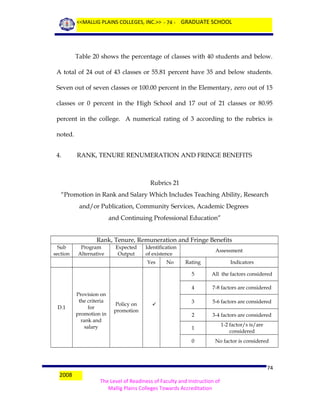
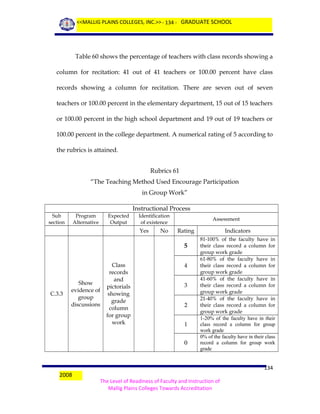
  • 45.
    <<MALLIG PLAINS COLLEGES,INC.>> - 45 - GRADUATE SCHOOL Graduate Degree is Satisfactory Academic Qualification Sub section Program Alternative Expected Output Identification of existence Yes No Assessment Ranking 5 4 A.2 Appropriate attractive salary scale to be able to hire MA and Ph.D. degree holders Qualified Faculty Members 3  2 1 0 Indicators 81- 100% of the faculty members are qualified 61-80% of the faculty members are qualified 41-60% of the faculty members are qualified 21-40% of the faculty members are qualified 1-20% of the faculty members are qualified 0% of the faculty members are qualified Table 2 Frequency Distribution of Teachers Having Earned 2008 45 The Level of Readiness of Faculty and Instruction of Mallig Plains Colleges Towards Accreditation
  • 46.
    <<MALLIG PLAINS COLLEGES,INC.>> - 46 - GRADUATE SCHOOL Graduate Degree Courses Actual Number of Faculty Members Qualified Faculty Members Percentage Elementary 7 7 100.00 High School 15 14 93.33 College 19 2 10.52 Graduate School 10 10 100.00 51 34 66.67 4 DEPARTMENT TOTAL NUMERICAL RATING Table 2 shows the breakdown of the qualified faculty members for each level. Seven out of seven or 100 percent in the elementary teachers are qualified, 14 out of 15 or 93.33 percent of the faculty in the high school are qualified. Due to verticalization policy by CHED, there are two out of 19 or 10.52 percent who are qualified. To sum up, there are 34 out of 51 or 66.67 percent of the faculty who are qualified enough to be part of the academic community, resulting to a numerical rating of 4, based on the range of percentage presented in the rubrics-based PACUCOA instrument. Rubrics 3 Faculty Members Teach Courses in Their Field of Specialization 2008 46 The Level of Readiness of Faculty and Instruction of Mallig Plains Colleges Towards Accreditation
  • 47.
    <<MALLIG PLAINS COLLEGES,INC.>> - 47 - GRADUATE SCHOOL Academic Qualification Sub section Program Alternative Expected Output Identification of existence Yes No Assessment 81-100% of the faculty members teach their line of specialization 61-80% of the faculty members teach their line of specialization 41-60% of the faculty members teach their line of specialization 21-40% of the faculty members teach their line of specialization 1-20% of the faculty members teach their line of specialization 0% of the faculty of the faculty members teach their line of specialization 5 Faculty should only be assigned to their line of specialization A.3 4 Qualified Faculty members teach their line of specialization Indicators Ranking 3  2 1 0 Table 3 Frequency Distribution of Teachers Teaching their Field of Specialization Number of Faculty Members Qualified Faculty Members Percentage Elementary 7 7 100.00 High School 15 14 93.33 College 19 2 10.52 Graduate School 10 10 100.00 51 34 66.67 4 DEPARTMENT TOTAL NUMERICAL RATING Table 3 shows the breakdown of faculty members who teach their line of specialization, seven out of seven teachers or 100 percent are qualified in the Elementary, 14 out of 15 teachers or 93.33 percent are qualified in the high 2008 47 The Level of Readiness of Faculty and Instruction of Mallig Plains Colleges Towards Accreditation
  • 48.
    <<MALLIG PLAINS COLLEGES,INC.>> - 48 - GRADUATE SCHOOL school. Due to the verticalization of CHED, only two out of 19 or 10.52 percent college teachers are qualified. A numerical rating of 4 is achieved based on the range of percentage presented in the rubrics-based PACUCOA instrument. Rubrics 4 Deficiencies in Graduate Degrees of Faculty Members are Compensated by Other Qualifications Such as Satisfactory Teaching Experience and Professional Practice Academic Qualification Sub section Program Alternative Expected Output Identification of existence Yes No Assessment Ranking 5 A.4 Seminars and In-service training Satisfactory Teaching experience and professional practice 4 3  2 1 0 Indicators 81-100% of the faculty members have satisfactory teaching experience 61-80% of the faculty members have satisfactory teaching experience 41-60% of the faculty members have satisfactory teaching experience 21-40% of the faculty members have satisfactory teaching experience 1-20% of the faculty members have satisfactory teaching experience 0% of the faculty members have satisfactory teaching experience Table 4 Frequency Distribution of Satisfactory Teaching Experience and Professional Practice 2008 48 The Level of Readiness of Faculty and Instruction of Mallig Plains Colleges Towards Accreditation
  • 49.
    <<MALLIG PLAINS COLLEGES,INC.>> - 49 - GRADUATE SCHOOL Actual Number of Faculty Members Faculty with at least 3 years of experience Percentage Elementary 7 5 71.43 High School 15 6 40.00 College 19 13 68.42 41 24 58.54 DEPARTMENT TOTAL NUMERICAL RATING 3 Table 4 shows the percentage of Faculty members with at least 3 years of teaching experience. A total of 24 out of 41 faculty members or 58.54 percent have more than three years of teaching experience. Five out of seven teachers or 71.43 percent are qualified in the Elementary, six out of 15 teachers or 40.00 percent are qualified in the High School and 13 out of 19 teachers or 68.42 percent are qualified in the college department. A numerical rating of 3 according to rubrics-based PACUCOA instrument is given.. 2008 49 The Level of Readiness of Faculty and Instruction of Mallig Plains Colleges Towards Accreditation
  • 50.
    <<MALLIG PLAINS COLLEGES,INC.>> - 50 - GRADUATE SCHOOL Rubrics 5 Faculty Members Assigned to Practicum Courses Have at Least Three Years of Experience in Their Specialized Field of Study Academic Qualification Sub section Program Alternative Expected Output Identification of existence Yes No Assessment Rating 5 A.5 Only faculty having 3 years and above experience in their field of specialization should be hired 4 Practicum subjects to be handled by the Faculty 3  2 1 0 Indicators 81-100% of the faculty members have satisfactory teaching experience 61-80% of the faculty members have satisfactory teaching experience 41-60% of the faculty members have satisfactory teaching experience 21-40% of the faculty members have satisfactory teaching experience 1-20% of the faculty members have satisfactory teaching experience 0% of the faculty members have satisfactory teaching experience Table 5 Frequency Distribution of the Number of Years of Experience of the Faculty Assigned to Practicum Courses Elementary High School College TOTAL Actual Number of Faculty Members Faculty that handles Practicum subjects with at least 3 years of experience Percentage 7 15 19 41 DEPARTMENT 5 10 17 32 71.43 66.67 89.47 78.05 NUMERICAL RATING 2008 4 50 The Level of Readiness of Faculty and Instruction of Mallig Plains Colleges Towards Accreditation
  • 51.
    <<MALLIG PLAINS COLLEGES,INC.>> - 51 - GRADUATE SCHOOL Table 5 shows the percentage of Faculty members teaching practicum courses with at least 3 years. A total of 32 out of 41 faculty members or 78.05% have more than three years of teaching experience in their field of specialization. Five out of seven teachers or 71.43 percent are qualified in the Elementary, 10 out of 15 teachers or 66.67 percent are qualified in the High School and 13 out of 19 teachers or 89.47 percent are qualified in the college. A numerical rating of 4 is achieved according to the rubrics–based PACUCOA instrument. Rubrics 6 Faculty Members are Updated on Global Issues and Technology Academic Qualification Sub section Program Alternativ e Expected Output Identification of existence Yes No Assessment 5 A.6 Special Studies in global issues and technology Faculty equipped with knowledge of global issues and technology Indicators Ranking 4 3  2 1 0 81-100% of the faculty members are knowledgeable about global issues 61-80% of the faculty members are knowledgeable about global issues 41-60% of the faculty members are knowledgeable about global issues 21-40% of the faculty members are knowledgeable about global issues 1-20% of the faculty members are knowledgeable about global issues 0% of the faculty members are knowledgeable about global issues Table 6 2008 51 The Level of Readiness of Faculty and Instruction of Mallig Plains Colleges Towards Accreditation
  • 52.
    <<MALLIG PLAINS COLLEGES,INC.>> - 52 - GRADUATE SCHOOL Frequency Distribution of the Faculty Members Equipped with Knowledge on Global Issues and Technology Actual Number of Faculty Faculty Equipped with Knowledge of Global Issues and Technology Percentage Elementary 7 5 71.43 High School 15 14 93.33 College 19 19 100.00 Graduate School 10 10 100.00 51 48 94.12 DEPARTMENT TOTAL NUMERICAL RATING 5 Table 6 shows that a total of 48 out of 51 faculty members or 94.12%% are equipped with enough knowledge on global issues and technology. In the elementary, five out of seven teachers or 71.43 percent are equipped with knowledge in global issues & technology, 14 out of 15 teachers or 93.33 percent in the High School, 19 out of 19 teachers or 100 percent in the college, and 10 out of 10 teachers or 100 percent in the Graduate School. This results to a numerical rating of 5 according to the rubrics–based PACUCOA instrument. 2. 2008 PROFESSIONAL PERFORMANCE 52 The Level of Readiness of Faculty and Instruction of Mallig Plains Colleges Towards Accreditation
  • 53.
    <<MALLIG PLAINS COLLEGES,INC.>> - 53 - GRADUATE SCHOOL Rubrics 7 Faculty Members Endeavor to Implement the Purposes and Objectives of the Institution and the Specific Objectives of the College Under Survey Professional Performance Sub section Program Alternative Expected Output Identification of existence Yes No Assessment Rating 5 4 B.1 Include this in the syllabi and introduction to every class orientation Vision and Mission in each of the syllabus 3 X 2 1 0 2008 Indicators 81-100% of the syllabus of the faculty include mission and vision of MPC 61-80% of the syllabus of the faculty include mission and vision of MPC 41-60% of the syllabus of the faculty include mission and vision of MPC 21-40% of the syllabus of the faculty include mission and vision of MPC 1-20% of the syllabus of the faculty include mission and vision of MPC 0% of the syllabus of the faculty include mission and vision of MPC 53 The Level of Readiness of Faculty and Instruction of Mallig Plains Colleges Towards Accreditation
  • 54.
    <<MALLIG PLAINS COLLEGES,INC.>> - 54 - GRADUATE SCHOOL Table 7 Frequency Distribution of Teachers who Include Vision, Mission, Goals and Objectives of the Institution in Their Syllabi Actual Number of Faculty Teachers who include vision, mission, goals and objectives of the institution in their syllabi Percentage Elementary 7 0 0 High School 15 0 0 College 19 0 0 Graduate School 10 0 0 51 0 0 DEPARTMENT TOTAL NUMERICAL RATING 0 Table 7 shows the frequency distribution of teachers who include vision, mission, goals and objectives of the institution in their syllabi. Zero out of 51 faculty members include vision, mission, goals and objectives of the institution in their syllabi. A numerical rating of 0 according to the rubrics is taken. Rubrics 8 Follow the Syllabi and Enrich Them Through Additional Reading 2008 54 The Level of Readiness of Faculty and Instruction of Mallig Plains Colleges Towards Accreditation
  • 55.
    <<MALLIG PLAINS COLLEGES,INC.>> - 55 - GRADUATE SCHOOL Professional Performance Sub section Program Alternative Expected Output Identification of existence Yes No Assessment Rating 5 B.2 Require students to submit book reports and current issues reports 4 Student book reports 3  2 1 0 Indicators 81-100% of the faculty have compilation of students’ book reports 61-80% of the faculty have compilation of students’ book reports 41-60% of the faculty have compilation of students’ book reports 21-40% of the faculty have compilation of students’ book reports 1-20% of the faculty have compilation of students’ book reports 0% of the faculty have compilation of students’ book reports Table 8 Frequency Distribution of Faculty with Compilation of Student’s Book Reports Actual Number of faculty Faculty with compilation of student’s book reports Percentage Elementary 7 0 0 High School 15 0 0 College 19 3 15.79 Graduate School 10 10 100.00 51 13 25.49 DEPARTMENT TOTAL NUMERICAL RATING 2 Table 8 shows the percentage of Faculty members with compilations of student’s book reports. A total of 13 out of 51 faculty members or 25.49% 2008 55 The Level of Readiness of Faculty and Instruction of Mallig Plains Colleges Towards Accreditation
  • 56.
    <<MALLIG PLAINS COLLEGES,INC.>> - 56 - GRADUATE SCHOOL have student book reports compilation. There are no book reports compilation from faculty members in both the Elementary and High School. Three out of 19 teachers in the college or 15.79 percent have. Ten out of 10 teachers in the Graduate School or 100 percent have compilation. The result has a numerical rating of 2 according to the rubrics. Rubrics 9 “Show Mastery of Subject Matter” Professional Performance Sub section Program Alternative Expected Output Identification of existence Yes No Assessment Rating 5 B.3 This should be evident by the observation and evaluation reports 4 Class observation reports  3 2 1 0 2008 Indicators 81-100% of the faculty were observed by the administrators 61-80% of the faculty were observed by the administrators 41-60% of the faculty were observed by the administrators 21-40% of the faculty were observed by the administrators 1-20% of the faculty were observed by the administrators 0% of the faculty were observed by the administrators 56 The Level of Readiness of Faculty and Instruction of Mallig Plains Colleges Towards Accreditation
  • 57.
    <<MALLIG PLAINS COLLEGES,INC.>> - 57 - GRADUATE SCHOOL Table 9 Frequency Distribution of Teachers who were Observed by the Administrators Actual Number of Faculty Member Faculty observed by the administrators Percentage Elementary 7 6 85.71 High School 15 11 73.33 College 19 15 78.95 41 32 78.05 DEPARTMENT TOTAL 4 NUMERICAL RATING Table 9 shows the percentage of faculty members who were observed by the administrators. A total of 32 out of 41 faculty members or 58.54 percent were observed. Six out of seven teachers or 85.71 percent were observed in the Elementary, 11 out of 15 teachers or 73.33 percent in the High School, and 15 out of 19 teachers or 78.95 percent in the college. The result has a numerical rating of 4 according to the rubrics. 2008 57 The Level of Readiness of Faculty and Instruction of Mallig Plains Colleges Towards Accreditation
  • 58.
    <<MALLIG PLAINS COLLEGES,INC.>> - 58 - GRADUATE SCHOOL Rubrics 10 “Show Evidence of Preparedness for Classes” Professional Performance Sub section Program Alternative Expected Output Identification of existence Yes Assessment No Rating 81-100% of the faculty have notes on daily exercises 61-80% of the faculty have notes on daily exercises 41-60% of the faculty have notes on daily exercises 21-40% of the faculty have notes on daily exercises 1-20% of the faculty have notes on daily exercises 0% of the faculty have notes on daily exercises 5 Require faculty to have objective evidence of prepared daily practical exercises B.4 4 Notes on daily exercises 3  Indicators 2 1 0 Table 10 Frequency Distribution of Teachers with Notes on Daily Exercises Actual Number of faculty Faculty with notes on daily exercises Percentage Elementary 7 5 71.43 High School 15 14 93.33 College 19 19 100.00 Graduate School 10 10 100.00 51 48 94.12 DEPARTMENT TOTAL NUMERICAL RATING 2008 5 58 The Level of Readiness of Faculty and Instruction of Mallig Plains Colleges Towards Accreditation
  • 59.
    <<MALLIG PLAINS COLLEGES,INC.>> - 59 - GRADUATE SCHOOL Table 10 shows the percentage of Faculty members with notes on daily exercises. A total of 48 out of 51 faculty members or 94.12 percent have notes, with five out of seven teachers or 71.43 percent in the Elementary, 14 out of 15 teachers or 40.00 percent in the High School, 19 out of 19 teachers or 100.00 percent in the college, and 10 out of 10 teachers or 100.00 percent in the Graduate School. A numerical rating of 5 according to the rubrics is attained. Rubrics 11 Faculty Members are Aware of Recent Educational Trends and Problems and are Able to Relate Subject Matter to Current Local and Global Issues Professional Performance Sub section Program Alternative Expected Output Identification of existence Yes No Assessment Rating 5 4 B.5 Special Studies in global issues and technology Global issue reports 3 X 2 1 0 2008 Indicators 81-100% of the faculty members are knowledgeable about global issues 61-80% of the faculty members are knowledgeable about global issues 41-60% of the faculty members are knowledgeable about global issues 21-40% of the faculty members are knowledgeable about global issues 1-20% of the faculty members are knowledgeable about global issues 0% of the faculty members are knowledgeable about global issues 59 The Level of Readiness of Faculty and Instruction of Mallig Plains Colleges Towards Accreditation
  • 60.
    <<MALLIG PLAINS COLLEGES,INC.>> - 60 - GRADUATE SCHOOL Table 11 Frequency Distribution of Faculty Members who are Aware of Recent Educational Trends and Problems and are Able to Relate Subject Matter to Current Local and Global Issues Actual Number of Faculty Teachers who are knowledgeable about global issues Percentage Elementary 7 0 0 High School 15 0 0 College 19 0 0 TOTAL 41 0 0 DEPARTMENT NUMERICAL RATING 0 Table 11 shows the frequency distribution of teachers who are knowledgeable about global issues. Zero out of 41 faculty members are knowledgeable on the said issue. A numerical rank of 0 according to the PACUCOA-based rubrics is taken. 2008 60 The Level of Readiness of Faculty and Instruction of Mallig Plains Colleges Towards Accreditation
  • 61.
    <<MALLIG PLAINS COLLEGES,INC.>> - 61 - GRADUATE SCHOOL RUBRICS 12 Evidence of Effective Use of Library, Internet, Instructional Media and Other Instructional Devices Professional Performance Sub section Program Alternative Expected Output Identification of existence Yes No Assessment Rating Indicators 3 81-100% of the faculty use internet and multi-media resources 61-80% of the faculty use internet and multi-media resources 41-60% of the faculty use internet and multi-media resources 2 21-40% of the faculty use internet and multi-media resources 1 1-20% of the faculty use internet and multi-media resources 0 0% of the faculty use internet and multi-media resources 5 Present logbook of internet access and multimedia usage in classroom B.6 4 Logbook for internet and multimedia usage  Table12 Frequency Distribution of Teachers with Logbook for Internet and Multi-Media Usage Elementary High School College Graduate School TOTAL Actual Number of Faculty Member Faculty with logbook for internet and multimedia usage 7 15 19 10 51 DEPARTMENT 2 4 11 4 21 NUMERICAL RATING 2008 Percentage 28.57 26.67 57.89 40.00 41.18 3 61 The Level of Readiness of Faculty and Instruction of Mallig Plains Colleges Towards Accreditation
  • 62.
    <<MALLIG PLAINS COLLEGES,INC.>> - 62 - GRADUATE SCHOOL Table 12 shows the percentage of faculty members with logbook for internet and multimedia usage. A total of 21 out of 51 faculty members or 41.18 percent do have logbooks. Two out of seven teachers or 28.57 percent in the Elementary, four out of 15 teachers or 26.67 percent in the High School, 11 out of 19 teachers or 57.89 percent in the college and 10 out of 10 teachers or 100 percent in the Graduate School have logbook. This feature has a numerical rating of 3 according to the rubrics. Rubrics 13 “Show Evidences of Professional Growth Through Research Activity and Publication and/or Membership in Recognized Educational Organization and Association” Professional Performance Sub section Program Alternative Expected Output Identification of existence Yes No Assessment Rating 5 B.7 Require faculty to engage in group research and encourage them to join Research Organizations Compilati on of researches and actual uploading of membership 4 3  2 1 0 Indicators 81-100% of the faculty submitted their compiled action researches 61-80% of the faculty submitted their compiled action researches 41-60% of the faculty submitted their compiled action researches 21-40% of the faculty submitted their compiled action researches 1-20% of the faculty submitted their compiled action researches 0% of the faculty submitted their compiled action researches Table 13 2008 62 The Level of Readiness of Faculty and Instruction of Mallig Plains Colleges Towards Accreditation
  • 63.
    <<MALLIG PLAINS COLLEGES,INC.>> - 63 - GRADUATE SCHOOL Frequency Distribution of Teachers with Compiled Action Researches Actual Number of Faculty Member Faculty with compilation of action researches Percentage Elementary 7 7 100.00 High School 15 15 100.00 College 19 19 100.00 Graduate School 10 10 100.00 51 51 100.00 DEPARTMENT TOTAL NUMERICAL RATING 5 Table 13 shows the percentage of faculty members with compilation of action researches. A total of 51 out of 51 faculty members or 100.00 percent submit action researches to help the administration in overseeing problems within the school. Seven out of seven teachers or 100.00 percent in the Elementary, 154 out of 15 teachers or 100.00 percent in the High School, 19 out of 19 teachers or 100.00 percent in the college, and 10 out of 10 teachers or 100 percent in the Graduate School. A numerical rating of 5 according to the rubrics is achieved. 3. 2008 TEACHING ASSIGNMENT 63 The Level of Readiness of Faculty and Instruction of Mallig Plains Colleges Towards Accreditation
  • 64.
    <<MALLIG PLAINS COLLEGES,INC.>> - 64 - GRADUATE SCHOOL Rubrics 14 “A Policy of Determining Teaching Assignments is Adopted and Followed” Teaching Assignment Sub section Program Alternative Expected Output Identification of existence Yes No Assessment Rating 5 4 C.1 Adoption of determining teacher’s assignment Policy on teaching assignment 3  2 1 0 Indicators 81-100% of the faculty have 24 maximum loads with 3 preparations 61-80% of the faculty have 24 maximum loads with 4 preparations 41-60% of the faculty have 24 maximum loads with 5 preparations 21-40% of the faculty have 24 maximum loads with 6 preparations 1-20% of the faculty have 24 maximum loads with 7 preparations None of the above Table 14 Frequency Distribution of Teachers with Maximum Load of 24 units Actual Number of faculty Faculty with maximum load of 24 units Percentage Elementary 7 0 0 High School 15 3 20.00 College TOTAL 19 41 15 18 78.95 43.90 3 DEPARTMENT NUMERICAL RATING Table 14 shows the percentage of faculty members with maximum load of 24 units. A total of 18 out of 41 faculty members or 43.90 percent do 2008 64 The Level of Readiness of Faculty and Instruction of Mallig Plains Colleges Towards Accreditation
  • 65.
    <<MALLIG PLAINS COLLEGES,INC.>> - 65 - GRADUATE SCHOOL have a maximum load; zero out of seven teachers or zero percent in the Elementary, three out of 15 teachers or 20.00 percent in the High School, and 15 out of 19 teachers or 78.95 percent in the college. A numerical rating of 3 according to the rubrics is taken. Rubrics 15 “The Percentage of Faculty Members Employed on a Full-time Basis Meets Accreditation Requirements” Teaching Assignment Sub section Program Alternative Expected Output Identification of existence Yes No Assessment Rating 5 4 C.2 percentage of full time instructors against part time percentage of full time instructors against part time 3  2 1 0 Indicators 81-100% of the faculty members are full-time instructors 61-80% of the faculty members are full-time instructors 41-60% of the faculty members are full-time instructors 21-40% of the faculty members are full-time instructors 1-20% of the faculty members are full-time instructors 0% of the faculty members are full-time instructors Table 15 Frequency Distribution of Full Time Faculty Instructors 2008 65 The Level of Readiness of Faculty and Instruction of Mallig Plains Colleges Towards Accreditation
  • 66.
    <<MALLIG PLAINS COLLEGES,INC.>> - 66 - GRADUATE SCHOOL Actual Number of faculty Full Time Faculty Instructors Percentage Elementary 7 7 100.00 High School 15 15 100.00 College 19 19 100.00 Graduate School 10 4 40.00 51 45 88.24 DEPARTMENT TOTAL NUMERICAL RATING 5 Table 15 shows the percentage of Full time faculty members. A total of 45 out of 51 faculty members or 88.24 percent are full time instructors. Seven out of seven teachers or 100.00 in the Elementary, 15 out of 15 teachers or 100.00 percent in the High School, 19 out of 19 teachers or 100.00 percent in the college, and four out of 10 teachers or 40.00 percent in the Graduate School. A numerical rating of 5 according to the rubrics is achieved. 2008 66 The Level of Readiness of Faculty and Instruction of Mallig Plains Colleges Towards Accreditation
  • 67.
    <<MALLIG PLAINS COLLEGES,INC.>> - 67 - GRADUATE SCHOOL Rubrics 16 “Faculty Members are Given Teaching Assignment Only In Their Major Fields of Specialization” Teaching Assignment Sub section Program Alternative Expected Output Identification of existence Yes No Assessment Rating Indicators 3 81-100% of the faculty members teach their field of specialization 61-80% of the faculty members teach their field of specialization 41-60% of the faculty members teach their field of specialization 2 21-40% of the faculty members teach their field of specialization 1 1-20% of the faculty members teach their field of specialization 0 0% of the faculty members teach their field of specialization 5 4 C.3 Teacher’s schedule showing qualification Teacher’s schedule showing qualification  Table 16 Frequency Distribution of Teachers who Teach their Field of Specialization DEPARTMENT Actual Number of faculty Faculty members who teach their field of specialization Elementary High School College Graduate School TOTAL 7 15 19 10 51 7 14 2 10 34 NUMERICAL RATING 2008 Percentage 100.00 93.33 10.52 100.00 66.67 5 67 The Level of Readiness of Faculty and Instruction of Mallig Plains Colleges Towards Accreditation
  • 68.
    <<MALLIG PLAINS COLLEGES,INC.>> - 68 - GRADUATE SCHOOL Table 16 shows the breakdown of faculty members who teach their line of specialization. Seven out of seven teachers or 100 percent are qualified in the Elementary, 14 out of 15 teachers or 93.33 percent are qualified in the high school. Due to the verticalization of CHED, only two out of 19 or 10.52 percent college teachers are qualified. A numerical rating of 4 is achieved based on the range of percentage presented in the rubrics-based PACUCOA instrument. Rubrics 17 “Teaching Loads of Faculty Members (Both Full-time and Part-time) Allow Sufficient Time for Preparation of Classes and Adequate Evaluation of Student Achievement” Teaching Assignment Sub section Program Alternative Expected Output Identification of existence Yes C.4 There should be no three consecutive lecture classes assigned to each faculty + B.4 2008 Class schedule showing that teachers have no 3 consecutive hours lecturing in his classes No Assessment Rating 5 4  3 2 1 0 Indicators 81-100% of the faculty do not teach 3 consecutive hours 61-80% of the faculty do not teach 3 consecutive hours 41-60% of the faculty do not teach 3 consecutive hours 21-40% of the faculty do not teach 3 consecutive hours 1-20% of the faculty do not teach 3 consecutive hours 0% of the faculty do not teach 3 consecutive hours 68 The Level of Readiness of Faculty and Instruction of Mallig Plains Colleges Towards Accreditation
  • 69.
    <<MALLIG PLAINS COLLEGES,INC.>> - 69 - GRADUATE SCHOOL Table 17 Frequency Distribution of Teachers with No 3 Consecutive Teaching Hours Actual Number of faculty Teachers with no 3 consecutive teaching hours Percentage Elementary 7 7 100.00 High School 15 15 100.00 College 19 14 73.68 41 36 87.80 DEPARTMENT TOTAL NUMERICAL RATING 5 Table 17 shows the percentage of faculty members with no three consecutive teaching hours. A total of 36 out of 51 faculty members or 87.80 percent do not have three consecutive teaching hours. Seven out of seven teachers or 100.00 percent in the Elementary, 15 out of 15 teachers or 100.00 percent in the High School and 14 out of 19 teachers or 73.68 percent in the college do not engage themselves teaching for three consecutive hours. A numerical rating of 5 according to rubrics is noted. 2008 69 The Level of Readiness of Faculty and Instruction of Mallig Plains Colleges Towards Accreditation
  • 70.
    <<MALLIG PLAINS COLLEGES,INC.>> - 70 - GRADUATE SCHOOL Rubrics 18 “The Quality of Teacher Performance is Considered When Assigning Faculty Load” Teaching Assignment Sub section Program Alternative Expected Output Identification of existence Yes No Assessment Rating 5 4 C.5 The quality of instruction a teacher has Policy on teaching assignment 3  2 1 0 Indicators 81-100% of the faculty satisfactory performance 61-80% of the faculty satisfactory performance 41-60% of the faculty satisfactory performance 21-40% of the faculty satisfactory performance have have have have 1-20% of the faculty have satisfactory performance 0% of the faculty have teaching assignment Table 18 Frequency Distribution of Teachers with Satisfactory Performance Actual Number of faculty Faculty with satisfactory performance Percentage Elementary 7 5 71.43 High School 15 12 80.00 College 19 18 94.74 Graduate School 10 10 100.00 51 45 88.24 DEPARTMENT TOTAL NUMERICAL RATING 2008 5 70 The Level of Readiness of Faculty and Instruction of Mallig Plains Colleges Towards Accreditation
  • 71.
    <<MALLIG PLAINS COLLEGES,INC.>> - 71 - GRADUATE SCHOOL Table 18 shows the percentage of faculty members with satisfactory performance. A total of 45 out of 51 faculty members or 88.24percent have satisfactory performance, five out of seven teachers or 71.43 percent in the Elementary, 12 out of 15 teachers or 80.00 percent in the High School, 18 out of 19 teachers or 94.74 percent in the college and 10 out of 10 teachers or 100 percent in the Graduate School. A numerical rating of 5 according to the rubrics is achieved. This performance rating of teachers is based on the records without having verified the objectivity of the instrument used in the evaluation. Rubrics 19 “Provision is Made for the Distribution of Extra Class Responsibilities of Faculty Members” Teaching Assignment Sub section Program Alternative Expected Output Identification of existence Yes No Assessment Rating 3 81-100% of the faculty have extra class assignment 61-80% of the faculty have extra class assignment 41-60% of the faculty have extra class assignment 2 21-40% of the faculty have extra class assignment 5 4 C.6 A responsibility checklist showing extra class assignments Policy on extra class assignment Indicators  1 0 1-20% of the faculty have extra class assignment 0% of the faculty have extra class assignment Table 19 2008 71 The Level of Readiness of Faculty and Instruction of Mallig Plains Colleges Towards Accreditation
  • 72.
    <<MALLIG PLAINS COLLEGES,INC.>> - 72 - GRADUATE SCHOOL Frequency Distribution of Teachers with Extra Class Assignment Number of faculty Faculty with Extra Class Assignment Percentage Elementary 7 7 100.00 High School 15 15 100.00 College 19 19 100.00 Graduate School 10 4 40.00 51 45 88.24 DEPARTMENT TOTAL NUMERICAL RATING 5 Table 19 shows the percentage of faculty members with extra class assignment. A total of 45 out of 51 faculty members or 88.24 percent have extra class assignment, seven out of 7 teachers or 100.00 percent in the Elementary, 15 out of 15 teachers or 100.00 percent in the High School, 19 out of 19 teachers or 100.00 percent in the college and four out of 10 teachers or 40 percent in the Graduate School. A numerical rating of 5 according to the rubrics is attained. Rubrics 20 2008 72 The Level of Readiness of Faculty and Instruction of Mallig Plains Colleges Towards Accreditation
  • 73.
    <<MALLIG PLAINS COLLEGES,INC.>> - 73 - GRADUATE SCHOOL “Student-Faculty Ratio is Generally Satisfactory” Teaching Assignment Sub section Program Alternative Expected Output Identification of existence Yes No Assessment Rating 5 4 C.7 Enrolmen t status per class Enrolmen t status per class 3  2 1 0 Indicators 81-100% of the classes have 35:1 student-teacher ratio 61-80% of the classes have 35:1 student-teacher ratio 41-60% of the classes have 35:1 student-teacher ratio 21-40% of the classes have 35:1 student-teacher ratio 1-20% of the classes have 35:1 student-teacher ratio 0% of the classes have 35:1 student-teacher ratio Table 20 Frequency Distribution of Classes with 40 Students and below Actual Number of Class Classes with 40 students and below Percentage Elementary 7 7 100.00 High School 15 0 0 College 21 17 80.95 43 24 55.81 3 DEPARTMENT TOTAL NUMERICAL RATING 2008 73 The Level of Readiness of Faculty and Instruction of Mallig Plains Colleges Towards Accreditation
  • 74.
    <<MALLIG PLAINS COLLEGES,INC.>> - 74 - GRADUATE SCHOOL Table 20 shows the percentage of classes with 40 students and below. A total of 24 out of 43 classes or 55.81 percent have 35 and below students. Seven out of seven classes or 100.00 percent in the Elementary, zero out of 15 classes or 0 percent in the High School and 17 out of 21 classes or 80.95 percent in the college. A numerical rating of 3 according to the rubrics is noted. 4. RANK, TENURE RENUMERATION AND FRINGE BENEFITS Rubrics 21 “Promotion in Rank and Salary Which Includes Teaching Ability, Research and/or Publication, Community Services, Academic Degrees and Continuing Professional Education” Rank, Tenure, Remuneration and Fringe Benefits Sub section Program Alternative Expected Output Identification of existence Yes 2008  All the factors considered 7-8 factors are considered 3 5-6 factors are considered 2 3-4 factors are considered 1 1-2 factor/s is/are considered 0 Policy on promotion Indicators 4 D.1 Rating 5 Provision on the criteria for promotion in rank and salary No Assessment No factor is considered 74 The Level of Readiness of Faculty and Instruction of Mallig Plains Colleges Towards Accreditation
  • 75.
    <<MALLIG PLAINS COLLEGES,INC.>> - 75 - GRADUATE SCHOOL Table 21 The Criteria for Promotion in Rank and Salary DEPARTMENT 1 2 3 4 5 Total Percentage Elementary √ √ X √ √ 4 80.00 High School √ √ X √ √ 4 80.00 College √ √ X √ √ 4 80.00 4 80.00 TOTAL NUMERICAL RATING 4 Table 21 shows that the 4 out of 5 policies on the promotion of faculty are being observed. A numerical rating of 4 according to the rubrics is achieved. 2008 75 The Level of Readiness of Faculty and Instruction of Mallig Plains Colleges Towards Accreditation
  • 76.
    <<MALLIG PLAINS COLLEGES,INC.>> - 76 - GRADUATE SCHOOL Rubrics 22 “In the Application of the Criteria, the Recommendation of College Administrators, Department Chairpersons, Students, Peer Groups and Others” Rank, Tenure, Remuneration and Fringe Benefits Sub section Program Alternative Expected Output Identification of existence Yes No Assessment Rating 5 4 D.2 Provision on the application of D.1 3 Policy on promotion  2 1 0 Indicators All the identified personalities have a say in the promotion of a faculty Only 4 of the identified personalities have a say in the promotion of a faculty Only 3of the identified personalities have a say in the promotion of a faculty Only 2of the identified personalities have a say in the promotion of a faculty Only 1of the identified personalities have a say in the promotion of a faculty None of the identified personalities have a say in the promotion of a faculty Table 22 The Groups Who are Entitled to Recommend Faculty for Promotion DEPARTMENT Elementary High School College College Administrators Dep’t Chairperson Students Peer Groups Others TOTAL Percentage √ √ √ X X X X X X X X X X X X 1 1 1 20.00 20.00 20.00 1 20.00 1 AVERAGE NUMERICAL RATING 2008 76 The Level of Readiness of Faculty and Instruction of Mallig Plains Colleges Towards Accreditation
  • 77.
    <<MALLIG PLAINS COLLEGES,INC.>> - 77 - GRADUATE SCHOOL Table 22 shows that only College administrators have a say on the policy on promotions of faculty. A numerical rating of 1 according to the rubrics is taken. Rubrics 23 “The Salary Rates are Adequate in Meeting the Economic and Social Demands of the Profession” Rank, Tenure, Remuneration and Fringe Benefits Sub section Program Alternative Expected Output Identification of existence Yes No Assessment Rating 5 4 D.3 Research output to prove economic viability of salaries Satisfactor y salary rates of faculty 3  2 1 Indicators 81-100% of the faculty receiving salary above minimum wage 61-80% of the faculty receiving salary above minimum wage 41-80% of the faculty receiving salary above minimum wage 21-40% of the faculty receiving salary above minimum wage 1-20% of the faculty receiving salary above minimum wage are the are the are the are the are the 0 Table 23 2008 77 The Level of Readiness of Faculty and Instruction of Mallig Plains Colleges Towards Accreditation
  • 78.
    <<MALLIG PLAINS COLLEGES,INC.>> - 78 - GRADUATE SCHOOL Frequency Distribution of Teachers Receiving Above Minimum Wage Actual Number of faculty Faculty members receiving above minimum wage Percentage Elementary 7 2 28.57 High School 15 8 53.33 College 19 18 94.74 41 28 68.29 DEPARTMENT TOTAL NUMERICAL RATING 4 Table 23 shows the percentage of faculty members receiving above minimum wage. There are 28 out of 41 faculty members or 68.29 percent who receive above minimum wage; two out of seven teachers or 28.57 percent in the elementary, eight out of 15 teachers or 53.33 percent in the high school and 18 out of 19 teachers or 94.74 percent in the College. A numerical rank of 4 according to the rubrics is achieved. Rubrics 24 2008 78 The Level of Readiness of Faculty and Instruction of Mallig Plains Colleges Towards Accreditation
  • 79.
    <<MALLIG PLAINS COLLEGES,INC.>> - 79 - GRADUATE SCHOOL “The Benefits and Responsibility of Tenure are Clearly Described in the Faculty Manual or Elsewhere” Rank, Tenure, Remuneration and Fringe Benefits Sub section Program Alternative Expected Output Identification of existence Yes No Assessment Rating 5 4 Resolve policy of tenure D.4 Policy of tenure  3 2 1 0 Indicators 81-100% of the policy are being observed 61-80% of the policy are being observed 41-60% of the policy are being observed 21-40% of the policy are being observed 1-20% of the policy are being observed There is no policy on tenure being made Table 24 Frequency Distribution of Permanent Teachers Actual Number of Faculty Permanent Percentage Elementary 7 6 85.71 High School 15 8 53.33 College 19 12 63.16 Graduate School TOTAL 10 51 4 30 40.00 58.82 3 DEPARTMENT NUMERICAL RATING Table 24 shows the percentage of permanent faculty members. A total of 30 out of 51 faculty members or 58.82 percent are permanent. Six out of 2008 79 The Level of Readiness of Faculty and Instruction of Mallig Plains Colleges Towards Accreditation
  • 80.
    <<MALLIG PLAINS COLLEGES,INC.>> - 80 - GRADUATE SCHOOL seven teachers or 85.71 percent in the Elementary, eight out of 15 teachers or 53.33 percent in the High School, 12 out of 19 teachers or 63.16 percent in the college, and four out of 10 professors or 40 percent in the Graduate School. A numerical rating of 3 according to the rubrics is achieved. Rubrics 25 “There are Definite Policies for Termination of Employment” Rank, Tenure, Remuneration and Fringe Benefits Sub section Program Alternative Expected Output Identification of existence Yes No Assessment Rating 5 4 D.5 Develop guidelines for policy on termination Policy on termination  3 2 1 0 2008 Indicators 81-100% of the policy are being observed 61-80% of the policy are being observed 41-60% of the policy are being observed 21-60% of the policy are being observed 1-20% of the policy are being observed There is no policy on termination being made 80 The Level of Readiness of Faculty and Instruction of Mallig Plains Colleges Towards Accreditation
  • 81.
    <<MALLIG PLAINS COLLEGES,INC.>> - 81 - GRADUATE SCHOOL Table 25 shows that 12 out of 13 or 92.31 percent of the policies on termination are being observed: 12 out of 13 policies or 92.31 percent in the elementary, 12 out of 13 policies or 92.31 percent in the high school, 12 out of 13 policies or 92.31 percent in the college and 12 out of 13 policies or 92.31 percent in the Graduate School. A numerical rating of 5 according to the rubrics is attained. Rubrics 26 “Fringe Benefits are Enjoyed by Faculty Members Such as: Sick Leave, Vacation Leave, Mandated Leave, Maternity Leave, Study Leave With Pay, Study Leave Without Pay, etc” Rank, Tenure, Remuneration and Fringe Benefits Sub section Program Alternative Expected Output Identification of existence Yes No Assessment Rating Indicators 3 All the identified benefits are implemented Only 6 identified benefits are implemented Only 5 identified benefits are implemented 2 Only 3-4 identified benefits are implemented 1 Only 1-2 identified benefits are implemented 0 No identified benefits are implemented 5 4 D.6 2008 Develop guidelines for policy on benefits Policy on benefits  81 The Level of Readiness of Faculty and Instruction of Mallig Plains Colleges Towards Accreditation
  • 82.
    <<MALLIG PLAINS COLLEGES,INC.>> - 82 - GRADUATE SCHOOL Table 26 The Policies on Fringe Benefits Enjoyed by the Faculty DEPARTMENT 1 2 3 4 5 6 7 8 Total Elementary √ √ X √ √ X X √ 5 High School √ √ X √ √ X X √ 5 College √ √ X √ √ X X √ 5 Graduate School √ √ X √ √ X X √ 5 TOTAL 5 NUMERICAL RATING 3 Table 26 shows that 5 out of 8 of the policies on fringe benefits are being observed: five out of eight policies in the elementary, five out of eight policies in the high school, five out of eight policies in the college and fie out of eight policies in the Graduate School. A numerical rating of 3 according to the rubrics is achieved. 5. 2008 FACULTY DEVELOPMENT 82 The Level of Readiness of Faculty and Instruction of Mallig Plains Colleges Towards Accreditation
  • 83.
    <<MALLIG PLAINS COLLEGES,INC.>> - 83 - GRADUATE SCHOOL Rubrics 27 “The Faculty Development Program of the College Gives Provision for: Scholarship, Fellowship, Study Grants, Stress Management And Acquaintance” Faculty Development Sub Section Program Alternative Expected Output Identification of existence Yes Assessment No Rating Indicators All provisions in the standards are available Only 5 provisions in the standards are available Only 4 provisions in the standards are available Only 3 provisions in the standards are available Only 1-2 provision/s in the standards is/are available There are no available provisions in the standards 5 Provision for scholarships, fellowships and study grants of faculty members E.1 4 Policy on Faculty Development Program 3  2 1 0 Table 27 The Faculty Development Program of the College Gives Provisions for Scholarships, Fellowships, Sabbatical Leaves, Faculty Loans for Professional Growth and Research Grants DEPARTMENT 1 2 3 4 5 Total Elementary √ √ √ √ √ 5 High School √ √ √ √ √ 5 College √ √ √ √ √ 5 5 5 TOTAL NUMERICAL RATING 2008 83 The Level of Readiness of Faculty and Instruction of Mallig Plains Colleges Towards Accreditation
  • 84.
    <<MALLIG PLAINS COLLEGES,INC.>> - 84 - GRADUATE SCHOOL Table 27 shows that all of the p0rovisions in the Faculty Development Program in Elementary, High School and College are being observed. A numerical rating of 5 according to the rubrics is attained. Rubrics 28 “The Institution Has a Policy on Faculty Meetings, Faculty Committees, Attendance at Seminars and Conferences, Membership in Professional Organizations and Research or Publication of Papers” Faculty Development Sub Section Program Alternative Expected Output Identification of existence Yes No Assessment Rating 5 4 E.2. Policy should be reviewed to identify how extensive is its implementation Policy on Faculty Development Program 3  2 1 0 2008 Indicators The college has policies in all identified areas The college has policies in 4 identified areas The college has policies in 3 identified areas The college has policies in 2 identified areas The college has policies in 1 identified area The college has no policies on Faculty Development Program 84 The Level of Readiness of Faculty and Instruction of Mallig Plains Colleges Towards Accreditation
  • 85.
    <<MALLIG PLAINS COLLEGES,INC.>> - 85 - GRADUATE SCHOOL Table 28 Policy on Faculty Meetings, Faculty Committees, Attendance at Seminars and Conferences, Membership in Professional Organizations and Research or Publication of Papers DEPARTMENT 1 2 3 4 5 Total Elementary √ √ √ √ √ 5 High School √ √ √ √ √ 5 College √ √ √ √ √ 5 TOTAL 5 NUMERICAL RATING 5 Table 28 shows that all of the policies in the Faculty Development Program in Elementary, High School and College are being observed. A numerical rating of 5 according to the rubrics is given. 2008 85 The Level of Readiness of Faculty and Instruction of Mallig Plains Colleges Towards Accreditation
  • 86.
    <<MALLIG PLAINS COLLEGES,INC.>> - 86 - GRADUATE SCHOOL Rubrics 29 “Provision for In-Service Development” Faculty Development Sub Section Program Alternative Expected Output Identification of existence Yes No Assessment Rating 5 E.3 The Deans should schedule more of these activities. All activities should be documented 4 Logbook for activities and Pictorial 3  2 1 0 Indicators 81-100% of the activities are well documented. 61-80% of the activities are well documented. 41-60% of the activities are well documented. 21-40% of the activities are well documented. 1-20% of the activities are well documented. 0% of the activities are well documented. Table 29 Provision for In-Service Development Such as Fellowship, Environmental Advocacy, Stress Management, In-Service Training and Team Teaching Fellowship Environmental Advocacy Stress Management In-service Training Team Teaching Total % Elementary √ √ X √ X 3 60.00 High School √ √ X √ X 3 60.00 College √ √ X √ X 3 60.00 3 60.00 DEPARTMENT TOTAL NUMERICAL RATING 2008 3 86 The Level of Readiness of Faculty and Instruction of Mallig Plains Colleges Towards Accreditation
  • 87.
    <<MALLIG PLAINS COLLEGES,INC.>> - 87 - GRADUATE SCHOOL Table 29 shows that 3 out of 5 activities or 60.00 percent under faculty development program were being observed: three out of five activities or 60.00 percent in the elementary department, three out of five activities or 60.00 percent in the high school department, three out of five activities or 60.00 percent in the college department. A numerical rating of 3 according to the rubrics is attained. B. INSTRUCTION 1. Program of Activities Rubrics 30 “The Program of Studies is Relevant to the Needs of the Community/ Region and/or the Larger Society that the College Serves” Program for Studies Sub section Program Alternative Expected Output Identification of existence Yes No Assessment Rating 5 A.1 The program is approved and recognized by CHED 4 Certificate of Recognitio n by CHED  3 2 1 0 2008 Indicators 81-100% of the program is recognized by CHED 61-80% of the program is recognized by CHED 41-60% of the program is recognized by CHED 21-40% of the program is recognized by CHED 1-20% of the program is recognized by CHED 0% of the program is recognized by CHED 87 The Level of Readiness of Faculty and Instruction of Mallig Plains Colleges Towards Accreditation
  • 88.
    <<MALLIG PLAINS COLLEGES,INC.>> - 88 - GRADUATE SCHOOL Table 30 The Existence of Program of Studies in the Different Departments GS Recognized by CHED CBA CE CCS CIT CHRM CC HS Elem Total % √ √ √ √ √ √ √ √ √ 9 100 NUMERICAL RATING 5 Table 30 shows that all of the programs offered by the institution are recognized by CHED. A numerical rating of 5 according to the PACUCOAbased rubrics is achieved. Rubrics 31 2008 88 The Level of Readiness of Faculty and Instruction of Mallig Plains Colleges Towards Accreditation
  • 89.
    <<MALLIG PLAINS COLLEGES,INC.>> - 89 - GRADUATE SCHOOL “The Course Offerings Exceed the CHED Minimum Curricular Requirements” Program for Studies Sub section Program Alternative Expected Output Identification of existence Yes No Assessment Rating 81-100% of the departments offer elective subjects 61-80% of the departments offer elective subjects 41-60% of the departments offer elective subjects 21-40% of the departments offer elective subjects 5 Add and offer electives as institutional requirements A.2 4 Apply for electives to be included in the curriculum 3  Indicators 2 1-20% of the departments offer elective subjects 0% of the departments offer elective subjects 1 0 Table 31 The Existence of Elective Subjects in the Curriculum CURRICULUM Elementary High School College Total Percentage Offers elective subjects X X √ 1 33.33 NUMERICAL RATING 2 Table 31 shows the existence of elective subjects in the curriculum: 1 out of 3 departments or 33.33% offers elective subject. A numerical rating of 2 according to the rubrics is noted. Rubrics 32 2008 89 The Level of Readiness of Faculty and Instruction of Mallig Plains Colleges Towards Accreditation
  • 90.
    <<MALLIG PLAINS COLLEGES,INC.>> - 90 - GRADUATE SCHOOL “The Inclusion of Research Requirement to Graduating Students” Program for Studies Sub section Program Alternative Expected Output Identification of existence Yes A.3 No Assessment Rating Indicators 3 81-100% of the graduating students submitted their research output 61-80% of the graduating students submitted their research output 41-60% of the graduating students submitted their research output 2 21-40% of the graduating students submitted their research output 1 1-20% of the graduating students submitted their research output 0 0% of the graduating students submitted their research output 5 If there is no research subject then add research into the curriculum. Compile all research undertaken by students Include research requirement in the curriculum 4  Table 32 Frequency Distribution of Graduating Students who Submitted Their Research Actual Number of Graduating Students Graduating Students who submitted their research Percentage Elementary 13 0 0 High School 157 0 0 College 75 33 44.00 Graduate School 42 42 100.00 287 75 26.13 DEPARTMENT TOTAL NUMERICAL RATING 2008 2 90 The Level of Readiness of Faculty and Instruction of Mallig Plains Colleges Towards Accreditation
  • 91.
    <<MALLIG PLAINS COLLEGES,INC.>> - 91 - GRADUATE SCHOOL Table 32 shows the percentage of graduating students with research requirements in their curriculum. Seventy-five graduating students out of 287 or 26.13 percent submitted their researches. Zero out of 13 graduating students in the elementary, zero out of 157 graduating students in the high school, 33 out of 75 graduating students in the college and 42 out of 42 graduating students or 100.00 percent in the Graduate School. A numerical rating of 2 according to rubrics is taken. 2008 91 The Level of Readiness of Faculty and Instruction of Mallig Plains Colleges Towards Accreditation
  • 92.
    <<MALLIG PLAINS COLLEGES,INC.>> - 92 - GRADUATE SCHOOL Rubrics 33 Sequence of the Subject is Logical Program for Studies Sub section Program Alternative Expected Output Identification of existence Yes No Assessment Rating 81-100% of the curriculum were designed by CHED 61-80% of the curriculum were designed by CHED 41-60% of the curriculum were designed by CHED 21-40% of the curriculum were designed by CHED 1-200% of the curriculum were designed by CHED 0% of the curriculum was designed by CHED 5 4 The sequence of the subject is logical A.4 A curriculum design approved by CHED 3  Indicators 2 1 0 Table 33 Existence of programs approved by CHED CURRICULUM Elementary High School College Total Percentage Approved by CHED √ √ √ 3 100.00 5 NUMERICAL RANKING Table 33 shows that the entire curriculum designs in Elementary, High School and College are approved by CHED considering that the basic education which includes the elementary and high school levels fall under the umbrella of the College of Education as its laboratory schools. A numerical 2008 92 The Level of Readiness of Faculty and Instruction of Mallig Plains Colleges Towards Accreditation
  • 93.
    <<MALLIG PLAINS COLLEGES,INC.>> - 93 - GRADUATE SCHOOL rating of 5 according to the rubrics is achieved. Rubrics 34 Pre-requisites are Strictly Complied With Program for Studies Sub section Program Alternative Expected Output Identification of existence Yes No Assessment Rating Indicators 5 81-100% of the matrix of subject areas are with prerequisites 4 A.5 Prerequisites are strictly complied with 3 A matrix of subject areas with prerequisites  2 1 0 61-80% of the matrix of subject areas are with pre-requisites 41-60% of the matrix of subject areas are with pre-requisites 21-40% of the matrix of subject areas are with pre-requisites 1-20% of the matrix of subject areas are with pre-requisites 0% of the matrix of subject areas are with pre-requisites Table 34 Matrix of Subject Areas with Pre-requisites Elementary Matrix of Subject areas are with pre-requisites NUMERICAL RATING 2008 High School College Total Percentage √ √ √ 3 100.00 5 93 The Level of Readiness of Faculty and Instruction of Mallig Plains Colleges Towards Accreditation
  • 94.
    <<MALLIG PLAINS COLLEGES,INC.>> - 94 - GRADUATE SCHOOL Table 34 shows that the entire matrix of subject areas of the entire curriculum is with pre-requisites. A numerical rating of 5 according to the rubrics. Rubrics 35 “Curriculum Structure Provides for Flexibility Through a System of Electives” Program for Studies Sub section Program Alternative Expected Output Identification of existence Yes No Assessment Rating Indicators 5 4 8-9 approved electives 3 6-7 approved electives 2 4-5 approved electives 1 2-3 approved electives 0 A.6 Add and offer elective subjects as institutional requirements Request written permission from CHED to offer elective subjects 10 or more approved electives 0-1 approved electives  Table 35 The Existence of Electives in the Curriculum DEPARTMENT Elementary High School College TOTAL 2008 Electives 0 0 12 12 Numerical Ranking 0 0 5 5 94 The Level of Readiness of Faculty and Instruction of Mallig Plains Colleges Towards Accreditation
  • 95.
    <<MALLIG PLAINS COLLEGES,INC.>> - 95 - GRADUATE SCHOOL Table 35 shows the number of elective subjects the curriculum has. There are 12 electives being offered. A numerical rating of 5 according to the rubrics is noted. RUBRICS 36 “The Faculty members Participate in the Formulation and Re-evaluation of the Program of Studies through Membership In a Curriculum Study Committee” Program for Studies Sub section Program Alternative Expected Output Identification of existence Yes No Assessment Rating 5 A.7 A.8 Provide objective evidence of faculty consultatio n and evaluation of the curriculum 4 Logbook for faculty meeting RE: curriculum evaluation 3  2 1 0 2008 Indicators 81-100% of the faculty participate in formulation of the program of studies 61-80% of the faculty participate in formulation of the program of studies 41-60% of the faculty participate in formulation of the program of studies 21-40% of the faculty participate in formulation of the program of studies 1-20% of the faculty participate in formulation of the program of studies 0% of the faculty participates in formulation of the program of studies 95 The Level of Readiness of Faculty and Instruction of Mallig Plains Colleges Towards Accreditation
  • 96.
    <<MALLIG PLAINS COLLEGES,INC.>> - 96 - GRADUATE SCHOOL Table 36 Frequency Distribution of Faculty Members Who Participate in the Formulation of the Program of Studies Actual Number of faculty Faculty members that participate in formulation of the program of Studies Percentage Elementary 7 0 0 High School 15 0 0 College 19 6 31.58 TOTAL/AVERAGE 41 6 14.63 1 DEPARTMENT NUMERICAL RATING Table 36 shows the percentage of faculty members who participate in the formulation of the Program of Studies. Six out of 41 faculty members are participating in the formulation: 0 out of 7 teachers in the elementary, 0 out of 15 teachers in the high school and 6 out of 19 teachers or 31.58% in the college. A numerical rating of 1 according to the rubrics is achieved. B. 2008 Co-Curricular Activities 96 The Level of Readiness of Faculty and Instruction of Mallig Plains Colleges Towards Accreditation
  • 97.
    <<MALLIG PLAINS COLLEGES,INC.>> - 97 - GRADUATE SCHOOL Rubrics 37 Co-curricular Activities are Given a Proportionate Role in the Overall Academic Program Co-curricular Activities Sub section Program Alternative Expected Output Identification of existence Yes No Assessment Rating 5 4 B.1 Pictorial compilation and summary of activities Weights of activities in a given computation of grades in a particular subject where Cocurricular activities are considered 3 X 2 1 0 2008 Indicators 81-100% of the students who want to join cocurricular activities should undergo academic qualification 61-80% of the students who want to join cocurricular activities should undergo academic qualification 41-60% of the students who want to join cocurricular activities should undergo academic qualification 21-40% of the students who want to join cocurricular activities should undergo academic qualification 1-20% of the students who want to join cocurricular activities should undergo academic qualification 0% of the students who want to join co- the curricular activities should undergo academic qualification 97 The Level of Readiness of Faculty and Instruction of Mallig Plains Colleges Towards Accreditation
  • 98.
    <<MALLIG PLAINS COLLEGES,INC.>> - 98 - GRADUATE SCHOOL TABLE 37 Frequency Distribution of Students who Join Co-curricular Activities with a Proportionate Role in the Overall Academic Program Actual Number of Students Students who join cocurricular activities with a proportionate role in the over-all academic program Percentage Elementary 116 0 0 High School 701 0 0 College 465 0 0 1282 0 0 DEPARTMENT TOTAL/AVERAGE NUMERICAL RATING 0 Table 37 shows the frequency distribution of students who join cocurricular activities with a proportionate role in the over-all academic program. No one out of 1282 students in the elementary, high school and college departments join in said co-curricular activities. A numerical rating of 0 according to the rubrics is given. 2008 98 The Level of Readiness of Faculty and Instruction of Mallig Plains Colleges Towards Accreditation
  • 99.
    <<MALLIG PLAINS COLLEGES,INC.>> - 99 - GRADUATE SCHOOL Rubrics 38 Policy Regarding Academic Qualifications for Student Participation in Co-curricular Activities Sub Section Program Alternative Co-curricular Activities Expected Identification Output of existence Yes No Assessment Rating 5 4 B.2 Develop policy and guidelines Policy identifying students’ qualifications in cocurricular activities 3 X 2 1 0 2008 Indicators 81-100% of the members of organization passed the qualifications set by administration 61-80% of the members of organization passed the qualifications set by administration 41-60% of the members of organization passed the qualifications set by administration 21-40% of the members of organization passed the qualifications set by administration 1-20% of the members of organization passed the qualifications set by administration 0% of the members of organization passed the qualifications set by administration 99 The Level of Readiness of Faculty and Instruction of Mallig Plains Colleges Towards Accreditation
  • 100.
    <<MALLIG PLAINS COLLEGES,INC.>> - 100 - GRADUATE SCHOOL Table 38 Frequency Distribution of Students Who Join Organization and Underwent Qualifications Set by Administration Actual Number of Students Students who join organization who underwent qualifications set by administration Percentage Elementary 116 0 0 High School 701 0 0 College 465 0 0 1282 0 0 0 DEPARTMENT TOTAL NUMERICAL RATING Table 38 shows the frequency distribution of students who join organization and underwent qualifications set by the administration. No one out of 1282 students from the elementary, high school and college department joined and underwent such qualifications. A numerical rating of 0 according to the rubrics is given. 2008 100 The Level of Readiness of Faculty and Instruction of Mallig Plains Colleges Towards Accreditation
  • 101.
    <<MALLIG PLAINS COLLEGES,INC.>> - 101 - GRADUATE SCHOOL Rubrics 39 “Enrichment Activities in Major/Specialization Fields” Co-curricular Activities Sub Section Program Alternative Expected Output Identification of existence Yes No Assessment Rating 81-100% of the students submit book reports 61-80% of the students submit book reports 41-60% of the students submit book reports 21-40% of the students submit book reports 1-20% of the students submit book reports 0% of the students submit book reports 5 Require students to submit book reports and internet researches and reports B.3.1 4 Book reports of students  Indicators 3 2 1 0 Table 39 Frequency Distribution of Students Who Submitted Their Book Reports Actual Number of Students Students who submitted their book reports Percentage Elementary 116 0 0 High School 701 0 0 College 465 212 45.60 Graduate School 42 42 100.00 1324 254 19.18 1 DEPARTMENT TOTAL NUMERICAL RATING 2008 101 The Level of Readiness of Faculty and Instruction of Mallig Plains Colleges Towards Accreditation
  • 102.
    <<MALLIG PLAINS COLLEGES,INC.>> - 102 - GRADUATE SCHOOL Table 39 shows the percentage of students who submitted their book reports: There are 254 students out of 1324 or 19.18 percent who have submitted their book reports. No one out of 116 students in the elementary and of 701 students in the high school, 212 out of 465 students or 45.60 percent in the college and 42 out of 42 students or 100.00 percent in the Graduate School submitted book reports. A numerical rating of 1 according to the rubrics is given. Rubrics 40 “Community Immersion/Exposure” Co-curricular Activities Sub section Program Alternative Expected Output Identification of existence Yes No Assessment Rating 5 4 B.3.2 Prepare logbook of community services Logbook for community services 3  2 1 0 2008 Indicators 81-100% of the students participate in community services 61-80% of the students participate in community services 41-60% of the students participate in community services 21-40% of the students participate in community services 1-20% of the students participate in community services 0% of the students participate in community services 102 The Level of Readiness of Faculty and Instruction of Mallig Plains Colleges Towards Accreditation
  • 103.
    <<MALLIG PLAINS COLLEGES,INC.>> - 103 - GRADUATE SCHOOL Table 40 Frequency Distribution of Students Who Participate in Community Services Actual Number of Students Students Who Participates on community Services Percentage Numerical Rating 1324 76 5.74 1 Table 40 shows the percentage of students who participate in community services: Out of 1324 students, 76 or 5.74 percent are participating in community services. A numerical rating of 1 according to the rubrics is noted. Rubrics 41 Academic Requirements are not Relaxed in Favor of Participation of Co-curricular Activities Co-curricular Activities Sub section Program Alternative Expected Output Identification of existence Yes No Assessment Rating 5 4 B.4 Academic requirements in favor of co-curricular activities Memo of no-class interruption 3 X 2 1 0 2008 Indicators 81-100% of activities have a memo of no class interruption 61-80% of activities have a memo of no class interruption 41-60% of activities have a memo of no class interruption 21-40% of activities have a memo of no class interruption 1-20% of activities have a memo of no class interruption 0% of activities have a memo of no class interruption 103 The Level of Readiness of Faculty and Instruction of Mallig Plains Colleges Towards Accreditation
  • 104.
    <<MALLIG PLAINS COLLEGES,INC.>> - 104 - GRADUATE SCHOOL Table 41 The Existence of No Class Interruption Memo Nutrition Month Buwan ng wika Intrams Foundation Total Percent Elementary X X X X 0 0 High School X X X X 0 0 College X X X X 0 0 DEPARTMENT TOTAL 0 NUMERICAL RATING 0 Table 41 shows the frequency distribution of no-class interruption memo being implemented during co-curricular activity programs. No memo was distributed during the co-curricular activity programs during Nutrition Month, Buwan ng Wika, Intramurals and Foundation. A numerical rating of 0 according to the rubrics is given. 2008 104 The Level of Readiness of Faculty and Instruction of Mallig Plains Colleges Towards Accreditation
  • 105.
    <<MALLIG PLAINS COLLEGES,INC.>> - 105 - GRADUATE SCHOOL Rubrics 42 Instructional Schedules are not Unduly Interrupted by Co-curricular Functions Co-curricular Activities Sub section Program Alternative Expected Output Identification of existence Yes No Assessment Rating 5 B.5 Instructional schedules should not be interrupted by cocurricular activities 4 3 Memo of noclass interruption X 2 1 0 Indicators 81-100% of activities have a memo of no class interruption 61-80% of activities have a memo of no class interruption 41-60% of activities have a memo of no class interruption 21-40% of activities have a memo of no class interruption 1-20% of activities have a memo of no class interruption 0% of activities have a memo of no class interruption Table 42 The existence of no class interruption memo Nutrition Month Buwan ng wika Intrams Foundation Total Percentage Elementary X X X X 0 0 High School X X X X 0 0 College TOTAL X X X X 0 0 0 DEPARTMENT NUMERICAL RATING 2008 0 105 The Level of Readiness of Faculty and Instruction of Mallig Plains Colleges Towards Accreditation
  • 106.
    <<MALLIG PLAINS COLLEGES,INC.>> - 106 - GRADUATE SCHOOL Table 42 shows the frequency distribution of no-class interruption memo being implemented during co-curricular activity programs. No memo was distributed during the co-curricular activity programs during Nutrition Month, Buwan ng Wika, Intramurals and Foundation. A numerical rating of 0 according to the PACUCOA-based rubrics is given. Rubrics 43 “Co-curricular Activities are Regularly Evaluated to Ensure Their Worth and Relevance to Student Needs and to the Attainment of the Objectives of the Academic Program” Sub section Program Alternative Co-Curricular Activities Expected Identification Output of existence Yes B.6 2008 Require students to submit their reaction papers on the co-curricular activities assigned to them identifying the values they have acquired No Assessment Rating 5 4 Reaction papers of students on activities participated in 3  2 1 0 Indicators 81-100% of the students submit reaction and evaluation papers 61-80% of the students submit reaction and evaluation papers 41-60% of the students submit reaction and evaluation papers 21-40% of the students submit reaction and evaluation papers 1-20% of the students submit reaction and evaluation papers 0% of the students submit reaction and evaluation papers 106 The Level of Readiness of Faculty and Instruction of Mallig Plains Colleges Towards Accreditation
  • 107.
    <<MALLIG PLAINS COLLEGES,INC.>> - 107 - GRADUATE SCHOOL Table 43 Frequency Distribution of Students Who Submitted Their Reaction Papers Actual Number of Students Students who submitted their reaction papers Percentage Elementary 116 0 0 High School 701 215 30.67 College 465 136 29.24 1282 351 27.38 DEPARTMENT TOTAL NUMERICAL RATING 2 Table 43 shows the percentage of students who submitted their reaction papers on the activities they have participated in. A total of 351 students out of 1282 or 27.38 percent have submitted reaction papers, zero out of 116 students in the elementary department, 215 out of 701 students or 30.67 percent in the high school department and 136 out of 465 students or 29.24 percent in the college department. A numerical rating of 2 according to the rubrics is given. 2008 107 The Level of Readiness of Faculty and Instruction of Mallig Plains Colleges Towards Accreditation
  • 108.
    <<MALLIG PLAINS COLLEGES,INC.>> - 108 - GRADUATE SCHOOL C. Instructional Process Rubrics 44 “The Instructional Process as a Whole is Directed Towards the Total Development of the Student Through Analytical and Critical Judgment Instructional Process Sub section Program Alternative Expected Output Identification of existence Yes No Assessment Rating 5 4 C.1.1 Show class records of teachers to prove participation of students in class recitation Class record RE: class recitation and group work 3  2 1 0 Indicators 81-100% of the faculty reflect the recitation grade in their class records 61-80% of the faculty reflect the recitation grade in their class records 41-60% of the faculty reflect the recitation grade in their class records 21-40% of the faculty reflect the recitation grade in their class records 1-20% of the faculty reflect the recitation grade in their class records 0% of the faculty reflect the recitation grade in their class records Tab le 44 2008 108 The Level of Readiness of Faculty and Instruction of Mallig Plains Colleges Towards Accreditation
  • 109.
    <<MALLIG PLAINS COLLEGES,INC.>> - 109 - GRADUATE SCHOOL Frequency Distribution of Teachers with Records of Student’s Recitation and Group Works Actual Number of Faculty Teachers with records of student’s recitation and group work Percentage Elementary 7 7 100.00 High School 15 15 100.00 College 19 19 100.00 41 41 100.00 5 DEPARTMENT TOTAL NUMERICAL RATING Table 44 shows the percentage of teachers with records of their students’ recitation and group work. All of the faculty members in the different departments have their records of students’ recitation and group work; 41 out of 41 or 100.00 percent. Seven out of seven in the elementary department, 15 out of 15 in the high school department and 19 out 19 in the college department. A numerical rank of 5 according to the rubrics is achieved. 2008 109 The Level of Readiness of Faculty and Instruction of Mallig Plains Colleges Towards Accreditation
  • 110.
    <<MALLIG PLAINS COLLEGES,INC.>> - 110 - GRADUATE SCHOOL Rubrics 45 “Promotion of Scholarly Effort” Instructional Process Sub section Program Alternative Expected Output Identification of existence Yes No Assessment Rating 5 4 C.1.2 Show evidence of group discussions 3  Pictorial 2 1 0 Indicators 81-100% of the pictorials show group discussion 61-80% of the pictorials show group discussion 41-60% of the pictorials show group discussion 21-40% of the pictorials show group discussion 1-20% of the pictorials show group discussion 0% of the pictorials show group discussion Table 45 The Existence of Group Discussion in Class GS Evidences of Group Discussion CBA CE CCS CIT CHRM CC HS Elem Total % √ √ √ √ √ √ √ √ √ 9 100 NUMERICAL RANKING 5 Table 45 shows the departments with evidences of group discussions in their classes. 2008 Nine out of nine departments or 100.00 percent have 110 The Level of Readiness of Faculty and Instruction of Mallig Plains Colleges Towards Accreditation
  • 111.
    <<MALLIG PLAINS COLLEGES,INC.>> - 111 - GRADUATE SCHOOL evidences of group discussion. A numerical rating of 5 according to the rubrics is attained. Rubrics 46 The Instructional Process as a Whole is Directed Towards the Total Development of Students Instructional Process Sub section Program Alternative Expected Output Identification of existence Yes No Assessment Rating 5 C.1.3 C.1.4 C.1.5 C.1.6 C.1.7 C.1.8 Require students to submit their reaction papers on the co-curricular activities assigned to them identifying the values they have acquired 4 Reaction papers on curricular activities participated in 3 X 2 1 0 2008 Indicators 81-100% of students submit reaction papers on co-curricular activities they participated in. 61-80% of students submit reaction papers on co-curricular activities they participated in. 41-60% of students submit reaction papers on co-curricular activities they participated in. 21-40% of students submit reaction papers on co-curricular activities they participated in. 1-20% of students submit reaction papers on cocurricular activities they participated in. 0% of students submit reaction papers on cocurricular activities they participated in. 111 The Level of Readiness of Faculty and Instruction of Mallig Plains Colleges Towards Accreditation
  • 112.
    <<MALLIG PLAINS COLLEGES,INC.>> - 112 - GRADUATE SCHOOL Table 46 Frequency Distribution of Students Who Submitted their Reaction Paper on Co-curricular Activities DEPARTMENT Actual Number of Students Number of Students who submitted their reaction paper on cocurricular activities they participated in. Percentage Elementary 116 0 0 High School 701 0 0 College 465 0 0 1282 0 0 TOTAL NUMERICAL RATING 0 Table 46 shows the frequency distribution of students who submitted their reaction papers on the co-curricular activities they participated in. No one out of total 1282 students from elementary, high school and college departments submitted any reaction papers. A numerical rating of 0 according to the rubrics is given. 2008 112 The Level of Readiness of Faculty and Instruction of Mallig Plains Colleges Towards Accreditation
  • 113.
    <<MALLIG PLAINS COLLEGES,INC.>> - 113 - GRADUATE SCHOOL Rubrics 47 “The School Makes Judicious Use of Textbooks” Instructional Process Sub Section Program Alternative Expected Output Identification of existence Yes No Assessment Rating 5 4 C.2.1 Provide Logbook for Library use Logbook for Library use  3 2 1 0 Indicators 81-100% of the students visit regularly the library 61-80% of the students visit regularly the library 41-60% of the students visit regularly the library 21-40% of the students visit regularly the library 1-20% of the students visit regularly the library 0% of the students visit regularly the library Table 47 Frequency Distribution of Students Who Visits the Library *Single visit a day; Number of students x Number of School Days from June 2007January 2008 Total Expected Actual Number of Number of Visits in Student visits in the DEPARTMENT Percentage the library from library from June-January* June-January Elementary High School College Graduate School TOTAL 18758 116366 77190 6972 219286 0 484 10534 56 11074 NUMERICAL RATING 2008 0 0.42 13.65 0.80 5.05 1 113 The Level of Readiness of Faculty and Instruction of Mallig Plains Colleges Towards Accreditation
  • 114.
    <<MALLIG PLAINS COLLEGES,INC.>> - 114 - GRADUATE SCHOOL Table 47 shows the percentage of the actual number of student visits in the library from the month of June 2007 to January 2008. There are 11074 visits out of 219286 or only 5.05% possible visits by total students to the library from June 2007-January 2008; Of a possible 18758 visits, not one was made from the elementary department, 484 out of 116366 expected visits or 0.42% from the high school department, 10534 out of 77190 or 13.65% from the college department and only 56 out 6972 or 0.80% from the Graduate School. A numerical rating of 1 according to the rubrics is given. Rubrics 48 References and Supplementary Materials Instructional Process Sub section Program Alternative Expected Output Identification of existence Yes No Assessment Rating 5 4 C.2.2 Require book reports Book reports of students  3 2 1 0 2008 Indicators 81-100% of the students submit book reports 61-80% of the students submit book reports 41-60% of the students submit book reports 21-40% of the students submit book reports 1-20% of the students submit book reports 0% of the students submit book reports 114 The Level of Readiness of Faculty and Instruction of Mallig Plains Colleges Towards Accreditation
  • 115.
    <<MALLIG PLAINS COLLEGES,INC.>> - 115 - GRADUATE SCHOOL Table 48 Frequency Distribution of Students Who Submitted their Book Reports Actual Number of Students Students who submitted their book reports Percentage Elementary 116 0 0 High School 701 0 0 College 465 212 45.60 Graduate School 42 42 100.00 1324 254 19.18 DEPARTMENT TOTAL NUMERICAL RATING 1 Table 48 shows the percentage of students who submitted their book reports: Out of 1324 students, 254 or 19.18 percent have submitted their book reports. No one out of 116 students in the elementary and of 701 students in the high school, 212 out of 465 students or 45.60 percent in the college and 42 out of 42 students or 100.00 percent in the Graduate School submitted book reports. A numerical rating of 1 according to the rubrics is given. 2008 115 The Level of Readiness of Faculty and Instruction of Mallig Plains Colleges Towards Accreditation
  • 116.
    <<MALLIG PLAINS COLLEGES,INC.>> - 116 - GRADUATE SCHOOL Rubrics 49 The School Makes Judicious Use of Audio-Visual Materials Instructional Process Sub Program section Alternative Expected Output Identification of existence Yes No Assessment Rating Indicators 1 21-25 days use of multi facilities in a semester 16-20 days use of multi facilities in a semester 11-15 days use of multi facilities in a semester 6-10 days use of multi facilities in a semester 1-5 days use of multi facilities in a semester 0 No proof of using multi media facilities in a semester 5 4 C.2.3 Prepare Logbook for multimedia usage Logbook for the use of multimedia 3 X 2 media media media media media Table 49 The Number of Days that the Multimedia Facilities were Used by the Students Number of days that the multimedia facilities were used by the students Numerical Rating Elementary 0 0 High School 0 0 College 0 0 0 0 DEPARTMENT TOTAL 2008 116 The Level of Readiness of Faculty and Instruction of Mallig Plains Colleges Towards Accreditation
  • 117.
    <<MALLIG PLAINS COLLEGES,INC.>> - 117 - GRADUATE SCHOOL Table 49 shows the number of days that the multimedia facilities were used by the students. It was never used during the semester. A numerical rating of 0 according to the PACUCOA-based rubrics is given. The students really manipulate the multimedia facilities but there were no objective evidences to support this subsection. Rubrics 50 “The School Makes Judicious use of Reference and Supplementary Materials” Instructional Process Sub section Program Alternative Expected Output Identification of existence Yes No Assessment Rating 5 4 C.2.4 Require Internet browsing reports associated with their courses Internet browsing reports 3 X 2 1 0 2008 Indicators 81-100% of the faculty can show evidence that their students submit reports from internet browsing 61-80% of the faculty can show evidence that their students submit reports from internet browsing 41-60% of the faculty can show evidence that their students submit reports from internet browsing 21-40% of the faculty can show evidence that their students submit reports from internet browsing 1-20% of the faculty can show evidence that their students submit reports from internet browsing 0% of the faculty can show evidence that their students submit reports from internet browsing 117 The Level of Readiness of Faculty and Instruction of Mallig Plains Colleges Towards Accreditation
  • 118.
    <<MALLIG PLAINS COLLEGES,INC.>> - 118 - GRADUATE SCHOOL Table 50 Frequency Distribution of Teachers with Evidence that their Students Submit Internet Browsing Reports Actual Number of Faculty Teachers with evidence that their students submit internet browsing reports Percentage Elementary 7 0 0 High School 15 0 0 College 19 0 0 41 0 0 DEPARTMENT TOTAL NUMERICAL RATING 0 Table 50 shows the frequency of teachers with evidences that their students submit internet browsing reports. No one of 41 faculty members showed such evidences. A numerical rating of 0 is given according to the rubrics. 2008 118 The Level of Readiness of Faculty and Instruction of Mallig Plains Colleges Towards Accreditation
  • 119.
    <<MALLIG PLAINS COLLEGES,INC.>> - 119 - GRADUATE SCHOOL Rubrics 51 The Existence of Team Teaching Instructional Process Sub Program Section Alternative Expected Output Identification of existence Yes Assessment No Rating 5 C.2.5 Show memo requests and approvals of team teaching Memo request and approval of team teaching 4 3 X 2 1 0 Indicators 9-10 times per semester, team teaching is being scheduled 7-8 times per semester, team teaching is being scheduled 5-6 times per semester, team teaching is being scheduled 3-4 times per semester, team teaching is being scheduled 1-2 times per semester, team teaching is being scheduled No team teaching is being scheduled Table 51 Frequency Distribution of Applying Team Teaching in a Semester Frequency of applying team teaching in a semester Numerical Rating Elementary 0 0 High School 0 0 College 0 0 0 0 DEPARTMENT TOTAL 2008 119 The Level of Readiness of Faculty and Instruction of Mallig Plains Colleges Towards Accreditation
  • 120.
    <<MALLIG PLAINS COLLEGES,INC.>> - 120 - GRADUATE SCHOOL Table 51 shows the frequency of applying team teaching in a semester. It was never applied. A numerical rating of 0 according to the rubrics is given. Rubrics 52 “The School Makes Judicious use of Programmed Instructional Materials” Instructional Process Sub Section Program Alternative Expected Output Identification of existence Yes No Assessment Rating 5 4 C.2.6 C.2.7 Require faculty to have objective evidences of daily practical exercises Daily lesson plans, instructional materials and exercises 3  2 1 0 2008 Indicators 81-100% of the faculty have printed soft copy of instructional materials 61-80% of the faculty have printed soft copy of instructional materials 41-60% of the faculty have printed soft copy of instructional materials 21-40% of the faculty have printed soft copy of instructional materials 1-20% of the faculty have printed soft copy of instructional materials 0% of the faculty have printed soft copy of instructional materials 120 The Level of Readiness of Faculty and Instruction of Mallig Plains Colleges Towards Accreditation
  • 121.
    <<MALLIG PLAINS COLLEGES,INC.>> - 121 - GRADUATE SCHOOL Table 52 Frequency Distribution of Teachers with Printed and Soft Copy of Instructional Materials Actual Number of Faculty Teachers with printed and soft copy of instructional material Percentage Elementary 7 4 57.14 High School 15 9 60.00 College 19 13 68.42 41 26 63.41 DEPARTMENT TOTAL NUMERICAL RATING 4 Table 52 shows the percentage of teachers with printed and soft copy of their instructional materials. There were 26 out of 41 teachers or 63.41 percent who have these; four out of seven teachers or 57.41 percent in the elementary department, nine out of 15 or 60.00 percent in the high school department and 13 out of 19 teachers or 68.42 percent in the college department. A numerical rating of 4 according to the rubrics is achieved. 2008 121 The Level of Readiness of Faculty and Instruction of Mallig Plains Colleges Towards Accreditation
  • 122.
    <<MALLIG PLAINS COLLEGES,INC.>> - 122 - GRADUATE SCHOOL Rubrics 53 “The School Makes Judicious Use of Field Trips” Instructional Process Sub section Program Alternative Expected Output Identification of existence Yes No Assessment Rating 5 4 C.2.8 Evidence with letter requests, approval and reaction reports Letter requests and approval for field trips and reaction papers submitted by students 3  2 1 0 2008 Indicators 81-100% of the students who attended field trips submitted their reaction papers about their trip 61-80% of the students who attended field trips submitted their reaction papers about their trip 41-60% of the students who attended field trips submitted their reaction papers about their trip 21-40% of the students who attended field trips submitted their reaction papers about their trip 1-20% of the students who attended field trips submitted their reaction papers about their trip 0% or less of the students who attended field trips submitted their reaction papers about their trip 122 The Level of Readiness of Faculty and Instruction of Mallig Plains Colleges Towards Accreditation
  • 123.
    <<MALLIG PLAINS COLLEGES,INC.>> - 123 - GRADUATE SCHOOL Table 53 Frequency Distribution of Students Who Attended Field Trips and Submitted their Book Reports Actual Number of Students Number of Students who attended field trips and submitted their book reports Percentage Elementary 116 0 0 High School 701 0 0 College 465 97 20.86 1282 97 7.57 DEPARTMENT TOTAL NUMERICAL RATING 1 Table 53 shows the percentage of students who attended field trips and submitted their book reports. 97 out 1282 students or 7.57% have attended and submitted. Not one of 116 students submitted in the elementary department, No one of the 701 students in the high school department did and 97 out of 465 students in the college department did the requirement. A numerical rating of 1 according to the rubrics is given. 2008 123 The Level of Readiness of Faculty and Instruction of Mallig Plains Colleges Towards Accreditation
  • 124.
    <<MALLIG PLAINS COLLEGES,INC.>> - 124 - GRADUATE SCHOOL Rubrics 54 “The School Makes Judicious use of Convocations and Assemblies” Instructional Process Sub section Program Alternative Expected Output Identification of existence Yes No Assessment Rating 5 4 C.2.9 Show schedules of convocations and assemblies Planned Schedules of convocations , assemblies and pictorials 3  2 1 0 Indicators 81-100% of the planned schedules of convocations were accomplished 61-80% of the planned schedules of convocations were accomplished 41-60% of the planned schedules of convocations were accomplished 21-40% of the planned schedules of convocations were accomplished 1-20% of the planned schedules of convocations were accomplished 0% of the planned schedules of convocations were accomplished Table 54 The Existence of Convocations and Assemblies Nutrition Month Elementary High School College TOTAL Buwan ng wika Intrams Foundation Total % √ √ √ DEPARTMENT √ √ √ √ √ √ √ √ √ 4 4 4 100.00 100.00 100.00 100.00 5 NUMERICAL RATING 2008 124 The Level of Readiness of Faculty and Instruction of Mallig Plains Colleges Towards Accreditation
  • 125.
    <<MALLIG PLAINS COLLEGES,INC.>> - 125 - GRADUATE SCHOOL Table 54 shows the planned convocations and assemblies that were accomplished. All or 100.00 percent of the four planned assemblies and convocations in the elementary, high school and college departments were accomplished. A numerical rating of 5 according to the rubrics is achieved. Rubrics 55 “The School Makes Judicious Use of Community Activities” Instructional Process Sub section Program Alternative Expected Output Identification of existence Yes No Assessment Rating 5 C.2.10 Require students to involve into community activities Photocopy of letter inviting students to attend community activities with pictorials 4 3  2 1 0 2008 Indicators 81-100% of the students participate in the community activities 61-80% of the students participate in the community activities 41-60% of the students participate in the community activities 21-40% of the students participate in the community activities 1-20% of the students participate in the community activities 0% of the students participate in the community activities 125 The Level of Readiness of Faculty and Instruction of Mallig Plains Colleges Towards Accreditation
  • 126.
    <<MALLIG PLAINS COLLEGES,INC.>> - 126 - GRADUATE SCHOOL Table 55 Frequency Distribution of Students Who Participate in Community Services Actual Number of Students Students Who Participates on community Services Percentage Numerical Rating 1324 76 5.74 1 Table 55 shows the percentage of students who participate in community services, 76 out of 1324 students or 5.74 percent are participating in community services. A numerical rating of 1 according to the rubrics is achieved. Rubrics 56 “The School Makes Judicious Use of Community Activities” Instructional Process Sub section Program Alternative Expected Output Identification of existence Yes No Assessment Rating 5 4 C.2.12 Provision about on and off campus practicum Require practicum compilation reports by students  3 2 1 0 2008 Indicators 81-100% of the interns compile their portfolio 61-80% of the interns compile their portfolio 41-60% of the interns compile their portfolio 21-40% of the interns compile their portfolio 1-20% of the interns compile their portfolio 0% of the interns compile their portfolio 126 The Level of Readiness of Faculty and Instruction of Mallig Plains Colleges Towards Accreditation
  • 127.
    <<MALLIG PLAINS COLLEGES,INC.>> - 127 - GRADUATE SCHOOL Table 56 Frequency Distribution of Interns with Compilations of Portfolio Actual Number of Interns Interns with Compilation of Portfolio Percentage Education 7 7 100.00 Criminology 10 8 80.00 Computer Science 12 8 66.67 Business Administration 25 25 100.00 Computer Secretarial 17 12 70.59 71 60 84.51 DEPARTMENT TOTAL NUMERICAL RATING 5 Table 56 shows the percentage of interns with compilation of portfolio. There are 60 out of 71 or 84.51percent interns who have compilations of their portfolio: seven out of seven or 100.00 percent interns from the Education, eight out of 10 interns or 80.00 percent from the Criminology Department, eight out of 12 interns or 66.67 percent from the Computer Science Department, 25 out of 25 interns or 100.00 percent from the Business Administration Department and 12 out of 17 interns or 70.59 percent from the Computer Secretarial Department. A numerical rating of 5 according to the rubrics is achieved. 2008 127 The Level of Readiness of Faculty and Instruction of Mallig Plains Colleges Towards Accreditation
  • 128.
    <<MALLIG PLAINS COLLEGES,INC.>> - 128 - GRADUATE SCHOOL Rubrics 57 The School Makes Judicious Use of Problem Solving/Case Studies Instructional Process Sub section Program Alternative Expected Output Identification of existence Yes No Assessment Rating 81-100% of the students compile their case studies 61-80% of the students compile their case studies 41-60% of the students compile their case studies 21-40% of the students compile their case studies 1-20% of the students compile their case studies 0% of the students compile their case studies 5 4 C.2.13 There are case studies included in the syllabi Require compilation of case studies 3 X Indicators 2 1 0 Table 57 Frequency Distribution of Students Who Compile their Case Studies Actual Number of Students Number of Students who compile their case studies Percentage Elementary 116 0 0 High School 701 0 0 College 465 0 0 1282 0 0 DEPARTMENT TOTAL NUMERICAL RATING 2008 0 128 The Level of Readiness of Faculty and Instruction of Mallig Plains Colleges Towards Accreditation
  • 129.
    <<MALLIG PLAINS COLLEGES,INC.>> - 129 - GRADUATE SCHOOL Table 57 shows the frequency of students who compile their case studies. No one of 1282 students has a compilation. A numerical rating of 0 according to the PACUCOA-based rubrics is noted. Table 58 “The School Makes Judicious Use of Teacher-made Instructional Materials” Instructional Process Sub section Program Alternative Expected Output Identification of existence Yes No Assessment Rating 5 C.2.15 All instructional materials should be compiled and submitted to the PACUCOA Room 4 Teachermade instructional materials 3  2 1 0 2008 Indicators 81-100% of the faculty have teacher-made instructional materials 61-80% of the faculty have teacher-made instructional materials 41-60% of the faculty have teacher-made instructional materials 21-40% of the faculty have teacher-made instructional materials 1-20% of the faculty have teacher-made instructional materials 0% or lesser of the faculty have teachermade instructional materials 129 The Level of Readiness of Faculty and Instruction of Mallig Plains Colleges Towards Accreditation
  • 130.
    <<MALLIG PLAINS COLLEGES,INC.>> - 130 - GRADUATE SCHOOL Table 58 Frequency Distribution of Teachers with Instructional Materials Actual Number of Faculty Teachers with instructional materials Percentage Elementary 7 7 100.00 High School 15 15 100.00 College 19 19 100.00 41 41 100.00 DEPARTMENT TOTAL NUMERICAL RATING 5 Table 58 shows the percentage of teachers with instructional materials. All teachers or 100.00 percent have instructional materials; seven out of seven teachers or 100.00 percent in the elementary department, 15 out of 15 teachers or 100.00 percent in the high school department and 19 out of 19 teachers or 100.00 percent in the college department. A numerical rating of 5 according to the rubrics is achieved. 2008 130 The Level of Readiness of Faculty and Instruction of Mallig Plains Colleges Towards Accreditation
  • 131.
    <<MALLIG PLAINS COLLEGES,INC.>> - 131 - GRADUATE SCHOOL Rubrics 59 “The Teaching Methods Used are Adapted to the Subject Matter” Instructional Process Sub Program section Alternative Expected Output Identification of existence Yes No Assessment Rating 5 4 C.3.1 Indicate the methods of instruction in the syllabi 3 Syllabi  2 1 0 2008 Indicators 81-100% of the faculty submitted a syllabi which include methods of instruction 61-80% of the faculty submitted a syllabi which include methods of instruction 41-60% of the faculty submitted a syllabi which include methods of instruction 21-40% of the faculty submitted a syllabi which include methods of instruction 1-20% of the faculty submitted a syllabi which include methods of instruction 0% of the faculty submitted a syllabi which include methods of instruction 131 The Level of Readiness of Faculty and Instruction of Mallig Plains Colleges Towards Accreditation
  • 132.
    <<MALLIG PLAINS COLLEGES,INC.>> - 132 - GRADUATE SCHOOL Table 59 Frequency Distribution of Teachers with Syllabi that Include Methods of Instruction Actual Number of Faculty Teachers with syllabi that includes method of instruction Percentage Elementary 7 7 100.00 High School 15 15 100.00 College 19 19 100.00 41 41 100.00 DEPARTMENT TOTAL 5 NUMERICAL RATING Table 59 shows the percentage of teachers with syllabi that include methods of instruction: 41 out of 41 teachers or 100.00% have included methods of instruction in their syllabi. There are seven out of seven teachers or 100.00 percent in the elementary department, 15 out of 15 teachers or 100.00 percent in the high school department and 19 out of 19 teachers or 100.00 percent in the college department. A numerical rating of 5 according to the rubrics is achieved. Rubrics 60 2008 132 The Level of Readiness of Faculty and Instruction of Mallig Plains Colleges Towards Accreditation
  • 133.
    <<MALLIG PLAINS COLLEGES,INC.>> - 133 - GRADUATE SCHOOL “The Teaching Methods Used Stipulate Students to Think” Instructional Process Sub section Program Alternative Expected Output Identification of existence Yes No Assessment Rating Indicators 81-100% of the faculty have in their class record a column for recitation 61-80% of the faculty have in their class record a column for recitation 41-60% of the faculty have in their class record a column for recitation 21-40% of the faculty have in their class record a column for recitation 1-20% of the faculty have their class record 0% of the faculty have in their class record a column for recitation 5 4 Proof of recitation in the class record C.3.2 Class record showing column for recitation 3 2 1 0 Table 60 Frequency Distribution of Teachers with Class Records Showing Column for Recitation DEPARTMENT Elementary High School College TOTAL NUMERICAL RATING 2008 Actual Number of Faculty Teachers with class records showing column for recitation 7 15 19 41 7 15 19 41 Percentage 100.00 100.00 100.00 100.00 5 133 The Level of Readiness of Faculty and Instruction of Mallig Plains Colleges Towards Accreditation
  • 134.
    <<MALLIG PLAINS COLLEGES,INC.>> - 134 - GRADUATE SCHOOL Table 60 shows the percentage of teachers with class records showing a column for recitation: 41 out of 41 teachers or 100.00 percent have class records showing a column for recitation. There are seven out of seven teachers or 100.00 percent in the elementary department, 15 out of 15 teachers or 100.00 percent in the high school department and 19 out of 19 teachers or 100.00 percent in the college department. A numerical rating of 5 according to the rubrics is attained. Rubrics 61 “The Teaching Method Used Encourage Participation in Group Work” Instructional Process Sub section Program Alternative Expected Output Identification of existence Yes No Assessment Rating 5 C.3.3 Show evidence of group discussions Class records and pictorials showing grade column for group work 4 3 2 1 0 2008 Indicators 81-100% of the faculty have in their class record a column for group work grade 61-80% of the faculty have in their class record a column for group work grade 41-60% of the faculty have in their class record a column for group work grade 21-40% of the faculty have in their class record a column for group work grade 1-20% of the faculty have in their class record a column for group work grade 0% of the faculty have in their class record a column for group work grade 134 The Level of Readiness of Faculty and Instruction of Mallig Plains Colleges Towards Accreditation
  • 135.
    <<MALLIG PLAINS COLLEGES,INC.>> - 135 - GRADUATE SCHOOL Table 61 Frequency Distribution of Teachers with Class Records Showing Column for Group Work Actual Number of Faculty Teachers with class records showing column for group work Percentage Elementary 7 7 100.00 High School 15 15 100.00 College 19 19 100.00 41 41 100.00 DEPARTMENT TOTAL NUMERICAL RATING 5 Table 61 shows the percentage of teachers with class records showing column for group work. All 41 teachers or 100.00% have class records showing a column for group works. There are 7 out of 7 teachers or 100.00% in the elementary department, 15 out of 15 teachers or 100.00% in the high school department and 19 out of 19 teachers or 100.00% in the college department. A numerical rating of 5 according to the rubrics is taken. . 2008 135 The Level of Readiness of Faculty and Instruction of Mallig Plains Colleges Towards Accreditation
  • 136.
    <<MALLIG PLAINS COLLEGES,INC.>> - 136 - GRADUATE SCHOOL Rubrics 62 “The Teaching Methods Arouse the Spirit of Inquiry” Instructional Process Sub section Program Alternative Expected Output Identification of existence Yes No Assessment Rating 5 4 C.3.4 Graded inquiry to be added in the class record Class record showing grade column for questioning 3 2 1 0 2008 Indicators 81-100% of the faculty have in their class record a column for grade in questioning 61-80% of the faculty have in their class record a column for grade in questioning 41-60% of the faculty have in their class record a column for grade in questioning 21-40% of the faculty have in their class record a column for grade in questioning 1-20% of the faculty have in their class record a column for grade in questioning 0% of the faculty have in their class record a column for grade in questioning 136 The Level of Readiness of Faculty and Instruction of Mallig Plains Colleges Towards Accreditation
  • 137.
    <<MALLIG PLAINS COLLEGES,INC.>> - 137 - GRADUATE SCHOOL Table 62 Frequency Distribution of Teachers with Class Record Showing Column for Questioning Actual Number of Faculty Teachers with class records showing column for questioning Percentage Elementary 7 7 100.00 High School 15 15 100.00 College 19 19 100.00 41 41 100.00 DEPARTMENT TOTAL NUMERICAL RATING 5 Table 62 shows the percentage of teachers with class records showing a grade column for questioning. There are 41 out of 41 teachers or 100.00 percent who have class records showing a grade column for questioning, seven out of seven teachers or 100.00 percent in the elementary department, 15 out of 15 teachers or 100.00 percent in the high school department and 19 out of 19 teachers or 100.00 percent in the college department. A numerical rating of 5 according to the rubrics is achieved. 2008 137 The Level of Readiness of Faculty and Instruction of Mallig Plains Colleges Towards Accreditation
  • 138.
    <<MALLIG PLAINS COLLEGES,INC.>> - 138 - GRADUATE SCHOOL Rubrics 63 “The Teaching Methods are Conducive to Independent Study” Instructional Process Sub Program section Alternative Expected Output Identification of existence Yes No Assessment Rating 5 4 Show memo requests and approvals of team teaching C.3.5 Memo request and approval of team teaching 3 X 2 1 0 Indicators 81-100% of the faculty apply team teaching included in their syllabi 61-80% of the faculty apply team teaching included in their syllabi 41-60% of the faculty apply team teaching included in their syllabi 21-40% of the faculty apply team teaching included in their syllabi 1-20% of the faculty apply team teaching included in their syllabi 0% of the faculty apply team teaching included in their syllabi Table 63 The Existence of Team Teaching Frequency of applying team teaching in a semester Numerical Rating Elementary 0 0 High School 0 0 College 0 0 0 0 DEPARTMENT TOTAL 2008 138 The Level of Readiness of Faculty and Instruction of Mallig Plains Colleges Towards Accreditation
  • 139.
    <<MALLIG PLAINS COLLEGES,INC.>> - 139 - GRADUATE SCHOOL Table 63 shows the frequency of applying team teaching in a semester. It was never applied. A numerical rating of 0 according to the rubrics is noted. Rubrics 64 The Teaching Methods Used are Conducive to Independent Study Instructional Process Sub section Program Alternative Expected Output Identification of existence Yes No Assessment Rating 5 4 C.3.7 Require students to submit a notebook separate for assignments 3 Assignment notebooks  2 1 0 2008 Indicators 81-100% of the faculty require assignment notebooks to students 61-80% of the faculty require assignment notebooks to students 41-60% of the faculty require assignment notebooks to students 21-40% of the faculty require assignment notebooks to students 1-20% of the faculty require students to have assignment notebooks 0% of the faculty require students to have their assignment notebooks 139 The Level of Readiness of Faculty and Instruction of Mallig Plains Colleges Towards Accreditation
  • 140.
    <<MALLIG PLAINS COLLEGES,INC.>> - 140 - GRADUATE SCHOOL Table 64 Frequency Distribution of Teachers Requiring Assignment Notebooks As a Proof of Independent Study Actual Number of Faculty Teachers requiring Assignment Notebooks Percentage Elementary 7 7 100.00 High School 15 12 80.00 College 19 8 42.11 41 27 65.85 DEPARTMENT TOTAL NUMERICAL RATING 4 Table 64 shows the number of teachers requiring assignment notebooks in their classes. There are 27 out of 41 teachers or 65.85 percent who are requiring assignment notebooks in their classes. Seven out of seven teachers or 100.00 percent in the elementary department, 12 out of 15 teachers or 80.00 percent in the high school department and 8 out of 19 teachers or 42.11 percent in the college department. A numerical rating of 4 according to the rubrics is achieved. 2008 140 The Level of Readiness of Faculty and Instruction of Mallig Plains Colleges Towards Accreditation
  • 141.
    <<MALLIG PLAINS COLLEGES,INC.>> - 141 - GRADUATE SCHOOL Rubrics 65 “The Teaching Methods Require a Reasonable Amount of Library Work” Instructional Process Sub section Program Alternative Expected Output Identification of existence Yes No Assessment Rating 5 4 C.3.8 Book reports Require book reports 3  2 1 0 2008 Indicators 81-100% of the faculty can show evidence that their students have enough library work 61-80% of the faculty can show evidence that their students have enough library work 41-60% of the faculty can show evidence that their students have enough library work 21-40% of the faculty can show evidence that their students have enough library work 1-20% of the faculty can show evidence that their students have enough library work 0% of the faculty can show evidence that their students have enough library work 141 The Level of Readiness of Faculty and Instruction of Mallig Plains Colleges Towards Accreditation
  • 142.
    <<MALLIG PLAINS COLLEGES,INC.>> - 142 - GRADUATE SCHOOL Table 65 Frequency Distribution of Teachers with Evidence that their Students have Enough Library Work Actual Number of Faculty Teachers with evidence that their students have enough library works Percentage Elementary 7 0 00.00 High School 15 9 60.00 College 19 10 52.63 41 19 46.34 DEPARTMENT TOTAL NUMERICAL RATING 3 Table 65 shows the percentage of teachers with evidence that their students have enough library works. There are 19 out of 41 teachers or 46.34 percent with evidences that their students have enough library work. No one of seven teachers in the elementary department has, nine out of 15 teachers or 60.00 percent in the high school department and 19 out of 19 teachers or 100.00 percent in the college department. A numerical rating of 5 according to the rubrics is noted. Rubrics 66 2008 142 The Level of Readiness of Faculty and Instruction of Mallig Plains Colleges Towards Accreditation
  • 143.
    <<MALLIG PLAINS COLLEGES,INC.>> - 143 - GRADUATE SCHOOL Teaching Methods are Relevant and Adapted to Existing Conditions or Situations and Thereby Develop Social Consciousness Instructional Process Sub section Program Alternative Expected Output Identification of existence Yes No Assessment Rating 5 C.3.9 Require students to submit their reaction papers on the cocurricular activities assigned to them identifying the values they have acquired 4 Reaction papers on cocurricular activities 3 X 2 1 0 Indicators 81-100% of the faculty can show objective evidence that their students have submitted reaction papers/ evaluation on co-curricular activities 61-80% of the faculty can show objective evidence that their students have submitted reaction papers/ evaluation on co-curricular activities 41-60% of the faculty can show objective evidence that their students have submitted reaction papers/ evaluation on co-curricular activities 21-40% of the faculty can show objective evidence that their students have submitted reaction papers/ evaluation on co-curricular activities 1-20% of the faculty can show objective evidence that their students have submitted reaction papers/ evaluation on co-curricular activities 0% of the faculty can show objective evidence that their students have submitted reaction papers/ evaluation on co-curricular activities Table 66 Frequency Distribution of Teachers Who can Show Objective 2008 143 The Level of Readiness of Faculty and Instruction of Mallig Plains Colleges Towards Accreditation
  • 144.
    <<MALLIG PLAINS COLLEGES,INC.>> - 144 - GRADUATE SCHOOL Evidence that their Students have Submitted Reaction Papers/evaluation on Co-curricular Activities Actual Number of Faculty Number of teachers who can show objective evidence that their students have submitted reaction papers/evaluation on co-curricular activities Percentage Elementary 7 0 0 High School 15 0 0 College 19 0 0 41 0 0 DEPARTMENT TOTAL NUMERICAL RATING 0 Table 66 shows the frequency of teachers who can show objective evidence that their students have submitted reaction papers/evaluation on co-curricular activities. None of the teachers have objective evidence. A numerical rating of 0 according to the rubrics is given. 2008 144 The Level of Readiness of Faculty and Instruction of Mallig Plains Colleges Towards Accreditation
  • 145.
    <<MALLIG PLAINS COLLEGES,INC.>> - 145 - GRADUATE SCHOOL Rubrics 67 “The Teaching Methods Conform to College Instructional Standards” Instructional Process Sub section Program Alternative Expected Output Identification of existence Yes No Assessment Rating 5 4 C.3.10 Provision on college instructional standards 3 Syllabi  2 1 0 2008 Indicators 81-100% of the faculty submitted a syllabi which include method of instruction 61-80% of the faculty submitted a syllabi which include method of instruction 41-60% of the faculty submitted a syllabi which include method of instruction 21-40% of the faculty submitted a syllabi which include method of instruction 1-20% of the faculty submitted a syllabi with method of instruction 0% of the faculty submitted a syllabi with instruction 145 The Level of Readiness of Faculty and Instruction of Mallig Plains Colleges Towards Accreditation
  • 146.
    <<MALLIG PLAINS COLLEGES,INC.>> - 146 - GRADUATE SCHOOL Table 67 Frequency Distribution of Teachers with Syllabi that Include Methods of Instruction Actual Number of Faculty Teachers with syllabi that includes method of instruction Percentage Elementary 7 7 100.00 High School 15 15 100.00 College 19 19 100.00 41 41 100.00 DEPARTMENT TOTAL NUMERICAL RATING 5 Table 67 shows that all the teachers have syllabi that include methods of instruction: 7 out of 7 or 100% in the elementary, 15 out of 15 or 100% in the high school, 19 out of 19 or 100% in the college department. A numerical rating of 5, based on the range of percentage presented in the rubrics is achieved. 2008 146 The Level of Readiness of Faculty and Instruction of Mallig Plains Colleges Towards Accreditation
  • 147.
    <<MALLIG PLAINS COLLEGES,INC.>> - 147 - GRADUATE SCHOOL Rubrics 68 “The Teaching Methods Encourage Resourcefulness and Creativity” Instructional Process Sub section Program Alternative Expected Output Identification of existence Yes No Assessment Rating 5 4 C.3.11 Show evidence of resources of subject matter and reflect it in the syllabi 3 Syllabi  2 1 0 2008 Indicators 81-100% of the faculty can show objective evidence that they use other resources in the provisions of instructional materials 61-800% of the faculty can show objective evidence that they use other resources in the provisions of instructional materials 41-60% of the faculty can show objective evidence that they use other resources in the provisions of instructional materials 21-40% of the faculty can show objective evidence that they use other resources in the provisions of instructional materials 1-20% of the faculty can show objective evidence that they use other resources in the provisions of instructional materials 0% of the faculty can show objective evidence that they use other resources in the provisions of instructional materials 147 The Level of Readiness of Faculty and Instruction of Mallig Plains Colleges Towards Accreditation
  • 148.
    <<MALLIG PLAINS COLLEGES,INC.>> - 148 - GRADUATE SCHOOL Table 68 Frequency Distribution of Teachers Showing Objective Evidence that they Use Other Resources in the Provision of Instructional Materials Actual Number of Faculty Teachers showing objective evidence that they use other resources in the provision of instructional materials Percentage Elementary 7 7 100.00 High School 15 15 100.00 College 19 19 100.00 41 41 100.00 DEPARTMENT TOTAL NUMERICAL RATING 5 Table 68 shows that the teachers are able to present objective evidence that they use other resources in the provision of instructional materials: seven out of seven or 100 percent in the elementary, 15 out of 15 or 100 percent in the high school, 19 out of 19 or 100 percent in the college department. A numerical rating of 5 is achieved, based on the range of percentage presented in the rubrics. Rubrics 69 2008 148 The Level of Readiness of Faculty and Instruction of Mallig Plains Colleges Towards Accreditation
  • 149.
    <<MALLIG PLAINS COLLEGES,INC.>> - 149 - GRADUATE SCHOOL “The Teaching Methods are Congruent with the Objectives of the Program” Instructional Process Sub section Program Alternative Expected Output Identification of existence Yes No Assessment Rating 5 4 C.3.12 Provision for the teaching methods that are congruent with the objectives of the program 3 Syllabi  2 1 0 2008 Indicators 81-100% of the faculty can show evidence that teaching materials can measure the objectives of each topic based on the objective classification identified by them 61-80% of the faculty can show evidence that teaching materials can measure the objectives of each topic based on the objective classification identified by them 41-60% of the faculty can show evidence that teaching materials can measure the objectives of each topic based on the objective classification identified by them 21-400% of the faculty can show evidence that teaching materials can measure the objectives of each topic based on the objective classification identified by them 1-20% of the faculty can show evidence that teaching materials can measure the objectives of each topic based on the objective classification identified by them 0% of the faculty can show evidence that teaching materials can measure the objectives of each topic based on the objective classification identified by them 149 The Level of Readiness of Faculty and Instruction of Mallig Plains Colleges Towards Accreditation
  • 150.
    <<MALLIG PLAINS COLLEGES,INC.>> - 150 - GRADUATE SCHOOL Table 69 Frequency Distribution of Teachers with Evidence that their Teaching Materials can Measure the Objectives of each Topic Based on the Objective Classification Actual Number of Faculty Teachers with evidence that their teaching materials can measure the objectives of each topic based on the objective classification Percentage Elementary 7 6 85.71 High School 15 14 93.33 College 19 19 100.00 41 39 95.12 DEPARTMENT TOTAL NUMERICAL RATING 5 Table 69 shows the percentage of teachers who can show objective evidence that they use other resources in the provision of instructional materials: 39 out of 41 or 95.12 percent teachers do have, six out of seven or 85.71 percent in the elementary department, 14 out of 15 or 93.33 percent in the high school department, 19 out of 19 or 100 percent in the college department. A numerical rating of 5, based on the range of percentage presented in the rubrics is achieved. 2008 150 The Level of Readiness of Faculty and Instruction of Mallig Plains Colleges Towards Accreditation
  • 151.
    <<MALLIG PLAINS COLLEGES,INC.>> - 151 - GRADUATE SCHOOL Rubrics 70 “The Teaching Methods are Student Centered” Instructional Process Sub section Program Alternative Expected Output Identification of existence Yes No Assessment Rating 5 4 C.3.13 Student activities should be identified in the syllabi 3 Syllabi  2 1 0 2008 Indicators 81-100% of the faculty can show objective evidence that they create student activities 61-80% of the faculty can show objective evidence that they create student activities 41-60% of the faculty can show objective evidence that they create student activities 21-40% of the faculty can show objective evidence that they create student activities 1-20% of the faculty can show objective evidence that they create student activities 0% of the faculty can show objective evidence that they create student activities 151 The Level of Readiness of Faculty and Instruction of Mallig Plains Colleges Towards Accreditation
  • 152.
    <<MALLIG PLAINS COLLEGES,INC.>> - 152 - GRADUATE SCHOOL Table 70 Frequency Distribution of Teachers Showing Objective Evidence that they Create Student Activities Actual Number of Faculty Teachers showing objective evidence that they create student activities Percentage Elementary 7 7 100.00 High School 15 15 100.00 College 19 19 100.00 41 41 100.00 DEPARTMENT TOTAL NUMERICAL RATING 5 Table 70 shows the percentage of teachers who can show objective evidence that they create student activities: 41 out of 41 teachers or 100.00% percent have objective evidence; seen out of seven or 100 percent in the elementary department, 15 out of 15 or 100 percent in the high school department and 19 out of 19 or 100 percent in the college department. A numerical rating of 5, based on the range of percentage presented in the rubrics is attained. D. 2008 CLASSROOM MANAGEMENT 152 The Level of Readiness of Faculty and Instruction of Mallig Plains Colleges Towards Accreditation
  • 153.
    <<MALLIG PLAINS COLLEGES,INC.>> - 153 - GRADUATE SCHOOL Rubrics 71 “Records are Kept of Students’ Daily Attendance” Classroom Management Sub section Program Alternative Expected Output Identification of existence Yes No Assessment Rating 5 4 D.1 Submit daily attendance sheet 3 Classroom attendance sheet  2 1 0 2008 Indicators 81-100% of the faculty submitted their classroom attendance sheet 61-80% of the faculty submitted their classroom attendance sheet 41-60% of the faculty submitted their classroom attendance sheet 21-40% of the faculty submitted their classroom attendance sheet 1-20% of the faculty submitted their classroom attendance sheet 0% of the faculty submitted their classroom attendance sheet 153 The Level of Readiness of Faculty and Instruction of Mallig Plains Colleges Towards Accreditation
  • 154.
    <<MALLIG PLAINS COLLEGES,INC.>> - 154 - GRADUATE SCHOOL Table 71 Frequency Distribution of Teachers who Submitted their Class Attendance Sheet Actual Number of Faculty Teachers who submitted their class attendance sheet Percentage Elementary 7 7 100.00 High School 15 15 100.00 College 19 19 100.00 41 41 100.00 DEPARTMENT TOTAL NUMERICAL RATING 5 Table 71 shows the percentage of teachers who submitted their class attendance sheets. 41 out of 41 teachers or 100.00 percent have submitted showing seven out of seven or 100 percent in the elementary department, 15 out of 15 or 100% in the high school department and 19 out of 19 or 100 percen in the college department. A numerical rating of 5 based on the range of percentage presented in the rubrics is attained. Rubrics 72 2008 154 The Level of Readiness of Faculty and Instruction of Mallig Plains Colleges Towards Accreditation
  • 155.
    <<MALLIG PLAINS COLLEGES,INC.>> - 155 - GRADUATE SCHOOL “Regular Class Attendance is Further Encouraged Through Class Standing, Unannounced Quizzes and Seat Work” Classroom Management Sub section Program Alternative Expected Output Identification of existence Yes No Assessment Rating 5 4 D.2 Provide an academic policy to indicate the percentage of attendance included in the grade computation 3 Student’s Handbook  2 1 0 2008 Indicators 81-100% of the faculty can show objective evidence that they include class standing, unannounced quizzes and seat work in the grade computation 61-80% of the faculty can show objective evidence that they include class standing, unannounced quizzes and seat work in the grade computation 41-60% of the faculty can show objective evidence that they include class standing, unannounced quizzes and seat work in the grade computation 21-40% of the faculty can show objective evidence that they include class standing, unannounced quizzes and seat work in the grade computation 1-20% of the faculty can show objective evidence that they include class standing, unannounced quizzes and seat work in the grade computation 0% of the faculty can show objective evidence that they include class standing, unannounced quizzes and seat work in the grade computation 155 The Level of Readiness of Faculty and Instruction of Mallig Plains Colleges Towards Accreditation
  • 156.
    <<MALLIG PLAINS COLLEGES,INC.>> - 156 - GRADUATE SCHOOL Table 72 Frequency Distribution of Teachers Showing Objective Evidence that they Include Class Standing, Unannounced Quizzes and Seat Work in the Grade Computation Actual Number of Faculty Teachers showing objective evidence that they include class standing, unannounced quizzes and seat work in the grade computation Percentage Elementary 7 7 100.00 High School 15 15 100.00 College 19 19 100.00 41 41 100.00 DEPARTMENT TOTAL NUMERICAL RATING 5 Table 72 shows the percentage of teachers with objective evidence that they include class standing, unannounced quizzes and seat work in the grade computation. A total of 41 out of 41 teachers or 100.00 percent have evidences: seven out of seven or 100 percent in the elementary department, 15 out of 15 or 100 percent in the high school department and 19 out of 19 or 100 percent in the college department. A numerical rating of 5 based on the range of percentage presented in the rubrics is achieved. 2008 156 The Level of Readiness of Faculty and Instruction of Mallig Plains Colleges Towards Accreditation
  • 157.
    <<MALLIG PLAINS COLLEGES,INC.>> - 157 - GRADUATE SCHOOL Rubrics 73 “The College Enforces Its Rules Concerning Class Attendance” Classroom Management Sub section Program Alternative Expected Output Identification of existence Yes No Assessment Rating 5 4 D.3 Provision on the enforcement of the college in class attendance 3 Student’s Handbook  2 1 0 2008 Indicators 81-100% of the faculty can show objective evidence that they require guidance counseling for unreasonable absences 61-80% of the faculty can show objective evidence that they require guidance counseling for unreasonable absences 41-60% of the faculty can show objective evidence that they require guidance counseling for unreasonable absences 21-40% of the faculty can show objective evidence that they require guidance counseling for unreasonable absences 1-20% of the faculty can show objective evidence that they require guidance counseling for unreasonable absences 0% of the faculty can show objective evidence that they require guidance counseling for unreasonable absences 157 The Level of Readiness of Faculty and Instruction of Mallig Plains Colleges Towards Accreditation
  • 158.
    <<MALLIG PLAINS COLLEGES,INC.>> - 158 - GRADUATE SCHOOL Table 73 Frequency Distribution of Teachers with Objective Evidence That They Require Guidance Counseling for Unreasonable Absences Actual Number of Faculty Teachers with objective evidence that they require guidance counseling for unreasonable absences Percentage Elementary 7 7 100.00 High School 15 15 100.00 College 19 19 100.00 41 41 100.00 DEPARTMENT TOTAL NUMERICAL RATING 5 Table 73 shows the percentage of teachers with objective evidence that they require guidance counseling for unreasonable absences. There are 41 out of 41 teachers or 100.00% who have evidences. seven out of seven or 100 percent in the elementary department, 15 out of 15 or 100 percent in the high school department and 19 out of 19 or 100 percent in the college department. A numerical rating of 5 based on the range of percentage presented in the PACUCOA-based rubrics is achieved. 2008 158 The Level of Readiness of Faculty and Instruction of Mallig Plains Colleges Towards Accreditation
  • 159.
    <<MALLIG PLAINS COLLEGES,INC.>> - 159 - GRADUATE SCHOOL Rubrics 74 There is One Laboratory Assistant for each Laboratory Class Classroom Management Sub section Program Alternative Expected Output Identification of existence Yes No Assessment Rating 5 Provision on the ratio of one laboratory assistant is to one student D.4 4 Justification for a laboratory assistant for each laboratory class 3 X 2 1 0 Indicators 81-100% of lab classes have assistants. 61-80% of lab classes have assistants. 41-600% of lab classes have assistants. 21-40% of lab classes have assistants. 1-20% of lab classes have assistants. 0% of lab classes have assistants. Table 74 The Existence of Laboratory Assistants in a Class Number of laboratory assistants in every class Numerical Rating Elementary 0 0 High School 0 0 College 0 0 0 0 DEPARTMENT TOTAL/AVERAGE 2008 159 The Level of Readiness of Faculty and Instruction of Mallig Plains Colleges Towards Accreditation
  • 160.
    <<MALLIG PLAINS COLLEGES,INC.>> - 160 - GRADUATE SCHOOL Table 74 shows the number of laboratory assistants for each laboratory class. There are no laboratory assistants in the lab class. A numerical rank of 0 according to the rubrics is noted. Rubrics 75 “In Purely Lecture Classes the Number of Students is Appropriate to the Size and Acoustics of the Rooms and Its Facilities” Classroom Management Sub section Program Alternative Expected Output Identification of existence Yes No Assessment Rating 5 4 D.5 Provisions on the number of students in a purely lecture class List of class size by the registrar 3  2 1 0 2008 Indicators 81-100% of the classes have a size of 40 and below 61-80% of the classes have a size of 40 and below 41-60% of the classes have a size of 40 and below 21-40% of the classes have a size of 40 and below 1-20% of the classes have a size of 40 and below 0% of the classes have a size of 40 and below 160 The Level of Readiness of Faculty and Instruction of Mallig Plains Colleges Towards Accreditation
  • 161.
    <<MALLIG PLAINS COLLEGES,INC.>> - 161 - GRADUATE SCHOOL Table 75 Frequency Distribution of Classes with Size of 40 Students and Below Actual Number of Classes Classes with size of 40 students and below Percentage Elementary 7 7 100.00 High School 15 0 0 College 21 17 80.95 43 24 55.81 DEPARTMENT TOTAL NUMERICAL RATING 3 Table 75 shows the percentage of classes with size of 40 students and below. There are 24 out of 43 classes or 55.81% with 40 and below students per class: seven out of seven or 100 percent in the elementary department, 0 out of 15 or 0 percent in the high school department and 17 out of 21 or 80.95 percent in the college department. A numerical rating of 3 based on the range of percentage presented in the rubrics is attained. 2008 161 The Level of Readiness of Faculty and Instruction of Mallig Plains Colleges Towards Accreditation
  • 162.
    <<MALLIG PLAINS COLLEGES,INC.>> - 162 - GRADUATE SCHOOL Rubrics 76 “Proper Classroom Discipline is Maintained in Consonance With Sound and Democratic Practice 1 0 2008 students to the guidance office 1-20% of the faculty can show objective evidence of referring erring students to the guidance office 0% of the faculty can show objective evidence of referring erring students to the guidance office 162 The Level of Readiness of Faculty and Instruction of Mallig Plains Colleges Towards Accreditation
  • 163.
    <<MALLIG PLAINS COLLEGES,INC.>> - 163 - GRADUATE SCHOOL Table 76 Frequency Distribution of Teachers with Objective Evidence that they Refer Erring Students to the Guidance Office Actual Number of Faculty Teachers showing objective evidence that they refer erring students to the guidance office Percentage Elementary 7 7 100.00 High School 15 15 100.00 College 19 19 100.00 41 41 100.00 DEPARTMENT TOTAL NUMERICAL RATING 5 Table 76 shows the percentage of teachers with objective evidence that they refer erring students to the guidance office. There are 41 out of 41 teachers or 100.00 percent who have evidences: seven out of seven teachers or 100.00 percent in the elementary department, 15 out of 15 teachers or 100.00 percent in the high school department and 19 out of 19 teachers or 100.00 percent in the college department. A numerical rating of 5 according to the rubrics is achieved. 2008 163 The Level of Readiness of Faculty and Instruction of Mallig Plains Colleges Towards Accreditation
  • 164.
    <<MALLIG PLAINS COLLEGES,INC.>> - 164 - GRADUATE SCHOOL Rubrics 77 “In Class Using Discussion and Other Interaction Methods of Teaching, the Number of Students Does Not Exceed Fifty (50). Classroom Management Sub section Program Alternative Expected Output Identification of existence Yes No Assessment Rating 5 4 D.7 Limit classes up to 50 students List of class size by the registrar  3 2 1 0 2008 Indicators 81-100% of the classes with discussion method do not exceed 50 students 61-80% of the classes with discussion method do not exceed 50 students 41-60% of the classes with discussion method do not exceed 50 students 21-40% of the classes with discussion method do not exceed 50 students 1-20% of the classes with discussion method do not exceed 50 students 0% of the classes with discussion method do not exceed 50 students 164 The Level of Readiness of Faculty and Instruction of Mallig Plains Colleges Towards Accreditation
  • 165.
    <<MALLIG PLAINS COLLEGES,INC.>> - 165 - GRADUATE SCHOOL TABLE 77 Frequency Distribution of Classes With Size of 40 Students and Below Actual Number of Classes Classes with size of 40 students and below Percentage Elementary 7 7 100.00 High School 15 0 0 College 21 17 80.95 43 24 55.81 DEPARTMENT TOTAL NUMERICAL RATING 3 Table 77 shows the percentage of classes with size of 40 students and below. There are 24 out of 43 classes or 55.81% with 40 students and below: seven out of seven or 100 percent in the elementary department, 0 out of 15 or 0 percent in the high school department and 17 out of 21 or 80.95 percent in the college department. A numerical rating of 3 based on the range of percentage presented in the rubrics is noted. Rubrics 78 2008 165 The Level of Readiness of Faculty and Instruction of Mallig Plains Colleges Towards Accreditation
  • 166.
    <<MALLIG PLAINS COLLEGES,INC.>> - 166 - GRADUATE SCHOOL “Independent Work and Performance are Encouraged and Monitored” Classroom Management Sub section Program Alternative Expected Output Identification of existence Yes No Assessment Rating 5 4 3 D.8 Assignment notebooks Assignment notebooks  2 1 0 2008 Indicators 81-100% of the faculty can show objective evidence that they require assignment notebooks to students 61-80% of the faculty can show objective evidence that they require assignment notebooks to students 41-60% of the faculty can show objective evidence that they require assignment notebooks to students 21-40% of the faculty can show objective evidence that they require assignment notebooks to students 1-20% of the faculty can show objective evidence that they require assignment notebooks to students 0% of the faculty can show objective evidence that they require assignment notebooks to students 166 The Level of Readiness of Faculty and Instruction of Mallig Plains Colleges Towards Accreditation
  • 167.
    <<MALLIG PLAINS COLLEGES,INC.>> - 167 - GRADUATE SCHOOL Table 78 Frequency Distribution of Teachers Requiring Assignment Notebooks Actual Number of Faculty Teachers requiring Assignment Notebooks Percentage Elementary 7 7 100.00% High School 15 12 80.00% College 19 8 42.11% 41 27 65.85% DEPARTMENT TOTAL NUMERICAL RATING 4 Table 78 shows the number of teachers requiring assignment notebooks in their classes. A total of 27 out of 41 teachers or 65.85 percent are requiring assignment notebooks in their classes; seven out of seven teachers or 100.00 percent in the elementary department, 12 out of 15 teachers or 80.00 percent in the high school department and 8 out of 19 teachers or 42.11 percent in the college department. A numerical rating of 4 according to the rubrics is achieved. 2008 167 The Level of Readiness of Faculty and Instruction of Mallig Plains Colleges Towards Accreditation
  • 168.
    <<MALLIG PLAINS COLLEGES,INC.>> - 168 - GRADUATE SCHOOL E. ACADEMIC PERFORMANCE OF STUDENTS Rubrics 79 “Pencil and Paper/Written Tests” Academic Performance of Students Sub section Program Alternative Expected Output Identification of existence Yes No Assessment Rating 5 4 E.1.1 Provision on pencil and paper tests  Final test papers 3 2 1 0 2008 Indicators 81-100% of the faculty submit their final exams to their respective deans 61-80% of the faculty submit their final exams to their respective deans 41-60% of the faculty submit their final exams to their respective deans 21-40% of the faculty submit their final exams to their respective deans 1-20% of the faculty submit their final exams to their respective deans 0% of the faculty submit their final exams to their respective deans 168 The Level of Readiness of Faculty and Instruction of Mallig Plains Colleges Towards Accreditation
  • 169.
    <<MALLIG PLAINS COLLEGES,INC.>> - 169 - GRADUATE SCHOOL Table 79 Frequency Distribution of Teachers Who Submit their Final Tests Actual Number of Faculty Teachers who submit their final tests Percentage Elementary 7 7 100.00 High School 15 15 100.00 College 19 19 100.00 41 41 100.00 DEPARTMENT TOTAL NUMERICAL RATING 5 Table 79 shows the percentage of teachers who submitted their final tests. There are 41 out of 41 teachers or 100.00 percent who submit final tests. Seven out of seven teachers or 100.00 percent in the elementary department, 15 out of 15 teachers or 100.00 percent in the high school department and 19 out of 19 teachers or 100.00 percent in the college department. A numerical rating of 5 according to the rubrics is noted. 2008 169 The Level of Readiness of Faculty and Instruction of Mallig Plains Colleges Towards Accreditation
  • 170.
    <<MALLIG PLAINS COLLEGES,INC.>> - 170 - GRADUATE SCHOOL Rubrics 80 “A Variety of Tools and Instruments are Used: Oral Examination/Reports” Academic Performance of Students Sub Program section Alternative Expected Output Identification of existence Yes No Assessment Rating 5 4 3 E.1.2 E.1.3 Class Records Class Records  2 1 0 2008 Indicators 81-100% of the faculty can show objective evidence that they provide grade column for oral and written exams in their class record 61-80% of the faculty can show objective evidence that they provide grade column for oral and written exams in their class record 41-60% of the faculty can show objective evidence that they provide grade column for oral and written exams in their class record 21-40% of the faculty can show objective evidence that they provide grade column for oral and written exams in their class record 1-20% of the faculty can show objective evidence that they provide grade column for oral and written exams in their class record 0% of the faculty can show objective evidence that they provide grade column for oral and written exams in their class record 170 The Level of Readiness of Faculty and Instruction of Mallig Plains Colleges Towards Accreditation
  • 171.
    <<MALLIG PLAINS COLLEGES,INC.>> - 171 - GRADUATE SCHOOL Table 80 Frequency Distribution of Teachers Showing Objective Evidence that they Provide Grade Column for Written and Oral Exams in Their Class Records Actual Number of Faculty Teachers showing objective evidence that they provide grade column for written and oral exams in their class records Percentage Elementary 7 7 100.00 High School 15 15 100.00 College 19 19 100.00 41 41 100.00 DEPARTMENT TOTAL NUMERICAL RATING 5 Table 80 shows the percentage of teachers with objective evidence that they provide grade column for written and oral exams in their class records. A total of 41 out of 41 teachers or 100.00 percent have evidences: seven out of seven teachers or 100.00 percent in the elementary department, 15 out of 15 teachers or 100.00 percent in the high school department and 19 out of 19 teachers or 100.00 percent in the college department. A numerical rating of 5 according to the rubrics is achieved. 2008 171 The Level of Readiness of Faculty and Instruction of Mallig Plains Colleges Towards Accreditation
  • 172.
    <<MALLIG PLAINS COLLEGES,INC.>> - 172 - GRADUATE SCHOOL Rubrics 81 Research as One of Variety of Tools and Instrument Used Academic Performance of Students Sub Section Program Alternative Expected Output Identification of existence Yes No Assessment Rating 5 4 E.1.4 Evidence with book reports or internet action reports output Book or internet reports 3 X 2 1 0 2008 Indicators 81-100% of the faculty can show objective evidence that they provide grade column for research in their class record 61-80% of the faculty can show objective evidence that they provide grade column for research in their class record 41-60% of the faculty can show objective evidence that they provide grade column for research in their class record 21-40% of the faculty can show objective evidence that they provide grade column for research in their class record 1-20% of the faculty can show objective evidence that they provide grade column for research in their class record 0% of the faculty can show objective evidence that they provide grade column for research in their class record 172 The Level of Readiness of Faculty and Instruction of Mallig Plains Colleges Towards Accreditation
  • 173.
    <<MALLIG PLAINS COLLEGES,INC.>> - 173 - GRADUATE SCHOOL Table 81 Frequency Distribution of Teachers Who Can Show Objective Evidence That They Provide Grade Column for Research on Their Class Records Actual Number of Faculty Teachers who can show objective evidence that they provide grade column for research on their class records Percentage Elementary 7 0 0 High School 15 0 0 College 19 0 0 41 0 0 DEPARTMENT TOTAL NUMERICAL RATING 0 Table 81 shows the frequency of teachers who can show objective evidence that they provide grade column for research in their class records. None of the 41 teachers provided a column for research in their class records. A numerical rating of 0 according to the rubrics is obtained. Note that research as a requirement for graduation is not the same with the research being discussed in this sub-section. 2008 173 The Level of Readiness of Faculty and Instruction of Mallig Plains Colleges Towards Accreditation
  • 174.
    <<MALLIG PLAINS COLLEGES,INC.>> - 174 - GRADUATE SCHOOL Rubrics 82 “A Variety of Tools and Instruments are Used: Computer Software Programs” Academic Performance of Students Sub section Program Alternative Expected Output Identification of existence Yes No Assessment Rating 5 4 3 E.1.5 Logbook for multi-media usage Logbook for multimedia usage  2 1 0 2008 Indicators 81-100% of the faculty can show objective evidence that they use computer software program in their method of instruction 61-80% of the faculty can show objective evidence that they use computer software program in their method of instruction 41-60% of the faculty can show objective evidence that they use computer software program in their method of instruction 21-40% of the faculty can show objective evidence that they use computer software program in their method of instruction 1-20% of the faculty can show objective evidence that they use computer software program in their method of instruction 0% of the faculty can show objective evidence that they use computer software program in their method of instruction 174 The Level of Readiness of Faculty and Instruction of Mallig Plains Colleges Towards Accreditation
  • 175.
    <<MALLIG PLAINS COLLEGES,INC.>> - 175 - GRADUATE SCHOOL Table 82 Frequency Distribution of Teachers Showing Objective Evidence That They Use Computer Software Program in Their Method of Instruction Actual Number of Faculty Teachers showing objective evidence that they use computer software program in their method of instruction Percentage Elementary 7 2 28.57 High School 15 1 6.67 College 19 4 21.05 41 7 17.07 DEPARTMENT TOTAL NUMERICAL RATING 1 Table 82 shows the percentage of teachers with objective evidence that they use computer software program in their method of instruction. There are seven out of 41 teachers or 17.07 percent who have evidences; two out of seen teachers or 28.57 percent in the elementary department, one out of 15 teachers or 6.67 percent in the high school department and four out of 19 teachers or 100.00 percent in the college department. A numerical rating of 1 according to the rubrics is noted. 2008 175 The Level of Readiness of Faculty and Instruction of Mallig Plains Colleges Towards Accreditation
  • 176.
    <<MALLIG PLAINS COLLEGES,INC.>> - 176 - GRADUATE SCHOOL Rubrics 83 “Evaluation Tools/Instruments are Reliable” Academic Performance of Students Sub section Program Alternative Expected Output Identification of existence Yes No Assessment Rating 5 4 E.2 E.3 Evidence with class records and Computerized computer grades system submitted to design for the Registrar grade computation 3  2 1 0 2008 Indicators 81-100% of the faculty submit their computerized grade sheets 61-80% of the faculty submit their computerized grade sheets 41-60% of the faculty submit their computerized grade sheets 21-40% of the faculty submit their computerized grade sheets 1-20% of the faculty submit their computerized grade sheets 0% or lesser of the faculty submit their computerized grade sheets 176 The Level of Readiness of Faculty and Instruction of Mallig Plains Colleges Towards Accreditation
  • 177.
    <<MALLIG PLAINS COLLEGES,INC.>> - 177 - GRADUATE SCHOOL Table 83 Frequency Distribution of Teachers Who Submitted Computerized Grade Sheets Actual Number of Faculty Teachers who submitted computerized grade sheets Percentage Elementary 7 7 100.00 High School 15 15 100.00 College 19 19 100.00 41 41 100.00 DEPARTMENT TOTAL NUMERICAL RATING Table 83 shows 5 the percentage of teachers who submitted computerized grade sheets. There are 41 out of 41 teachers or 100.00 percent who have submitted: seven out of seven teachers or 100.00 percent in the elementary department, 15 out of 15 teachers or 100.00 percent in the high school department and 19 out of 19 teachers or 100.00 percent in the college department. A numerical rating of 5 according to the rubrics is achieved. 2008 177 The Level of Readiness of Faculty and Instruction of Mallig Plains Colleges Towards Accreditation
  • 178.
    <<MALLIG PLAINS COLLEGES,INC.>> - 178 - GRADUATE SCHOOL Rubrics 84 The System of Evaluation and Grading is Clearly Defined and Understood Academic Performance of Students Sub section Program Alternative Expected Output Identification of existence Yes No Assessment Rating 5 4 3 E.4 The system of evaluation and grading Student’s Handbook X 2 1 0 2008 Indicators 81-100% of the students are provided copy of the student’s handbook where grading system is planned 61-80% of the students are provided copy of the student’s handbook where grading system is planned 41-60% of the students are provided copy of the student’s handbook where grading system is planned 21-40% of the students are provided copy of the student’s handbook where grading system is planned 1-20% of the students are provided copy of the student’s handbook where grading system is planned 0% of the students are provided copy of the student’s handbook where grading system is planned 178 The Level of Readiness of Faculty and Instruction of Mallig Plains Colleges Towards Accreditation
  • 179.
    <<MALLIG PLAINS COLLEGES,INC.>> - 179 - GRADUATE SCHOOL Table 84 Frequency Distribution of Students Who Were Provided Copy of the Student’s Handbook Where Grading System is Planned Actual Number of Students Number of Students who were provided copy of the student’s handbook where grading system is planned Percentage Elementary 116 0 0 High School 701 0 0 College 465 0 0 1282 0 0 DEPARTMENT TOTAL NUMERICAL RATING 0 Table 84 shows the frequency of students who were provided a copy of the student’s handbook where grading system is planned. No student was provided. A numerical rating of 0 according to the rubrics is noted. 2008 179 The Level of Readiness of Faculty and Instruction of Mallig Plains Colleges Towards Accreditation
  • 180.
    <<MALLIG PLAINS COLLEGES,INC.>> - 180 - GRADUATE SCHOOL Rubrics 85 “Grades are Based on All Significant Aspects of the Students Performance, Tests, Class Participation, Oral and Written Reports, Assigned Projects, etc.” Academic Performance of Students Sub section Program Alternative Expected Output Identification of existence Yes No Assessment Rating 5 4 E.5.1 Final appraisal of student’s performance Computerized grade sheets submitted to the Registrar 3  2 1 0 2008 Indicators 81-100% of the faculty submit their computerized grade sheets 61-80% of the faculty submit their computerized grade sheets 41-60% of the faculty submit their computerized grade sheets 21-40% of the faculty submit their computerized grade sheets 1-20% of the faculty submit their computerized grade sheets 0% of the faculty submit their computerized grade sheets 180 The Level of Readiness of Faculty and Instruction of Mallig Plains Colleges Towards Accreditation
  • 181.
    <<MALLIG PLAINS COLLEGES,INC.>> - 181 - GRADUATE SCHOOL Table 85 Frequency Distribution of Teachers Who Submitted Computerized Grade Sheets Actual Number of Faculty Teachers who submitted computerized grade sheets Percentage Elementary 7 7 100.00 High School 15 15 100.00 College 19 19 100.00 41 41 100.00 DEPARTMENT TOTAL NUMERICAL RATING Table 85 shows 5 the percentage of teachers who submitted computerized grade sheets: 41 out of 41 teachers or 100.00 have submitted. Seven out of seven teachers or 100.00% in the elementary department submitted, 15 out of 15 teachers or 100.00 percent in the high school department and 19 out of 19 teachers or 100.00% in the college department. A numerical rating of 5 according to the rubrics is achieved. Rubrics 86 2008 181 The Level of Readiness of Faculty and Instruction of Mallig Plains Colleges Towards Accreditation
  • 182.
    <<MALLIG PLAINS COLLEGES,INC.>> - 182 - GRADUATE SCHOOL “The Content Average of Tests/Examinations is Intensive and Thorough, and Interior-Based” Academic Performance of Students Sub section Program Alternative Expected Output Identification of existence Yes No Assessment Rating 5 4 E.5.2 Teacher’s test papers should have been approved by the Dean Office file for corrected test papers and Final copy of the test papers  3 2 1 0 2008 Indicators 81-100% of the faculty have submitted a copy of the draft with correction and the final copy of the test papers to their respective deans 61-80% of the faculty have submitted a copy of the draft with correction and the final copy of the test papers to their respective deans 41-60% of the faculty have submitted a copy of the draft with correction and the final copy of the test papers to their respective deans 21-40% of the faculty have submitted a copy of the draft with correction and the final copy of the test papers to their respective deans 1-20% of the faculty have submitted a copy of the draft with correction and the final copy of the test papers to their respective deans 0% of the faculty have submitted a copy of the draft with correction and the final copy of the test papers to their respective deans 182 The Level of Readiness of Faculty and Instruction of Mallig Plains Colleges Towards Accreditation
  • 183.
    <<MALLIG PLAINS COLLEGES,INC.>> - 183 - GRADUATE SCHOOL Table 86 Frequency Distribution of Teachers Who Submitted a Copy of the Draft with Correction and the Final Copy of the Test Papers to their Respective Deans Actual Number of Faculty Teachers who submitted a copy of the draft with correction and the final copy of the test papers to their respective deans Percentage Elementary 7 7 100.00 High School 15 15 100.00 College 19 19 100.00 41 41 100.00 DEPARTMENT TOTAL NUMERICAL RATING 5 Table 86 shows the percentage of teachers who submitted a copy of the draft with correction and the final copy of the test papers to their respective deans. There are 41 out of 41 teachers or 100.00 percent who have submitted: Seven out of seven teachers or 100.00 percent in the elementary department, 15 out of 15 teachers or 100.00 percent in the high school department and 19 out of 19 teachers or 100.00 percent in the college department. A numerical rating of 5 according to the rubrics is attained. 2008 183 The Level of Readiness of Faculty and Instruction of Mallig Plains Colleges Towards Accreditation
  • 184.
    <<MALLIG PLAINS COLLEGES,INC.>> - 184 - GRADUATE SCHOOL Rubrics 87 “Students are Informed of the Basis for Rating and Their Test Results and Periodic Ratings for Each Course” Academic Performance of Students Sub Program section Alternative Expected Output Identification of existence Yes No Assessment Rating 5 4 E.5.3 Provision for a copy of review papers Test scoring and grade assignment 3  2 1 0 2008 Indicators 81-100% of the faculty show objective evidence that they inform their students the basis of rating for test results 61-80% of the faculty show objective evidence that they inform their students the basis of rating for test results 41-60% of the faculty show objective evidence that they inform their students the basis of rating for test results 21-40% of the faculty show objective evidence that they inform their students the basis of rating for test results 1-20% of the faculty show objective evidence that they inform their students the basis of rating for test results 0% of the faculty show objective evidence that they inform their students the basis of rating for test results 184 The Level of Readiness of Faculty and Instruction of Mallig Plains Colleges Towards Accreditation
  • 185.
    <<MALLIG PLAINS COLLEGES,INC.>> - 185 - GRADUATE SCHOOL Table 87 Frequency Distribution of Teachers with Objective Evidence That They Inform their Students the Basis of Rating for Test Results Actual Number of Faculty Teachers with objective evidence that they inform their students the basis of rating for test results Percent Elementary 7 7 100.00 High School 15 15 100.00 College 19 19 100.00 41 41 100.00 DEPARTMENT TOTAL NUMERICAL RATING 5 Table 87 shows the percentage of teachers with objective evidence that they inform their students the basis of rating for test results. There are 41 out of 41 teachers or 100.00 percent who have evidences: seven out of seven teachers or 100.00 percent in the elementary department, 15 out of 15 teachers or 100.00 percent in the high school department and 19 out of 19 teachers or 100.00% in the college department. A numerical rating of 5 according to the rubrics is achieved. Although the students were not provided with student’s handbooks, the grading system is clearly indicated in the syllabi. Every student was aware of this policy. 2008 185 The Level of Readiness of Faculty and Instruction of Mallig Plains Colleges Towards Accreditation
  • 186.
    <<MALLIG PLAINS COLLEGES,INC.>> - 186 - GRADUATE SCHOOL Rubrics 88 “Student’s Papers and Projects of Students are Returned Immediately” Academic Performance of Students Sub section Program Alternative Expected Output Identification of existence Yes No Assessment Rating 5 4 Projects of students are graded immediately but not returned. They should be collated for documentations E.6 Student’s projects should be kept in the PACUCOA room  3 2 1 0 2008 Indicators 81-100% of the students’ projects are displayed in the portfolio room 61-80% of the students’ projects are displayed in the portfolio room 41-60% of the students’ projects are displayed in the portfolio room 21-40% of the students’ projects are displayed in the portfolio room 1-20% of the students’ projects are displayed in the portfolio room 0% of the students’ projects are displayed in the portfolio room 186 The Level of Readiness of Faculty and Instruction of Mallig Plains Colleges Towards Accreditation
  • 187.
    <<MALLIG PLAINS COLLEGES,INC.>> - 187 - GRADUATE SCHOOL Table 88 Frequency Distribution of Students With Projects in the PACUCOA Room Actual Number of Students Number of Students with Projects in the PACUCOA Room Percentage Elementary 116 0 0 High School 701 0 0 College 465 266 57.20 1282 266 20.75 DEPARTMENT TOTAL NUMERICAL RATING 2 Table 88 shows the percentage of students with projects that are kept at the PACUCOA room. There are 266 out of 1282 students or 20.75 percent with projects that are kept. There are zero out of 116 in the elementary department, zero out of 701 in the high school department and 266 out of 465 or 57.20 percent in the college department. A numerical rating of 2 according to the rubrics is noted. 2008 187 The Level of Readiness of Faculty and Instruction of Mallig Plains Colleges Towards Accreditation
  • 188.
    <<MALLIG PLAINS COLLEGES,INC.>> - 188 - GRADUATE SCHOOL F. ADMINISTRATIVE MEASURES Rubrics 89 “Adequate Measures are Adopted to Ensure Punctual Attendance of the Faculty and Students in Their Respective Classes” Administrative Measures for Effective Instruction Sub section Program Alternative Expected Output Identification of existence Yes No Assessment Rating 5 4 F.1 Adequate measures to ensure the punctuality of faculty members Student’s Handbook and Faculty Manual 3  2 1 0 2008 Indicators 81-100% of the faculty can show objective evidence of punctual attendance 61-80% of the faculty can show objective evidence of punctual attendance 41-60% of the faculty can show objective evidence of punctual attendance 21-40% of the faculty can show objective evidence of punctual attendance 1-20% of the faculty can show objective evidence of punctual attendance 0% of the faculty can show objective evidence of punctual attendance 188 The Level of Readiness of Faculty and Instruction of Mallig Plains Colleges Towards Accreditation
  • 189.
    <<MALLIG PLAINS COLLEGES,INC.>> - 189 - GRADUATE SCHOOL Table 89 Frequency Distribution of Teachers Who Show Evidence of Punctual Attendance Actual Number of Faculty Teachers with Punctual attendance Percentage Elementary 7 7 100.00 High School 15 15 100.00 College 19 19 100.00 41 41 100.00 DEPARTMENT TOTAL NUMERICAL RATING 5 Table 89 shows the percentage of teachers with evidences of punctual attendance. There are 41 out of 41 teachers or 100.00 percent who have. Seven out of seven teachers or 100.00% in the elementary department, 15 out of 15 teachers or 100.00 percent in the high school department and 19 out of 19 teachers or 100.00 percent in the college department. A numerical rating of 5 according to the rubrics is attained. Rubrics 90 2008 189 The Level of Readiness of Faculty and Instruction of Mallig Plains Colleges Towards Accreditation
  • 190.
    <<MALLIG PLAINS COLLEGES,INC.>> - 190 - GRADUATE SCHOOL Provisions for Substitution or for Special Arrangements Whenever Teachers are Absent Administrative Measures for Effective Instruction Sub section Program Alternative Expected Output Identification of existence Yes No Assessment Rating 5 4 F.2 Guidelines for substitution and prepare forms for substitution requests and approvals Letter requests for substitution by teachers and approval of the Dean of the department 3 X 2 1 0 2008 Indicators 81-100% of the teachers can show letter request for substitution approved by their respective Deans when they are in leave or absent 61-80% of the teachers can show letter request for substitution approved by their respective Deans when they are in leave or absent 41-60% of the teachers can show letter request for substitution approved by their respective Deans when they are in leave or absent 21-40% of the teachers can show letter request for substitution approved by their respective Deans when they are in leave or absent 1-20% of the teachers can show letter request for substitution approved by their respective Deans when they are in leave or absent 0% of the teachers can show letter request for substitution approved by their respective Deans when they are in leave or absent 190 The Level of Readiness of Faculty and Instruction of Mallig Plains Colleges Towards Accreditation
  • 191.
    <<MALLIG PLAINS COLLEGES,INC.>> - 191 - GRADUATE SCHOOL Table 90 Frequency Distribution of Teachers Who Can Show Letter Request for Substitution Approved by Their Deans When They Are on Leave or Absent Actual Number of Faculty Number of teachers who can show letter request for substitution approved by their respective deans when they are on leave or absent Percentage Elementary 7 0 0 High School 15 0 0 College 19 0 0 41 0 0 DEPARTMENT TOTAL NUMERICAL RATING 0 Table 90 shows the frequency of teachers who can show letter request for substitution approved by their respective deans when they are on leave or absent. Not one of the 41 teachers showed a letter request. A numerical rating of 0 according to the rubrics is noted. 2008 191 The Level of Readiness of Faculty and Instruction of Mallig Plains Colleges Towards Accreditation
  • 192.
    <<MALLIG PLAINS COLLEGES,INC.>> - 192 - GRADUATE SCHOOL Rubrics 91 “Quality Instruction is Ensured by Requiring a Syllabus for Each Subject Approved by the Appropriate Authority and Providing Copies to Students. Administrative Measures for Effective Instruction Sub section Program Alternative Expected Output Identification of existence Yes No Assessment Rating 5 4 F.3.1 Indicates the methods of instruction in the syllabi 3 Syllabi  2 1 0 2008 Indicators 81-100% of the faculty submitted syllabi which include methods of instruction 61-80% of the faculty submitted syllabi which include methods of instruction 41-60% of the faculty submitted syllabi which include methods of instruction 21-40% of the faculty submitted syllabi which include methods of instruction 1-20% of the faculty submitted syllabi which include methods of instruction 0% or lesser of the faculty submitted syllabi which include methods of instruction 192 The Level of Readiness of Faculty and Instruction of Mallig Plains Colleges Towards Accreditation
  • 193.
    <<MALLIG PLAINS COLLEGES,INC.>> - 193 - GRADUATE SCHOOL Table 91 Frequency Distribution of Teachers Who Submitted Syllabi Which Includes Methods of Instruction Actual Number of Faculty Teachers who submitted syllabi which include methods of instruction Percentage Elementary 7 7 100.00 High School 15 15 100.00 College 19 19 100.00 41 41 100.00 DEPARTMENT TOTAL NUMERICAL RATING 5 Table 91 shows the percentage of teachers who submitted syllabi which includes methods of instruction. There 41 out of 41 teachers or 100.00 percent who have submitted. Seven out of seven teachers or 100.00 percent in the elementary department, 15 out of 15 teachers or 100.00 percent in the high school department and 19 out of 19 teachers or 100.00 percent in the college department. A numerical rating of 5 according to the rubrics is noted. 2008 193 The Level of Readiness of Faculty and Instruction of Mallig Plains Colleges Towards Accreditation
  • 194.
    <<MALLIG PLAINS COLLEGES,INC.>> - 194 - GRADUATE SCHOOL Rubrics 92 Copy of the Draft With Correction and the Final Copy Of The Test Papers Submitted By The Teachers Administrative Measures for Effective Instruction Sub section Program Alternative Expected Output Identification of existence Yes No Assessment Rating 5 4  F.3.2 Teacher’s test papers should have been approved by the Dean Office file for corrected test papers and Final copy of the test papers 3 2 1 0 2008 Indicators 81-100% of the faculty have submitted a copy of the draft with correction and the final copy of the test papers to their respective deans 61-80% of the faculty have submitted a copy of the draft with correction and the final copy of the test papers to their respective deans 41-60% of the faculty have submitted a copy of the draft with correction and the final copy of the test papers to their respective deans 21-40% of the faculty have submitted a copy of the draft with correction and the final copy of the test papers to their respective deans 1-20% of the faculty have submitted a copy of the draft with correction and the final copy of the test papers to their respective deans 0% of the faculty have submitted a copy of the draft with correction and the final copy of the test papers to their respective deans 194 The Level of Readiness of Faculty and Instruction of Mallig Plains Colleges Towards Accreditation
  • 195.
    <<MALLIG PLAINS COLLEGES,INC.>> - 195 - GRADUATE SCHOOL Table 92 Frequency Distribution of Teachers Who Submitted a Copy of the Draft with Correction and the Final Copy of the Test Papers to their Respective Deans Actual Number of Faculty Teachers who Submitted a Copy of the Draft with Correction and the Final Copy of the Test Papers to their Respective Deans Percentage Elementary 7 7 100.00 High School 15 15 100.00 College 19 19 100.00 41 41 100.00 DEPARTMENT TOTAL NUMERICAL RATING 5 Table 92 shows the percentage of teachers who submitted a copy of the draft with correction and the final copy of the test papers to their respective deans. Forty-one out of 41 teachers or 100.00 percent have submitted. Seven out of seven teachers or 100.00 percent in the elementary department, 15 out of 15 teachers or 100.00 percent in the high school department and 19 out of 19 teachers or 100.00 percent in the college department. A numerical rating of 5 according to the rubrics is given. 2008 195 The Level of Readiness of Faculty and Instruction of Mallig Plains Colleges Towards Accreditation
  • 196.
    <<MALLIG PLAINS COLLEGES,INC.>> - 196 - GRADUATE SCHOOL Rubrics 93 “Regular Faculty Meetings with the Dean” Administrative Measures for Effective Instruction Sub section Program Alternative Expected Output Identification of existence Yes No Assessment Rating 81-100% of the faculty attends department meetings 61-80% of the faculty attends department meetings 41-60% of the faculty attends department meetings 21-40% of the faculty attends department meetings 1-200% of the faculty attends department meetings 0% of the faculty attends department meetings 5 4 Provide logbook of department meetings F.3.3 Logbook of faculty members Indicators 3  2 1 0 Table 93 The Existence of Department Meetings Actual Number of Faculty Number of faculty members who attend regular department meetings Percentage Elementary 7 7 100.00 High School 15 15 100.00 College 19 19 100.00 Graduate School 10 10 100.00 51 51 100.00 DEPARTMENT TOTAL NUMERICAL RATING 2008 5 196 The Level of Readiness of Faculty and Instruction of Mallig Plains Colleges Towards Accreditation
  • 197.
    <<MALLIG PLAINS COLLEGES,INC.>> - 197 - GRADUATE SCHOOL Table 93 shows the percentage of faculty members who attend regular department meetings. There are 51 out of 51 or 100 percent of the faculty members attend regular department meetings. There are seven out of seven or 100% in the elementary department, 15 out of 15 or 100 percent in the high school department, 19 out of 19 or 100 percent in the college department and 10 out of 10 or 100 percent in the graduate school department. A numerical rating of 5 according to the rubrics is noted. Rubrics 94 “Periodic Conferences of Department Heads and Faculty” Administrative Measures for Effective Instruction Sub section Program Alternative Expected Output Identification of existence Yes No Assessment Rating 5 4 F.3.4 Logbook of Department meeting and compilation of minutes Logbook for Department meetings/ memo for meetings with agenda 3  2 1 0 Indicators There are regular weekly meetings being held There are regular twice a month meetings being held There are regular monthly meetings being held There are regular twice a semester meetings being held There are regular once a semester meetings being held There are no meetings being held Table 94 2008 197 The Level of Readiness of Faculty and Instruction of Mallig Plains Colleges Towards Accreditation
  • 198.
    <<MALLIG PLAINS COLLEGES,INC.>> - 198 - GRADUATE SCHOOL Periodic Conferences of Department Heads and the Faculty Weekly Twice a Month Monthly Twice a Semester Once a semester X X X DEPARTMENT √ √ √ X X X X X X X X X 4 Elementary High School College NUMERICAL RATING Table 94 shows the frequency of department meetings. The entire departments do have a regular meeting twice a month. A numerical rating of 4 according to the rubrics is obtained. Rubrics 95 The Existence of Department Meetings Administrative Measures for Effective Instruction Sub section Program Alternative Expected Output Identification of existence Yes No Assessment 5 F.3.5 Compilation of memo on meetings of Department Head Logbook for Department meetings/ memo for meetings with agenda 4  3 2 1 0 2008 Indicators Rating There are regular weekly meetings being held There are regular twice a month meetings being held There are regular monthly meetings being held There are regular twice a semester meetings being held There are regular once a semester meetings being held There are no meetings being held 198 The Level of Readiness of Faculty and Instruction of Mallig Plains Colleges Towards Accreditation
  • 199.
    <<MALLIG PLAINS COLLEGES,INC.>> - 199 - GRADUATE SCHOOL Table 95 The Existence of Department Meetings DEPARTMENT Weekly Twice a Month Monthly Twice a Semester Once a semester Elementary X √ X X X High School X √ X X X College X √ X X X NUMERICAL RATING 4 Table 95 shows the frequency of department meetings. The entire departments do have a regular meeting of twice a month. It has a numerical rank of 4 according to the PACUCOA-based rubrics. 2008 199 The Level of Readiness of Faculty and Instruction of Mallig Plains Colleges Towards Accreditation
  • 200.
    <<MALLIG PLAINS COLLEGES,INC.>> - 200 - GRADUATE SCHOOL Rubrics 96 Quality Instruction is Ensured by Informal Dialogues Between Students and Faculty Administrative Measures for Effective Instruction Sub section Program Alternative Expected Output Identification of existence Yes No Assessment Rating 5 4 F.3.6 Logbook for Consultation Logbook for consultation with students 3 X 2 1 0 2008 Indicators There is a logbook for a twice a month consultation with students There is a logbook for a monthly consultation with students There is a logbook for a twice a semester consultation with students There is a logbook for a once a semester consultation with students There is a logbook for once a year consultation with students There is no logbook for consultation with students 200 The Level of Readiness of Faculty and Instruction of Mallig Plains Colleges Towards Accreditation
  • 201.
    <<MALLIG PLAINS COLLEGES,INC.>> - 201 - GRADUATE SCHOOL Table 96 The Existence of Consultative Meetings to Ensure Quality of Instruction 1 Twice a month 2 Monthly 3 Twice a Semester 4 Once a Semester 5 Once a year Elementary X X X X High School X X X College X X X DEPARTMENT Total % X 0 0 X X 0 0 X X 0 0 0 0 AVERAGE RATING 0 Table 96 shows the frequency of consultative meetings with students during the school year. There are no consultative meetings being held. A numerical rank of 0 according to the rubrics is noted. Rubrics 97 2008 201 The Level of Readiness of Faculty and Instruction of Mallig Plains Colleges Towards Accreditation
  • 202.
    <<MALLIG PLAINS COLLEGES,INC.>> - 202 - GRADUATE SCHOOL “Correlation and Other Studies on Performance” Administrative Measures for Effective Instruction Sub Section Program Alternative Expected Output Identification of existence Yes No Assessment Rating 5 4 3 F.3.7 Performanc e Chart for faculty Performance chart for each faculty  2 1 0 2008 Indicators 81-100% of the Deans can show objective evidence that they correlate the performance of their faculty with related factors 61-80% of the Deans can show objective evidence that they correlate the performance of their faculty with related factors 41-60% of the Deans can show objective evidence that they correlate the performance of their faculty with related factors 21-40% of the Deans can show objective evidence that they correlate the performance of their faculty with related factors 1-20% of the Deans can show objective evidence that they correlate the performance of their faculty with related factors 0% of the Deans can show objective evidence that they correlate the performance of their faculty with related factors 202 The Level of Readiness of Faculty and Instruction of Mallig Plains Colleges Towards Accreditation
  • 203.
    <<MALLIG PLAINS COLLEGES,INC.>> - 203 - GRADUATE SCHOOL Table 97 Frequency Distribution of Deans/Principal with Performance Chart of Their Faculty Actual Number of Deans/Principal Deans/Principal with performance chart of their faculty Percentage Elementary 1 1 100.00 High School 1 1 100.00 College 6 6 100.00 8 8 100.00 DEPARTMENT TOTAL NUMERICAL RATING 5 Table 97 shows the existence of a performance chart for each faculty as monitored by their respective academic heads. There is one out of one or 100 percent in the elementary department, one out of one or 100 percent in the High school department, there are six out of six or 100 percent in the college department which complied with the requirement. A numerical rating of 5 according to the rubrics is achieved. 2008 203 The Level of Readiness of Faculty and Instruction of Mallig Plains Colleges Towards Accreditation
  • 204.
    <<MALLIG PLAINS COLLEGES,INC.>> - 204 - GRADUATE SCHOOL Rubrics 98 “Supervision is Directed Towards Sufficient Class Preparation by Faculty Members” Administrative Measures for Effective Instruction Sub section Program Alternative Expected Output Identification of existence Yes No Assessment Rating 5 4 F.4 Provide Logbook of class supervisions and commitment forms signed by the Dean and the faculty Class supervision forms accomplished by the Dean and signed by the teacher 3  2 1 0 2008 Indicators 81-100% of the Deans show objective evidence that they have accomplished observation forms for the concerned Dean and the faculty 61-80% of the Deans show objective evidence that they have accomplished observation forms for the concerned Dean and the faculty 41-60% of the Deans show objective evidence that they have accomplished observation forms for the concerned Dean and the faculty 21-40% of the Deans show objective evidence that they have accomplished observation forms for the concerned Dean and the faculty 1-20% of the Deans show objective evidence that they have accomplished observation forms for the concerned Dean and the faculty 0% of the Deans show objective evidence that they have accomplished observation forms for the concerned Dean and the faculty 204 The Level of Readiness of Faculty and Instruction of Mallig Plains Colleges Towards Accreditation
  • 205.
    <<MALLIG PLAINS COLLEGES,INC.>> - 205 - GRADUATE SCHOOL Table 98 Frequency Distribution of Deans/Principals with Accomplished Observation Forms Actual Number of Deans/Principal Deans/Principal with accomplished observation forms Percentage Elementary 1 1 100.00 High School 1 1 100.00 College 6 6 100.00 8 8 100.00 DEPARTMENT TOTAL NUMERICAL RATING 5 Table 98 shows accomplishment of class supervision forms of observed faculty by their respective academic heads: one out of one or 100 percent in the elementary department, one out of one or 100 percent in the High school department, six out of six or 100 percent in the college department complied with it. A numerical rating of 5 according to the rubrics is achieved. Rubrics 99 2008 205 The Level of Readiness of Faculty and Instruction of Mallig Plains Colleges Towards Accreditation
  • 206.
    <<MALLIG PLAINS COLLEGES,INC.>> - 206 - GRADUATE SCHOOL “Adequately Equipped Faculty Rooms are Provided in Order to Facilitate Class Preparation” Administrative Measures for Effective Instruction Sub section Program Alternative Expected Output Identification of existence Yes No Assessment Rating 5 F.5 Picture of Faculty room with facilities Individual tables, conference table, lighting facilities, electric fan, cubicle for student’s consultation, filing cabinets 4 3  2 1 0 2008 Indicators 81-100% of faculty rooms have amenities provided 61-80% of faculty rooms have amenities provided 41-60% of faculty rooms have amenities provided 21-40% of faculty rooms have amenities provided 1-20% of faculty rooms have amenities provided 0% of faculty rooms have amenities provided 206 The Level of Readiness of Faculty and Instruction of Mallig Plains Colleges Towards Accreditation
  • 207.
    <<MALLIG PLAINS COLLEGES,INC.>> - 207 - GRADUATE SCHOOL Table 99 The Existence of Amenities in the Faculty Room Individual Tables Conference Table Lighting Facilities Electric Fan Cubicle Filing Cabinets Numerical Rating Elementary √ √ √ √ X √ 4 High School √ √ √ √ X √ 4 College √ √ √ √ X √ 4 TOTAL 4 Table 99 shows that five out of six amenities were present in the faculty room. Only cubicle for student’s consultation is not present. A numerical rating of 4 is noted based on the range of percentage presented in the rubrics. 2008 207 The Level of Readiness of Faculty and Instruction of Mallig Plains Colleges Towards Accreditation
  • 208.
    <<MALLIG PLAINS COLLEGES,INC.>> - 208 - GRADUATE SCHOOL Rubrics 100 “There is Periodic Faculty Evaluation by Academic Heads” Administrative Measures for Effective Instruction Sub section Program Alternative Expected Output Identification of existence Yes No Assessment Rating 5 4 F.6 Class supervision forms Compilation accomplished of by the evaluation academic forms heads and signed by the teacher 3  2 1 0 2008 Indicators 81-100% of the academic heads have compiled class supervision forms of their faculty 61-80% of the academic heads have compiled class supervision forms of their faculty 41-60% of the academic heads have compiled class supervision forms of their faculty 21-40% of the academic heads have compiled class supervision forms of their faculty 1-20% of the academic heads have compiled class supervision forms of their faculty 0% of the academic heads have compiled class supervision forms of their faculty 208 The Level of Readiness of Faculty and Instruction of Mallig Plains Colleges Towards Accreditation
  • 209.
    <<MALLIG PLAINS COLLEGES,INC.>> - 209 - GRADUATE SCHOOL Table 100 Frequency Distribution of Deans/Principal with Compilations of Accomplished Observation Forms of their Faculty Actual Number of Deans/Principal Deans/Principal with compilations of accomplished observation forms of their faculty Percentage Elementary 1 1 100.00 High School 1 1 100.00 College 6 6 100.00 8 8 100.00 DEPARTMENT TOTAL NUMERICAL RATING 5 Table 100 shows the frequency of academic heads who accomplished class supervision forms. One out of one or 100 percent in the elementary department, one out of one or 100 percent in the High school department, six out of six or 100 percent in the college department complied with the requirement. A numerical rating of 5 according to the rubrics is attained. 2008 209 The Level of Readiness of Faculty and Instruction of Mallig Plains Colleges Towards Accreditation
  • 210.
    <<MALLIG PLAINS COLLEGES,INC.>> - 210 - GRADUATE SCHOOL Rubrics 101 Effective Instruction is Further Promoted Through the Faculty Development Program Administrative Measures for Effective Instruction Sub section Program Alternative Expected Output Identification of existence Yes No Assessment Rating 5 4 F.7.1 Policy and graphic Development presentation chart for of Faculty each faculty Development 3 X 2 1 0 2008 Indicators 81-100% of the Deans have Development chart for their faculty 61-80% of the Deans have Development chart for their faculty 41-60% of the Deans have Development chart for their faculty 21-40% of the Deans have Development chart for their faculty 1-20% of the Deans have Development chart for their faculty 0% of the Deans have Development chart for their faculty 210 The Level of Readiness of Faculty and Instruction of Mallig Plains Colleges Towards Accreditation
  • 211.
    <<MALLIG PLAINS COLLEGES,INC.>> - 211 - GRADUATE SCHOOL Table 101 Frequency Distribution of Academic Heads Who Have Development Chart for their Faculty Actual Number of Academic Heads Academic heads who have development chart for their faculty Percentage Elementary 1 0 0 High School 1 0 0 College 6 0 0 8 0 0 DEPARTMENT TOTAL NUMERICAL RATING 0 Table 101 shows the frequency of Academic Heads who have development charts for their faculty. No Academic Head has a development chart for their faculty. A numerical rating of 0 according to the rubrics is noted. 2008 211 The Level of Readiness of Faculty and Instruction of Mallig Plains Colleges Towards Accreditation
  • 212.
    <<MALLIG PLAINS COLLEGES,INC.>> - 212 - GRADUATE SCHOOL Rubrics 102 Effective Instruction is Further Promoted Through Personalized Instruction Administrative Measures for Effective Instruction Sub section Program Alternative Expected Output Identification of existence Yes No Assessment Rating 5 4 F.7.2 Prepare modules for individual instruction Modules for personalized instruction √ 3 2 1 0 2008 Indicators 81-100% of the faculty have modules for personalized instruction 61-80% of the faculty have modules for personalized instruction 41-60% of the faculty have modules for personalized instruction 21-40% of the faculty have modules for personalized instruction 1-20% of the faculty have modules for personalized instruction 0% or less of the faculty have modules for personalized instruction 212 The Level of Readiness of Faculty and Instruction of Mallig Plains Colleges Towards Accreditation
  • 213.
    <<MALLIG PLAINS COLLEGES,INC.>> - 213 - GRADUATE SCHOOL Table 102 Frequency Distribution of Teachers with Modules for Personalized Instruction Actual Number of Faculty Teachers with modules for personalized instruction Percentage Elementary 7 0 0 High School 15 0 0 College 19 1 5.29 41 0 5.29 DEPARTMENT TOTAL NUMERICAL RATING 1 Table 102 shows the frequency of teachers with modules for personalized instruction. Only one professor in the college level has a personalized instruction out of the 41 teachers. A numerical rating of 1 according to the rubrics is given. 2008 213 The Level of Readiness of Faculty and Instruction of Mallig Plains Colleges Towards Accreditation
  • 214.
    <<MALLIG PLAINS COLLEGES,INC.>> - 214 - GRADUATE SCHOOL Rubrics 103 “Effective Instruction is Further Promoted Through Teacher Awards” Administrative Measures for Effective Instruction Sub section Program Alternative Expected Output Identification of existence Yes No Assessment Rating 5 4 F.7.3 Compilation of certificates of award plus policy on merit rating Photocopy of certificates of award and Policy on Merit rating 3  2 1 0 2008 Indicators 81-100% of the faculty perform on an average of 85% and above for merit ratings as an evidence of recognition 61-80% of the faculty perform on an average of 85% and above for merit ratings as an evidence of recognition 41-60% of the faculty perform on an average of 85% and above for merit ratings as an evidence of recognition 21-40% of the faculty perform on an average of 85% and above for merit ratings as an evidence of recognition 1-20% of the faculty perform on an average of 85% and above for merit ratings as an evidence of recognition 0% of the faculty perform on an average of 85% and above for merit ratings as an evidence of recognition 214 The Level of Readiness of Faculty and Instruction of Mallig Plains Colleges Towards Accreditation
  • 215.
    <<MALLIG PLAINS COLLEGES,INC.>> - 215 - GRADUATE SCHOOL Table 103 Frequency Distribution of Teachers with Above Average of 85% and Above for Merit Ratings as an Evidence of Recognition Actual Number of Faculty Teachers with above average of 85% for merit ratings as an evidence of recognition Percentage Elementary 7 7 100.00 High School 15 15 100.00 College 19 19 100.00 41 41 100.00 DEPARTMENT TOTAL NUMERICAL RATING 5 Table 103 shows that the teachers have an average of 85% and above for merit rating as an evidence for recognition. All 41 teachers or 100.00% obtained an average of 85 percent and above. Seven out of seven teachers or 100.00 percent in the elementary department, 15 out of 15 teachers or 100.00 percent in the high school department and 19 out of 19 teachers or 100.00 percent in the college department. A numerical rating of 5 according to the rubrics is achieved. 2008 215 The Level of Readiness of Faculty and Instruction of Mallig Plains Colleges Towards Accreditation
  • 216.
    <<MALLIG PLAINS COLLEGES,INC.>> - 216 - GRADUATE SCHOOL Rubrics 104 “Active Participation in Workshops, Seminars on Methodology of Instruction and Evaluation” Administrative Measures for Effective Instruction Sub section Program Alternative Expected Output Identification of existence Yes No Assessment Rating 5 4 F.7.4 Compilation of certificates of attendance Photocopy of certificates of attendance 3  2 1 0 2008 Indicators 81-100% of the faculty have attended at least 10 seminars and workshops on methodology of instruction 61-80% of the faculty have attended at least 10 seminars and workshops on methodology of instruction 41-60% of the faculty have attended at least 10 seminars and workshops on methodology of instruction 21-40% of the faculty have attended at least 10 seminars and workshops on methodology of instruction 1-20% of the faculty have attended at least 10 seminars and workshops on methodology of instruction 0% of the faculty have attended at least 10 seminars and workshops on methodology of instruction 216 The Level of Readiness of Faculty and Instruction of Mallig Plains Colleges Towards Accreditation
  • 217.
    <<MALLIG PLAINS COLLEGES,INC.>> - 217 - GRADUATE SCHOOL Table 104 Frequency of Teachers Who Actively Participate in Workshops and Seminars in Methodology of Instruction Actual Number of Faculty Teachers with at least 10 seminars and workshops attended on methodology of instruction Percentage Elementary 7 0 0 High School 15 2 13.33 College 19 2 10.53 41 4 9.76 DEPARTMENT TOTAL NUMERICAL RATING 1 Table 104 shows the number of teachers with at least 10 seminars and workshops attended on methodology of instruction. Not one of the seven or 0.00 percent in the elementary, two out of 15 or 13.33 percent in the high school and two out of 19 or 10.53 percet in the college department did. A numerical rating of 1 according to the rubric is attained. Rubrics 105 2008 217 The Level of Readiness of Faculty and Instruction of Mallig Plains Colleges Towards Accreditation
  • 218.
    <<MALLIG PLAINS COLLEGES,INC.>> - 218 - GRADUATE SCHOOL “Dialogues Involving the Administration, Faculty and Students are Encouraged” Administrative Measures for Effective Instruction Sub section Program Alternative Expected Output Identification of existence Yes No Assessment Rating Indicators 1 10 meetings and above are held during a semester. 7-9 meetings are held during a semester. 5-6 meetings are held during a semester. 3-4 meetings are held during a semester. 1-2 meetings are held during a semester. 0 No meetings are held during a semester. 5 Logbook of Department meeting and compilation of minutes F.8 Memo for meetings and agenda plus minutes of the meeting 4 3  2 Table 105 The Existence of Meetings Number of meetings in a semester Numerical Rating Elementary 12 5 High School 12 5 College 12 5 12 5 DEPARTMENT TOTAL 2008 218 The Level of Readiness of Faculty and Instruction of Mallig Plains Colleges Towards Accreditation
  • 219.
    <<MALLIG PLAINS COLLEGES,INC.>> - 219 - GRADUATE SCHOOL Table 105 shows the number of meetings attended during a semester. All departments met 12 times each during the semester. A numerical rating of 5 according to the rubrics is achieved. Rubrics 106 Outstanding Achievement is Recognized and Encouraged Administrative Measures for Effective Instruction Sub section Program Alternative Expected Output Identification of existence Yes No Assessment Rating 5 4 F.9.1 F.9.2 F.9.3 F.9.4 F.9.5 Policy awards in the Student handbook Student’s Handbook 3  2 1 0 Indicators No formal complaints honor roll awards 1 formal complaint honor roll awards 2 formal complaints honor roll awards 3 formal complaints honor roll awards 4 formal complaints honor roll awards 5 or more complaints honor roll awards on on on on on on Table 106 The Existence of Complaints in the Honor Roll DEPARTMENT Elementary High School College TOTAL 2008 Number of complaints Numerical Rating 0 1 0 1 5 4 5 4 219 The Level of Readiness of Faculty and Instruction of Mallig Plains Colleges Towards Accreditation
  • 220.
    <<MALLIG PLAINS COLLEGES,INC.>> - 220 - GRADUATE SCHOOL Table 106 shows the number of complaints for policy on awards. It was only in the high school department which had one complaint recorded. A numerical rating of 4, based on the range of percentage presented in the rubrics is achieved. Rubrics 107 Indicators on Performance of Graduates are Evaluated Administrative Measures for Effective Instruction Sub section Program Alternative Expected Output Identification of existence Yes No Assessment Rating 5 4 F.10 Tracer Studies on Graduates Research Output of either Registrar or Alumni Office 3 X 2 1 0 2008 Indicators 81-100% of the graduates have a record of their employment status 61-80% of the graduates have a record of their employment status 41-60% of the graduates have a record of their employment status 21-40% of the graduates have a record of their employment status 1-20% of the graduates have a record of their employment status 0% of the graduates have a record of their employment status 220 The Level of Readiness of Faculty and Instruction of Mallig Plains Colleges Towards Accreditation
  • 221.
    <<MALLIG PLAINS COLLEGES,INC.>> - 221 - GRADUATE SCHOOL Table 107 The Existence of Trace Studies of Graduates DEPARTMENT 2003 2004 2005 2006 2007 Total Percentage Business Administration X X X X X 0 0 Computer Studies X X X X X 0 0 Education X X X X X 0 0 HRM X X X X X 0 0 Criminology Industrial Technology X X X X X 0 0 X X X X X 0 0 NUMERICAL RATING 0 Table 107 shows the data of records of employment of the graduates during the past 5 years. There are no records at all. A numerical rating of 0 according to the rubrics is given. 2008 221 The Level of Readiness of Faculty and Instruction of Mallig Plains Colleges Towards Accreditation
  • 222.
    <<MALLIG PLAINS COLLEGES,INC.>> - 222 - GRADUATE SCHOOL Chapter 5 SUMMARY OF FINDINGS, CONCLUSION, AND RECOMMENDATIONS This chapter presents the summary of findings and conclusion where recommendations are formulated. Summary of Findings After having a thorough and comprehensive analysis and assessment of the documents available vis-à-vis PACUCOA standards, the researcher came up with a summary of the strengths and weaknesses of the faculty and instruction areas of Mallig Plains Colleges. 1. FACULTY Strength A. Academic Qualifications 1. Sixty-five percent of the policy on recruitment for faculty members is met. 2. Sixty-six point sixty seven percent of the faculty members have earned graduate degree courses. 3. Sixty-six point sixty seven percent of faculty members teach their line of specialization. 2008 222 The Level of Readiness of Faculty and Instruction of Mallig Plains Colleges Towards Accreditation
  • 223.
    <<MALLIG PLAINS COLLEGES,INC.>> - 223 - GRADUATE SCHOOL 4. Seventy-eight point zero five percent of the faculty members handle practicum subjects with at least three years experience. 5. Ninety-four point twelve percent of faculty members are equipped with knowledge on global issues and technology. B. Professional Performance 1. Seventy-eight point zero five percent of faculty members were observed by the administrators. 2. Ninety-four point twelve percent faculty members have notes on daily exercises. 3. One hundred percent of the faculty members have compilation of action researches. C. Teaching Assignment 1. Eighty-eight point twenty four percent of the faculty members are full time by appointment. 2. Sixty-six point sixty seven percent of faculty members teach their field of specialization. 3. Eighty-eight point seventy percent of faculty members do not have three consecutive teaching hours. 4. Eighty-eight point twenty four percent of faculty members have satisfactory performance. 2008 223 The Level of Readiness of Faculty and Instruction of Mallig Plains Colleges Towards Accreditation
  • 224.
    <<MALLIG PLAINS COLLEGES,INC.>> - 224 - GRADUATE SCHOOL 5. Eighty-eight point twenty four percent of faculty members have extra class assignment. D. Rank, Tenure, Remuneration, and Fringe Benefits 1. Eighty percent of the criteria for promotion in rank and salary of faculty members are observed. 2. Sixty-eight point twenty nine percent of faculty members are receiving above minimum wage. 3. Ninety-two point thirty one percent of the policies for termination of employment are being observed. E. Faculty Development 1. All of the provisions for faculty development program are existing and functional. 2. All of the policies in faculty meetings, faculty committees, attendance at seminars and conferences, membership in professional organizations and research or publication papers are observed. 2008 224 The Level of Readiness of Faculty and Instruction of Mallig Plains Colleges Towards Accreditation
  • 225.
    <<MALLIG PLAINS COLLEGES,INC.>> - 225 - GRADUATE SCHOOL 2. INSTRUCTION A. Program of Studies 1. One hundred percent of the programs offered by the institution are recognized by CHED. 2. One hundred percent of curriculum designs in Elementary, High School and College are approved by CHED. 3. One hundred percent of the entire matrix of subject areas of the entire curriculum is with pre-requisites. 4. There are twelve elective or cognate subjects being offered in consonance with the standards set by CHED. B. Co-Curricular Activities C. Instructional Process 1. One hundred percent of the faculty members have records of their students’ recitation and group work. 2. One hundred percent of all departments have evidences of group discussions in their classes. 3. Sixty three point forty one percent of faculty members have printed and soft copy of their instructional materials. 4. One hundred percent of the planned convocations and assemblies are accomplished. 2008 225 The Level of Readiness of Faculty and Instruction of Mallig Plains Colleges Towards Accreditation
  • 226.
    <<MALLIG PLAINS COLLEGES,INC.>> - 226 - GRADUATE SCHOOL 5. Eighty four point fifty one percent of interns have compilation of their portfolio. 6. One hundred percent of faculty members have instructional materials. 7. One hundred percent of faculty members have syllabi that include methods of instruction. 8. One hundred percent of faculty members have class records showing a column for recitation. 9. One hundred percent of faculty members have class records showing a column for group work. 10. One hundred percent of faculty members have class records showing a column for questioning. 11. Sixty five point eighty five percent of faculty members require assignment notebooks in their classes as proof of independent study. 12. One hundred percent of faculty members have syllabi that include methods of instruction. 13. One hundred percent of faculty members have objective evidence that they use other resources in the provision of instructional materials. 2008 226 The Level of Readiness of Faculty and Instruction of Mallig Plains Colleges Towards Accreditation
  • 227.
    <<MALLIG PLAINS COLLEGES,INC.>> - 227 - GRADUATE SCHOOL 14. Ninety five point twelve percent of faculty members have evidence that their teaching materials can measure the objectives of each topic based on the objective classification. 15. One hundred percent of faculty members have objective evidence that they create student activities. D. Classroom Management 1. One hundred percent of faculty members submitted their class attendance sheets. 2. One hundred percent of faculty members have evidence that they include class standing, unannounced quizzes and seat work in the grade computation. 3. One hundred percent of faculty members have evidence that they require guidance counseling for unreasonable absences of students. 4. One hundred percent of faculty members have evidence that they refer erring students to the guidance office. 5. Sixty-five point eighty five percent of faculty members require assignment notebooks in their classes. 6. One hundred percent of faculty members submitted their final tests. 2008 227 The Level of Readiness of Faculty and Instruction of Mallig Plains Colleges Towards Accreditation
  • 228.
    <<MALLIG PLAINS COLLEGES,INC.>> - 228 - GRADUATE SCHOOL 7. One hundred percent of faculty members have evidence that they provide grade column for written and oral exams in their class records. 8. One hundred percent of faculty members submitted of faculty members submitted computerized grade sheets. 9. One hundred percent computerized grade sheets. 10. One hundred percent of faculty members submitted a copy of the draft with correction and the final copy of the test papers to their respective deans. 11. One hundred percent of faculty members inform their students the basis of rating for test results. F. Administrative Measures 1. One hundred percent of faculty members are punctual in coming to school. 2. One hundred percent of faculty members submitted syllabi which include methods of instruction. 3. One hundred percent of faculty members submitted a copy of the draft with correction and the final copy of the test papers to their respective deans. 2008 228 The Level of Readiness of Faculty and Instruction of Mallig Plains Colleges Towards Accreditation
  • 229.
    <<MALLIG PLAINS COLLEGES,INC.>> - 229 - GRADUATE SCHOOL 4. One hundred percent of the faculty members attend regular department meetings. 5. A regular meeting of twice a month in every department is observed. 6. One hundred percent of deans/principals have accomplished observation forms of their faculty. 7. All of the faculty rooms have amenities provided. 8. One hundred percent of academic heads have accomplished class supervision forms of their faculty. 9. One hundred percent of faculty members have an average of 85 percent and above for merit rating. 10. Twelve meetings are held in a semester in every department. 11. There is only one complaint recorded in the policy on awards. 1. FACULTY Weaknesses A. Academic Qualifications B. Professional Performance 1. There are no objective evidences that teachers reflect the school’s Mission, Vision, Goals and Objectives in their syllabi. 2008 229 The Level of Readiness of Faculty and Instruction of Mallig Plains Colleges Towards Accreditation
  • 230.
    <<MALLIG PLAINS COLLEGES,INC.>> - 230 - GRADUATE SCHOOL 2. Only 25.49 percent of the faculty members have compilations of student’s book reports. C. Teaching Assignment D. Rank, Tenure, Remuneration, and Fringe Benefits 1. Only the college administrators have the authority to give promotion to a certain teacher. E. Faculty Development 1. Only three of the provisions for the In-Service Development are present. 2. INSTRUCTION Weaknesses: A. Program of Studies 1. Only 26.13 percent of the graduating students have submitted their researches. 2. Only 14.63 percent of the faculty members participate in the formulation of program of studies. B. Co-Curricular Activities 1. The students may have joined co-curricular programs but there were no objective evidence to support this claim. It was rated 0 percent 2008 230 The Level of Readiness of Faculty and Instruction of Mallig Plains Colleges Towards Accreditation
  • 231.
    <<MALLIG PLAINS COLLEGES,INC.>> - 231 - GRADUATE SCHOOL 2. The students joined a lot of co-curricular activities but they were not able to undergo organization qualifications set by the administration. Likewise, there were no qualifications set by the administration. 3. Only 19.18 percent of the total population of the students have submitted book reports. 4. Only 5. 74 percent of the total population of students have participated in the community services. 5. There were no memoranda of no-class interruption during cocurricular activities. 6. Only 27.38 percent of the actual number of students have submitted reaction papers. C. INSTRUCTIONAL PROCESS 1. Of the actual number of students, none of them have submitted their reaction paper on co-curricular activities they participated in. 2. There were only 5.05 percent of the actual visits of the students in the library from June 2007-January 2008. 3. There was no objective evidence that the students are using the multimedia facilities. 2008 231 The Level of Readiness of Faculty and Instruction of Mallig Plains Colleges Towards Accreditation
  • 232.
    <<MALLIG PLAINS COLLEGES,INC.>> - 232 - GRADUATE SCHOOL 4. There is no objective evidence that faculty members require their students to submit INTERNET browsing reports. 5. Team teaching is not evident 6. Only 7.57 percent of the total number of students who attended field trips have submitted book reports. 7. There were no compilation of case studies. 8. None of the teachers can show objective evidence that their students have submitted reaction papers/evaluation on cocurricular activities. D. Classroom Management 1. There were no laboratory assistants in every class. E. Academic Performance of Students 1. Teachers cannot show objective evidence that they provide grade column for research on their class records. 2. Only 17.07 percent of the faculty members can show objective evidence that they use computer software program in their method of instruction. 3. No one of the students is provided a copy of student’s handbook, where grading system is planned. 2008 232 The Level of Readiness of Faculty and Instruction of Mallig Plains Colleges Towards Accreditation
  • 233.
    <<MALLIG PLAINS COLLEGES,INC.>> - 233 - GRADUATE SCHOOL 4. Only 20.75 percent of the total number of students have projects and displayed in the PACUCOA room. F. Administrative Measures 1. No one of the teachers can show letter request for substitution approved by their respective deans when they are on leave or absent. 2. There were no consultative meetings with the students. There might have but they are not well-documented. 3. Academic heads do not have development charts for their faculty members. 4. Only 5.26 percent of the total number of faculty members have modules for personalized instruction. 5. Only 9.76 percent of the teachers have at least 10 seminars and workshops attended on methodology of instruction. 6. There was no tracer studies of graduates in the past 5 years. Conclusions Based on the computed mean of the numerical rating of each rubric, Faculty obtained 3.76 while Instruction has 2.91. Based on the transmutation table for the standardized ratings, both areas are not ready for accreditation. 2008 233 The Level of Readiness of Faculty and Instruction of Mallig Plains Colleges Towards Accreditation
  • 234.
    <<MALLIG PLAINS COLLEGES,INC.>> - 234 - GRADUATE SCHOOL There are a number of identified rubrics to be improved to come up with the set standards. Administration should take serious concern of the identified weaknesses of the respective areas. Based on the transmutation figures from PACUCOA, the Faculty area has 3.76 with 87.40 percent average rating which means that the area remains in the candidate status for level 1. On the other hand, Instruction garnered a mean of 2.91 with 78.66 percent numerical as rating which means that this area is not yet ready for accreditation. Unless this is given immediate and appropriate action the goal to reach an accredited level would not be achieved. An assessment of the two areas with a transmutation of 87.40 percent and 78.66 percent, respectively, would have an average of 83.03 percent which means that these areas are not ready for accreditation. 2008 234 The Level of Readiness of Faculty and Instruction of Mallig Plains Colleges Towards Accreditation
  • 235.
    <<MALLIG PLAINS COLLEGES,INC.>> - 235 - GRADUATE SCHOOL Recommendations 1. The Vision, Mission, Goals, Objectives and Core Values of the school should be properly integrated in the syllabi of the faculty members. 2. Faculty members should continue updating themselves with global issues so that they can integrate important topics to discuss with their students who will also become aware of world events. 3. There should be a policy for academic qualifications to observe for students who intend to join co-curricular activities. With this policy, the administration would be more selective in choosing students who will participate in co-curricular activities. 4. The students should be required to submit book and INTERNET researches. This will be supplementary resources for knowledge acquired by the students. Moreover, the trend in today’s learning is the use of technological gadgets. This will motivate the learners to be technologically updated. 5. The practice of using comprehensive memoranda for minimum disruption of classes will enhance learners to be centered in their study habits. 2008 235 The Level of Readiness of Faculty and Instruction of Mallig Plains Colleges Towards Accreditation
  • 236.
    <<MALLIG PLAINS COLLEGES,INC.>> - 236 - GRADUATE SCHOOL 6. The students should be required to submit reaction papers on the co-curricular activities they participate in. This will intensify their skills and knowledge in preparation of different educational requirements. 7. The use of a logbook to monitor activities in the multimedia/audiovisual room to justify that students are really using the multimedia facilities in consonance with their subject matter is an identified need. 8. The presence of INTERNET is very beneficial for the learners. Therefore, students should be advised to use the INTERNET and require them submit INTERNET browsing reports for authenticity of activity done. 9. Students should be able to make decisions for practical situations. The task of the teacher is to be able to give them case studies. and require them to submit well-prepared outputs. 10. Integrative and collaborative teaching can be done if the faculty members work cooperatively. Faculty members should practice team teaching to strengthen and enhance the instructional process. 2008 236 The Level of Readiness of Faculty and Instruction of Mallig Plains Colleges Towards Accreditation
  • 237.
    <<MALLIG PLAINS COLLEGES,INC.>> - 237 - GRADUATE SCHOOL 11. Full-time laboratory assistants are required to take charge of the different laboratories the school has and make laboratory instruction satisfactory and productive. 12. Provide students with individual copies of Student’s Handbook so that they will be aware of the rules and regulations of the school and make them more law-abiding in the school community. 13. Proper communications for faculty members who plan to file leave, whether study leave, maternity leave, vacation leave or the like must be required. Requests for substitution should also be properly made. Basically, the students are much-affected when teachers fail to communicate their absences. 14. There must be a logbook for monthly consultation of students as this will manifest a teacher’s total concern for his words. 15. The school must strengthen the Faculty Development Program. Although these are existing policies, these should be wellimplemented as provided by the school. 16. The development of modules for personalized instruction to speed up of the competencies of the faculty members is necessary for enhanced instruction. 2008 237 The Level of Readiness of Faculty and Instruction of Mallig Plains Colleges Towards Accreditation
  • 238.
    <<MALLIG PLAINS COLLEGES,INC.>> - 238 - GRADUATE SCHOOL 17. Tracer Studies of the graduates should be made. This policy must be regularly monitored in order to know the employability of graduates and be able to assess the productivity of successful professionals of the school. 2008 238 The Level of Readiness of Faculty and Instruction of Mallig Plains Colleges Towards Accreditation
  • 239.
    <<MALLIG PLAINS COLLEGES,INC.>> - 239 - GRADUATE SCHOOL BIBLIOGRAPHY A. Books A Handbook for Philippine Public Elementary School Principles, 1968. Abella, K.T. Building Successful Training Program: Step by Step Guide. New York: Addison-Wesley. Allender, S. Occupational Health Needs of Universities. A Review with emphasis on the United Kingdom, University of Oxford, UK. Blanchard, K. Management of Organizational Behavior. 2nd Edition, New Jersey: Prentice Hall, Inc. Hersey. Management of Organizational Behavior. 2nd Edition. New Jersey: Prentice Hall, Inc. Katz, Robert L. ”Skills of Effective Administrator.“ Harvard Business Review, Vol. 33, No.1 (January-February 1995. Lussier, Robert N. Human Relations: A Skills Building Approach. Edition. USA: Irwing Publishing Co., 1989. 2nd McGehee, W. Training in Business and Industry. New York: J. Wiley and Sons. Sison, P. S. Personnel and Human Resource Management. 6th Edition, Manila, Rex Bookstore. Venables, K.M. “Occupational Health Needs of Universities: A Review with emphasis on the United Kingdom, University of Oxford, UK. 2008 239 The Level of Readiness of Faculty and Instruction of Mallig Plains Colleges Towards Accreditation
  • 240.
    <<MALLIG PLAINS COLLEGES,INC.>> - 240 - GRADUATE SCHOOL B. Journals/Magazines Manual of Accreditation, Philippine Association of Colleges and Universities Commission on Accreditation. Villamar, Fortunata C. “The Role of an Education Management.” The Modern Teacher. XXVI: 8 (November 1970). C. Internet Basini, Serge. “Employee Needs and Expectations in the Irish Voluntary Sector. Email (basini@dcu.ic) Buckley, Finian. “Employee Needs and Expectations in the Irish Voluntary Sector. Email (buckley@dcu.ic) Lawler, E.E.” A Journal on Play An http//www.pdffactory@yahoo.com Organization Development. Riipinen, M. “The Relation of Work Involvement to Occupational Needs, Need Satisfaction, Locus of Control and Affect (Department of Psychology, University of Helsinki, Finland) http//www.ericdigest.com D. Unpublished Materials Flores, Corazon K. “Teachers Morale in the Division of Cotobato: Malaybalay, Bukidnon.” Unpublished Master’s Thesis, Bukidnon State University, Bukidnon, June 1980. Lizardo, Rubelyn M. “The Instructional Competence of Teachers in WIPC.” Unpublished Master’s Thesis, Mallig Plains Colleges, Mallig, Isabela, March 2000. 2008 240 The Level of Readiness of Faculty and Instruction of Mallig Plains Colleges Towards Accreditation
  • 241.
    <<MALLIG PLAINS COLLEGES,INC.>> - 241 - GRADUATE SCHOOL Malabanan, Remedios B.”In-Service Training Needs of Elementary Schools, Principals and Head Teachers in the Division of Cavite City S.Y. 19941995.” Unpublished Master’s Thesis, Republican College, Quezon City, October 1994. Ollosa, Cesar B. “A Study of the Factors That Motivate Efficient Work Performance of Public Elementary Grades Teachers and School Officials of Buhangin District, Davao City.” Unpublished Master’s Thesis, Ateneo de Davao University, 1980. Paranete, Carmen L. “Training Needs-Based teacher Development Program for Muntinlupa.” Unpublished Master’s Thesis, Philippine Christian University, Manila, 1980 Santos, Rosita C. ”The Training Needs of Public Elementary School Principals in Pililla-Jala jala: Their Implications To Their Training Development Program.” Unpublished Master’s Thesis, Central Colleges of the Philippines, Manila, May 1989. 2008 241 The Level of Readiness of Faculty and Instruction of Mallig Plains Colleges Towards Accreditation
  • 242.
    <<MALLIG PLAINS COLLEGES,INC.>> - 242 - GRADUATE SCHOOL MALLIG PLAINS COLLEGES Mallig, Isabela January 17, 2008 LEOCADIO E. IGNACIO, Ed. D, Ph.D. President This Institution Mallig, Isabela S i r: I am presently enrolled in Thesis Writing II. The panel of adjudicator has approved my research proposal entitled “The Level of Readiness of Faculty and Instruction of Mallig Plains Colleges Towards Accreditation”. On this light, the undersigned wishes to seek an approval to use the PACUCOA room where documents that I need were exhibited. These documents will be the basis of identifying the readiness of our school in accreditation. I am looking forward for your favorable approval on this matter. Very truly yours, VICTOR MICHAEL Q. BALISI Researcher 2008 242 The Level of Readiness of Faculty and Instruction of Mallig Plains Colleges Towards Accreditation
  • 243.
    <<MALLIG PLAINS COLLEGES,INC.>> - 243 - GRADUATE SCHOOL MALLIG PLAINS COLLEGES Mallig, Isabela January 17, 2008 IMELDA S. QUINIA, MAEd Chairperson, Faculty Area This Institution Mallig, Isabela Madam: Our school has been granted a candidate status for Level 1 by the Philippine Association of Colleges and Universities - Commission on Accreditation sometime in July 2006. On this light, the undersigned wishes to seek an approval to conduct my study entitled: “The Level of Readiness of Faculty and Instruction of Mallig Plains Colleges Towards Accreditation”, in partial fulfillment of the requirements for the degree Master of Arts in Education that I am currently pursuing here at Mallig Plains Colleges, Mallig, Isabela. I am looking forward for your favorable approval on this matter. Very truly yours, VICTOR MICHAEL Q. BALISI Researcher 2008 243 The Level of Readiness of Faculty and Instruction of Mallig Plains Colleges Towards Accreditation
  • 244.
    <<MALLIG PLAINS COLLEGES,INC.>> - 244 - GRADUATE SCHOOL MALLIG PLAINS COLLEGES Mallig, Isabela January 17, 2008 JIMMY I. PERU, CPA, MBM Chairperson, Instruction Area This Institution Mallig, Isabela Sir: Our school has been granted a candidate status for Level 1 by the Philippine Association of Colleges and Universities- Commission on Accreditation sometime in July 2006. On this light, the undersigned wishes to seek an approval to conduct my study entitled: “The Level of Readiness of Faculty and Instruction of Mallig Plains Colleges Towards Accreditation”, in partial fulfillment of the requirements for the degree Master of Arts in Education that I am currently pursuing here at Mallig Plains Colleges, Mallig, Isabela. I am looking forward for your favorable approval on this matter. Very truly yours, VICTOR MICHAEL Q. BALISI Researcher 2008 244 The Level of Readiness of Faculty and Instruction of Mallig Plains Colleges Towards Accreditation
  • 245.
    <<MALLIG PLAINS COLLEGES,INC.>> - 245 - GRADUATE SCHOOL APPENDIX B SUMMARY OF FINDINGS A. Faculty CATEGORY AVERAGE 1. Academic Qualification 2. Professional Performance 3. Teaching Assignment 4. Rank, Tenure, Remuneration 5. Faculty Development TOTAL General Average RATING 4.00 2.71 4.28 3.50 4.33 18.82 3.76 90 77 92 85 93 437.0 87.40 B. INSTRUCTION CATEGORY 1. Program for Studies 2. Co-curricular Activities 3. Instructional Process 4. Classroom Management 5. Academic Performance 6. Administrative Measures TOTAL GENERAL AVERAGE AVERAGE 3.57 0.57 2.96 3.75 3.30 3.31 17.46 2.91 RATING 85 55 79 87 83 83 472 78.66 TALLY PRESENTATION AREA Faculty Instruction TOTAL AVERAGE INTERPRETATION 2008 AVERAGE RATING 3.76 87.40 2.91 78.66 6.67 166.06 3.35 83.03 NOT QUALIFIED FOR ACCREDITATION 245 The Level of Readiness of Faculty and Instruction of Mallig Plains Colleges Towards Accreditation
  • 246.
    <<MALLIG PLAINS COLLEGES,INC.>> - 246 - GRADUATE SCHOOL CURRICULUM VITAE Name : VICTOR MICHAEL Q. BALISI Address : CASILI, MALLIG, ISABELA Date of Birth : OCTOBER 27, 1981 Place of Birth : ILAGAN, ISABELA Father : QUIRINO C. BALISI (deceased) Mother : VICTORIA Q. BALISI Occupation : PUBLIC SERVANT EDUCATIONAL BACKGROUND Elementary : VICTORIA ELEMENTARY SCHOOL Victoria, Mallig, Isabela (2ND Honorable Mention and Leadership Award) Secondary : WESTERN ISABELA POLYTECHNIC COLLEGE (Now MALLIG PLAINS COLLEGES) Casili, Mallig, Isabela 4th Honorable Mention, Performing Artist of the Year and Journalist of the Year) College : ST. FERDINAND COLLEGE Ilagan, Isabela BACHELOR OF SECONDARY EDUCATION Majors in English and Literature Performing Artist of the Year Most Outstanding Red Cross Youth- Isabela Chapter Most Outstanding Peer Counselor of the Year Journalist of the Year 2008 246 The Level of Readiness of Faculty and Instruction of Mallig Plains Colleges Towards Accreditation
  • 247.
    <<MALLIG PLAINS COLLEGES,INC.>> - 247 - GRADUATE SCHOOL Recipient, Isabela Historical and Cultural Council for Excellence in Culture and Performing Arts TEACHING/WORK EXPERIENCE Mallig National High School-Main Olango, Mallig, Isabela 2002-2004 Mallig National High School- Annex San Jose Norte,Mallig, Isabela 2004-2006 Mallig Plains Colleges Casili, Mallig, Isabela 2006- present PROFESSIONAL ORGANIZATIONS • • Special Program of Education for Language and Literature (SPELL) • Philippine Association for Teacher Education (PAFTE) • Philippine Association for Teacher Educational Foundations (PATEF) • Regional Higher Education Paper Advisers Association (RHEPAARegion 2) • 2008 National Organization of Professional Teachers Inc. (NOPTI) Philippine Association of Deans and Directors for Student Affairs and Services (PADDSAS) 247 The Level of Readiness of Faculty and Instruction of Mallig Plains Colleges Towards Accreditation
  • 248.
    <<MALLIG PLAINS COLLEGES,INC.>> - 248 - GRADUATE SCHOOL 2008 248 The Level of Readiness of Faculty and Instruction of Mallig Plains Colleges Towards Accreditation
  • 249.
    <<MALLIG PLAINS COLLEGES,INC.>> - 249 - GRADUATE SCHOOL THE LEVEL OF READINESS OF FACULTY AND INSTRUCTION OF MALLIG PLAINS COLLEGES TOWARDS ACCREDITATION ________________ A Thesis Presented to the Faculty of the Graduate School Mallig Plains Colleges Mallig, Isabela ________________ In Partial Fulfillment of the Requirements for the Degree Master of Arts in Education ________________ By: VICTOR MICHAEL Q. BALISI March 2008 2008 249 The Level of Readiness of Faculty and Instruction of Mallig Plains Colleges Towards Accreditation
  • 250.
    <<MALLIG PLAINS COLLEGES,INC.>> - 250 - GRADUATE SCHOOL APPROVAL SHEET In partial fulfillment of the requirements for the degree in Master of Arts in Education, this thesis entitled The Level of Readiness of Faculty and Instruction of Mallig Plains Colleges Towards Accreditation has been prepared and submitted by Victor Michael Q. Balisi who is hereby recommended for Oral Examination. ARNOLD C. COLLADO, Ph.D. Adviser Approved by the Tribunal at the Oral Examination with a grade of PASSED. AUREA A. SIMON, Ed.D. Chairman FELONILA L. CATUIZA, Ph.D. Member METHODIA B. LAGADI, Ph.D. Member RECOMMENDED BY: AURORA V. ADAYA, Ph. D. Consultant, Graduate School Accepted as partial fulfillment of the requirements for the degree in Master of Arts in Education. LEOCADIO E. IGNACIO, Ph.D., Ed. D. President 2008 250 The Level of Readiness of Faculty and Instruction of Mallig Plains Colleges Towards Accreditation
  • 251.
    <<MALLIG PLAINS COLLEGES,INC.>> - 251 - GRADUATE SCHOOL ACKNOWLEDGMENT The writer wishes to express his profound gratitude to the following concerned people who through their sincere encouragement, guidance, and support made possible the realization of this study: To Dr. Leocadio E. Ignacio, President of Mallig Plains Colleges, who have been very generous in spearheading scholarship grant which made the researcher to possibly finish this study; To Dr. Praxedes A. Ignacio, Vice President, Mallig Plains Colleges, for being an epitome of a supportive mother and for her words of wisdom and encouragement to forge ahead with this study; To Dr. Aurora V. Adaya, Graduate School Consultant, for her guidance and inspiration in transforming the researcher to realize the immense values of education; To Dr. Arnold C. Collado, Research Director, Thesis Adviser and Statistician, for patiently checking the manuscript of the researcher and for giving worthy suggestions in the realization of this study. He had exposed the researcher in the real workforce scenario; 2008 251 The Level of Readiness of Faculty and Instruction of Mallig Plains Colleges Towards Accreditation
  • 252.
    <<MALLIG PLAINS COLLEGES,INC.>> - 252 - GRADUATE SCHOOL To Dr. Aurea A. Simon, Dean, College of Education, Mallig Plains Colleges, for her supplementary insights regarding the completion of this study. She had been a mentor, a mother, a counselor, a friend, and buddy. To Dr. Violeta S. Directo, President Emeritus, St. Ferdinand College, for patiently and constantly editing the manuscript which transformed the output into a better one. To Mrs. Lorvie Macutay, for her immeasurable guidance and inputs as the technical adviser and in modifying tables and rubrics of this output and for her painstaking pieces of advice on the standards as needed. To Mr. John B. David, Assistant to the President for Administration, Mallig Plains Colleges, for being supportive in providing some of the references which were in cognizance with the study; To Sir Andy and Ma’am Charry Salazar, for being the technical consultants in comprehensive editing of manuscript amid their busy time; To all the PC members, Allan, Lea, Jaycel, Glen, Edward, Pax, Andy, Charry, Eric, Diana, Edison, Loreto, George and MPC family, for their warm company, making the researcher well-motivated all the time; To Hillary, Beyonce, Paris, Drew, and Cameroon, for their utmost support in encoding, data analysis, and table drawing, motivation, and prayers; 2008 252 The Level of Readiness of Faculty and Instruction of Mallig Plains Colleges Towards Accreditation
  • 253.
    <<MALLIG PLAINS COLLEGES,INC.>> - 253 - GRADUATE SCHOOL To his mother, Portia, for her immeasurable guidance, prayer, motivation, and for making me a tangible person; Above all, to God Almighty, for His bountiful blessings and graces that gave him courage, wisdom, strength, patience, and determination in the successful completion of this piece of work. The Researcher 2008 253 The Level of Readiness of Faculty and Instruction of Mallig Plains Colleges Towards Accreditation
  • 254.
    <<MALLIG PLAINS COLLEGES,INC.>> - 254 - GRADUATE SCHOOL DEDICATION I Dedicate This piece of work to my loving mother, PORTIA; my brothers, JASON, and VICE LLOYD; my family members, CINDY, KING, and ANNAVIE; my special friends, Hillary, Beyonce, Paris, JR and Jeff; professors, who gave me the encouragement and invaluable inspiration in writing this piece of work; To my Dad and brother, Ian Quinn, they were called by the Creator earlier, but this is indeed, for them. 2008 254 The Level of Readiness of Faculty and Instruction of Mallig Plains Colleges Towards Accreditation
  • 255.
    <<MALLIG PLAINS COLLEGES,INC.>> - 255 - GRADUATE SCHOOL TABLE OF CONTENTS Page TITLE PAGE.................................................................................………... i APPROVAL SHEET.....................................................................……….. ii ACKNOWLEDGMENT…………………………………………………. iii DEDICATION……………………………………………………………. v TABLE OF CONTENTS.................................................................……… vi LIST OF TABLES………………………………………………………… viii ABSTRACT……………………………………………………………… Chapter x 1 1 Introduction...............................................................……… 1 Theoretical .Framework ………………………………….. 5 Research Paradigm………………………………………... 9 Statement of the Problem.........................................……... 10 Hypotheses……….………………………………………… 11 Significance of the Study………………………………….. 12 Scope and Delimitation of the Study.……………………. 13 Definition of Terms..................................................……….. 2 THE PROBLEM AND ITS BACKGROUND......…….……… 14 REVIEW OF RELATED LITERATURE AND STUDIES........................................................................………… 19 Related Literature....................................................……….. 19 Related Studies........................................................………… 36 Chapter 2008 Page 255 The Level of Readiness of Faculty and Instruction of Mallig Plains Colleges Towards Accreditation
  • 256.
    <<MALLIG PLAINS COLLEGES,INC.>> - 256 - GRADUATE SCHOOL 3 RESEARCH METHODOLOGY AND PROCEDURE.……… 45 Research Design..............................................................….. Research Locale and Respondents of the Study...……… 45 Source of Data……………………………………………… 46 Data Gathering Procedure.....................................………. 47 Interpreting Scores………………………………………… 49 Statistical Treatment Used in the Study.………………… 50 Data Analysis Procedure………………………………….. 4 45 68 PRESENTATION, ANALYSIS, AND INTERPRETATION OF DATA……………………………………………………….. 5 55 SUMMARY, FINDINGS, CONCLUSIONS, AND RECOMMENDATIONS……………………………………… 73 Summary ………………………………………………….. 73 Findings……………………………………………………. 75 Conclusions………………………………………………… 80 Recommendations…………………………………………. 83 BIBLIOGRAPHY…………………………………………………………… 86 APPENDICES……………………………………………………………… 89 CURRICULUM VITAE…………………………………………………… 121 2008 256 The Level of Readiness of Faculty and Instruction of Mallig Plains Colleges Towards Accreditation
  • 257.
    <<MALLIG PLAINS COLLEGES,INC.>> - 257 - GRADUATE SCHOOL LIST OF TABLES Table Page 1. Distribution of Respondents of the Study..………………… 46 2. Frequency and Percentage Distribution of Respondents in Terms of Sex…..…………………………………………….. 55 3. Frequency and Percentage Distribution of Respondents in Terms of Age.……………………………….……………… 56 4. Frequency and Percentage Distribution of Respondents In Terms of the Educational Attainment of their Parents.... 57 5. Frequency and Percentage Distribution of Respondents in the Pre-Test and Post-Test in Reading as to Word Recognition……………………………………….…………… 58 6. Frequency and Percentage Distribution of Respondents in the Pre-Test and Post-Test in English as to Level of Comprehension.……………………………….…………… 59 7. Weighted Means and Qualitative Descriptions of Physical Factors Affecting the Respondents’ Competency in Reading as Perceived by Themselves……………………….. 60 8. Weighted Means of Reading Habits Affecting Reading Competency in English……………………………………….. 61 9. Weighted Means on the Reading Skills that Affect The Reading Competency of the Pupils…………………….. 63 10. Weighted Means on the Vocabulary Skills that Affect the Reading Competency of t he Pupils..…………………… 64 11. T-test Analysis of Difference Between the Pre-Test and Post-Test in Word Recognition.…………………………….. Table 2008 65 Page 257 The Level of Readiness of Faculty and Instruction of Mallig Plains Colleges Towards Accreditation
  • 258.
    <<MALLIG PLAINS COLLEGES,INC.>> - 258 - GRADUATE SCHOOL 12. T-test Analysis of Difference Between the Pre-Test and Post-Test in Reading Comprehension./…………………….. 13. T-test Analysis on the Difference in the Reading Ability of Pupils as to Sex………………..…………………………….. 67 14. T-test Analysis on the Difference in the Reading Ability of Pupils as to Age………………..…………………………….. 68 15. T-test Analysis on the Difference in the Reading Ability of Pupils as to Educational Attainment of Parents………….. 69 16. Chi-square Test on the Relationship Between Reading Ability of Pupils and their Personal Profile on Sex………….. 70 17. Chi-square Test on the Relationship Between Reading Ability of Pupils and their Personal Profile on Age………….. 71 18. Chi-square Test on the Relationship Between Reading Ability of Pupils and their Personal Profile on Educational Attainment of Parents…………………………….. 2008 66 72 258 The Level of Readiness of Faculty and Instruction of Mallig Plains Colleges Towards Accreditation
  • 259.
    <<MALLIG PLAINS COLLEGES,INC.>> - 259 - GRADUATE SCHOOL Thesis Abstract THE LEVEL OF READINESS OF FACULTY AND INSTRUCTION OF MALLIG PLAINS COLLEGES TOWARDS ACCREDITATION (Victor Michael Q. Balisi) Summary The study sought to identify The Level of Readiness of Faculty and Instruction of Mallig Plains Colleges Towards Accreditation. Specifically, it addressed issues that concern: 1. Faculty a. Academic qualifications b. Professional Performance c. Teaching Assignment d. Rank, Tenure, Remuneration and Fringe Benefits e. Faculty Development 2. Instruction a. Program of Studies b. Co-curricular Activities c. Instructional Process d. Classroom management 2008 259 The Level of Readiness of Faculty and Instruction of Mallig Plains Colleges Towards Accreditation
  • 260.
    <<MALLIG PLAINS COLLEGES,INC.>> - 260 - GRADUATE SCHOOL e. Academic Performance of Students f. Administrative Measures for Effective Instruction The documentary analysis was used in the study. It deals on documentary process which is rubrics-based against the documents that are available. The researcher opines that since his study dealt on identifying and describing the readiness of faculty and instruction towards accreditation, this is the most fitting research design to bring out the real state of faculty and instruction in the institution as key areas in PACUCOA accreditation standards to be addressed. The rubrics used were rated 0-5 with corresponding indicators depending upon their existence and functionality in response to the factors concerning faculty and instruction. After scrutinizing the corresponding mean of each rubric, they were added to come up with the mean of every category in each area. The computed mean of each category were totaled to come up with the general average of a certain area. After the averages of faculty and instruction had been determined, the standardized transmutation table served as the reference point in assessing whether an area is qualified for a Level 1, 2 or 3 status. Findings 2008 260 The Level of Readiness of Faculty and Instruction of Mallig Plains Colleges Towards Accreditation
  • 261.
    <<MALLIG PLAINS COLLEGES,INC.>> - 261 - GRADUATE SCHOOL 1. FACULTY Strength A. Academic Qualifications 1. Sixty-five percent of the policy on recruitment for faculty members is met. 2. Sixty-six point sixty seven percent of the faculty members have earned graduate degree courses. 3. Sixty-six point sixty seven percent of faculty members teach their line of specialization. 4. Seventy-eight point zero five percent of the faculty members handle practicum subjects with at least three years experience. 5. Ninety-four point twelve percent of faculty members are equipped with knowledge on global issues and technology. B. Professional Performance 1. Seventy-eight point zero five percent of faculty members were observed by the administrators. 2. Ninety-four point twelve percent faculty members have notes on daily exercises. 3. One hundred percent of the faculty members have compilation of action researches. 2008 261 The Level of Readiness of Faculty and Instruction of Mallig Plains Colleges Towards Accreditation
  • 262.
    <<MALLIG PLAINS COLLEGES,INC.>> - 262 - GRADUATE SCHOOL C. Teaching Assignment 1. Eighty-eight point twenty four percent of the faculty members are full time by appointment. 2. Sixty-six point sixty seven percent of faculty members teach their field of specialization. 3. Eighty-eight point seventy percent of faculty members do not have three consecutive teaching hours. 4. Eighty-eight point twenty four percent of faculty members have satisfactory performance. 5. Eighty-eight point twenty four percent of faculty members have extra class assignment. D. Rank, Tenure, Remuneration, and Fringe Benefits 1. Eighty percent of the criteria for promotion in rank and salary of faculty members are observed. 2. Sixty-eight point twenty nine percent of faculty members are receiving above minimum wage. 3. Ninety-two point thirty one percent of the policies for termination of employment are being observed. E. Faculty Development 2008 262 The Level of Readiness of Faculty and Instruction of Mallig Plains Colleges Towards Accreditation
  • 263.
    <<MALLIG PLAINS COLLEGES,INC.>> - 263 - GRADUATE SCHOOL 1. All of the provisions for faculty development program are existing and functional. 2. All of the policies in faculty meetings, faculty committees, attendance at seminars and conferences, membership in professional organizations and research or publication papers are observed. 2. INSTRUCTION A. Program of Studies 1. One hundred percent of the programs offered by the institution are recognized by CHED. 2. One hundred percent of curriculum designs in Elementary, High School and College are approved by CHED. 3. One hundred percent of the entire matrix of subject areas of the entire curriculum is with pre-requisites. 4. There are twelve elective or cognate subjects being offered in consonance with the standards set by CHED. B. Co-Curricular Activities 2008 263 The Level of Readiness of Faculty and Instruction of Mallig Plains Colleges Towards Accreditation
  • 264.
    <<MALLIG PLAINS COLLEGES,INC.>> - 264 - GRADUATE SCHOOL C. Instructional Process 1. One hundred percent of the faculty members have records of their students’ recitation and group work. 2. One hundred percent of all departments have evidences of group discussions in their classes. 3. Sixty three point forty one percent of faculty members have printed and soft copy of their instructional materials. 4. One hundred percent of the planned convocations and assemblies are accomplished. 5. Eighty four point fifty one percent of interns have compilation of their portfolio. 6. One hundred percent of faculty members have instructional materials. 7. One hundred percent of faculty members have syllabi that include methods of instruction. 8. One hundred percent of faculty members have class records showing a column for recitation. 9. One hundred percent of faculty members have class records showing a column for group work. 2008 264 The Level of Readiness of Faculty and Instruction of Mallig Plains Colleges Towards Accreditation
  • 265.
    <<MALLIG PLAINS COLLEGES,INC.>> - 265 - GRADUATE SCHOOL 10. One hundred percent of faculty members have class records showing a column for questioning. 11. Sixty five point eighty five percent of faculty members require assignment notebooks in their classes as proof of independent study. 12. One hundred percent of faculty members have syllabi that include methods of instruction. 13. One hundred percent of faculty members have objective evidence that they use other resources in the provision of instructional materials. 14. Ninety five point twelve percent of faculty members have evidence that their teaching materials can measure the objectives of each topic based on the objective classification. 15. One hundred percent of faculty members have objective evidence that they create student activities. D. Classroom Management 1. One hundred percent of faculty members submitted their class attendance sheets. 2008 265 The Level of Readiness of Faculty and Instruction of Mallig Plains Colleges Towards Accreditation
  • 266.
    <<MALLIG PLAINS COLLEGES,INC.>> - 266 - GRADUATE SCHOOL 2. One hundred percent of faculty members have evidence that they include class standing, unannounced quizzes and seat work in the grade computation. 3. One hundred percent of faculty members have evidence that they require guidance counseling for unreasonable absences of students. 4. One hundred percent of faculty members have evidence that they refer erring students to the guidance office. 5. Sixty-five point eighty five percent of faculty members require assignment notebooks in their classes. 6. One hundred percent of faculty members submitted their final tests. 7. One hundred percent of faculty members have evidence that they provide grade column for written and oral exams in their class records. 8. One hundred percent of faculty members submitted of faculty members submitted computerized grade sheets. 9. One hundred percent computerized grade sheets. 2008 266 The Level of Readiness of Faculty and Instruction of Mallig Plains Colleges Towards Accreditation
  • 267.
    <<MALLIG PLAINS COLLEGES,INC.>> - 267 - GRADUATE SCHOOL 10. One hundred percent of faculty members submitted a copy of the draft with correction and the final copy of the test papers to their respective deans. 11. One hundred percent of faculty members inform their students the basis of rating for test results. F. Administrative Measures 1. One hundred percent of faculty members are punctual in coming to school. 2. One hundred percent of faculty members submitted syllabi which include methods of instruction. 3. One hundred percent of faculty members submitted a copy of the draft with correction and the final copy of the test papers to their respective deans. 4. One hundred percent of the faculty members attend regular department meetings. 5. A regular meeting of twice a month in every department is observed. 6. One hundred percent of deans/principals have accomplished observation forms of their faculty. 7. All of the faculty rooms have amenities provided. 2008 267 The Level of Readiness of Faculty and Instruction of Mallig Plains Colleges Towards Accreditation
  • 268.
    <<MALLIG PLAINS COLLEGES,INC.>> - 268 - GRADUATE SCHOOL 8. One hundred percent of academic heads have accomplished class supervision forms of their faculty. 9. One hundred percent of faculty members have an average of 85 percent and above for merit rating. 10. Twelve meetings are held in a semester in every department. 11. There is only one complaint recorded in the policy on awards. 1. FACULTY Weaknesses A. Academic Qualifications B. Professional Performance 1. There are no objective evidences that teachers reflect the school’s Mission, Vision, Goals and Objectives in their syllabi. 2. Only 25.49 percent of the faculty members have compilations of student’s book reports. C. Teaching Assignment D. Rank, Tenure, Remuneration, and Fringe Benefits 1. Only the college administrators have the authority to give promotion to a certain teacher. E. Faculty Development 2008 268 The Level of Readiness of Faculty and Instruction of Mallig Plains Colleges Towards Accreditation
  • 269.
    <<MALLIG PLAINS COLLEGES,INC.>> - 269 - GRADUATE SCHOOL 1. Only three of the provisions for the In-Service Development are present. 2. INSTRUCTION Weaknesses: A. Program of Studies 1. Only 26.13 percent of the graduating students have submitted their researches. 2. Only 14.63 percent of the faculty members participate in the formulation of program of studies. B. Co-Curricular Activities 1. The students may have joined co-curricular programs but there were no objective evidence to support this claim. It was rated 0 percent 2. The students joined a lot of co-curricular activities but they were not able to undergo organization qualifications set by the administration. Likewise, there were no qualifications set by the administration. 3. Only 19.18 percent of the total population of the students have submitted book reports. 2008 269 The Level of Readiness of Faculty and Instruction of Mallig Plains Colleges Towards Accreditation
  • 270.
    <<MALLIG PLAINS COLLEGES,INC.>> - 270 - GRADUATE SCHOOL 4. Only 5. 74 percent of the total population of students have participated in the community services. 5. There were no memoranda of no-class interruption during cocurricular activities. 6. Only 27.38 percent of the actual number of students have submitted reaction papers. C. INSTRUCTIONAL PROCESS 1. Of the actual number of students, none of them have submitted their reaction paper on co-curricular activities they participated in. 2. There were only 5.05 percent of the actual visits of the students in the library from June 2007-January 2008. 3. There was no objective evidence that the students are using the multimedia facilities. 4. There is no objective evidence that faculty members require their students to submit INTERNET browsing reports. 5. Team teaching is not evident 6. Only 7.57 percent of the total number of students who attended field trips have submitted book reports. 7. There were no compilation of case studies. 2008 270 The Level of Readiness of Faculty and Instruction of Mallig Plains Colleges Towards Accreditation
  • 271.
    <<MALLIG PLAINS COLLEGES,INC.>> - 271 - GRADUATE SCHOOL 8. None of the teachers can show objective evidence that their students have submitted reaction papers/evaluation on cocurricular activities. D. Classroom Management 1. There were no laboratory assistants in every class. E. Academic Performance of Students 1. Teachers cannot show objective evidence that they provide grade column for research on their class records. 2. Only 17.07 percent of the faculty members can show objective evidence that they use computer software program in their method of instruction. 3. No one of the students is provided a copy of student’s handbook, where grading system is planned. 4. Only 20.75 percent of the total number of students have projects and displayed in the PACUCOA room. F. Administrative Measures 1. No one of the teachers can show letter request for substitution approved by their respective deans when they are on leave or absent. 2008 271 The Level of Readiness of Faculty and Instruction of Mallig Plains Colleges Towards Accreditation
  • 272.
    <<MALLIG PLAINS COLLEGES,INC.>> - 272 - GRADUATE SCHOOL 2. There were no consultative meetings with the students. There might have but they are not well-documented. 3. Academic heads do not have development charts for their faculty members. 4. Only 5.26 percent of the total number of faculty members have modules for personalized instruction. 5. Only 9.76 percent of the teachers have at least 10 seminars and workshops attended on methodology of instruction. 6. There was no tracer studies of graduates in the past 5 years. Conclusions Based on the computed mean of the numerical rating of each rubric, Faculty obtained 3.76 while Instruction has 2.91. Based on the transmutation table for the standardized ratings, both areas are not ready for accreditation. There are a number of identified rubrics to be improved to come up with the set standards. Administration should take serious concern of the identified weaknesses of the respective areas. 2008 272 The Level of Readiness of Faculty and Instruction of Mallig Plains Colleges Towards Accreditation
  • 273.
    <<MALLIG PLAINS COLLEGES,INC.>> - 273 - GRADUATE SCHOOL Based on the transmutation figures from PACUCOA, the Faculty area has 3.76 with 87.40 percent average rating which means that the area remains in the candidate status for level 1. On the other hand, Instruction garnered a mean of 2.91 with 78.66 percent numerical as rating which means that this area is not yet ready for accreditation. Unless this is given immediate and appropriate action the goal to reach an accredited level would not be achieved. An assessment of the two areas with a transmutation of 87.40 percent and 78.66 percent, respectively, would have an average of 83.03 percent which means that these areas are not ready for accreditation. Recommendations 1. The Vision, Mission, Goals, Objectives and Core Values of the school should be properly integrated in the syllabi of the faculty members. 2. Faculty members should continue updating themselves with global issues so that they can integrate important topics to discuss with their students who will also become aware of world events. 3. There should be a policy for academic qualifications to observe for students who intend to join co-curricular activities. With this 2008 273 The Level of Readiness of Faculty and Instruction of Mallig Plains Colleges Towards Accreditation
  • 274.
    <<MALLIG PLAINS COLLEGES,INC.>> - 274 - GRADUATE SCHOOL policy, the administration would be more selective in choosing students who will participate in co-curricular activities. 4. The students should be required to submit book and INTERNET researches. This will be supplementary resources for knowledge acquired by the students. Moreover, the trend in today’s learning is the use of technological gadgets. This will motivate the learners to be technologically updated. 5. The practice of using comprehensive memoranda for minimum disruption of classes will enhance learners to be centered in their study habits. 6. The students should be required to submit reaction papers on the co-curricular activities they participate in. This will intensify their skills and knowledge in preparation of different educational requirements. 7. The use of a logbook to monitor activities in the multimedia/audiovisual room to justify that students are really using the multimedia facilities in consonance with their subject matter is an identified need. 8. The presence of INTERNET is very beneficial for the learners. Therefore, students should be advised to use the INTERNET and 2008 274 The Level of Readiness of Faculty and Instruction of Mallig Plains Colleges Towards Accreditation
  • 275.
    <<MALLIG PLAINS COLLEGES,INC.>> - 275 - GRADUATE SCHOOL require them submit INTERNET browsing reports for authenticity of activity done. 9. Students should be able to make decisions for practical situations. The task of the teacher is to be able to give them case studies. and require them to submit well-prepared outputs. 10. Integrative and collaborative teaching can be done if the faculty members work cooperatively. Faculty members should practice team teaching to strengthen and enhance the instructional process. 11. Full-time laboratory assistants are required to take charge of the different laboratories the school has and make laboratory instruction satisfactory and productive. 12. Provide students with individual copies of Student’s Handbook so that they will be aware of the rules and regulations of the school and make them more law-abiding in the school community. 13. Proper communications for faculty members who plan to file leave, whether study leave, maternity leave, vacation leave or the like must be required. Requests for substitution should also be properly made. Basically, the students are much-affected when teachers fail to communicate their absences. 2008 275 The Level of Readiness of Faculty and Instruction of Mallig Plains Colleges Towards Accreditation
  • 276.
    <<MALLIG PLAINS COLLEGES,INC.>> - 276 - GRADUATE SCHOOL 14. There must be a logbook for monthly consultation of students as this will manifest a teacher’s total concern for his words. 15. The school must strengthen the Faculty Development Program. Although these are existing policies, these should be wellimplemented as provided by the school. 16. The development of modules for personalized instruction to speed up of the competencies of the faculty members is necessary for enhanced instruction. 17. Tracer Studies of the graduates should be made. This policy must be regularly monitored in order to know the employability of graduates and be able to assess the productivity of successful professionals of the school. 2008 276 The Level of Readiness of Faculty and Instruction of Mallig Plains Colleges Towards Accreditation