


THE MULTI-LEVEL
LANGUAGE
CLASSROOM
K AY L A D E V E N B U R G ,
E N G L I S H L A N G U A G E F E L LO W, PA N A M A
A LITTLE BACKGROUND
HELP! MY STUDENTS ARE ALL AT
DIFFERENT LEVELS!
Where does this happen?
• In programs with fewer teachers than levels
• In programs where students progress by grade
• In multi-grade classrooms
• In almost every class!
WHAT CHALLENGES DO YOU FACE?
• Meeting the needs of all groups
• Meeting the needs of individual students
• Meeting course objectives
• Distraction while working
• Use of first language among students
• Dependence on teacher
• Two (or more) textbooks
• Varying ages of students
• Complex planning
IN MIXED-LEVEL CLASSES, WHAT
ADVANTAGES ARE THERE FOR STUDENTS?
• Students can:
• develop responsibility for their own learning.
• become more independent learners.
• learn at their own pace.
• learn to work well in a group.
• develop strong relationships with their peers.
• become partners in learning.
• motivate each other to work and learn!
IN MIXED-LEVEL CLASSES, WHAT
ADVANTAGES ARE THERE FOR TEACHERS?
• It challenges you to be creative and increase your
teaching skills. 
WHAT ARE...
• …the program’s goals?
• …your goals?
• …your students’ goals?
OUR OBJECTIVES TODAY
• To discuss solutions that will:
• help students reach their learning goals.
• help teachers provide classes that meet the program’s
goals.
• help teachers better manage lesson planning and teaching
classes of multi-level students.
KEY STRATEGIES
Increasing learner
autonomy
Dividing and combining
students
Planning and preparing
materials
ENCOURAGING LEARNER AUTONOMY
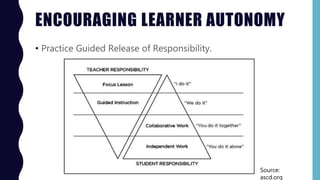
• Practice Guided Release of Responsibility.
Source:
ascd.org
ENCOURAGING LEARNER AUTONOMY
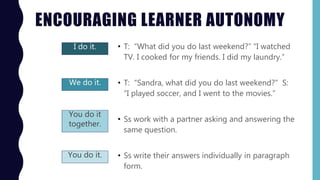
• T: “What did you do last weekend?” “I watched
TV. I cooked for my friends. I did my laundry.”
• T: “Sandra, what did you do last weekend?” S:
“I played soccer, and I went to the movies.”
• Ss work with a partner asking and answering the
same question.
• Ss write their answers individually in paragraph
form.
I do it.
We do it.
You do it.
You do it
together.
ENCOURAGING LEARNER AUTONOMY
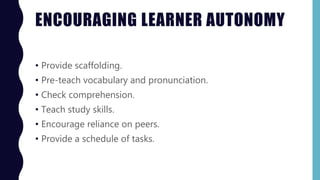
• Provide scaffolding.
• Pre-teach vocabulary and pronunciation.
• Check comprehension.
• Teach study skills.
• Encourage reliance on peers.
• Provide a schedule of tasks.
ENCOURAGING LEARNER AUTONOMY
WITH SCAFFOLDING
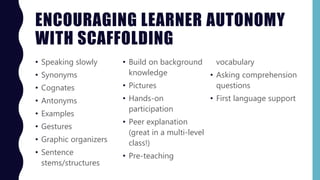
• Speaking slowly
• Synonyms
• Cognates
• Antonyms
• Examples
• Gestures
• Graphic organizers
• Sentence
stems/structures
• Build on background
knowledge
• Pictures
• Hands-on
participation
• Peer explanation
(great in a multi-level
class!)
• Pre-teaching
vocabulary
• Asking comprehension
questions
• First language support
ENCOURAGING LEARNER AUTONOMY
BY PRE-TEACHING VOCABULARY
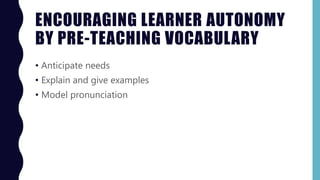
• Anticipate needs
• Explain and give examples
• Model pronunciation
ENCOURAGING LEARNER AUTONOMY
WITH STUDY SKILLS
• Note-taking
• Dictionary use
• Asking appropriate questions
ENCOURAGING LEARNER AUTONOMY
• Provide scaffolding.
• Pre-teach vocabulary and pronunciation.
• Check comprehension.
• Teach study skills.
• Encourage reliance on peers.
• Provide a schedule of tasks.
• Now your learners are ready to work more autonomously!
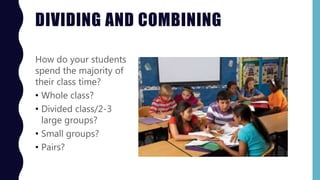
DIVIDING AND COMBINING
How do your students
spend the majority of
their class time?
• Whole class?
• Divided class/2-3
large groups?
• Small groups?
• Pairs?
GROUPING
• What factors do you consider when grouping or pairing
students in a multi-level class?
• Age
• Learning style
• English proficiency
• Personality/motivation level
LIKE-ABILITY GROUPING
ADVANTAGES
Students feel comfortable with
peers.
DISADVANTAGES
Students may lack the skills to
answer each other’s questions.
Students work with other students with similar language
level or ability.
When should we use it?
• To work on level-specific skills
• For problem-solving
• With plenty of scaffolding and
GRR
Students can work from the same
textbook or materials.
DIFFERENTIATING INSTRUCTION
• What does it mean to differentiate instruction?
• Often used with like-ability grouping.
• Differentiate:
• Content
• Process
• Product
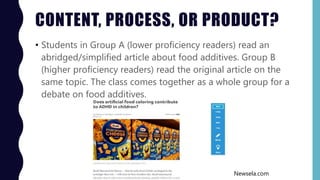
CONTENT, PROCESS, OR PRODUCT?
• Students in Group A (lower proficiency readers) read an
abridged/simplified article about food additives. Group B
(higher proficiency readers) read the original article on the
same topic. The class comes together as a whole group for a
debate on food additives.
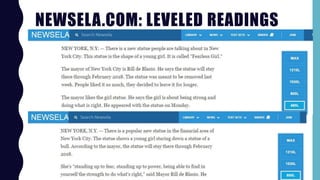
Newsela.com
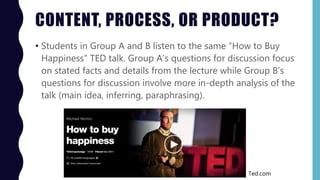
CONTENT, PROCESS, OR PRODUCT?
• Students in Group A and B listen to the same “How to Buy
Happiness” TED talk. Group A’s questions for discussion focus
on stated facts and details from the lecture while Group B’s
questions for discussion involve more in-depth analysis of the
talk (main idea, inferring, paraphrasing).
Ted.com
CONTENT, PROCESS, OR PRODUCT?
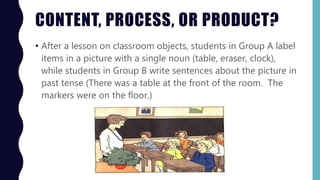
• After a lesson on classroom objects, students in Group A label
items in a picture with a single noun (table, eraser, clock),
while students in Group B write sentences about the picture in
past tense (There was a table at the front of the room. The
markers were on the floor.)
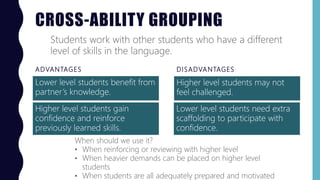
CROSS-ABILITY GROUPING
ADVANTAGES
Lower level students benefit from
partner’s knowledge.
DISADVANTAGES
Higher level students may not
feel challenged.
Students work with other students who have a different
level of skills in the language.
When should we use it?
• When reinforcing or reviewing with higher level
• When heavier demands can be placed on higher level
students
• When students are all adequately prepared and motivated
Higher level students gain
confidence and reinforce
previously learned skills.
Lower level students need extra
scaffolding to participate with
confidence.
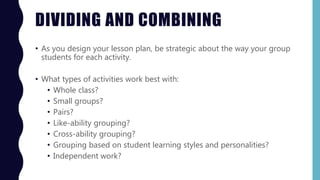
DIVIDING AND COMBINING
• As you design your lesson plan, be strategic about the way your group
students for each activity.
• What types of activities work best with:
• Whole class?
• Small groups?
• Pairs?
• Like-ability grouping?
• Cross-ability grouping?
• Grouping based on student learning styles and personalities?
• Independent work?
PLANNING FOR MULTI-LEVEL
CLASSES: MATERIALS
LIKE-ABILITY GROUPS
• Scope and Sequence
pages of textbook
• Substitute activities that
accomplish the same
objective
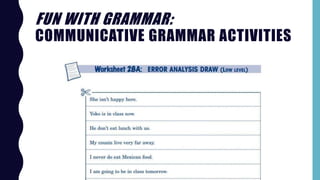
• Fun with Grammar
WHOLE CL ASS OR CROSS-ABILITY
GROUPS
• Create tiered Info Gap and
Jigsaw activities
• NewsELA.com
• TED talks
NEWSELA.COM: LEVELED READINGS
FUN WITH GRAMMAR:
COMMUNICATIVE GRAMMAR ACTIVITIES
PLANNING FOR MULTI-LEVEL
CLASSES: THE SCHEDULE
• How can creating a schedule of activities help you as the
teacher?
• How can it help the students?
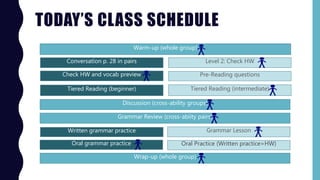
TODAY’S CLASS SCHEDULE
Warm-up (whole group)
Conversation p. 28 in pairs
Discussion (cross-ability groups)
Check HW and vocab preview Pre-Reading questions
Level 2: Check HW
Grammar LessonWritten grammar practice
Tiered Reading (intermediate)Tiered Reading (beginner)
Wrap-up (whole group)
Grammar Review (cross-abiity pairs)
Oral grammar practice Oral Practice (Written practice=HW)
IN-CLASS SOLUTIONS
• Encourage learner autonomy.
• Alternate between whole-class, group instruction, and independent
work.
• Collect samples of student work.
• Provide self-access materials for students who finish early.
• Give your full attention to the group you’re with. Provide:
• pronunciation correction
• grammar feedback
• comprehension questions
• vocabulary assistance
OUTSIDE-OF-CLASS SOLUTIONS
• Lesson plan.
• What are the objectives?
• What do the groups have in common?
• Adapt and find materials.
• Which groupings will work best?
• Provide differentiated feedback.
• simpler for lower level students
• more in-depth for higher students.
• Create a schedule to share.
CASE STUDY: MICHIKO
• Michiko teaches a class of 18 students. Ten students are beginners, six
are high-beginners, and two are intermediate learners of English. She
taught some of them last year, but the beginners are all new. Each
group has its own textbook, levels 1, 2 and 3 from the same series.
• What can she do to prepare for classes?
• What can she do during class?
Submit your ideas to ELFKayla on Facebook.
CASE STUDY: YAMILETH
• Yamileth teaches a class of 20 11th graders. 2 are well ahead of grade
level expectations, 12 are working well with the 11th grade curriculum,
and 6 struggle to keep up with the class.
• What can she do to prepare for classes?
• What can she do during class?
Submit your ideas to ELFKayla on Facebook.
WHICH SOLUTIONS WILL YOU TRY?
• Encourage learner autonomy
• Experiment with grouping in different ways
• Differentiate instruction
• Try new resources
• Provide students with a class schedule
QUESTIONS?
kaylamashburn@hotmail.co
m
ELFKayla

The Multi-Level Language Classroom [RELO Andes Webinar]

  • 1.
    THE MULTI-LEVEL LANGUAGE CLASSROOM K AYL A D E V E N B U R G , E N G L I S H L A N G U A G E F E L LO W, PA N A M A
  • 2.
  • 3.
    HELP! MY STUDENTSARE ALL AT DIFFERENT LEVELS! Where does this happen? • In programs with fewer teachers than levels • In programs where students progress by grade • In multi-grade classrooms • In almost every class!
  • 4.
    WHAT CHALLENGES DOYOU FACE? • Meeting the needs of all groups • Meeting the needs of individual students • Meeting course objectives • Distraction while working • Use of first language among students • Dependence on teacher • Two (or more) textbooks • Varying ages of students • Complex planning
  • 5.
    IN MIXED-LEVEL CLASSES,WHAT ADVANTAGES ARE THERE FOR STUDENTS? • Students can: • develop responsibility for their own learning. • become more independent learners. • learn at their own pace. • learn to work well in a group. • develop strong relationships with their peers. • become partners in learning. • motivate each other to work and learn!
  • 6.
    IN MIXED-LEVEL CLASSES,WHAT ADVANTAGES ARE THERE FOR TEACHERS? • It challenges you to be creative and increase your teaching skills. 
  • 7.
    WHAT ARE... • …theprogram’s goals? • …your goals? • …your students’ goals?
  • 8.
    OUR OBJECTIVES TODAY •To discuss solutions that will: • help students reach their learning goals. • help teachers provide classes that meet the program’s goals. • help teachers better manage lesson planning and teaching classes of multi-level students.
  • 9.
    KEY STRATEGIES Increasing learner autonomy Dividingand combining students Planning and preparing materials
  • 10.
    ENCOURAGING LEARNER AUTONOMY •Practice Guided Release of Responsibility. Source: ascd.org
  • 11.
    ENCOURAGING LEARNER AUTONOMY •T: “What did you do last weekend?” “I watched TV. I cooked for my friends. I did my laundry.” • T: “Sandra, what did you do last weekend?” S: “I played soccer, and I went to the movies.” • Ss work with a partner asking and answering the same question. • Ss write their answers individually in paragraph form. I do it. We do it. You do it. You do it together.
  • 12.
    ENCOURAGING LEARNER AUTONOMY •Provide scaffolding. • Pre-teach vocabulary and pronunciation. • Check comprehension. • Teach study skills. • Encourage reliance on peers. • Provide a schedule of tasks.
  • 13.
    ENCOURAGING LEARNER AUTONOMY WITHSCAFFOLDING • Speaking slowly • Synonyms • Cognates • Antonyms • Examples • Gestures • Graphic organizers • Sentence stems/structures • Build on background knowledge • Pictures • Hands-on participation • Peer explanation (great in a multi-level class!) • Pre-teaching vocabulary • Asking comprehension questions • First language support
  • 14.
    ENCOURAGING LEARNER AUTONOMY BYPRE-TEACHING VOCABULARY • Anticipate needs • Explain and give examples • Model pronunciation
  • 15.
    ENCOURAGING LEARNER AUTONOMY WITHSTUDY SKILLS • Note-taking • Dictionary use • Asking appropriate questions
  • 16.
    ENCOURAGING LEARNER AUTONOMY •Provide scaffolding. • Pre-teach vocabulary and pronunciation. • Check comprehension. • Teach study skills. • Encourage reliance on peers. • Provide a schedule of tasks. • Now your learners are ready to work more autonomously!
  • 17.
    DIVIDING AND COMBINING Howdo your students spend the majority of their class time? • Whole class? • Divided class/2-3 large groups? • Small groups? • Pairs?
  • 18.
    GROUPING • What factorsdo you consider when grouping or pairing students in a multi-level class? • Age • Learning style • English proficiency • Personality/motivation level
  • 19.
    LIKE-ABILITY GROUPING ADVANTAGES Students feelcomfortable with peers. DISADVANTAGES Students may lack the skills to answer each other’s questions. Students work with other students with similar language level or ability. When should we use it? • To work on level-specific skills • For problem-solving • With plenty of scaffolding and GRR Students can work from the same textbook or materials.
  • 20.
    DIFFERENTIATING INSTRUCTION • Whatdoes it mean to differentiate instruction? • Often used with like-ability grouping. • Differentiate: • Content • Process • Product
  • 21.
    CONTENT, PROCESS, ORPRODUCT? • Students in Group A (lower proficiency readers) read an abridged/simplified article about food additives. Group B (higher proficiency readers) read the original article on the same topic. The class comes together as a whole group for a debate on food additives. Newsela.com
  • 22.
    CONTENT, PROCESS, ORPRODUCT? • Students in Group A and B listen to the same “How to Buy Happiness” TED talk. Group A’s questions for discussion focus on stated facts and details from the lecture while Group B’s questions for discussion involve more in-depth analysis of the talk (main idea, inferring, paraphrasing). Ted.com
  • 23.
    CONTENT, PROCESS, ORPRODUCT? • After a lesson on classroom objects, students in Group A label items in a picture with a single noun (table, eraser, clock), while students in Group B write sentences about the picture in past tense (There was a table at the front of the room. The markers were on the floor.)
  • 24.
    CROSS-ABILITY GROUPING ADVANTAGES Lower levelstudents benefit from partner’s knowledge. DISADVANTAGES Higher level students may not feel challenged. Students work with other students who have a different level of skills in the language. When should we use it? • When reinforcing or reviewing with higher level • When heavier demands can be placed on higher level students • When students are all adequately prepared and motivated Higher level students gain confidence and reinforce previously learned skills. Lower level students need extra scaffolding to participate with confidence.
  • 25.
    DIVIDING AND COMBINING •As you design your lesson plan, be strategic about the way your group students for each activity. • What types of activities work best with: • Whole class? • Small groups? • Pairs? • Like-ability grouping? • Cross-ability grouping? • Grouping based on student learning styles and personalities? • Independent work?
  • 26.
    PLANNING FOR MULTI-LEVEL CLASSES:MATERIALS LIKE-ABILITY GROUPS • Scope and Sequence pages of textbook • Substitute activities that accomplish the same objective • Fun with Grammar WHOLE CL ASS OR CROSS-ABILITY GROUPS • Create tiered Info Gap and Jigsaw activities • NewsELA.com • TED talks
  • 27.
  • 28.
  • 29.
    PLANNING FOR MULTI-LEVEL CLASSES:THE SCHEDULE • How can creating a schedule of activities help you as the teacher? • How can it help the students?
  • 30.
    TODAY’S CLASS SCHEDULE Warm-up(whole group) Conversation p. 28 in pairs Discussion (cross-ability groups) Check HW and vocab preview Pre-Reading questions Level 2: Check HW Grammar LessonWritten grammar practice Tiered Reading (intermediate)Tiered Reading (beginner) Wrap-up (whole group) Grammar Review (cross-abiity pairs) Oral grammar practice Oral Practice (Written practice=HW)
  • 31.
    IN-CLASS SOLUTIONS • Encouragelearner autonomy. • Alternate between whole-class, group instruction, and independent work. • Collect samples of student work. • Provide self-access materials for students who finish early. • Give your full attention to the group you’re with. Provide: • pronunciation correction • grammar feedback • comprehension questions • vocabulary assistance
  • 32.
    OUTSIDE-OF-CLASS SOLUTIONS • Lessonplan. • What are the objectives? • What do the groups have in common? • Adapt and find materials. • Which groupings will work best? • Provide differentiated feedback. • simpler for lower level students • more in-depth for higher students. • Create a schedule to share.
  • 33.
    CASE STUDY: MICHIKO •Michiko teaches a class of 18 students. Ten students are beginners, six are high-beginners, and two are intermediate learners of English. She taught some of them last year, but the beginners are all new. Each group has its own textbook, levels 1, 2 and 3 from the same series. • What can she do to prepare for classes? • What can she do during class? Submit your ideas to ELFKayla on Facebook.
  • 34.
    CASE STUDY: YAMILETH •Yamileth teaches a class of 20 11th graders. 2 are well ahead of grade level expectations, 12 are working well with the 11th grade curriculum, and 6 struggle to keep up with the class. • What can she do to prepare for classes? • What can she do during class? Submit your ideas to ELFKayla on Facebook.
  • 35.
    WHICH SOLUTIONS WILLYOU TRY? • Encourage learner autonomy • Experiment with grouping in different ways • Differentiate instruction • Try new resources • Provide students with a class schedule
  • 36.

Editor's Notes

  • #4 Poll: All of my English students are at basically the same level. / Some students in my class are at a higher or lower level than others.
  • #5 Audience feedback: chat box
  • #8 Ask them to write them down.
  • #11 Hand raise: how many of you practice this model?
  • #14 Chat box: What are some ways you provide scaffolding to support your students?
  • #18 Poll: How do your students spend the majority of their class time? As a whole group, Divided class/2-3 large groups? , small groups, pairs ? Select one.
  • #19 Poll: all that apply
  • #22 Poll: Content, Process or Product
  • #23 Poll: Content, Process or Product
  • #34 Email responses to Kayla and we’ll choose some to post on the RELO Andes page
  • #36 Final poll: encourage learner autonomy, divide students in different ways, differentiate instruction, try new resources