
Ricardo Domingos Bembele
Universidade Pedagógica
Chimoio
2015
Chapter I - Introduction
Background of the study
The present study focuses on discipline problems in large classes
especially in grade 11 at Vila Nova Secondary School in Chimoio
town.
It is believed that with this paper, teachers, and school
administrators, and education officials will be helpful on effectively
managing students discipline problems.
It provides with non-violent ways to deal with behavioural
challenges positively and pro-actively.
Statement of the Problem
Teaching large classes is a challenge, as it requires some
additional skills mainly on discipline management along
the teaching and learning process.
Classrooms in many parts of Mozambique may contain
around 60 or 100 students.
How can effectively teachers manage the discipline
problems in the large classes for effective learning in
(grade 11 at Vila Nova Secondary School)?
Research Question
General
 How can teachers develop positive discipline in a large
class for effective learning in large classes (in grade 11 at
Vila Nova Secondary School)?
Specific
 What are the possible major causes of discipline
problems in large classes?
 How does teachers’ behaviour affect the behaviour of
the students during English lessons?
 Is there any technique to make a large class fell small?
 How can individual problems be faced in large classes?
Objectives of the Study
General
 To identify and suggest the positive discipline
techniques for effective learning in large classes at Vila-
Nova Secondary School (Chimoio town).
Specific
 To find ways of overcoming discipline problems in
Mozambican Secondary Schools and at Vila Nova
Secondary School in particular;
 To find out the major causes of discipline problems in
large classes;
 To find out the ways that the school director employs in
solving discipline problems.
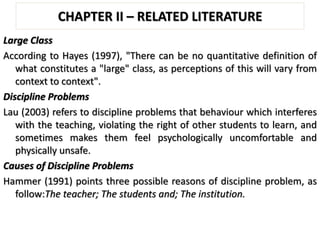
CHAPTER II – RELATED LITERATURE
Large Class
According to Hayes (1997), "There can be no quantitative definition of
what constitutes a "large" class, as perceptions of this will vary from
context to context".
Discipline Problems
Lau (2003) refers to discipline problems that behaviour which interferes
with the teaching, violating the right of other students to learn, and
sometimes makes them feel psychologically uncomfortable and
physically unsafe.
Causes of Discipline Problems
Hammer (1991) points three possible reasons of discipline problem, as
follow:The teacher; The students and; The institution.
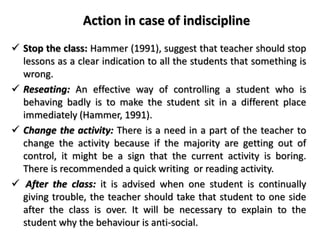
Action in case of indiscipline
 Stop the class: Hammer (1991), suggest that teacher should stop
lessons as a clear indication to all the students that something is
wrong.
 Reseating: An effective way of controlling a student who is
behaving badly is to make the student sit in a different place
immediately (Hammer, 1991).
 Change the activity: There is a need in a part of the teacher to
change the activity because if the majority are getting out of
control, it might be a sign that the current activity is boring.
There is recommended a quick writing or reading activity.
 After the class: it is advised when one student is continually
giving trouble, the teacher should take that student to one side
after the class is over. It will be necessary to explain to the
student why the behaviour is anti-social.
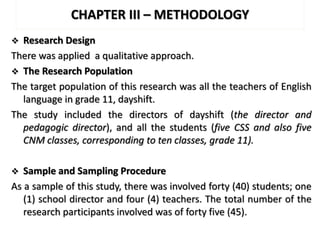
CHAPTER III – METHODOLOGY
 Research Design
There was applied a qualitative approach.
 The Research Population
The target population of this research was all the teachers of English
language in grade 11, dayshift.
The study included the directors of dayshift (the director and
pedagogic director), and all the students (five CSS and also five
CNM classes, corresponding to ten classes, grade 11).
 Sample and Sampling Procedure
As a sample of this study, there was involved forty (40) students; one
(1) school director and four (4) teachers. The total number of the
research participants involved was of forty five (45).
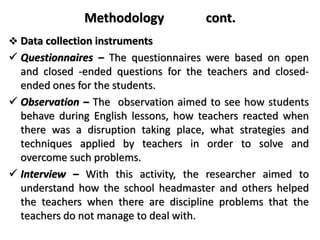
Methodology cont.
 Data collection instruments
 Questionnaires – The questionnaires were based on open
and closed -ended questions for the teachers and closed-
ended ones for the students.
 Observation – The observation aimed to see how students
behave during English lessons, how teachers reacted when
there was a disruption taking place, what strategies and
techniques applied by teachers in order to solve and
overcome such problems.
 Interview – With this activity, the researcher aimed to
understand how the school headmaster and others helped
the teachers when there are discipline problems that the
teachers do not manage to deal with.
CHAPTER IV – PRESENTATION AND DISCUSSION
OF RESULTS
 Presentation and discussion of data from students’ Questionnaire
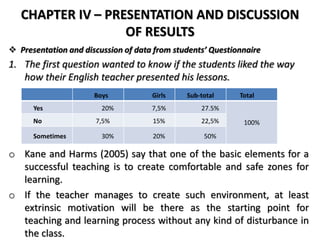
1. The first question wanted to know if the students liked the way
how their English teacher presented his lessons.
o Kane and Harms (2005) say that one of the basic elements for a
successful teaching is to create comfortable and safe zones for
learning.
o If the teacher manages to create such environment, at least
extrinsic motivation will be there as the starting point for
teaching and learning process without any kind of disturbance in
the class.
Boys Girls Sub-total Total
Yes 20% 7,5% 27.5%
100%No 7,5% 15% 22,5%
Sometimes 30% 20% 50%
Cont…
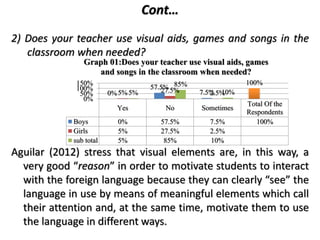
2) Does your teacher use visual aids, games and songs in the
classroom when needed?
Aguilar (2012) stress that visual elements are, in this way, a
very good “reason” in order to motivate students to interact
with the foreign language because they can clearly “see” the
language in use by means of meaningful elements which call
their attention and, at the same time, motivate them to use
the language in different ways.
Yes No Sometimes
Total Of the
Respondents
Boys 0% 57.5% 7.5% 100%
Girls 5% 27.5% 2.5%
sub total 5% 85% 10%
0%
57.5%
7.5%
100%
5% 27.5% 2.5%5%
85%
10%
0%
50%
100%
150%
Graph 01:Does your teacher use visual aids, games
and songs in the classroom when needed?
Presentation and discussion of data from
students’ Questionnaire cont.
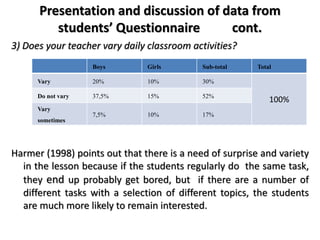
3) Does your teacher vary daily classroom activities?
Harmer (1998) points out that there is a need of surprise and variety
in the lesson because if the students regularly do the same task,
they end up probably get bored, but if there are a number of
different tasks with a selection of different topics, the students
are much more likely to remain interested.
Boys Girls Sub-total Total
Vary 20% 10% 30%
100%Do not vary 37,5% 15% 52%
Vary
sometimes
7,5% 10% 17%
Presentation and discussion of data from the teachers’
questionnaire
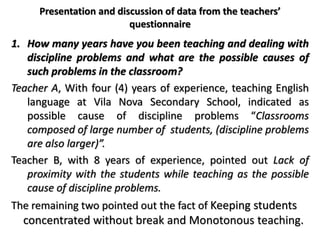
1. How many years have you been teaching and dealing with
discipline problems and what are the possible causes of
such problems in the classroom?
Teacher A, With four (4) years of experience, teaching English
language at Vila Nova Secondary School, indicated as
possible cause of discipline problems “Classrooms
composed of large number of students, (discipline problems
are also larger)”.
Teacher B, with 8 years of experience, pointed out Lack of
proximity with the students while teaching as the possible
cause of discipline problems.
The remaining two pointed out the fact of Keeping students
concentrated without break and Monotonous teaching.
Cont…
2: Do you have your learner’s personal profile?
All the teachers provided the same answer which, confirmed
that they do have their students’ personal profile.
In large classes, teachers need an effective way to learn about
their students’ lives outside of the classroom so if learning
problems arise, they can help the student as much as
possible, Caroline (2006).
Cont…
3) What strategies do you apply to meet individual discipline
problems?
The answers provided by some teachers stressed the following
techniques:
 Punitive techniques;
 Replacement techniques;
 Accentuate the positive.
If a child's behaviour is unacceptable suggest appropriate
alternatives “positive substitutes” rather than focusing
negative attention on the inappropriate behavior.
Cont…
3) Is there any strategy to make large classes feel small?
The teachers answered differently but with the same intention
to say that large class would never feels small in such, but
teacher can establish a respect in the classroom that would
in somehow make it a comfortable place to be working on.
Caroline (2006) says that, there is of course a possibility of
making a large class feels small simply by treating it
accordingly through.
Presentation and discussion of data from the
classrooms observations
 Teachers presentation
All the observed teachers were dressed accordingly;
Teachers motivated their students as a way to get them
concentrated to learn;
 Students Involvement:
Some of the teacher did not involve their students, they were only
concentrated on writing on the black board;
Some teachers showed a lack of preparation for the lessons and
that they had problems in presenting what was to be taught.
Cont…
 Positive Aspects noted in the field:
 All the teachers observed were well presented in terms of
teacher wearing code;
 The capability of some teachers observed to keep the
environment of teaching and learning process well prepared and
conditioned for effectiveness of daily activity;
 Negative Aspects noted in the field:
 There was noticed that some of the teachers do not talk while
writing on the board, the researcher consider it a bad attitude as
teacher in the teaching field;
 Great party of the observed teachers showed problems in using
proper strategies in case of discipline problems.
Presentation of data from School director
Interview
Summary of the findings got from interview
The S. director considered the fact of adopting Positive
Discipline Principles which does not differ considerably from
those mentioned by Caroline (2006) as fallow:
 Respect the child’s dignity;
 Develop pro-social behaviour, self-discipline, and character;
 Maximize the child’s active participation;
 Assure fairness (equity and non-discrimination) and justice;
CHAPTER V – CONCLUSION AND SUGGESTIONS
It was concluded that Discipline Problems result from many
aspects involved in a teaching process, such as: Inadequate
teaching strategies; Teacher’s attitude while teaching;
Students themselves towards English language; etc.
There is a need of applying strategies and techniques in
accordance with the level or kind of discipline problem.
There is a need for educators to show and make understand
what is expected from them, because children often behave
inappropriately because they do not know what is expected
of them.
It could be concluded from data of the teachers’ questionnaire
that most of them are not experienced enough to tackle
with discipline problems.
Suggestions and recommendations
To the teachers
 Sense of responsibility;
 Take things seriously;
 Involve and motivate students to learn;
 keep one well-informed in some linguistic aspects like:
vocabulary, grammar, and proficiency on uttering words;
To the students
 Responsibility in their learning;
 Develop good practices;
Thank for the attention!
Obrigado!
richardomimbele@gmail.com
The End!!!

Slides 07-08-2015 - disruptive behaviour in overcrowded classes

  • 1.
    Ricardo Domingos Bembele UniversidadePedagógica Chimoio 2015
  • 2.
    Chapter I -Introduction Background of the study The present study focuses on discipline problems in large classes especially in grade 11 at Vila Nova Secondary School in Chimoio town. It is believed that with this paper, teachers, and school administrators, and education officials will be helpful on effectively managing students discipline problems. It provides with non-violent ways to deal with behavioural challenges positively and pro-actively.
  • 3.
    Statement of theProblem Teaching large classes is a challenge, as it requires some additional skills mainly on discipline management along the teaching and learning process. Classrooms in many parts of Mozambique may contain around 60 or 100 students. How can effectively teachers manage the discipline problems in the large classes for effective learning in (grade 11 at Vila Nova Secondary School)?
  • 4.
    Research Question General  Howcan teachers develop positive discipline in a large class for effective learning in large classes (in grade 11 at Vila Nova Secondary School)? Specific  What are the possible major causes of discipline problems in large classes?  How does teachers’ behaviour affect the behaviour of the students during English lessons?  Is there any technique to make a large class fell small?  How can individual problems be faced in large classes?
  • 5.
    Objectives of theStudy General  To identify and suggest the positive discipline techniques for effective learning in large classes at Vila- Nova Secondary School (Chimoio town). Specific  To find ways of overcoming discipline problems in Mozambican Secondary Schools and at Vila Nova Secondary School in particular;  To find out the major causes of discipline problems in large classes;  To find out the ways that the school director employs in solving discipline problems.
  • 6.
    CHAPTER II –RELATED LITERATURE Large Class According to Hayes (1997), "There can be no quantitative definition of what constitutes a "large" class, as perceptions of this will vary from context to context". Discipline Problems Lau (2003) refers to discipline problems that behaviour which interferes with the teaching, violating the right of other students to learn, and sometimes makes them feel psychologically uncomfortable and physically unsafe. Causes of Discipline Problems Hammer (1991) points three possible reasons of discipline problem, as follow:The teacher; The students and; The institution.
  • 7.
    Action in caseof indiscipline  Stop the class: Hammer (1991), suggest that teacher should stop lessons as a clear indication to all the students that something is wrong.  Reseating: An effective way of controlling a student who is behaving badly is to make the student sit in a different place immediately (Hammer, 1991).  Change the activity: There is a need in a part of the teacher to change the activity because if the majority are getting out of control, it might be a sign that the current activity is boring. There is recommended a quick writing or reading activity.  After the class: it is advised when one student is continually giving trouble, the teacher should take that student to one side after the class is over. It will be necessary to explain to the student why the behaviour is anti-social.
  • 8.
    CHAPTER III –METHODOLOGY  Research Design There was applied a qualitative approach.  The Research Population The target population of this research was all the teachers of English language in grade 11, dayshift. The study included the directors of dayshift (the director and pedagogic director), and all the students (five CSS and also five CNM classes, corresponding to ten classes, grade 11).  Sample and Sampling Procedure As a sample of this study, there was involved forty (40) students; one (1) school director and four (4) teachers. The total number of the research participants involved was of forty five (45).
  • 9.
    Methodology cont.  Datacollection instruments  Questionnaires – The questionnaires were based on open and closed -ended questions for the teachers and closed- ended ones for the students.  Observation – The observation aimed to see how students behave during English lessons, how teachers reacted when there was a disruption taking place, what strategies and techniques applied by teachers in order to solve and overcome such problems.  Interview – With this activity, the researcher aimed to understand how the school headmaster and others helped the teachers when there are discipline problems that the teachers do not manage to deal with.
  • 10.
    CHAPTER IV –PRESENTATION AND DISCUSSION OF RESULTS  Presentation and discussion of data from students’ Questionnaire 1. The first question wanted to know if the students liked the way how their English teacher presented his lessons. o Kane and Harms (2005) say that one of the basic elements for a successful teaching is to create comfortable and safe zones for learning. o If the teacher manages to create such environment, at least extrinsic motivation will be there as the starting point for teaching and learning process without any kind of disturbance in the class. Boys Girls Sub-total Total Yes 20% 7,5% 27.5% 100%No 7,5% 15% 22,5% Sometimes 30% 20% 50%
  • 11.
    Cont… 2) Does yourteacher use visual aids, games and songs in the classroom when needed? Aguilar (2012) stress that visual elements are, in this way, a very good “reason” in order to motivate students to interact with the foreign language because they can clearly “see” the language in use by means of meaningful elements which call their attention and, at the same time, motivate them to use the language in different ways. Yes No Sometimes Total Of the Respondents Boys 0% 57.5% 7.5% 100% Girls 5% 27.5% 2.5% sub total 5% 85% 10% 0% 57.5% 7.5% 100% 5% 27.5% 2.5%5% 85% 10% 0% 50% 100% 150% Graph 01:Does your teacher use visual aids, games and songs in the classroom when needed?
  • 12.
    Presentation and discussionof data from students’ Questionnaire cont. 3) Does your teacher vary daily classroom activities? Harmer (1998) points out that there is a need of surprise and variety in the lesson because if the students regularly do the same task, they end up probably get bored, but if there are a number of different tasks with a selection of different topics, the students are much more likely to remain interested. Boys Girls Sub-total Total Vary 20% 10% 30% 100%Do not vary 37,5% 15% 52% Vary sometimes 7,5% 10% 17%
  • 13.
    Presentation and discussionof data from the teachers’ questionnaire 1. How many years have you been teaching and dealing with discipline problems and what are the possible causes of such problems in the classroom? Teacher A, With four (4) years of experience, teaching English language at Vila Nova Secondary School, indicated as possible cause of discipline problems “Classrooms composed of large number of students, (discipline problems are also larger)”. Teacher B, with 8 years of experience, pointed out Lack of proximity with the students while teaching as the possible cause of discipline problems. The remaining two pointed out the fact of Keeping students concentrated without break and Monotonous teaching.
  • 14.
    Cont… 2: Do youhave your learner’s personal profile? All the teachers provided the same answer which, confirmed that they do have their students’ personal profile. In large classes, teachers need an effective way to learn about their students’ lives outside of the classroom so if learning problems arise, they can help the student as much as possible, Caroline (2006).
  • 15.
    Cont… 3) What strategiesdo you apply to meet individual discipline problems? The answers provided by some teachers stressed the following techniques:  Punitive techniques;  Replacement techniques;  Accentuate the positive. If a child's behaviour is unacceptable suggest appropriate alternatives “positive substitutes” rather than focusing negative attention on the inappropriate behavior.
  • 16.
    Cont… 3) Is thereany strategy to make large classes feel small? The teachers answered differently but with the same intention to say that large class would never feels small in such, but teacher can establish a respect in the classroom that would in somehow make it a comfortable place to be working on. Caroline (2006) says that, there is of course a possibility of making a large class feels small simply by treating it accordingly through.
  • 17.
    Presentation and discussionof data from the classrooms observations  Teachers presentation All the observed teachers were dressed accordingly; Teachers motivated their students as a way to get them concentrated to learn;  Students Involvement: Some of the teacher did not involve their students, they were only concentrated on writing on the black board; Some teachers showed a lack of preparation for the lessons and that they had problems in presenting what was to be taught.
  • 18.
    Cont…  Positive Aspectsnoted in the field:  All the teachers observed were well presented in terms of teacher wearing code;  The capability of some teachers observed to keep the environment of teaching and learning process well prepared and conditioned for effectiveness of daily activity;  Negative Aspects noted in the field:  There was noticed that some of the teachers do not talk while writing on the board, the researcher consider it a bad attitude as teacher in the teaching field;  Great party of the observed teachers showed problems in using proper strategies in case of discipline problems.
  • 19.
    Presentation of datafrom School director Interview Summary of the findings got from interview The S. director considered the fact of adopting Positive Discipline Principles which does not differ considerably from those mentioned by Caroline (2006) as fallow:  Respect the child’s dignity;  Develop pro-social behaviour, self-discipline, and character;  Maximize the child’s active participation;  Assure fairness (equity and non-discrimination) and justice;
  • 20.
    CHAPTER V –CONCLUSION AND SUGGESTIONS It was concluded that Discipline Problems result from many aspects involved in a teaching process, such as: Inadequate teaching strategies; Teacher’s attitude while teaching; Students themselves towards English language; etc. There is a need of applying strategies and techniques in accordance with the level or kind of discipline problem. There is a need for educators to show and make understand what is expected from them, because children often behave inappropriately because they do not know what is expected of them. It could be concluded from data of the teachers’ questionnaire that most of them are not experienced enough to tackle with discipline problems.
  • 21.
    Suggestions and recommendations Tothe teachers  Sense of responsibility;  Take things seriously;  Involve and motivate students to learn;  keep one well-informed in some linguistic aspects like: vocabulary, grammar, and proficiency on uttering words; To the students  Responsibility in their learning;  Develop good practices;
  • 22.
    Thank for theattention! Obrigado! richardomimbele@gmail.com The End!!!