Classroom Helpers ProgramWeek 1 – March 1stBeing a helperHelping with Speaking and ListeningWeek 2 – March 8thHelping with ReadingWeek 3 – March 15thHelping with Writing
Purpose :To help with literacy learning in the early years.What is expected of participants?Attend each session which will take approximately one hour.Complete follow-up activities in a classroom each week.Assist in classrooms on a regular basis.
Part 1 - Being a HelperPurposeTo explore how children learnTo recognise and value differenceTo explore the role of classroom helpers
To learn, students need...A reason to learnTo be actively involvedDemonstration and modellingActivity based learningOpportunities for repetition and reinforcementOpportunities for practisingEfforts to be praised
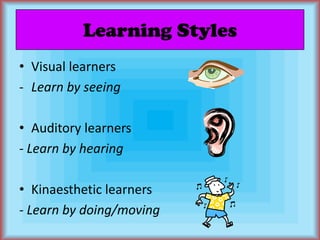
Learning StylesVisual learnersLearn by seeingAuditory learners- Learn by hearingKinaesthetic learners- Learn by doing/moving
What does being a classroom helper mean?    Assisting in the classroom under the direction of theclassroom teacher by:working with small groups of children providing a role model for learning.    Being a valued member of the school community: your support in the classroom will ensure that children remain on task while the teacher is working with other groupsyour willingness to assist in classroom activities shows other parents what can be achieved when partnerships are formed.
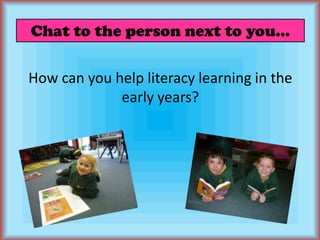
Chat to the person next to you...How can you help literacy learning in the early years?
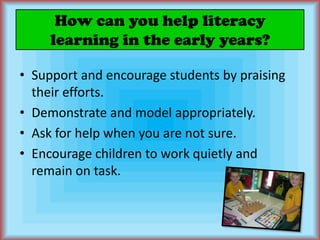
How can you help literacy learning in the early years?Support and encourage students by praising their efforts.Demonstrate and model appropriately.Ask for help when you are not sure.Encourage children to work quietly and remain on task.
What other issues should be kept in mind when helping in classrooms?Discuss
What other issues should be kept in mind when helping in classrooms?Beware of making judgmentsAll children can learn.Children learn at different rates and have different learning needs.Retain confidentialityThe privacy of both parents and children must be    respected at all times.Do not mention the names of children or teachers with whom you are working in front of your own children or other parents. Children can easily be hurt by apparently harmless remarks from their peers or other children.
Part 2 - Helping with Speaking and ListeningPurposeTo explore the development of speaking and listening skillsTo discuss ways classroom helpers can demonstrate good listening skills and appropriate speaking behaviours to assist children
As your children's first teacher you have already taught them to speak and listen by:expecting them to speak providing models of how spoken language works	demonstrating how to listensupporting their attempts with praise
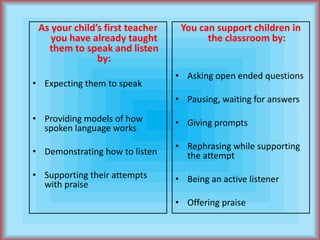
As your child’s first teacher you have already taught them to speak and listen by:Expecting them to speakProviding models of how spoken language worksDemonstrating how to listenSupporting their attempts with praiseYou can support children in the classroom by:Asking open ended questionsPausing, waiting for answersGiving promptsRephrasing while supporting the attemptBeing an active listenerOffering praise
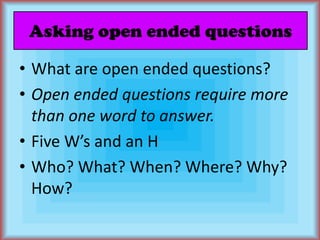
Asking open ended questionsWhat are open ended questions?Open ended questions require more than one word to answer.Five W’s and an HWho? What? When? Where? Why? How?
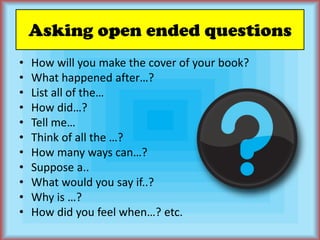
Asking open ended questionsHow will you make the cover of your book?What happened after…?List all of the…How did…?Tell me…Think of all the …?How many ways can…?Suppose a..What would you say if..?Why is …?How did you feel when…? etc.
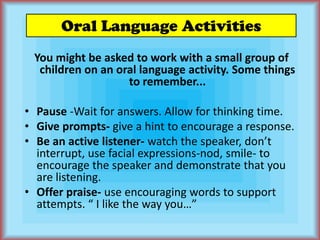
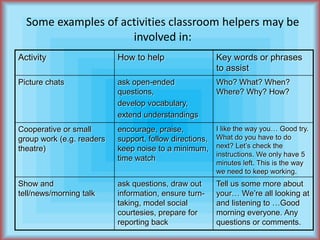
Oral Language ActivitiesYou might be asked to work with a small group of children on an oral language activity. Some things to remember...Pause -Wait for answers. Allow for thinking time.Give prompts- give a hint to encourage a response.Be an active listener- watch the speaker, don’t interrupt, use facial expressions-nod, smile- to encourage the speaker and demonstrate that you are listening.	Offer praise- use encouraging words to support attempts. “ I like the way you…”
Some examples of activities classroom helpers may be involved in:Picture chatsCooperative or small group work (e.g. readers theatre)Show and tell/news/morning talk
Picture chatsConduct a picture chat. Demonstrate strategies from previous slide.Discuss value of picture chat- extend vocabulary; develop knowledge of sentence structure( modelling); creating ideas for writing; sharing knowledge and understanding.
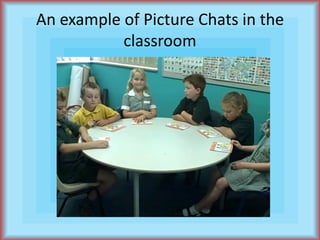
An example of Picture Chats in the classroom
What are some situations where children need to use a variety of speaking and listening skills?Discuss
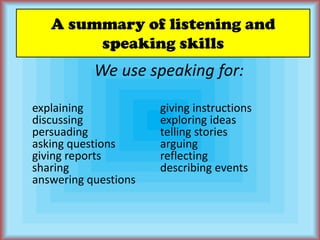
A summary of listening and speaking skillsWe use speaking for:explaining            		giving instructionsdiscussing         		exploring ideas        persuading  			telling stories      asking questions		arguing      giving reports		reflecting             sharing           		describing events   answering questions
To be successful speakers we need to:know procedures i.e. introductions, phone calls demonstrate social conventions i.e. look at speaker, wait for turn to speak, accept and encourage othersspeak confidently be aware of our audienceuse correct tone and style use volume appropriate to the situation use facial expressions and gestures be able to speak to large or small groups
Readers’ TheatreReaders’ theatre is a cooperative group activity, as opposed to small group work where students may complete individual tasks. Cooperative activities will require greater input from the classroom helper. Children have specific roles.Three key aspects of the classroom helper’s role. Ensure that the children -Understand the activity and remain focussed upon it.Keep noise to a minimumAre aware of the time available.
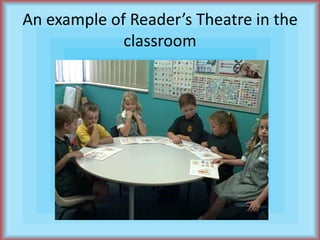
An example of Reader’s Theatre in the classroom
Some examples of activities classroom helpers may be involved in:
Helping with Speaking and ListeningThe purpose of today’s session was-To explore the development of speaking and listening skillsTo discuss ways classroom helpers can demonstrate good listening skills and appropriate speaking behaviours to assist children.Follow-up activity: Conduct a picture chat, news or readers theatre. Or use some of these strategies at home. E.g. open-ended questions about their day.

Classroom Helpers Speaking and Listening

  • 1.
    Classroom Helpers ProgramWeek1 – March 1stBeing a helperHelping with Speaking and ListeningWeek 2 – March 8thHelping with ReadingWeek 3 – March 15thHelping with Writing
  • 2.
    Purpose :To helpwith literacy learning in the early years.What is expected of participants?Attend each session which will take approximately one hour.Complete follow-up activities in a classroom each week.Assist in classrooms on a regular basis.
  • 3.
    Part 1 -Being a HelperPurposeTo explore how children learnTo recognise and value differenceTo explore the role of classroom helpers
  • 4.
    To learn, studentsneed...A reason to learnTo be actively involvedDemonstration and modellingActivity based learningOpportunities for repetition and reinforcementOpportunities for practisingEfforts to be praised
  • 5.
    Learning StylesVisual learnersLearnby seeingAuditory learners- Learn by hearingKinaesthetic learners- Learn by doing/moving
  • 6.
    What does beinga classroom helper mean? Assisting in the classroom under the direction of theclassroom teacher by:working with small groups of children providing a role model for learning. Being a valued member of the school community: your support in the classroom will ensure that children remain on task while the teacher is working with other groupsyour willingness to assist in classroom activities shows other parents what can be achieved when partnerships are formed.
  • 7.
    Chat to theperson next to you...How can you help literacy learning in the early years?
  • 8.
    How can youhelp literacy learning in the early years?Support and encourage students by praising their efforts.Demonstrate and model appropriately.Ask for help when you are not sure.Encourage children to work quietly and remain on task.
  • 9.
    What other issuesshould be kept in mind when helping in classrooms?Discuss
  • 10.
    What other issuesshould be kept in mind when helping in classrooms?Beware of making judgmentsAll children can learn.Children learn at different rates and have different learning needs.Retain confidentialityThe privacy of both parents and children must be respected at all times.Do not mention the names of children or teachers with whom you are working in front of your own children or other parents. Children can easily be hurt by apparently harmless remarks from their peers or other children.
  • 11.
    Part 2 -Helping with Speaking and ListeningPurposeTo explore the development of speaking and listening skillsTo discuss ways classroom helpers can demonstrate good listening skills and appropriate speaking behaviours to assist children
  • 12.
    As your children'sfirst teacher you have already taught them to speak and listen by:expecting them to speak providing models of how spoken language works demonstrating how to listensupporting their attempts with praise
  • 13.
    As your child’sfirst teacher you have already taught them to speak and listen by:Expecting them to speakProviding models of how spoken language worksDemonstrating how to listenSupporting their attempts with praiseYou can support children in the classroom by:Asking open ended questionsPausing, waiting for answersGiving promptsRephrasing while supporting the attemptBeing an active listenerOffering praise
  • 14.
    Asking open endedquestionsWhat are open ended questions?Open ended questions require more than one word to answer.Five W’s and an HWho? What? When? Where? Why? How?
  • 15.
    Asking open endedquestionsHow will you make the cover of your book?What happened after…?List all of the…How did…?Tell me…Think of all the …?How many ways can…?Suppose a..What would you say if..?Why is …?How did you feel when…? etc.
  • 16.
    Oral Language ActivitiesYoumight be asked to work with a small group of children on an oral language activity. Some things to remember...Pause -Wait for answers. Allow for thinking time.Give prompts- give a hint to encourage a response.Be an active listener- watch the speaker, don’t interrupt, use facial expressions-nod, smile- to encourage the speaker and demonstrate that you are listening. Offer praise- use encouraging words to support attempts. “ I like the way you…”
  • 17.
    Some examples ofactivities classroom helpers may be involved in:Picture chatsCooperative or small group work (e.g. readers theatre)Show and tell/news/morning talk
  • 18.
    Picture chatsConduct apicture chat. Demonstrate strategies from previous slide.Discuss value of picture chat- extend vocabulary; develop knowledge of sentence structure( modelling); creating ideas for writing; sharing knowledge and understanding.
  • 19.
    An example ofPicture Chats in the classroom
  • 20.
    What are somesituations where children need to use a variety of speaking and listening skills?Discuss
  • 21.
    A summary oflistening and speaking skillsWe use speaking for:explaining giving instructionsdiscussing exploring ideas persuading telling stories asking questions arguing giving reports reflecting sharing describing events answering questions
  • 22.
    To be successfulspeakers we need to:know procedures i.e. introductions, phone calls demonstrate social conventions i.e. look at speaker, wait for turn to speak, accept and encourage othersspeak confidently be aware of our audienceuse correct tone and style use volume appropriate to the situation use facial expressions and gestures be able to speak to large or small groups
  • 23.
    Readers’ TheatreReaders’ theatreis a cooperative group activity, as opposed to small group work where students may complete individual tasks. Cooperative activities will require greater input from the classroom helper. Children have specific roles.Three key aspects of the classroom helper’s role. Ensure that the children -Understand the activity and remain focussed upon it.Keep noise to a minimumAre aware of the time available.
  • 24.
    An example ofReader’s Theatre in the classroom
  • 25.
    Some examples ofactivities classroom helpers may be involved in:
  • 26.
    Helping with Speakingand ListeningThe purpose of today’s session was-To explore the development of speaking and listening skillsTo discuss ways classroom helpers can demonstrate good listening skills and appropriate speaking behaviours to assist children.Follow-up activity: Conduct a picture chat, news or readers theatre. Or use some of these strategies at home. E.g. open-ended questions about their day.