British Council Resources I 
The following resources are designed by members of the British Council 
and are meant to be implemented thorughout LINGUAVENTURAS, ESL 
Project from SED
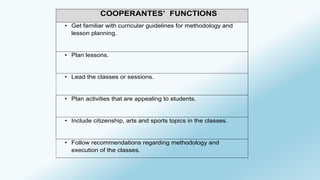
COOPERANTES’ FUNCTIONS 
• Get familiar with curricular guidelines for methodology and 
lesson planning. 
• Plan lessons. 
• Lead the classes or sessions. 
• Plan activities that are appealing to students. 
• Include citizenship, arts and sports topics in the classes. 
• Follow recommendations regarding methodology and 
execution of the classes.
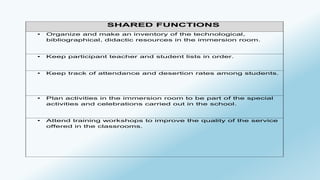
SHARED FUNCTIONS 
• Organize and make an inventory of the technological, 
bibliographical, didactic resources in the immersion room. 
• Keep participant teacher and student lists in order. 
• Keep track of attendance and desertion rates among students. 
• Plan activities in the immersion room to be part of the special 
activities and celebrations carried out in the school. 
• Attend training workshops to improve the quality of the service 
offered in the classrooms.
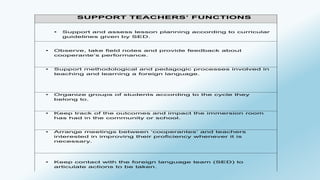
SUPPORT TEACHERS’ FUNCTIONS 
• Support and assess lesson planning according to curricular 
guidelines given by SED. 
• Observe, take field notes and provide feedback about 
cooperante’s performance. 
• Support methodological and pedagogic processes involved in 
teaching and learning a foreign language. 
• Organize groups of students according to the cycle they 
belong to. 
• Keep track of the outcomes and impact the immersion room 
has had in the community or school. 
• Arrange meetings between ‘cooperantes’ and teachers 
interested in improving their proficiency whenever it is 
necessary. 
• Keep contact with the foreign language team (SED) to 
articulate actions to be taken.
AIMS 
• By the end of this session you will: 
• be better prepared to choose classroom tasks for 
different age ranges and needs. 
• have a better and wider understanding of your 
students behaviors and how you can deal with them in 
the classroom.
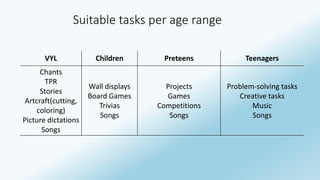
Suitable tasks per age range 
VYL Children Preteens Teenagers 
Chants 
TPR 
Stories 
Artcraft(cutting, 
coloring) 
Picture dictations 
Songs 
Wall displays 
Board Games 
Trivias 
Songs 
Projects 
Games 
Competitions 
Songs 
Problem-solving tasks 
Creative tasks 
Music 
Songs
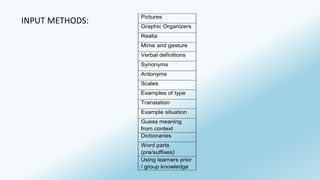
INPUT METHODS: Pictures 
Graphic Organizers 
Realia 
Mime and gesture 
Verbal definitions 
Synonyms 
Antonyms 
Scales 
Examples of type 
Translation 
Example situation 
Guess meaning 
from context 
Dictionaries 
Word parts 
(pre/suffixes) 
Using learners prior 
/ group knowledge
Aims 
By the end of this session you will: 
▪ be better prepared to set activities and give clear, 
well-staged instructions without resorting to 
students’ L1. 
▪ have become familiar with a number of tips to for 
effective instruction-giving.
Failure to get instructions through 
Any failure to hear or understand teachers 
directions will undoubtedly result in unwanted 
behavior: 
▪ Failure to do the tasks, teachers will need to 
use reminders, reprimands, sanctions… 
▪ Repeating things all the time will teach 
students not to bother listening as you always 
repeat things.
Failure to get instructions through 
▪ Both students and teachers will feel 
frustration, a deadly feeling for any learning 
and teaching process. 
▪ Learners get angry because they feel helpless. 
▪ Teachers get angry because learners fail to 
comply.
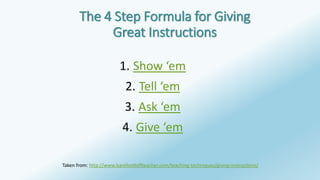
The 4 Step Formula for Giving 
Great Instructions 
1. Show ‘em 
2. Tell ‘em 
3. Ask ‘em 
4. Give ‘em 
Taken from: http://www.barefootteflteacher.com/teaching-techniques/giving-instructions/
Show’em 
▪ If possible, model the activity. Act out what you expect them 
to do. 
▪ Let students help you do this. If it is a dialogue, ask a high 
achiever to help you role-play an example. If it’s a worksheet, 
show them an example using the smart board. 
▪ You set the standards when you show a perfect example so, 
plan your model really well. Setting the standards gives you a 
higher chance of drawing out better quality work.
Tell’em 
▪ Plan your instructions. 
▪ Grade your language so that students understand you. Are 
there any words that they won’t understand? Leave out the 
‘um, er, yeah, like, OK’ fillers that creep into our daily speech. 
▪ Simplify and shorten your instructions. How can you say 
what you need to in the minimum number of words? 
▪ Stage your instructions. Turn them into a list. Hold up your 
fingers for emphasis as you count through them. By turning 
instructions into bite-size chunks, students are more likely to 
remember them.
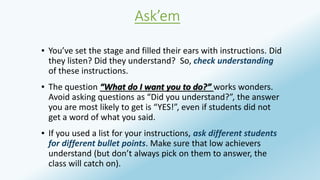
Ask’em 
▪ You’ve set the stage and filled their ears with instructions. Did 
they listen? Did they understand? So, check understanding 
of these instructions. 
▪ The question “What do I want you to do?” works wonders. 
Avoid asking questions as “Did you understand?”, the answer 
you are most likely to get is “YES!”, even if students did not 
get a word of what you said. 
▪ If you used a list for your instructions, ask different students 
for different bullet points. Make sure that low achievers 
understand (but don’t always pick on them to answer, the 
class will catch on).
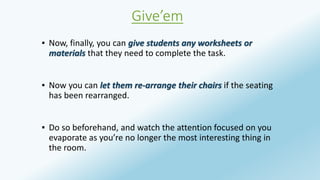
Give’em 
▪ Now, finally, you can give students any worksheets or 
materials that they need to complete the task. 
▪ Now you can let them re-arrange their chairs if the seating 
has been rearranged. 
▪ Do so beforehand, and watch the attention focused on you 
evaporate as you’re no longer the most interesting thing in 
the room.
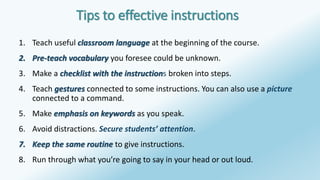
Tips to effective instructions 
1. Teach useful classroom language at the beginning of the course. 
2. Pre-teach vocabulary you foresee could be unknown. 
3. Make a checklist with the instructions broken into steps. 
4. Teach gestures connected to some instructions. You can also use a picture 
connected to a command. 
5. Make emphasis on keywords as you speak. 
6. Avoid distractions. Secure students’ attention. 
7. Keep the same routine to give instructions. 
8. Run through what you’re going to say in your head or out loud.
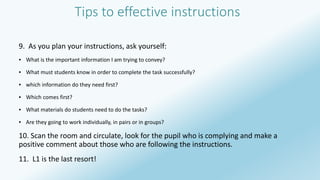
Tips to effective instructions 
9. As you plan your instructions, ask yourself: 
▪ What is the important information I am trying to convey? 
▪ What must students know in order to complete the task successfully? 
▪ which information do they need first? 
▪ Which comes first? 
▪ What materials do students need to do the tasks? 
▪ Are they going to work individually, in pairs or in groups? 
10. Scan the room and circulate, look for the pupil who is complying and make a 
positive comment about those who are following the instructions. 
11. L1 is the last resort!
AIMS 
• By the end of this session you will 
• Be more aware of the importance of observation for your professional 
growth as a teacher 
• Have identified practical aspects to focus on during observations 
• Have experienced observing peers to mirror your own teaching.
WHAT TO OBSERVE? 
1. Lesson structure 
2. Classroom management strategies 
3. Types of teaching activities 
4. Teaching techniques 
5. Use of materials 
6. Teacher’s use of language 
7. Learners’ use of language 
8. Student interaction
HOW TO OBSERVE? 
1. Select the aspect or aspects your observation will focus on. 
2. Take notes during the observation, both on what the teacher does 
and on what that makes you think 
3. Identify the main aspects observed 
4. If possible, discuss your observations with a peer to make sure you 
have identified the same points 
5. Plan your feedback
SESSION AIMS 
• By the end of this session you will… 
• have become more aware about the importance of 
providing feedback after observation in teacher development 
and practice improvement. 
• have gotten familiar with a variety of styles and 
procedures to give feedback.
Aims of Feedback 
•To help teachers develop their teaching 
•To help teachers develop awareness & 
reflection 
•For teachers to experiment with their own 
ideas in a ‘safe’ environment 
• In feedback, trainer is always aware of these aims 
and thinking how to help teacher develop
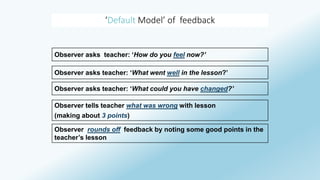
‘Default Model’ of feedback 
Observer asks teacher: ‘How do you feel now?’ 
Observer asks teacher: ‘What went well in the lesson?’ 
Observer asks teacher: ‘What could you have changed?’ 
Observer tells teacher what was wrong with lesson 
(making about 3 points) 
Observer rounds off feedback by noting some good points in the 
teacher’s lesson

British council resources i

  • 1.
    British Council ResourcesI The following resources are designed by members of the British Council and are meant to be implemented thorughout LINGUAVENTURAS, ESL Project from SED
  • 2.
    COOPERANTES’ FUNCTIONS •Get familiar with curricular guidelines for methodology and lesson planning. • Plan lessons. • Lead the classes or sessions. • Plan activities that are appealing to students. • Include citizenship, arts and sports topics in the classes. • Follow recommendations regarding methodology and execution of the classes.
  • 3.
    SHARED FUNCTIONS •Organize and make an inventory of the technological, bibliographical, didactic resources in the immersion room. • Keep participant teacher and student lists in order. • Keep track of attendance and desertion rates among students. • Plan activities in the immersion room to be part of the special activities and celebrations carried out in the school. • Attend training workshops to improve the quality of the service offered in the classrooms.
  • 4.
    SUPPORT TEACHERS’ FUNCTIONS • Support and assess lesson planning according to curricular guidelines given by SED. • Observe, take field notes and provide feedback about cooperante’s performance. • Support methodological and pedagogic processes involved in teaching and learning a foreign language. • Organize groups of students according to the cycle they belong to. • Keep track of the outcomes and impact the immersion room has had in the community or school. • Arrange meetings between ‘cooperantes’ and teachers interested in improving their proficiency whenever it is necessary. • Keep contact with the foreign language team (SED) to articulate actions to be taken.
  • 5.
    AIMS • Bythe end of this session you will: • be better prepared to choose classroom tasks for different age ranges and needs. • have a better and wider understanding of your students behaviors and how you can deal with them in the classroom.
  • 6.
    Suitable tasks perage range VYL Children Preteens Teenagers Chants TPR Stories Artcraft(cutting, coloring) Picture dictations Songs Wall displays Board Games Trivias Songs Projects Games Competitions Songs Problem-solving tasks Creative tasks Music Songs
  • 7.
    INPUT METHODS: Pictures Graphic Organizers Realia Mime and gesture Verbal definitions Synonyms Antonyms Scales Examples of type Translation Example situation Guess meaning from context Dictionaries Word parts (pre/suffixes) Using learners prior / group knowledge
  • 8.
    Aims By theend of this session you will: ▪ be better prepared to set activities and give clear, well-staged instructions without resorting to students’ L1. ▪ have become familiar with a number of tips to for effective instruction-giving.
  • 9.
    Failure to getinstructions through Any failure to hear or understand teachers directions will undoubtedly result in unwanted behavior: ▪ Failure to do the tasks, teachers will need to use reminders, reprimands, sanctions… ▪ Repeating things all the time will teach students not to bother listening as you always repeat things.
  • 10.
    Failure to getinstructions through ▪ Both students and teachers will feel frustration, a deadly feeling for any learning and teaching process. ▪ Learners get angry because they feel helpless. ▪ Teachers get angry because learners fail to comply.
  • 11.
    The 4 StepFormula for Giving Great Instructions 1. Show ‘em 2. Tell ‘em 3. Ask ‘em 4. Give ‘em Taken from: http://www.barefootteflteacher.com/teaching-techniques/giving-instructions/
  • 12.
    Show’em ▪ Ifpossible, model the activity. Act out what you expect them to do. ▪ Let students help you do this. If it is a dialogue, ask a high achiever to help you role-play an example. If it’s a worksheet, show them an example using the smart board. ▪ You set the standards when you show a perfect example so, plan your model really well. Setting the standards gives you a higher chance of drawing out better quality work.
  • 13.
    Tell’em ▪ Planyour instructions. ▪ Grade your language so that students understand you. Are there any words that they won’t understand? Leave out the ‘um, er, yeah, like, OK’ fillers that creep into our daily speech. ▪ Simplify and shorten your instructions. How can you say what you need to in the minimum number of words? ▪ Stage your instructions. Turn them into a list. Hold up your fingers for emphasis as you count through them. By turning instructions into bite-size chunks, students are more likely to remember them.
  • 14.
    Ask’em ▪ You’veset the stage and filled their ears with instructions. Did they listen? Did they understand? So, check understanding of these instructions. ▪ The question “What do I want you to do?” works wonders. Avoid asking questions as “Did you understand?”, the answer you are most likely to get is “YES!”, even if students did not get a word of what you said. ▪ If you used a list for your instructions, ask different students for different bullet points. Make sure that low achievers understand (but don’t always pick on them to answer, the class will catch on).
  • 15.
    Give’em ▪ Now,finally, you can give students any worksheets or materials that they need to complete the task. ▪ Now you can let them re-arrange their chairs if the seating has been rearranged. ▪ Do so beforehand, and watch the attention focused on you evaporate as you’re no longer the most interesting thing in the room.
  • 16.
    Tips to effectiveinstructions 1. Teach useful classroom language at the beginning of the course. 2. Pre-teach vocabulary you foresee could be unknown. 3. Make a checklist with the instructions broken into steps. 4. Teach gestures connected to some instructions. You can also use a picture connected to a command. 5. Make emphasis on keywords as you speak. 6. Avoid distractions. Secure students’ attention. 7. Keep the same routine to give instructions. 8. Run through what you’re going to say in your head or out loud.
  • 17.
    Tips to effectiveinstructions 9. As you plan your instructions, ask yourself: ▪ What is the important information I am trying to convey? ▪ What must students know in order to complete the task successfully? ▪ which information do they need first? ▪ Which comes first? ▪ What materials do students need to do the tasks? ▪ Are they going to work individually, in pairs or in groups? 10. Scan the room and circulate, look for the pupil who is complying and make a positive comment about those who are following the instructions. 11. L1 is the last resort!
  • 18.
    AIMS • Bythe end of this session you will • Be more aware of the importance of observation for your professional growth as a teacher • Have identified practical aspects to focus on during observations • Have experienced observing peers to mirror your own teaching.
  • 19.
    WHAT TO OBSERVE? 1. Lesson structure 2. Classroom management strategies 3. Types of teaching activities 4. Teaching techniques 5. Use of materials 6. Teacher’s use of language 7. Learners’ use of language 8. Student interaction
  • 20.
    HOW TO OBSERVE? 1. Select the aspect or aspects your observation will focus on. 2. Take notes during the observation, both on what the teacher does and on what that makes you think 3. Identify the main aspects observed 4. If possible, discuss your observations with a peer to make sure you have identified the same points 5. Plan your feedback
  • 21.
    SESSION AIMS •By the end of this session you will… • have become more aware about the importance of providing feedback after observation in teacher development and practice improvement. • have gotten familiar with a variety of styles and procedures to give feedback.
  • 22.
    Aims of Feedback •To help teachers develop their teaching •To help teachers develop awareness & reflection •For teachers to experiment with their own ideas in a ‘safe’ environment • In feedback, trainer is always aware of these aims and thinking how to help teacher develop
  • 23.
    ‘Default Model’ offeedback Observer asks teacher: ‘How do you feel now?’ Observer asks teacher: ‘What went well in the lesson?’ Observer asks teacher: ‘What could you have changed?’ Observer tells teacher what was wrong with lesson (making about 3 points) Observer rounds off feedback by noting some good points in the teacher’s lesson

Editor's Notes

  • #20 10 MIN Ask pairs of trainees to choose one of the aspects and try to expand into more specific items to observe. Invite trainees to share their ideas on each aspect. The following items provide help on this regard: Lesson structure: the way the lesson opens, develops and closes, the number of activities that constitute the lesson, the links and transitions between activities Classroom management strategies: setting up groups, mantaining order, time management, seating arrangements Types of teaching activities: whole-class, pair and group work, individual activities Teaching techniques: presenting tasks, introducing vocab, developing learners’ language skills Use of materials: use of textbook, use of visual aids, use of other resources Teacher’s use of Language: instructional language, use of questions, feedback techniques, explanations of vocabulary and grammar Students’ use of language: Language used in group work, use of the mother tongue in class, problems with grammar, problems with pronunciation Student interaction: Time on task, questioning behaviors, student-to-student talk.
  • #21 Ask trainees to reflect upon the changes in the process, if the observation is done for one’s professional growth and not to give feedback.
  • #23 As cooperantes are not really teachers, in most cases, it is absolutely important to use this tool (observation + feedback) as a way to help them develop teaching skills. If they can identify the things they´ve done well, they´re likely to keep on using them in further lessons. Reflecting upon the things that went well on a lesson and the areas to improve can help teachers (new and experienced) to identify their strenghts & weaknesses and to set achievable action plans. Teachers (cooperantes included) should be able to express their views on the lesson. This shows their level of reflection and their understanding of what teaching implies. Ergo, it is important to ask them questions and help them reflect… when somebody’s feedback is prescriptive it is not always conducive to real changes in the way lessons are given.