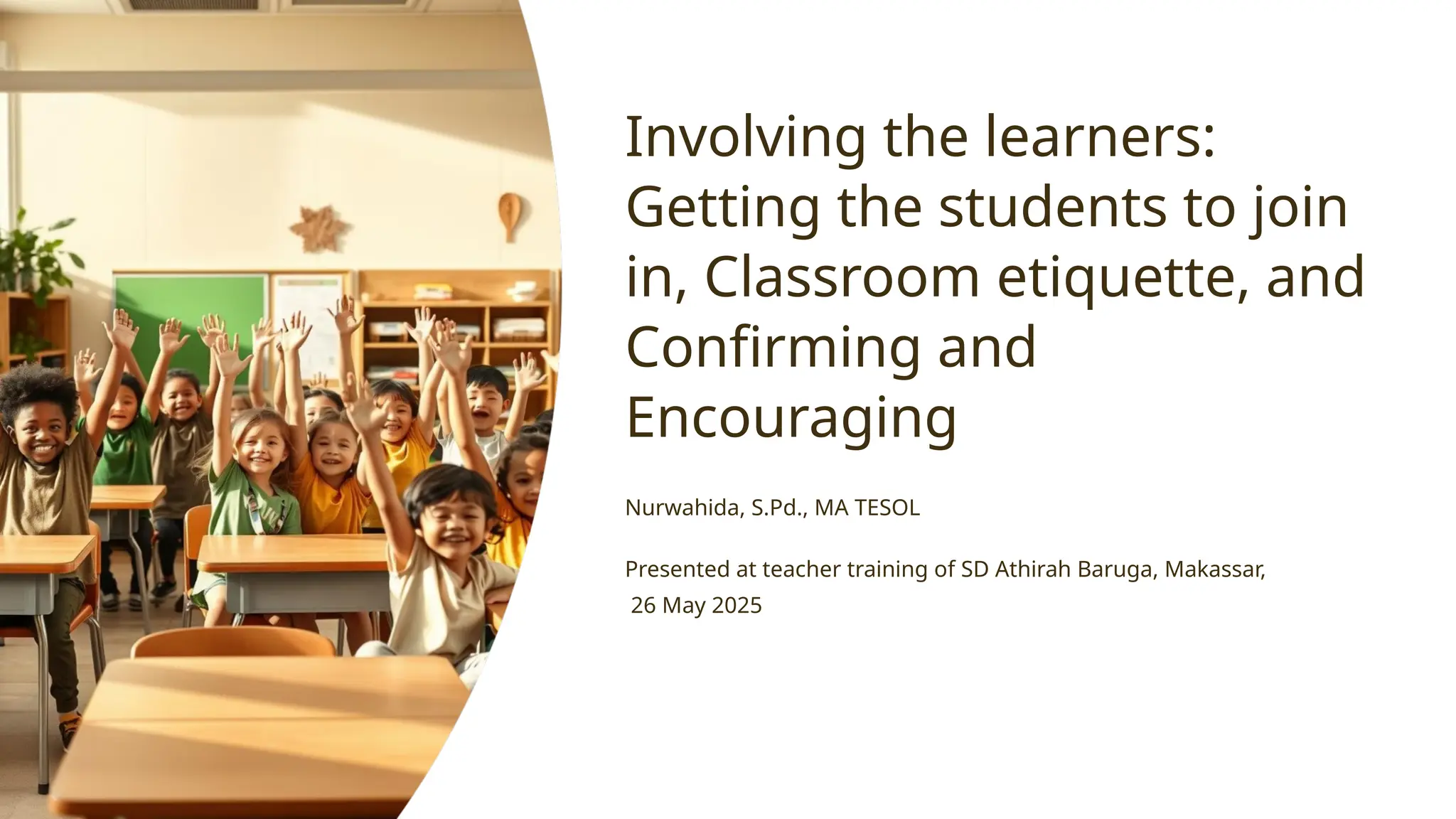
Involving the learners:
Getting the students to join
in, Classroom etiquette, and
Confirming and
Encouraging
Nurwahida, S.Pd., MA TESOL
Presented at teacher training of SD Athirah Baruga, Makassar,
26 May 2025
'Stand Up If...'
👏 You've used songs in class
😅 a student made you laugh recently
📚 You’ve taught over 5 years
😅 You have had a noisy class.
😅 You have lost your voice from teaching.
💭 You believe every child can learn.
🎉 You're ready to have fun today!
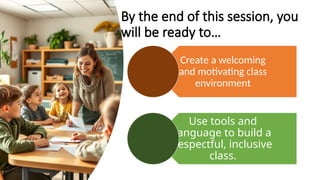
By the end of this session, you
will be ready to…
Create a welcoming
and motivating class
environment
Use tools and
language to build a
respectful, inclusive
class.
Key Discussion Questions
Getting Students to Join In
• Why encourage all students to
participate?
• Two phrases to invite
participation?
• How to help shy students join in?
Classroom Etiquette
• Examples of good etiquette?
• How to model etiquette?
• Why discuss rules with students?
Confirming & Encouraging
• What to say after a wrong answer?
• Why praise effort, not just right
answers?
• Example of encouraging phrase?
Section A.
Getting the students to join in
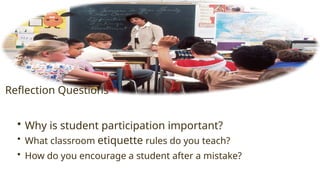
Reflection Questions
• Why is student participation important?
• What classroom etiquette rules do you teach?
• How do you encourage a student after a mistake?
How often do you struggle to
engage with a class?
• Never
• Every now and then
• Often
• Almost every time
Let's Start With This
Points to think and talk about?
• Is it necessary to speak more slowly and more clearly if you are using English
to run your class? Do you modify your English in any way when speaking to
students?
• If you want to make sure that all students have understood and can take
part equally in the lesson (for example, seeing or hearing properly), what
kind of signs and gestures could you use to accompany your words?
• Think about a typical lesson. How many opportunities do the students have
to make choices? What kind of things can they choose?
• Do you think pair work and group work is always more motivating? What
have been your own experiences of group work, both as a teacher and as a
student?
Language to think about
• What would you say to check that all students can hear and see what
is going on?
• How many ways can you think of for saying, Read one after another?
• if you needed volunteers to help you, how would you ask?
• What phrases would you use to break the class up into pairs or
groups?
1. Taking parts
1. Can you all hear?
2. I’ll speak a bit louder.
3. Can everybody see?
4. Is that better?
Taking turns
1. In turns.
2. Your turn
3. Who’s going to start?
4. Who’s next?
5. Who hasn’t had a turn?
6. Not you again.
Student choice
1. who would like to do this?
2. are there any volunteers?
3. which group do you want to join?
4. you can decide.
Working in groups
• work in groups.//I’ll divide/split the class up into five groups.
• Find yourself a partner
• Could you join this group?
• Work on your own.//work by yourself
• One of you will read the question, the other one will answer it.
Section B:
Classroom etiquette
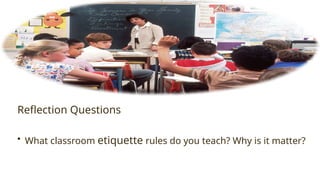
Reflection Questions
• What classroom etiquette rules do you teach? Why is it matter?
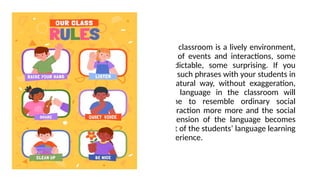
The classroom is a lively environment,
full of events and interactions, some
predictable, some surprising. If you
use such phrases with your students in
a natural way, without exaggeration,
the language in the classroom will
come to resemble ordinary social
interaction more more and the social
dimension of the language becomes
part of the students’ language learning
experience.
Points to think and talk about
• An important part of English language learning in school is the study of
English-speaking cultures. What kind of British or American festivals, for
example could you present to your students? Would it be useful to
celebrate these as part of your annual teaching programme? Would the
age of the students influence your choice?
• Which aspects of everyday life and social interaction in English-speaking
cultures do you think your students find strange? Is it important to teach
these aspect?
• As a teacher of English, should you follow the etiquette rules of your own
classroom culture or try to introduce those associated with English-
speaking cultures?
• How does your own culture and language express politeness. Do you
think it differs from typically British or American usage?
• Is it the custom to celebrate students’ birthdays at school? And what
about the achievements of individual students (for example, playing
in a soccer team)?
• Do you consider yourself a speaker of British or American English? Do
you encourage your students to use a particular variety?
• Do you think it is a good idea to allow your students to hear all
possible varieties of English?
Language to think about
• Think of some occasions in the classroom when you might say “thank you”,
“sorry”, “good luck”, excuse me”?
• When would you use the “same to you?”
• How do you use the phrase ”help yourself” in English?
• Is ”here you are’ the same as ”you are here?”
• Think of typical holidays in your school’s annual calendar. What would be an
appropriate wish or greeting for each of them?
• “Mind” is very useful word in English. How many different ways of using it can you
think of?
• What would you say to your class if one of your students had won a national
sporting championship?
Useful classroom expression in these areas:
B1
• Birthdays and holidays
B2
• Wishes
B3
• Thanking
B4
• Apologizing and not catching what has someone said
B5
• Leaving the classroom
B1. Birthdays and holidays
1. What’s the date today?
What day/date is it today?// what today’s date?//what’s special about
today?
2. Happy birthday!
Many happy return, Tessa.// Tessa has a birthday today
3. Have a good holiday.
Enjoy your holiday.// Have a great vacation.//I hope you all have a good
holiday
4. Thank you. The same to you.// you, too.// thanks, same to you.
Reminder
• In British English dates are read aloud as follows:
December 9th = December the ninth
9th
December = the ninth of December
In American English we say : December nine
In modern usage, the dates are written:
9 December, 2006 or December 9, 2006
In short forms are: 9/12/06 (BE) and
12/9/06 (AE)
B2. Wishes
1. Bless you!
2. Good luck!//best of luck!//break a leg! (AE)// best of luck
3. Congratulations!// well done//good job
4. Sometimes you need to express commiserations:
Bad luck!/never mind//better luck next time!// what a shame!// that’s
life.// that’s the way it goes
B3. Thanking
1. Thank you
2. Here you are//there you are/take this
3. Thanks for your help
4. Typical replies include:
That’s all right// not at all.// don’t mention it. // think nothing of it.//
you’re welcome.// any time.// no problem.// be my guest.
What are the the phrases you usually use for
giving or handing over something to your
students?
B4. Apologizing and not catching what
someone has said
1. Sorry
2. That’s all right.
3. Pardon? //sorry? What was that again? //What did you say?
4. I’m sorry to hear that.// oh dear, that’s a pity.// what a pity
If you are not feeling too well, you can apologize
to students in advance. What would you say?
Use I’m afraid and I’m sorry
• I’m afraid I’m not feeling very well today.
• I’m afraid I can’t speak any louder.
• I’m afraid I seem to be losing my voice.
• I’m sorry I have a headache
B5. Leaving the classroom
Excuse me for a moment
• Would you excuse me for a
while.
• Please excuse me. I’ve just got to
go to the next door for a
moment.
• I’ll be back in a moment.
Excuse me
• May I pass, please?
• Do you mind moving?
• Could you step aside, please?
Section C.
Confirming and encouraging
Language Points to think and talk about.
• If a student answers a question correctly, what do you say? And if the
answer is wrong, what do you say?
• How many different ways can you think of for saying “good”?
• How would you encourage a student not to give up on a difficult task?
• What do you say if you’re not sure whether a student’s answer is
correct?
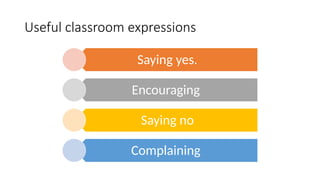
Useful classroom expressions
Saying yes.
Encouraging
Saying no
Complaining
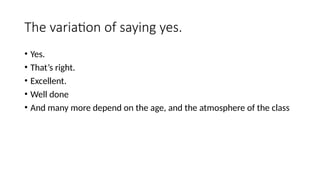
The variation of saying yes.
• Yes.
• That’s right.
• Excellent.
• Well done
• And many more depend on the age, and the atmosphere of the class
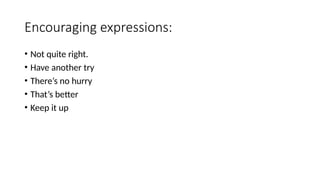
Encouraging expressions:
• Not quite right.
• Have another try
• There’s no hurry
• That’s better
• Keep it up
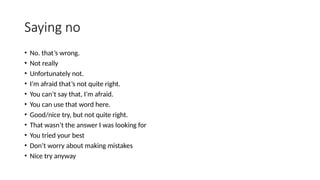
Saying no
• No. that’s wrong.
• Not really
• Unfortunately not.
• I’m afraid that’s not quite right.
• You can’t say that, I’m afraid.
• You can use that word here.
• Good/nice try, but not quite right.
• That wasn’t the answer I was looking for
• You tried your best
• Don’t worry about making mistakes
• Nice try anyway
Complaining
• Come on! Try harder
• You can do this!
• A bit more effort, please!
• You can do better than this
• I wasn’t very happy with the way you did that.
Falling & Rising Intonation Practice
• ↘ Falling: Statements, instructions, praise
• ↗ Rising: Questions, invitations, curiosity
• Try reading:
• • What do you think? ↗
• • You can do it! ↘
• • Now it’s your turn. ↘
• • Who wants to help me? ↗
Part 2: Intonation Sorting
Instructions: Read each phrase aloud and decide whether it should be said with
rising (↗️
) or falling (↘️
) intonation. Then mark it with the appropriate arrow.
• Let’s try together! _____
• What do you think? _____
• You can do it! _____
• Now it’s your turn. _____
• Please raise your hand. _____
• Who wants to help me? _____
• Nice try! _____
• Say it kindly. _____
• Keep going, you’re doing great. _____
• Repeat after me. _____
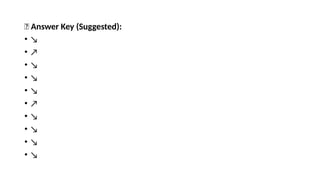
✅ Answer Key (Suggested):
• ↘️
• ↗️
• ↘️
• ↘️
• ↘️
• ↗️
• ↘️
• ↘️
• ↘️
• ↘️
Remember:
Motivation and constant encouragement are central to successful
learning. Using appropriate encouraging phrases creates supportive
environment for every student to learn equally and fairly.
What kind of phrases do you use?
• SCENARIO 1: A Shy Student Doesn’t Want to Speak Situation: A
student hesitates when it’s their turn to speak.
• SCENARIO 2: A Student Makes a Mistake Situation: A student gives the
wrong answer.
• SCENARIO 3: A Student Says "I Can’t Do It" Situation: Student is
frustrated with a task.
• SCENARIO 4: A Group Finishes a Task Well Situation: A group
completes a task or presentation.
• SCENARIO 5: A Student Tries Something New Situation: A quiet
student finally volunteers.
• SCENARIO 6: A Student Completes Their First Full Sentence
Situation: A beginner student successfully says a full sentence in
English.
• SCENARIO 7: A Student Asks for Help Situation: A student raises their
hand and asks for help for the first time.
• SCENARIO 8: A Student Helps a Classmate Situation: A student
assists a peer during an activity.
• SCENARIO 9: A Student is Feeling Nervous Before a Presentation
Situation: Student looks anxious before presenting.
• SCENARIO 10: A Student Comes Late but Still Joins In Situation:
Student arrives late but joins the activity.
📌 Final Thoughts:
• Your tone, words, and presence set the tone for
participation and respect.
• When students feel safe and supported, they are
more willing to take risks and grow.
• Keep your language positive, clear, and
intentional.
Thank you
nurwahida@unm.ac.id
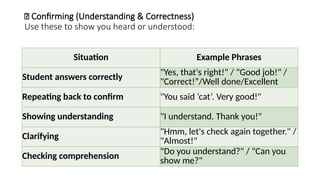
✅ Confirming (Understanding & Correctness)
Use these to show you heard or understood:
Situation Example Phrases
Student answers correctly
"Yes, that's right!" / "Good job!" /
"Correct!”/Well done/Excellent
Repeating back to confirm "You said ‘cat’. Very good!"
Showing understanding "I understand. Thank you!"
Clarifying
"Hmm, let's check again together." /
"Almost!"
Checking comprehension "Do you understand?" / "Can you
show me?"
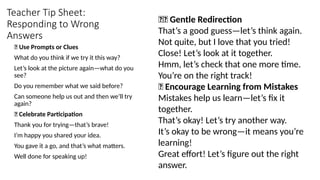
Teacher Tip Sheet:
Responding to Wrong
Answers
🎯 Use Prompts or Clues
What do you think if we try it this way?
Let’s look at the picture again—what do you
see?
Do you remember what we said before?
Can someone help us out and then we’ll try
again?
🙌 Celebrate Participation
Thank you for trying—that’s brave!
I’m happy you shared your idea.
You gave it a go, and that’s what matters.
Well done for speaking up!
❌✅ Gentle Redirection
That’s a good guess—let’s think again.
Not quite, but I love that you tried!
Close! Let’s look at it together.
Hmm, let’s check that one more time.
You’re on the right track!
🌱 Encourage Learning from Mistakes
Mistakes help us learn—let’s fix it
together.
That’s okay! Let’s try another way.
It’s okay to be wrong—it means you’re
learning!
Great effort! Let’s figure out the right
answer.
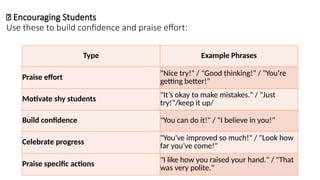
🌟 Encouraging Students
Use these to build confidence and praise effort:
Type Example Phrases
Praise effort "Nice try!" / "Good thinking!" / "You’re
getting better!"
Motivate shy students "It’s okay to make mistakes." / "Just
try!”/keep it up/
Build confidence "You can do it!" / "I believe in you!"
Celebrate progress
"You’ve improved so much!" / "Look how
far you’ve come!"
Praise specific actions
"I like how you raised your hand." / "That
was very polite."
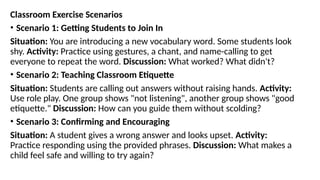
Classroom Exercise Scenarios
• Scenario 1: Getting Students to Join In
Situation: You are introducing a new vocabulary word. Some students look
shy. Activity: Practice using gestures, a chant, and name-calling to get
everyone to repeat the word. Discussion: What worked? What didn't?
• Scenario 2: Teaching Classroom Etiquette
Situation: Students are calling out answers without raising hands. Activity:
Use role play. One group shows "not listening", another group shows "good
etiquette." Discussion: How can you guide them without scolding?
• Scenario 3: Confirming and Encouraging
Situation: A student gives a wrong answer and looks upset. Activity:
Practice responding using the provided phrases. Discussion: What makes a
child feel safe and willing to try again?

Classroom management in teaching primary learners

  • 1.
    Involving the learners: Gettingthe students to join in, Classroom etiquette, and Confirming and Encouraging Nurwahida, S.Pd., MA TESOL Presented at teacher training of SD Athirah Baruga, Makassar, 26 May 2025
  • 2.
  • 3.
    👏 You've usedsongs in class
  • 4.
    😅 a studentmade you laugh recently
  • 5.
  • 6.
    😅 You havehad a noisy class.
  • 7.
    😅 You havelost your voice from teaching.
  • 8.
    💭 You believeevery child can learn.
  • 9.
    🎉 You're readyto have fun today!
  • 10.
    By the endof this session, you will be ready to… Create a welcoming and motivating class environment Use tools and language to build a respectful, inclusive class.
  • 11.
    Key Discussion Questions GettingStudents to Join In • Why encourage all students to participate? • Two phrases to invite participation? • How to help shy students join in? Classroom Etiquette • Examples of good etiquette? • How to model etiquette? • Why discuss rules with students? Confirming & Encouraging • What to say after a wrong answer? • Why praise effort, not just right answers? • Example of encouraging phrase?
  • 12.
    Section A. Getting thestudents to join in
  • 13.
    Reflection Questions • Whyis student participation important? • What classroom etiquette rules do you teach? • How do you encourage a student after a mistake?
  • 14.
    How often doyou struggle to engage with a class? • Never • Every now and then • Often • Almost every time Let's Start With This
  • 15.
    Points to thinkand talk about? • Is it necessary to speak more slowly and more clearly if you are using English to run your class? Do you modify your English in any way when speaking to students? • If you want to make sure that all students have understood and can take part equally in the lesson (for example, seeing or hearing properly), what kind of signs and gestures could you use to accompany your words? • Think about a typical lesson. How many opportunities do the students have to make choices? What kind of things can they choose? • Do you think pair work and group work is always more motivating? What have been your own experiences of group work, both as a teacher and as a student?
  • 16.
    Language to thinkabout • What would you say to check that all students can hear and see what is going on? • How many ways can you think of for saying, Read one after another? • if you needed volunteers to help you, how would you ask? • What phrases would you use to break the class up into pairs or groups?
  • 17.
    1. Taking parts 1.Can you all hear? 2. I’ll speak a bit louder. 3. Can everybody see? 4. Is that better?
  • 18.
    Taking turns 1. Inturns. 2. Your turn 3. Who’s going to start? 4. Who’s next? 5. Who hasn’t had a turn? 6. Not you again.
  • 19.
    Student choice 1. whowould like to do this? 2. are there any volunteers? 3. which group do you want to join? 4. you can decide.
  • 20.
    Working in groups •work in groups.//I’ll divide/split the class up into five groups. • Find yourself a partner • Could you join this group? • Work on your own.//work by yourself • One of you will read the question, the other one will answer it.
  • 21.
  • 22.
    Reflection Questions • Whatclassroom etiquette rules do you teach? Why is it matter?
  • 23.
    The classroom isa lively environment, full of events and interactions, some predictable, some surprising. If you use such phrases with your students in a natural way, without exaggeration, the language in the classroom will come to resemble ordinary social interaction more more and the social dimension of the language becomes part of the students’ language learning experience.
  • 24.
    Points to thinkand talk about • An important part of English language learning in school is the study of English-speaking cultures. What kind of British or American festivals, for example could you present to your students? Would it be useful to celebrate these as part of your annual teaching programme? Would the age of the students influence your choice? • Which aspects of everyday life and social interaction in English-speaking cultures do you think your students find strange? Is it important to teach these aspect? • As a teacher of English, should you follow the etiquette rules of your own classroom culture or try to introduce those associated with English- speaking cultures?
  • 25.
    • How doesyour own culture and language express politeness. Do you think it differs from typically British or American usage? • Is it the custom to celebrate students’ birthdays at school? And what about the achievements of individual students (for example, playing in a soccer team)? • Do you consider yourself a speaker of British or American English? Do you encourage your students to use a particular variety? • Do you think it is a good idea to allow your students to hear all possible varieties of English?
  • 26.
    Language to thinkabout • Think of some occasions in the classroom when you might say “thank you”, “sorry”, “good luck”, excuse me”? • When would you use the “same to you?” • How do you use the phrase ”help yourself” in English? • Is ”here you are’ the same as ”you are here?” • Think of typical holidays in your school’s annual calendar. What would be an appropriate wish or greeting for each of them? • “Mind” is very useful word in English. How many different ways of using it can you think of? • What would you say to your class if one of your students had won a national sporting championship?
  • 27.
    Useful classroom expressionin these areas: B1 • Birthdays and holidays B2 • Wishes B3 • Thanking B4 • Apologizing and not catching what has someone said B5 • Leaving the classroom
  • 28.
    B1. Birthdays andholidays 1. What’s the date today? What day/date is it today?// what today’s date?//what’s special about today? 2. Happy birthday! Many happy return, Tessa.// Tessa has a birthday today 3. Have a good holiday. Enjoy your holiday.// Have a great vacation.//I hope you all have a good holiday 4. Thank you. The same to you.// you, too.// thanks, same to you.
  • 29.
    Reminder • In BritishEnglish dates are read aloud as follows: December 9th = December the ninth 9th December = the ninth of December In American English we say : December nine In modern usage, the dates are written: 9 December, 2006 or December 9, 2006 In short forms are: 9/12/06 (BE) and 12/9/06 (AE)
  • 30.
    B2. Wishes 1. Blessyou! 2. Good luck!//best of luck!//break a leg! (AE)// best of luck 3. Congratulations!// well done//good job 4. Sometimes you need to express commiserations: Bad luck!/never mind//better luck next time!// what a shame!// that’s life.// that’s the way it goes
  • 31.
    B3. Thanking 1. Thankyou 2. Here you are//there you are/take this 3. Thanks for your help 4. Typical replies include: That’s all right// not at all.// don’t mention it. // think nothing of it.// you’re welcome.// any time.// no problem.// be my guest.
  • 32.
    What are thethe phrases you usually use for giving or handing over something to your students?
  • 33.
    B4. Apologizing andnot catching what someone has said 1. Sorry 2. That’s all right. 3. Pardon? //sorry? What was that again? //What did you say? 4. I’m sorry to hear that.// oh dear, that’s a pity.// what a pity
  • 34.
    If you arenot feeling too well, you can apologize to students in advance. What would you say?
  • 35.
    Use I’m afraidand I’m sorry • I’m afraid I’m not feeling very well today. • I’m afraid I can’t speak any louder. • I’m afraid I seem to be losing my voice. • I’m sorry I have a headache
  • 36.
    B5. Leaving theclassroom Excuse me for a moment • Would you excuse me for a while. • Please excuse me. I’ve just got to go to the next door for a moment. • I’ll be back in a moment. Excuse me • May I pass, please? • Do you mind moving? • Could you step aside, please?
  • 37.
  • 38.
    Language Points tothink and talk about. • If a student answers a question correctly, what do you say? And if the answer is wrong, what do you say? • How many different ways can you think of for saying “good”? • How would you encourage a student not to give up on a difficult task? • What do you say if you’re not sure whether a student’s answer is correct?
  • 39.
    Useful classroom expressions Sayingyes. Encouraging Saying no Complaining
  • 40.
    The variation ofsaying yes. • Yes. • That’s right. • Excellent. • Well done • And many more depend on the age, and the atmosphere of the class
  • 41.
    Encouraging expressions: • Notquite right. • Have another try • There’s no hurry • That’s better • Keep it up
  • 42.
    Saying no • No.that’s wrong. • Not really • Unfortunately not. • I’m afraid that’s not quite right. • You can’t say that, I’m afraid. • You can use that word here. • Good/nice try, but not quite right. • That wasn’t the answer I was looking for • You tried your best • Don’t worry about making mistakes • Nice try anyway
  • 43.
    Complaining • Come on!Try harder • You can do this! • A bit more effort, please! • You can do better than this • I wasn’t very happy with the way you did that.
  • 44.
    Falling & RisingIntonation Practice • ↘ Falling: Statements, instructions, praise • ↗ Rising: Questions, invitations, curiosity • Try reading: • • What do you think? ↗ • • You can do it! ↘ • • Now it’s your turn. ↘ • • Who wants to help me? ↗
  • 45.
    Part 2: IntonationSorting Instructions: Read each phrase aloud and decide whether it should be said with rising (↗️ ) or falling (↘️ ) intonation. Then mark it with the appropriate arrow. • Let’s try together! _____ • What do you think? _____ • You can do it! _____ • Now it’s your turn. _____ • Please raise your hand. _____ • Who wants to help me? _____ • Nice try! _____ • Say it kindly. _____ • Keep going, you’re doing great. _____ • Repeat after me. _____
  • 46.
    ✅ Answer Key(Suggested): • ↘️ • ↗️ • ↘️ • ↘️ • ↘️ • ↗️ • ↘️ • ↘️ • ↘️ • ↘️
  • 47.
    Remember: Motivation and constantencouragement are central to successful learning. Using appropriate encouraging phrases creates supportive environment for every student to learn equally and fairly.
  • 48.
    What kind ofphrases do you use? • SCENARIO 1: A Shy Student Doesn’t Want to Speak Situation: A student hesitates when it’s their turn to speak. • SCENARIO 2: A Student Makes a Mistake Situation: A student gives the wrong answer. • SCENARIO 3: A Student Says "I Can’t Do It" Situation: Student is frustrated with a task. • SCENARIO 4: A Group Finishes a Task Well Situation: A group completes a task or presentation. • SCENARIO 5: A Student Tries Something New Situation: A quiet student finally volunteers.
  • 49.
    • SCENARIO 6:A Student Completes Their First Full Sentence Situation: A beginner student successfully says a full sentence in English. • SCENARIO 7: A Student Asks for Help Situation: A student raises their hand and asks for help for the first time. • SCENARIO 8: A Student Helps a Classmate Situation: A student assists a peer during an activity. • SCENARIO 9: A Student is Feeling Nervous Before a Presentation Situation: Student looks anxious before presenting. • SCENARIO 10: A Student Comes Late but Still Joins In Situation: Student arrives late but joins the activity.
  • 50.
    📌 Final Thoughts: •Your tone, words, and presence set the tone for participation and respect. • When students feel safe and supported, they are more willing to take risks and grow. • Keep your language positive, clear, and intentional.
  • 51.
  • 52.
    ✅ Confirming (Understanding& Correctness) Use these to show you heard or understood: Situation Example Phrases Student answers correctly "Yes, that's right!" / "Good job!" / "Correct!”/Well done/Excellent Repeating back to confirm "You said ‘cat’. Very good!" Showing understanding "I understand. Thank you!" Clarifying "Hmm, let's check again together." / "Almost!" Checking comprehension "Do you understand?" / "Can you show me?"
  • 53.
    Teacher Tip Sheet: Respondingto Wrong Answers 🎯 Use Prompts or Clues What do you think if we try it this way? Let’s look at the picture again—what do you see? Do you remember what we said before? Can someone help us out and then we’ll try again? 🙌 Celebrate Participation Thank you for trying—that’s brave! I’m happy you shared your idea. You gave it a go, and that’s what matters. Well done for speaking up! ❌✅ Gentle Redirection That’s a good guess—let’s think again. Not quite, but I love that you tried! Close! Let’s look at it together. Hmm, let’s check that one more time. You’re on the right track! 🌱 Encourage Learning from Mistakes Mistakes help us learn—let’s fix it together. That’s okay! Let’s try another way. It’s okay to be wrong—it means you’re learning! Great effort! Let’s figure out the right answer.
  • 54.
    🌟 Encouraging Students Usethese to build confidence and praise effort: Type Example Phrases Praise effort "Nice try!" / "Good thinking!" / "You’re getting better!" Motivate shy students "It’s okay to make mistakes." / "Just try!”/keep it up/ Build confidence "You can do it!" / "I believe in you!" Celebrate progress "You’ve improved so much!" / "Look how far you’ve come!" Praise specific actions "I like how you raised your hand." / "That was very polite."
  • 55.
    Classroom Exercise Scenarios •Scenario 1: Getting Students to Join In Situation: You are introducing a new vocabulary word. Some students look shy. Activity: Practice using gestures, a chant, and name-calling to get everyone to repeat the word. Discussion: What worked? What didn't? • Scenario 2: Teaching Classroom Etiquette Situation: Students are calling out answers without raising hands. Activity: Use role play. One group shows "not listening", another group shows "good etiquette." Discussion: How can you guide them without scolding? • Scenario 3: Confirming and Encouraging Situation: A student gives a wrong answer and looks upset. Activity: Practice responding using the provided phrases. Discussion: What makes a child feel safe and willing to try again?

Editor's Notes

  • #10 1. quickly create welcoming environments where students feel comfortable speaking, sharing missteps, and detailing accomplishments; (E) 2. use principles of inclusive pedagogy to create customized and effective active learning exercises; and (S) 3. empower students to take leadership roles in their learning experiences.
  • #14 We are going to ask everyone a couple questions about your instruction experience and give you a minute to respond to the poll. Read Question and Answer Choices Struggling to engage students in class can be a common challenge. We may be really excited about a learning activity or research theme and imagine that student will be excited as well…but they’re not. These situations can be really discouraging and demotivating for us. So, today we are going to touch on a number of evidence-based approaches and share ways in which we apply them with groups and individuals. 1) If you have successfully used strategies we mention, we would love to hear about it in the chat. We’ll recap your comments at certain points in the presentation. Special note: you will notice a variety of images or photographs throughout the presentation. These images are all creative commons licensed and the image links are displayed on each slide. ONCE THE RESPONSES COME: Short recap of results. At end—we all have certain difficult classes. We don’t have a magic bullet but hopefully these approaches will allow you to engage with students more often than not.