GIVING INSTRUCTIONS
The way teachers talk to students, the manner in which they interact  is crucial to both successful learning and teaching. The most important point that determines how successfully students will learn is the way instructions are formulated and sometimes it is this point which distinguishes good teachers from bad ones.
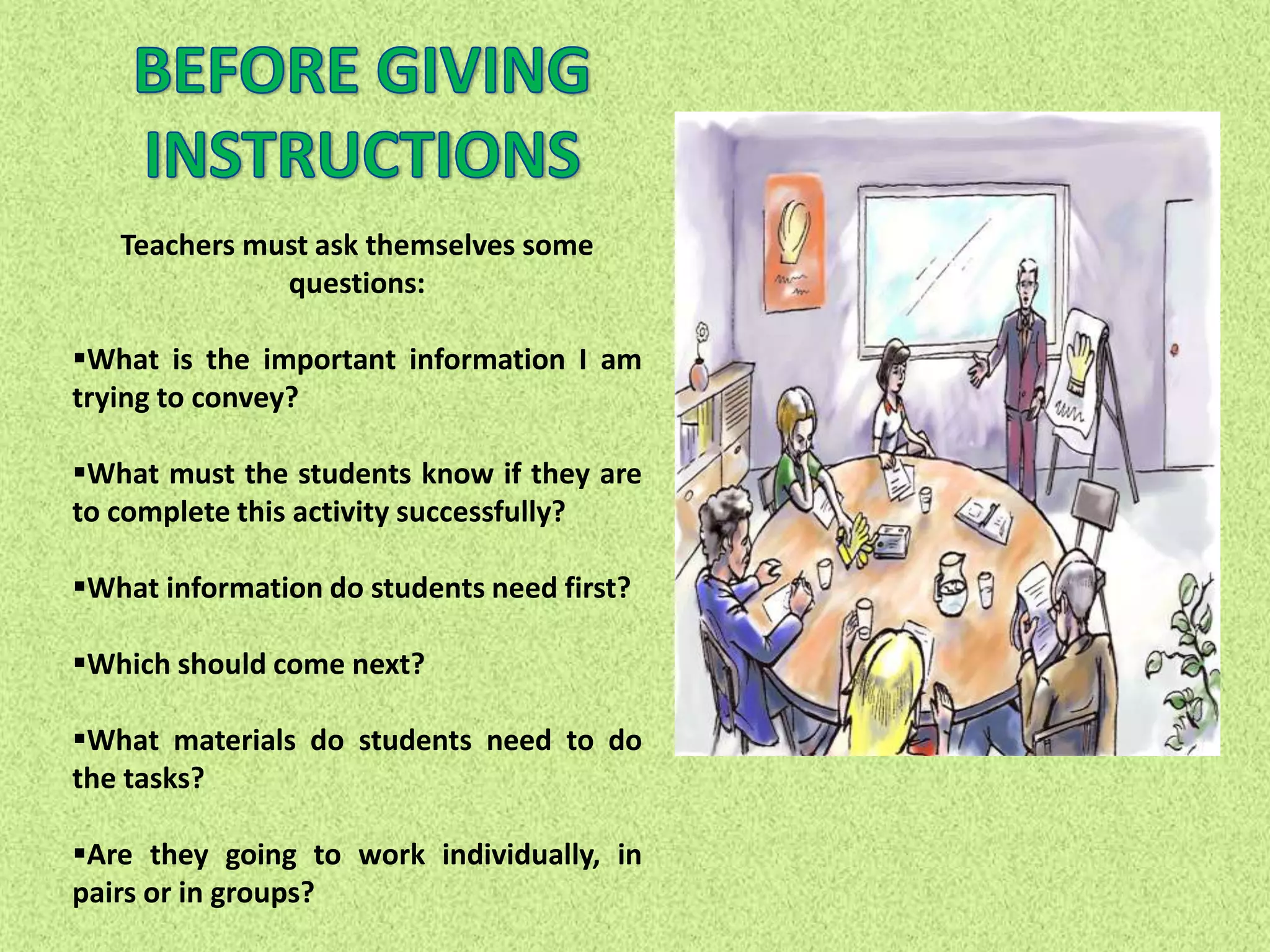
BEFORE GIVING INSTRUCTIONSTeachers must ask themselves some questions:What is the important information I am trying to convey?
What must the students know if they are to complete this activity successfully?
What information do students need first?
Which should come next?

Giving instructions

  • 1.
  • 2.
    The way teacherstalk to students, the manner in which they interact  is crucial to both successful learning and teaching. The most important point that determines how successfully students will learn is the way instructions are formulated and sometimes it is this point which distinguishes good teachers from bad ones.
  • 3.
    BEFORE GIVING INSTRUCTIONSTeachersmust ask themselves some questions:What is the important information I am trying to convey?
  • 4.
    What must thestudents know if they are to complete this activity successfully?
  • 5.
    What information dostudents need first?
  • 6.
  • 7.
    What materials dostudents need to do the tasks?
  • 8.
    Are they goingto work individually, in pairs or in groups? SOMETHING IMPORTANT TO TAKE INTO ACCOUNT WHEN GIVING INSTRUCTIONSThe formulations should be short, easy to understand and precise.
  • 9.
    To attract theattention of a group, try clapping your hands or knocking on a desk.
  • 10.
    The spoken instructionsare not everything. The body language counts as well, the gestures, miming etc.
  • 11.
    Instructions should alwaysbe followed by demonstration. The best way to tell students how to do something is to actually do it yourself. Teachers should prepare everything carefully beforehand.
  • 12.
    Teachers should notforget that wordy instructions do not work effectively, particularly with learners of low English proficiency.
  • 13.
    When an activityis introduced for the first time, words might not be enough for low level students. In some cases, visuals can support learners’ understanding even for instructions.
  • 14.
    The fundamental obstructionis the Mother Tongue Interference.
  • 15.
    Check for understandingby asking questions related to instruction.If instructions are not effectively and clearly formulated, there will be a number of students who will simply not have assimilated what is to be done or have only caught part of the information.Being clear with your instructions and expectations will reduce the possibility of ongoing distraction and interruptions.