www.nancyakhavan.com
Dr. Nancy Akhavan
2014
Goals for PresentationGoals for Presentation
Develop an understanding of how to increase
student reading ability.
Understand how to decrease the number of
struggling readers in primary grades.
Focus on rigorous instruction in fiction and non-
fiction
Understand the effect of prosody, fluency,
motivation and comprehension on a young
reader’s abilities.
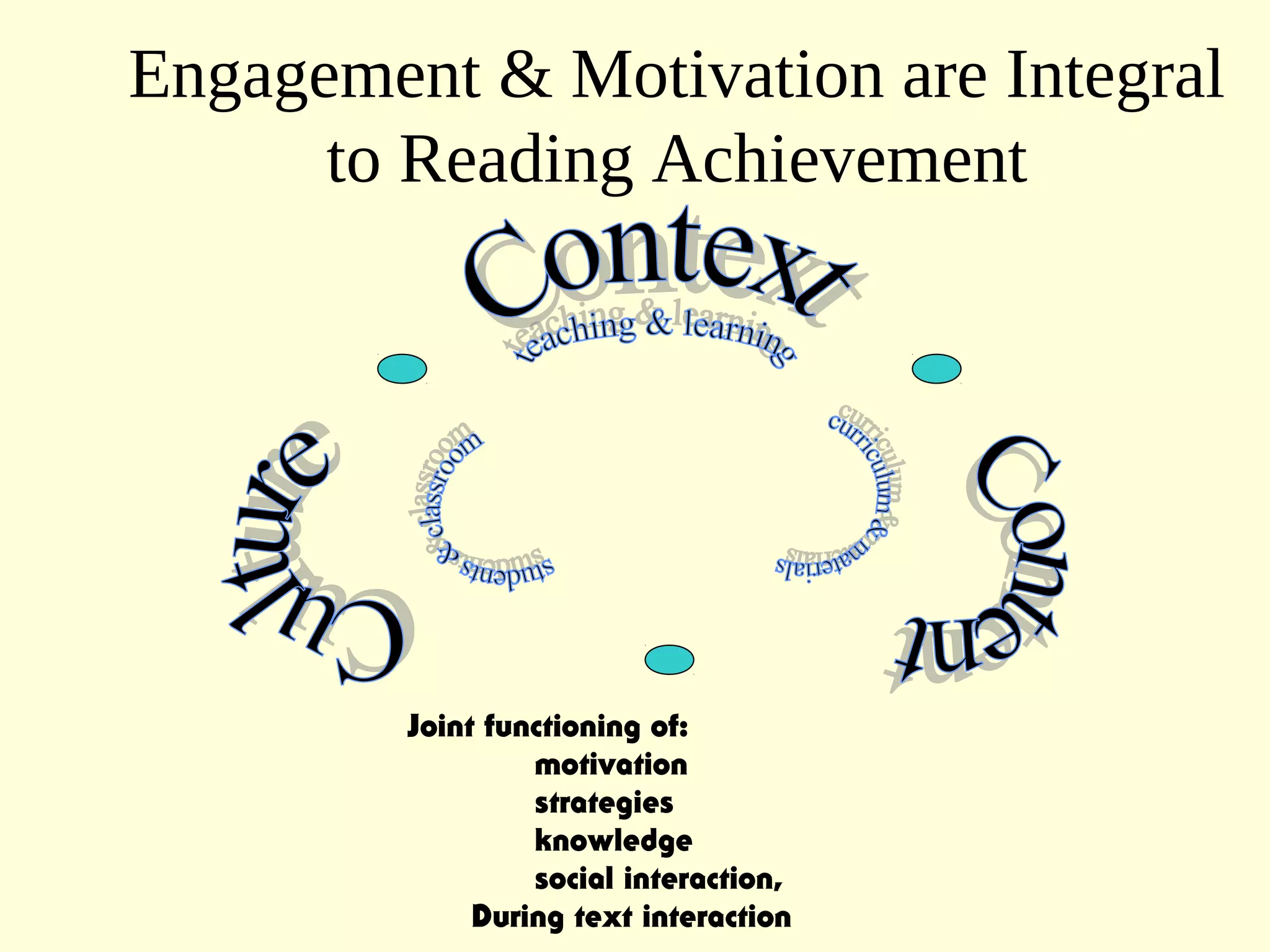
Engagement & Motivation are Integral
to Reading Achievement
Joint functioning of:
motivation
strategies
knowledge
social interaction,
During text interaction
Goals for Reading Instruction
• To acquire accuracy,
fluency at a given text
level.
• To acquire
comprehension
strategies
• To read with prosody
• To make meaning from
a variety of texts and
genres.
• To write about reading
to develop
comprehension
• To accurately use ‘fix-
up’ strategies
• To be motivated to read
and be engaged as a
reader
• To love to read
Goals for Primary Reading Workshop
Goals of primary reading workshop include developing student
ability to:
• Make decisions about important themes and ideas in
texts read aloud, based on evidence in the text, as
well as their experiences, knowledge and beliefs.
• Share their ideas, decisions and beliefs orally and in
writing.
• Learn to carry on conversations with others about
their ideas.
• Think critically by analyzing, synthesizing,
comparing and evaluating texts, ideas and problems.
Goals for Language Workshop
• Think critically by responding orally, and in writing,
with peers and their teacher.
• Think, reason, and discuss together before they are
expected to do the thinking independently.
• Write about their thinking
• Know and apply proper forms and function of
English through modeling.
• Acquire language through authentic thinking and
speaking opportunities.
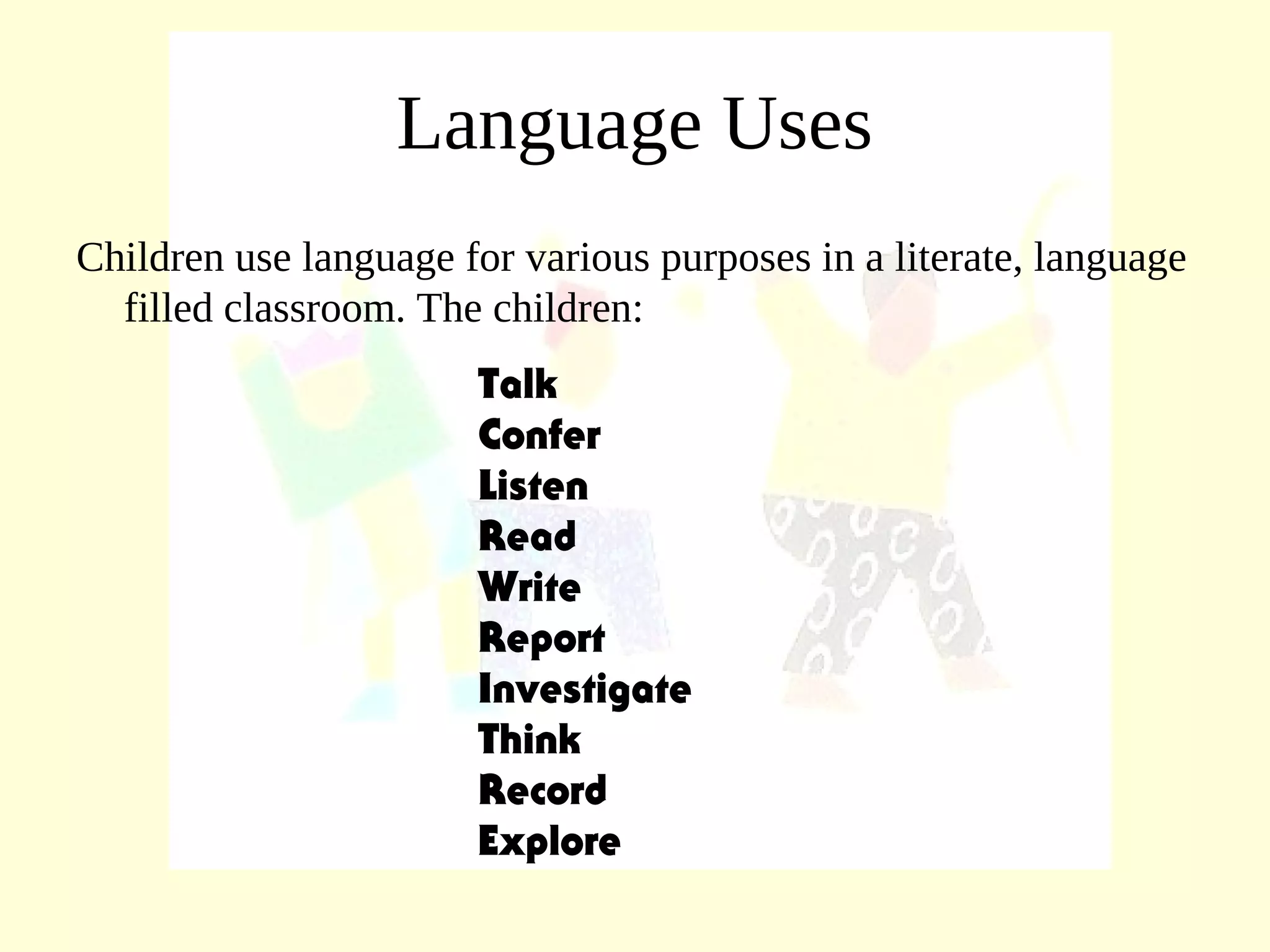
Language Uses
Children use language for various purposes in a literate, language
filled classroom. The children:
Talk
Confer
Listen
Read
Write
Report
Investigate
Think
Record
Explore
When Students Develop Language
• Conversational fluency – ability to carry on
face-to-face conversation
• Discrete language skills – specific
phonological, literacy and grammatical knowledge
taught in context
• Academic language proficiency-
knowledge of less frequent vocabulary and the ability
to interpret and produce increasingly complex
language
Consider Language Workshop
In a workshop, learning is:
• Constructed by the children
• Facilitated by the teacher
• Organized in units of study around socially important
ideas, comprehension strategies, or genre
• Natural, and occurs for each child in individual ways
Consider Language Workshop
In a workshop, learning is:
• Shared between children through peer groups and
partners
• Collective between the whole class, groups, and the
teacher
• Cooperative – no one is seen as holding all
knowledge, including the teacher
Consider Language Workshop
In a workshop, teachers are:
• Designing units of study based on standards and
student needs
• Participating in discussions, reading groups, and
writing
• Facilitating learning
• Creating visuals to support learning through charts
and wall displays
Consider Language Workshop
In a workshop, teachers are:
• Immersing children in language through story,
poetry, non-fiction studies, music and discussion
• Teaching precisely language, strategies, and
information so that children own the learning and
have responsibility for the knowledge
• Assessing through anecdotal notes, running records,
kid-watching and teacher made assessments in order
to learn and teach to each child’s needs.
Language Workshop
and Our Schedule
• There are two main structures to the language
workshop
(Five to Ten Minutes)
during a read aloud (Twenty to
Thirty Minutes)
Language Workshop
and Our Schedule
• During the guided practice the teacher reads aloud a
fiction or non-fiction book and pauses in pre
determined places to facilitate discussion.
– The discussion is based on what the objective of the mini-
lesson is which builds upon the overall goals of the current
unit of study.
– The teacher writes and draws on charts, graphic organizers,
sentence strips, or different sizes of paper to create visuals
to aide discussion and comprehension of the discussion,
and to make the content of the discussion comprehensible.
TheMini-Lesson
(one minute):
• The teacher reminds students of what they have been
learning on previous days in the current unit of study.
• She also discusses what they know as learners and
thinkers in the classroom community.
Strategy for Teaching English Learners:
• The teacher taps into their prior knowledge to remind
them of what they have been learning.
• Connect this to the larger theme that is guiding their
current work.
TheMini-Lesson
(five to six minutes):
• The teacher provides specific information about the day’s new
learning.
• This is not the time where the teacher poses questions to have
the students recall information.
• She tells them what they are going to learn and why it is
important to know this learning.
Strategy for Teaching English Learners:
• Be explicit when teaching by using visuals, student models,
charts, graphics, drawings, pictures, writing, and mentor texts.
• Explain how to do break the thinking down into steps, show
how this looks visually, and showcase student thinking to
make the discussion understandable to the children acquiring
English and for the children with less experience thinking
critically about ideas and information.
TheMini-Lesson
(one to two minutes):
• The teacher asks the children to think about the task for the
day.
• She tells them to remind themselves of what they are going to
do during the reading of the text.
Strategy for Teaching English Learners:
• The students share with a partner sitting knee to knee, eye to
eye.
• The students tell their partner what they are going to do during
the read aloud and discussion.
• The partners share information and discuss ideas
cooperatively.
The Mini-Lesson
(one minute):
• The teacher strategically chooses a student, or one paired
group, to share their thinking.
• It is best if the teacher was listening to the quick discussion
during the engagement so that she can strategically choose
someone to tell their thinking and reinforce the task at hand.
Strategy for Teaching English Learners:
• During the engagement part of the lesson, the teacher coaches
students to be ready to share.
• Students acquiring English should be encouraged to share, and
not overlooked.
• Students can point to the chart or visual from the lesson, and
use other gestures to help them communicate.
Guided Practice
your thinking out loud. Show your thinking, don’t tell
your opinions.
questions to make the kids think. Have them write their jots
around their thinking and around the direction you are leading
in the book (character, plot, theme, action, etc.)
“What are you thinking?” “Why?”
“What makes you think that?” (action/event in the book)
“What are you connecting that idea to in the book/non-
fiction text?”
Guided Practice
• Don’t recap what the kids say. Focus on having them
listen to the person speaking, and then building the
conversation on the last person’s comments. Let them
state their thought and then you again model the
reflection.
• “Does anyone agree?’ “Does anyone
disagree?”“Does that remind any one of something in
the book, another book, situation, “___________what
do you think about what _________said?”
• Units of study in language workshop last 4-5
weeks. Short studies can be 2-3 weeks.
• Topics follow reading strategies, and content
theme studies.
– Pick one strategy/theme and make it the overarching goal of the unit
• Choose performance objectives for the unit
• Focus the mini-lessons on the topic and goals
• Re-teach and coach during conferring
Units of Study for Language Workshop

Akhavan comprehension matters ideas slideshare

  • 1.
  • 2.
    Goals for PresentationGoalsfor Presentation Develop an understanding of how to increase student reading ability. Understand how to decrease the number of struggling readers in primary grades. Focus on rigorous instruction in fiction and non- fiction Understand the effect of prosody, fluency, motivation and comprehension on a young reader’s abilities.
  • 3.
    Engagement & Motivationare Integral to Reading Achievement Joint functioning of: motivation strategies knowledge social interaction, During text interaction
  • 4.
    Goals for ReadingInstruction • To acquire accuracy, fluency at a given text level. • To acquire comprehension strategies • To read with prosody • To make meaning from a variety of texts and genres. • To write about reading to develop comprehension • To accurately use ‘fix- up’ strategies • To be motivated to read and be engaged as a reader • To love to read
  • 5.
    Goals for PrimaryReading Workshop Goals of primary reading workshop include developing student ability to: • Make decisions about important themes and ideas in texts read aloud, based on evidence in the text, as well as their experiences, knowledge and beliefs. • Share their ideas, decisions and beliefs orally and in writing. • Learn to carry on conversations with others about their ideas. • Think critically by analyzing, synthesizing, comparing and evaluating texts, ideas and problems.
  • 6.
    Goals for LanguageWorkshop • Think critically by responding orally, and in writing, with peers and their teacher. • Think, reason, and discuss together before they are expected to do the thinking independently. • Write about their thinking • Know and apply proper forms and function of English through modeling. • Acquire language through authentic thinking and speaking opportunities.
  • 7.
    Language Uses Children uselanguage for various purposes in a literate, language filled classroom. The children: Talk Confer Listen Read Write Report Investigate Think Record Explore
  • 8.
    When Students DevelopLanguage • Conversational fluency – ability to carry on face-to-face conversation • Discrete language skills – specific phonological, literacy and grammatical knowledge taught in context • Academic language proficiency- knowledge of less frequent vocabulary and the ability to interpret and produce increasingly complex language
  • 9.
    Consider Language Workshop Ina workshop, learning is: • Constructed by the children • Facilitated by the teacher • Organized in units of study around socially important ideas, comprehension strategies, or genre • Natural, and occurs for each child in individual ways
  • 10.
    Consider Language Workshop Ina workshop, learning is: • Shared between children through peer groups and partners • Collective between the whole class, groups, and the teacher • Cooperative – no one is seen as holding all knowledge, including the teacher
  • 11.
    Consider Language Workshop Ina workshop, teachers are: • Designing units of study based on standards and student needs • Participating in discussions, reading groups, and writing • Facilitating learning • Creating visuals to support learning through charts and wall displays
  • 12.
    Consider Language Workshop Ina workshop, teachers are: • Immersing children in language through story, poetry, non-fiction studies, music and discussion • Teaching precisely language, strategies, and information so that children own the learning and have responsibility for the knowledge • Assessing through anecdotal notes, running records, kid-watching and teacher made assessments in order to learn and teach to each child’s needs.
  • 13.
    Language Workshop and OurSchedule • There are two main structures to the language workshop (Five to Ten Minutes) during a read aloud (Twenty to Thirty Minutes)
  • 14.
    Language Workshop and OurSchedule • During the guided practice the teacher reads aloud a fiction or non-fiction book and pauses in pre determined places to facilitate discussion. – The discussion is based on what the objective of the mini- lesson is which builds upon the overall goals of the current unit of study. – The teacher writes and draws on charts, graphic organizers, sentence strips, or different sizes of paper to create visuals to aide discussion and comprehension of the discussion, and to make the content of the discussion comprehensible.
  • 15.
    TheMini-Lesson (one minute): • Theteacher reminds students of what they have been learning on previous days in the current unit of study. • She also discusses what they know as learners and thinkers in the classroom community. Strategy for Teaching English Learners: • The teacher taps into their prior knowledge to remind them of what they have been learning. • Connect this to the larger theme that is guiding their current work.
  • 16.
    TheMini-Lesson (five to sixminutes): • The teacher provides specific information about the day’s new learning. • This is not the time where the teacher poses questions to have the students recall information. • She tells them what they are going to learn and why it is important to know this learning. Strategy for Teaching English Learners: • Be explicit when teaching by using visuals, student models, charts, graphics, drawings, pictures, writing, and mentor texts. • Explain how to do break the thinking down into steps, show how this looks visually, and showcase student thinking to make the discussion understandable to the children acquiring English and for the children with less experience thinking critically about ideas and information.
  • 17.
    TheMini-Lesson (one to twominutes): • The teacher asks the children to think about the task for the day. • She tells them to remind themselves of what they are going to do during the reading of the text. Strategy for Teaching English Learners: • The students share with a partner sitting knee to knee, eye to eye. • The students tell their partner what they are going to do during the read aloud and discussion. • The partners share information and discuss ideas cooperatively.
  • 18.
    The Mini-Lesson (one minute): •The teacher strategically chooses a student, or one paired group, to share their thinking. • It is best if the teacher was listening to the quick discussion during the engagement so that she can strategically choose someone to tell their thinking and reinforce the task at hand. Strategy for Teaching English Learners: • During the engagement part of the lesson, the teacher coaches students to be ready to share. • Students acquiring English should be encouraged to share, and not overlooked. • Students can point to the chart or visual from the lesson, and use other gestures to help them communicate.
  • 19.
    Guided Practice your thinkingout loud. Show your thinking, don’t tell your opinions. questions to make the kids think. Have them write their jots around their thinking and around the direction you are leading in the book (character, plot, theme, action, etc.) “What are you thinking?” “Why?” “What makes you think that?” (action/event in the book) “What are you connecting that idea to in the book/non- fiction text?”
  • 20.
    Guided Practice • Don’trecap what the kids say. Focus on having them listen to the person speaking, and then building the conversation on the last person’s comments. Let them state their thought and then you again model the reflection. • “Does anyone agree?’ “Does anyone disagree?”“Does that remind any one of something in the book, another book, situation, “___________what do you think about what _________said?”
  • 21.
    • Units ofstudy in language workshop last 4-5 weeks. Short studies can be 2-3 weeks. • Topics follow reading strategies, and content theme studies. – Pick one strategy/theme and make it the overarching goal of the unit • Choose performance objectives for the unit • Focus the mini-lessons on the topic and goals • Re-teach and coach during conferring Units of Study for Language Workshop