ANNAMALAI UNIVERSITY
FACULTY OF AGRICULTURE
DEPARTMENT OF HORTICULTUE
TOPIC: Review on seed viability of different crops
2
SUBMITTED BY:
S. SHARVESH,
M.Sc. HORTICULTURE,
DEPARTMENT OF HORTICULTURE,
FACULTY OF AGRICULTUR,
ANNAMALAI UNIVERSITY.
What is Seed?
In broad sense:
Seed is a material which is used for planting or
regeneration purpose.
Scientifically:
Seed is a fertilized matured ovule together covered
with seed coat is called seed or it is a propagating material.
Technological point of view:
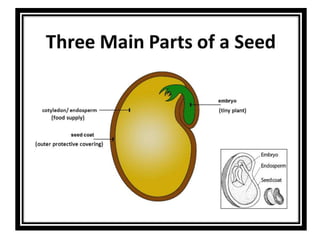
Seed is a fertilized ripened ovule consisting of three
main parts namely seed coat, endosperm and embryo, which in
due course gives rise to a new plant.
It also refers to:
Propagating materials of healthy seedlings, tuber,
bulbs, rhizome, roots, cuttings, setts, all types of grafts and
vegetatively propagating materials used for production purpose.
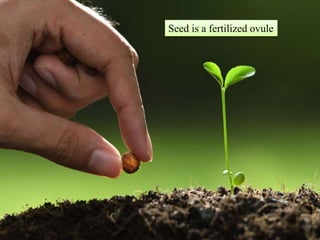
Seed is a fertilized ovule
 The viable seed is a source of a new plant, a beginning based on
inherited parental characteristics. Seeds contain genetic material in
compact form that is well protected from extraneous factors.
 Seeds are a viable tool for long-term conservation of genetic
diversity because they are easier to handle, practicable,
inexpensive, and capable of maintaining genetic stability on
storage.
 The principal purpose of storing seeds of economic plants is to
preserve planting stocks from one season until the next.
 Seeds are largely involved in evolutionary processes in the plant
industry. Vast genetic diversity is the result of repeated natural
propagation by seeds. The farming community also depends on
quality seeds for rich harvests.
 They are used for raising rootstocks and also in breeding
programs.
 In botanical terms, a seed is a fertilized ovule, and for practical
purposes, it is a dry unit of propagation that transmits genetic
material from generation to generation. A seed consists of a tiny
embryonic plant in the resting stage that is provided with food
and well protected by the hard seed covering.
 A seedling emerges from the seed upon germination under
favorable conditions. Seeds vary in size, shape, and color. They
can be oval, round, triangular, cylindrical, and sometimes
irregular in shape. Their surface can be rough, smooth, or
covered with hairs. Colors include red, yellow, green, white,
black, or brown in various crop plants.
SEED DEVELOPMENT
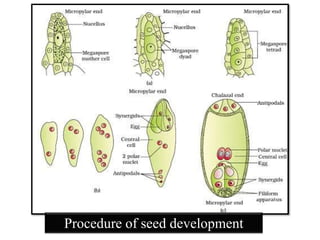
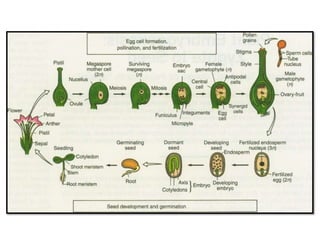
Procedure of seed development
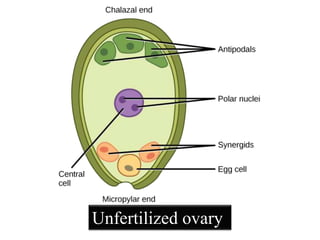
Unfertilized ovary
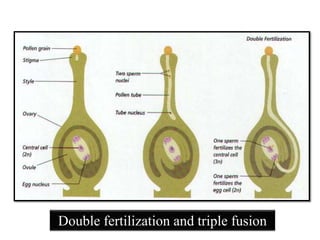
Double fertilization and triple fusion
SEED VIABILITY
 “Seed viability is the ability of the embryo to germinate and
gives rise to a normal seedling”
 Seed viability is the capability of seed to show living
properties like germination and growth.
 Seed viability decreases under improper storage conditions.
The viability loss rate varies in different species.
 The degree to which the seed is alive (metabolically active)
Seed viability
 Viability is highest at the point of physiological maturity and
then gradually declines
 Average life span of a seed is 10 to 15 years.
 Some are very short-lived. e. g. willow (<1 week)
 Some are very long-lived. e.g. mimosa 221 years
 Conditions are very important for longevity
 Cold, dry, anaerobic conditions
 Those are the conditions which are maintained in sedd seed
banks.
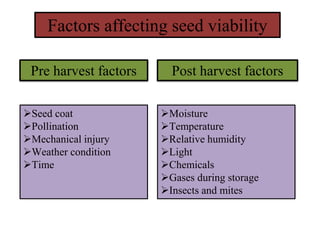
Factors affecting seed viability
Pre harvest factors Post harvest factors
Seed coat
Pollination
Mechanical injury
Weather condition
Time
Moisture
Temperature
Relative humidity
Light
Chemicals
Gases during storage
Insects and mites
• Mechanical injury to seeds by threshing usually contributes
to immediate reduction in germination capacity and to an
accelerated loss of viability in storage.
• Wahlen 91929) found that viability in clover seeds depend
upon the impermeability of the seed coat.
• Allison et al 91990) studied that poor seed emergence of
pea, vicia faba, Phaseolus vulgaris. Chick pea and long bean
and found associated with genotypes having wite or
unpigmented seed coat.
• Genotypes with pigmented seed coats showed high levels of
seed viability.
• Incomplete pollination results in a high proportion of empty
seeds.
• They look like seeds, but there is no embryo, or one which is
only partly developed.
• Most viable seeds are positioned around the outer perimeter of
the head.
• As flowers and vegetables are further and further hybridized to
produce colour and style which is more and more remote from
the natural parents, the viability of the “germ” is reduced.
• Mechanical damage during harvesting can severely reduce the
viability of some seeds, e.g…, certain large seeded legumes.
• Cereals are largely immune from mechanical injury,
presumably because of the protective outer structures, the
palea and lemma.
• Small seeds tend to escape injury during harvest, and seeds
that are spherical tend to suffer less damage than irregular or
elongated shaped seeds.
• Bacteria do not play a significant role in seed deterioration, since
it requires free water to grow.
• If conditions were moist enough, this would encourage growth of
fungi which would suppress bacterial growth.
Two types of fungi invade seeds:
1. FIELD FUNGI
2. STORAGE FUNGI
FIELD FUNGI:
These invade seeds during their development on plants in field.
They need a high moisture content for growth.
Aperiod of high rainfall at the time of harvest result in extensive
grain deterioration.
Ex: Alternaria, Fusarium and Helminthosporium
• STORAGE FUNGI
They infest seeds only under storage conditions.
The major deleterious effects of storage fungi are to
Decrease viability
Cause discoloration
Produce mycotoxins
Cause heat production
• Different seeds from the same seed pod will have different
degrees of viability in the embryo.
• Some will germinate at once, or go into “deep dormancy’, or
have insufficient viability to germinate at a later date.
• Similarly, different seeds from the same seed pod will have a
“chemical” lock which will not degrade except for the passage
of time.
• Environmental variation duriing seed development usually had
a little effect on the viability of seeds unless the ripening
process is interrupted by premature harvesting.
• Weathering of mature seeds in the field particularly in
conditions of excess moisture or freezing temperatures, results
in a product with inferior storage potential.
• The amount of moisture in the seeds is the most important
factor influencing seed viability during storage.
• Generally if the seed moisture content increases storage life
decreases.
• If seeds are kept at high moisture content the losses could be
very rapid due to mould growth.
• If they are kept at very low moisture content below 4% may
also damage seeds due to extreme desication or cause hard
seededness in some crops.
• The life of a seed largely revolves around its moisture content.
• It is necessary to dry seeds to safe moisture contents.
• The safe moisture content however depends upon storage
length, type of storagestructure, kind/variety of seed typeof
packing material used.
• For cereals in ordinary storage conditions for 12-18 months,
seed drying upto 10% moisture content appears quite
satisfactory.
• However, for storage in sealed container, drying upto 5-8%
moisture content depending upon particular kind may be
necessary.
Harringtons thumb rule on seed moisture content:
• For every 1% decrease in seed moisture content the life of seed
will be doubled. This is again hold good between 4-12 0c.
• Based on the tolerance and susceptibility of seeds towards
moisture loss.
• Orthodox: The seeds able to tolerate moisture loss and less
seed moisture favours the storage. i.e, decrease moisture
increased storage period.
• Recalcitrant: Just opposite to the orthodox . Seeds not able to
tolerate moisture loss. Required high moisture for viability
maintenance.
• Temperature also plays an important role in life of seed.
• Insects and moulds increase as temperature increases.
• The higher the moisture content of the seeds the more they are
adversely affected by temperature.
• Decreasing temperature and seed moisture is an effective means of
maintaining seed quality in storage.
• The thumb rules by Harrington are useful measures for assessing the
effect of moisture and tempreture on seed storage.
These rules are as follows.
1. For every decrease of 1% seed moisture content the life of
the seed doubles. This rule is applicable between moisture
content of 5-14%.
2. For every decrease of 5 0c in storage temperature the life of
the seed doubles. This rules applies between 00c to 500c.
3. Good seed storage is achieved when the % relative humidity
in storage environment and the storage temperature in
degrees Fahrenheit add up to one hundred but the
contribution from temperature should not exceed 500F.
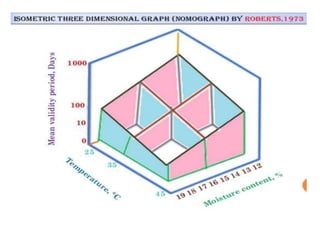
• Roberts (1973) developed formulae to describe the relationship
between temperature seed moisture content and period of
viability.
• From these relationships it was possible to construct a seed
viability nomograph.
• These nomograph are helpful in predicting the retention of
seed viability indefined storage environment for a particular
period or to determine combinations of temperature and
moisture content which will ensure the retention of a desired
level of seed viability for specific period.
• Relative humidity is the amount of H2O present in the air at a
given temperature in proportion to its maximum water holding
capacity.
• Relative Humidity and temperature are the most important
factors determining the storage life of seeds.
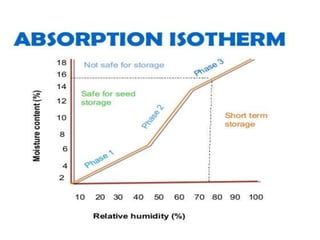
• Seeds attain a specific and characteristic moisture content
when subjected to given levels of atmospheric humidities.
• This characteristic moisture content called equilibrium
moisture content.
• Equilibrium moisture content for aparticular kind of seed at a
given Relative Humidity tends to increase as temperature
decreases.
• Thus the maintenance of seed moisture content during seed
germination and storage is a function of relative humidity and
toa lesser extent of temperature.
• At equilibrium moisture content there is no net gain or loss in
seed moisture content.
• C. Jensen (1941) treated seeds of cauliflower by exposing
them to a quartz-lamp and a sollux-lamp together, with full
strength for one hour at a distance of 1m from the lamps
• .
• Following this treatment the seeds were stored in glass
containers pluggged with an ordinary cork or a paraffin cork.
• The light-treated seeds maintained a higher germination %over
a period of eight years than untreated seeds.
• Light treatment not only extended the life span of fresh seeds,
but also increase the germination capacity and vigour of seeds.
• CLAYTON (1931) found that treatment of vegetables seeds
with mercuric chloride, liquid organic mercurials, or hot water,
greatly shortened the life of vegetables.
• Cotton-seed may be treated with organic mercury dusts at any
time after harvest and there after stored for periods of up to
seventeen months without injurious effects resulting from the
treatment and without decreasing the beneficial effects of the
treatment in increasing seed viability and yield(Miles, 1939,
1941)
• Increase in o2 pressure decrease the period of viability.
• N2 and CO2 atmosphere will increase the storage life of seeds.
• Gaseous exchange is directly related to moisture content of the
seed and temperature at which it is stored.
• The activity of all these organisms can lead to damage
resulting in loss of viability.
• Treated the seeds with fungicides ca be stored for longer
periods.
• Fumigation to control insects will also help in longer period of
storage.
• Fumigants- methyl bromide, hydrgen cynanide, ethylene
dichloride, carbon tetra chloride, carbon disulphide
naphthalene and aluminium phosphine.
• Weevils, flour beetes, or borers are rarely active below 8%
moisture contentand 18-200C but are increasingly destructiv as
the moisture content risesto 15% and temperature to 30-350C.
• Seed loose viability due to adverse weather conditions during
seed development and maturation e.g. drought, excess water ,
extreme temperature etc,
• Nutrient deficiencies and pesticides injury during seed
development and maturation.
• Environmental conditions after physiological maturity e.g.
during harvesting, drying, cleaning, storage and handling of
seeds.
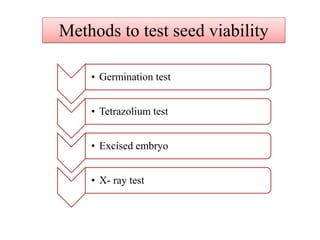
Methods to test seed viability
• Germination test
• Tetrazolium test
• Excised embryo
• X- ray test
• Cut test
• Spectral imaging
• Ferric chloride Test for Mechanical Damage.
• Indoxyl Acetate Test for seed coat damage.
• Noninvasive diagnosis of seed viability using infrared
thermography.
TETRAZOLIUM TEST (George Lakon in 1943) OBJECTIVE:
“Rapid assessment of viability.”
PRINCIPLE:
• “A colourless tetrazolium solution is used as an indicator
producing in living cells a red, stable and non-diffusible
substance, named
Formazan.
• Thus, it’s possible to distinguish the red coloured living tissues
from the colourless dead ones and the seeds are classified into
viable and non-viable seed classes.”
• Preconditioing of seeds before Tetrazolium (Tz) test no
moistening or preparation required (small seeded legumes with
soft coats).
• Seeds directly placed in Tz solution in case of peas and beans
bisect longitudinally before placing in Tz solution.
• Eg: The seed coat may be removed e.g. cucurbits The seed
coat may be scratched above embryo e.g. lettuce
SEED HYDRATION
• It is done by soaking seeds in water for a specific period of
time.
• This is done to active hydrolytic enzyme (dehydrogenase) and
stimulate respiration.
CUTTING OR PUNCTURING OF SEED
This is done to allow the penetration of Tz solution into
internal tissues.
• Staining of seeds: It is done by soaking seeds in Tz solution
for a specific period of time to allow staining of viable tissue
in the seed.
• Tz is used @ 0.1 or 1% solution, at 30-35 0c temperature for
24-48 hours at PH of 6-8.
• Evaluation of seeds evaluated according to straining pattern.
OBJECTIVE:
• To gain information about the field planting value of the seed
lot.
GERMINATION:
Germination in a laboratory test refers to the emergence from the
seed embryo of those essential structures which for the kind or
seed being tested; indicate its ability to develop into a normal
plant under favourable conditions.
Imbibition phase ( Rapid uptake of water)
Active metabolism (Major metabolic pathways affected are
respiration, protein synthesis, DNA replication, RNA synthesis
etc.)
Cell expansion and seedling protrusion.
• Suitable substratum: Paper, sand or soil.
• Adequate moisture/water: pH 6-7.5
• Favourable tempareture : as per the crop
• Light: Required for germination in some of the crop like lettuce etc.
• Chemicals: KNO3,GA3, Ethephon as prescribed by ISTA.
• Pre chilling:Also called stratification and it is exposing of imbibed
seeds to cool tempareture usually between 5-10 0C for a period of
time (days, week or months)
• Duration of germination tests: Number of days to first and final
count.
Germination methods in the laboratory:
 Between the paper (BP method)
 Top of the paper (TP)
 Sand
• From working sample take 400seed at random.
• Method Between Paper/Top Paper/Sand
• Plant seed as 100x4R,50X8R,25X16R
• Provide temperature or light and humidity as recommended.
• Germination count(1st and final as per speie)
• The cut test is simple and easily executed.
• Viability is determined by cutting the seed open and examining
the contents.
• In particular, the seed embryo must appeat intact and healthy if
the seed is to go on and germinate.
• In addition, the endosperm must appear clean and firm.
• X-ray radiography is a valuable tool to supplement laboratory
tests, provide additional information about the seed lot quality
along with the internal detail/structure of the seed.
• X-ray analysis can be a very efficient and non-destructive
method of assessing seed quality.
• Agood x-ray image will reveal details of seed fill, insect
infestation and also size or absence of the embryo.
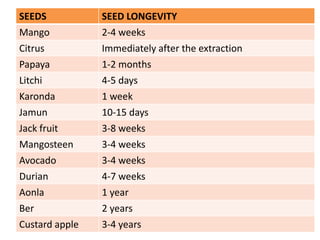
SEEDS SEED LONGEVITY
Mango 2-4 weeks
Citrus Immediately after the extraction
Papaya 1-2 months
Litchi 4-5 days
Karonda 1 week
Jamun 10-15 days
Jack fruit 3-8 weeks
Mangosteen 3-4 weeks
Avocado 3-4 weeks
Durian 4-7 weeks
Aonla 1 year
Ber 2 years
Custard apple 3-4 years
Recent Advances
• Rekha et al. (2009), reported that Recalcitrant seeds are desiccation and chilling
sensitive and are viable for a very short period. Seeds of Artocarpus
heterophyllus being recalcitrant in nature pose storage problems. The present
study was taken up to identify methods to prolong seed viability of the species.
Seeds were stored at four different temperatures: Ambient (25 ± 2˚C), 20˚C, 15˚C
and 0 ± 2˚C and subjected to germination tests at the end of 1, 2, 3, 4 and 5 weeks
of storage. Seeds stored at 20˚C retained viability for 5 weeks with 41%
germination. Experiments to store seeds with and without bulb revealed that
seeds should be extracted from the bulb to ensure effective storage. The viability
of seeds can be prolonged to 32 weeks (with 48% germination) when stored at
20˚C.
• Nache et al. (2011), studied that fresh seeds were subjected for germination
compared to stored seeds, the viability of seed decreased gradually with the
increase in storage period. Seedling growth, fresh and dry weight and vigor were
found to be maximum in the fresh seeds, than in stored seeds. The seed viability
study revealed that tamarind seeds were viable up to 270 days, jack seeds up to
150 days, S. cumini - 150 days, S. jambos - 150 days, aonla seeds - 90 days,
annona seeds - 150 days and wood apple seeds up to 90 days under ambient
conditions.
• Shivashankar et al. (2013), reported that Treating fruit with 1.0 g l–1 gibberellic acid
(GA3) at 50% maturity increased fruit fresh weight and presumably seed growth, and
reduced the incidence of CT compared with that in untreated control fruit. In contrast,
fruit treated with 3.0 g l–1 paclobutrazol (PBZ) showed the opposite response. Fruit
treated at 70% or 90% maturity gave no response, suggesting that poor seed viability
during the early stage of fruit development was associated with CT. Seed stored for 30 d
under ambient conditions lost water and had lower viability. There were decreases in the
moisture content and calcium concentration in seed and pulp as the severity of CT
increased in fruit harvested in the field, indicating a “reverse flow” of water and
nutrients from the fruit. It is proposed that the incidence of CT is related to reduced seed
viability and the consequent losses of water and calcium from fruit due to competition
for resources with the rest of the tree. Further studies are required to assess the potential
of the application of GA3 to reduce the incidence of CT in commercial orchards.
• Zulhisyam et al. (2013), found that The seeds were dried to 6%, 8% and 10% moisture
contents using silica gel and stored at 0ºC, 4ºC and 28ºC for three months. Seeds
containing 6% moisture content and stored at 0ºC gave higher percentage of
germination, lower dormancy, lower seed death compared to the seed of the other
storage conditions. The result suggested that such condition was the best condition for
papaya seed storage. Seeds containing 10% moisture content and stored at 28ºC is not
recommended for papaya seed storage because seed deterioration rate under such
condition is higher within three months of storage.
• Devi et al. (2016), studied the effect of the seeds possessed short viability
due to recalcitrant. This could be overcome by finding a suitable storage
temperature and container for storage of jamun seeds. This study showed
significant differences among the various storage and treatments. The seeds
stored at refrigerated (5p C) gave higher germination per cent at zero, 15,
30, 45, 60, 75 and 90 days after extraction (DAE)(78.56%, 73.52%,
43.33%, 60.41%, 60.09%, 53.76% and 54.36% respectively) compared to
seed of other storage conditions. Seeds treated with Poly bag +
Trichoderma harzianum (86.68%, 66.29%, 22.64%, 35.13%, 33.21%,
28.78% and 30.75% respectively)at zero, 15, 30, 45, 60, 75 and 90 days
after extraction (DAE) gave higher germination followed by seeds kept in
poly bag and seeds treated with Poly bag + Charcoal powder. Seeds stored
at room temperature are not recommended for jamun seed storage because
seed deterioration rate under such condition is higher within 15 days of
extraction. The use of bio-control agents and moisture holding media are
therefore recommended as an approach for extending the viability and
potential to increase the germination of jamun seeds.
• Yallesh et al. (2018), studied that Among different days, seeds sowed at
zero days after extraction got early initiation, 50% germination (15.74 and
22.55), Number of leaves (20.33) and stem diameter (5.37mm). whereas
three days after extraction seeds recorded significantly maximum
germination percentage (100%), germination index (2.45) extent of
Polyembryony (3.59), Plant height (20.22 cm), primary root length (26.07
cm), numbers of secondary roots (44.61), volume of roots (5.64 ml),
rootstock vigour (594.22 g), vigour index (2022.70 cm) and Survival
percentages (64.26%). However six days after extraction recorded highest
height (7.41 cm) and Per cent graft success (70.40%). The germination
percentage decreased with increased storage period. For viable seeds
maximum germination percent growth, root, vigour and graft parameter
was recorded three days after extraction and lowest was recorded twenty
four days after extraction seeds.
• Nagendra et al. (2019), reported that storing the jamun seeds a highly
recalcitrant species in the refrigerated condition (5℃) to extend the seed
longevity. Jamun seeds were stored under ambient and refrigerated condition,
and were assessed for their germinability on alternate days. It was noticed that
refrigerated jamun seeds maintained 100% germination until 13 days of storage
irrespective of the reduction in moisture content but under ambient conditions
80% of seeds remained viable till 7 days with moisture content of 32.5% further
reduction in moisture content brought down the germinability to 20%. The
results of the study indicate that the storability of recalcitrant seeds can be
extended under refrigerated condition and until the presence of critical moisture
the seeds are able to germinate and moisture content of 31% may be the critical
moisture for storing the jamun seeds. From the above results it can be concluded
that jamun seeds can be stored upto 7 days under ambient conditions without
reduction in viability beyond which germination get reduced due to reduction in
moisture content affecting the seed viability. Jamun seeds when stored under
refrigerated conditions extend the seed viability until 13th day by preventing the
rapid decline in moisture content from the seeds.
• Pavithra et al. (2020), found that significantly minimum number of days for
initiation of germination (13.67 days), complete germination (30.67
days),fifty per cent germination (21.00 days), maximum germination
percentage (100.00%) and survivability percentage (95.83%) was noticed
in the seeds which were sown on the day of extraction. Seedling growth
parameters like longest root length (8.03 cm), shoot length (7.08 cm),
vigour index-I (1511.67), vigour index-II (16.67), fresh weight (46.83 mg),
dry weight (15.67 mg), at 30, 60, 90 and 120 days after transplanting was
also maximum in seeds sown on the day of extraction. Delay in seed
sowing caused a considerable decrease in all these parameters.
References
• Ch. Allaylay Devi, G.S.K. Swamy and Nagesh Naik. 2016. Studies on
Storage and Viability of Jamun Seeds (Syzygium cuminii Skeels). Biosci.,
Biotech. Res. Asia. 13(4): 2371-2378.
• M. S. Nagendra, C. Tamilarasan, K. V. Shobha, K. P. Ragupathi and P. R.
Renganayaki. 2019. Refrigerated Storage of Recalcitrant Seeds Reduces
the Seed Viability. Res. Jr. of Agril. Sci. 10(2): 455-456.
• Rekha R. Warrier, B. Gurudev Singh, R. Anandalakshmi, V. Sivakumar, S.
Geetha, A. M. Kumar and Maheshwar T. Hegde. 2009. Standardization of
storage conditions to prolong viability of seeds of artocarpus heterophyllus
lam- a tropical fruit tree. Journal of Agricultural and Biological Science.
4(2): 1990-6145.
• S. Pavithra, G. S. K. Swamy, G. J. Suresh and T. Ruchita. 2020. Study on
viability of Surinam cherry (Eugenia uniflora L.) seeds on germination
behaviour and Vigour of the seedling. Journal of Pharmacognosy and
Phytochemistry. 9(4): 1802-1804.
• Seshadri shivashankar, Jaya joshi and Manoharan sumathi. 2013.
The role of seed viability in the development of corky tissue in
sapota (Manilkara achras) fruit in India. Journal of Horticultural
Science & Biotechnology. 88(5): 671–677.
• V. Nache Gowda, M.N. Smitha and P. Vinaya Kumar Reddy. 2011.
Studies on Seed Viability, Germination and Seedling Growth of
Minor Fruit Plants. ishs. Acta Hort. 890.
• Yallesh Kumar., H. S., Kulapati Hippargi, Swamy G. S. K,
Hemavathi G. N, Sadashiv Nadukeri and Kanthraju Y. 2018. Studies
on seed viability and its effects on germination, growth and graft-
take in medicinal fruit plant of Jamun. Journal of Pharmacognosy
and Phytochemistry. 3: 471-474.
• Zulhisyam a.k., Chuah tse seng, Ahmad anwar ismail, n.n. azwanida,
shazani, s., and jamaludin, m.h. 2013. J. Sustain. Sci. Manage.8(1):
87-92.
THANK YOU...!

Seed viability of different crops

  • 2.
    ANNAMALAI UNIVERSITY FACULTY OFAGRICULTURE DEPARTMENT OF HORTICULTUE TOPIC: Review on seed viability of different crops 2 SUBMITTED BY: S. SHARVESH, M.Sc. HORTICULTURE, DEPARTMENT OF HORTICULTURE, FACULTY OF AGRICULTUR, ANNAMALAI UNIVERSITY.
  • 3.
    What is Seed? Inbroad sense: Seed is a material which is used for planting or regeneration purpose. Scientifically: Seed is a fertilized matured ovule together covered with seed coat is called seed or it is a propagating material. Technological point of view: Seed is a fertilized ripened ovule consisting of three main parts namely seed coat, endosperm and embryo, which in due course gives rise to a new plant. It also refers to: Propagating materials of healthy seedlings, tuber, bulbs, rhizome, roots, cuttings, setts, all types of grafts and vegetatively propagating materials used for production purpose.
  • 5.
    Seed is afertilized ovule
  • 6.
     The viableseed is a source of a new plant, a beginning based on inherited parental characteristics. Seeds contain genetic material in compact form that is well protected from extraneous factors.  Seeds are a viable tool for long-term conservation of genetic diversity because they are easier to handle, practicable, inexpensive, and capable of maintaining genetic stability on storage.  The principal purpose of storing seeds of economic plants is to preserve planting stocks from one season until the next.  Seeds are largely involved in evolutionary processes in the plant industry. Vast genetic diversity is the result of repeated natural propagation by seeds. The farming community also depends on quality seeds for rich harvests.
  • 7.
     They areused for raising rootstocks and also in breeding programs.  In botanical terms, a seed is a fertilized ovule, and for practical purposes, it is a dry unit of propagation that transmits genetic material from generation to generation. A seed consists of a tiny embryonic plant in the resting stage that is provided with food and well protected by the hard seed covering.  A seedling emerges from the seed upon germination under favorable conditions. Seeds vary in size, shape, and color. They can be oval, round, triangular, cylindrical, and sometimes irregular in shape. Their surface can be rough, smooth, or covered with hairs. Colors include red, yellow, green, white, black, or brown in various crop plants.
  • 8.
  • 9.
    Procedure of seeddevelopment
  • 10.
  • 11.
  • 13.
  • 14.
     “Seed viabilityis the ability of the embryo to germinate and gives rise to a normal seedling”  Seed viability is the capability of seed to show living properties like germination and growth.  Seed viability decreases under improper storage conditions. The viability loss rate varies in different species.  The degree to which the seed is alive (metabolically active)
  • 15.
    Seed viability  Viabilityis highest at the point of physiological maturity and then gradually declines  Average life span of a seed is 10 to 15 years.  Some are very short-lived. e. g. willow (<1 week)  Some are very long-lived. e.g. mimosa 221 years  Conditions are very important for longevity  Cold, dry, anaerobic conditions  Those are the conditions which are maintained in sedd seed banks.
  • 16.
    Factors affecting seedviability Pre harvest factors Post harvest factors Seed coat Pollination Mechanical injury Weather condition Time Moisture Temperature Relative humidity Light Chemicals Gases during storage Insects and mites
  • 18.
    • Mechanical injuryto seeds by threshing usually contributes to immediate reduction in germination capacity and to an accelerated loss of viability in storage. • Wahlen 91929) found that viability in clover seeds depend upon the impermeability of the seed coat. • Allison et al 91990) studied that poor seed emergence of pea, vicia faba, Phaseolus vulgaris. Chick pea and long bean and found associated with genotypes having wite or unpigmented seed coat. • Genotypes with pigmented seed coats showed high levels of seed viability.
  • 19.
    • Incomplete pollinationresults in a high proportion of empty seeds. • They look like seeds, but there is no embryo, or one which is only partly developed. • Most viable seeds are positioned around the outer perimeter of the head. • As flowers and vegetables are further and further hybridized to produce colour and style which is more and more remote from the natural parents, the viability of the “germ” is reduced.
  • 20.
    • Mechanical damageduring harvesting can severely reduce the viability of some seeds, e.g…, certain large seeded legumes. • Cereals are largely immune from mechanical injury, presumably because of the protective outer structures, the palea and lemma. • Small seeds tend to escape injury during harvest, and seeds that are spherical tend to suffer less damage than irregular or elongated shaped seeds.
  • 21.
    • Bacteria donot play a significant role in seed deterioration, since it requires free water to grow. • If conditions were moist enough, this would encourage growth of fungi which would suppress bacterial growth. Two types of fungi invade seeds: 1. FIELD FUNGI 2. STORAGE FUNGI FIELD FUNGI: These invade seeds during their development on plants in field. They need a high moisture content for growth. Aperiod of high rainfall at the time of harvest result in extensive grain deterioration. Ex: Alternaria, Fusarium and Helminthosporium
  • 22.
    • STORAGE FUNGI Theyinfest seeds only under storage conditions. The major deleterious effects of storage fungi are to Decrease viability Cause discoloration Produce mycotoxins Cause heat production
  • 23.
    • Different seedsfrom the same seed pod will have different degrees of viability in the embryo. • Some will germinate at once, or go into “deep dormancy’, or have insufficient viability to germinate at a later date. • Similarly, different seeds from the same seed pod will have a “chemical” lock which will not degrade except for the passage of time. • Environmental variation duriing seed development usually had a little effect on the viability of seeds unless the ripening process is interrupted by premature harvesting. • Weathering of mature seeds in the field particularly in conditions of excess moisture or freezing temperatures, results in a product with inferior storage potential.
  • 25.
    • The amountof moisture in the seeds is the most important factor influencing seed viability during storage. • Generally if the seed moisture content increases storage life decreases. • If seeds are kept at high moisture content the losses could be very rapid due to mould growth. • If they are kept at very low moisture content below 4% may also damage seeds due to extreme desication or cause hard seededness in some crops.
  • 26.
    • The lifeof a seed largely revolves around its moisture content. • It is necessary to dry seeds to safe moisture contents. • The safe moisture content however depends upon storage length, type of storagestructure, kind/variety of seed typeof packing material used. • For cereals in ordinary storage conditions for 12-18 months, seed drying upto 10% moisture content appears quite satisfactory. • However, for storage in sealed container, drying upto 5-8% moisture content depending upon particular kind may be necessary.
  • 27.
    Harringtons thumb ruleon seed moisture content: • For every 1% decrease in seed moisture content the life of seed will be doubled. This is again hold good between 4-12 0c. • Based on the tolerance and susceptibility of seeds towards moisture loss. • Orthodox: The seeds able to tolerate moisture loss and less seed moisture favours the storage. i.e, decrease moisture increased storage period. • Recalcitrant: Just opposite to the orthodox . Seeds not able to tolerate moisture loss. Required high moisture for viability maintenance.
  • 28.
    • Temperature alsoplays an important role in life of seed. • Insects and moulds increase as temperature increases. • The higher the moisture content of the seeds the more they are adversely affected by temperature. • Decreasing temperature and seed moisture is an effective means of maintaining seed quality in storage. • The thumb rules by Harrington are useful measures for assessing the effect of moisture and tempreture on seed storage.
  • 29.
    These rules areas follows. 1. For every decrease of 1% seed moisture content the life of the seed doubles. This rule is applicable between moisture content of 5-14%. 2. For every decrease of 5 0c in storage temperature the life of the seed doubles. This rules applies between 00c to 500c. 3. Good seed storage is achieved when the % relative humidity in storage environment and the storage temperature in degrees Fahrenheit add up to one hundred but the contribution from temperature should not exceed 500F.
  • 31.
    • Roberts (1973)developed formulae to describe the relationship between temperature seed moisture content and period of viability. • From these relationships it was possible to construct a seed viability nomograph. • These nomograph are helpful in predicting the retention of seed viability indefined storage environment for a particular period or to determine combinations of temperature and moisture content which will ensure the retention of a desired level of seed viability for specific period.
  • 33.
    • Relative humidityis the amount of H2O present in the air at a given temperature in proportion to its maximum water holding capacity. • Relative Humidity and temperature are the most important factors determining the storage life of seeds. • Seeds attain a specific and characteristic moisture content when subjected to given levels of atmospheric humidities. • This characteristic moisture content called equilibrium moisture content.
  • 34.
    • Equilibrium moisturecontent for aparticular kind of seed at a given Relative Humidity tends to increase as temperature decreases. • Thus the maintenance of seed moisture content during seed germination and storage is a function of relative humidity and toa lesser extent of temperature. • At equilibrium moisture content there is no net gain or loss in seed moisture content.
  • 35.
    • C. Jensen(1941) treated seeds of cauliflower by exposing them to a quartz-lamp and a sollux-lamp together, with full strength for one hour at a distance of 1m from the lamps • . • Following this treatment the seeds were stored in glass containers pluggged with an ordinary cork or a paraffin cork. • The light-treated seeds maintained a higher germination %over a period of eight years than untreated seeds. • Light treatment not only extended the life span of fresh seeds, but also increase the germination capacity and vigour of seeds.
  • 36.
    • CLAYTON (1931)found that treatment of vegetables seeds with mercuric chloride, liquid organic mercurials, or hot water, greatly shortened the life of vegetables. • Cotton-seed may be treated with organic mercury dusts at any time after harvest and there after stored for periods of up to seventeen months without injurious effects resulting from the treatment and without decreasing the beneficial effects of the treatment in increasing seed viability and yield(Miles, 1939, 1941)
  • 37.
    • Increase ino2 pressure decrease the period of viability. • N2 and CO2 atmosphere will increase the storage life of seeds. • Gaseous exchange is directly related to moisture content of the seed and temperature at which it is stored.
  • 38.
    • The activityof all these organisms can lead to damage resulting in loss of viability. • Treated the seeds with fungicides ca be stored for longer periods. • Fumigation to control insects will also help in longer period of storage. • Fumigants- methyl bromide, hydrgen cynanide, ethylene dichloride, carbon tetra chloride, carbon disulphide naphthalene and aluminium phosphine. • Weevils, flour beetes, or borers are rarely active below 8% moisture contentand 18-200C but are increasingly destructiv as the moisture content risesto 15% and temperature to 30-350C.
  • 39.
    • Seed looseviability due to adverse weather conditions during seed development and maturation e.g. drought, excess water , extreme temperature etc, • Nutrient deficiencies and pesticides injury during seed development and maturation. • Environmental conditions after physiological maturity e.g. during harvesting, drying, cleaning, storage and handling of seeds.
  • 40.
    Methods to testseed viability • Germination test • Tetrazolium test • Excised embryo • X- ray test
  • 41.
    • Cut test •Spectral imaging • Ferric chloride Test for Mechanical Damage. • Indoxyl Acetate Test for seed coat damage. • Noninvasive diagnosis of seed viability using infrared thermography.
  • 42.
    TETRAZOLIUM TEST (GeorgeLakon in 1943) OBJECTIVE: “Rapid assessment of viability.” PRINCIPLE: • “A colourless tetrazolium solution is used as an indicator producing in living cells a red, stable and non-diffusible substance, named Formazan. • Thus, it’s possible to distinguish the red coloured living tissues from the colourless dead ones and the seeds are classified into viable and non-viable seed classes.”
  • 43.
    • Preconditioing ofseeds before Tetrazolium (Tz) test no moistening or preparation required (small seeded legumes with soft coats). • Seeds directly placed in Tz solution in case of peas and beans bisect longitudinally before placing in Tz solution. • Eg: The seed coat may be removed e.g. cucurbits The seed coat may be scratched above embryo e.g. lettuce
  • 44.
    SEED HYDRATION • Itis done by soaking seeds in water for a specific period of time. • This is done to active hydrolytic enzyme (dehydrogenase) and stimulate respiration. CUTTING OR PUNCTURING OF SEED This is done to allow the penetration of Tz solution into internal tissues.
  • 45.
    • Staining ofseeds: It is done by soaking seeds in Tz solution for a specific period of time to allow staining of viable tissue in the seed. • Tz is used @ 0.1 or 1% solution, at 30-35 0c temperature for 24-48 hours at PH of 6-8.
  • 46.
    • Evaluation ofseeds evaluated according to straining pattern.
  • 47.
    OBJECTIVE: • To gaininformation about the field planting value of the seed lot. GERMINATION: Germination in a laboratory test refers to the emergence from the seed embryo of those essential structures which for the kind or seed being tested; indicate its ability to develop into a normal plant under favourable conditions.
  • 48.
    Imbibition phase (Rapid uptake of water) Active metabolism (Major metabolic pathways affected are respiration, protein synthesis, DNA replication, RNA synthesis etc.) Cell expansion and seedling protrusion.
  • 49.
    • Suitable substratum:Paper, sand or soil. • Adequate moisture/water: pH 6-7.5 • Favourable tempareture : as per the crop • Light: Required for germination in some of the crop like lettuce etc. • Chemicals: KNO3,GA3, Ethephon as prescribed by ISTA. • Pre chilling:Also called stratification and it is exposing of imbibed seeds to cool tempareture usually between 5-10 0C for a period of time (days, week or months) • Duration of germination tests: Number of days to first and final count. Germination methods in the laboratory:  Between the paper (BP method)  Top of the paper (TP)  Sand
  • 50.
    • From workingsample take 400seed at random. • Method Between Paper/Top Paper/Sand • Plant seed as 100x4R,50X8R,25X16R • Provide temperature or light and humidity as recommended. • Germination count(1st and final as per speie)
  • 51.
    • The cuttest is simple and easily executed. • Viability is determined by cutting the seed open and examining the contents. • In particular, the seed embryo must appeat intact and healthy if the seed is to go on and germinate. • In addition, the endosperm must appear clean and firm.
  • 52.
    • X-ray radiographyis a valuable tool to supplement laboratory tests, provide additional information about the seed lot quality along with the internal detail/structure of the seed. • X-ray analysis can be a very efficient and non-destructive method of assessing seed quality. • Agood x-ray image will reveal details of seed fill, insect infestation and also size or absence of the embryo.
  • 53.
    SEEDS SEED LONGEVITY Mango2-4 weeks Citrus Immediately after the extraction Papaya 1-2 months Litchi 4-5 days Karonda 1 week Jamun 10-15 days Jack fruit 3-8 weeks Mangosteen 3-4 weeks Avocado 3-4 weeks Durian 4-7 weeks Aonla 1 year Ber 2 years Custard apple 3-4 years
  • 54.
  • 55.
    • Rekha etal. (2009), reported that Recalcitrant seeds are desiccation and chilling sensitive and are viable for a very short period. Seeds of Artocarpus heterophyllus being recalcitrant in nature pose storage problems. The present study was taken up to identify methods to prolong seed viability of the species. Seeds were stored at four different temperatures: Ambient (25 ± 2˚C), 20˚C, 15˚C and 0 ± 2˚C and subjected to germination tests at the end of 1, 2, 3, 4 and 5 weeks of storage. Seeds stored at 20˚C retained viability for 5 weeks with 41% germination. Experiments to store seeds with and without bulb revealed that seeds should be extracted from the bulb to ensure effective storage. The viability of seeds can be prolonged to 32 weeks (with 48% germination) when stored at 20˚C. • Nache et al. (2011), studied that fresh seeds were subjected for germination compared to stored seeds, the viability of seed decreased gradually with the increase in storage period. Seedling growth, fresh and dry weight and vigor were found to be maximum in the fresh seeds, than in stored seeds. The seed viability study revealed that tamarind seeds were viable up to 270 days, jack seeds up to 150 days, S. cumini - 150 days, S. jambos - 150 days, aonla seeds - 90 days, annona seeds - 150 days and wood apple seeds up to 90 days under ambient conditions.
  • 56.
    • Shivashankar etal. (2013), reported that Treating fruit with 1.0 g l–1 gibberellic acid (GA3) at 50% maturity increased fruit fresh weight and presumably seed growth, and reduced the incidence of CT compared with that in untreated control fruit. In contrast, fruit treated with 3.0 g l–1 paclobutrazol (PBZ) showed the opposite response. Fruit treated at 70% or 90% maturity gave no response, suggesting that poor seed viability during the early stage of fruit development was associated with CT. Seed stored for 30 d under ambient conditions lost water and had lower viability. There were decreases in the moisture content and calcium concentration in seed and pulp as the severity of CT increased in fruit harvested in the field, indicating a “reverse flow” of water and nutrients from the fruit. It is proposed that the incidence of CT is related to reduced seed viability and the consequent losses of water and calcium from fruit due to competition for resources with the rest of the tree. Further studies are required to assess the potential of the application of GA3 to reduce the incidence of CT in commercial orchards. • Zulhisyam et al. (2013), found that The seeds were dried to 6%, 8% and 10% moisture contents using silica gel and stored at 0ºC, 4ºC and 28ºC for three months. Seeds containing 6% moisture content and stored at 0ºC gave higher percentage of germination, lower dormancy, lower seed death compared to the seed of the other storage conditions. The result suggested that such condition was the best condition for papaya seed storage. Seeds containing 10% moisture content and stored at 28ºC is not recommended for papaya seed storage because seed deterioration rate under such condition is higher within three months of storage.
  • 57.
    • Devi etal. (2016), studied the effect of the seeds possessed short viability due to recalcitrant. This could be overcome by finding a suitable storage temperature and container for storage of jamun seeds. This study showed significant differences among the various storage and treatments. The seeds stored at refrigerated (5p C) gave higher germination per cent at zero, 15, 30, 45, 60, 75 and 90 days after extraction (DAE)(78.56%, 73.52%, 43.33%, 60.41%, 60.09%, 53.76% and 54.36% respectively) compared to seed of other storage conditions. Seeds treated with Poly bag + Trichoderma harzianum (86.68%, 66.29%, 22.64%, 35.13%, 33.21%, 28.78% and 30.75% respectively)at zero, 15, 30, 45, 60, 75 and 90 days after extraction (DAE) gave higher germination followed by seeds kept in poly bag and seeds treated with Poly bag + Charcoal powder. Seeds stored at room temperature are not recommended for jamun seed storage because seed deterioration rate under such condition is higher within 15 days of extraction. The use of bio-control agents and moisture holding media are therefore recommended as an approach for extending the viability and potential to increase the germination of jamun seeds.
  • 58.
    • Yallesh etal. (2018), studied that Among different days, seeds sowed at zero days after extraction got early initiation, 50% germination (15.74 and 22.55), Number of leaves (20.33) and stem diameter (5.37mm). whereas three days after extraction seeds recorded significantly maximum germination percentage (100%), germination index (2.45) extent of Polyembryony (3.59), Plant height (20.22 cm), primary root length (26.07 cm), numbers of secondary roots (44.61), volume of roots (5.64 ml), rootstock vigour (594.22 g), vigour index (2022.70 cm) and Survival percentages (64.26%). However six days after extraction recorded highest height (7.41 cm) and Per cent graft success (70.40%). The germination percentage decreased with increased storage period. For viable seeds maximum germination percent growth, root, vigour and graft parameter was recorded three days after extraction and lowest was recorded twenty four days after extraction seeds.
  • 59.
    • Nagendra etal. (2019), reported that storing the jamun seeds a highly recalcitrant species in the refrigerated condition (5℃) to extend the seed longevity. Jamun seeds were stored under ambient and refrigerated condition, and were assessed for their germinability on alternate days. It was noticed that refrigerated jamun seeds maintained 100% germination until 13 days of storage irrespective of the reduction in moisture content but under ambient conditions 80% of seeds remained viable till 7 days with moisture content of 32.5% further reduction in moisture content brought down the germinability to 20%. The results of the study indicate that the storability of recalcitrant seeds can be extended under refrigerated condition and until the presence of critical moisture the seeds are able to germinate and moisture content of 31% may be the critical moisture for storing the jamun seeds. From the above results it can be concluded that jamun seeds can be stored upto 7 days under ambient conditions without reduction in viability beyond which germination get reduced due to reduction in moisture content affecting the seed viability. Jamun seeds when stored under refrigerated conditions extend the seed viability until 13th day by preventing the rapid decline in moisture content from the seeds.
  • 60.
    • Pavithra etal. (2020), found that significantly minimum number of days for initiation of germination (13.67 days), complete germination (30.67 days),fifty per cent germination (21.00 days), maximum germination percentage (100.00%) and survivability percentage (95.83%) was noticed in the seeds which were sown on the day of extraction. Seedling growth parameters like longest root length (8.03 cm), shoot length (7.08 cm), vigour index-I (1511.67), vigour index-II (16.67), fresh weight (46.83 mg), dry weight (15.67 mg), at 30, 60, 90 and 120 days after transplanting was also maximum in seeds sown on the day of extraction. Delay in seed sowing caused a considerable decrease in all these parameters.
  • 61.
    References • Ch. AllaylayDevi, G.S.K. Swamy and Nagesh Naik. 2016. Studies on Storage and Viability of Jamun Seeds (Syzygium cuminii Skeels). Biosci., Biotech. Res. Asia. 13(4): 2371-2378. • M. S. Nagendra, C. Tamilarasan, K. V. Shobha, K. P. Ragupathi and P. R. Renganayaki. 2019. Refrigerated Storage of Recalcitrant Seeds Reduces the Seed Viability. Res. Jr. of Agril. Sci. 10(2): 455-456. • Rekha R. Warrier, B. Gurudev Singh, R. Anandalakshmi, V. Sivakumar, S. Geetha, A. M. Kumar and Maheshwar T. Hegde. 2009. Standardization of storage conditions to prolong viability of seeds of artocarpus heterophyllus lam- a tropical fruit tree. Journal of Agricultural and Biological Science. 4(2): 1990-6145. • S. Pavithra, G. S. K. Swamy, G. J. Suresh and T. Ruchita. 2020. Study on viability of Surinam cherry (Eugenia uniflora L.) seeds on germination behaviour and Vigour of the seedling. Journal of Pharmacognosy and Phytochemistry. 9(4): 1802-1804.
  • 62.
    • Seshadri shivashankar,Jaya joshi and Manoharan sumathi. 2013. The role of seed viability in the development of corky tissue in sapota (Manilkara achras) fruit in India. Journal of Horticultural Science & Biotechnology. 88(5): 671–677. • V. Nache Gowda, M.N. Smitha and P. Vinaya Kumar Reddy. 2011. Studies on Seed Viability, Germination and Seedling Growth of Minor Fruit Plants. ishs. Acta Hort. 890. • Yallesh Kumar., H. S., Kulapati Hippargi, Swamy G. S. K, Hemavathi G. N, Sadashiv Nadukeri and Kanthraju Y. 2018. Studies on seed viability and its effects on germination, growth and graft- take in medicinal fruit plant of Jamun. Journal of Pharmacognosy and Phytochemistry. 3: 471-474. • Zulhisyam a.k., Chuah tse seng, Ahmad anwar ismail, n.n. azwanida, shazani, s., and jamaludin, m.h. 2013. J. Sustain. Sci. Manage.8(1): 87-92.
  • 63.