ANNAMALAI UNIVERSITY
FACULTY OF AGRICULTURE
DEPARTMENT OF HORTICULTUE
PRESENTATION ON UNFRUITFULNESS IN FRUIT
CROPS
Name of the Student : S. SHARVESH
Degree Programme and Subject : M. Sc. (Hort.) Fruit Science
Department : Horticulture
INTRODUCTION
• Fruit growing is one of the most important and
profitable venture in horticulture.
• The art and science has now developed into
one of the most deviled, skillful and intensive
forms of land utilization.
• Today the standard of living of different people
of countries is judged by the production and
per capita consumption of fruits.
What is unfruitfulness ?
• ‘Fruitfulness’ refers to the state where a plant
is not only capable of flowering and bearing
fruit, but also takes these fruits to maturity. The
inability to do so is known as ‘unfruitfulness’
or ‘barrenness’.
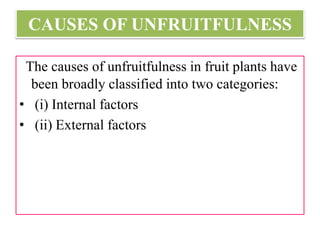
CAUSES OF UNFRUITFULNESS
The causes of unfruitfulness in fruit plants have
been broadly classified into two categories:
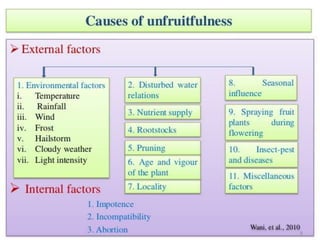
• (i) Internal factors
• (ii) External factors
Classification and explanation of unfruitfulness
 External factors
1. Environmental factors
i. Temperature
 It affects the flowering, pollination, fruit set,
growth and development of the plants.
 Extreme temperature fluctuations and
continuous high temperature etc., are
injurious to fertilization process.
• The pollen of most of the fruit crops grown in
temperate climate, like apple, pear, cherry,
plum, walnut, pecannut etc., germinate freely
at a temperature of 50 ˚F or above, but the
fertilization process is practically inhibited if
the temperature falls below 40 ˚F.
• Of the different climatic factors, temperature
appears to have some relation with the
variability in the incidence of mango
malformation.
• Higher temperature and dry atmosphere appear
to be associated with the increased production
of pollen per anther in mango crop
• It have indirect influence on fruit set through
its effect on the activity of pollen carrying
insects.
• Influence of temperature on fruit set has also
been reported in papaya such as sex reversing
male plants.
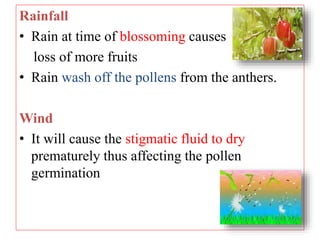
Rainfall
• Rain at time of blossoming causes
loss of more fruits
• Rain wash off the pollens from the anthers.
Wind
• It will cause the stigmatic fluid to dry
prematurely thus affecting the pollen
germination
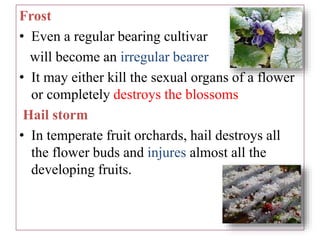
Frost
• Even a regular bearing cultivar
will become an irregular bearer
• It may either kill the sexual organs of a flower
or completely destroys the blossoms
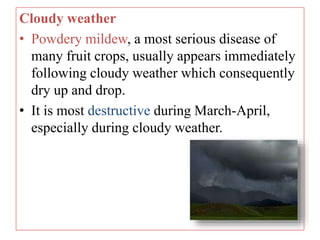
Hail storm
• In temperate fruit orchards, hail destroys all
the flower buds and injures almost all the
developing fruits.
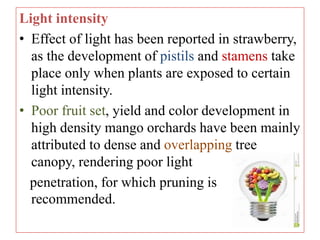
Cloudy weather
• Powdery mildew, a most serious disease of
many fruit crops, usually appears immediately
following cloudy weather which consequently
dry up and drop.
• It is most destructive during March-April,
especially during cloudy weather.
Light intensity
• Effect of light has been reported in strawberry,
as the development of pistils and stamens take
place only when plants are exposed to certain
light intensity.
• Poor fruit set, yield and color development in
high density mango orchards have been mainly
attributed to dense and overlapping tree
canopy, rendering poor light
penetration, for which pruning is
recommended.
2. Disturbed water relations
• For fruitful production, adequate supply of
water is required, and disturbance in water or
moisture in soil may lead to the formation of
an abscission layer, resulting in the dropping
of the blossoms, leaves or fruits, thereby
affecting fruitfulness of the plant.
• Moisture deficit may be responsible for
disturbance in C:N ratio and composition of
other chemicals, which are responsible for fruit
drop.
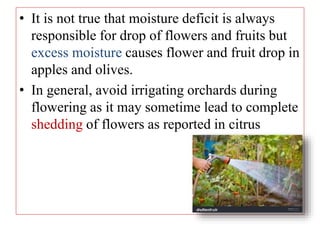
• It is not true that moisture deficit is always
responsible for drop of flowers and fruits but
excess moisture causes flower and fruit drop in
apples and olives.
• In general, avoid irrigating orchards during
flowering as it may sometime lead to complete
shedding of flowers as reported in citrus
3. Nutrient supply
• Excess supply of manures and fertilizers,
though, may result in vigorous growth of the
plants, but it affects flowering and fruiting
adversely.
• It is assumed that overfed plants have low C:N
ratio, which is not desirable for proper set in
fruit plants.
• Example: Jonathan apple - Self sterile on rich
land in Victoria (Australia), becomes self-
fruitful when grown on land of low
productivity.
• The Hope grape and Muscadine group, produce
hermaphrodite flowers only when proper nutrient
supply is given. Under inadequate management
practices, most of the flowers produced by these
varieties are staminate.
• Some cultivars of strawberry produce perfect
flowers and are productive when grown under
ordinary management cultural practices, but
produce only little pollen for satisfactory crop
when grown on rich soils.
4. Rootstocks
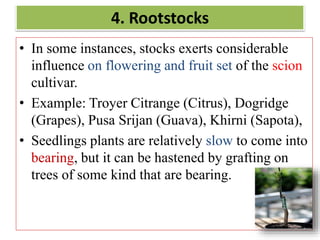
• In some instances, stocks exerts considerable
influence on flowering and fruit set of the scion
cultivar.
• Example: Troyer Citrange (Citrus), Dogridge
(Grapes), Pusa Srijan (Guava), Khirni (Sapota),
• Seedlings plants are relatively slow to come into
bearing, but it can be hastened by grafting on
trees of some kind that are bearing.
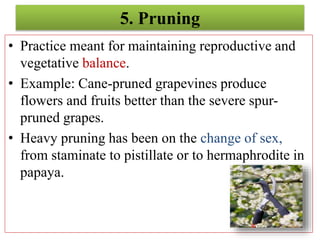
5. Pruning
• Practice meant for maintaining reproductive and
vegetative balance.
• Example: Cane-pruned grapevines produce
flowers and fruits better than the severe spur-
pruned grapes.
• Heavy pruning has been on the change of sex,
from staminate to pistillate or to hermaphrodite in
papaya.
6. Age and vigour of the plant
• Young and vigorous plum trees are known to
produce higher proportion of defective pistils
than older trees of the same variety.
• Young vigorous apple trees often fail to set
fruits under controlled cross- pollination,
whereas old and less vigorous trees of the
same variety set freely.
• The problem of coulure is very serious disease
in the initial years of bearing in Muscat of
Alexandria grape, but later it is less serious.
7. Locality
• It is the only environmental complex, which
influences the fruit set in a locality.
• Example: The American grape varieties have been
found to be self sterile in Columbia, although,
perfectly self fertile in California, which is in the
south
• The Jonathan apple is almost sterile in Victoria
(Australia), although it is fertile in USA.
• The Bose pear is self sterile in many localities,
but becomes partially fertile in New York (USA).
• The South Indian variety (Neelum and Baneshan)
of mango don’t perform better under North Indian
conditions
8. Seasonal influence
• Trees of some plum varieties have been found to
be greatly in fertility from season to season and a
plum variety, which is protandrous in one season,
may be protogynous in the next season.
• a) End season fertility (Grape varieties – Ideal)
• b) Change of sex with season
(Japanese Persimmon, Myrica gale,
Grapes Hybrid – Vitis riparia x Vitis Labrusca)
9. Spraying fruit plants during
flowering
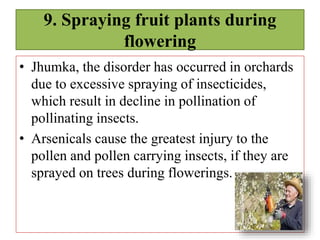
• Jhumka, the disorder has occurred in orchards
due to excessive spraying of insecticides,
which result in decline in pollination of
pollinating insects.
• Arsenicals cause the greatest injury to the
pollen and pollen carrying insects, if they are
sprayed on trees during flowerings.
10. Insect-pest and diseases
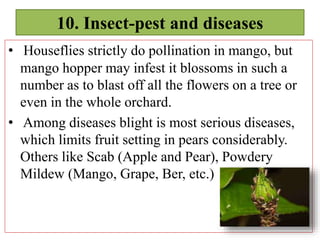
• Houseflies strictly do pollination in mango, but
mango hopper may infest it blossoms in such a
number as to blast off all the flowers on a tree or
even in the whole orchard.
• Among diseases blight is most serious diseases,
which limits fruit setting in pears considerably.
Others like Scab (Apple and Pear), Powdery
Mildew (Mango, Grape, Ber, etc.)
11. Miscellaneous factors
• Management of orchard
• Presence of illuminating gases in the
atmosphere (Black tip of mango)
• Presence of high salt concentrations (Chloride)
• Continuous spray of certain chemicals
(Lime sulphur)
Internal factors
• It is a common observation that some fruit
plants even produce abundant flowers, but
usually fail to set adequate number of fruits
and sometimes they do not produce fruits at
all.
• This failure of fruit set may be due to various
reasons, like failure of pollination, sterility or
even nutritional deficiency.
Stout and his co-workers in 1916 recognised
that such type of unfruitfulness is mainly due
to the following three internal factors.
1. Sterility from impotence
2. Sterility from incompatibility
3. Sterility from embryo abortion
• Sterility from impotence arises when one or
both the sex organs fail to develop the fruit
properly. The impotence may be complete, in
which either no flower or no sex organs are
formed, or it may be partial, in which either
stamens or pistils are abortive
• Sterility from incompatibility arises, when,
although the sex organs are completely
formed, they fail to function properly.
• The pollen grains are unable to germinate
freely on stigma or stigma is not compatible
with the pollen.
• Thus in incompatibility, the properly
developed gametes fail to unite together,
although the sex are organs are completely
formed or functional
• In sterility due to abortion, even after the
proper pollination and fertilization, the
abortion of the embryo takes place before
reaching the maturity.
Sterility associated with the internal factors are
based upon the following fundamental
processes:
a) due to evolutionary tendencies
b) due to genetic influences
c) due to physiological factors
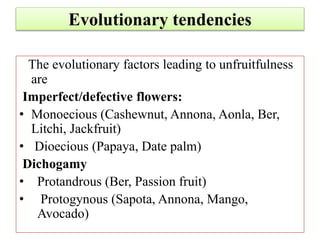
Evolutionary tendencies
The evolutionary factors leading to unfruitfulness
are
Imperfect/defective flowers:
• Monoecious (Cashewnut, Annona, Aonla, Ber,
Litchi, Jackfruit)
• Dioecious (Papaya, Date palm)
Dichogamy
• Protandrous (Ber, Passion fruit)
• Protogynous (Sapota, Annona, Mango,
Avocado)
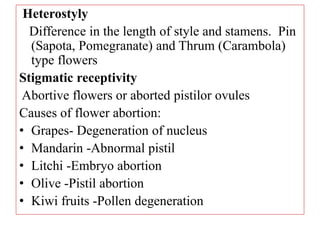
Heterostyly
Difference in the length of style and stamens. Pin
(Sapota, Pomegranate) and Thrum (Carambola)
type flowers
Stigmatic receptivity
Abortive flowers or aborted pistilor ovules
Causes of flower abortion:
• Grapes- Degeneration of nucleus
• Mandarin -Abnormal pistil
• Litchi -Embryo abortion
• Olive -Pistil abortion
• Kiwi fruits -Pollen degeneration
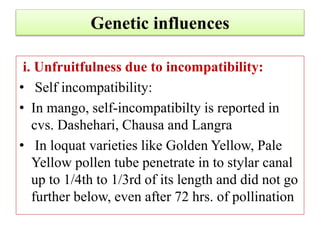
Genetic influences
i. Unfruitfulness due to incompatibility:
• Self incompatibility:
• In mango, self-incompatibilty is reported in
cvs. Dashehari, Chausa and Langra
• In loquat varieties like Golden Yellow, Pale
Yellow pollen tube penetrate in to stylar canal
up to 1/4th to 1/3rd of its length and did not go
further below, even after 72 hrs. of pollination
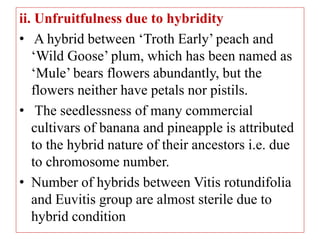
ii. Unfruitfulness due to hybridity
• A hybrid between ‘Troth Early’ peach and
‘Wild Goose’ plum, which has been named as
‘Mule’ bears flowers abundantly, but the
flowers neither have petals nor pistils.
• The seedlessness of many commercial
cultivars of banana and pineapple is attributed
to the hybrid nature of their ancestors i.e. due
to chromosome number.
• Number of hybrids between Vitis rotundifolia
and Euvitis group are almost sterile due to
hybrid condition
iii. Inter-fruitfulness and inter-fertility:
• The ability of two plants or two varieties to set
fruits and develop seeds with each other’s pollen
is called as inter-fruitfulness or inter-fertility.
• Smyrna fig, Datepalm, some varieties of Grapes.
• in sweet type cherry, leading varieties of sweet
cherries in many locations are inter-sterile or
inter-unfruitful. Similar type of inter sterility has
been also reported in other fruit crops like
almond, plum, pear and some varieties of filberts
iv. Reciprocal crossings
• Tragedy plum (European type) good pollinizer
for several varieties of Japanese type, but fail
to set fruits when Japanese varieties is used for
the Tragedy plum.
• Vitis Vinifera, V. labrusca and V. cordifolia
species of grape set fruits freely either with V.
rotundifolia and V. munsoniana, but when V.
rotundifolia and V. munsoniana are used as
pollen parents either for V. Vinifera, V.
labrusca and V. cordifolia, they never set fruits
freely.
Physiological influences
• Slow growth of the pollen tube (Clementine
mandarin)
• Poor pollen germination
• Premature or delayed pollination (Kagzi
Kalan)
• Nutritive condition of plant
Remedial measures
• Use of suitable rootstocks
• Control of frost damage
• Proper nutrition
• Proper use of pollinzers
• Application of plant growth regulators
• Balancing vegetative and reproductive growth
with proper pruning and thinning
Unfruitfulness

Unfruitfulness

  • 1.
    ANNAMALAI UNIVERSITY FACULTY OFAGRICULTURE DEPARTMENT OF HORTICULTUE PRESENTATION ON UNFRUITFULNESS IN FRUIT CROPS Name of the Student : S. SHARVESH Degree Programme and Subject : M. Sc. (Hort.) Fruit Science Department : Horticulture
  • 2.
    INTRODUCTION • Fruit growingis one of the most important and profitable venture in horticulture. • The art and science has now developed into one of the most deviled, skillful and intensive forms of land utilization. • Today the standard of living of different people of countries is judged by the production and per capita consumption of fruits.
  • 3.
    What is unfruitfulness? • ‘Fruitfulness’ refers to the state where a plant is not only capable of flowering and bearing fruit, but also takes these fruits to maturity. The inability to do so is known as ‘unfruitfulness’ or ‘barrenness’.
  • 4.
    CAUSES OF UNFRUITFULNESS Thecauses of unfruitfulness in fruit plants have been broadly classified into two categories: • (i) Internal factors • (ii) External factors
  • 6.
    Classification and explanationof unfruitfulness  External factors 1. Environmental factors i. Temperature  It affects the flowering, pollination, fruit set, growth and development of the plants.  Extreme temperature fluctuations and continuous high temperature etc., are injurious to fertilization process.
  • 7.
    • The pollenof most of the fruit crops grown in temperate climate, like apple, pear, cherry, plum, walnut, pecannut etc., germinate freely at a temperature of 50 ˚F or above, but the fertilization process is practically inhibited if the temperature falls below 40 ˚F. • Of the different climatic factors, temperature appears to have some relation with the variability in the incidence of mango malformation.
  • 8.
    • Higher temperatureand dry atmosphere appear to be associated with the increased production of pollen per anther in mango crop • It have indirect influence on fruit set through its effect on the activity of pollen carrying insects. • Influence of temperature on fruit set has also been reported in papaya such as sex reversing male plants.
  • 9.
    Rainfall • Rain attime of blossoming causes loss of more fruits • Rain wash off the pollens from the anthers. Wind • It will cause the stigmatic fluid to dry prematurely thus affecting the pollen germination
  • 10.
    Frost • Even aregular bearing cultivar will become an irregular bearer • It may either kill the sexual organs of a flower or completely destroys the blossoms Hail storm • In temperate fruit orchards, hail destroys all the flower buds and injures almost all the developing fruits.
  • 11.
    Cloudy weather • Powderymildew, a most serious disease of many fruit crops, usually appears immediately following cloudy weather which consequently dry up and drop. • It is most destructive during March-April, especially during cloudy weather.
  • 12.
    Light intensity • Effectof light has been reported in strawberry, as the development of pistils and stamens take place only when plants are exposed to certain light intensity. • Poor fruit set, yield and color development in high density mango orchards have been mainly attributed to dense and overlapping tree canopy, rendering poor light penetration, for which pruning is recommended.
  • 13.
    2. Disturbed waterrelations • For fruitful production, adequate supply of water is required, and disturbance in water or moisture in soil may lead to the formation of an abscission layer, resulting in the dropping of the blossoms, leaves or fruits, thereby affecting fruitfulness of the plant. • Moisture deficit may be responsible for disturbance in C:N ratio and composition of other chemicals, which are responsible for fruit drop.
  • 14.
    • It isnot true that moisture deficit is always responsible for drop of flowers and fruits but excess moisture causes flower and fruit drop in apples and olives. • In general, avoid irrigating orchards during flowering as it may sometime lead to complete shedding of flowers as reported in citrus
  • 15.
    3. Nutrient supply •Excess supply of manures and fertilizers, though, may result in vigorous growth of the plants, but it affects flowering and fruiting adversely. • It is assumed that overfed plants have low C:N ratio, which is not desirable for proper set in fruit plants. • Example: Jonathan apple - Self sterile on rich land in Victoria (Australia), becomes self- fruitful when grown on land of low productivity.
  • 16.
    • The Hopegrape and Muscadine group, produce hermaphrodite flowers only when proper nutrient supply is given. Under inadequate management practices, most of the flowers produced by these varieties are staminate. • Some cultivars of strawberry produce perfect flowers and are productive when grown under ordinary management cultural practices, but produce only little pollen for satisfactory crop when grown on rich soils.
  • 17.
    4. Rootstocks • Insome instances, stocks exerts considerable influence on flowering and fruit set of the scion cultivar. • Example: Troyer Citrange (Citrus), Dogridge (Grapes), Pusa Srijan (Guava), Khirni (Sapota), • Seedlings plants are relatively slow to come into bearing, but it can be hastened by grafting on trees of some kind that are bearing.
  • 18.
    5. Pruning • Practicemeant for maintaining reproductive and vegetative balance. • Example: Cane-pruned grapevines produce flowers and fruits better than the severe spur- pruned grapes. • Heavy pruning has been on the change of sex, from staminate to pistillate or to hermaphrodite in papaya.
  • 19.
    6. Age andvigour of the plant • Young and vigorous plum trees are known to produce higher proportion of defective pistils than older trees of the same variety. • Young vigorous apple trees often fail to set fruits under controlled cross- pollination, whereas old and less vigorous trees of the same variety set freely. • The problem of coulure is very serious disease in the initial years of bearing in Muscat of Alexandria grape, but later it is less serious.
  • 20.
    7. Locality • Itis the only environmental complex, which influences the fruit set in a locality. • Example: The American grape varieties have been found to be self sterile in Columbia, although, perfectly self fertile in California, which is in the south • The Jonathan apple is almost sterile in Victoria (Australia), although it is fertile in USA. • The Bose pear is self sterile in many localities, but becomes partially fertile in New York (USA). • The South Indian variety (Neelum and Baneshan) of mango don’t perform better under North Indian conditions
  • 21.
    8. Seasonal influence •Trees of some plum varieties have been found to be greatly in fertility from season to season and a plum variety, which is protandrous in one season, may be protogynous in the next season. • a) End season fertility (Grape varieties – Ideal) • b) Change of sex with season (Japanese Persimmon, Myrica gale, Grapes Hybrid – Vitis riparia x Vitis Labrusca)
  • 22.
    9. Spraying fruitplants during flowering • Jhumka, the disorder has occurred in orchards due to excessive spraying of insecticides, which result in decline in pollination of pollinating insects. • Arsenicals cause the greatest injury to the pollen and pollen carrying insects, if they are sprayed on trees during flowerings.
  • 23.
    10. Insect-pest anddiseases • Houseflies strictly do pollination in mango, but mango hopper may infest it blossoms in such a number as to blast off all the flowers on a tree or even in the whole orchard. • Among diseases blight is most serious diseases, which limits fruit setting in pears considerably. Others like Scab (Apple and Pear), Powdery Mildew (Mango, Grape, Ber, etc.)
  • 24.
    11. Miscellaneous factors •Management of orchard • Presence of illuminating gases in the atmosphere (Black tip of mango) • Presence of high salt concentrations (Chloride) • Continuous spray of certain chemicals (Lime sulphur)
  • 25.
    Internal factors • Itis a common observation that some fruit plants even produce abundant flowers, but usually fail to set adequate number of fruits and sometimes they do not produce fruits at all. • This failure of fruit set may be due to various reasons, like failure of pollination, sterility or even nutritional deficiency.
  • 26.
    Stout and hisco-workers in 1916 recognised that such type of unfruitfulness is mainly due to the following three internal factors. 1. Sterility from impotence 2. Sterility from incompatibility 3. Sterility from embryo abortion
  • 27.
    • Sterility fromimpotence arises when one or both the sex organs fail to develop the fruit properly. The impotence may be complete, in which either no flower or no sex organs are formed, or it may be partial, in which either stamens or pistils are abortive • Sterility from incompatibility arises, when, although the sex organs are completely formed, they fail to function properly.
  • 28.
    • The pollengrains are unable to germinate freely on stigma or stigma is not compatible with the pollen. • Thus in incompatibility, the properly developed gametes fail to unite together, although the sex are organs are completely formed or functional • In sterility due to abortion, even after the proper pollination and fertilization, the abortion of the embryo takes place before reaching the maturity.
  • 29.
    Sterility associated withthe internal factors are based upon the following fundamental processes: a) due to evolutionary tendencies b) due to genetic influences c) due to physiological factors
  • 30.
    Evolutionary tendencies The evolutionaryfactors leading to unfruitfulness are Imperfect/defective flowers: • Monoecious (Cashewnut, Annona, Aonla, Ber, Litchi, Jackfruit) • Dioecious (Papaya, Date palm) Dichogamy • Protandrous (Ber, Passion fruit) • Protogynous (Sapota, Annona, Mango, Avocado)
  • 31.
    Heterostyly Difference in thelength of style and stamens. Pin (Sapota, Pomegranate) and Thrum (Carambola) type flowers Stigmatic receptivity Abortive flowers or aborted pistilor ovules Causes of flower abortion: • Grapes- Degeneration of nucleus • Mandarin -Abnormal pistil • Litchi -Embryo abortion • Olive -Pistil abortion • Kiwi fruits -Pollen degeneration
  • 32.
    Genetic influences i. Unfruitfulnessdue to incompatibility: • Self incompatibility: • In mango, self-incompatibilty is reported in cvs. Dashehari, Chausa and Langra • In loquat varieties like Golden Yellow, Pale Yellow pollen tube penetrate in to stylar canal up to 1/4th to 1/3rd of its length and did not go further below, even after 72 hrs. of pollination
  • 33.
    ii. Unfruitfulness dueto hybridity • A hybrid between ‘Troth Early’ peach and ‘Wild Goose’ plum, which has been named as ‘Mule’ bears flowers abundantly, but the flowers neither have petals nor pistils. • The seedlessness of many commercial cultivars of banana and pineapple is attributed to the hybrid nature of their ancestors i.e. due to chromosome number. • Number of hybrids between Vitis rotundifolia and Euvitis group are almost sterile due to hybrid condition
  • 34.
    iii. Inter-fruitfulness andinter-fertility: • The ability of two plants or two varieties to set fruits and develop seeds with each other’s pollen is called as inter-fruitfulness or inter-fertility. • Smyrna fig, Datepalm, some varieties of Grapes. • in sweet type cherry, leading varieties of sweet cherries in many locations are inter-sterile or inter-unfruitful. Similar type of inter sterility has been also reported in other fruit crops like almond, plum, pear and some varieties of filberts
  • 35.
    iv. Reciprocal crossings •Tragedy plum (European type) good pollinizer for several varieties of Japanese type, but fail to set fruits when Japanese varieties is used for the Tragedy plum. • Vitis Vinifera, V. labrusca and V. cordifolia species of grape set fruits freely either with V. rotundifolia and V. munsoniana, but when V. rotundifolia and V. munsoniana are used as pollen parents either for V. Vinifera, V. labrusca and V. cordifolia, they never set fruits freely.
  • 36.
    Physiological influences • Slowgrowth of the pollen tube (Clementine mandarin) • Poor pollen germination • Premature or delayed pollination (Kagzi Kalan) • Nutritive condition of plant
  • 37.
    Remedial measures • Useof suitable rootstocks • Control of frost damage • Proper nutrition • Proper use of pollinzers • Application of plant growth regulators • Balancing vegetative and reproductive growth with proper pruning and thinning