PRESENTED BY Ahmed Ali Abbas
 It should permit immediate visualization of the type
of partially edentulous arch being considered.
 It should permit immediate differentiation between
the tooth borne and tooth tissue supported RPD
 It should be universally acceptable
 Tooth borne
 Mucosa borne
 Tooth and mucosa borne
 World wide acceptable classification
 Devised by Edward Kennedy in 1923
 When use in conjunction with a support
classification, it helps to give a clear classification
understanding about the type of denture under
consideration during a discussion on partial
dentures.
 Kennedy classification is based on the relationship
of the saddles to the natural teeth.
1. The most posterior edentulous area
determines the class.
2. The size of the modification is not
important.
3. If a third molar is missing and not to be
replaced it is not considered in determining
the class.
 Kennedys classification has four main groups
with modifications except for class IV
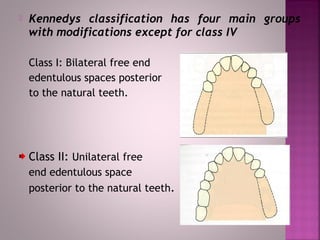
Class I: Bilateral free end
edentulous spaces posterior
to the natural teeth.
Class II: Unilateral free
end edentulous space
posterior to the natural teeth.
Class III: Abounded unilateral
edentulous space having
natural teeth at each end.
Class IV: Abounded
edentulous space
anterior to the natural teeth.
Examples of modifications:
An additional edentulous area in Class I
would be designated as Class I modification 1
If two additional edentulous areas are
present it could be designate as Class I
modification 2
A unilateral saddle with one additional
edentulous area is Class II modification 1
A unilateral bounded edentulous area with three
additional edentulous areas is class III modification
3
 Allows visualization of partially edentulous
arch
 Differentiates between tooth supported and
tooth tissue supported
 Type of design can be decided
 Is universally accepted
 Aids in discussing identifying and planning
the design
 Easy to apply the system to any situation
 Widely used system
 Formed the basis for two other systems as Apllgate
Kennedy and Swenson’s system
 CUMMERS CLASSIFICATION (1921)
 CHARLES. W. BAILYN (1928)
 NEUROHRS CLASSIFICATION
 FRIEDMANS SYSTEM
 OSBORNE and LAMMIE
 First classification to be recognised by the
dental profession
 He classified partial dentures than edentulous
spaces
 Four types
1. Diagonal: 2 retainers diagonally opposite another
2. Diametric: 2 retainers diametrically opposite
one another.
3. Unilateral: 2 or more direct retainers on same
side.
4. Multilateral: 3 direct retainers on either side.
 He emphasized the importance of support for
partial dentures.
 “A”- Anterior restorations where there were
saddle areas anterior to the bicuspids.
 “P”- Posterior restorations where there were
saddle areas posterior to the canines.
 Class I: Bounded saddle
(Tooth supported).
 Class II: Free end saddle
(Mucosa supported).
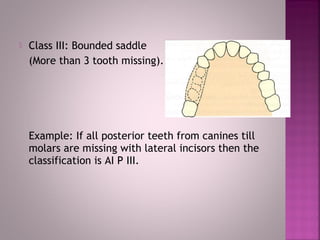
 Class III: Bounded saddle
(More than 3 tooth missing).
Example: If all posterior teeth from canines till
molars are missing with lateral incisors then the
classification is AI P III.
 Class I:
 Variation I:
a. Posterior missing, Anterior all teeth present.
b. Posterior missing, some anterior teeth
missing.
 Variation II
a. Anterior missing, All posteriors present.
b. Anterior missing, some posteriors missing.
 Class II: Division I has variation 1 and 2.
 Division II has variation 1 and 2
 This classification is tooth tissue bearing.
 Class III is edentulous state.
 A- Anterior space.
 B- Bound posterior space.
 C-Cantilever situation or a posterior free end
saddle.
 Class I: Mucosa borne.
 Class II: Tooth borne
 Class III: Combination of mucosa borne and
tissue borne.
 RULE 1: classification should follow rather
than precede any extractions of teeth hat
might alter the original classification.
 RULE 2: If a third molar is missing and not to
be replaced it is not considered in the
classification
 RULE 3: If a third molar is present and is to
be used as an abutment, it is considered in
the classification
 RULE 4:If a second molar is missing and is not
to be replaced, it is not considered in the
classification
 RULE 5: The classification is always
determined by the most posteriorly
edentulous area or areas
 RULE 6: Edentulous areas other than those
determining the classification are referred to
as modifications and are designated by their
number.
 RULE 7:The extent of modification is not
considered, only the number of additional
edentulous areas.
 RULE 8: There can be no modification areas
in class IV arches (another edentulous area
lying posterior to the “single bilateral area
crossing the midline” would determine the
classification.)
Applegate added two more classes to Kennedys
existing classification
Class V: This is an edentulous area bounded anteriorly
and posteriorly by natural teeth, in which the
anterior abutment is not suitable for support.
Class VI: This is an edentulous situation in which the
abutment tooth is capable of total support.(As in
young patients)
Removable partial denture

Removable partial denture

  • 1.
  • 2.
     It shouldpermit immediate visualization of the type of partially edentulous arch being considered.  It should permit immediate differentiation between the tooth borne and tooth tissue supported RPD  It should be universally acceptable
  • 3.
     Tooth borne Mucosa borne  Tooth and mucosa borne
  • 4.
     World wideacceptable classification  Devised by Edward Kennedy in 1923  When use in conjunction with a support classification, it helps to give a clear classification understanding about the type of denture under consideration during a discussion on partial dentures.  Kennedy classification is based on the relationship of the saddles to the natural teeth.
  • 5.
    1. The mostposterior edentulous area determines the class. 2. The size of the modification is not important. 3. If a third molar is missing and not to be replaced it is not considered in determining the class.
  • 6.
     Kennedys classificationhas four main groups with modifications except for class IV Class I: Bilateral free end edentulous spaces posterior to the natural teeth. Class II: Unilateral free end edentulous space posterior to the natural teeth.
  • 7.
    Class III: Aboundedunilateral edentulous space having natural teeth at each end. Class IV: Abounded edentulous space anterior to the natural teeth.
  • 8.
    Examples of modifications: Anadditional edentulous area in Class I would be designated as Class I modification 1 If two additional edentulous areas are present it could be designate as Class I modification 2 A unilateral saddle with one additional edentulous area is Class II modification 1
  • 9.
    A unilateral boundededentulous area with three additional edentulous areas is class III modification 3
  • 10.
     Allows visualizationof partially edentulous arch  Differentiates between tooth supported and tooth tissue supported  Type of design can be decided  Is universally accepted  Aids in discussing identifying and planning the design
  • 11.
     Easy toapply the system to any situation  Widely used system  Formed the basis for two other systems as Apllgate Kennedy and Swenson’s system
  • 12.
     CUMMERS CLASSIFICATION(1921)  CHARLES. W. BAILYN (1928)  NEUROHRS CLASSIFICATION  FRIEDMANS SYSTEM  OSBORNE and LAMMIE
  • 13.
     First classificationto be recognised by the dental profession  He classified partial dentures than edentulous spaces  Four types 1. Diagonal: 2 retainers diagonally opposite another 2. Diametric: 2 retainers diametrically opposite one another. 3. Unilateral: 2 or more direct retainers on same side. 4. Multilateral: 3 direct retainers on either side.
  • 14.
     He emphasizedthe importance of support for partial dentures.  “A”- Anterior restorations where there were saddle areas anterior to the bicuspids.  “P”- Posterior restorations where there were saddle areas posterior to the canines.
  • 15.
     Class I:Bounded saddle (Tooth supported).  Class II: Free end saddle (Mucosa supported).
  • 16.
     Class III:Bounded saddle (More than 3 tooth missing). Example: If all posterior teeth from canines till molars are missing with lateral incisors then the classification is AI P III.
  • 17.
     Class I: Variation I: a. Posterior missing, Anterior all teeth present. b. Posterior missing, some anterior teeth missing.  Variation II a. Anterior missing, All posteriors present. b. Anterior missing, some posteriors missing.
  • 18.
     Class II:Division I has variation 1 and 2.  Division II has variation 1 and 2  This classification is tooth tissue bearing.  Class III is edentulous state.
  • 19.
     A- Anteriorspace.  B- Bound posterior space.  C-Cantilever situation or a posterior free end saddle.
  • 20.
     Class I:Mucosa borne.  Class II: Tooth borne  Class III: Combination of mucosa borne and tissue borne.
  • 21.
     RULE 1:classification should follow rather than precede any extractions of teeth hat might alter the original classification.  RULE 2: If a third molar is missing and not to be replaced it is not considered in the classification  RULE 3: If a third molar is present and is to be used as an abutment, it is considered in the classification  RULE 4:If a second molar is missing and is not to be replaced, it is not considered in the classification
  • 22.
     RULE 5:The classification is always determined by the most posteriorly edentulous area or areas  RULE 6: Edentulous areas other than those determining the classification are referred to as modifications and are designated by their number.  RULE 7:The extent of modification is not considered, only the number of additional edentulous areas.  RULE 8: There can be no modification areas in class IV arches (another edentulous area lying posterior to the “single bilateral area crossing the midline” would determine the classification.)
  • 23.
    Applegate added twomore classes to Kennedys existing classification Class V: This is an edentulous area bounded anteriorly and posteriorly by natural teeth, in which the anterior abutment is not suitable for support. Class VI: This is an edentulous situation in which the abutment tooth is capable of total support.(As in young patients)