
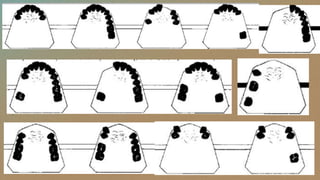


Classification of
RPD
Dr Hiba Hamid
REQUIREMENTS OF AN ACCEPTABLE
METHOD OF CLASSIFICATION
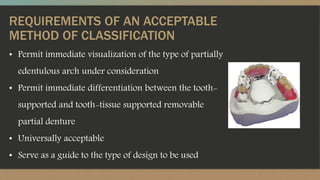
• Permit immediate visualization of the type of partially
edentulous arch under consideration
• Permit immediate differentiation between the tooth-
supported and tooth-tissue supported removable
partial denture
• Universally acceptable
• Serve as a guide to the type of design to be used
KENNEDY’S CLASSIFICATION
▪ Most widely used method of classification
▪ Proposed in 1923 by Dr. Edward Kennedy.
▪ Based on relationship of partially edentulous spaces to
abutment teeth, unlike Cummer, who classified on
basis of dentures
▪ Classification is positional or anatomical (gives mental
picture of teeth and their relationships)
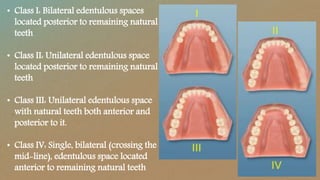
• Class I: Bilateral edentulous spaces
located posterior to remaining natural
teeth
• Class II: Unilateral edentulous space
located posterior to remaining natural
teeth
• Class III: Unilateral edentulous space
with natural teeth both anterior and
posterior to it.
• Class IV: Single, bilateral (crossing the
mid-line), edentulous space located
anterior to remaining natural teeth
APPLEGATE’S RULES
▪ Rule One: Classification should follow rather than precede extractions that might alter original
classification
▪ Rule Two: If third molar is missing and not to be replaced, it is not considered in the
classification
▪ Rule Three: If third molar is present and is used as an abutment, it is considered in the
classification
▪ Rule Four: If second molar is missing and not to be replaced, it is not considered in the
classification
▪ Rule Five: The most posterior edentulous area or areas always determine the classification
▪ Rule Six: Edentulous areas other than those determining classification are referred to as
modification areas and are designated by their number
▪ Rule Seven: The extent of modification is not considered, only the number of edentulous spaces
are considered.
▪ Rule Eight: There can be no modification areas in class IV. Because if there are any additional
BAILYN’S CLASSIFICATION
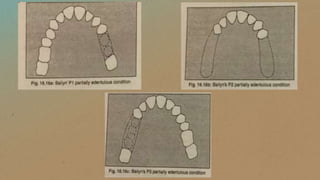
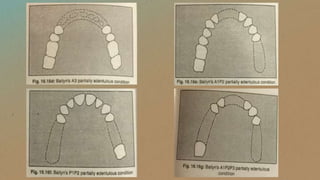
Bailyn’s system introduced a classification based on whether the
prosthesis is tooth-borne, tissue-borne, or a combination of the
two based on support
Bailyn divided all RPDs in to:
▪ A: Anterior restorations: saddle area anterior to
1st bicuspids
▪ B: Posterior restorations: saddle area posterior to
cuspids
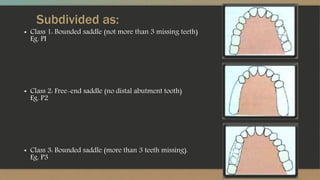
Subdivided as:
▪ Class 1: Bounded saddle (not more than 3 missing teeth)
Eg. PI
▪ Class 2: Free-end saddle (no distal abutment tooth)
Eg. P2
▪ Class 3: Bounded saddle (more than 3 teeth missing).
Eg. P3
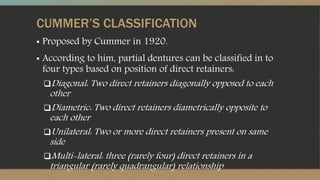
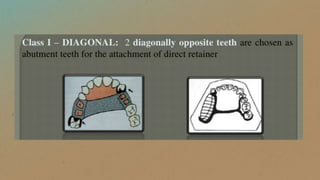
CUMMER’S CLASSIFICATION
▪ Proposed by Cummer in 1920.
▪ According to him, partial dentures can be classified in to
four types based on position of direct retainers:
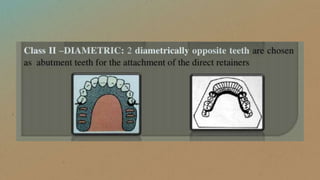
Diagonal: Two direct retainers diagonally opposed to each
other
Diametric: Two direct retainers diametrically opposite to
each other
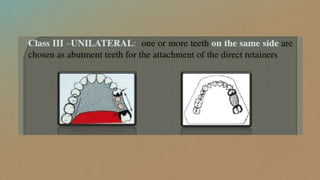
Unilateral: Two or more direct retainers present on same
side
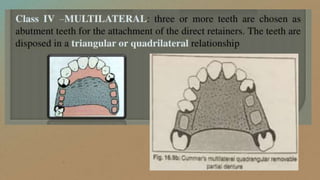
Multi-lateral: three (rarely four) direct retainers in a
triangular (rarely quadrangular) relationship
SKINNER’S CLASSIFICATION
▪ Introduced classification in 1959.
▪ Influenced by Cummer’s classification.
▪ Has five classes.
▪ Skinner said that about 1,31,072 combinations of partially
edentulous arches are possible.
▪ Based on relationship of abutment teeth to supporting alveolar
ridge
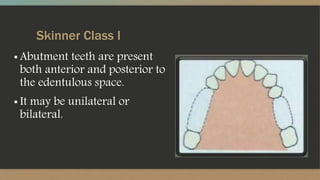
Skinner Class I
▪ Abutment teeth are present
both anterior and posterior to
the edentulous space.
▪ It may be unilateral or
bilateral.
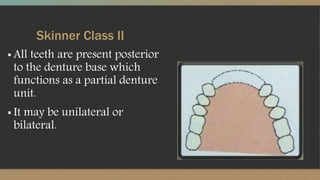
Skinner Class II
▪ All teeth are present posterior
to the denture base which
functions as a partial denture
unit.
▪ It may be unilateral or
bilateral.
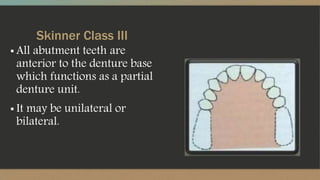
Skinner Class III
▪ All abutment teeth are
anterior to the denture base
which functions as a partial
denture unit.
▪ It may be unilateral or
bilateral.
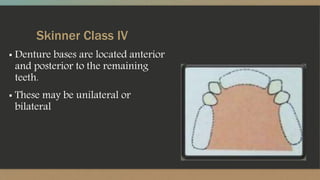
Skinner Class IV
▪ Denture bases are located anterior
and posterior to the remaining
teeth.
▪ These may be unilateral or
bilateral
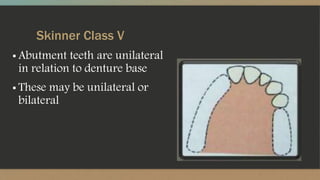
Skinner Class V
▪ Abutment teeth are unilateral
in relation to denture base
▪ These may be unilateral or
bilateral
Classification of rpd (lecture)

Classification of rpd (lecture)

  • 1.
  • 2.
    REQUIREMENTS OF ANACCEPTABLE METHOD OF CLASSIFICATION • Permit immediate visualization of the type of partially edentulous arch under consideration • Permit immediate differentiation between the tooth- supported and tooth-tissue supported removable partial denture • Universally acceptable • Serve as a guide to the type of design to be used
  • 3.
    KENNEDY’S CLASSIFICATION ▪ Mostwidely used method of classification ▪ Proposed in 1923 by Dr. Edward Kennedy. ▪ Based on relationship of partially edentulous spaces to abutment teeth, unlike Cummer, who classified on basis of dentures ▪ Classification is positional or anatomical (gives mental picture of teeth and their relationships)
  • 4.
    • Class I:Bilateral edentulous spaces located posterior to remaining natural teeth • Class II: Unilateral edentulous space located posterior to remaining natural teeth • Class III: Unilateral edentulous space with natural teeth both anterior and posterior to it. • Class IV: Single, bilateral (crossing the mid-line), edentulous space located anterior to remaining natural teeth
  • 5.
    APPLEGATE’S RULES ▪ RuleOne: Classification should follow rather than precede extractions that might alter original classification ▪ Rule Two: If third molar is missing and not to be replaced, it is not considered in the classification ▪ Rule Three: If third molar is present and is used as an abutment, it is considered in the classification ▪ Rule Four: If second molar is missing and not to be replaced, it is not considered in the classification ▪ Rule Five: The most posterior edentulous area or areas always determine the classification ▪ Rule Six: Edentulous areas other than those determining classification are referred to as modification areas and are designated by their number ▪ Rule Seven: The extent of modification is not considered, only the number of edentulous spaces are considered. ▪ Rule Eight: There can be no modification areas in class IV. Because if there are any additional
  • 7.
    BAILYN’S CLASSIFICATION Bailyn’s systemintroduced a classification based on whether the prosthesis is tooth-borne, tissue-borne, or a combination of the two based on support
  • 8.
    Bailyn divided allRPDs in to: ▪ A: Anterior restorations: saddle area anterior to 1st bicuspids ▪ B: Posterior restorations: saddle area posterior to cuspids
  • 9.
    Subdivided as: ▪ Class1: Bounded saddle (not more than 3 missing teeth) Eg. PI ▪ Class 2: Free-end saddle (no distal abutment tooth) Eg. P2 ▪ Class 3: Bounded saddle (more than 3 teeth missing). Eg. P3
  • 12.
    CUMMER’S CLASSIFICATION ▪ Proposedby Cummer in 1920. ▪ According to him, partial dentures can be classified in to four types based on position of direct retainers: Diagonal: Two direct retainers diagonally opposed to each other Diametric: Two direct retainers diametrically opposite to each other Unilateral: Two or more direct retainers present on same side Multi-lateral: three (rarely four) direct retainers in a triangular (rarely quadrangular) relationship
  • 17.
    SKINNER’S CLASSIFICATION ▪ Introducedclassification in 1959. ▪ Influenced by Cummer’s classification. ▪ Has five classes. ▪ Skinner said that about 1,31,072 combinations of partially edentulous arches are possible. ▪ Based on relationship of abutment teeth to supporting alveolar ridge
  • 18.
    Skinner Class I ▪Abutment teeth are present both anterior and posterior to the edentulous space. ▪ It may be unilateral or bilateral.
  • 19.
    Skinner Class II ▪All teeth are present posterior to the denture base which functions as a partial denture unit. ▪ It may be unilateral or bilateral.
  • 20.
    Skinner Class III ▪All abutment teeth are anterior to the denture base which functions as a partial denture unit. ▪ It may be unilateral or bilateral.
  • 21.
    Skinner Class IV ▪Denture bases are located anterior and posterior to the remaining teeth. ▪ These may be unilateral or bilateral
  • 22.
    Skinner Class V ▪Abutment teeth are unilateral in relation to denture base ▪ These may be unilateral or bilateral