Antoniette B. Geolina
  Biology Teacher
CHARACTERISTICS OF
    AN ANIMAL
 EUKARYOTE
 - Organism with membrane
 -bound nucleus
 MULTICELLULAR
 - Organism composed of
 many cells
CHARACTERISTICS OF
    AN ANIMAL
 HETEROTROPH
- Organism that can’t
make their own food
- Absence of chloroplast
- No cell wall
MAJOR GROUPS OF
      ANIMALS

Vertebrates
  - Animals with backbones
 Invertebrates
  - Animals w/out backbones
CLASSIFICATION
• PORIFERA
   (PORE-BEARING ANIMALS)
• CNIDARIA
   (STINGING ANIMALS)
• PLATYHELMINTHES
   (FLATWORMS)
• NEMATODA
   (ROUND WORMS)
• ANNELIDA
   (SEGMENTED WORMS)
CLASSIFICATION
• MOLLUSKA
   (SOFT-BODIED ANIMALS)
• ECHINODERMATA
   (SPINY SKIN ANIMALS)
• ARTHROPODA
   (JOINTED LEG ANIMALS)
• CHORDATA
   (with NOTOCHORD)
CHARACTERISTICS OF
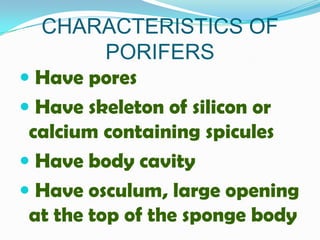
          PORIFERS
 Have pores
 Have skeleton of silicon or
 calcium containing spicules
 Have body cavity
 Have osculum, large opening
 at the top of the sponge body
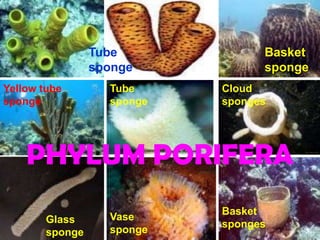
Tube             Basket
                 sponge           sponge
Yellow tube        Tube     Cloud
sponge             sponge   sponges


    PHYLUM PORIFERA
                            Basket
        Glass      Vase
                            sponges
        sponge     sponge
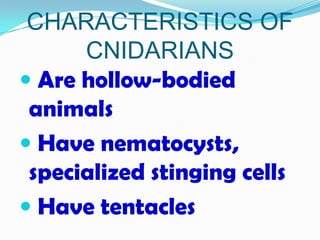
CHARACTERISTICS OF
      CNIDARIANS
 Are hollow-bodied
 animals
 Have nematocysts,
 specialized stinging cells
 Have tentacles
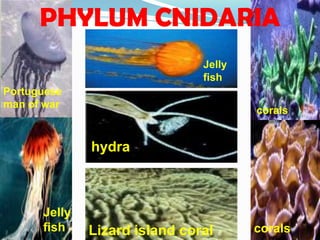
PHYLUM CNIDARIA
                               Jelly
                               fish
Portuguese
man of war
                                       corals


              hydra


      Jelly
      fish    Lizard island coral      corals
CHARACTERISTICS OF
         FLATWORMS
 Are long ribbon-shaped
 worms
 Are free living while others
 are parasitic
 Live in freshwater or sea
 water
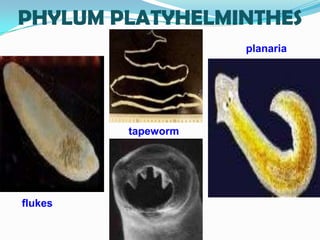
PHYLUM PLATYHELMINTHES
                    planaria


         tapeworm


flukes
CHARACTERISTICS OF
     NEMATODES
 Are long, slender,
 smooth-bodied worms
 Have mouth and anus
 Live in soil and some are
 parasitic
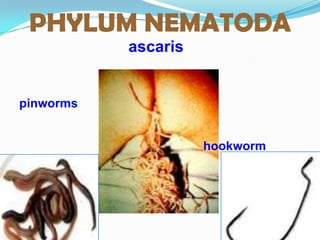
PHYLUM NEMATODA
           ascaris


pinworms


                     hookworm
CHARACTERISTICS OF
     ANNELIDS
 Have segmented bodies
 Most are burrowers in
 the sand
 Some are
 hermaphrodite
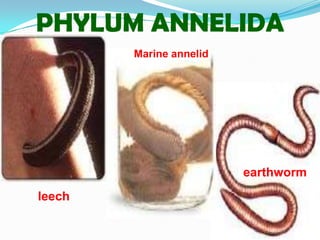
PHYLUM ANNELIDA
        Marine annelid


                         earthworm
leech
CHARACTERISTICS OF
      MOLLUSKS
 Are soft-bodied animals
 Have protective shells
 Have a mantle which
 secretes the shells
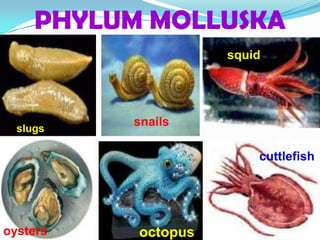
PHYLUM MOLLUSKA
                     squid


          snails
  slugs

                         cuttlefish


oysters    octopus
CHARACTERISTICS OF
       ECHINODERMS
 Have hard bodies covered
 with spines
 Have no head nor tails and
 have no left nor right
 Have mouth and anus at its
 top and bottom ends
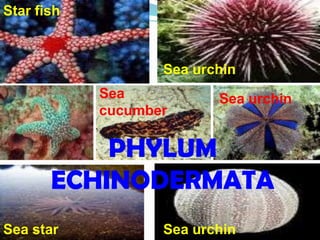
Star fish


                   Sea urchin
            Sea           Sea urchin
            cucumber

           PHYLUM
       ECHINODERMATA
Sea star           Sea urchin
CHARACTERISTICS OF
    ARTHROPODS
 Have  jointed legs
 Have exoskeleton
 Have segmented bodies
 with 2 or 3 regions
 Most have antennae
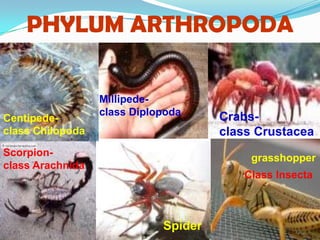
PHYLUM ARTHROPODA

                  Millipede-
                  class Diplopoda     Crabs-
Centipede-
class Chilopoda                       class Crustacea
Scorpion-                                  grasshopper
class Arachnida
                                         Class Insecta


                             Spider
CHARACTERISTICS OF
     CHORDATES
 Have  a notochord at
 certain stage of their life
 cycle
 Have gill slits and a tail
 at a stage in their
 development
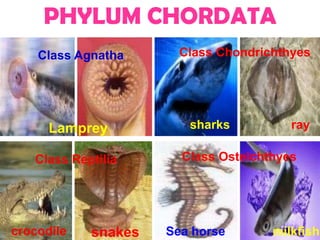
PHYLUM CHORDATA
    Class Agnatha      Class Chondrichthyes


      Lamprey           sharks          ray

   Class Reptilia      Class Osteichthyes


crocodile   snakes   Sea horse       milkfish
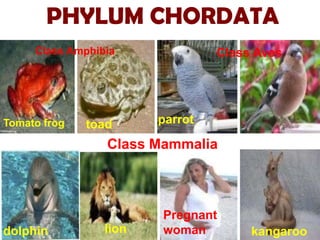
PHYLUM CHORDATA
     Class Amphibia              Class Aves


Tomato frog   toad      parrot

                 Class Mammalia


                        Pregnant
dolphin          lion   woman         kangaroo
THANK YOU
   FOR
LISTENING!

Kingdom animalia

  • 1.
    Antoniette B. Geolina Biology Teacher
  • 3.
    CHARACTERISTICS OF AN ANIMAL  EUKARYOTE - Organism with membrane -bound nucleus  MULTICELLULAR - Organism composed of many cells
  • 4.
    CHARACTERISTICS OF AN ANIMAL  HETEROTROPH - Organism that can’t make their own food - Absence of chloroplast - No cell wall
  • 5.
    MAJOR GROUPS OF ANIMALS Vertebrates - Animals with backbones  Invertebrates - Animals w/out backbones
  • 6.
    CLASSIFICATION • PORIFERA (PORE-BEARING ANIMALS) • CNIDARIA (STINGING ANIMALS) • PLATYHELMINTHES (FLATWORMS) • NEMATODA (ROUND WORMS) • ANNELIDA (SEGMENTED WORMS)
  • 7.
    CLASSIFICATION • MOLLUSKA (SOFT-BODIED ANIMALS) • ECHINODERMATA (SPINY SKIN ANIMALS) • ARTHROPODA (JOINTED LEG ANIMALS) • CHORDATA (with NOTOCHORD)
  • 8.
    CHARACTERISTICS OF PORIFERS  Have pores  Have skeleton of silicon or calcium containing spicules  Have body cavity  Have osculum, large opening at the top of the sponge body
  • 9.
    Tube Basket sponge sponge Yellow tube Tube Cloud sponge sponge sponges PHYLUM PORIFERA Basket Glass Vase sponges sponge sponge
  • 10.
    CHARACTERISTICS OF CNIDARIANS  Are hollow-bodied animals  Have nematocysts, specialized stinging cells  Have tentacles
  • 11.
    PHYLUM CNIDARIA Jelly fish Portuguese man of war corals hydra Jelly fish Lizard island coral corals
  • 12.
    CHARACTERISTICS OF FLATWORMS  Are long ribbon-shaped worms  Are free living while others are parasitic  Live in freshwater or sea water
  • 13.
    PHYLUM PLATYHELMINTHES planaria tapeworm flukes
  • 14.
    CHARACTERISTICS OF NEMATODES  Are long, slender, smooth-bodied worms  Have mouth and anus  Live in soil and some are parasitic
  • 15.
    PHYLUM NEMATODA ascaris pinworms hookworm
  • 16.
    CHARACTERISTICS OF ANNELIDS  Have segmented bodies  Most are burrowers in the sand  Some are hermaphrodite
  • 17.
    PHYLUM ANNELIDA Marine annelid earthworm leech
  • 18.
    CHARACTERISTICS OF MOLLUSKS  Are soft-bodied animals  Have protective shells  Have a mantle which secretes the shells
  • 19.
    PHYLUM MOLLUSKA squid snails slugs cuttlefish oysters octopus
  • 20.
    CHARACTERISTICS OF ECHINODERMS  Have hard bodies covered with spines  Have no head nor tails and have no left nor right  Have mouth and anus at its top and bottom ends
  • 21.
    Star fish Sea urchin Sea Sea urchin cucumber PHYLUM ECHINODERMATA Sea star Sea urchin
  • 22.
    CHARACTERISTICS OF ARTHROPODS  Have jointed legs  Have exoskeleton  Have segmented bodies with 2 or 3 regions  Most have antennae
  • 23.
    PHYLUM ARTHROPODA Millipede- class Diplopoda Crabs- Centipede- class Chilopoda class Crustacea Scorpion- grasshopper class Arachnida Class Insecta Spider
  • 24.
    CHARACTERISTICS OF CHORDATES  Have a notochord at certain stage of their life cycle  Have gill slits and a tail at a stage in their development
  • 25.
    PHYLUM CHORDATA Class Agnatha Class Chondrichthyes Lamprey sharks ray Class Reptilia Class Osteichthyes crocodile snakes Sea horse milkfish
  • 26.
    PHYLUM CHORDATA Class Amphibia Class Aves Tomato frog toad parrot Class Mammalia Pregnant dolphin lion woman kangaroo
  • 27.
    THANK YOU FOR LISTENING!