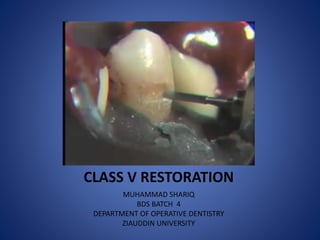
CLASS V RESTORATION
MUHAMMAD SHARIQ
BDS BATCH 4
DEPARTMENT OF OPERATIVE DENTISTRY
ZIAUDDIN UNIVERSITY
DEFINITION
Smooth surface carious lesion located on gingival/cervical third
of the labial/buccal and more rarely on lingual surfaces of all
teeth.
Simple lesions as it Involves one surface of tooth.
CAUSE/ETIOLOGY
Caries is not only the reason for cavitation, abrasion and erosion may be
responsible.
RESTORATIVE MATERIALS FOR CLASS V CAVITY
Amalgam
Composite
Resin modified GIC
Compomer.
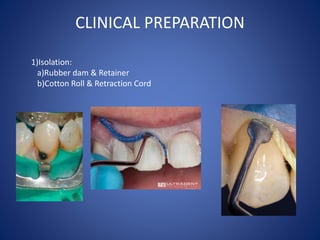
CLINICAL PREPARATION
1)Isolation:
a)Rubber dam & Retainer
b)Cotton Roll & Retraction Cord
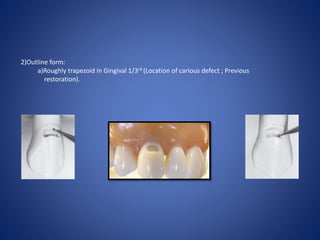
2)Outline form:
a)Roughly trapezoid in Gingival 1/3rd (Location of carious defect ; Previous
restoration).
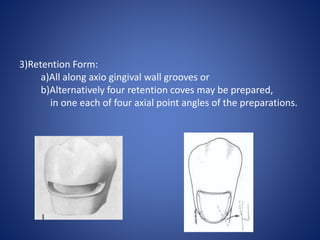
3)Retention Form:
a)All along axio gingival wall grooves or
b)Alternatively four retention coves may be prepared,
in one each of four axial point angles of the preparations.
4) Placement of restorative material:
a)Amalgam
b)Composite
c)Compomer
d)RMGIC
5) Final Preparation:
a)Removal of any remaining infected dentin
b)Pulp protection.
c)Finishing External walls.
d)Cleaning and inspecting.
Reference:
Sturdevant's art & science of operative dentistry
THANKYOU
ANY QUESTIONS?

Class v-restoration - Operative

Editor's Notes

  • #6 Distance bwtween alveolar bone and restoration margin should be atleast 3mm (to maintain attacthed gingival width) retraction: Non surgical: retration cord and rubber dam Surgical: Flap and crown lengthing Ferrule effect cord: hemostatic preparations: alumimium chloride and ferrous sulfate or epinehprine
  • #9 RMGI = GI with resin Compomer = GI + resin + poly acids
  • #10 RMGI = GI with resin Compomer = GI + resin + poly acids