BONDING
AGENT
GENERATIONS
DEFINITION,MECHANISM
AND GENERATIONS
BY : Farah Sarmad
Dental student /4th stage
At university of baghdad
DEFINITION
are resin materials used to make a dental
composite filling material adhere to
both dentin and enamel.
IT IS CONSISTS OF :
PMMA(POLY METHYL METHACRYLATE)
volatile carrier
solvent like acetone
They may also contain diluent monomers.
MECHANISMS OF ACTION
ETCH PRIMER
BONDING
AGENT
 PARTIALTOTAL
REMOVAL OF SMEAR
LAYER.
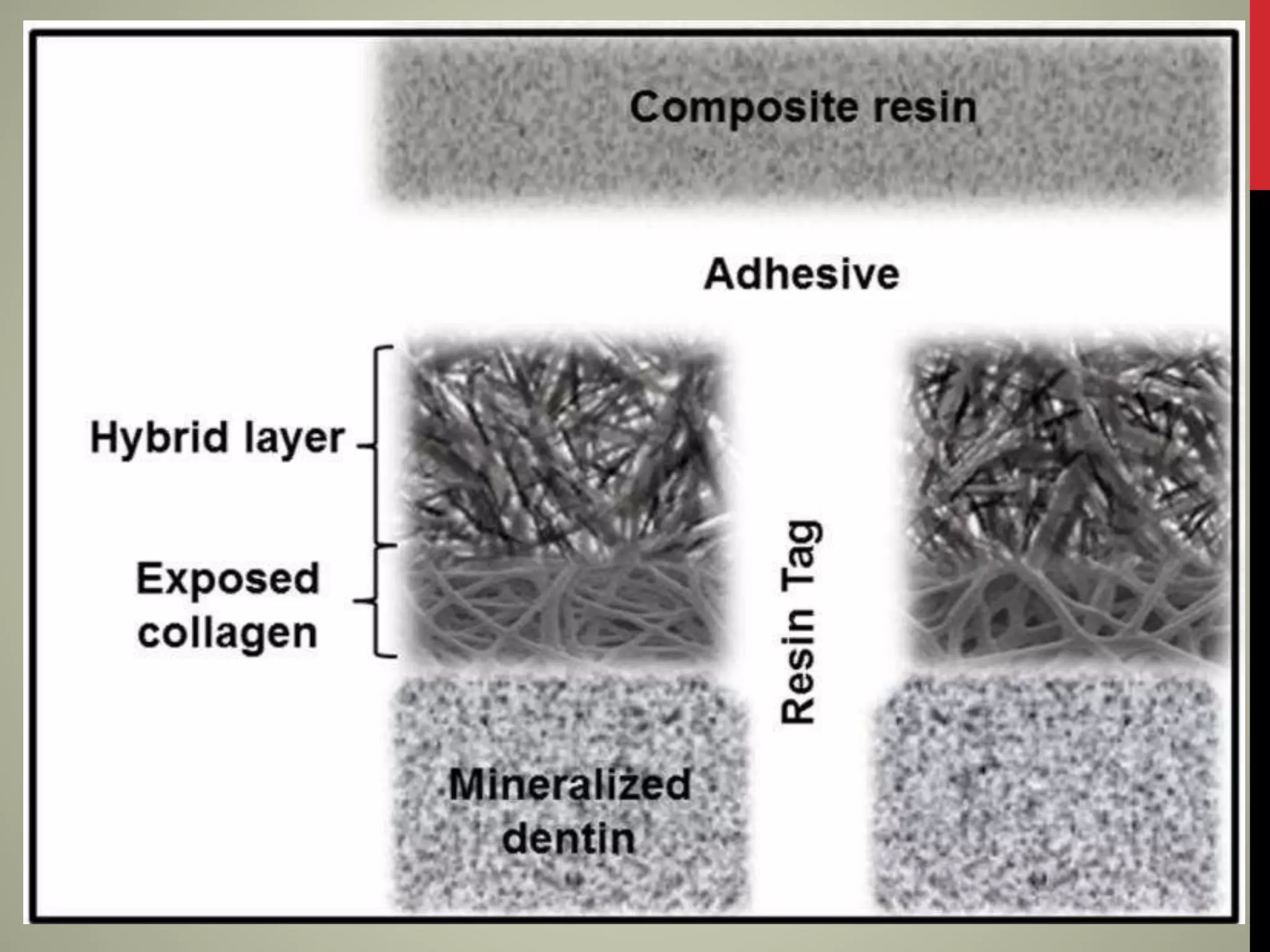
 DEMINERALIZATION OF
INTERTUBULAR &
PERITUBULAR DENTIN.
 DENTINAL TUBULES
OPENED WHILE
EXPOSING COLLAGEN
FIBERS.
 MICROPOROSITY OF
INTERTUBULAR
DENTIN INCREASED.
 INCREASE THE
CRITICAL
SURFACE
TENSION OF
DENTIN.
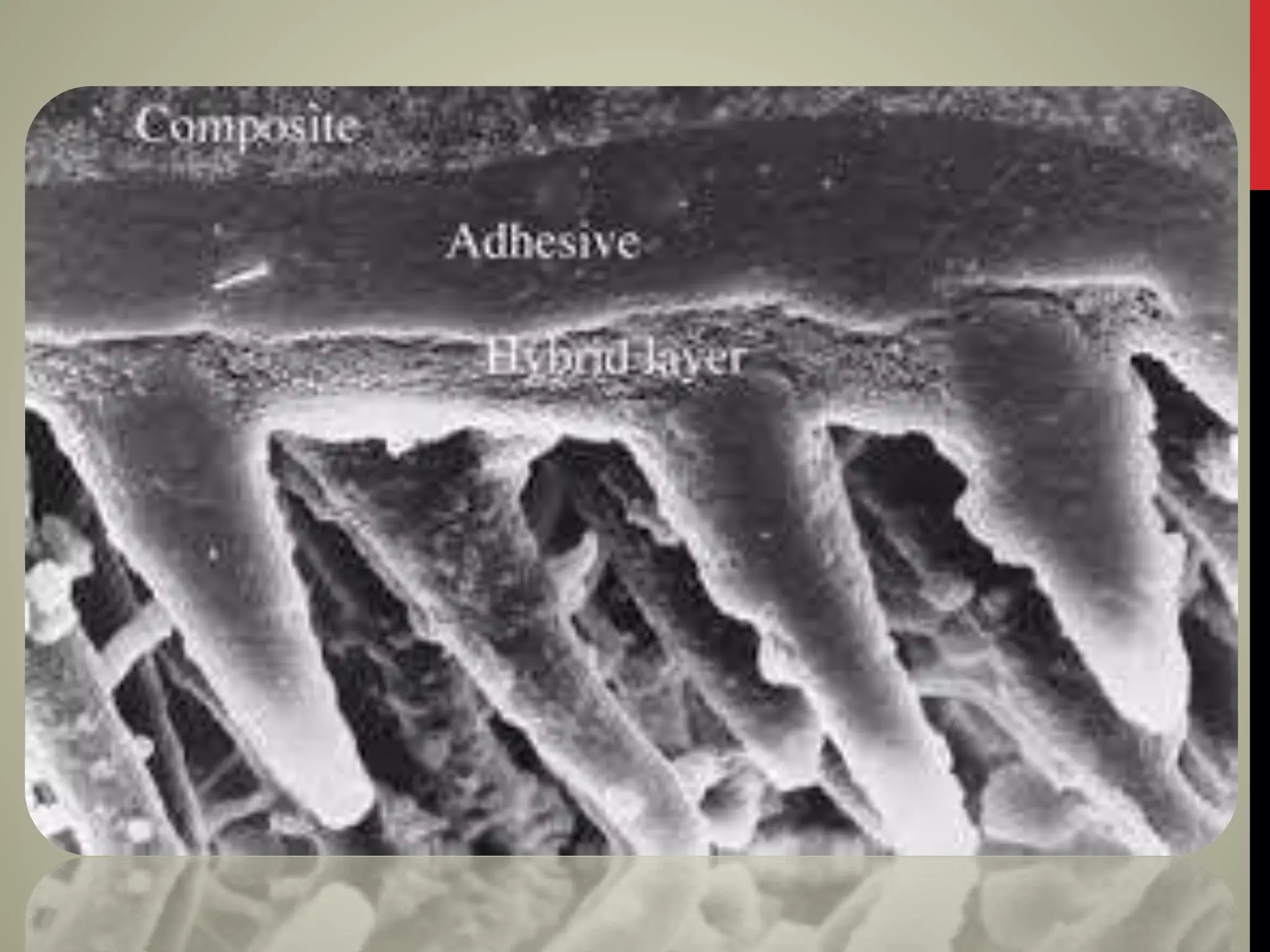
 PENTERATE THE
INTERTUBULAR
DENTIN & FORMING
HYBRID LAYER.
 PENTERATE &
POLYMERIZE IN
OPEN DENTINAL
TUBULES
&FORMING RESIN
TAGS.
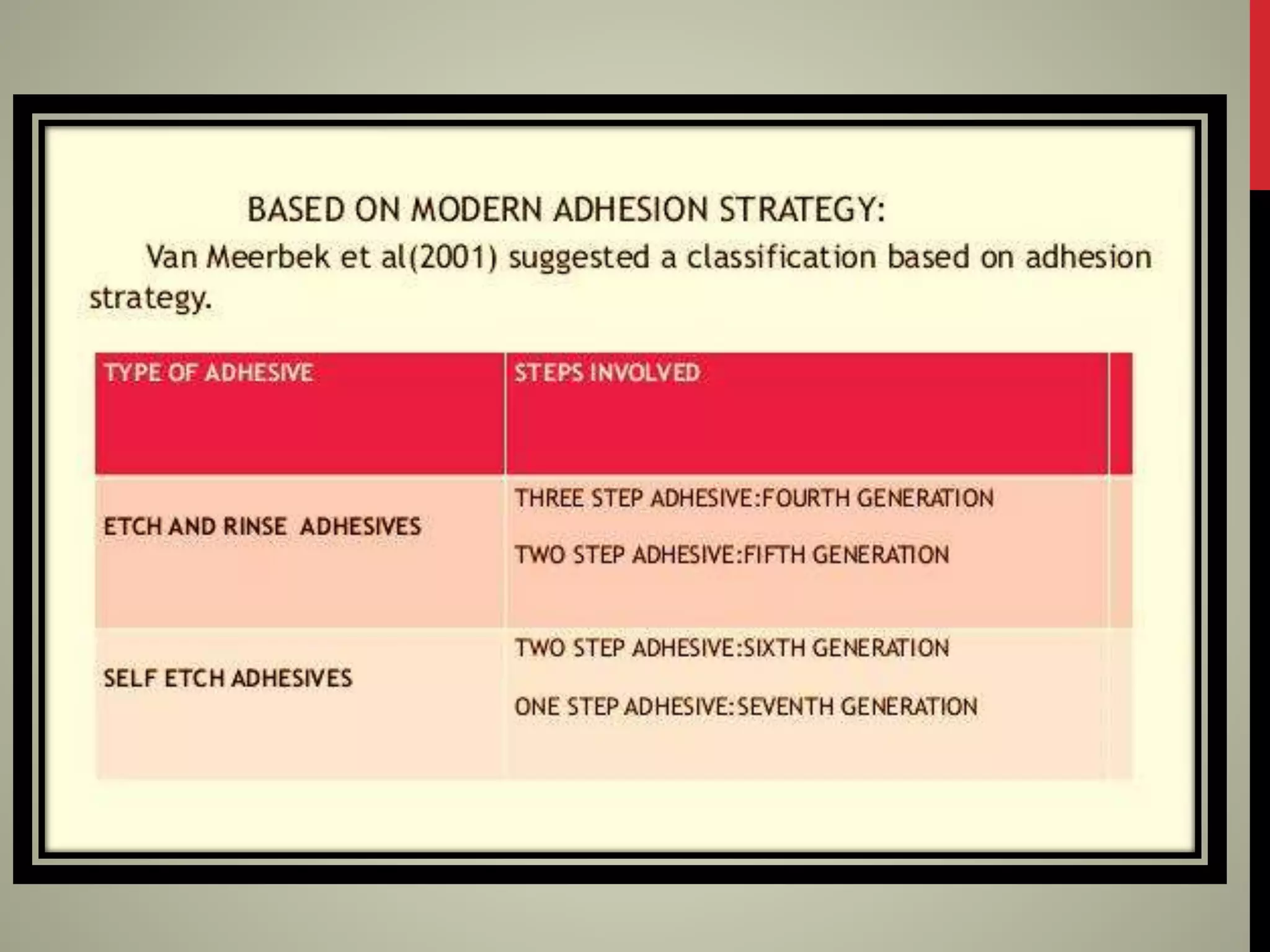
FOURTH GENERATION
(THREE STEP ADHESIVE)
etchant
primer
adhesive
• Etchant (phosphoric acid in gel form)
• Primer : is a bifunctional molecule consist of hydrophilic
(monomers in ethanol , acetone & water attaches to the tooth) .
hydrophobic monomer attaches to the composite resin.
Examples : HMA
NTG-GMA
PENTA
• Bonding agent: consist of unfilled & filled resins BisGMA ,
UDMA with TEGDMA & HEMA .
Aids in penetration into intertubular dentin
to form a resin dentin inter diffusion zone
called HYBRID LAYER .
ADVANTAGES
 Higher bond strength of 17-24MPa
 Reliable and consistent results
DISADVANTAGES
 Technique sensitive
 Time consuming procedure
 Over wetting or over drying of dentin
BRAND NAMES
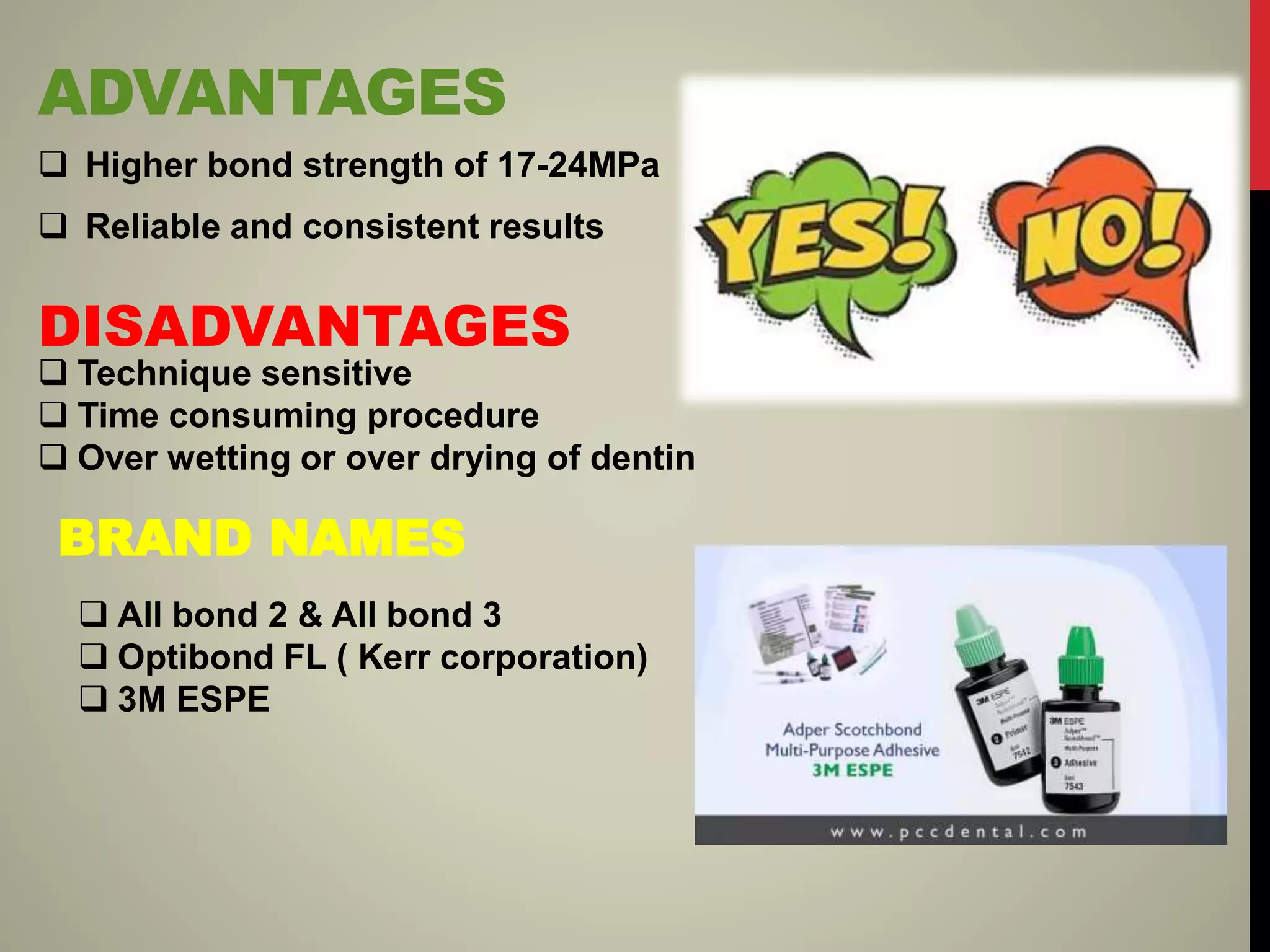
 All bond 2 & All bond 3
 Optibond FL ( Kerr corporation)
 3M ESPE
Total etchant
for 15 sec
Rinse the
etchant
thoroughly
+blot dry
primer
Adhesive
Light cure
FIFTH GENERATION
TWO STEPS
PRIMER &
ADHESIVE
ETCHA
NT
Prime&bond
NT(Dentsply
Adper
single
bond 2
ExciTE(ivocl
ar,vivadent)
XP
bond
One
caot
bond
SISTH
GENERATION
2 STEPS & 2
COMPONENT
1 STEP & 2
COMPONENT
VI GENERATION
2 STEPS & 2 COMPONENT
 NOURSHING CONDITIONER OR SELF PRIMER ETCHANT
 MECHANISM OF ACION:-
 THE ACIDIC PRIMERS CONTAIN PHOSPHATED RESIN
MOLECULES PERFORMS FUNCTIONS:-
 ETCHING & PRIMERING OF ENAMEL .
 INCORPORATING SMEAR PLUGS INTO RESIN TAGS.
APPLICATION
OF BOTTLE 1
ETCHANT+
PRIMER
AFTER 10S ,APPLY
BOTTLE 2 ON
TOOTH SURFACE
LIGHT CURE
SIXTH GENERATION
1 STEP & 2 COMPONENT
Bottle 1
Conditioner
+primer
Bottle 2
Adhesive
resin
 Self etching primers are acidic in nature leading to it’s
penetration along the aqueous channels found in smear
layer and widening them.
 When the concentration of acidic monomers increased
(30-40% in VI) aided in etching through smear layer .
 Self etching primers contain acidic esters like
HEMA,MDP,TEGDMA .
 Simpler than that of total etchant adhesive systems.
Xeno III(Dentsply)
One Up bond
(tokuyama)
Prompt L bond
(3M ESPE)
 NO ETCHING NEEDED.
 LESS TECHNIQUE SENSITIVE.
 LESS TIME CONSUMING .
 SELF ETCH ADHESIVES ARE LESS LIKELY TO RESULT IN
DISCREPANCY BETWEEN DEPTH OF DEMINERALIZATION
AND DEPTH OF INFILTRATION.
 DECREASE SHELF LIFE.
 INCOMPATIBLE WITH CHEMICAL CURE COMPOSITE.
 SELF ETCH ADHESIVES ARE CURRENTLY AVAILABLE DO NOT
ETCH AS EFFECIENTLY AS PHOSPHORIC ACID ESPECIALLY IF
THE ENAMEL HAS NOT BEEN INSTRUMENTED.
SEVENTH GENERATION
SELF ETCHING ADHESIVE
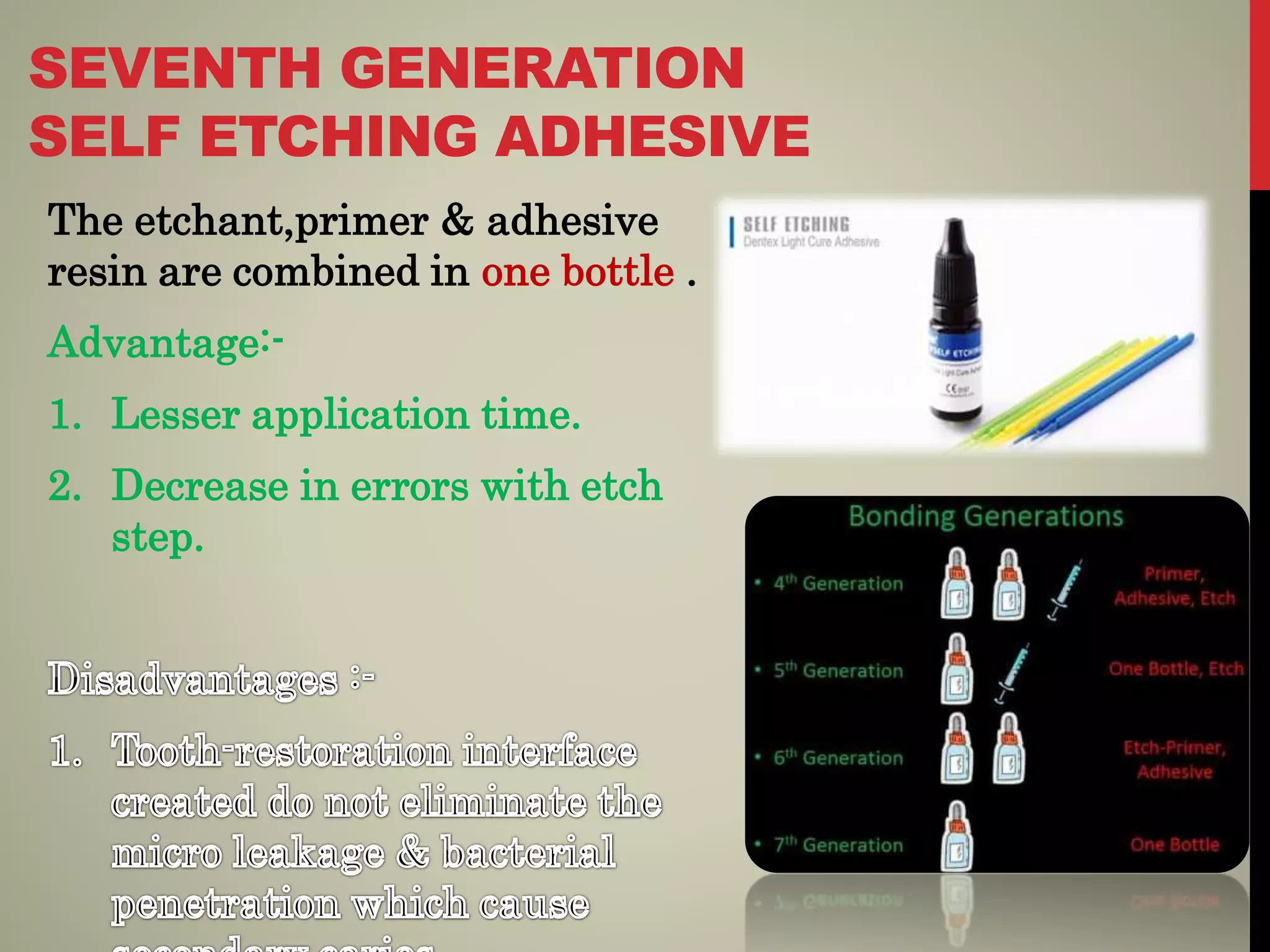
The etchant,primer & adhesive
resin are combined in one bottle .
Advantage:-
1. Lesser application time.
2. Decrease in errors with etch
step.
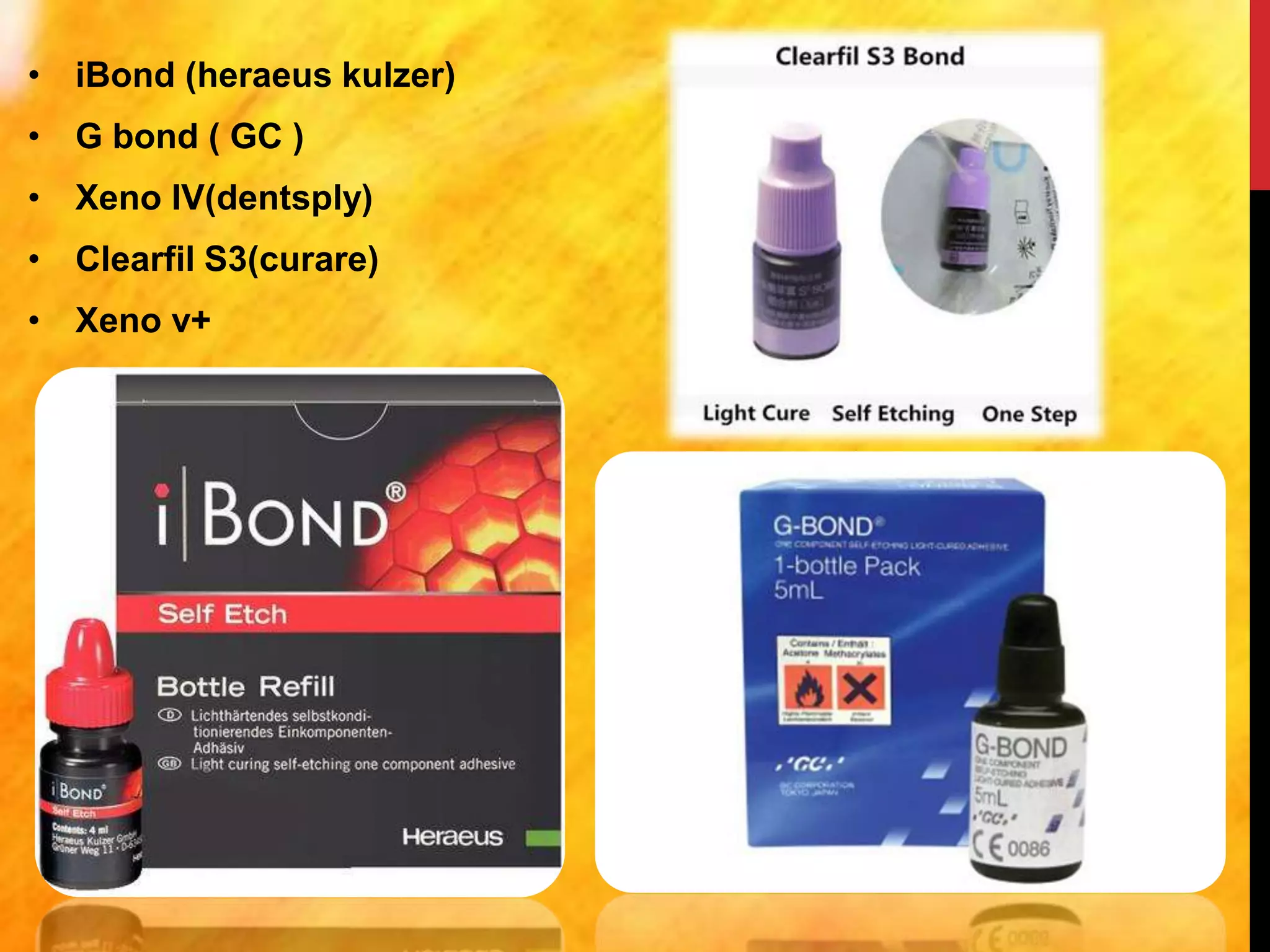
• iBond (heraeus kulzer)
• G bond ( GC )
• Xeno IV(dentsply)
• Clearfil S3(curare)
• Xeno v+
 Can be used with self-etch , selective-etch &
total_etch technique.
 Can be used with dual- cure , self-cure & light-cure
without need to separate activator.
 Can be used for both direct and indirect substrates.
 The adhesive MDP monomer contained in most
universal adhesives enables effective bonding to
calcium, dentin, enamel, zirconia and metal alloys
1) The first universal adhesive has a 100% retention rate after three
years with a total-etch approach. Scotchbond Universal from 3M was
the first universal adhesive introduced. It has the 10 MDP Monomer.
2) Universal adhesives have a higher pH level than other adhesives,
Phosphoric acid etches enamel well and “enamel likes an aggressive
etch.”
3) The application techniques are simplified with universal adhesives.
4) curing light matters-a lot.
5) Universals are much more resistant to contamination than their
predecessors.
6) Universals have a separate bonding mechanism in addition to the
hybrid layer formation. All bonding agents create a hybrid layer
consisting of collagen encased adhesive but the US creating a
chemical bond from the 10 MDP monomers to the calcium in the
tooth. This makes the bond more durable-and getting more so all the
time.
7) Most universals bond well to zirconia.
 Dentin Bonding agents generations
 Dentin Bonding agents generations

Dentin Bonding agents generations

  • 1.
    BONDING AGENT GENERATIONS DEFINITION,MECHANISM AND GENERATIONS BY :Farah Sarmad Dental student /4th stage At university of baghdad
  • 2.
    DEFINITION are resin materialsused to make a dental composite filling material adhere to both dentin and enamel. IT IS CONSISTS OF : PMMA(POLY METHYL METHACRYLATE) volatile carrier solvent like acetone They may also contain diluent monomers.
  • 3.
    MECHANISMS OF ACTION ETCHPRIMER BONDING AGENT  PARTIALTOTAL REMOVAL OF SMEAR LAYER.  DEMINERALIZATION OF INTERTUBULAR & PERITUBULAR DENTIN.  DENTINAL TUBULES OPENED WHILE EXPOSING COLLAGEN FIBERS.  MICROPOROSITY OF INTERTUBULAR DENTIN INCREASED.  INCREASE THE CRITICAL SURFACE TENSION OF DENTIN.  PENTERATE THE INTERTUBULAR DENTIN & FORMING HYBRID LAYER.  PENTERATE & POLYMERIZE IN OPEN DENTINAL TUBULES &FORMING RESIN TAGS.
  • 7.
    FOURTH GENERATION (THREE STEPADHESIVE) etchant primer adhesive
  • 8.
    • Etchant (phosphoricacid in gel form) • Primer : is a bifunctional molecule consist of hydrophilic (monomers in ethanol , acetone & water attaches to the tooth) . hydrophobic monomer attaches to the composite resin. Examples : HMA NTG-GMA PENTA • Bonding agent: consist of unfilled & filled resins BisGMA , UDMA with TEGDMA & HEMA . Aids in penetration into intertubular dentin to form a resin dentin inter diffusion zone called HYBRID LAYER .
  • 9.
    ADVANTAGES  Higher bondstrength of 17-24MPa  Reliable and consistent results DISADVANTAGES  Technique sensitive  Time consuming procedure  Over wetting or over drying of dentin BRAND NAMES  All bond 2 & All bond 3  Optibond FL ( Kerr corporation)  3M ESPE
  • 10.
    Total etchant for 15sec Rinse the etchant thoroughly +blot dry primer Adhesive Light cure
  • 11.
  • 13.
  • 15.
    SISTH GENERATION 2 STEPS &2 COMPONENT 1 STEP & 2 COMPONENT
  • 16.
    VI GENERATION 2 STEPS& 2 COMPONENT  NOURSHING CONDITIONER OR SELF PRIMER ETCHANT  MECHANISM OF ACION:-  THE ACIDIC PRIMERS CONTAIN PHOSPHATED RESIN MOLECULES PERFORMS FUNCTIONS:-  ETCHING & PRIMERING OF ENAMEL .  INCORPORATING SMEAR PLUGS INTO RESIN TAGS.
  • 17.
    APPLICATION OF BOTTLE 1 ETCHANT+ PRIMER AFTER10S ,APPLY BOTTLE 2 ON TOOTH SURFACE LIGHT CURE
  • 19.
    SIXTH GENERATION 1 STEP& 2 COMPONENT Bottle 1 Conditioner +primer Bottle 2 Adhesive resin
  • 20.
     Self etchingprimers are acidic in nature leading to it’s penetration along the aqueous channels found in smear layer and widening them.  When the concentration of acidic monomers increased (30-40% in VI) aided in etching through smear layer .  Self etching primers contain acidic esters like HEMA,MDP,TEGDMA .  Simpler than that of total etchant adhesive systems. Xeno III(Dentsply) One Up bond (tokuyama) Prompt L bond (3M ESPE)
  • 23.
     NO ETCHINGNEEDED.  LESS TECHNIQUE SENSITIVE.  LESS TIME CONSUMING .  SELF ETCH ADHESIVES ARE LESS LIKELY TO RESULT IN DISCREPANCY BETWEEN DEPTH OF DEMINERALIZATION AND DEPTH OF INFILTRATION.  DECREASE SHELF LIFE.  INCOMPATIBLE WITH CHEMICAL CURE COMPOSITE.  SELF ETCH ADHESIVES ARE CURRENTLY AVAILABLE DO NOT ETCH AS EFFECIENTLY AS PHOSPHORIC ACID ESPECIALLY IF THE ENAMEL HAS NOT BEEN INSTRUMENTED.
  • 24.
    SEVENTH GENERATION SELF ETCHINGADHESIVE The etchant,primer & adhesive resin are combined in one bottle . Advantage:- 1. Lesser application time. 2. Decrease in errors with etch step.
  • 26.
    • iBond (heraeuskulzer) • G bond ( GC ) • Xeno IV(dentsply) • Clearfil S3(curare) • Xeno v+
  • 28.
     Can beused with self-etch , selective-etch & total_etch technique.  Can be used with dual- cure , self-cure & light-cure without need to separate activator.  Can be used for both direct and indirect substrates.  The adhesive MDP monomer contained in most universal adhesives enables effective bonding to calcium, dentin, enamel, zirconia and metal alloys
  • 31.
    1) The firstuniversal adhesive has a 100% retention rate after three years with a total-etch approach. Scotchbond Universal from 3M was the first universal adhesive introduced. It has the 10 MDP Monomer. 2) Universal adhesives have a higher pH level than other adhesives, Phosphoric acid etches enamel well and “enamel likes an aggressive etch.” 3) The application techniques are simplified with universal adhesives. 4) curing light matters-a lot. 5) Universals are much more resistant to contamination than their predecessors. 6) Universals have a separate bonding mechanism in addition to the hybrid layer formation. All bonding agents create a hybrid layer consisting of collagen encased adhesive but the US creating a chemical bond from the 10 MDP monomers to the calcium in the tooth. This makes the bond more durable-and getting more so all the time. 7) Most universals bond well to zirconia.