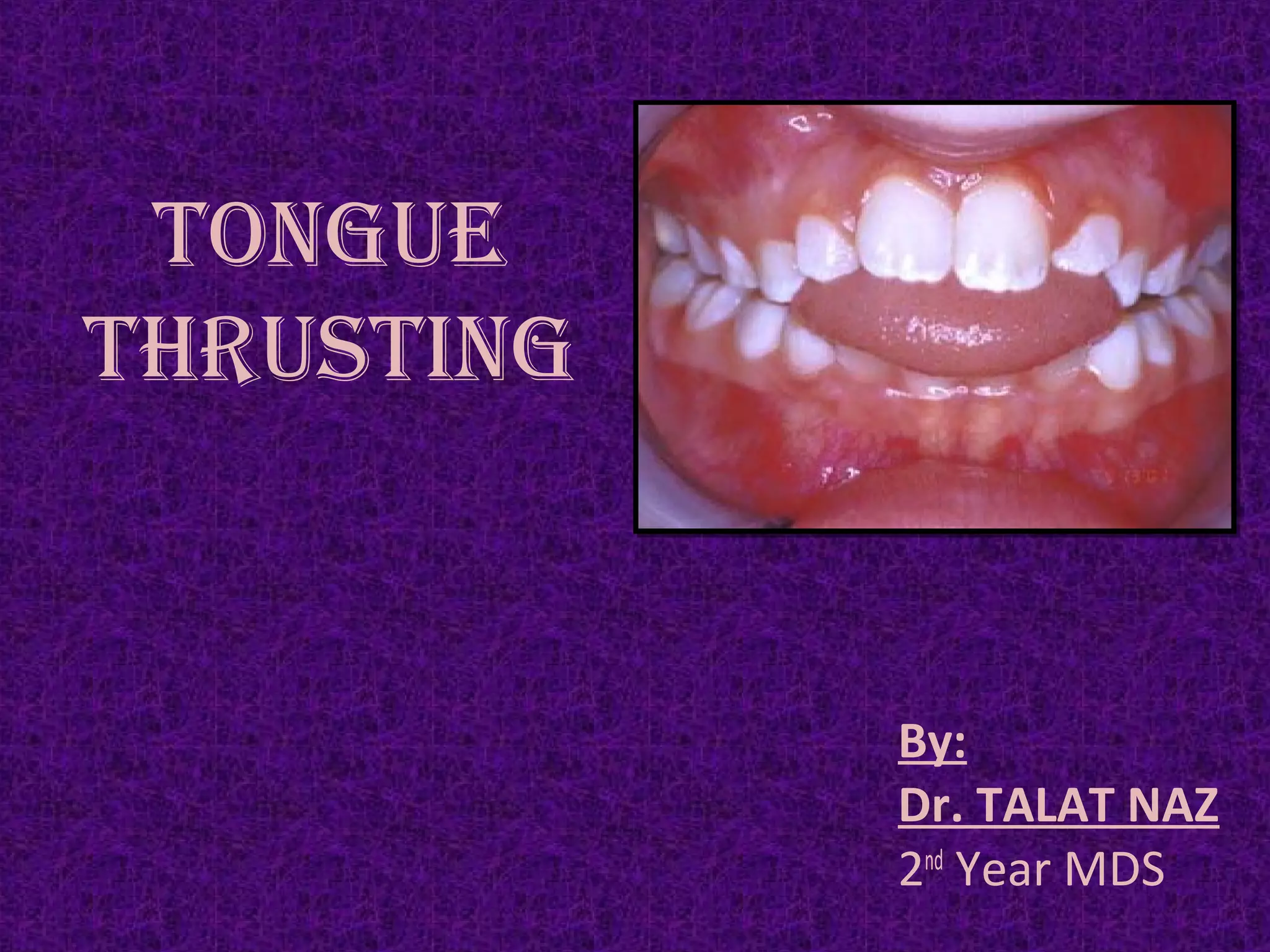
TONGUE
THRUSTING
By:
Dr. TALAT NAZ
2nd
Year MDS
CONTENTS
• INTRODUCTION
• DEFINITION
• CLASSIFICATION
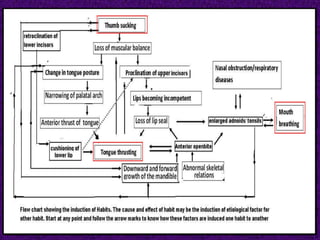
• ETIOLOGY
• CORRECT SWALLOWING PATTERN
• INCORRECT SWALLOWING PATTERN
• BUCCINATOR MECHANISM
• DIAGNOSIS
• MANAGEMENT
• TREATMENT PLAN
• APPLIANCES
INTRODUCTION
• Oral habits
• Buttersworth (1961)
• Pernicious oral habits
DEfINITIONS
Brauer (1965)
Schneider (1982)
Barber (1975)
Tulley (1969)
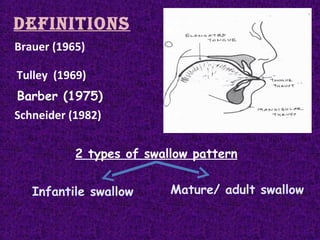
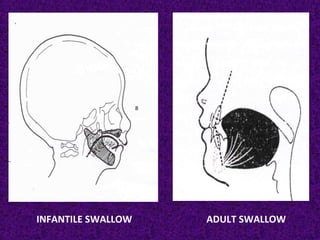
2 types of swallow pattern
Infantile swallow Mature/ adult swallow
INFANTILE SWALLOW ADULT SWALLOW
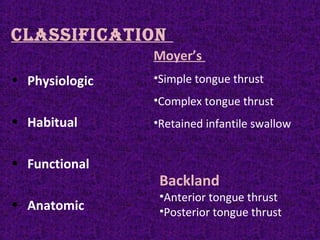
ClaSSIfICaTION
• Physiologic
• Habitual
• Functional
• Anatomic
Moyer’s
•Simple tongue thrust
•Complex tongue thrust
•Retained infantile swallow
Backland
•Anterior tongue thrust
•Posterior tongue thrust
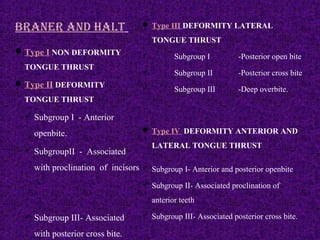
BRaNER aND HalT
Type I NON DEFORMITY
TONGUE THRUST
Type II DEFORMITY
TONGUE THRUST
 Subgroup I - Anterior
openbite.
 SubgroupII - Associated
with proclination of incisors
 Subgroup III- Associated
with posterior cross bite.
 Type III DEFORMITY LATERAL
TONGUE THRUST
 Subgroup I -Posterior open bite
 Subgroup II -Posterior cross bite
 Subgroup III -Deep overbite.
 Type IV DEFORMITY ANTERIOR AND
LATERAL TONGUE THRUST
 Subgroup I- Anterior and posterior openbite
 Subgroup II- Associated proclination of
anterior teeth
 Subgroup III- Associated posterior cross bite.
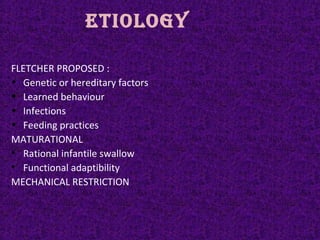
ETIOlOGy
FLETCHER PROPOSED :
• Genetic or hereditary factors
• Learned behaviour
• Infections
• Feeding practices
MATURATIONAL
• Rational infantile swallow
• Functional adaptibility
MECHANICAL RESTRICTION
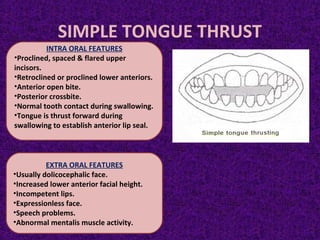
SIMPLE TONGUE THRUST
INTRA ORAL FEATURES
•Proclined, spaced & flared upper
incisors.
•Retroclined or proclined lower anteriors.
•Anterior open bite.
•Posterior crossbite.
•Normal tooth contact during swallowing.
•Tongue is thrust forward during
swallowing to establish anterior lip seal.
EXTRA ORAL FEATURES
•Usually dolicocephalic face.
•Increased lower anterior facial height.
•Incompetent lips.
•Expressionless face.
•Speech problems.
•Abnormal mentalis muscle activity.
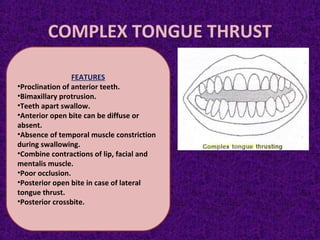
COMPLEX TONGUE THRUST
FEATURES
•Proclination of anterior teeth.
•Bimaxillary protrusion.
•Teeth apart swallow.
•Anterior open bite can be diffuse or
absent.
•Absence of temporal muscle constriction
during swallowing.
•Combine contractions of lip, facial and
mentalis muscle.
•Poor occlusion.
•Posterior open bite in case of lateral
tongue thrust.
•Posterior crossbite.
LATERAL TONGUE THRUST
• May be unilateral or bilateral.
• Lateral open bite is seen.
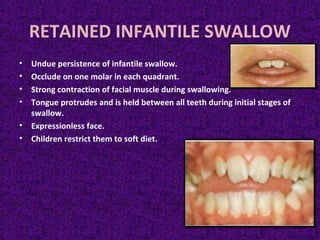
RETAINED INFANTILE SWALLOW
• Undue persistence of infantile swallow.
• Occlude on one molar in each quadrant.
• Strong contraction of facial muscle during swallowing.
• Tongue protrudes and is held between all teeth during initial stages of
swallow.
• Expressionless face.
• Children restrict them to soft diet.
BUCCINATOR MECHANISM
BUCCINATOR MUSCLE : Its purpose is to pull back the angle of the mouth and to
flatten the cheek area, which aids in holding the cheek to the teeth during chewing.
This action causes the muscle to keep food pushed back on the occlusal surface of
the posterior teeth, as when a person chews. By keeping the food in the correct
position when chewing, the buccinator assists the muscles of mastication.
It aids whistling and smiling, and in neonates it is used to suckle.
According to Graber the momentarily greater forces of the tongue are offset by "tonal
contraction, peripheral fiber recruitment of the buccal and labial muscles, and
atmospheric pressure" and the net result is that of equilibrium.
DIAGNOSTIC PROCEDURES
• Case history
• Informal observation
• Examination of the oral peripheral mechanism
• Examination of the swallow
CASE HISTORY
1. Early Feeding and Habit History
2. Pertinent Medical Information
3. Pertinent Dental Information
4. Eating Habits
5. Associated Oral Behaviors
6. Family Dental History
INFORMAL OBSERVATION
• Resting posture
• Swallowing
• Speech
EXAMINATION OF ORAL PERIPHERAL
MECHANISM
• Teeth
• Jaw
• Palate
• Tongue
• Lips
EXAMINATION OF SWALLOW
• Solid food swallow
• Liquid swallow
• Saliva swallow
TREATMENT
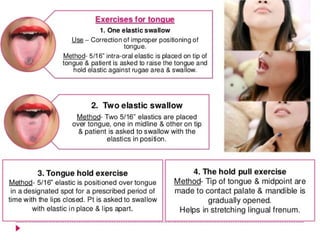
I. Training of correct swallow and posture of the tongue
Myofunctional exercises :
• Placement at rugae
• Orthodontic elastic and sugarless fruit drop exercises:
• 4S exercises: spotting, salivating, squeezing and swallowing.
Other exercises:
Whistling, Reciting count from 60-69 , Gargling , Yawning
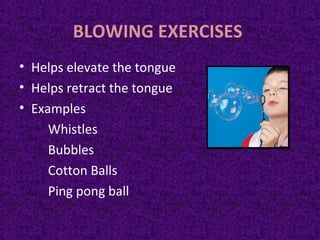
BLOWING EXERCISES
• Helps elevate the tongue
• Helps retract the tongue
• Examples
Whistles
Bubbles
Cotton Balls
Ping pong ball
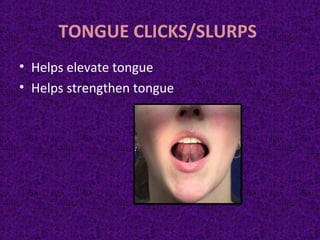
TONGUE CLICKS/SLURPS
• Helps elevate tongue
• Helps strengthen tongue
KISSES
• Increases lip closure
• Increases tongue retraction
• Make child protrude lips and smack
• Make child line up stuffed animals and kiss
them all goodnight.
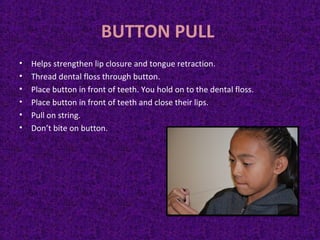
BUTTON PULL
• Helps strengthen lip closure and tongue retraction.
• Thread dental floss through button.
• Place button in front of teeth. You hold on to the dental floss.
• Place button in front of teeth and close their lips.
• Pull on string.
• Don’t bite on button.
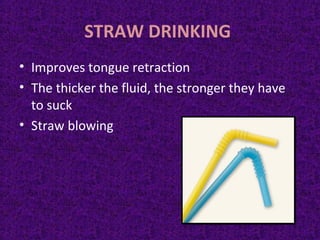
STRAW DRINKING
• Improves tongue retraction
• The thicker the fluid, the stronger they have
to suck
• Straw blowing
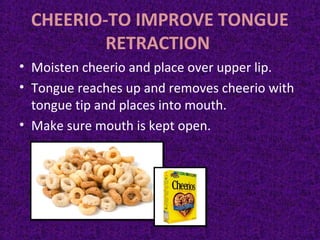
CHEERIO-TO IMPROVE TONGUE
RETRACTION
• Moisten cheerio and place over upper lip.
• Tongue reaches up and removes cheerio with
tongue tip and places into mouth.
• Make sure mouth is kept open.
CHEERIO- /S/
• Have child hold cheerio with tongue tip up to
the palate
• Hold cheerio and count, keeping cheerio up
on the roof of the mouth.
• Play a game to encourage child to increase the
time they can keep their tongue up.
CHEERIO- /K/
• Have child hold the cheerio down at bottom
of their mouth.
• Don’t move tongue tip.
• You can have child say /k, g, h/ while holding
the cheerio down.
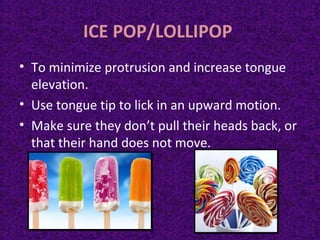
ICE POP/LOLLIPOP
• To minimize protrusion and increase tongue
elevation.
• Use tongue tip to lick in an upward motion.
• Make sure they don’t pull their heads back, or
that their hand does not move.
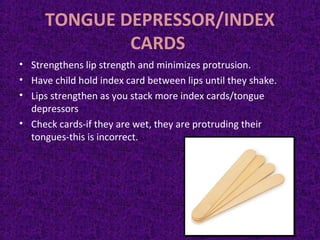
TONGUE DEPRESSOR/INDEX
CARDS
• Strengthens lip strength and minimizes protrusion.
• Have child hold index card between lips until they shake.
• Lips strengthen as you stack more index cards/tongue
depressors
• Check cards-if they are wet, they are protruding their
tongues-this is incorrect.
GARGLING- IMPROVES /H, G, K/
• Tilt head back with a small amount of
water/saliva.
• Have child gargle.
• Count up to 10.
Oral Motor Speech Exercises - Leticia Segura & Grace Mckissick
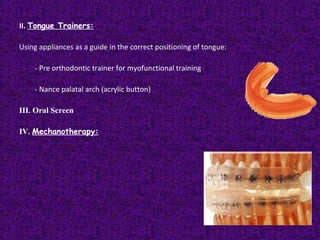
II. Tongue Trainers:
Using appliances as a guide in the correct positioning of tongue:
- Pre orthodontic trainer for myofunctional training
- Nance palatal arch (acrylic button)
III. Oral Screen
IV. Mechanotherapy:
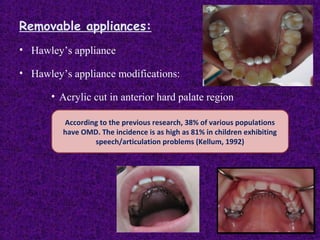
Removable appliances:
• Hawley’s appliance
• Hawley’s appliance modifications:
• Acrylic cut in anterior hard palate region
• Cribs or rakes employed in anterior partAccording to the previous research, 38% of various populations
have OMD. The incidence is as high as 81% in children exhibiting
speech/articulation problems (Kellum, 1992)
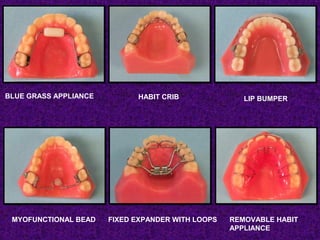
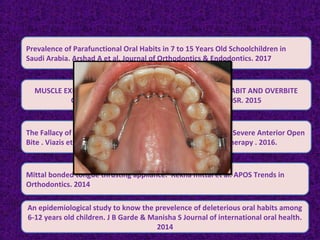
BLUE GRASS APPLIANCE HABIT CRIB LIP BUMPER
MYOFUNCTIONAL BEAD FIXED EXPANDER WITH LOOPS REMOVABLE HABIT
APPLIANCE
Prevalence of Parafunctional Oral Habits in 7 to 15 Years Old Schoolchildren in
Saudi Arabia. Arshad A et al. Journal of Orthodontics & Endodontics. 2017
MUSCLE EXERCISES IN CORRECTING TONGUE THRUSTING HABIT AND OVERBITE
CORRECTION - A CASE REPORT . Maurya G S. NJDSR. 2015
The Fallacy of Tongue Thrust and Non-Surgical Treatment of a Severe Anterior Open
Bite . Viazis et al. Journal of Dental Health, Oral Disorders & Therapy . 2016.
Mittal bonded tongue thrusting appliance. Rekha mittal et al. APOS Trends in
Orthodontics. 2014
An epidemiological study to know the prevelence of deleterious oral habits among
6-12 years old children. J B Garde & Manisha S Journal of international oral health.
2014
• REFFRENCES
• Tomgue thrust habit – a review. Annals and essences of
dentistry. Chetan kumar. 2009.
• Effect of tongue thrust swallowing on position of anterior
teeth. Journal of dental research, dental clinics, dental
prospects, vol.3, no. 3. 2009.
• Orthodontics-principles and practice
• Graber T.M.
• Textbook of Pedodontics:
• Shobha Tandon
• Orthodontics- the art and science
• S.I. Bhalajhi

Tongue thrusting - Dr. TALAT NAZ

  • 1.
  • 2.
    CONTENTS • INTRODUCTION • DEFINITION •CLASSIFICATION • ETIOLOGY • CORRECT SWALLOWING PATTERN • INCORRECT SWALLOWING PATTERN • BUCCINATOR MECHANISM • DIAGNOSIS • MANAGEMENT • TREATMENT PLAN • APPLIANCES
  • 3.
    INTRODUCTION • Oral habits •Buttersworth (1961) • Pernicious oral habits
  • 4.
    DEfINITIONS Brauer (1965) Schneider (1982) Barber(1975) Tulley (1969) 2 types of swallow pattern Infantile swallow Mature/ adult swallow
  • 5.
  • 6.
    ClaSSIfICaTION • Physiologic • Habitual •Functional • Anatomic Moyer’s •Simple tongue thrust •Complex tongue thrust •Retained infantile swallow Backland •Anterior tongue thrust •Posterior tongue thrust
  • 7.
    BRaNER aND HalT TypeI NON DEFORMITY TONGUE THRUST Type II DEFORMITY TONGUE THRUST  Subgroup I - Anterior openbite.  SubgroupII - Associated with proclination of incisors  Subgroup III- Associated with posterior cross bite.  Type III DEFORMITY LATERAL TONGUE THRUST  Subgroup I -Posterior open bite  Subgroup II -Posterior cross bite  Subgroup III -Deep overbite.  Type IV DEFORMITY ANTERIOR AND LATERAL TONGUE THRUST  Subgroup I- Anterior and posterior openbite  Subgroup II- Associated proclination of anterior teeth  Subgroup III- Associated posterior cross bite.
  • 8.
    ETIOlOGy FLETCHER PROPOSED : •Genetic or hereditary factors • Learned behaviour • Infections • Feeding practices MATURATIONAL • Rational infantile swallow • Functional adaptibility MECHANICAL RESTRICTION
  • 10.
    SIMPLE TONGUE THRUST INTRAORAL FEATURES •Proclined, spaced & flared upper incisors. •Retroclined or proclined lower anteriors. •Anterior open bite. •Posterior crossbite. •Normal tooth contact during swallowing. •Tongue is thrust forward during swallowing to establish anterior lip seal. EXTRA ORAL FEATURES •Usually dolicocephalic face. •Increased lower anterior facial height. •Incompetent lips. •Expressionless face. •Speech problems. •Abnormal mentalis muscle activity.
  • 11.
    COMPLEX TONGUE THRUST FEATURES •Proclinationof anterior teeth. •Bimaxillary protrusion. •Teeth apart swallow. •Anterior open bite can be diffuse or absent. •Absence of temporal muscle constriction during swallowing. •Combine contractions of lip, facial and mentalis muscle. •Poor occlusion. •Posterior open bite in case of lateral tongue thrust. •Posterior crossbite.
  • 12.
    LATERAL TONGUE THRUST •May be unilateral or bilateral. • Lateral open bite is seen.
  • 13.
    RETAINED INFANTILE SWALLOW •Undue persistence of infantile swallow. • Occlude on one molar in each quadrant. • Strong contraction of facial muscle during swallowing. • Tongue protrudes and is held between all teeth during initial stages of swallow. • Expressionless face. • Children restrict them to soft diet.
  • 14.
    BUCCINATOR MECHANISM BUCCINATOR MUSCLE: Its purpose is to pull back the angle of the mouth and to flatten the cheek area, which aids in holding the cheek to the teeth during chewing. This action causes the muscle to keep food pushed back on the occlusal surface of the posterior teeth, as when a person chews. By keeping the food in the correct position when chewing, the buccinator assists the muscles of mastication. It aids whistling and smiling, and in neonates it is used to suckle. According to Graber the momentarily greater forces of the tongue are offset by "tonal contraction, peripheral fiber recruitment of the buccal and labial muscles, and atmospheric pressure" and the net result is that of equilibrium.
  • 15.
    DIAGNOSTIC PROCEDURES • Casehistory • Informal observation • Examination of the oral peripheral mechanism • Examination of the swallow
  • 16.
    CASE HISTORY 1. EarlyFeeding and Habit History 2. Pertinent Medical Information 3. Pertinent Dental Information 4. Eating Habits 5. Associated Oral Behaviors 6. Family Dental History
  • 17.
    INFORMAL OBSERVATION • Restingposture • Swallowing • Speech
  • 18.
    EXAMINATION OF ORALPERIPHERAL MECHANISM • Teeth • Jaw • Palate • Tongue • Lips
  • 19.
    EXAMINATION OF SWALLOW •Solid food swallow • Liquid swallow • Saliva swallow
  • 20.
    TREATMENT I. Training ofcorrect swallow and posture of the tongue Myofunctional exercises : • Placement at rugae • Orthodontic elastic and sugarless fruit drop exercises: • 4S exercises: spotting, salivating, squeezing and swallowing. Other exercises: Whistling, Reciting count from 60-69 , Gargling , Yawning
  • 21.
    BLOWING EXERCISES • Helpselevate the tongue • Helps retract the tongue • Examples Whistles Bubbles Cotton Balls Ping pong ball
  • 22.
    TONGUE CLICKS/SLURPS • Helpselevate tongue • Helps strengthen tongue
  • 23.
    KISSES • Increases lipclosure • Increases tongue retraction • Make child protrude lips and smack • Make child line up stuffed animals and kiss them all goodnight.
  • 24.
    BUTTON PULL • Helpsstrengthen lip closure and tongue retraction. • Thread dental floss through button. • Place button in front of teeth. You hold on to the dental floss. • Place button in front of teeth and close their lips. • Pull on string. • Don’t bite on button.
  • 25.
    STRAW DRINKING • Improvestongue retraction • The thicker the fluid, the stronger they have to suck • Straw blowing
  • 26.
    CHEERIO-TO IMPROVE TONGUE RETRACTION •Moisten cheerio and place over upper lip. • Tongue reaches up and removes cheerio with tongue tip and places into mouth. • Make sure mouth is kept open.
  • 27.
    CHEERIO- /S/ • Havechild hold cheerio with tongue tip up to the palate • Hold cheerio and count, keeping cheerio up on the roof of the mouth. • Play a game to encourage child to increase the time they can keep their tongue up.
  • 28.
    CHEERIO- /K/ • Havechild hold the cheerio down at bottom of their mouth. • Don’t move tongue tip. • You can have child say /k, g, h/ while holding the cheerio down.
  • 29.
    ICE POP/LOLLIPOP • Tominimize protrusion and increase tongue elevation. • Use tongue tip to lick in an upward motion. • Make sure they don’t pull their heads back, or that their hand does not move.
  • 30.
    TONGUE DEPRESSOR/INDEX CARDS • Strengthenslip strength and minimizes protrusion. • Have child hold index card between lips until they shake. • Lips strengthen as you stack more index cards/tongue depressors • Check cards-if they are wet, they are protruding their tongues-this is incorrect.
  • 31.
    GARGLING- IMPROVES /H,G, K/ • Tilt head back with a small amount of water/saliva. • Have child gargle. • Count up to 10. Oral Motor Speech Exercises - Leticia Segura & Grace Mckissick
  • 33.
    II. Tongue Trainers: Usingappliances as a guide in the correct positioning of tongue: - Pre orthodontic trainer for myofunctional training - Nance palatal arch (acrylic button) III. Oral Screen IV. Mechanotherapy:
  • 34.
    Removable appliances: • Hawley’sappliance • Hawley’s appliance modifications: • Acrylic cut in anterior hard palate region • Cribs or rakes employed in anterior partAccording to the previous research, 38% of various populations have OMD. The incidence is as high as 81% in children exhibiting speech/articulation problems (Kellum, 1992)
  • 35.
    BLUE GRASS APPLIANCEHABIT CRIB LIP BUMPER MYOFUNCTIONAL BEAD FIXED EXPANDER WITH LOOPS REMOVABLE HABIT APPLIANCE
  • 37.
    Prevalence of ParafunctionalOral Habits in 7 to 15 Years Old Schoolchildren in Saudi Arabia. Arshad A et al. Journal of Orthodontics & Endodontics. 2017 MUSCLE EXERCISES IN CORRECTING TONGUE THRUSTING HABIT AND OVERBITE CORRECTION - A CASE REPORT . Maurya G S. NJDSR. 2015 The Fallacy of Tongue Thrust and Non-Surgical Treatment of a Severe Anterior Open Bite . Viazis et al. Journal of Dental Health, Oral Disorders & Therapy . 2016. Mittal bonded tongue thrusting appliance. Rekha mittal et al. APOS Trends in Orthodontics. 2014 An epidemiological study to know the prevelence of deleterious oral habits among 6-12 years old children. J B Garde & Manisha S Journal of international oral health. 2014
  • 38.
    • REFFRENCES • Tomguethrust habit – a review. Annals and essences of dentistry. Chetan kumar. 2009. • Effect of tongue thrust swallowing on position of anterior teeth. Journal of dental research, dental clinics, dental prospects, vol.3, no. 3. 2009. • Orthodontics-principles and practice • Graber T.M. • Textbook of Pedodontics: • Shobha Tandon • Orthodontics- the art and science • S.I. Bhalajhi