Enhancing Facial Harmony ORTHOGNATHIC SURGERY COMBINED WITH FACIAL PLASTIC PROCEDURES Samuel Benarroch Mahfoda  MD, DDS, OMS Assistant Professor Oral & Maxillofacial Surgery Residency Program Woodhull Medical Center. New York Hospital Magallanes de Catia. Caracas
ORTHOGNATHIC AND  ESTHETIC  PROCEDURES   Create improvement while maintaining a natural appearance
Purpose Determine the type of cosmetic surgery procedures most frequently performed to enhance the result of orthognathic surgery
DESIGN  Multicenter  Retrospective study  Conducted  from 1996 to 2005
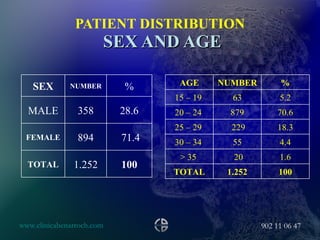
PATIENT DISTRIBUTION  SEX AND AGE SEX NUMBER % MALE 358 28.6 FEMALE 894 71.4 TOTAL 1.252 100 AGE NUMBER % 15 – 19  63 5.2 20 – 24  879 70.6 25 – 29  229 18.3 30  – 34   55 4.4 > 35  20 1.6 TOTAL 1.252 100
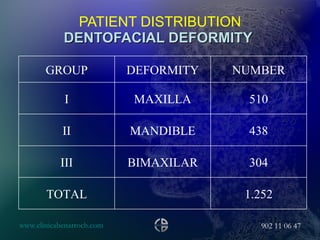
PATIENT DISTRIBUTION DENTOFACIAL DEFORMITY   GROUP DEFORMITY NUMBER I MAXILLA 510 II MANDIBLE 438 III BIMAXILAR 304 TOTAL 1.252
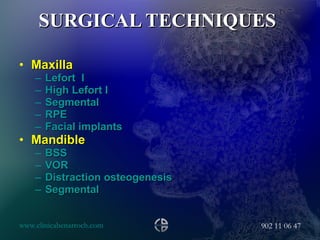
SURGICAL TECHNIQUES   Maxilla  Lefort  I High Lefort I Segmental  RPE Facial implants Mandible  BSS VOR Distraction osteogenesis Segmental
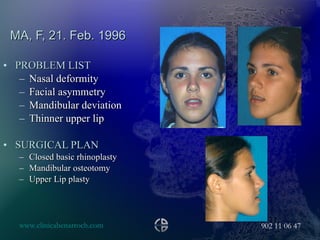
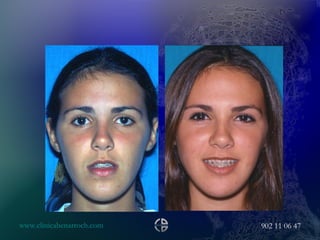
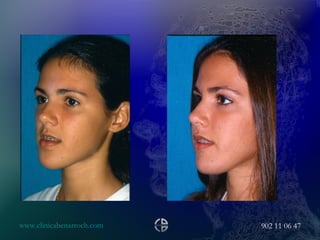
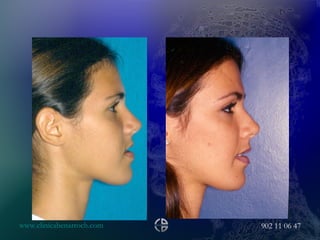
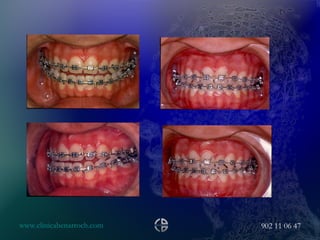
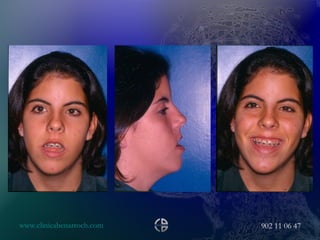
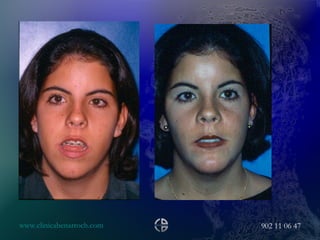
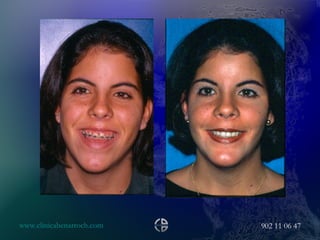
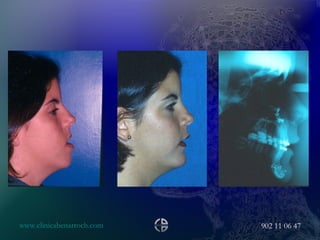
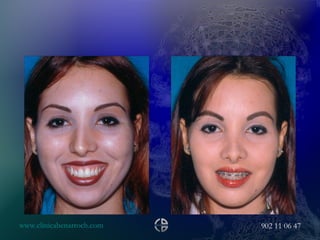
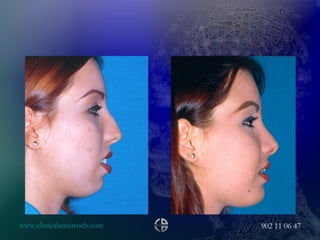
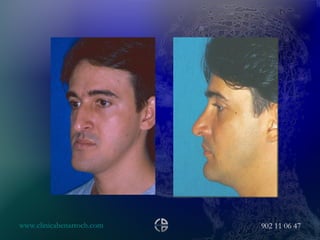
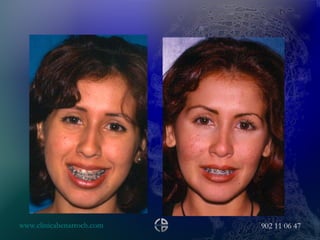
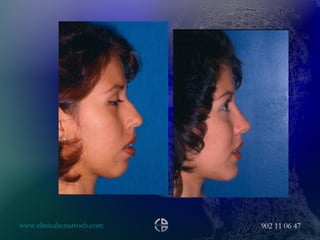
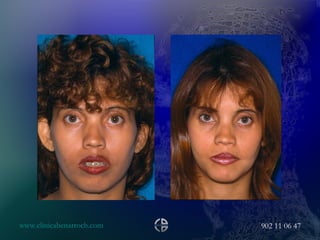
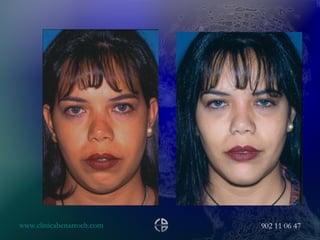
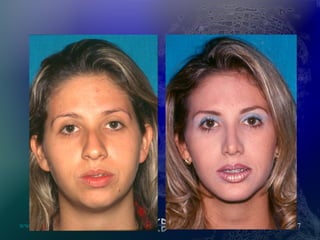
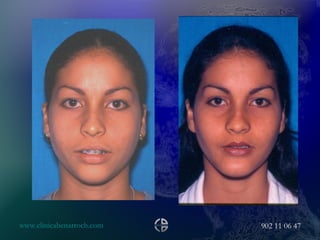
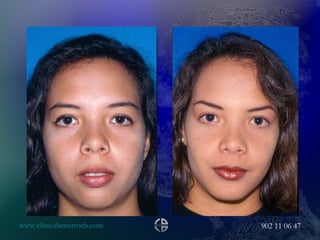
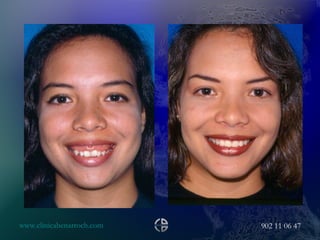
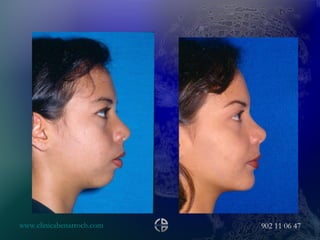
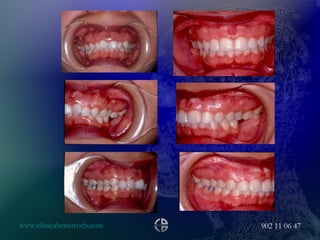
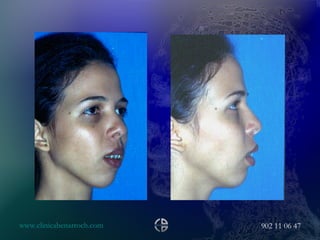
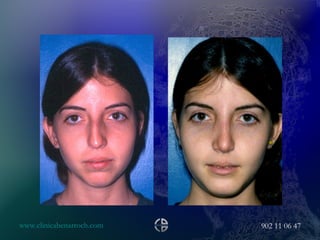
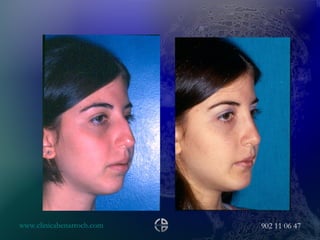
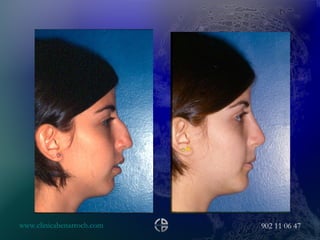
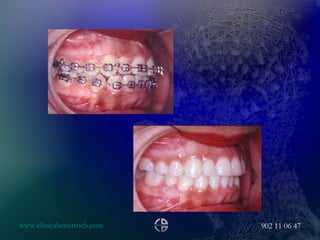
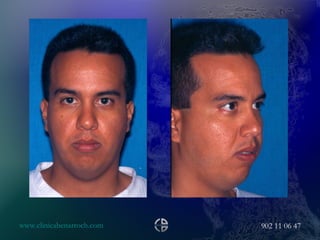
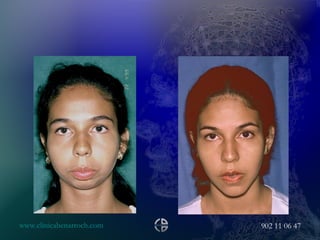
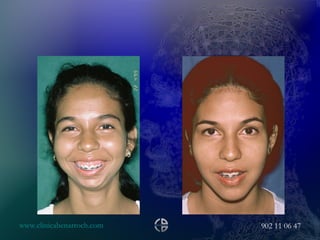
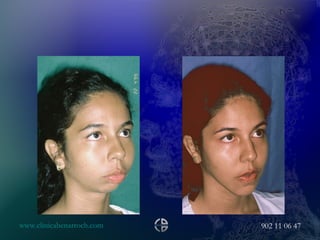
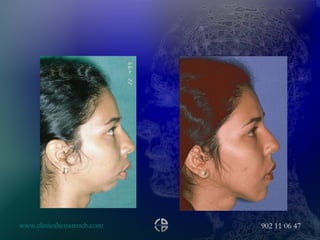
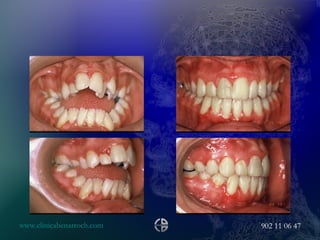
MA, F, 21. Feb. 1996 PROBLEM LIST Nasal deformity Facial asymmetry Mandibular deviation Thinner upper lip  SURGICAL PLAN  Closed basic rhinoplasty Mandibular osteotomy Upper Lip plasty


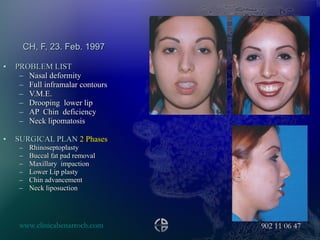
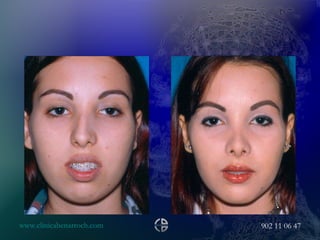
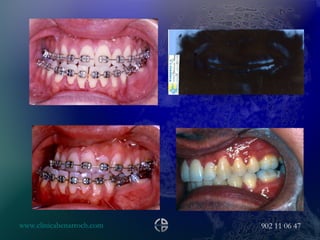
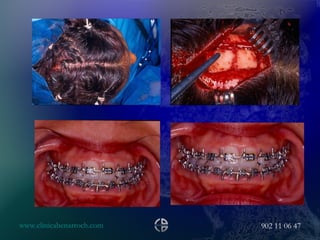
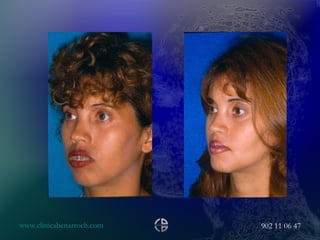
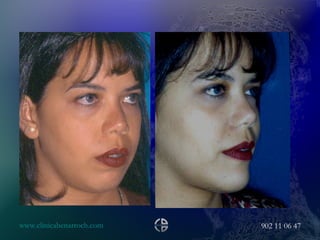
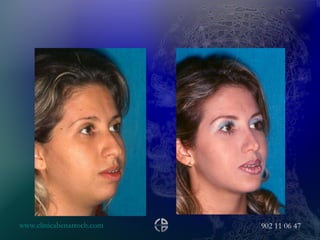
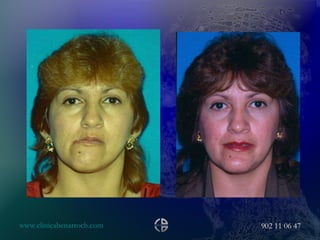
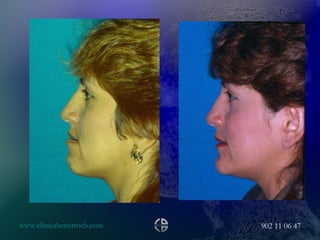
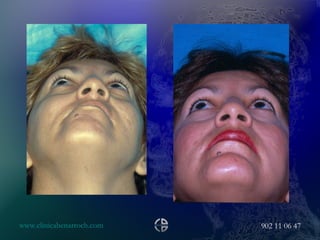
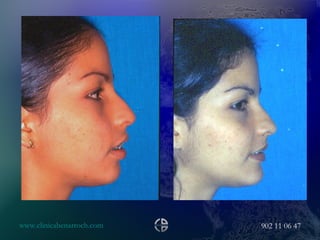
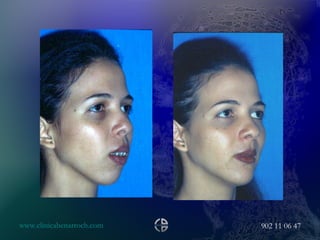
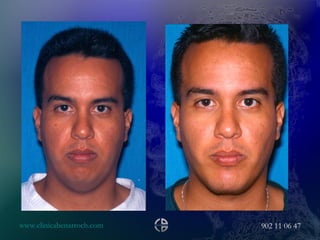
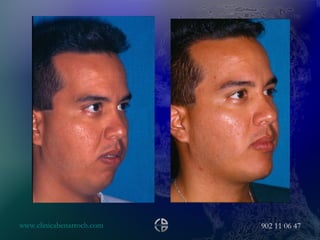
CH, F, 23. Feb. 1997 PROBLEM LIST Nasal deformity Full inframalar contours V.M.E. Drooping  lower lip  AP  Chin  deficiency Neck lipomatosis SURGICAL PLAN  2 Phases Rhinoseptoplasty  Buccal fat pad removal  Maxillary  impaction Lower Lip plasty Chin advancement Neck liposuction


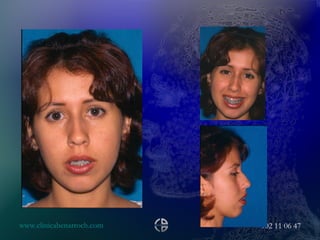
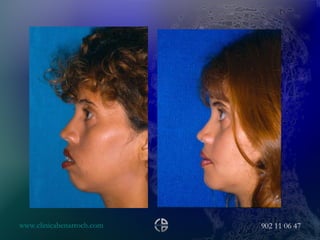
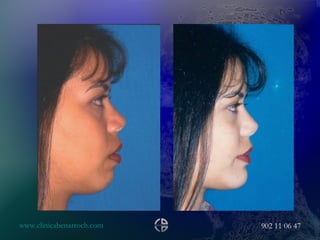
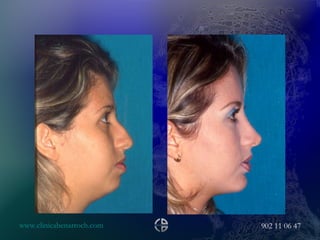
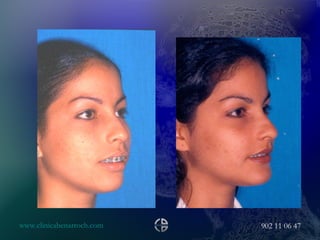
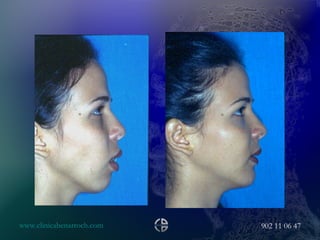
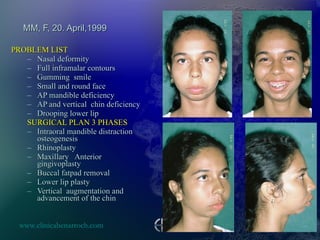
MM, F, 20. April,1999 PROBLEM LIST Nasal deformity Full inframalar contours Gumming  smile Small and round face  AP mandible deficiency AP and vertical  chin deficiency Drooping lower lip  SURGICAL PLAN 3 PHASES Intraoral mandible distraction osteogenesis Rhinoplasty Maxillary  Anterior gingivoplasty  Buccal fatpad removal Lower lip plasty Vertical  augmentation and advancement of the chin


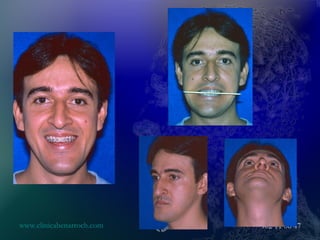
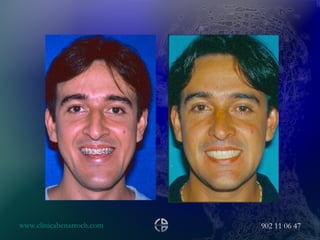
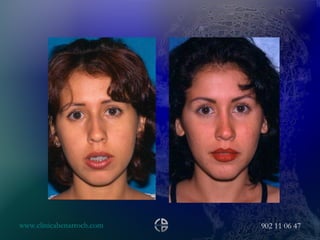
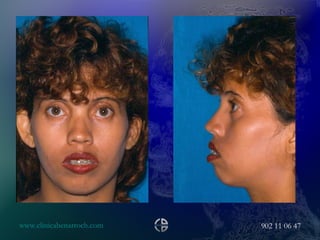
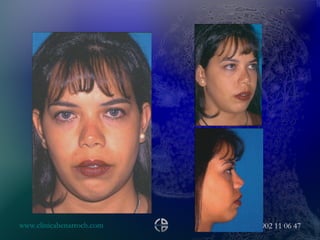
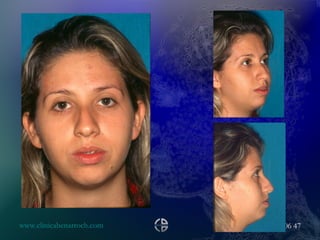
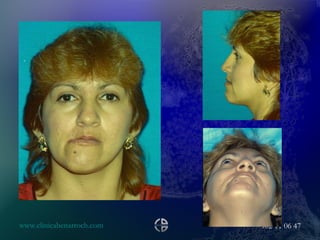
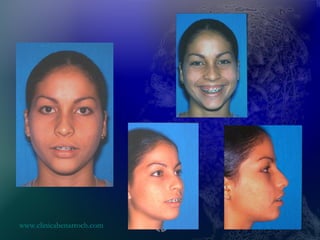
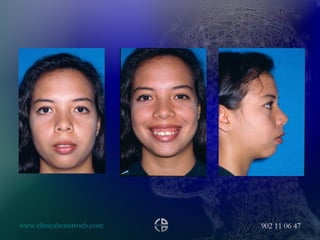
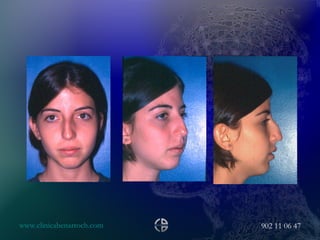
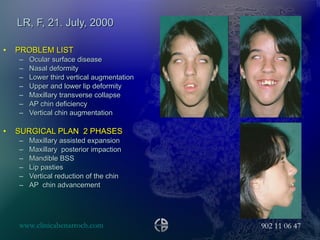
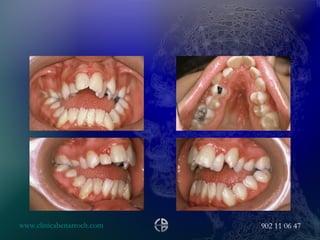
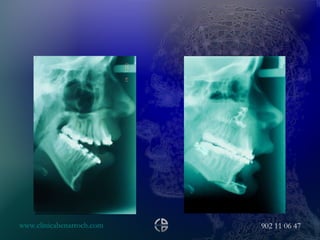
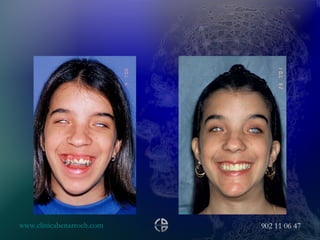
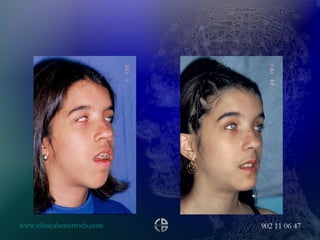
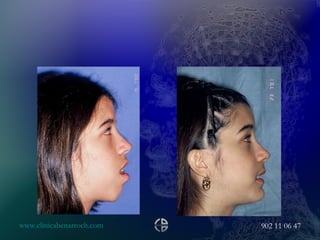
LR, F, 21. July, 2000 PROBLEM LIST Ocular surface disease Nasal deformity Lower third vertical augmentation Upper and lower lip deformity Maxillary transverse collapse AP chin deficiency Vertical chin augmentation SURGICAL PLAN  2 PHASES Maxillary assisted expansion Maxillary  posterior impaction Mandible BSS Lip pasties Vertical reduction of the chin AP  chin advancement


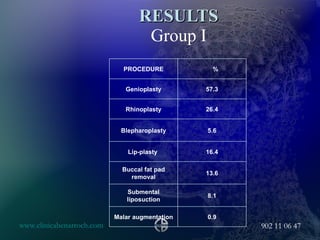
RESULTS Group I PROCEDURE % Genioplasty 57.3 Rhinoplasty 26.4 Blepharoplasty 5.6 Lip-plasty  16.4 Buccal fat pad removal 13.6 Submental liposuction 8.1 Malar augmentation 0.9
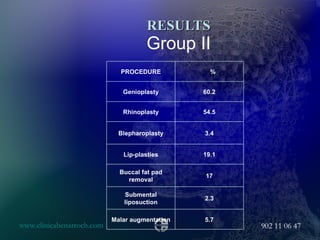
RESULTS Group II PROCEDURE % Genioplasty 60.2 Rhinoplasty 54.5 Blepharoplasty 3.4 Lip-plasties 19.1 Buccal fat pad removal 17 Submental liposuction 2.3 Malar augmentation 5.7
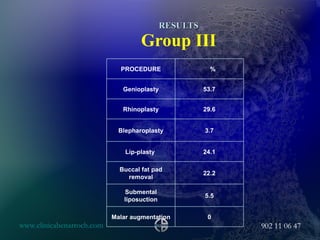
RESULTS Group III PROCEDURE % Genioplasty 53.7 Rhinoplasty 29.6 Blepharoplasty 3.7 Lip-plasty  24.1 Buccal fat pad removal 22.2 Submental liposuction 5.5 Malar augmentation 0
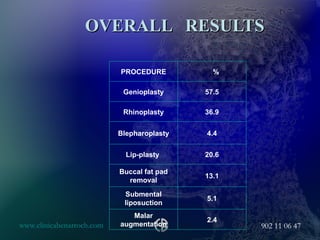
OVERALL  RESULTS PROCEDURE % Genioplasty 57.5 Rhinoplasty 36.9 Blepharoplasty 4.4 Lip-plasty  20.6 Buccal fat pad removal 13.1 Submental liposuction 5.1 Malar augmentation 2.4
DISCUSSION  There is great variability (sex, race) and subjectivity (eye of the beholder) in appreciation of facial beauty  The advantages of combined procedures include a single recovery period, reduced surgery costs, and faster patient gratification The results of this retrospective review does not indicate that the combination of cosmetic surgical procedures increases morbidity
DISCUSSION  The  correction of the  dominant  negative  traits ,  is it enough? When should we stop?
CONCLUSION Facial harmony will not appear as “beautiful” unless the combination of different facial procedures  Orthognathic  + Cosmetic +  Esthetics Guidance
ESTETHIC Patient's needs  Surgeon's satisfaction
Thank you for your kind attention Enhancing Facial Harmony ORTHOGNATHIC SURGERY COMBINED WITH FACIAL PLASTIC PROCEDURES Samuel Benarroch Mahfoda MD, DDS Oral & Maxillofacial  Surgery

Cirugía Ortognática - Orthognathic surgery

  • 1.
    Enhancing Facial HarmonyORTHOGNATHIC SURGERY COMBINED WITH FACIAL PLASTIC PROCEDURES Samuel Benarroch Mahfoda MD, DDS, OMS Assistant Professor Oral & Maxillofacial Surgery Residency Program Woodhull Medical Center. New York Hospital Magallanes de Catia. Caracas
  • 2.
    ORTHOGNATHIC AND ESTHETIC PROCEDURES Create improvement while maintaining a natural appearance
  • 3.
    Purpose Determine thetype of cosmetic surgery procedures most frequently performed to enhance the result of orthognathic surgery
  • 4.
    DESIGN Multicenter Retrospective study Conducted from 1996 to 2005
  • 5.
    PATIENT DISTRIBUTION SEX AND AGE SEX NUMBER % MALE 358 28.6 FEMALE 894 71.4 TOTAL 1.252 100 AGE NUMBER % 15 – 19 63 5.2 20 – 24 879 70.6 25 – 29 229 18.3 30 – 34 55 4.4 > 35 20 1.6 TOTAL 1.252 100
  • 6.
    PATIENT DISTRIBUTION DENTOFACIALDEFORMITY GROUP DEFORMITY NUMBER I MAXILLA 510 II MANDIBLE 438 III BIMAXILAR 304 TOTAL 1.252
  • 7.
    SURGICAL TECHNIQUES Maxilla Lefort I High Lefort I Segmental RPE Facial implants Mandible BSS VOR Distraction osteogenesis Segmental
  • 8.
    MA, F, 21.Feb. 1996 PROBLEM LIST Nasal deformity Facial asymmetry Mandibular deviation Thinner upper lip SURGICAL PLAN Closed basic rhinoplasty Mandibular osteotomy Upper Lip plasty
  • 9.
  • 10.
  • 11.
  • 12.
  • 13.
  • 14.
  • 15.
  • 16.
  • 17.
  • 18.
    CH, F, 23.Feb. 1997 PROBLEM LIST Nasal deformity Full inframalar contours V.M.E. Drooping lower lip AP Chin deficiency Neck lipomatosis SURGICAL PLAN 2 Phases Rhinoseptoplasty Buccal fat pad removal Maxillary impaction Lower Lip plasty Chin advancement Neck liposuction
  • 19.
  • 20.
  • 21.
  • 22.
  • 23.
  • 24.
  • 25.
  • 26.
  • 27.
  • 28.
  • 29.
  • 30.
  • 31.
  • 32.
  • 33.
  • 34.
  • 35.
  • 36.
  • 37.
  • 38.
  • 39.
  • 40.
  • 41.
  • 42.
  • 43.
  • 44.
  • 45.
  • 46.
  • 47.
  • 48.
  • 49.
  • 50.
  • 51.
  • 52.
  • 53.
  • 54.
  • 55.
  • 56.
  • 57.
  • 58.
  • 59.
  • 60.
  • 61.
  • 62.
  • 63.
  • 64.
  • 65.
  • 66.
  • 67.
    MM, F, 20.April,1999 PROBLEM LIST Nasal deformity Full inframalar contours Gumming smile Small and round face AP mandible deficiency AP and vertical chin deficiency Drooping lower lip SURGICAL PLAN 3 PHASES Intraoral mandible distraction osteogenesis Rhinoplasty Maxillary Anterior gingivoplasty Buccal fatpad removal Lower lip plasty Vertical augmentation and advancement of the chin
  • 68.
  • 69.
  • 70.
  • 71.
  • 72.
  • 73.
  • 74.
  • 75.
  • 76.
    LR, F, 21.July, 2000 PROBLEM LIST Ocular surface disease Nasal deformity Lower third vertical augmentation Upper and lower lip deformity Maxillary transverse collapse AP chin deficiency Vertical chin augmentation SURGICAL PLAN 2 PHASES Maxillary assisted expansion Maxillary posterior impaction Mandible BSS Lip pasties Vertical reduction of the chin AP chin advancement
  • 77.
  • 78.
  • 79.
  • 80.
  • 81.
  • 82.
  • 83.
  • 84.
  • 85.
    RESULTS Group IPROCEDURE % Genioplasty 57.3 Rhinoplasty 26.4 Blepharoplasty 5.6 Lip-plasty 16.4 Buccal fat pad removal 13.6 Submental liposuction 8.1 Malar augmentation 0.9
  • 86.
    RESULTS Group IIPROCEDURE % Genioplasty 60.2 Rhinoplasty 54.5 Blepharoplasty 3.4 Lip-plasties 19.1 Buccal fat pad removal 17 Submental liposuction 2.3 Malar augmentation 5.7
  • 87.
    RESULTS Group IIIPROCEDURE % Genioplasty 53.7 Rhinoplasty 29.6 Blepharoplasty 3.7 Lip-plasty 24.1 Buccal fat pad removal 22.2 Submental liposuction 5.5 Malar augmentation 0
  • 88.
    OVERALL RESULTSPROCEDURE % Genioplasty 57.5 Rhinoplasty 36.9 Blepharoplasty 4.4 Lip-plasty 20.6 Buccal fat pad removal 13.1 Submental liposuction 5.1 Malar augmentation 2.4
  • 89.
    DISCUSSION Thereis great variability (sex, race) and subjectivity (eye of the beholder) in appreciation of facial beauty The advantages of combined procedures include a single recovery period, reduced surgery costs, and faster patient gratification The results of this retrospective review does not indicate that the combination of cosmetic surgical procedures increases morbidity
  • 90.
    DISCUSSION The correction of the dominant negative traits , is it enough? When should we stop?
  • 91.
    CONCLUSION Facial harmonywill not appear as “beautiful” unless the combination of different facial procedures Orthognathic + Cosmetic + Esthetics Guidance
  • 92.
    ESTETHIC Patient's needs Surgeon's satisfaction
  • 93.
    Thank you foryour kind attention Enhancing Facial Harmony ORTHOGNATHIC SURGERY COMBINED WITH FACIAL PLASTIC PROCEDURES Samuel Benarroch Mahfoda MD, DDS Oral & Maxillofacial Surgery

Editor's Notes

  • #3 Facial harmony is the sum of a number of factors beginning with the skeleton, then influenced by the muscle, fat, cartilage and finally by the skin Aesthetic ideals and proportional norms of the human face have been well studied and documented by artists, scientists, and physicians The functional correction of dentofacial deformities by orthognathic surgery PRODUCES major changes in facial appearance Combining orthognathic and esthetic procedures to enhance the overall result is proposed.
  • #4 The purpose of this study is to determine the type of cosmetic surgery procedures most frequently used to enhance the result of orthognathic surgery
  • #5 This is a multicenter retrospective study conducted from 1994 to 2004
  • #6 A total o fone hundred two hundred and fifty two orthognathic surgery patients, with an average age of 21.8 years, combined with plastic procedures were included, 71.4 % of them were females
  • #7 All the patients underwent a complete facial analysis in order to achieve other disharmonies aside from the dental skeletal anomalies. No distinction was made among patients based on whether the cosmetic surgery was done before, during or after the surgical correction. Three groups were evaluated depending on the dentofacial deformity diagnosed Group I Maxillary deformities Group II: Mandibulary deformities Group III: Maxillo-mandibular deformities
  • #9 She had a inferior position of the eye lateral canthus this is highly associated with VME, impact the maxilla 4 mm and I keep the tooth to lip relation in the range of 4 to 6 mm
  • #10 Presurgical on your left and post surgical on your right.
  • #19 She had a inferior position of the eye lateral canthus this is highly associated with VME, impact the maxilla 4 mm and I keep the tooth to lip relation in the range of 4 to 6 mm
  • #20 Presurgical on your left and post surgical on your right.
  • #21 I over correct the septal deformity in the severe deviations and the nose done 3 months after the orthognathic surgery
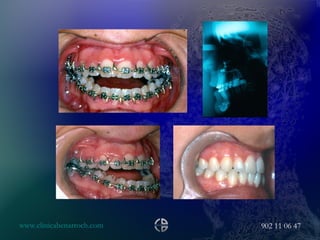
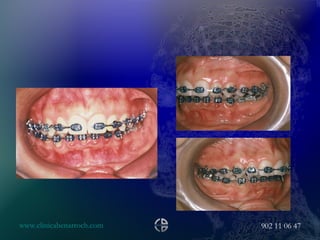
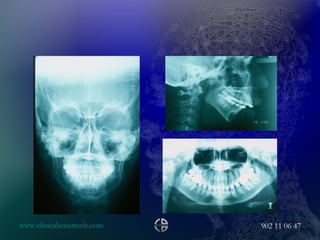
  • #68 Poor definition of the tip she had a Dominant negative trait which is the Mandible deficiency Long upper lip many controversies in this patient
  • #69 Class II malocclusion with a deep overbite
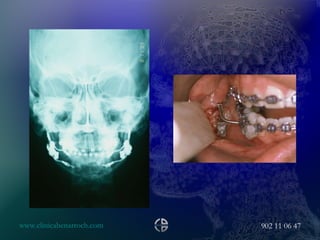
  • #70 Distraction osteogenesis in this particular case is just another treatment option
  • #71 DO protocol Latency of 5 days Distraction Phase rate of 1 mm/d. a rhythm of 1-2 times per day Consolidation phase 8 to 12 weeks
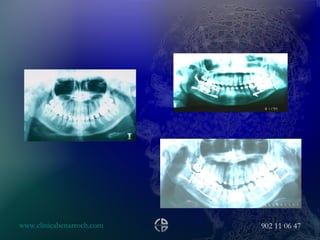
  • #72 X Rays After the latency period and after 12 weeks with the distractor extended advancement of 0.9 mm About the fixation period must be rigid enough to prevent the formation of fibrous tissue but not too rigid to prevent physiologic loading of the new bone
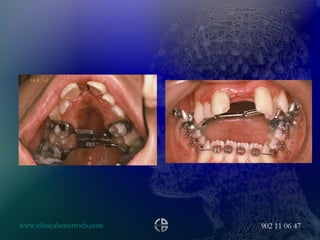
  • #79 Maxillary assisted expansion with the same protocol of the last case, the orthodontics star to move the central incisors after 4 months
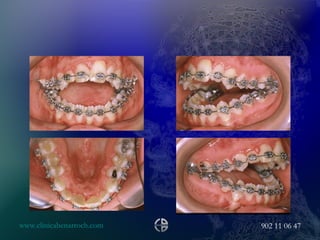
  • #80 10 month after de expansion
  • #82 13 months after surgery
  • #83 Note that the dominant negative traits on the left, has been corrected. And the assessment of the postoperative result is a combination…………………………………..
  • #84 of orthognathic surgery, the performances of cosmetic facial plastic procedures and cosmetology advises (eye shape and color , hair cut and color , color make up and skin tones),
  • #89 The overall esthetic procedures most frequently associated were No statistically significant differences in complication rates were found among the groups. The prevalence of morbidity in all groups was practically identical to previous studies. Of the total facial plastic procedures included in this study, 77 % were performed at the time of the dentofacial correction. Patients´ satisfaction was evaluated after 6 months: 85 % were satisfied with the results in terms of increase of self esteem and improvement in their social life
  • #93 Estethic it’s a balance between patient needs and surgical goals with an inclination towards the patient´s side