Nance Appliance, Trans Palatal Arch
& Quad Helix
Guided By :
Dr D.K. Agarwal (Prof & H.O.D)
Dr. Preeti Bhattacharya (Prof)
Dr. Ankur Gupta (Reader.)
Dr. Juhi Ansar (Senior Lect.)
Dr. Ravi Bhandari (Senior Lect.)
Presented By:
Asad Yusuf
P.G. Ist year
Department of
Orthodontic
CONTENT
• Nance appliance
• Trance Palatal Arch
• Quadhelix
Introduction
Design
Indication
Disadvantages
Introduction
• Described by Nance in 1947
• It is simply a Modified maxillary lingual arch
that does not contact the anterior teeth, but
approximates the slope of anterior palate
The Transpalatal Arch: An Alternative to the
Nance Appliance for Space MaintenanceAri Kupietzky,Eli Tal,Pediatr Dent
2007;29:235-8
Design
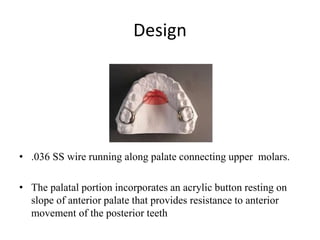
• .036 SS wire running along palate connecting upper molars.
• The palatal portion incorporates an acrylic button resting on
slope of anterior palate that provides resistance to anterior
movement of the posterior teeth
Indication
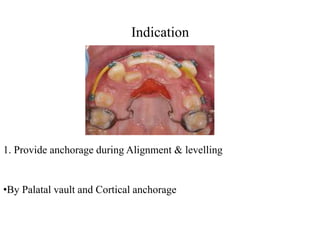
1. Provide anchorage during Alignment & levelling
•By Palatal vault and Cortical anchorage
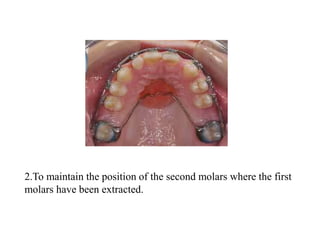
2.To maintain the position of the second molars where the first
molars have been extracted.
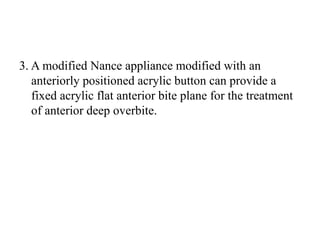
3. A modified Nance appliance modified with an
anteriorly positioned acrylic button can provide a
fixed acrylic flat anterior bite plane for the treatment
of anterior deep overbite.
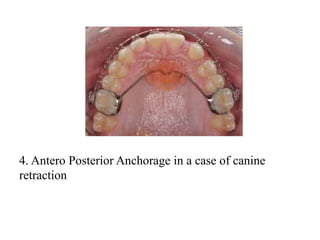
4. Antero Posterior Anchorage in a case of canine
retraction
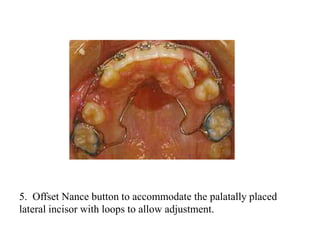
5. Offset Nance button to accommodate the palatally placed
lateral incisor with loops to allow adjustment.
Diadvantages
1. Oral hygiene difficulties: Nance appliances result in
deterioration of oral hygiene beneath the acrylic plate
leading to inflammation of the palate.
2.Poor patient tolerance in comparison to the standard
TPA
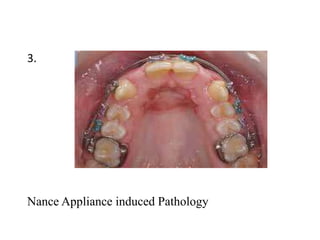
3.
Nance Appliance induced Pathology
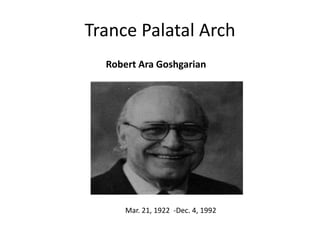
Trance Palatal Arch
Mar. 21, 1922 -Dec. 4, 1992
Robert Ara Goshgarian
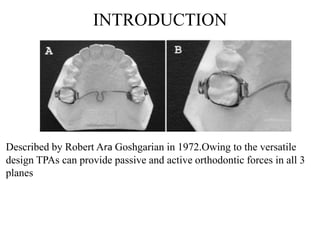
INTRODUCTION
Described by Robert Ara Goshgarian in 1972.Owing to the versatile
design TPAs can provide passive and active orthodontic forces in all 3
planes
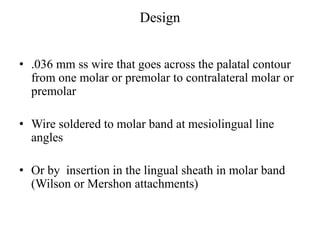
Design
• .036 mm ss wire that goes across the palatal contour
from one molar or premolar to contralateral molar or
premolar
• Wire soldered to molar band at mesiolingual line
angles
• Or by insertion in the lingual sheath in molar band
(Wilson or Mershon attachments)
Major indication in mixed dentition is to prevent mesial
migration of upper first molar during transition from second
deciduous molar to 2nd premolar
Graber Vanarsdall Vig 5th ed. Pg 484
Rationale :
• When permanent maxillary molars move anteriorly, they
rotate mesiolingually around the large lingual root.
• TPA reduces anterior molar movement by coupling the right
and left permanent molars together and, thus, preventing
any possibility of rotations.
INDICATION in Transverse Plane
1. Anchorage and arch width stabilization during
orthodontic treatments or surgery
2. Retainer after active maxillary expansion
3. To Avoid Molar Tipping
4. Habit breaking appliance
5. Minimally expand dental arches
Transverse Plane :
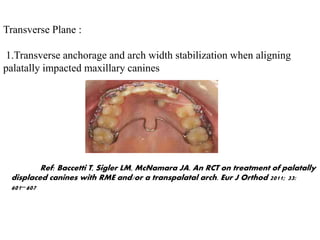
1.Transverse anchorage and arch width stabilization when aligning
palatally impacted maxillary canines
Ref: Baccetti T, Sigler LM, McNamara JA. An RCT on treatment of palatally
displaced canines with RME and/or a transpalatal arch. Eur J Orthod 2011; 33:
601−607
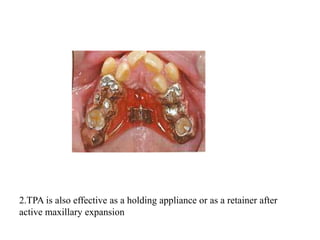
2.TPA is also effective as a holding appliance or as a retainer after
active maxillary expansion
•
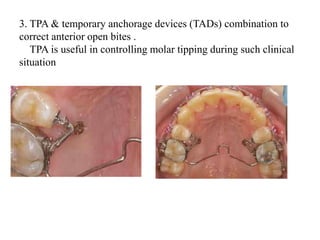
3. TPA & temporary anchorage devices (TADs) combination to
correct anterior open bites .
TPA is useful in controlling molar tipping during such clinical
situation
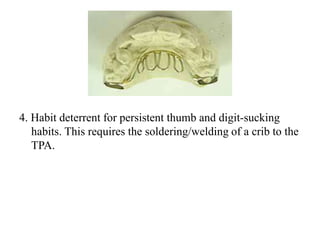
4. Habit deterrent for persistent thumb and digit-sucking
habits. This requires the soldering/welding of a crib to the
TPA.
5. Bilateral space maintenance following premature loss
of primary molars.
• Prevent loss of Leeway space and potential crowding
of the premolars where extractions of the deciduous
molars are planned.
6. TPAs can be used actively to minimally expand dental arches.
• Expanded by 3−4 mm to provide a force of around 200 gm.
INDICATION in Anteroposterior Plane
Anteroposterior anchorage :The loop is directed posteriorly if the
TPA is to provide antero-posterior anchorage
GOOD MORNING
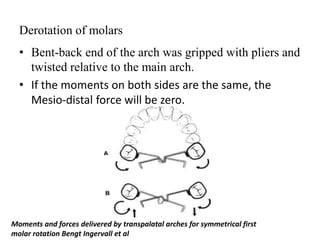
Derotation of molars
• Bent-back end of the arch was gripped with pliers and
twisted relative to the main arch.
• If the moments on both sides are the same, the
Mesio-distal force will be zero.
Moments and forces delivered by transpalatal arches for symmetrical first
molar rotation Bengt Ingervall et al
Complications of TPA
1. Anchorage loss :
Type B Anchorage
2.5 mm of mesial movement of the upper first permanent molars in
TPA while the TADs group provided Absolute anchorage
Feldmann I, Bondemark L. Anchorage capacity of osseointegrated and
conventional anchorage systems: a randomized controlled trial. Am J Orthod
Dentofac Orthop 2008
2.Increase of risk of root resorption :
As TPA positions the root of anchor units against The cortical
bone plate
3.Breakage and cementation failure is approximately 2% and 30%,
respectively
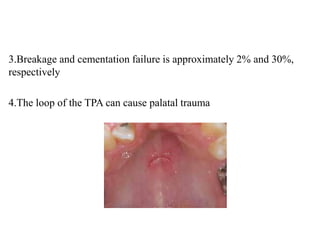
4.The loop of the TPA can cause palatal trauma
Quad helix
• Described by Ricketts in 1975
• Evolved from Coffin’s vulcanite expansion appliance
• He used with great success in the early treatment of those
patients with cleft palate in whom the lateral maxillary
segments had collapsed behind the premaxillary processes
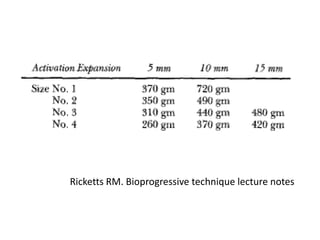
• Wide range of continuous controlled force
• Frank et al: Forces in the range of 0.5 to 1.5 lbs (200 to
600 g).
• Palatal separation of .92 mm average intermolar
expansion was 5.88 mm.
• With the quad helix appliance there was a 6:1 ratio
between the orthodontic and the orthopedic expansion.
The Quad Helix Appliance Ruel W. Bench
Design
Pair of anterior helices
Pair of posterior helices
Anterior bridge.
Palatal bridge
Posterior loops should be 4-5mm distal to banded
molar but not extending to pterygomandibular raphe
Each of the helical loops adds an about additional 25
mm of wire to the appliance which lightens the force
magnitude, rendering a more continuous action due to
the greater range of activation provided by the longer
wire.
Types
• Custom made: 1 - 0·9mm stainless steel
• Preformed ready type
• Fixed : retained by bands cemented on the permanent first molars.
Adjustment ease with properties of .036 blue ELGILOY
(Co,Cr,Ni, Mo, Mn)
Ricketts RM. Bioprogressive technique lecture notes
Action
Fan-like sweeping action :buccally expand and distally
rotate the maxillary molar teeth
Jones SP et al: Anterior arms of the appliance affect
both the forces produced by the appliance as well as
the force couples operating on the molar teeth. This
results from the fact that the anterior arms are a rigid
part of the whole appliance.
Importance of fan like action
• Parallel expansive force, larger amount of tensile strain was
recorded in the molar region.
• Fan type of expansive force by Quad helix, larger amounts of
tensile strain were observed in the canine region.
A reduction occurred as the strain was measured back toward
the molar teeth.
T. M. Graber. Jpn. Orthod. So. 42:442-453, 1983
• Parallel expansive force:
Frontal view: maxillary bones were expanded laterally
Occlusal view: palate and alveolar processes were expanded
laterally in the molar region.
• Fan type of forcer by quad helix: Palatal and alveolar
expansion was noted more in the canine region.
• Since many Class II malocclusions are characterized by
maxillary arches that are narrowest in the canine region, it
would follow that the fan type of appliance would be most
effective.
T. M. Graber. Jpn. Orthod. So. 42: 442-453, 1983
Fan like sweeping action for molar de rotation
• With this appliance,molar derotation is best
accomplished by leaving the arms of the quad helix
away from the lingual surfaces of the cuspid teeth. As
the molar teeth derotate, the arms will come to push
against the cuspid teeth and they will then expand
together with the rest of the maxillary teeth. The
advantage of activating the quad helix appliance in
this manner lies in the fact that the maxillary teeth are
expanded in a differential manner that "sweeps" them
into the ovoid arch form.
The Quad Helix Appliance Ruel W. Bench
Indications
1. Correct cross bites by Upper arch expansion
2. Case needing mild expansion with lack of space for
upper laterals
3. Molar Rotation correction
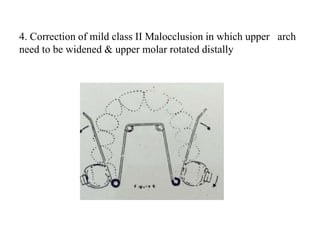
4. Correction of mild class II Malocclusion in which upper arch
need to be widened & upper molar rotated distally
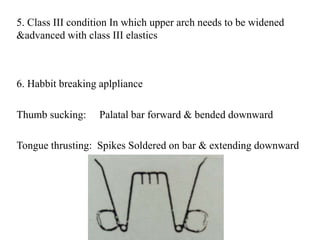
5. Class III condition In which upper arch needs to be widened
&advanced with class III elastics
6. Habbit breaking aplpliance
Thumb sucking: Palatal bar forward & bended downward
Tongue thrusting: Spikes Soldered on bar & extending downward
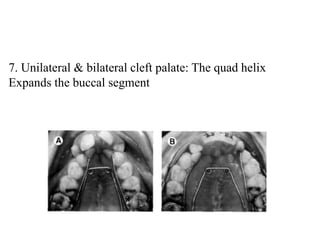
7. Unilateral & bilateral cleft palate: The quad helix
Expands the buccal segment
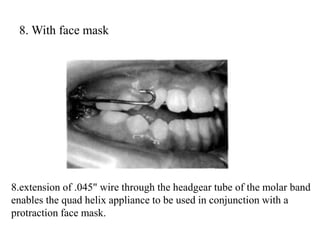
8. With face mask
8.extension of .045" wire through the headgear tube of the molar band
enables the quad helix appliance to be used in conjunction with a
protraction face mask.
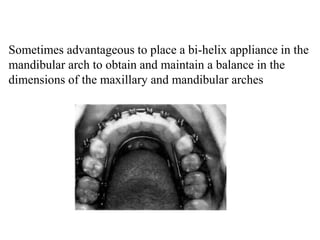
Sometimes advantageous to place a bi-helix appliance in the
mandibular arch to obtain and maintain a balance in the
dimensions of the maxillary and mandibular arches
Practical Application
• Bands are placed on upper second deciduous molar
for young case or 1st permanent molar . Particular
care is taken to adapt the lingual surface of bands
because this is strong purchase area of appliance
• Most appropriate size is selected
• Original cast is used & wire is formed with the
finger together with three pong plier to adapt wire
according to patients need
•Soldering spot is marked in front of posterior loops
depending on the adaptation of arms
•The band is picked up in the tong & approximated as
solder is flowed into position
•Desired activation is given
•Appliance is cemented making sure the bands are
well seated
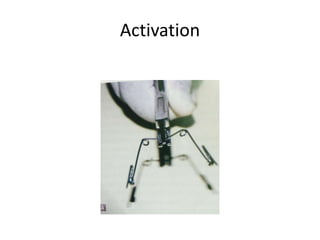
Activation
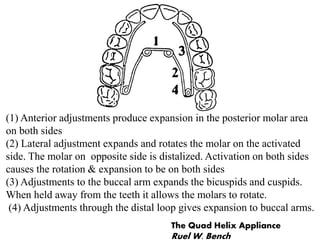
(1) Anterior adjustments produce expansion in the posterior molar area
on both sides
(2) Lateral adjustment expands and rotates the molar on the activated
side. The molar on opposite side is distalized. Activation on both sides
causes the rotation & expansion to be on both sides
(3) Adjustments to the buccal arm expands the bicuspids and cuspids.
When held away from the teeth it allows the molars to rotate.
(4) Adjustments through the distal loop gives expansion to buccal arms.
The Quad Helix Appliance
Ruel W. Bench
Clinical Management
• Patients should be reviewed on a six-weekly basis for
activation.
• Intra Oral adjustment can be done in subsequent visits
• Widening of molars can be activated by pinching between
anterior loops.
• Care is taken to give only little activation is of anterior
arms and wire is left out of contact with anterior teeth
until molar rotation is achieved
Retention after the expansion
• At least three-month retention period
• Achieved expansion should be retained with an upper
removable appliance.
• If fixed appliances are being used, the quadhelix can
be removed and replaced by TPA.
Disadvantages
• The limited amount of skeletal change &
palatal relapse.
• Opening of the bite due to molar buccal
tipping.
• Outward positioning of upper buccal tooth by
an attempt of nature to upright the root.
• Downward Backward appliance posture
restrict tongue functions , so adaptation should
be 2-3 mm of palatal tissue
References
1.Ricketts : Bio Progressive therapy
2.Influence of’ arch, shape on the transverse eff’cts of
transpalatal arches of the Goshgarian type during
application ofbuccal root torque G. Baldini and H. ‘U.
Luder
3.The Transpalatal Arch: An Alternative to the Nance
Appliance for Space MaintenanceAri Kupietzky,Eli
Tal,Pediatr Dent 2007;29:235-8
• American Journal of Orthodontics and Dentofacial
Orthopedics hl memorianl 561 Volume 103, No. 6 Robert Ara
Goshgarian 1922-1992
• Transpalatal, Nance and Lingual Arch Appliances:Clinical
Tips and Applications Ortho Update 2015; 8: 92-100
Rationale :
When permanent maxillary molars move anteriorly, they rotate
mesiolingually around the large lingual root. The space between
the buccal and lingual cortical plates becomes narrow anterior to
the first molar roots.The large lingual root contacts the lingual
plate and acts as a pivot, allowing the 2 buccal roots to rotate
mesiolingually.
The TPA reduces anterior molar movement by coupling the right
and left permanent molars together and, thus, preventing any
possibility of rotations.
• In the treatment of narrow restricted maxillary arches,quad
helix tip the maxillary molar teeth bucally
To counter the tipping :buccal root torque is placed in the molar
bands before cementation & leaving the anterior arms of the
quad helix away from the lingual surfaces of the cuspid teeth.
As the molar teeth derotate, the anterior arms will come to
push against the cuspid teeth and they will then expand
together with the rest of the maxillary teeth, so the maxillary
teeth are expanded in a differential manner that "sweeps"
them into the ovoid arch form of the final occlusion.
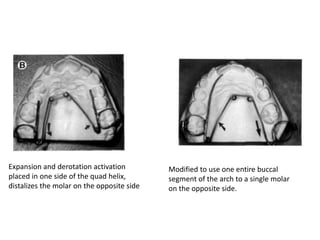
Expansion and derotation activation
placed in one side of the quad helix,
distalizes the molar on the opposite side
Modified to use one entire buccal
segment of the arch to a single molar
on the opposite side.
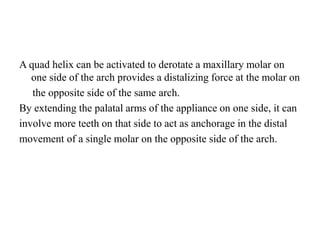
A quad helix can be activated to derotate a maxillary molar on
one side of the arch provides a distalizing force at the molar on
the opposite side of the same arch.
By extending the palatal arms of the appliance on one side, it can
involve more teeth on that side to act as anchorage in the distal
movement of a single molar on the opposite side of the arch.
VHA has intrusive effect on maxillary molar eruption.
Orthodontist must usually guard against further anterior
bite opening during leveling and aligning procedures in
patient with increased lower anterior facial height.
An ideal treatment goal for a patient with an acceptable
pretreatment overbite would be to at least maintain the
same amount of overlap throughout treatment.
Evaluation of the vertical holding appliance in treatment of high-angle patients Marc
DeBerardinis et al :Am J Orthod Dentofacial Orthop 2000;117:700-5)
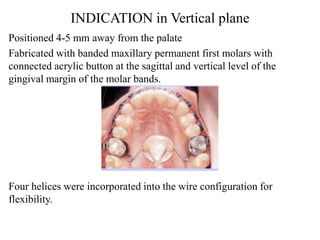
INDICATION in Vertical plane
Positioned 4-5 mm away from the palate
Fabricated with banded maxillary permanent first molars with
connected acrylic button at the sagittal and vertical level of the
gingival margin of the molar bands.
Four helices were incorporated into the wire configuration for
flexibility.
Nance
• Provide anchorage during Alignment & levelling
Antero Posterior Anchorage in a case of canine retraction
• To maintain the position of the second molars where the
first molars have been extracted.
• A modified Nance appliance modified with an anteriorly
positioned acrylic button can provide a fixed acrylic flat
anterior bite plane for the treatment of anterior deep
overbite.
TPA
1. Anchorage and arch width stabilization during
orthodontic treatments or surgery
2. prevent mesial migration of upper first molar during
transition from second deciduous molar to 2nd
premolar
3 Retainer after active maxillary expansion
4. Habit breaking appliance
5. Minimally expand dental arches
6. VHA
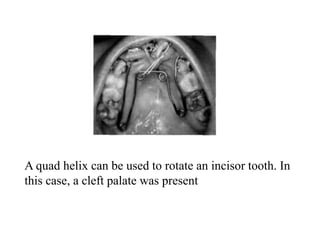
A quad helix can be used to rotate an incisor tooth. In
this case, a cleft palate was present

Trans Palatal Arch

  • 1.
    Nance Appliance, TransPalatal Arch & Quad Helix Guided By : Dr D.K. Agarwal (Prof & H.O.D) Dr. Preeti Bhattacharya (Prof) Dr. Ankur Gupta (Reader.) Dr. Juhi Ansar (Senior Lect.) Dr. Ravi Bhandari (Senior Lect.) Presented By: Asad Yusuf P.G. Ist year Department of Orthodontic
  • 2.
    CONTENT • Nance appliance •Trance Palatal Arch • Quadhelix Introduction Design Indication Disadvantages
  • 3.
    Introduction • Described byNance in 1947 • It is simply a Modified maxillary lingual arch that does not contact the anterior teeth, but approximates the slope of anterior palate The Transpalatal Arch: An Alternative to the Nance Appliance for Space MaintenanceAri Kupietzky,Eli Tal,Pediatr Dent 2007;29:235-8
  • 4.
    Design • .036 SSwire running along palate connecting upper molars. • The palatal portion incorporates an acrylic button resting on slope of anterior palate that provides resistance to anterior movement of the posterior teeth
  • 5.
    Indication 1. Provide anchorageduring Alignment & levelling •By Palatal vault and Cortical anchorage
  • 6.
    2.To maintain theposition of the second molars where the first molars have been extracted.
  • 7.
    3. A modifiedNance appliance modified with an anteriorly positioned acrylic button can provide a fixed acrylic flat anterior bite plane for the treatment of anterior deep overbite.
  • 8.
    4. Antero PosteriorAnchorage in a case of canine retraction
  • 9.
    5. Offset Nancebutton to accommodate the palatally placed lateral incisor with loops to allow adjustment.
  • 10.
    Diadvantages 1. Oral hygienedifficulties: Nance appliances result in deterioration of oral hygiene beneath the acrylic plate leading to inflammation of the palate. 2.Poor patient tolerance in comparison to the standard TPA
  • 11.
  • 12.
    Trance Palatal Arch Mar.21, 1922 -Dec. 4, 1992 Robert Ara Goshgarian
  • 13.
    INTRODUCTION Described by RobertAra Goshgarian in 1972.Owing to the versatile design TPAs can provide passive and active orthodontic forces in all 3 planes
  • 14.
    Design • .036 mmss wire that goes across the palatal contour from one molar or premolar to contralateral molar or premolar • Wire soldered to molar band at mesiolingual line angles • Or by insertion in the lingual sheath in molar band (Wilson or Mershon attachments)
  • 15.
    Major indication inmixed dentition is to prevent mesial migration of upper first molar during transition from second deciduous molar to 2nd premolar Graber Vanarsdall Vig 5th ed. Pg 484 Rationale : • When permanent maxillary molars move anteriorly, they rotate mesiolingually around the large lingual root. • TPA reduces anterior molar movement by coupling the right and left permanent molars together and, thus, preventing any possibility of rotations.
  • 16.
    INDICATION in TransversePlane 1. Anchorage and arch width stabilization during orthodontic treatments or surgery 2. Retainer after active maxillary expansion 3. To Avoid Molar Tipping 4. Habit breaking appliance 5. Minimally expand dental arches
  • 17.
    Transverse Plane : 1.Transverseanchorage and arch width stabilization when aligning palatally impacted maxillary canines Ref: Baccetti T, Sigler LM, McNamara JA. An RCT on treatment of palatally displaced canines with RME and/or a transpalatal arch. Eur J Orthod 2011; 33: 601−607
  • 18.
    2.TPA is alsoeffective as a holding appliance or as a retainer after active maxillary expansion
  • 19.
    • 3. TPA &temporary anchorage devices (TADs) combination to correct anterior open bites . TPA is useful in controlling molar tipping during such clinical situation
  • 20.
    4. Habit deterrentfor persistent thumb and digit-sucking habits. This requires the soldering/welding of a crib to the TPA.
  • 21.
    5. Bilateral spacemaintenance following premature loss of primary molars. • Prevent loss of Leeway space and potential crowding of the premolars where extractions of the deciduous molars are planned.
  • 22.
    6. TPAs canbe used actively to minimally expand dental arches. • Expanded by 3−4 mm to provide a force of around 200 gm.
  • 23.
    INDICATION in AnteroposteriorPlane Anteroposterior anchorage :The loop is directed posteriorly if the TPA is to provide antero-posterior anchorage
  • 24.
  • 25.
    Derotation of molars •Bent-back end of the arch was gripped with pliers and twisted relative to the main arch. • If the moments on both sides are the same, the Mesio-distal force will be zero. Moments and forces delivered by transpalatal arches for symmetrical first molar rotation Bengt Ingervall et al
  • 26.
    Complications of TPA 1.Anchorage loss : Type B Anchorage 2.5 mm of mesial movement of the upper first permanent molars in TPA while the TADs group provided Absolute anchorage Feldmann I, Bondemark L. Anchorage capacity of osseointegrated and conventional anchorage systems: a randomized controlled trial. Am J Orthod Dentofac Orthop 2008 2.Increase of risk of root resorption : As TPA positions the root of anchor units against The cortical bone plate
  • 27.
    3.Breakage and cementationfailure is approximately 2% and 30%, respectively 4.The loop of the TPA can cause palatal trauma
  • 28.
    Quad helix • Describedby Ricketts in 1975 • Evolved from Coffin’s vulcanite expansion appliance • He used with great success in the early treatment of those patients with cleft palate in whom the lateral maxillary segments had collapsed behind the premaxillary processes • Wide range of continuous controlled force
  • 29.
    • Frank etal: Forces in the range of 0.5 to 1.5 lbs (200 to 600 g). • Palatal separation of .92 mm average intermolar expansion was 5.88 mm. • With the quad helix appliance there was a 6:1 ratio between the orthodontic and the orthopedic expansion. The Quad Helix Appliance Ruel W. Bench
  • 30.
    Design Pair of anteriorhelices Pair of posterior helices Anterior bridge. Palatal bridge Posterior loops should be 4-5mm distal to banded molar but not extending to pterygomandibular raphe
  • 31.
    Each of thehelical loops adds an about additional 25 mm of wire to the appliance which lightens the force magnitude, rendering a more continuous action due to the greater range of activation provided by the longer wire.
  • 32.
    Types • Custom made:1 - 0·9mm stainless steel • Preformed ready type • Fixed : retained by bands cemented on the permanent first molars. Adjustment ease with properties of .036 blue ELGILOY (Co,Cr,Ni, Mo, Mn)
  • 33.
    Ricketts RM. Bioprogressivetechnique lecture notes
  • 34.
    Action Fan-like sweeping action:buccally expand and distally rotate the maxillary molar teeth Jones SP et al: Anterior arms of the appliance affect both the forces produced by the appliance as well as the force couples operating on the molar teeth. This results from the fact that the anterior arms are a rigid part of the whole appliance.
  • 35.
    Importance of fanlike action • Parallel expansive force, larger amount of tensile strain was recorded in the molar region. • Fan type of expansive force by Quad helix, larger amounts of tensile strain were observed in the canine region. A reduction occurred as the strain was measured back toward the molar teeth. T. M. Graber. Jpn. Orthod. So. 42:442-453, 1983
  • 36.
    • Parallel expansiveforce: Frontal view: maxillary bones were expanded laterally Occlusal view: palate and alveolar processes were expanded laterally in the molar region. • Fan type of forcer by quad helix: Palatal and alveolar expansion was noted more in the canine region. • Since many Class II malocclusions are characterized by maxillary arches that are narrowest in the canine region, it would follow that the fan type of appliance would be most effective. T. M. Graber. Jpn. Orthod. So. 42: 442-453, 1983
  • 37.
    Fan like sweepingaction for molar de rotation • With this appliance,molar derotation is best accomplished by leaving the arms of the quad helix away from the lingual surfaces of the cuspid teeth. As the molar teeth derotate, the arms will come to push against the cuspid teeth and they will then expand together with the rest of the maxillary teeth. The advantage of activating the quad helix appliance in this manner lies in the fact that the maxillary teeth are expanded in a differential manner that "sweeps" them into the ovoid arch form. The Quad Helix Appliance Ruel W. Bench
  • 38.
    Indications 1. Correct crossbites by Upper arch expansion 2. Case needing mild expansion with lack of space for upper laterals 3. Molar Rotation correction
  • 39.
    4. Correction ofmild class II Malocclusion in which upper arch need to be widened & upper molar rotated distally
  • 40.
    5. Class IIIcondition In which upper arch needs to be widened &advanced with class III elastics 6. Habbit breaking aplpliance Thumb sucking: Palatal bar forward & bended downward Tongue thrusting: Spikes Soldered on bar & extending downward
  • 41.
    7. Unilateral &bilateral cleft palate: The quad helix Expands the buccal segment
  • 42.
    8. With facemask 8.extension of .045" wire through the headgear tube of the molar band enables the quad helix appliance to be used in conjunction with a protraction face mask.
  • 43.
    Sometimes advantageous toplace a bi-helix appliance in the mandibular arch to obtain and maintain a balance in the dimensions of the maxillary and mandibular arches
  • 44.
    Practical Application • Bandsare placed on upper second deciduous molar for young case or 1st permanent molar . Particular care is taken to adapt the lingual surface of bands because this is strong purchase area of appliance • Most appropriate size is selected • Original cast is used & wire is formed with the finger together with three pong plier to adapt wire according to patients need
  • 45.
    •Soldering spot ismarked in front of posterior loops depending on the adaptation of arms •The band is picked up in the tong & approximated as solder is flowed into position •Desired activation is given •Appliance is cemented making sure the bands are well seated
  • 46.
  • 47.
    (1) Anterior adjustmentsproduce expansion in the posterior molar area on both sides (2) Lateral adjustment expands and rotates the molar on the activated side. The molar on opposite side is distalized. Activation on both sides causes the rotation & expansion to be on both sides (3) Adjustments to the buccal arm expands the bicuspids and cuspids. When held away from the teeth it allows the molars to rotate. (4) Adjustments through the distal loop gives expansion to buccal arms. The Quad Helix Appliance Ruel W. Bench
  • 48.
    Clinical Management • Patientsshould be reviewed on a six-weekly basis for activation. • Intra Oral adjustment can be done in subsequent visits • Widening of molars can be activated by pinching between anterior loops. • Care is taken to give only little activation is of anterior arms and wire is left out of contact with anterior teeth until molar rotation is achieved
  • 49.
    Retention after theexpansion • At least three-month retention period • Achieved expansion should be retained with an upper removable appliance. • If fixed appliances are being used, the quadhelix can be removed and replaced by TPA.
  • 50.
    Disadvantages • The limitedamount of skeletal change & palatal relapse. • Opening of the bite due to molar buccal tipping. • Outward positioning of upper buccal tooth by an attempt of nature to upright the root. • Downward Backward appliance posture restrict tongue functions , so adaptation should be 2-3 mm of palatal tissue
  • 51.
    References 1.Ricketts : BioProgressive therapy 2.Influence of’ arch, shape on the transverse eff’cts of transpalatal arches of the Goshgarian type during application ofbuccal root torque G. Baldini and H. ‘U. Luder 3.The Transpalatal Arch: An Alternative to the Nance Appliance for Space MaintenanceAri Kupietzky,Eli Tal,Pediatr Dent 2007;29:235-8
  • 52.
    • American Journalof Orthodontics and Dentofacial Orthopedics hl memorianl 561 Volume 103, No. 6 Robert Ara Goshgarian 1922-1992 • Transpalatal, Nance and Lingual Arch Appliances:Clinical Tips and Applications Ortho Update 2015; 8: 92-100
  • 53.
    Rationale : When permanentmaxillary molars move anteriorly, they rotate mesiolingually around the large lingual root. The space between the buccal and lingual cortical plates becomes narrow anterior to the first molar roots.The large lingual root contacts the lingual plate and acts as a pivot, allowing the 2 buccal roots to rotate mesiolingually. The TPA reduces anterior molar movement by coupling the right and left permanent molars together and, thus, preventing any possibility of rotations.
  • 54.
    • In thetreatment of narrow restricted maxillary arches,quad helix tip the maxillary molar teeth bucally To counter the tipping :buccal root torque is placed in the molar bands before cementation & leaving the anterior arms of the quad helix away from the lingual surfaces of the cuspid teeth. As the molar teeth derotate, the anterior arms will come to push against the cuspid teeth and they will then expand together with the rest of the maxillary teeth, so the maxillary teeth are expanded in a differential manner that "sweeps" them into the ovoid arch form of the final occlusion.
  • 56.
    Expansion and derotationactivation placed in one side of the quad helix, distalizes the molar on the opposite side Modified to use one entire buccal segment of the arch to a single molar on the opposite side.
  • 57.
    A quad helixcan be activated to derotate a maxillary molar on one side of the arch provides a distalizing force at the molar on the opposite side of the same arch. By extending the palatal arms of the appliance on one side, it can involve more teeth on that side to act as anchorage in the distal movement of a single molar on the opposite side of the arch.
  • 58.
    VHA has intrusiveeffect on maxillary molar eruption. Orthodontist must usually guard against further anterior bite opening during leveling and aligning procedures in patient with increased lower anterior facial height. An ideal treatment goal for a patient with an acceptable pretreatment overbite would be to at least maintain the same amount of overlap throughout treatment. Evaluation of the vertical holding appliance in treatment of high-angle patients Marc DeBerardinis et al :Am J Orthod Dentofacial Orthop 2000;117:700-5)
  • 59.
    INDICATION in Verticalplane Positioned 4-5 mm away from the palate Fabricated with banded maxillary permanent first molars with connected acrylic button at the sagittal and vertical level of the gingival margin of the molar bands. Four helices were incorporated into the wire configuration for flexibility.
  • 60.
    Nance • Provide anchorageduring Alignment & levelling Antero Posterior Anchorage in a case of canine retraction • To maintain the position of the second molars where the first molars have been extracted. • A modified Nance appliance modified with an anteriorly positioned acrylic button can provide a fixed acrylic flat anterior bite plane for the treatment of anterior deep overbite.
  • 61.
    TPA 1. Anchorage andarch width stabilization during orthodontic treatments or surgery 2. prevent mesial migration of upper first molar during transition from second deciduous molar to 2nd premolar 3 Retainer after active maxillary expansion 4. Habit breaking appliance 5. Minimally expand dental arches 6. VHA
  • 63.
    A quad helixcan be used to rotate an incisor tooth. In this case, a cleft palate was present