Angle’s class II Malocclusion
In sagittal plane this malocclusion is called as postnormal occlusion.
According to lischer’s modification of angle’s
classification this malocclusion is known as
distocclusion.
The term class II is an unfortunate generalization
which groups together morphologies of wide ranging
varieties often with one common trait – their abnormal
molar relationship.
www.indiandentalacademy.com
According to Angle’s classification a class II
malocclusion indicates that the mandibular arch is in a
distal relation to that of the maxilla.
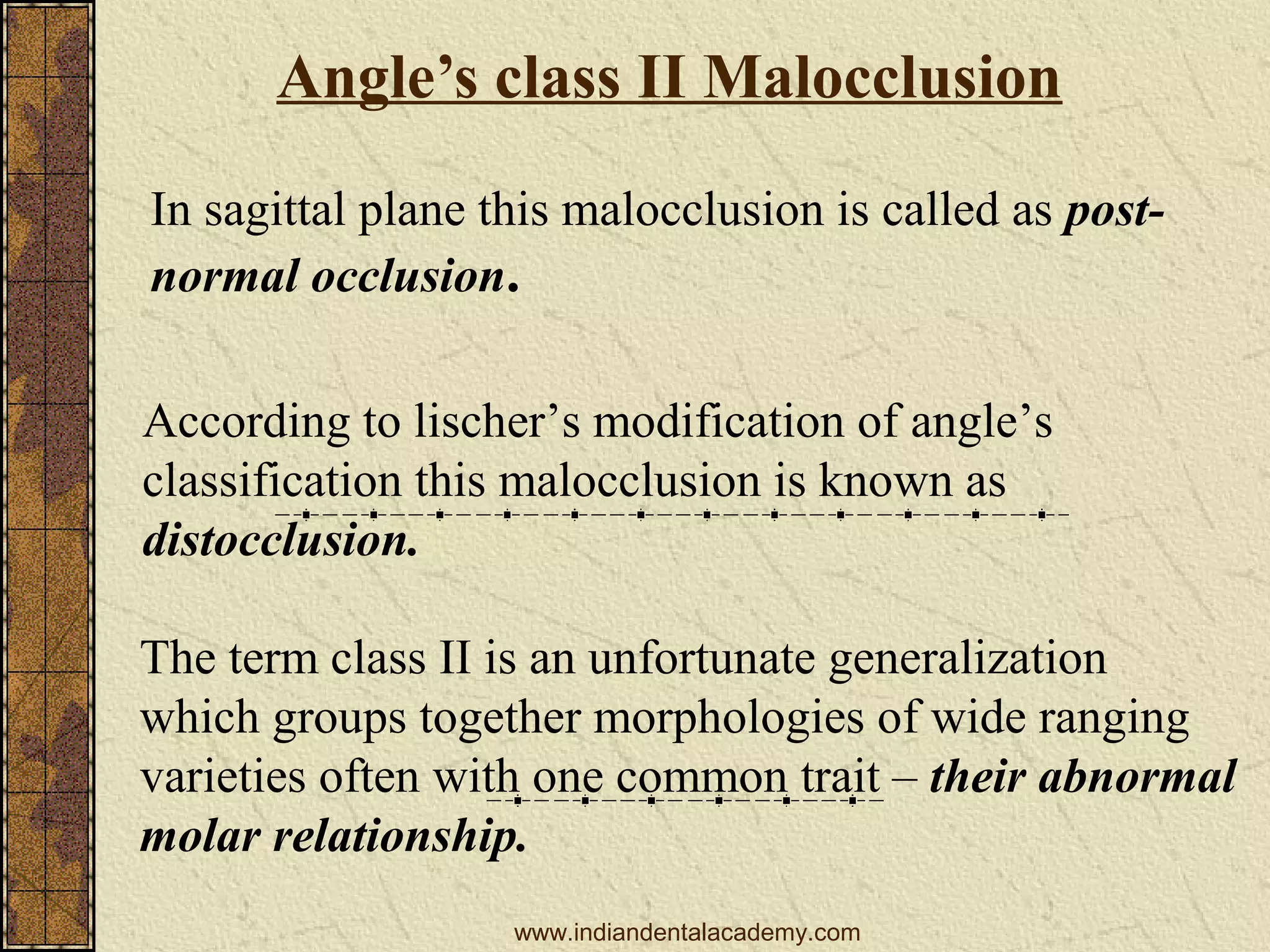
Class II malocclusion is
characterized by a class II
molar relationship where the
disto-buccal cusp of the upper
first permenent molar
occludes in the mesio-buccal
groove of the lower first
permenent molar.
www.indiandentalacademy.com
Angle divided the class II malocclusion into two
divisions based on the labiolingual angulation of the
maxillary incisors as-

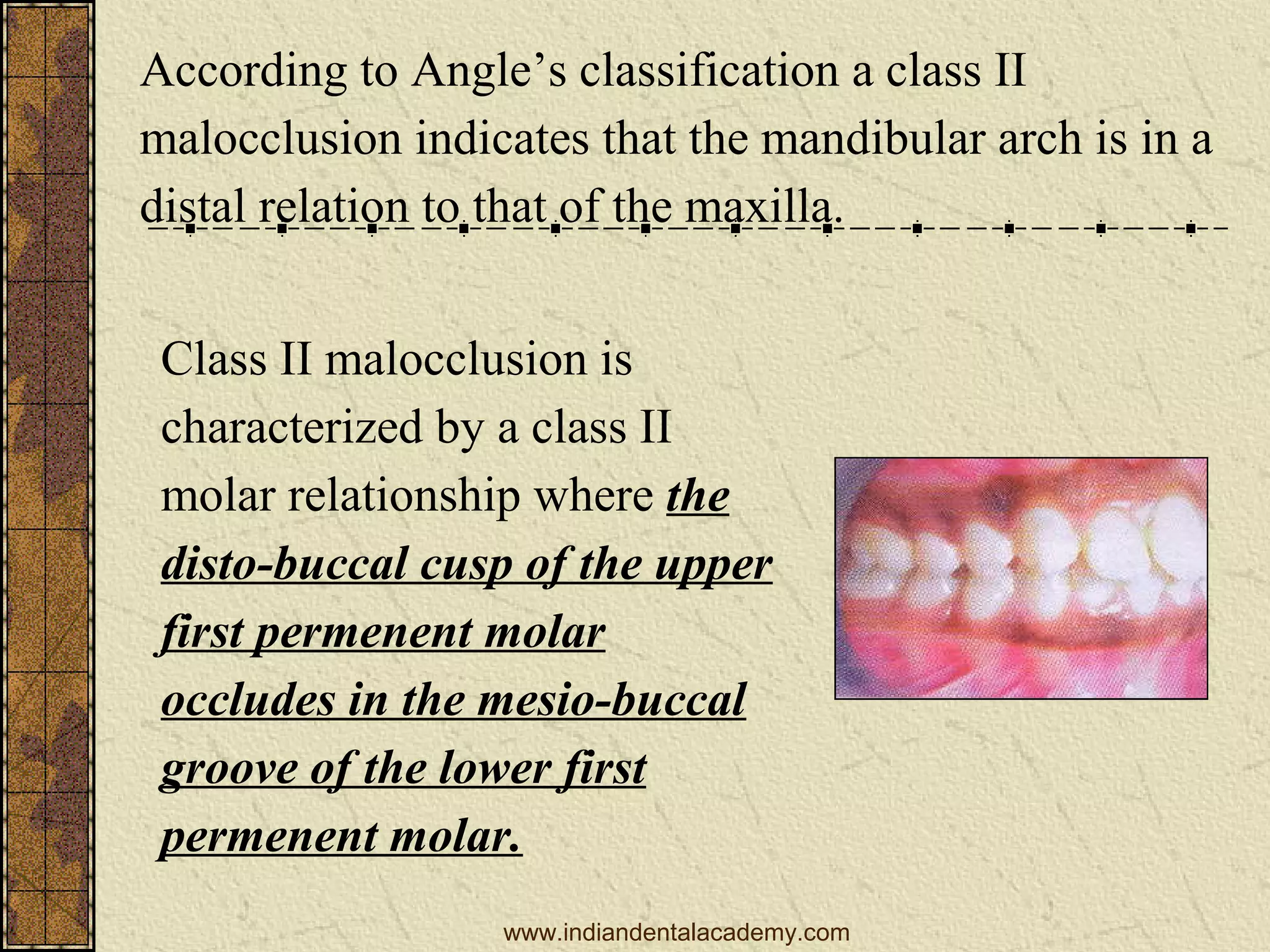
Class II,division 1: the molar
relationship is class II with the
upper anteriors proclined.

www.indiandentalacademy.com
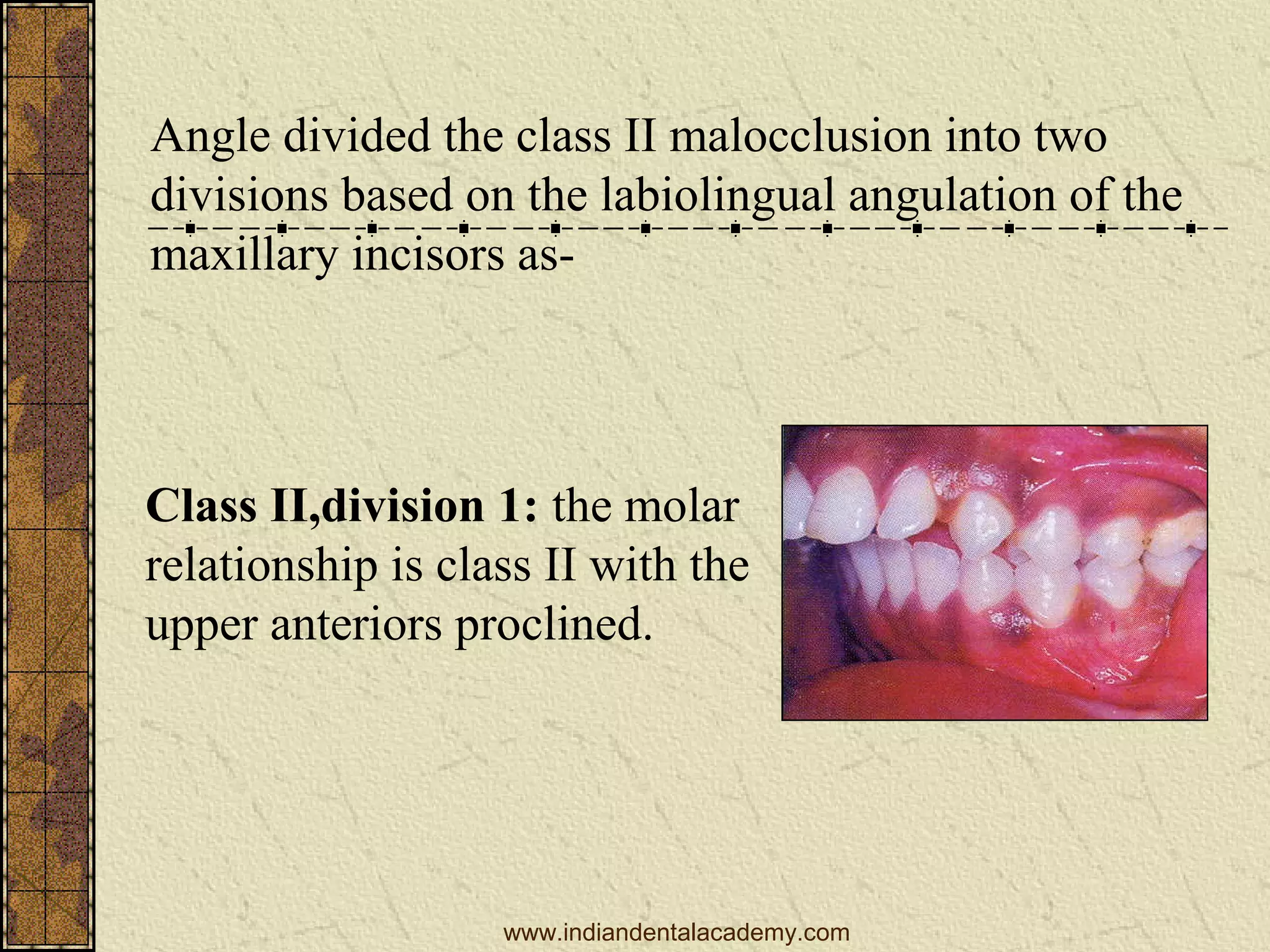
Class II,division 2: the molar
relationship is class II and the
upper central incisors are
retroclined and overlapped by
the lateral incisors.
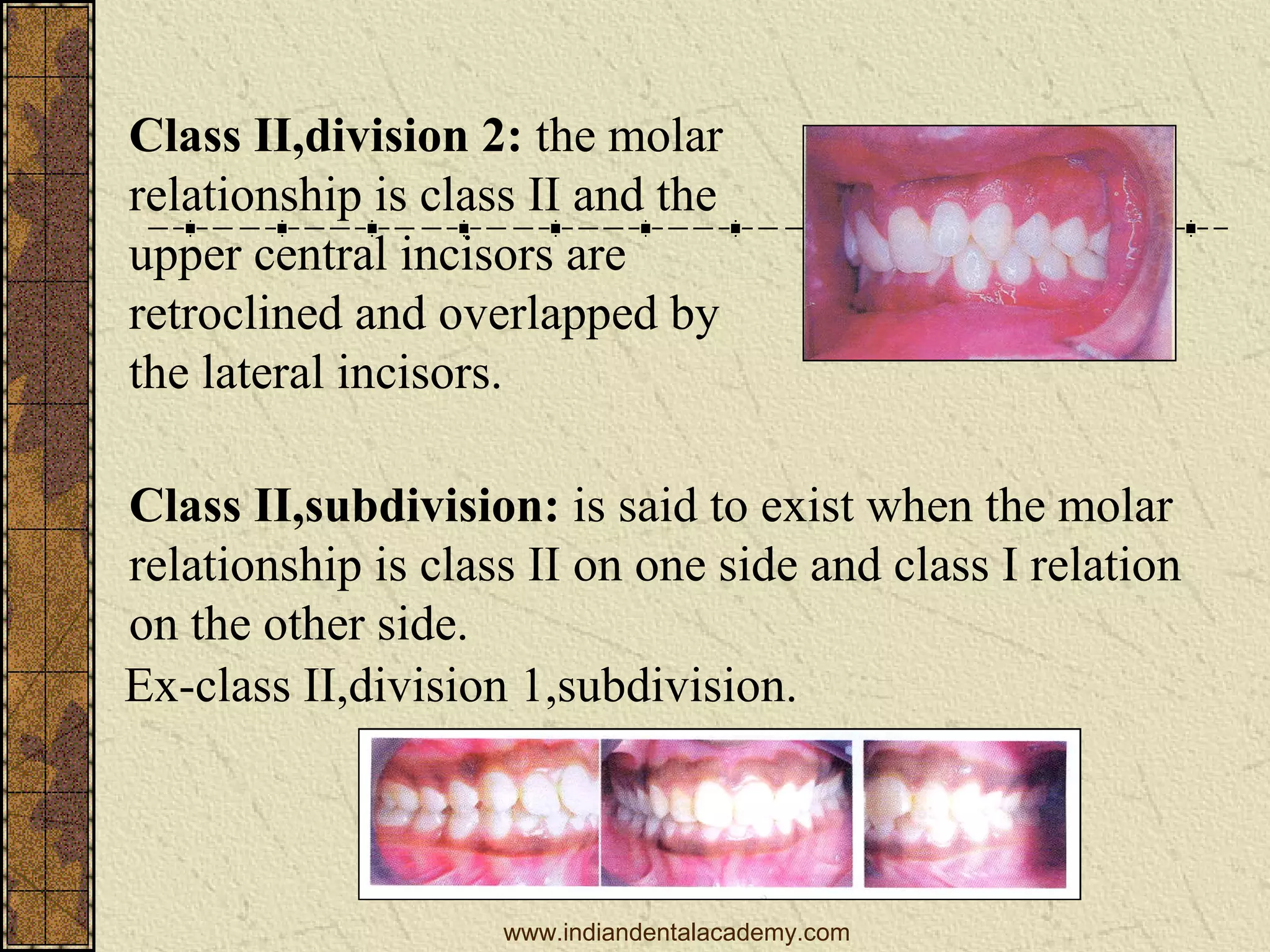
Class II,subdivision: is said to exist when the molar
relationship is class II on one side and class I relation
on the other side.
Ex-class II,division 1,subdivision.

www.indiandentalacademy.com
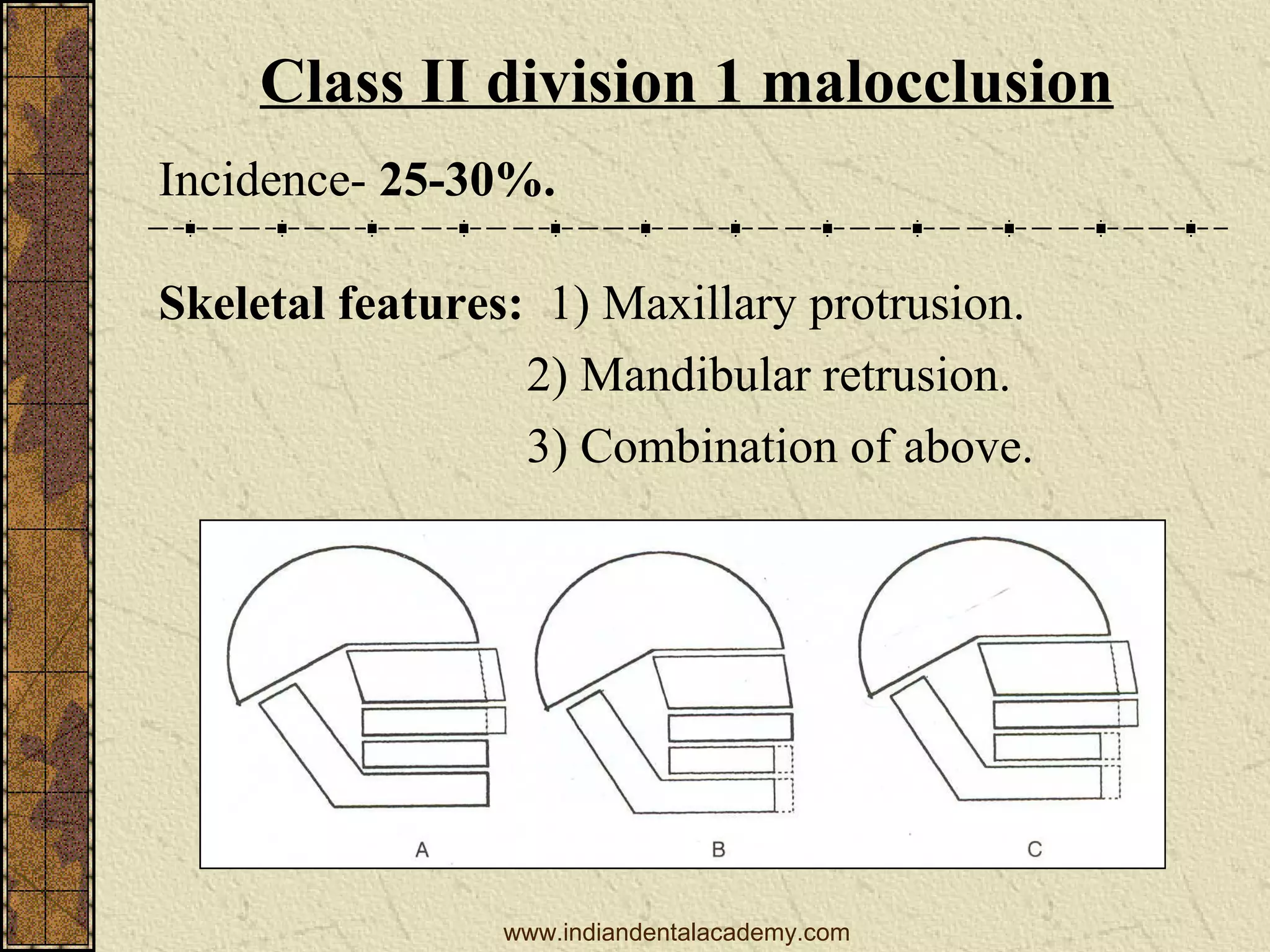
Class II division 1 malocclusion
Incidence- 25-30%.
Skeletal features: 1) Maxillary protrusion.
2) Mandibular retrusion.
3) Combination of above.

www.indiandentalacademy.com
Etiological considerations:
Pre-natal factors: 1) Hereditary.
2) Teratogenesis.
3) Irradiation.
4) Intra-uterine fetal posture.

Natal factors: Improper forceps application during
delivery.
www.indiandentalacademy.com
Post-natal factors:
1)
2)
3)
4)

Sleeping habits.
Traumatic injuries.
Long term irradiation therapy.
Infectious conditions like rheumatoid
arthritis.
5) Pernicious habits like thumb sucking.
6) Anomalies of dentition like congenitally
missing teeth etc..
www.indiandentalacademy.com
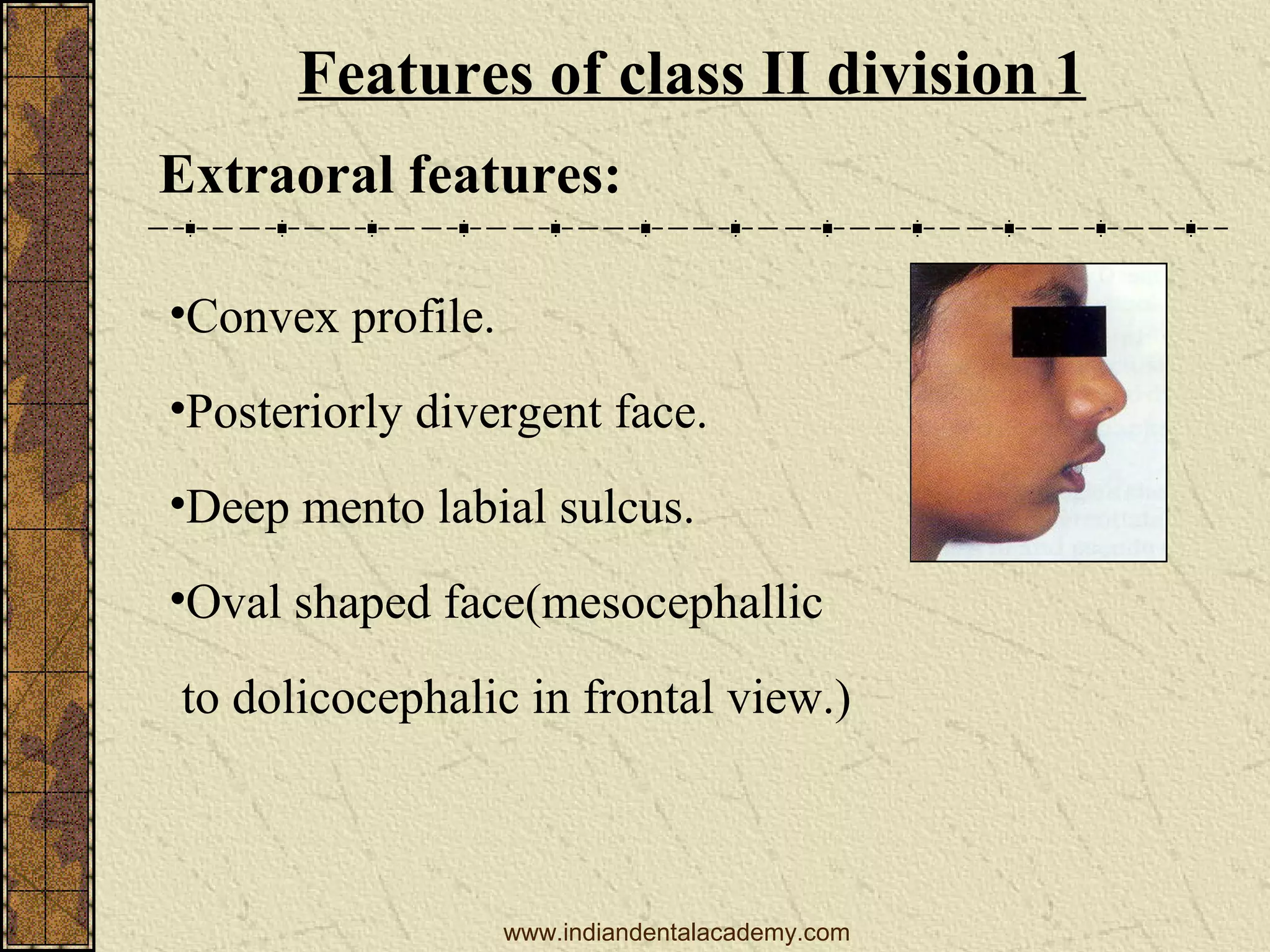
Features of class II division 1
Extraoral features:
•Convex profile.
•Posteriorly divergent face.
•Deep mento labial sulcus.
•Oval shaped face(mesocephallic
to dolicocephalic in frontal view.)

www.indiandentalacademy.com
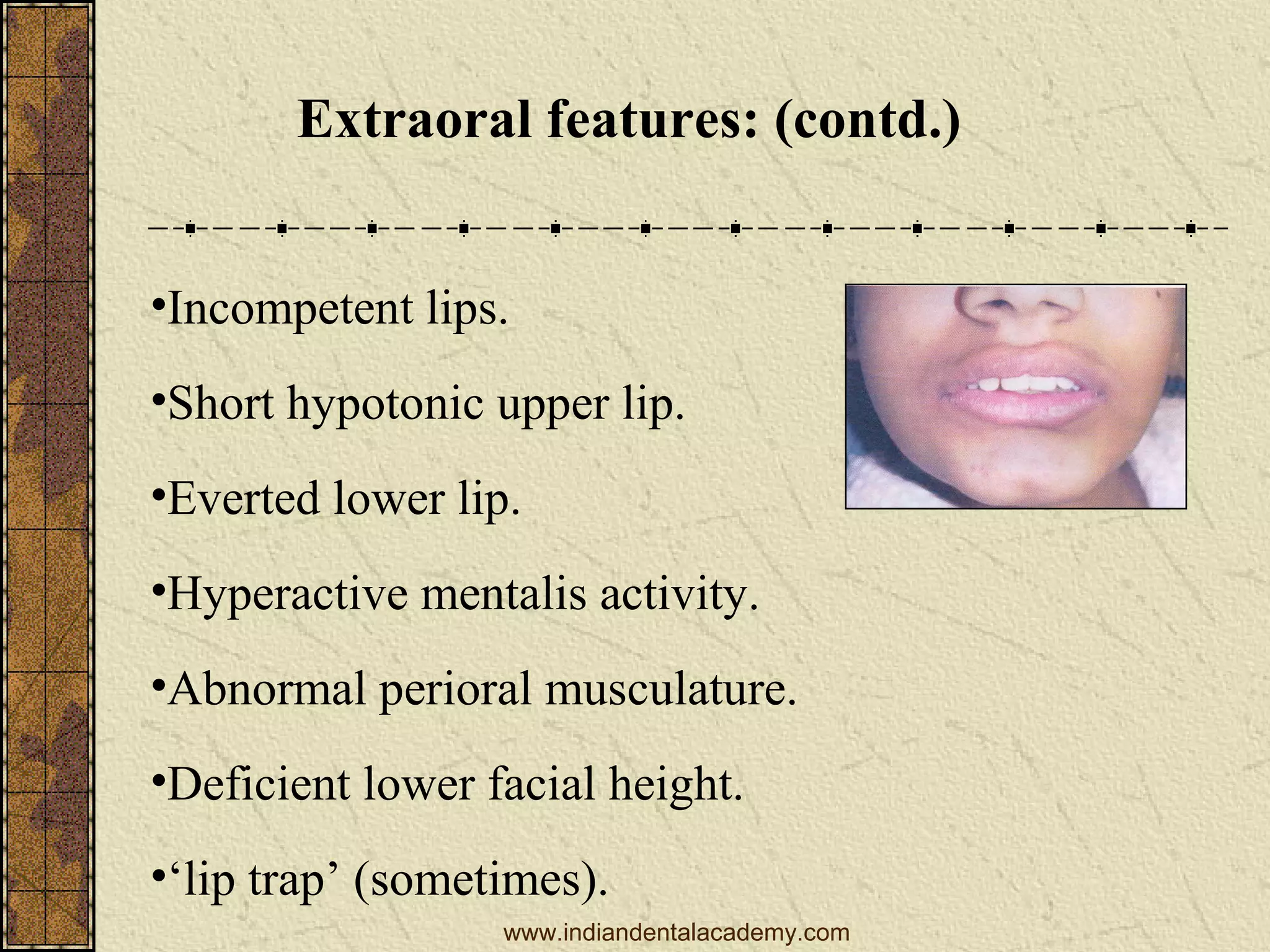
Extraoral features: (contd.)
•Incompetent lips.
•Short hypotonic upper lip.
•Everted lower lip.
•Hyperactive mentalis activity.
•Abnormal perioral musculature.
•Deficient lower facial height.
•‘lip trap’ (sometimes).
www.indiandentalacademy.com
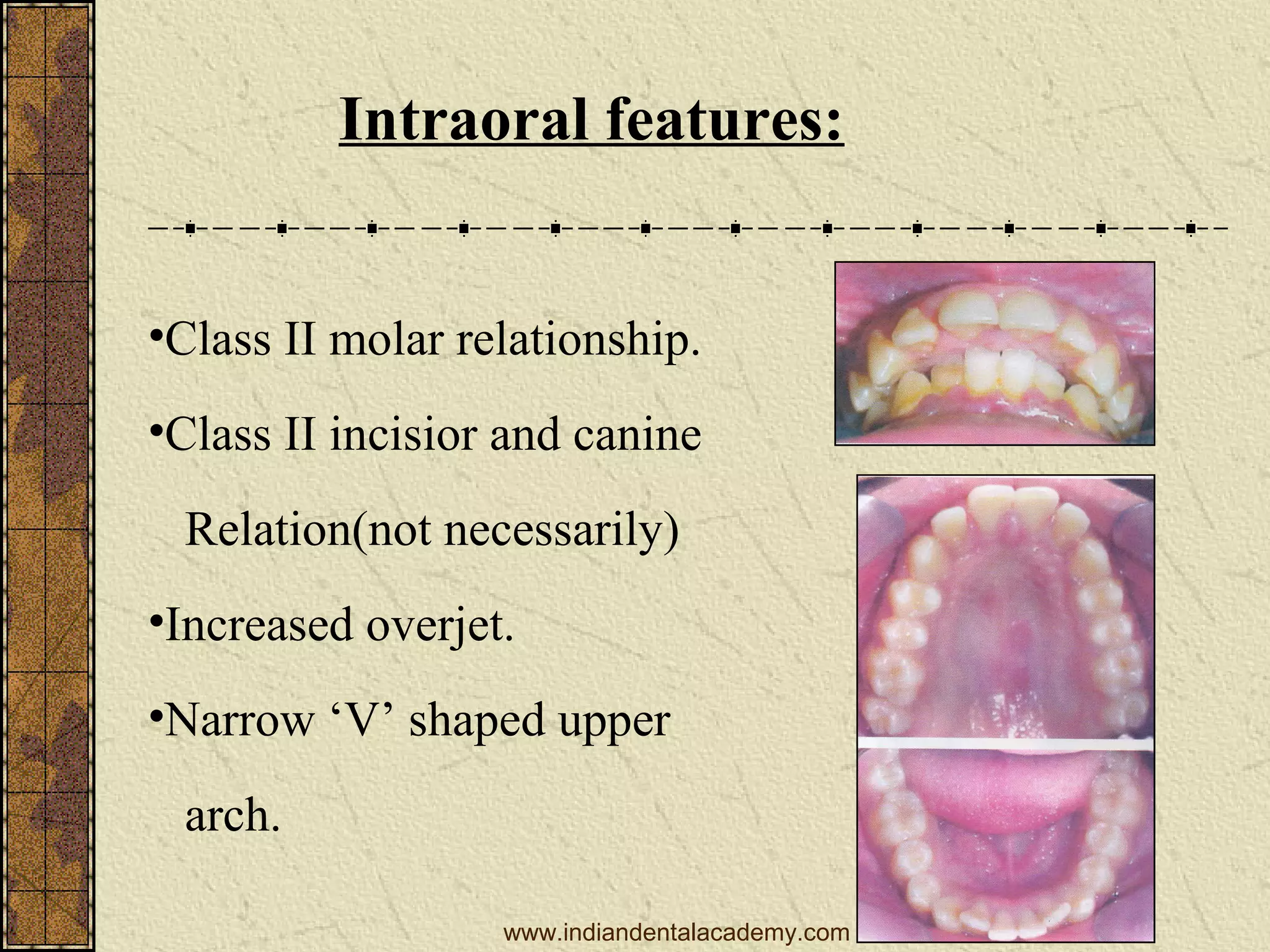
Intraoral features:
•Class II molar relationship.
•Class II incisior and canine
Relation(not necessarily)
•Increased overjet.
•Narrow ‘V’ shaped upper
arch.
www.indiandentalacademy.com
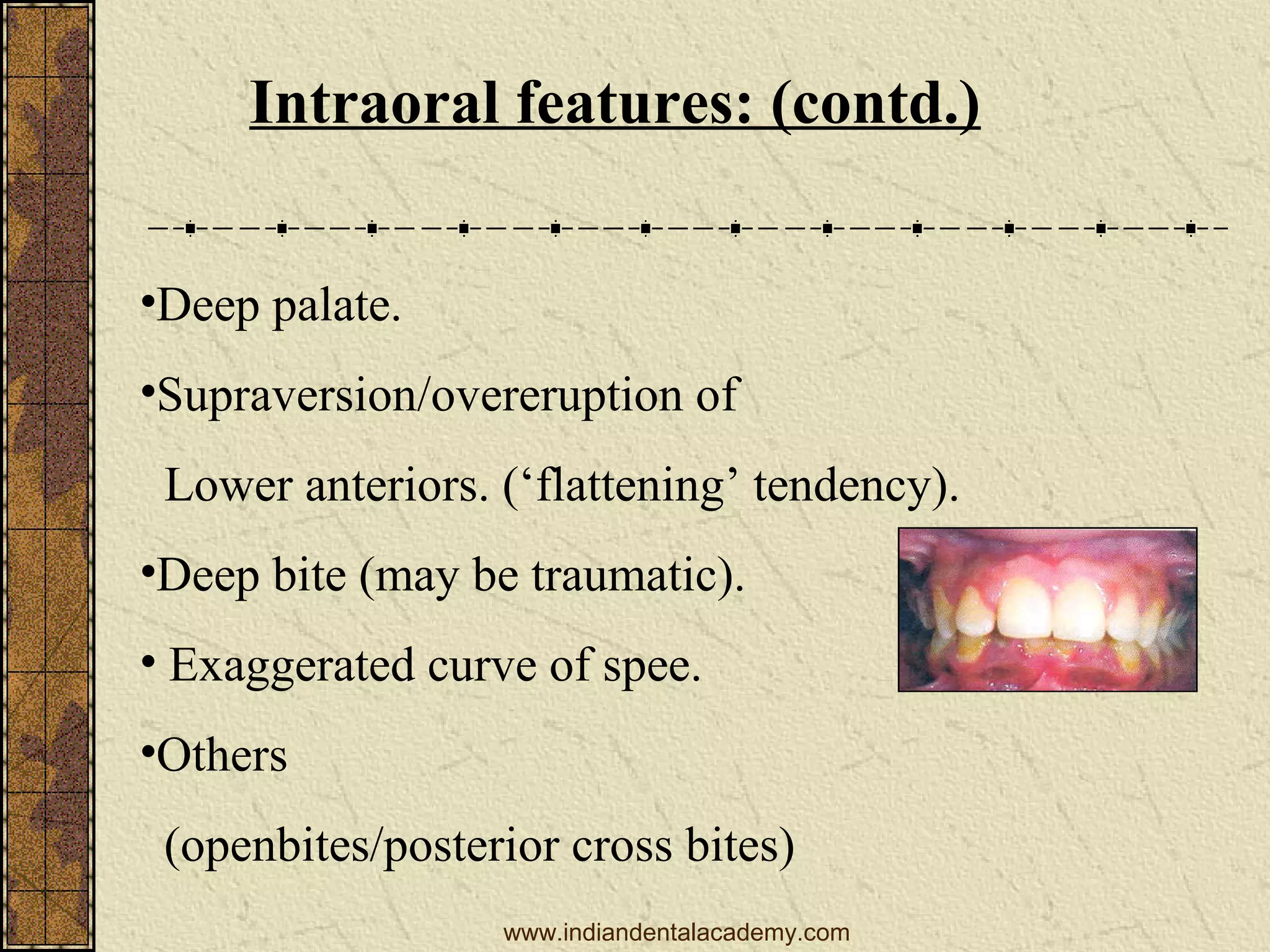
Intraoral features: (contd.)
•Deep palate.
•Supraversion/overeruption of
Lower anteriors. (‘flattening’ tendency).
•Deep bite (may be traumatic).
• Exaggerated curve of spee.
•Others
(openbites/posterior cross bites)
www.indiandentalacademy.com
Diagnosis
Factors to be considered:
1) Skeletal or dentoalveolar origin.
2) True or functional class II.
3) Probable growth direction.
4) Treatment timing.
5) Etiological considerations.

www.indiandentalacademy.com
Functional criteria:
1) Relationship between rest position and
occlusion.
2) Relationship between overjet and function of
lips.
3) Posture and function of tongue.
4) Mode of breathing.

www.indiandentalacademy.com
Cephalometric criteria:
1) Relationship of maxilla to the cranial base.
2) Position and size of mandible.
3) Axial inclination and position of the incisiors.
4) Growth pattern.

www.indiandentalacademy.com
Classification of class II
Malocclusions
Morphological Classification:
1) Class II dentoalveolar malocclusions.
2) Class II with retrognathic mandible.
3) Class II with prognathic maxilla.
4) Class II combination type.

www.indiandentalacademy.com
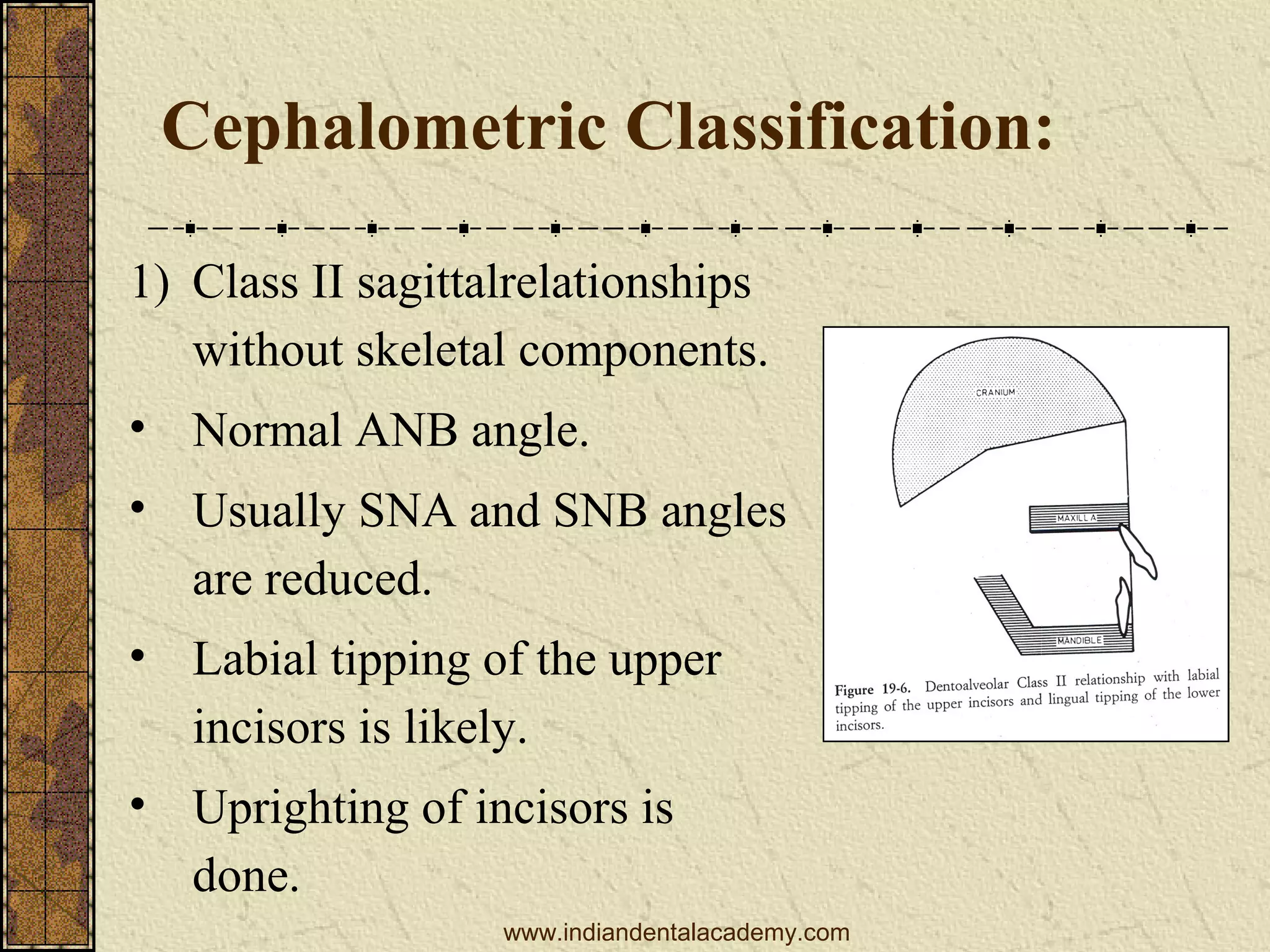
Cephalometric Classification:
1) Class II sagittalrelationships
without skeletal components.
• Normal ANB angle.
• Usually SNA and SNB angles
are reduced.
• Labial tipping of the upper
incisors is likely.
• Uprighting of incisors is
done.
www.indiandentalacademy.com
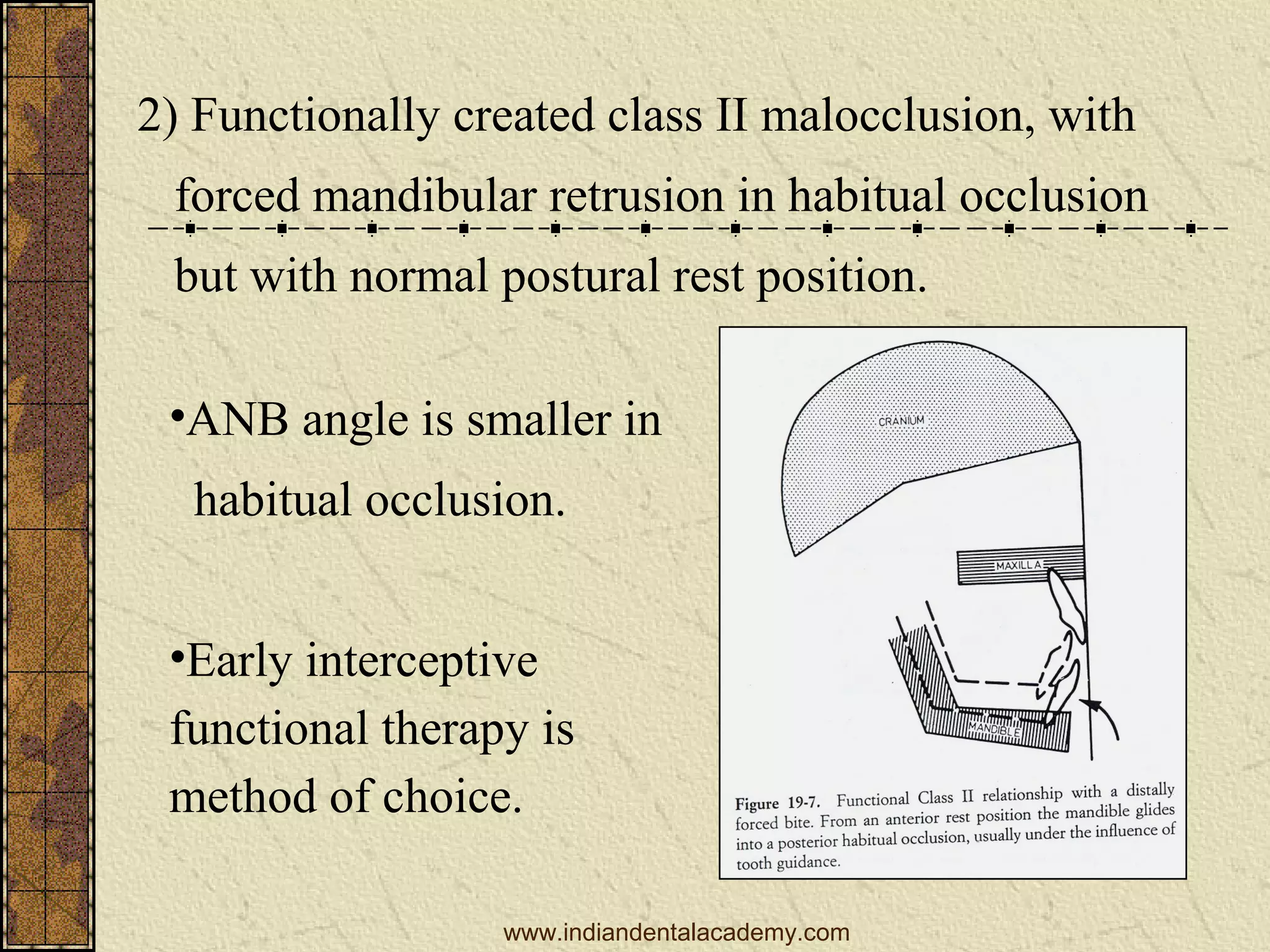
2) Functionally created class II malocclusion, with
forced mandibular retrusion in habitual occlusion
but with normal postural rest position.
•ANB angle is smaller in
habitual occlusion.
•Early interceptive
functional therapy is
method of choice.
www.indiandentalacademy.com
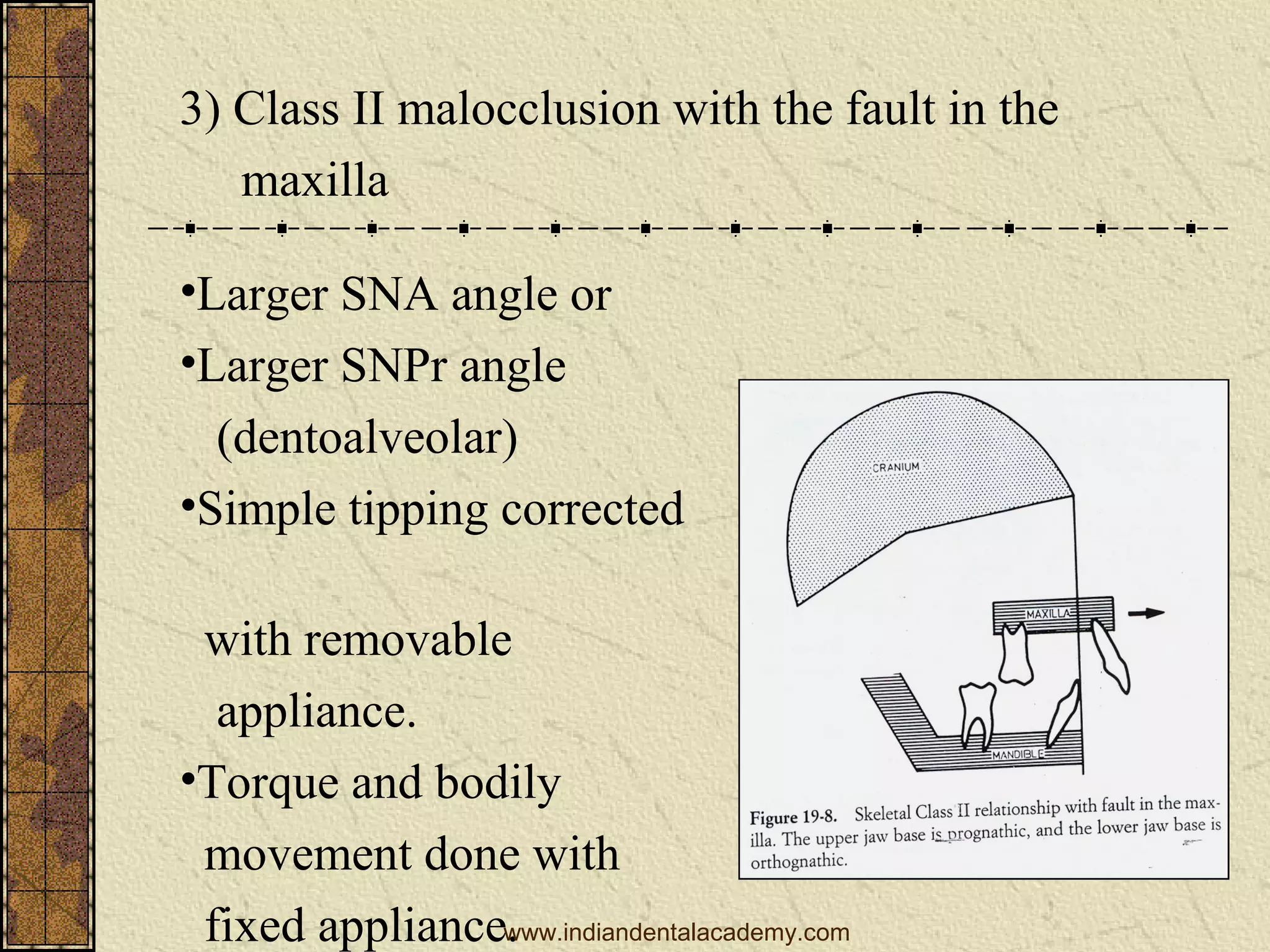
3) Class II malocclusion with the fault in the
maxilla
•Larger SNA angle or
•Larger SNPr angle
(dentoalveolar)
•Simple tipping corrected
with removable
appliance.
•Torque and bodily
movement done with
w
fixed appliance. ww.indiandentalacademy.com
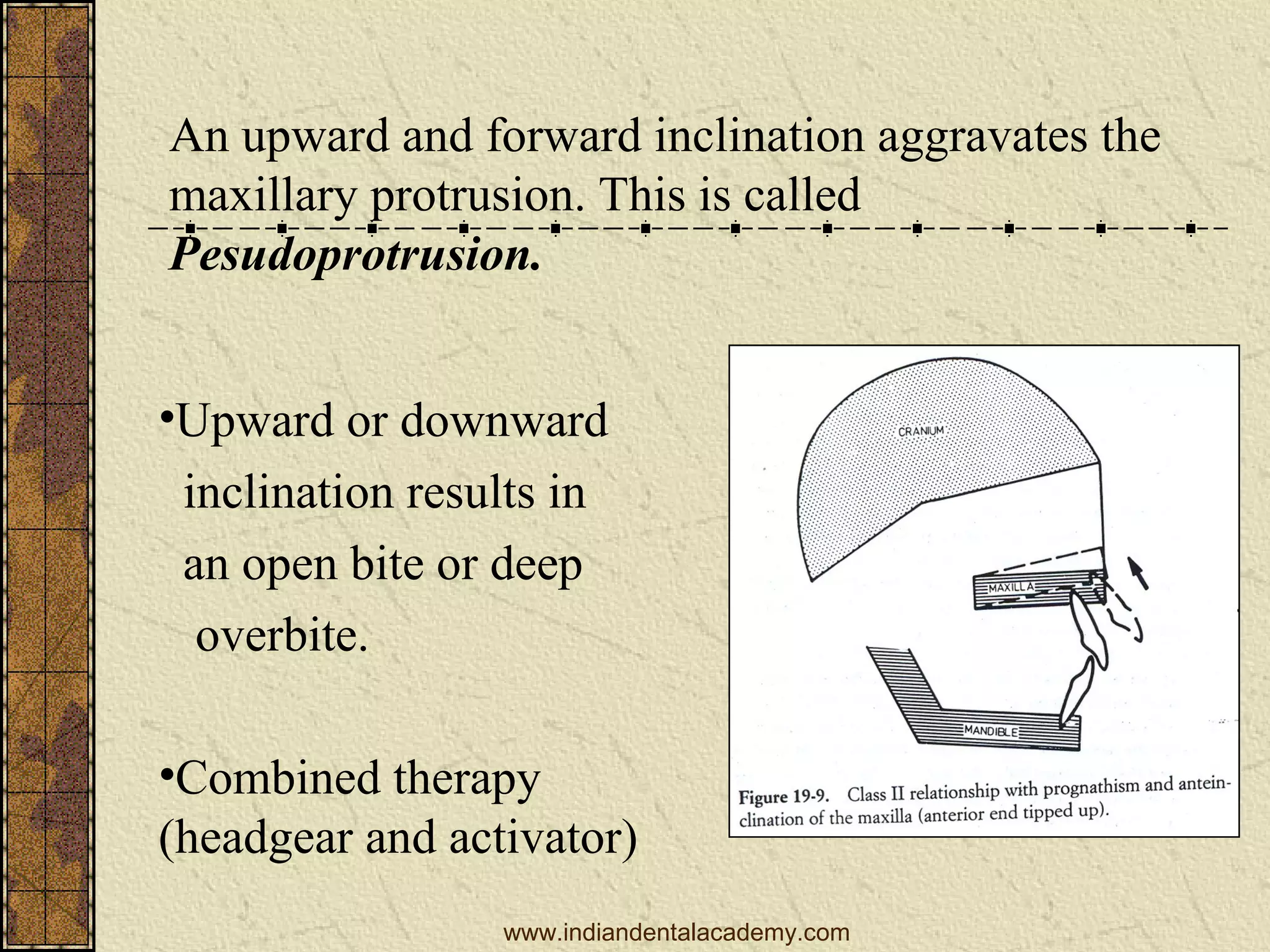
An upward and forward inclination aggravates the
maxillary protrusion. This is called
Pesudoprotrusion.
•Upward or downward
inclination results in
an open bite or deep
overbite.
•Combined therapy
(headgear and activator)
www.indiandentalacademy.com
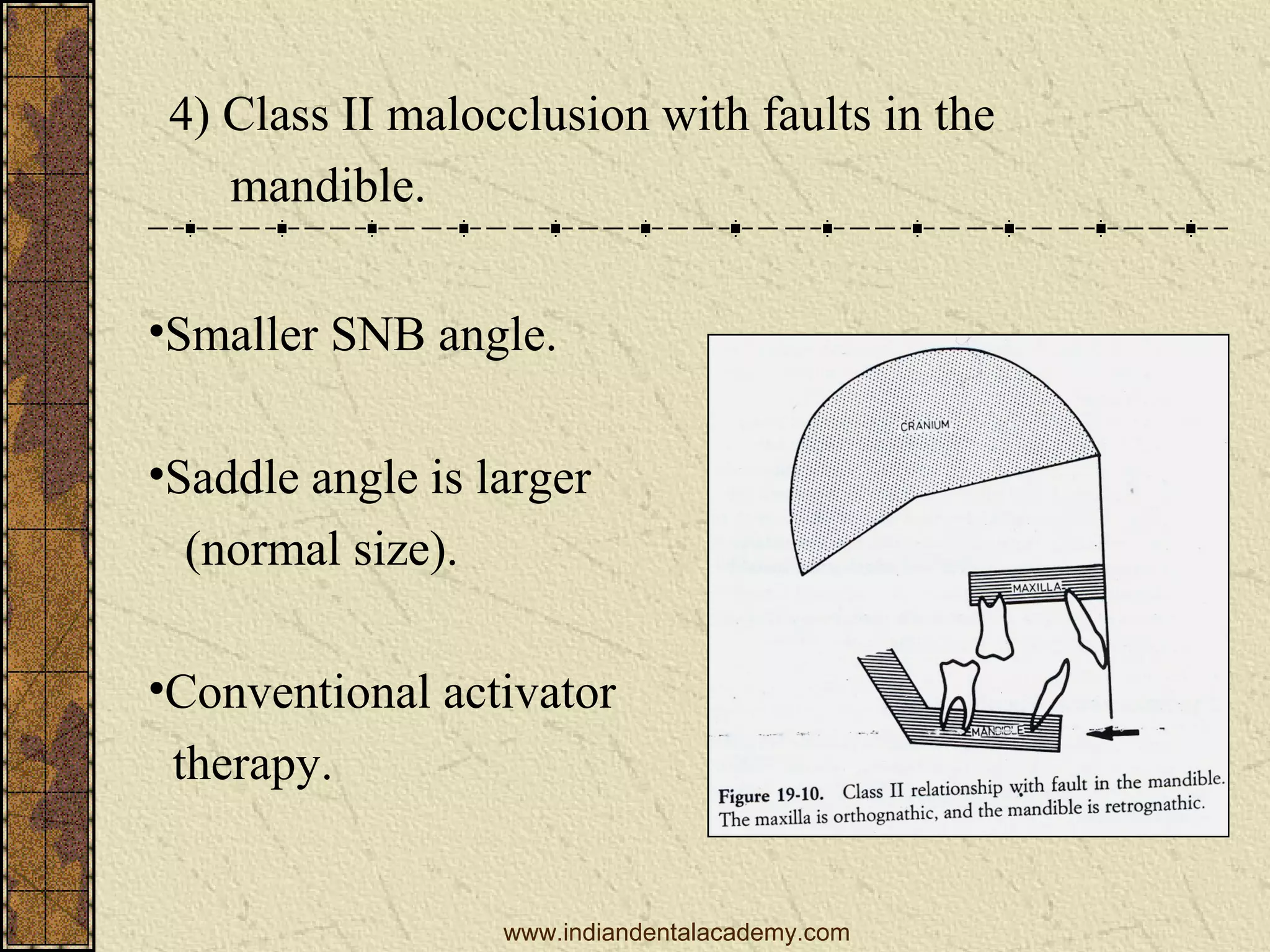
4) Class II malocclusion with faults in the
mandible.
•Smaller SNB angle.
•Saddle angle is larger
(normal size).
•Conventional activator
therapy.

www.indiandentalacademy.com
5) Combination type class II malocclusion
•Prognathic maxilla and retruded mandible.
•Retrognathic upper and lower jaws is also
possible, treatment follows a combined
functional and fixed appliance approach.

www.indiandentalacademy.com
Management
Treatment principles depends on:
1) Age.
2) Nature and severity of problem.
3) Etiologic factors.

www.indiandentalacademy.com
There are three approaches:
1) Prevent malocclusion from occuring.
2) Intercept a developing malocclusion.
3) Correct an already existing malocclusion.

www.indiandentalacademy.com
Management of functional disturbances:
•Mouth breathing – habit breaking appliance.
•Abnormal tongue position and swallowing
patterns- fixed or removable habit breaking
appliance.
•Lip posture and activity- lip exercises.
•Finger sucking habit - fixed or removable habit
breaking appliance.
www.indiandentalacademy.com
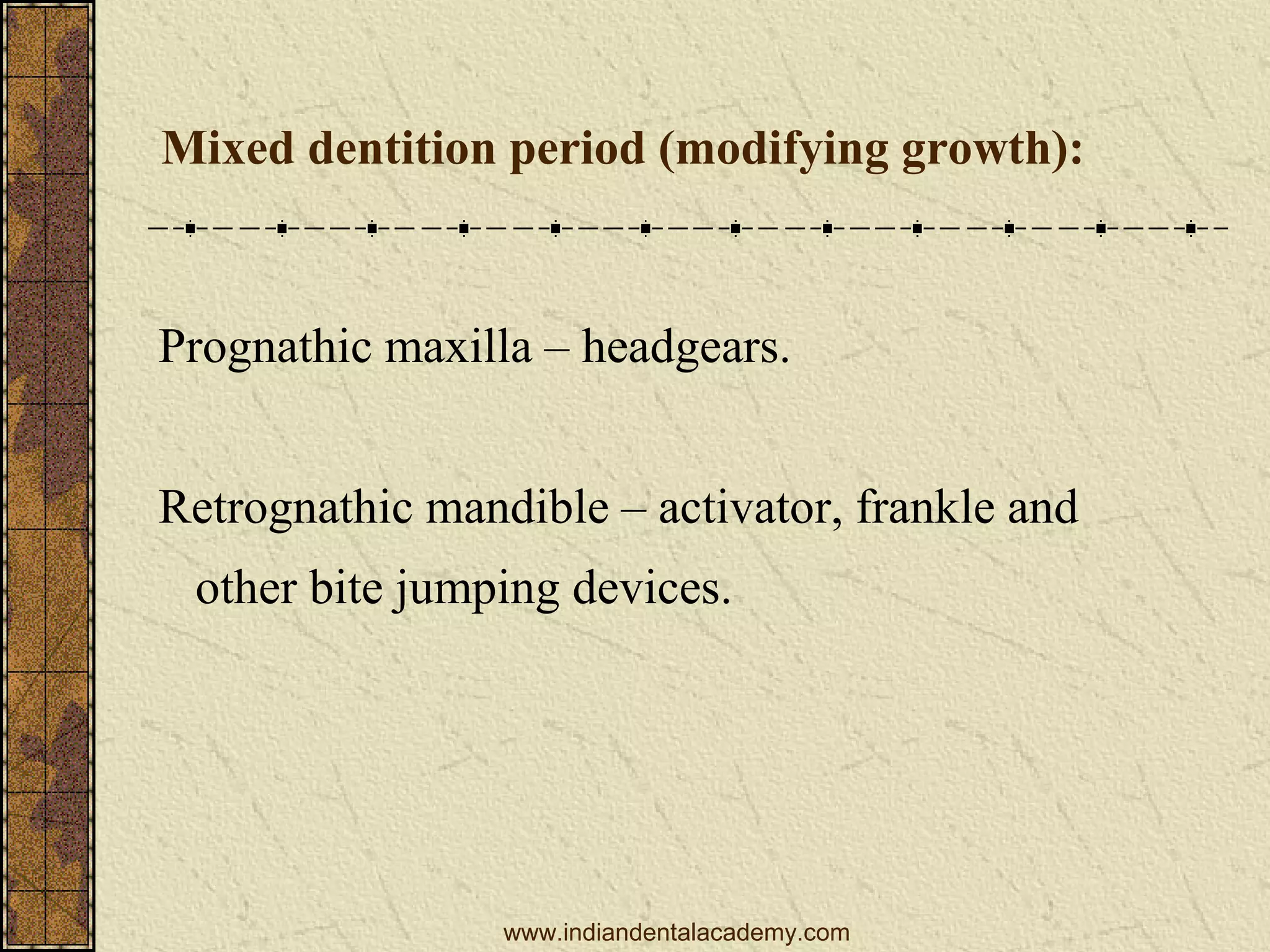
Mixed dentition period (modifying growth):

Prognathic maxilla – headgears.
Retrognathic mandible – activator, frankle and
other bite jumping devices.

www.indiandentalacademy.com
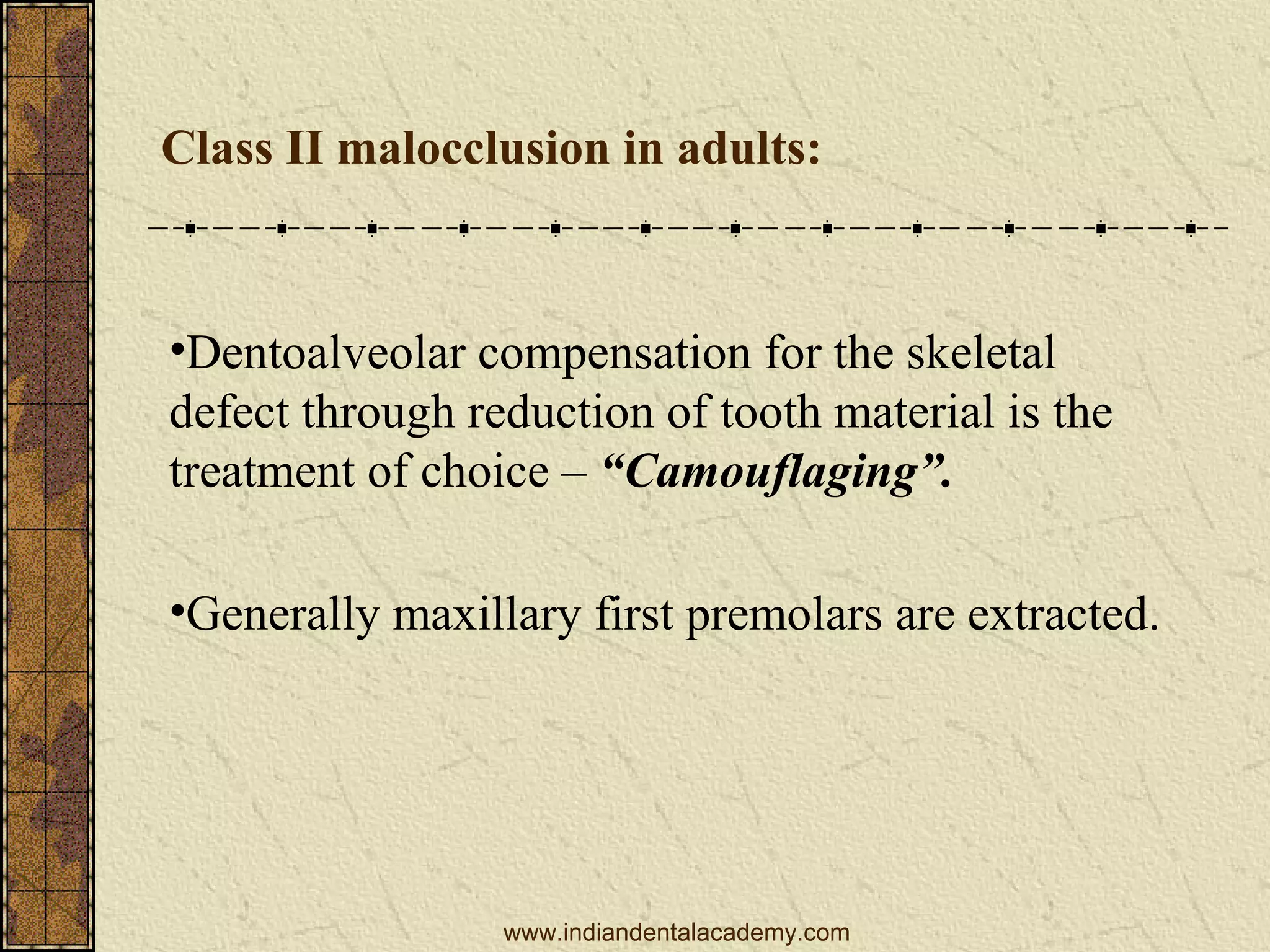
Class II malocclusion in adults:

•Dentoalveolar compensation for the skeletal
defect through reduction of tooth material is the
treatment of choice – “Camouflaging”.
•Generally maxillary first premolars are extracted.

www.indiandentalacademy.com
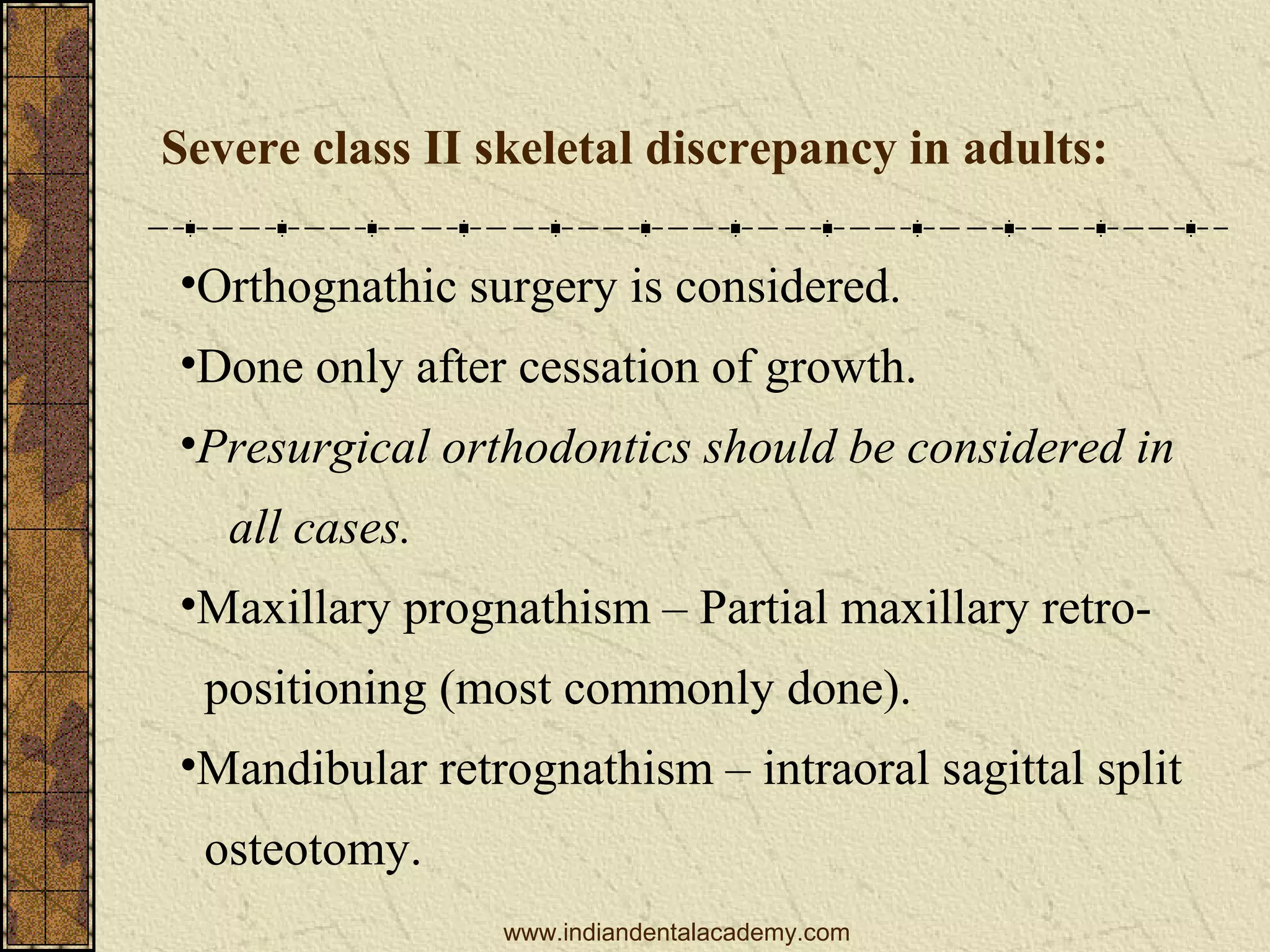
Severe class II skeletal discrepancy in adults:
•Orthognathic surgery is considered.
•Done only after cessation of growth.
•Presurgical orthodontics should be considered in
all cases.
•Maxillary prognathism – Partial maxillary retropositioning (most commonly done).
•Mandibular retrognathism – intraoral sagittal split
osteotomy.
www.indiandentalacademy.com
Leader in continuing dental education

www.indiandentalacademy.com

Class 2 MALOCCLUSION /certified fixed orthodontic courses by Indian dental academy

  • 1.
    Angle’s class IIMalocclusion In sagittal plane this malocclusion is called as postnormal occlusion. According to lischer’s modification of angle’s classification this malocclusion is known as distocclusion. The term class II is an unfortunate generalization which groups together morphologies of wide ranging varieties often with one common trait – their abnormal molar relationship. www.indiandentalacademy.com
  • 2.
    According to Angle’sclassification a class II malocclusion indicates that the mandibular arch is in a distal relation to that of the maxilla. Class II malocclusion is characterized by a class II molar relationship where the disto-buccal cusp of the upper first permenent molar occludes in the mesio-buccal groove of the lower first permenent molar. www.indiandentalacademy.com
  • 3.
    Angle divided theclass II malocclusion into two divisions based on the labiolingual angulation of the maxillary incisors as- Class II,division 1: the molar relationship is class II with the upper anteriors proclined. www.indiandentalacademy.com
  • 4.
    Class II,division 2:the molar relationship is class II and the upper central incisors are retroclined and overlapped by the lateral incisors. Class II,subdivision: is said to exist when the molar relationship is class II on one side and class I relation on the other side. Ex-class II,division 1,subdivision. www.indiandentalacademy.com
  • 5.
    Class II division1 malocclusion Incidence- 25-30%. Skeletal features: 1) Maxillary protrusion. 2) Mandibular retrusion. 3) Combination of above. www.indiandentalacademy.com
  • 6.
    Etiological considerations: Pre-natal factors:1) Hereditary. 2) Teratogenesis. 3) Irradiation. 4) Intra-uterine fetal posture. Natal factors: Improper forceps application during delivery. www.indiandentalacademy.com
  • 7.
    Post-natal factors: 1) 2) 3) 4) Sleeping habits. Traumaticinjuries. Long term irradiation therapy. Infectious conditions like rheumatoid arthritis. 5) Pernicious habits like thumb sucking. 6) Anomalies of dentition like congenitally missing teeth etc.. www.indiandentalacademy.com
  • 8.
    Features of classII division 1 Extraoral features: •Convex profile. •Posteriorly divergent face. •Deep mento labial sulcus. •Oval shaped face(mesocephallic to dolicocephalic in frontal view.) www.indiandentalacademy.com
  • 9.
    Extraoral features: (contd.) •Incompetentlips. •Short hypotonic upper lip. •Everted lower lip. •Hyperactive mentalis activity. •Abnormal perioral musculature. •Deficient lower facial height. •‘lip trap’ (sometimes). www.indiandentalacademy.com
  • 10.
    Intraoral features: •Class IImolar relationship. •Class II incisior and canine Relation(not necessarily) •Increased overjet. •Narrow ‘V’ shaped upper arch. www.indiandentalacademy.com
  • 11.
    Intraoral features: (contd.) •Deeppalate. •Supraversion/overeruption of Lower anteriors. (‘flattening’ tendency). •Deep bite (may be traumatic). • Exaggerated curve of spee. •Others (openbites/posterior cross bites) www.indiandentalacademy.com
  • 12.
    Diagnosis Factors to beconsidered: 1) Skeletal or dentoalveolar origin. 2) True or functional class II. 3) Probable growth direction. 4) Treatment timing. 5) Etiological considerations. www.indiandentalacademy.com
  • 13.
    Functional criteria: 1) Relationshipbetween rest position and occlusion. 2) Relationship between overjet and function of lips. 3) Posture and function of tongue. 4) Mode of breathing. www.indiandentalacademy.com
  • 14.
    Cephalometric criteria: 1) Relationshipof maxilla to the cranial base. 2) Position and size of mandible. 3) Axial inclination and position of the incisiors. 4) Growth pattern. www.indiandentalacademy.com
  • 15.
    Classification of classII Malocclusions Morphological Classification: 1) Class II dentoalveolar malocclusions. 2) Class II with retrognathic mandible. 3) Class II with prognathic maxilla. 4) Class II combination type. www.indiandentalacademy.com
  • 16.
    Cephalometric Classification: 1) ClassII sagittalrelationships without skeletal components. • Normal ANB angle. • Usually SNA and SNB angles are reduced. • Labial tipping of the upper incisors is likely. • Uprighting of incisors is done. www.indiandentalacademy.com
  • 17.
    2) Functionally createdclass II malocclusion, with forced mandibular retrusion in habitual occlusion but with normal postural rest position. •ANB angle is smaller in habitual occlusion. •Early interceptive functional therapy is method of choice. www.indiandentalacademy.com
  • 18.
    3) Class IImalocclusion with the fault in the maxilla •Larger SNA angle or •Larger SNPr angle (dentoalveolar) •Simple tipping corrected with removable appliance. •Torque and bodily movement done with w fixed appliance. ww.indiandentalacademy.com
  • 19.
    An upward andforward inclination aggravates the maxillary protrusion. This is called Pesudoprotrusion. •Upward or downward inclination results in an open bite or deep overbite. •Combined therapy (headgear and activator) www.indiandentalacademy.com
  • 20.
    4) Class IImalocclusion with faults in the mandible. •Smaller SNB angle. •Saddle angle is larger (normal size). •Conventional activator therapy. www.indiandentalacademy.com
  • 21.
    5) Combination typeclass II malocclusion •Prognathic maxilla and retruded mandible. •Retrognathic upper and lower jaws is also possible, treatment follows a combined functional and fixed appliance approach. www.indiandentalacademy.com
  • 22.
    Management Treatment principles dependson: 1) Age. 2) Nature and severity of problem. 3) Etiologic factors. www.indiandentalacademy.com
  • 23.
    There are threeapproaches: 1) Prevent malocclusion from occuring. 2) Intercept a developing malocclusion. 3) Correct an already existing malocclusion. www.indiandentalacademy.com
  • 24.
    Management of functionaldisturbances: •Mouth breathing – habit breaking appliance. •Abnormal tongue position and swallowing patterns- fixed or removable habit breaking appliance. •Lip posture and activity- lip exercises. •Finger sucking habit - fixed or removable habit breaking appliance. www.indiandentalacademy.com
  • 25.
    Mixed dentition period(modifying growth): Prognathic maxilla – headgears. Retrognathic mandible – activator, frankle and other bite jumping devices. www.indiandentalacademy.com
  • 26.
    Class II malocclusionin adults: •Dentoalveolar compensation for the skeletal defect through reduction of tooth material is the treatment of choice – “Camouflaging”. •Generally maxillary first premolars are extracted. www.indiandentalacademy.com
  • 27.
    Severe class IIskeletal discrepancy in adults: •Orthognathic surgery is considered. •Done only after cessation of growth. •Presurgical orthodontics should be considered in all cases. •Maxillary prognathism – Partial maxillary retropositioning (most commonly done). •Mandibular retrognathism – intraoral sagittal split osteotomy. www.indiandentalacademy.com
  • 28.
    www.indiandentalacademy.com Leader in continuingdental education www.indiandentalacademy.com