JOSNA THANKACHAN
FINAL YEAR PART I
AL-AZHAR DENTAL COLLEGE
RETENTION
APPLIANCES
 INTRODUCTION
 THEORIESOF RETENTION
 RALEIGHWILLIAMSKEYS TO ELIMINATELOWERRETENTION
 TYPESOF RETENTION
 RETAINERS
 CLASSIFICATION
 REMOVABLERETAINERS
 FIXEDRETAINERS
 ACTIVERETAINERS
 CONCLUSION
 REFERENCES
CONTENTS
 What is retention?
 has been defined by Moyers as
“Maintaining newly moved teeth in
position long enough to aid in stabilizing
their correction”.
INTRODUCTION
 Why is retention necessary?
 Retention is necessary for 3 main reasons
1. The gingival and periodontal tissues are affected by
orthodontic tooth movement and require time for
reorganization when the appliances are removed.
2. The teeth may be in an inherently unstable position
after the treatment,so that soft tissue pressures
constantly produce a relapse tendancy.
3. Changes produced by growth may alter the
orthodontic treatment.
If teeth are not in an inherently
unstable position and if there is no
further growth, retention still s vitally
important until gingival and periodontal
organization is complete.
Retention cannot be abandoned until
growth is essentially completed.
 What is relapse?

 Relapse implies loss of
any correction
achieved by orthodontic
 treatment.
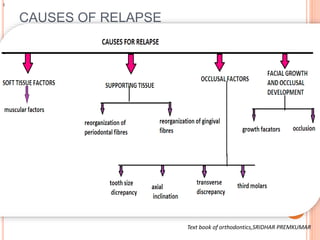
CAUSES OF RELAPSE
L
Text book of orthodontics,SRIDHAR PREMKUMAR
SCHOOLS OF THOUGHT PERTAINING TO
RETENTION/HISTORY OF RETENTION
 There are 4 schools of thought pertaining to
retention:-
1. Occlusion school of thought(kingsley)
 A/C to this,proper occlusion of teeth is a potent factor in
maintaining the stability of the teeth.
 At the end of active orthodontic treatment there should
be proper intercuspation and interdigitation.
 There should be cusp to fossa relationship between
maxillary and mandibular teeth.
2. Apical base school of thought(Axel lundstrom)
 A/C to this,apical base is one of the most important
factors in both correction of malocclusion as well as
maintenance of correct occusion.
 Intercanine and intermolar width should be altered to
prevent relapse.
 Nance advised to increase the arch length only to a
minimal extent.
3. Mandibular incisor school of thought(Grieve and
Tweed)
 This theory postulated that the mandibular incisors
should be placed upright and over the basal bone.
4. Musculature school of thought(Roger’s)
 Establishing proper functional muscle balance is a
must to achieve stable occlusion.
 Improper muscle balance leads to relapse.
THEOREMS ON RETENTION
 There are 10 theorems of which 9 are put forward
by Riedel and the last one by Moyer.
 THEOREM 1
 “Teeth that have been moved tend to return to their
former positions”
 THEOREM 2
 “elimination of the cause of malocclusion will prevent
recurrence”
 THEOREM 3
 “Malocclusion should be overcorrected as a safety
factor”
 THEOREM 4
 “proper occlusion is a potent factor in holding teeth in
their corrected positions”
 THEOREM 5
 “bone and adjacent tissues must be allowed to
reorganize around newly positioned teeth”.
 THEOREM 6
 “if the lower incisors are placed upright over basal
bone,they are more likely to remain in good alignment”
 THEOREM 7
 “corrections carried out during periods of growth are
less likely to relapse”
 THEOREM 8
 “the farther teeth have been moved ,the less likelyhood
of relapse.
 THEOREM 9
 “arch form particularly in the mandibular arch,cannot be
altered permanently by appliance therapy”.
 THEOREM 10
 “many treated malocclusions require permanent
retaining devices”.
PRINCIPLES OF RETENTION
 Relapse potential may be predicted by evaluation of
initial occlusion; teeth usually want to return to their
original position; this is due to gingival fibers and
unbalanced lip-tongue forces
 Full-time retention is required for 3-4 months to
allow for reorganization of PDL
 Retention should continue for at least 12 months in
non-growing patients or until growth has ceased in
growing patients
TYPES OF RETENTION
 natural/no retention
 Limited or short term retention
 Medium term/moderate retention
 prolonged/permanent/semi permanent retention
NATURAL RETENTION
--Occlusion is self retentive
--an upper incisor is moved over the bite, no retention is
required
--Conditions that do not require any retention
 anterior crossbite
 Serial extraction procedures
 Blocked out or highly placed canines in class I
extraction cases
 Posterior crossbite in patients having steep cusps
SHORT TERM RETENTION
 Limited retention-3-6 months
 Class I non-extraction with dental arches showing
proclination and spacing
 Deep bite
 Class I,Class II div 1 and div 2 cases treated by
extraction
MEDIUM TERM/MODERATE RETENTION
 Supporting tissue will take longer time to adapt
 Retention may extend between 1-5 years
 Class I non extraction cases,with protrusion and
spacing of maxillary incisors
 Corrected deep bites in classI or class II
malocclusion
 Corrected class II div 2 malocclusion
PROLONGED/PERMANENT/SEMI PERMANENT
RETENTION
 Cases treated by expansion particularly in the
mandibular arch
 Generalized spacing with arch length excess
 Severe rotatation
 Midline diastema
 Cleft palate cases
 Adult patients with periodontal problems
 Severe labiolingual malposition
RALEIGH WILLIAMS KEYS TO ELIMINATE
LOWER RETENTION.
6 keys:-
1. Incisal edge of the lower incisor should
be placed on the A-P line or 1mm infront of
it. This position of the lower incisor
ensures stability following treatment. It also
creates optimum balance of soft tissues in
the lower third of the face.
2. The lower incisor apices should
bespread distally to the crowns
more than is generally considered
appropriate and the apices of the
lower lateral incisors must be
spread more than those of central
incisors. In otherwords the lower
incisor roots should be diverging.
3. The apex of the lower cuspid
should be positioned distal to the
crown
4. All 4 lower incisors apices must
be in the same labolingual plane
5. The lower cuspid root apex must
be positioned slightly buccal to the
crown apex.
6. The lower incisors should be
slenderised as needed after
treatment
RETAINERS
 Retainers are passive orthodontic appliances that
help in maintaining and stabilizing the position of
the teeth long enough to permit reorganization of
the supporting structures after the active phase of
orthodontic therapy
IDEAL REQUIREMENTS FOR
RETAINERS(GRABER)
 It should restrain each tooth that has been moved
in to the desired position
 It should be easily cleanable
 It should allow functional forces to be transmitted to
the retained teeth if worn
 It should be self cleansable
 It should be inconspicuous
It should be strong enough to achieve the objectives
of retention
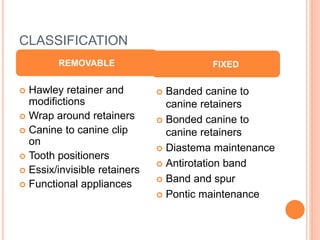
CLASSIFICATION
 Hawley retainer and
modifictions
 Wrap around retainers
 Canine to canine clip
on
 Tooth positioners
 Essix/invisible retainers
 Functional appliances
 Banded canine to
canine retainers
 Bonded canine to
canine retainers
 Diastema maintenance
 Antirotation band
 Band and spur
 Pontic maintenance
REMOVABLE FIXED
REMOVABLE RETAINERS
 Effective for retention against intra arch stability
 Effective in growth problems
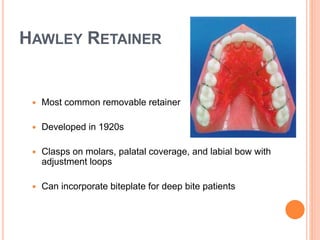
HAWLEY RETAINER
 Most common removable retainer
 Developed in 1920s
 Clasps on molars, palatal coverage, and labial bow with
adjustment loops
 Can incorporate biteplate for deep bite patients
 MODIFICATIONS
 Labial bow can be made to extend from 1st premolar
to the opposite 1st premolar. The design helps in
closing spaces distal to canine.
 Solder the bow to the bridge of the Adam’s clasp.This
design avoids the risk of space opening upbetween
the canine and premolar due to the crossover wires.
 Fitted labial bow offers excellent retention
 Anterior bite planes can be incorporated to retain
correct deep bite cases.
 Advantages
 Ease of fabrication
 Minimal patient discomfort
 Acceptable to most patients.
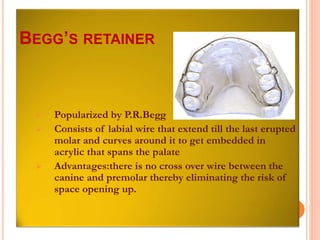
 Popularized by P.R.Begg
 Consists of labial wire that extend till the last erupted
molar and curves around it to get embedded in
acrylic that spans the palate
 Advantages:there is no cross over wire between the
canine and premolar thereby eliminating the risk of
space opening up.
BEGG’S RETAINER
CLIP-ON RETAINER/SPRING ALIGNER
 Made of a wire framework that runs labially over the
incisors and then passes between the canine and
premolar and is recurved to lie over the lingual
surface. Both the labial as well as the lingual wire
segments are embedded in a strip of clear acrylic.
 Used for correction of rotations commonly seen in
the lower anterior region.
WRAP AROUND RETAINER
 Extended version of the spring aligner that covers
all the teeth.
 It consists of a wire that passes along the labial as
well as lingual surfaces of all erupted teeth which is
embedded in a strip of acrylic.
 APPLICATION
 Stabilizing a periodontally week dentition.
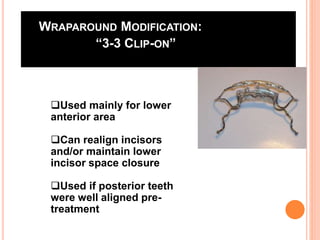
WRAPAROUND MODIFICATION:
“3-3 CLIP-ON”
Used mainly for lower
anterior area
Can realign incisors
and/or maintain lower
incisor space closure
Used if posterior teeth
were well aligned pre-
treatment
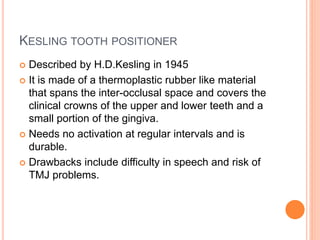
KESLING TOOTH POSITIONER
 Described by H.D.Kesling in 1945
 It is made of a thermoplastic rubber like material
that spans the inter-occlusal space and covers the
clinical crowns of the upper and lower teeth and a
small portion of the gingiva.
 Needs no activation at regular intervals and is
durable.
 Drawbacks include difficulty in speech and risk of
TMJ problems.
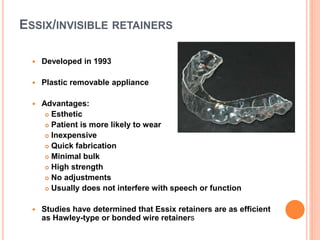
ESSIX/INVISIBLE RETAINERS
 Developed in 1993
 Plastic removable appliance
 Advantages:
 Esthetic
 Patient is more likely to wear
 Inexpensive
 Quick fabrication
 Minimal bulk
 High strength
 No adjustments
 Usually does not interfere with speech or function
 Studies have determined that Essix retainers are as efficient
as Hawley-type or bonded wire retainers
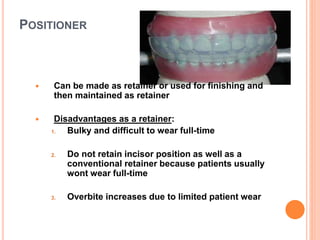
POSITIONER
 Can be made as retainer or used for finishing and
then maintained as retainer
 Disadvantages as a retainer:
1. Bulky and difficult to wear full-time
2. Do not retain incisor position as well as a
conventional retainer because patients usually
wont wear full-time
3. Overbite increases due to limited patient wear
Advantages as a retainer:
1. Reestablishes normal tissue when gingival
hyperplasia is present
2. Maintains occlusal relationship and intra-arch
position
3. Unlikely to break
4. Can be made with jaws rotated down and
back to prevent Class III relapse
5. Can be constructed to prevent relapse in
skeletal Class II and open bite cases
 Growth control is less effective than part-
time functional appliance or headgear
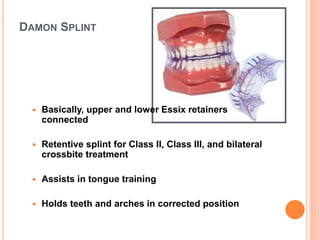
DAMON SPLINT
 Basically, upper and lower Essix retainers
connected
 Retentive splint for Class II, Class III, and bilateral
crossbite treatment
 Assists in tongue training
 Holds teeth and arches in corrected position
Designed By Dr. Dwight Damon
 Can be used by adults or patients in mixed
dentition
 Minimal vertical opening to allow for air slot
 Esthetic
 Can be made using:hard pressure formed, dual
hardness/soft liner and elastic silicone
FIXED RETAINERS
 Utilized in cases where stability is
questionable and prolonged retention is
planned
 Four main indications:
1. Maintaining lower incisor position
2. Holding diastema closed
3. Implant or pontic space maintenance
4. Retaining closed extraction spaces
BONDED CANINE TO CANINE RETAINER
 Commonly used in lower anterior region.
 Canines are banded and a thick wire is contoured
over the lingual aspects and soldered to the canine
bands.
 The bands predispose to poor oral hygiene and are
unesthetic.in addition when these retainers are
removed band spaces are seen around these
bands.
 These drawbacks of the banded retainers have
made them less popular than the bonded retainers.
BONDED LINGUAL RETAINERS
 They are retainers that are bonded on the lingual
aspect.
 Stainless steel/elgiloy wire is adapted lingually to
follow the anterior curvature. The ends are curved
over the canine where it is bonded.
 Disadvantage : anterior teeth can sometimes rotate
 This is overcome by using bonded retainers that
are bonded to each of the anterior teeth from
canine to canine.
 In case extractions have been done as part of the
orthodontic treatment it may be advisable to extend
the retainer to include the 1st premolar of both the
sides.
 Alternatives
 Use of etched or perforated metal cast bars that can be
bonded on the lingual side of the teeth.
 Braided or multistranded wire that can be bonded
individually to each tooth in a segment.
 Advantage
 All individual teeth are retained with no possibility of
rotation of the incisors.
 Use of lighter braided wires permit physiological
movement of the teeth within the periodontal ligament.
 Disadvantage
 The bonding of the lingual retainers on the lingual
surface of the teeth can be accomplished by direct or
indirect bonding.
BAND AND SPUR RETAINER
 Used in cases where a single tooth has been orthodontically
treated for rotation,correction or labiolingual displacement. The
tooth that has been moved is banded and spurs are soldered
on to the bands so as to overlap the adjacent teeth.
In case it is used to retain a tooth that has been blocked
partially,the spurs are made on the labial aspect so that tooth
doesnot onceagain get displaced palataly.In derotation cases
,one spur is placed labially and the other lingually to avoid
relapse.
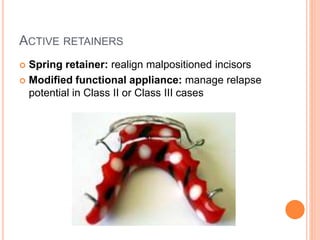
ACTIVE RETAINERS
 Spring retainer: realign malpositioned incisors
 Modified functional appliance: manage relapse
potential in Class II or Class III cases
ACTIVE RETAINERS
 Spring retainer: realign malpositioned incisors
 Will usually need to perform IPR prior to
appliance placement to prevent proclining
incisors into unstable position
 IPR flattens contacts increasing stability
 Can reduce incisors 0.5 mm/side
 If teeth are severely crowded, retreatment with
bonded brackets is recommended; followed by
fixed retention
Modified functional appliance: manage
relapse potential in Class II or Class III
cases
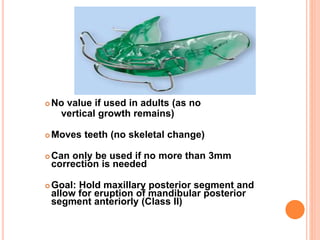
Activator or Bionator:
 Upper and lower retainers joined by inter-occlusal bite
blocks
 Maintain teeth within arch while slightly altering occlusal
relationship
 Example: If adolescent slips back 2-3 mm into Class II
after early correction, this appliance can be used to
recover proper occlusion
 No value if used in adults (as no
vertical growth remains)
 Moves teeth (no skeletal change)
 Can only be used if no more than 3mm
correction is needed
 Goal: Hold maxillary posterior segment and
allow for eruption of mandibular posterior
segment anteriorly (Class II)
CONCLUSION
 Goals of occlusion are predefined prior to start of
orthodontic treatment.Procedures should be
conducted with extreme care to minimize iatrogenic
effects on dental hard tissues and periodontium.
REFERENCES
 CONTEMPORARY OF ORTHODONTICS
BY WILLIAM PROFITT,HENRY W
FIELD,DAVID M SARVER
 ORTHODONTICS ART AND SCIENCE BY
S.I BHALAJHI

Retention appliances

  • 1.
    JOSNA THANKACHAN FINAL YEARPART I AL-AZHAR DENTAL COLLEGE RETENTION APPLIANCES
  • 2.
     INTRODUCTION  THEORIESOFRETENTION  RALEIGHWILLIAMSKEYS TO ELIMINATELOWERRETENTION  TYPESOF RETENTION  RETAINERS  CLASSIFICATION  REMOVABLERETAINERS  FIXEDRETAINERS  ACTIVERETAINERS  CONCLUSION  REFERENCES CONTENTS
  • 3.
     What isretention?  has been defined by Moyers as “Maintaining newly moved teeth in position long enough to aid in stabilizing their correction”. INTRODUCTION
  • 4.
     Why isretention necessary?  Retention is necessary for 3 main reasons 1. The gingival and periodontal tissues are affected by orthodontic tooth movement and require time for reorganization when the appliances are removed. 2. The teeth may be in an inherently unstable position after the treatment,so that soft tissue pressures constantly produce a relapse tendancy. 3. Changes produced by growth may alter the orthodontic treatment.
  • 5.
    If teeth arenot in an inherently unstable position and if there is no further growth, retention still s vitally important until gingival and periodontal organization is complete. Retention cannot be abandoned until growth is essentially completed.
  • 6.
     What isrelapse?   Relapse implies loss of any correction achieved by orthodontic  treatment.
  • 7.
    CAUSES OF RELAPSE L Textbook of orthodontics,SRIDHAR PREMKUMAR
  • 8.
    SCHOOLS OF THOUGHTPERTAINING TO RETENTION/HISTORY OF RETENTION  There are 4 schools of thought pertaining to retention:- 1. Occlusion school of thought(kingsley)  A/C to this,proper occlusion of teeth is a potent factor in maintaining the stability of the teeth.  At the end of active orthodontic treatment there should be proper intercuspation and interdigitation.  There should be cusp to fossa relationship between maxillary and mandibular teeth.
  • 9.
    2. Apical baseschool of thought(Axel lundstrom)  A/C to this,apical base is one of the most important factors in both correction of malocclusion as well as maintenance of correct occusion.  Intercanine and intermolar width should be altered to prevent relapse.  Nance advised to increase the arch length only to a minimal extent.
  • 10.
    3. Mandibular incisorschool of thought(Grieve and Tweed)  This theory postulated that the mandibular incisors should be placed upright and over the basal bone. 4. Musculature school of thought(Roger’s)  Establishing proper functional muscle balance is a must to achieve stable occlusion.  Improper muscle balance leads to relapse.
  • 11.
    THEOREMS ON RETENTION There are 10 theorems of which 9 are put forward by Riedel and the last one by Moyer.  THEOREM 1  “Teeth that have been moved tend to return to their former positions”  THEOREM 2  “elimination of the cause of malocclusion will prevent recurrence”
  • 12.
     THEOREM 3 “Malocclusion should be overcorrected as a safety factor”  THEOREM 4  “proper occlusion is a potent factor in holding teeth in their corrected positions”  THEOREM 5  “bone and adjacent tissues must be allowed to reorganize around newly positioned teeth”.
  • 13.
     THEOREM 6 “if the lower incisors are placed upright over basal bone,they are more likely to remain in good alignment”  THEOREM 7  “corrections carried out during periods of growth are less likely to relapse”  THEOREM 8  “the farther teeth have been moved ,the less likelyhood of relapse.
  • 14.
     THEOREM 9 “arch form particularly in the mandibular arch,cannot be altered permanently by appliance therapy”.  THEOREM 10  “many treated malocclusions require permanent retaining devices”.
  • 15.
    PRINCIPLES OF RETENTION Relapse potential may be predicted by evaluation of initial occlusion; teeth usually want to return to their original position; this is due to gingival fibers and unbalanced lip-tongue forces  Full-time retention is required for 3-4 months to allow for reorganization of PDL  Retention should continue for at least 12 months in non-growing patients or until growth has ceased in growing patients
  • 16.
    TYPES OF RETENTION natural/no retention  Limited or short term retention  Medium term/moderate retention  prolonged/permanent/semi permanent retention
  • 17.
    NATURAL RETENTION --Occlusion isself retentive --an upper incisor is moved over the bite, no retention is required --Conditions that do not require any retention  anterior crossbite  Serial extraction procedures  Blocked out or highly placed canines in class I extraction cases  Posterior crossbite in patients having steep cusps
  • 18.
    SHORT TERM RETENTION Limited retention-3-6 months  Class I non-extraction with dental arches showing proclination and spacing  Deep bite  Class I,Class II div 1 and div 2 cases treated by extraction
  • 19.
    MEDIUM TERM/MODERATE RETENTION Supporting tissue will take longer time to adapt  Retention may extend between 1-5 years  Class I non extraction cases,with protrusion and spacing of maxillary incisors  Corrected deep bites in classI or class II malocclusion  Corrected class II div 2 malocclusion
  • 20.
    PROLONGED/PERMANENT/SEMI PERMANENT RETENTION  Casestreated by expansion particularly in the mandibular arch  Generalized spacing with arch length excess  Severe rotatation  Midline diastema  Cleft palate cases  Adult patients with periodontal problems  Severe labiolingual malposition
  • 21.
    RALEIGH WILLIAMS KEYSTO ELIMINATE LOWER RETENTION. 6 keys:- 1. Incisal edge of the lower incisor should be placed on the A-P line or 1mm infront of it. This position of the lower incisor ensures stability following treatment. It also creates optimum balance of soft tissues in the lower third of the face.
  • 22.
    2. The lowerincisor apices should bespread distally to the crowns more than is generally considered appropriate and the apices of the lower lateral incisors must be spread more than those of central incisors. In otherwords the lower incisor roots should be diverging.
  • 23.
    3. The apexof the lower cuspid should be positioned distal to the crown 4. All 4 lower incisors apices must be in the same labolingual plane 5. The lower cuspid root apex must be positioned slightly buccal to the crown apex. 6. The lower incisors should be slenderised as needed after treatment
  • 24.
    RETAINERS  Retainers arepassive orthodontic appliances that help in maintaining and stabilizing the position of the teeth long enough to permit reorganization of the supporting structures after the active phase of orthodontic therapy
  • 25.
    IDEAL REQUIREMENTS FOR RETAINERS(GRABER) It should restrain each tooth that has been moved in to the desired position  It should be easily cleanable  It should allow functional forces to be transmitted to the retained teeth if worn  It should be self cleansable  It should be inconspicuous It should be strong enough to achieve the objectives of retention
  • 26.
    CLASSIFICATION  Hawley retainerand modifictions  Wrap around retainers  Canine to canine clip on  Tooth positioners  Essix/invisible retainers  Functional appliances  Banded canine to canine retainers  Bonded canine to canine retainers  Diastema maintenance  Antirotation band  Band and spur  Pontic maintenance REMOVABLE FIXED
  • 27.
    REMOVABLE RETAINERS  Effectivefor retention against intra arch stability  Effective in growth problems
  • 28.
    HAWLEY RETAINER  Mostcommon removable retainer  Developed in 1920s  Clasps on molars, palatal coverage, and labial bow with adjustment loops  Can incorporate biteplate for deep bite patients
  • 29.
     MODIFICATIONS  Labialbow can be made to extend from 1st premolar to the opposite 1st premolar. The design helps in closing spaces distal to canine.  Solder the bow to the bridge of the Adam’s clasp.This design avoids the risk of space opening upbetween the canine and premolar due to the crossover wires.
  • 30.
     Fitted labialbow offers excellent retention  Anterior bite planes can be incorporated to retain correct deep bite cases.  Advantages  Ease of fabrication  Minimal patient discomfort  Acceptable to most patients.
  • 31.
     Popularized byP.R.Begg  Consists of labial wire that extend till the last erupted molar and curves around it to get embedded in acrylic that spans the palate  Advantages:there is no cross over wire between the canine and premolar thereby eliminating the risk of space opening up. BEGG’S RETAINER
  • 32.
    CLIP-ON RETAINER/SPRING ALIGNER Made of a wire framework that runs labially over the incisors and then passes between the canine and premolar and is recurved to lie over the lingual surface. Both the labial as well as the lingual wire segments are embedded in a strip of clear acrylic.  Used for correction of rotations commonly seen in the lower anterior region.
  • 33.
    WRAP AROUND RETAINER Extended version of the spring aligner that covers all the teeth.  It consists of a wire that passes along the labial as well as lingual surfaces of all erupted teeth which is embedded in a strip of acrylic.  APPLICATION  Stabilizing a periodontally week dentition.
  • 34.
    WRAPAROUND MODIFICATION: “3-3 CLIP-ON” Usedmainly for lower anterior area Can realign incisors and/or maintain lower incisor space closure Used if posterior teeth were well aligned pre- treatment
  • 35.
    KESLING TOOTH POSITIONER Described by H.D.Kesling in 1945  It is made of a thermoplastic rubber like material that spans the inter-occlusal space and covers the clinical crowns of the upper and lower teeth and a small portion of the gingiva.  Needs no activation at regular intervals and is durable.  Drawbacks include difficulty in speech and risk of TMJ problems.
  • 36.
    ESSIX/INVISIBLE RETAINERS  Developedin 1993  Plastic removable appliance  Advantages:  Esthetic  Patient is more likely to wear  Inexpensive  Quick fabrication  Minimal bulk  High strength  No adjustments  Usually does not interfere with speech or function  Studies have determined that Essix retainers are as efficient as Hawley-type or bonded wire retainers
  • 37.
    POSITIONER  Can bemade as retainer or used for finishing and then maintained as retainer  Disadvantages as a retainer: 1. Bulky and difficult to wear full-time 2. Do not retain incisor position as well as a conventional retainer because patients usually wont wear full-time 3. Overbite increases due to limited patient wear
  • 38.
    Advantages as aretainer: 1. Reestablishes normal tissue when gingival hyperplasia is present 2. Maintains occlusal relationship and intra-arch position 3. Unlikely to break 4. Can be made with jaws rotated down and back to prevent Class III relapse 5. Can be constructed to prevent relapse in skeletal Class II and open bite cases  Growth control is less effective than part- time functional appliance or headgear
  • 39.
    DAMON SPLINT  Basically,upper and lower Essix retainers connected  Retentive splint for Class II, Class III, and bilateral crossbite treatment  Assists in tongue training  Holds teeth and arches in corrected position
  • 40.
    Designed By Dr.Dwight Damon  Can be used by adults or patients in mixed dentition  Minimal vertical opening to allow for air slot  Esthetic  Can be made using:hard pressure formed, dual hardness/soft liner and elastic silicone
  • 41.
    FIXED RETAINERS  Utilizedin cases where stability is questionable and prolonged retention is planned  Four main indications: 1. Maintaining lower incisor position 2. Holding diastema closed 3. Implant or pontic space maintenance 4. Retaining closed extraction spaces
  • 42.
    BONDED CANINE TOCANINE RETAINER  Commonly used in lower anterior region.  Canines are banded and a thick wire is contoured over the lingual aspects and soldered to the canine bands.  The bands predispose to poor oral hygiene and are unesthetic.in addition when these retainers are removed band spaces are seen around these bands.  These drawbacks of the banded retainers have made them less popular than the bonded retainers.
  • 43.
    BONDED LINGUAL RETAINERS They are retainers that are bonded on the lingual aspect.  Stainless steel/elgiloy wire is adapted lingually to follow the anterior curvature. The ends are curved over the canine where it is bonded.  Disadvantage : anterior teeth can sometimes rotate  This is overcome by using bonded retainers that are bonded to each of the anterior teeth from canine to canine.
  • 44.
     In caseextractions have been done as part of the orthodontic treatment it may be advisable to extend the retainer to include the 1st premolar of both the sides.  Alternatives  Use of etched or perforated metal cast bars that can be bonded on the lingual side of the teeth.  Braided or multistranded wire that can be bonded individually to each tooth in a segment.
  • 45.
     Advantage  Allindividual teeth are retained with no possibility of rotation of the incisors.  Use of lighter braided wires permit physiological movement of the teeth within the periodontal ligament.  Disadvantage  The bonding of the lingual retainers on the lingual surface of the teeth can be accomplished by direct or indirect bonding.
  • 46.
    BAND AND SPURRETAINER  Used in cases where a single tooth has been orthodontically treated for rotation,correction or labiolingual displacement. The tooth that has been moved is banded and spurs are soldered on to the bands so as to overlap the adjacent teeth. In case it is used to retain a tooth that has been blocked partially,the spurs are made on the labial aspect so that tooth doesnot onceagain get displaced palataly.In derotation cases ,one spur is placed labially and the other lingually to avoid relapse.
  • 47.
    ACTIVE RETAINERS  Springretainer: realign malpositioned incisors  Modified functional appliance: manage relapse potential in Class II or Class III cases
  • 48.
    ACTIVE RETAINERS  Springretainer: realign malpositioned incisors  Will usually need to perform IPR prior to appliance placement to prevent proclining incisors into unstable position  IPR flattens contacts increasing stability  Can reduce incisors 0.5 mm/side  If teeth are severely crowded, retreatment with bonded brackets is recommended; followed by fixed retention
  • 49.
    Modified functional appliance:manage relapse potential in Class II or Class III cases Activator or Bionator:  Upper and lower retainers joined by inter-occlusal bite blocks  Maintain teeth within arch while slightly altering occlusal relationship  Example: If adolescent slips back 2-3 mm into Class II after early correction, this appliance can be used to recover proper occlusion
  • 50.
     No valueif used in adults (as no vertical growth remains)  Moves teeth (no skeletal change)  Can only be used if no more than 3mm correction is needed  Goal: Hold maxillary posterior segment and allow for eruption of mandibular posterior segment anteriorly (Class II)
  • 51.
    CONCLUSION  Goals ofocclusion are predefined prior to start of orthodontic treatment.Procedures should be conducted with extreme care to minimize iatrogenic effects on dental hard tissues and periodontium.
  • 52.
    REFERENCES  CONTEMPORARY OFORTHODONTICS BY WILLIAM PROFITT,HENRY W FIELD,DAVID M SARVER  ORTHODONTICS ART AND SCIENCE BY S.I BHALAJHI