Session 2 -ADLT 602 Program Planning, Management, and Evaluation Dr.  Terry Carter [email_address]
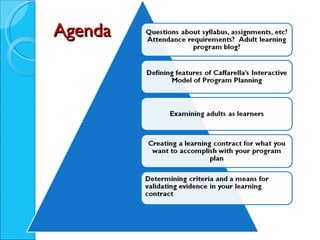
Agenda
Caffarella’s Interactive Model Interactive Model of Program  Planning Building a Solid Base of support Identifying Program Ideas Sorting and Prioritizing Program Ideas Developing  Program  Objectives Designing Instructional  Plans Devising Transfer of  Learning Plans Formulating Evaluating Plans Making Recommendations and Communicating Results Preparing Budgets and Marketing Plans Coordinating Facilities and On-site Events Discerning the  Context  Selecting Formats, Schedules, and Staff Needs
What are the features of Caffarella’s model that make it unique and valuable for program planners?
Assumptions Inherent in the Interactive Model of Program Planning
What do we know about adults as learners and how does that affect program planning?
Adults as learners: What are the implications?
Five Critical Issues in Program Planning
Developing a Learning Contract for the Program You Want to Create Learning Objectives Learning Resources and Strategies  Evidence of Accomplishment of Objectives  Criteria and Means for Validating
Step 1:  Diagnose Your Learning Needs
Step 2: Specify Your Learning Objectives
Writing Behavioral Objectives “ An objective is a written statement, defining in precise terms,  what  the learner will be able to do at the end of training and  how well .”   Robert Mager
Traditionally, behavioral objectives address three things: The  desired behavior The  conditions  under which the behavior is performed The  performance standards   that are to be met
Example for ADLT 602: At the end of this course  (condition),   learners will be able to design a program plan  (desired behavior)   that uses all of the elements of Caffarella’s interactive model of program planning  (performance standard).
Analysis Evaluation Synthesis Application Comprehension Knowledge Bloom’s Taxonomy for Levels of Cognitive Processing
Step 3:  Specify Learning Resources and Strategies
Step 4:  Specify Evidence of Accomplishment
Step 5: Specify How The Evidence Will be Validated
Step 6: Review Your Contract with Your Peers
Step 7:  Carry out your contract. Step 8. Evaluate your learning.  Ask those you indicated in Step 6 (peers or others) to examine your evidence and validation data and give you their judgment.

Class 2 adlt 602 ppt

  • 1.
    Session 2 -ADLT602 Program Planning, Management, and Evaluation Dr. Terry Carter [email_address]
  • 2.
  • 3.
    Caffarella’s Interactive ModelInteractive Model of Program Planning Building a Solid Base of support Identifying Program Ideas Sorting and Prioritizing Program Ideas Developing Program Objectives Designing Instructional Plans Devising Transfer of Learning Plans Formulating Evaluating Plans Making Recommendations and Communicating Results Preparing Budgets and Marketing Plans Coordinating Facilities and On-site Events Discerning the Context Selecting Formats, Schedules, and Staff Needs
  • 4.
    What are thefeatures of Caffarella’s model that make it unique and valuable for program planners?
  • 5.
    Assumptions Inherent inthe Interactive Model of Program Planning
  • 6.
    What do weknow about adults as learners and how does that affect program planning?
  • 7.
    Adults as learners:What are the implications?
  • 8.
    Five Critical Issuesin Program Planning
  • 9.
    Developing a LearningContract for the Program You Want to Create Learning Objectives Learning Resources and Strategies Evidence of Accomplishment of Objectives Criteria and Means for Validating
  • 10.
    Step 1: Diagnose Your Learning Needs
  • 11.
    Step 2: SpecifyYour Learning Objectives
  • 12.
    Writing Behavioral Objectives“ An objective is a written statement, defining in precise terms, what the learner will be able to do at the end of training and how well .” Robert Mager
  • 13.
    Traditionally, behavioral objectivesaddress three things: The desired behavior The conditions under which the behavior is performed The performance standards that are to be met
  • 14.
    Example for ADLT602: At the end of this course (condition), learners will be able to design a program plan (desired behavior) that uses all of the elements of Caffarella’s interactive model of program planning (performance standard).
  • 15.
    Analysis Evaluation SynthesisApplication Comprehension Knowledge Bloom’s Taxonomy for Levels of Cognitive Processing
  • 16.
    Step 3: Specify Learning Resources and Strategies
  • 17.
    Step 4: Specify Evidence of Accomplishment
  • 18.
    Step 5: SpecifyHow The Evidence Will be Validated
  • 19.
    Step 6: ReviewYour Contract with Your Peers
  • 20.
    Step 7: Carry out your contract. Step 8. Evaluate your learning. Ask those you indicated in Step 6 (peers or others) to examine your evidence and validation data and give you their judgment.