Writing Performance Objectives

          Emily Mross
Objectives

 Students will be able to write their own
  performance objectives, which describe
  behaviors, conditions and criteria, for hypothetical
  lessons and post them to the discussion forum.
 Students will be able to critique and discuss the
  performance objectives of their peers with
  constructive feedback in the discussion forum.
Performance Objectives
 Performance objectives create guidelines for
  instructional designers, students, or both – it
  identifies the skill(s) to be learned, and the criteria
  for mastery of a given lesson.
 It may also be called a behavioral
  objective, learning objective, and instructional
  objective.
 Writing performance objectives engages the
  previous steps of the instructional design
  process: instructional goals, instructional
  analysis, and learner/context analysis. All have
  bearing on the performance objectives.
Breaking down the Performance
Objective
 Performance objectives describe three main
 things:

   Content/Behavior – What skill(s) will be
   demonstrated?

   Conditions – What will the learner need to
   demonstrate the skill? How/where will it be
   demonstrated?

   Criteria – How will the skill be evaluated? What
   constitutes success?
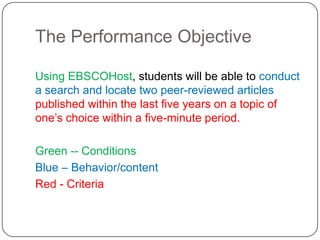
The Performance Objective

Using EBSCOHost, students will be able to conduct
a search and locate two peer-reviewed articles
published within the last five years on a topic of
one’s choice within a five-minute period.

Green -- Conditions
Blue – Behavior/content
Red - Criteria
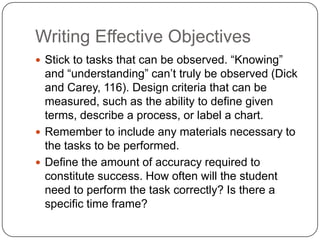
Writing Effective Objectives
 Stick to tasks that can be observed. “Knowing”
  and “understanding” can’t truly be observed (Dick
  and Carey, 116). Design criteria that can be
  measured, such as the ability to define given
  terms, describe a process, or label a chart.
 Remember to include any materials necessary to
  the tasks to be performed.
 Define the amount of accuracy required to
  constitute success. How often will the student
  need to perform the task correctly? Is there a
  specific time frame?
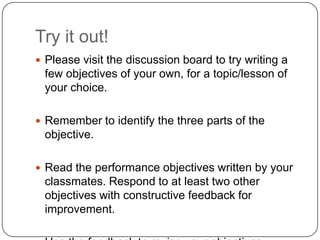
Try it out!
 Please visit the discussion board to try writing a
 few objectives of your own, for a topic/lesson of
 your choice.

 Remember to identify the three parts of the
 objective.

 Read the performance objectives written by your
 classmates. Respond to at least two other
 objectives with constructive feedback for
 improvement.

Writing performance objectives

  • 1.
  • 2.
    Objectives  Students willbe able to write their own performance objectives, which describe behaviors, conditions and criteria, for hypothetical lessons and post them to the discussion forum.  Students will be able to critique and discuss the performance objectives of their peers with constructive feedback in the discussion forum.
  • 3.
    Performance Objectives  Performanceobjectives create guidelines for instructional designers, students, or both – it identifies the skill(s) to be learned, and the criteria for mastery of a given lesson.  It may also be called a behavioral objective, learning objective, and instructional objective.  Writing performance objectives engages the previous steps of the instructional design process: instructional goals, instructional analysis, and learner/context analysis. All have bearing on the performance objectives.
  • 4.
    Breaking down thePerformance Objective  Performance objectives describe three main things:  Content/Behavior – What skill(s) will be demonstrated?  Conditions – What will the learner need to demonstrate the skill? How/where will it be demonstrated?  Criteria – How will the skill be evaluated? What constitutes success?
  • 5.
    The Performance Objective UsingEBSCOHost, students will be able to conduct a search and locate two peer-reviewed articles published within the last five years on a topic of one’s choice within a five-minute period. Green -- Conditions Blue – Behavior/content Red - Criteria
  • 6.
    Writing Effective Objectives Stick to tasks that can be observed. “Knowing” and “understanding” can’t truly be observed (Dick and Carey, 116). Design criteria that can be measured, such as the ability to define given terms, describe a process, or label a chart.  Remember to include any materials necessary to the tasks to be performed.  Define the amount of accuracy required to constitute success. How often will the student need to perform the task correctly? Is there a specific time frame?
  • 7.
    Try it out! Please visit the discussion board to try writing a few objectives of your own, for a topic/lesson of your choice.  Remember to identify the three parts of the objective.  Read the performance objectives written by your classmates. Respond to at least two other objectives with constructive feedback for improvement.