ALTERNATING
GROUP
Prem Vishwanath Joshi
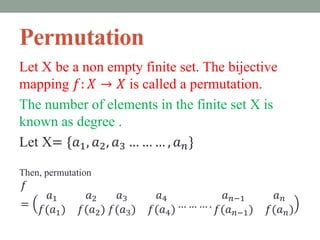
Permutation
Let X be a non empty finite set. The bijective
mapping 𝑓: 𝑋 → 𝑋 is called a permutation.
The number of elements in the finite set X is
known as degree .
Let X= {𝑎1, 𝑎2, 𝑎3 … … … , 𝑎 𝑛}
Then, permutation
𝑓
=
𝑎1 𝑎2
𝑓(𝑎1) 𝑓(𝑎2)
𝑎3 𝑎4
𝑓(𝑎3) 𝑓(𝑎4) … … … .
𝑎 𝑛−1 𝑎 𝑛
𝑓(𝑎 𝑛−1) 𝑓(𝑎 𝑛)
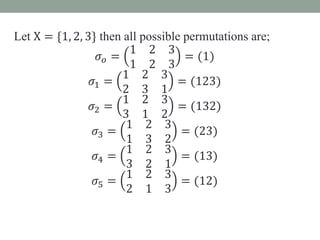
Let X = {1, 2, 3} then all possible permutations are;
𝜎𝑜 =
1 2 3
1 2 3
= (1)
𝜎1 =
1 2 3
2 3 1
= (123)
𝜎2 =
1 2 3
3 1 2
= (132)
𝜎3 =
1 2 3
1 3 2
= (23)
𝜎4 =
1 2 3
3 2 1
= (13)
𝜎5 =
1 2 3
2 1 3
= (12)
The set of all permutations
𝑆3 = { 1 , 12 , 13 , 23 , 123 ,
(132)} is called the permutation group of
the set X={1,2,3}.
This permutation group has the degree 3
and order (3!=6)
The permutation group is also called the
symmetric group.
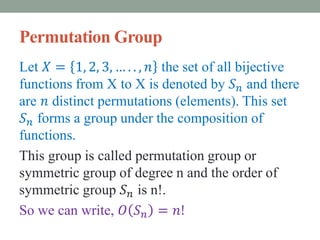
Permutation Group
Let 𝑋 = 1, 2, 3, … . . , 𝑛 the set of all bijective
functions from X to X is denoted by 𝑆 𝑛 and there
are 𝑛 distinct permutations (elements). This set
𝑆 𝑛 forms a group under the composition of
functions.
This group is called permutation group or
symmetric group of degree n and the order of
symmetric group 𝑆 𝑛 is n!.
So we can write, 𝑂 𝑆 𝑛 = 𝑛!
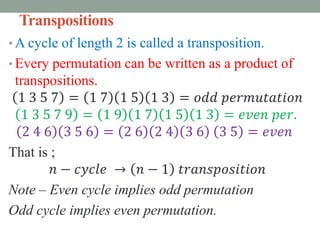
Transpositions
• A cycle of length 2 is called a transposition.
• Every permutation can be written as a product of
transpositions.
1 3 5 7 = 1 7 1 5 1 3 = 𝑜𝑑𝑑 𝑝𝑒𝑟𝑚𝑢𝑡𝑎𝑡𝑖𝑜𝑛
1 3 5 7 9 = 1 9 1 7 1 5 1 3 = 𝑒𝑣𝑒𝑛 𝑝𝑒𝑟.
2 4 6 3 5 6 = 2 6 2 4 3 6 3 5 = 𝑒𝑣𝑒𝑛
That is ;
𝑛 − 𝑐𝑦𝑐𝑙𝑒 → 𝑛 − 1 𝑡𝑟𝑎𝑛𝑠𝑝𝑜𝑠𝑖𝑡𝑖𝑜𝑛
Note – Even cycle implies odd permutation
Odd cycle implies even permutation.
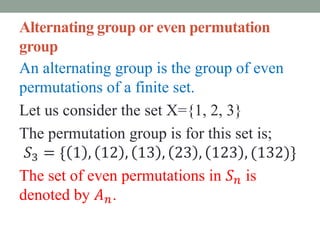
Alternating group or even permutation
group
An alternating group is the group of even
permutations of a finite set.
Let us consider the set X={1, 2, 3}
The permutation group is for this set is;
𝑆3 = { 1 , 12 , 13 , 23 , 123 , (132)}
The set of even permutations in 𝑆 𝑛 is
denoted by 𝐴 𝑛.
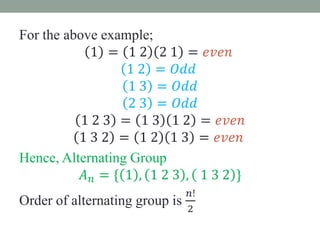
For the above example;
1 = 1 2 2 1 = 𝑒𝑣𝑒𝑛
1 2 = 𝑂𝑑𝑑
1 3 = 𝑂𝑑𝑑
2 3 = 𝑂𝑑𝑑
1 2 3 = 1 3 1 2 = 𝑒𝑣𝑒𝑛
1 3 2 = 1 2 1 3 = 𝑒𝑣𝑒𝑛
Hence, Alternating Group
𝐴 𝑛 = { 1 , 1 2 3 , 1 3 2 }
Order of alternating group is
𝑛!
2
Thank
You

Alternating Group presentation

  • 1.
  • 2.
    Permutation Let X bea non empty finite set. The bijective mapping 𝑓: 𝑋 → 𝑋 is called a permutation. The number of elements in the finite set X is known as degree . Let X= {𝑎1, 𝑎2, 𝑎3 … … … , 𝑎 𝑛} Then, permutation 𝑓 = 𝑎1 𝑎2 𝑓(𝑎1) 𝑓(𝑎2) 𝑎3 𝑎4 𝑓(𝑎3) 𝑓(𝑎4) … … … . 𝑎 𝑛−1 𝑎 𝑛 𝑓(𝑎 𝑛−1) 𝑓(𝑎 𝑛)
  • 3.
    Let X ={1, 2, 3} then all possible permutations are; 𝜎𝑜 = 1 2 3 1 2 3 = (1) 𝜎1 = 1 2 3 2 3 1 = (123) 𝜎2 = 1 2 3 3 1 2 = (132) 𝜎3 = 1 2 3 1 3 2 = (23) 𝜎4 = 1 2 3 3 2 1 = (13) 𝜎5 = 1 2 3 2 1 3 = (12)
  • 4.
    The set ofall permutations 𝑆3 = { 1 , 12 , 13 , 23 , 123 , (132)} is called the permutation group of the set X={1,2,3}. This permutation group has the degree 3 and order (3!=6) The permutation group is also called the symmetric group.
  • 5.
    Permutation Group Let 𝑋= 1, 2, 3, … . . , 𝑛 the set of all bijective functions from X to X is denoted by 𝑆 𝑛 and there are 𝑛 distinct permutations (elements). This set 𝑆 𝑛 forms a group under the composition of functions. This group is called permutation group or symmetric group of degree n and the order of symmetric group 𝑆 𝑛 is n!. So we can write, 𝑂 𝑆 𝑛 = 𝑛!
  • 6.
    Transpositions • A cycleof length 2 is called a transposition. • Every permutation can be written as a product of transpositions. 1 3 5 7 = 1 7 1 5 1 3 = 𝑜𝑑𝑑 𝑝𝑒𝑟𝑚𝑢𝑡𝑎𝑡𝑖𝑜𝑛 1 3 5 7 9 = 1 9 1 7 1 5 1 3 = 𝑒𝑣𝑒𝑛 𝑝𝑒𝑟. 2 4 6 3 5 6 = 2 6 2 4 3 6 3 5 = 𝑒𝑣𝑒𝑛 That is ; 𝑛 − 𝑐𝑦𝑐𝑙𝑒 → 𝑛 − 1 𝑡𝑟𝑎𝑛𝑠𝑝𝑜𝑠𝑖𝑡𝑖𝑜𝑛 Note – Even cycle implies odd permutation Odd cycle implies even permutation.
  • 7.
    Alternating group oreven permutation group An alternating group is the group of even permutations of a finite set. Let us consider the set X={1, 2, 3} The permutation group is for this set is; 𝑆3 = { 1 , 12 , 13 , 23 , 123 , (132)} The set of even permutations in 𝑆 𝑛 is denoted by 𝐴 𝑛.
  • 8.
    For the aboveexample; 1 = 1 2 2 1 = 𝑒𝑣𝑒𝑛 1 2 = 𝑂𝑑𝑑 1 3 = 𝑂𝑑𝑑 2 3 = 𝑂𝑑𝑑 1 2 3 = 1 3 1 2 = 𝑒𝑣𝑒𝑛 1 3 2 = 1 2 1 3 = 𝑒𝑣𝑒𝑛 Hence, Alternating Group 𝐴 𝑛 = { 1 , 1 2 3 , 1 3 2 } Order of alternating group is 𝑛! 2
  • 9.

Editor's Notes

  • #9 But odd permutation does not form group because there is no identity element.