
How Civil Engineers can involve in
Green Buildings Projects?
Module Development and Delivery for
Civil Engineering Degree Program at
Universitas Negeri Semarang, Indonesia
Presented By:
Boon Cheong Chew ;Yu Xin, Ou Yang
22nd March 2017
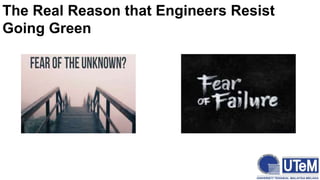
The Real Reason that Engineers Resist
Going Green
Does Civil Engineer Contribute in Green
Rating Tools Process?
• Architects always blame that Civil Engineer is the hardest one to contribute in green
buildings or contribute the least among the design team toward a green project.
• However, Civil Engineers should be an enthusiastic and integrated contributor to green
rating process.
Civil Engineers can add value to
LEED process
• Construction activity pollution
prevention
• Site selection (input to the
project owner)
• Development density and
community connectivity
• Brownfield redevelopment
• Alternative transportation
• Site development
• Storm water design
• Heat island effect
• Light pollution reduction
16 Ways Civil Engineer Can Add Value to The
LEED Process
• Water efficient landscaping
• Innovative wastewater
technologies
• Optimize energy performance
• Construction waste
management
• Recycled content
• Innovation in design
• Regional priority
SUSTAINABLE SITE
Prerequisite 1 – Construction Activity
Pollution Prevention
• Credit 1 – Site Selection (1pt) – Although its often not the
case, civil engineers should always be a part of the site
selection process. A civil engineers input to the project
owner can often save money, time and headaches.
• Credit 2 – Development Density and Community
Connectivity (5pts) – This comes down to the civil
engineer being a part of the site selection process, working
closely with the city council.
• Credit 3 – Brownfield Redevelopment
(1pt) – Civil engineers can be an integral part
of the site rehabilitation process. Take note
on legal aspects.
• Credit 4.1-4.4 – Alternative Transportation
(12 pts) – Transportation is what civil
engineers do. By providing for
public transportation access in the form of
site selection or creating new infrastructure,
making walking and bicycling more
appealing.
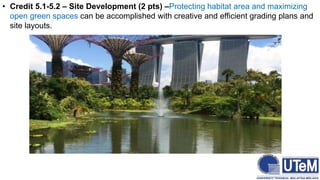
• Credit 5.1-5.2 – Site Development (2 pts) –Protecting habitat area and maximizing
open green spaces can be accomplished with creative and efficient grading plans and
site layouts.
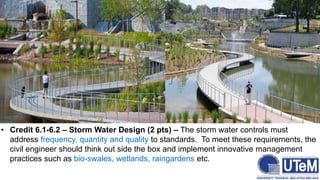
• Credit 6.1-6.2 – Storm Water Design (2 pts) – The storm water controls must
address frequency, quantity and quality to standards. To meet these requirements, the
civil engineer should think out side the box and implement innovative management
practices such as bio-swales, wetlands, raingardens etc.
• Credit 7.1-7.2 – Heat Island Effect (2 pts) – Civil engineers can help achieve these
points for both roof and non-roof credits by recommending appropriate hardscape
materials, providing shade from landscaping (new or existing), or assisting with green
roof specification and design.
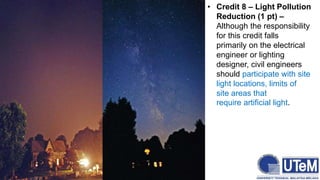
• Credit 8 – Light Pollution
Reduction (1 pt) –
Although the responsibility
for this credit falls
primarily on the electrical
engineer or lighting
designer, civil engineers
should participate with site
light locations, limits of
site areas that
require artificial light.
WATER EFFICIENCY
• Credit 1 – Water Efficient Landscaping (4
pts) – Civil engineers can assist with
eliminating potable water use for
landscaping by recommending and
designing rainwater catchment systems,
wastewater treatment systems or rain water
harvesting for use in irrigation, and designing
storm water management controls (such as
raingardens) that divert storm water
to landscape areas and provide for
landscape water needs.
WATER
EFFICIENCY
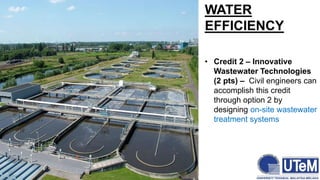
• Credit 2 – Innovative
Wastewater Technologies
(2 pts) – Civil engineers can
accomplish this credit
through option 2 by
designing on-site wastewater
treatment systems
ENERGY AND
ATMOSPHERE
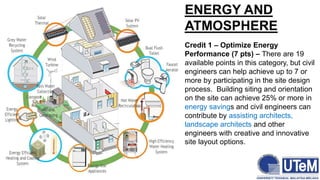
Credit 1 – Optimize Energy
Performance (7 pts) – There are 19
available points in this category, but civil
engineers can help achieve up to 7 or
more by participating in the site design
process. Building siting and orientation
on the site can achieve 25% or more in
energy savings and civil engineers can
contribute by assisting architects,
landscape architects and other
engineers with creative and innovative
site layout options.
MATERIALS AND RESOURCES
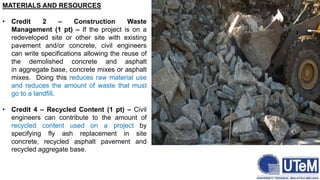
• Credit 2 – Construction Waste
Management (1 pt) – If the project is on a
redeveloped site or other site with existing
pavement and/or concrete, civil engineers
can write specifications allowing the reuse of
the demolished concrete and asphalt
in aggregate base, concrete mixes or asphalt
mixes. Doing this reduces raw material use
and reduces the amount of waste that must
go to a landfill.
• Credit 4 – Recycled Content (1 pt) – Civil
engineers can contribute to the amount of
recycled content used on a project by
specifying fly ash replacement in site
concrete, recycled asphalt pavement and
recycled aggregate base.
• Credit 5 – Regional Materials (1 pt) – The largest ingredient in both asphalt and
concrete is the aggregate, which is almost always meets the regional materials
requirements of LEED. While it is usually a small portion of the cost on a project, it
can still contribute to the total nonetheless.
INNOVATION IN DESIGN
• Credit 1 – Innovation in Design (2 pts) – Everyone on the design team should be
trying to achieve innovation in design credits. The ID credit was established by the
USGBC to reward innovative design and construction strategies that are
not specifically accounted for the in the rating system. 4 points are possible in this
credit and civil engineers should be able to provide valuable inputs.
REGIONAL PRIORITY
• Credit 1 – Regional Priority (2 pts) – Regional priority credits obviously vary by
region, and a total of 4 points are possible.
-Historical site
-Biodiversity site
-Commercial areas
-Residential areas
How do Structural Engineers Contribute to
LEED Certification?
• Structural engineer is a specialty within the field of civil engineering that focuses on the
framework of structures and designing those structures to withstand the stress and
pressures of the environment.
• Structural engineers are trained to understand and calculate the stability, strength, and
rigidity of built structures, to develop designs and integrate their design with that of
other designers, and to supervise construction of projects on site.
• Since LEED certification is a label for buildings, it seems reasonable that structural
engineers would be involved with the process.
• Structural engineer can join LEED certification process early in the design phase to
collaborate with the architect and develop a scheme for an efficient structural system.
• A structural engineer’s knowledge of building materials and structural penetrations
helps LEED project teams to:
-Decrease material consumption
-Create a waste management plan
-Encourage recycling and reuse
-Reduce storm water runoff
-Source local materials
-Reduce carbon omissions
• A building’s structure can have a significant impact on its embodied energy – i.e., the
available energy used in the work of constructing a building.
• A building’s structure accounts for about 25% of the building’s embodied energy but
only 10% of the building’s cost. A structural engineer with LEED knowledge can assist
with sound sustainable design principles that can significantly reduce the building’s
embodied energy.
• With regard to LEED certification projects, structural engineers contribute most to the
Materials & Resources credit category.
• Structural engineers should be careful when specifying the structural components of a
building in order to capture all of the available LEED points and minimize the building’s
embodied energy.
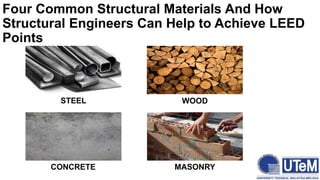
Four Common Structural Materials And How
Structural Engineers Can Help to Achieve LEED
Points
STEEL
CONCRETE MASONRY
WOOD
Steel
Materials and Resources credit 1 (MR 1) - Existing steel frame structures are easily
reinforced so the original structure can be reused.
Credit MR 2 and MR 3 – Steel is the most recycled material in the world. Virtually any
steel on a construction site can be recycled or re-fabricated and reused.
Credit MR 4.1 and MR4.2 - Most structural steel shapes are made from 97% recycled
material. Recycled content in steel plate is about 65%. HSS sections are typically not
made with recycled steel and should be avoided on LEED projects. The Steel Recycling
Institute reports the post-consumer recycled content is about 64% and the post-industrial
recycled content is about 30%.
Credit MR 5 - Steel is usually manufactured locally but locally extracted materials are
not always available.
Concrete
Credit MR 1 - Existing concrete buildings are often reinforced and reused.
Credit MR 2 – Concrete can be crushed and reused as fill material. Steel rebar can be
recycled.
Credit MR 4.1 and MR4.2 – Rebar is made with recycled steel. Cement increases CO2
emissions. Pozzolans such as fly ash (High Volume Fly Ash Concrete - HVFA) and
ground granulated blast furnace slag can reduce the cement content by more than 50%.
Credit MR 5 – Locally manufactured and extracted materials are commonly available.
Masonry
Sustainable Sites credit 6 and 7 (SS 6 and SS 7) – Permeable concrete or masonry
pavements or open cell concrete masonry pavers can improve storm water management
and reduce non-roof heat island effects.
Credit MR 1 - Existing masonry buildings are often reinforced and reused.
Credit MR 2 – Masonry can be crushed and reused as fill material. Steel rebar can be
recycled.
Credit MR 4.1 and MR4.2 – Rebar is made with recycled steel. Concrete masonry units
and grout can be made with HVFA. Clay brick is often made with recycled brick ground
and used as grog. The grog can qualify as post-consumer recycled content. Other
common recycled content in masonry is bottom ash, fly ash, sludge, and even
contaminated soil.
Credit MR 5 – Locally manufactured and extracted materials are commonly available.
Wood
Credit MR 2 – Wood is easily recyclable and reused.
Credit MR 5 – Locally manufactured and extracted materials can be available for some
projects.
Credit MR 6 – Wood is an entirely renewable material.
Credit MR 7 – Sustainable material suppliers with FSC-certified wood products is readily
available.
Tasks
• Find information about new construction materials which are
produced by using recycling materials. For example:
-Ferrock
-AshCrete
-TimberCreate
Contact
Boon Cheong Chew
Email: bcchew@utem.edu.my
LinkedIn:
https://my.linkedin.com/in/bcchew
My Primary Research Interests:
(a) Renewable Energy Development &
Deployment
(b) Clean Technologies Innovation &
Implementation
(c) Green & Sustainability Practices
(d) Human Technology Innovation &
Introduction
*Please google BCChew to follow my work
Yu Xin Ou Yang
Email: yuxin01_ouyang@hotmail.com
My Primary Research Interests:
(a) Green & Sustainability Practices
(b) Robotics & Automation Engineering
* Please google Ou Yang Yu Xin
Academia to follow my work

Civil Engineer for Green Buildings

  • 1.
    How Civil Engineerscan involve in Green Buildings Projects? Module Development and Delivery for Civil Engineering Degree Program at Universitas Negeri Semarang, Indonesia Presented By: Boon Cheong Chew ;Yu Xin, Ou Yang 22nd March 2017
  • 2.
    The Real Reasonthat Engineers Resist Going Green
  • 3.
    Does Civil EngineerContribute in Green Rating Tools Process? • Architects always blame that Civil Engineer is the hardest one to contribute in green buildings or contribute the least among the design team toward a green project. • However, Civil Engineers should be an enthusiastic and integrated contributor to green rating process.
  • 4.
    Civil Engineers canadd value to LEED process • Construction activity pollution prevention • Site selection (input to the project owner) • Development density and community connectivity • Brownfield redevelopment • Alternative transportation • Site development • Storm water design • Heat island effect • Light pollution reduction 16 Ways Civil Engineer Can Add Value to The LEED Process • Water efficient landscaping • Innovative wastewater technologies • Optimize energy performance • Construction waste management • Recycled content • Innovation in design • Regional priority
  • 5.
    SUSTAINABLE SITE Prerequisite 1– Construction Activity Pollution Prevention • Credit 1 – Site Selection (1pt) – Although its often not the case, civil engineers should always be a part of the site selection process. A civil engineers input to the project owner can often save money, time and headaches. • Credit 2 – Development Density and Community Connectivity (5pts) – This comes down to the civil engineer being a part of the site selection process, working closely with the city council.
  • 6.
    • Credit 3– Brownfield Redevelopment (1pt) – Civil engineers can be an integral part of the site rehabilitation process. Take note on legal aspects. • Credit 4.1-4.4 – Alternative Transportation (12 pts) – Transportation is what civil engineers do. By providing for public transportation access in the form of site selection or creating new infrastructure, making walking and bicycling more appealing.
  • 7.
    • Credit 5.1-5.2– Site Development (2 pts) –Protecting habitat area and maximizing open green spaces can be accomplished with creative and efficient grading plans and site layouts.
  • 8.
    • Credit 6.1-6.2– Storm Water Design (2 pts) – The storm water controls must address frequency, quantity and quality to standards. To meet these requirements, the civil engineer should think out side the box and implement innovative management practices such as bio-swales, wetlands, raingardens etc.
  • 9.
    • Credit 7.1-7.2– Heat Island Effect (2 pts) – Civil engineers can help achieve these points for both roof and non-roof credits by recommending appropriate hardscape materials, providing shade from landscaping (new or existing), or assisting with green roof specification and design.
  • 10.
    • Credit 8– Light Pollution Reduction (1 pt) – Although the responsibility for this credit falls primarily on the electrical engineer or lighting designer, civil engineers should participate with site light locations, limits of site areas that require artificial light.
  • 11.
    WATER EFFICIENCY • Credit1 – Water Efficient Landscaping (4 pts) – Civil engineers can assist with eliminating potable water use for landscaping by recommending and designing rainwater catchment systems, wastewater treatment systems or rain water harvesting for use in irrigation, and designing storm water management controls (such as raingardens) that divert storm water to landscape areas and provide for landscape water needs.
  • 12.
    WATER EFFICIENCY • Credit 2– Innovative Wastewater Technologies (2 pts) – Civil engineers can accomplish this credit through option 2 by designing on-site wastewater treatment systems
  • 13.
    ENERGY AND ATMOSPHERE Credit 1– Optimize Energy Performance (7 pts) – There are 19 available points in this category, but civil engineers can help achieve up to 7 or more by participating in the site design process. Building siting and orientation on the site can achieve 25% or more in energy savings and civil engineers can contribute by assisting architects, landscape architects and other engineers with creative and innovative site layout options.
  • 14.
    MATERIALS AND RESOURCES •Credit 2 – Construction Waste Management (1 pt) – If the project is on a redeveloped site or other site with existing pavement and/or concrete, civil engineers can write specifications allowing the reuse of the demolished concrete and asphalt in aggregate base, concrete mixes or asphalt mixes. Doing this reduces raw material use and reduces the amount of waste that must go to a landfill. • Credit 4 – Recycled Content (1 pt) – Civil engineers can contribute to the amount of recycled content used on a project by specifying fly ash replacement in site concrete, recycled asphalt pavement and recycled aggregate base.
  • 15.
    • Credit 5– Regional Materials (1 pt) – The largest ingredient in both asphalt and concrete is the aggregate, which is almost always meets the regional materials requirements of LEED. While it is usually a small portion of the cost on a project, it can still contribute to the total nonetheless.
  • 16.
    INNOVATION IN DESIGN •Credit 1 – Innovation in Design (2 pts) – Everyone on the design team should be trying to achieve innovation in design credits. The ID credit was established by the USGBC to reward innovative design and construction strategies that are not specifically accounted for the in the rating system. 4 points are possible in this credit and civil engineers should be able to provide valuable inputs.
  • 17.
    REGIONAL PRIORITY • Credit1 – Regional Priority (2 pts) – Regional priority credits obviously vary by region, and a total of 4 points are possible. -Historical site -Biodiversity site -Commercial areas -Residential areas
  • 18.
    How do StructuralEngineers Contribute to LEED Certification? • Structural engineer is a specialty within the field of civil engineering that focuses on the framework of structures and designing those structures to withstand the stress and pressures of the environment. • Structural engineers are trained to understand and calculate the stability, strength, and rigidity of built structures, to develop designs and integrate their design with that of other designers, and to supervise construction of projects on site. • Since LEED certification is a label for buildings, it seems reasonable that structural engineers would be involved with the process. • Structural engineer can join LEED certification process early in the design phase to collaborate with the architect and develop a scheme for an efficient structural system.
  • 19.
    • A structuralengineer’s knowledge of building materials and structural penetrations helps LEED project teams to: -Decrease material consumption -Create a waste management plan -Encourage recycling and reuse -Reduce storm water runoff -Source local materials -Reduce carbon omissions • A building’s structure can have a significant impact on its embodied energy – i.e., the available energy used in the work of constructing a building. • A building’s structure accounts for about 25% of the building’s embodied energy but only 10% of the building’s cost. A structural engineer with LEED knowledge can assist with sound sustainable design principles that can significantly reduce the building’s embodied energy.
  • 20.
    • With regardto LEED certification projects, structural engineers contribute most to the Materials & Resources credit category. • Structural engineers should be careful when specifying the structural components of a building in order to capture all of the available LEED points and minimize the building’s embodied energy.
  • 21.
    Four Common StructuralMaterials And How Structural Engineers Can Help to Achieve LEED Points STEEL CONCRETE MASONRY WOOD
  • 22.
    Steel Materials and Resourcescredit 1 (MR 1) - Existing steel frame structures are easily reinforced so the original structure can be reused. Credit MR 2 and MR 3 – Steel is the most recycled material in the world. Virtually any steel on a construction site can be recycled or re-fabricated and reused. Credit MR 4.1 and MR4.2 - Most structural steel shapes are made from 97% recycled material. Recycled content in steel plate is about 65%. HSS sections are typically not made with recycled steel and should be avoided on LEED projects. The Steel Recycling Institute reports the post-consumer recycled content is about 64% and the post-industrial recycled content is about 30%. Credit MR 5 - Steel is usually manufactured locally but locally extracted materials are not always available.
  • 23.
    Concrete Credit MR 1- Existing concrete buildings are often reinforced and reused. Credit MR 2 – Concrete can be crushed and reused as fill material. Steel rebar can be recycled. Credit MR 4.1 and MR4.2 – Rebar is made with recycled steel. Cement increases CO2 emissions. Pozzolans such as fly ash (High Volume Fly Ash Concrete - HVFA) and ground granulated blast furnace slag can reduce the cement content by more than 50%. Credit MR 5 – Locally manufactured and extracted materials are commonly available.
  • 24.
    Masonry Sustainable Sites credit6 and 7 (SS 6 and SS 7) – Permeable concrete or masonry pavements or open cell concrete masonry pavers can improve storm water management and reduce non-roof heat island effects. Credit MR 1 - Existing masonry buildings are often reinforced and reused. Credit MR 2 – Masonry can be crushed and reused as fill material. Steel rebar can be recycled. Credit MR 4.1 and MR4.2 – Rebar is made with recycled steel. Concrete masonry units and grout can be made with HVFA. Clay brick is often made with recycled brick ground and used as grog. The grog can qualify as post-consumer recycled content. Other common recycled content in masonry is bottom ash, fly ash, sludge, and even contaminated soil. Credit MR 5 – Locally manufactured and extracted materials are commonly available.
  • 25.
    Wood Credit MR 2– Wood is easily recyclable and reused. Credit MR 5 – Locally manufactured and extracted materials can be available for some projects. Credit MR 6 – Wood is an entirely renewable material. Credit MR 7 – Sustainable material suppliers with FSC-certified wood products is readily available.
  • 26.
    Tasks • Find informationabout new construction materials which are produced by using recycling materials. For example: -Ferrock -AshCrete -TimberCreate
  • 27.
    Contact Boon Cheong Chew Email:bcchew@utem.edu.my LinkedIn: https://my.linkedin.com/in/bcchew My Primary Research Interests: (a) Renewable Energy Development & Deployment (b) Clean Technologies Innovation & Implementation (c) Green & Sustainability Practices (d) Human Technology Innovation & Introduction *Please google BCChew to follow my work Yu Xin Ou Yang Email: yuxin01_ouyang@hotmail.com My Primary Research Interests: (a) Green & Sustainability Practices (b) Robotics & Automation Engineering * Please google Ou Yang Yu Xin Academia to follow my work