Sustainability Concepts in Civil Engineering (18CV654)
ABHILASH B.L. M.Tech, IGBC-AP.
Assistant Professor
Dept. of Civil Engineering
Vidyavardhaka College of Engineering
Mysuru – 570002.
Sustainability Concepts in Civil Engineering (18CV654)
Module 3 - Sustainable Design
• Basic concepts of sustainable habitat,
• Green buildings
• Green building certification GRIHA
• IGBC certification for buildings,
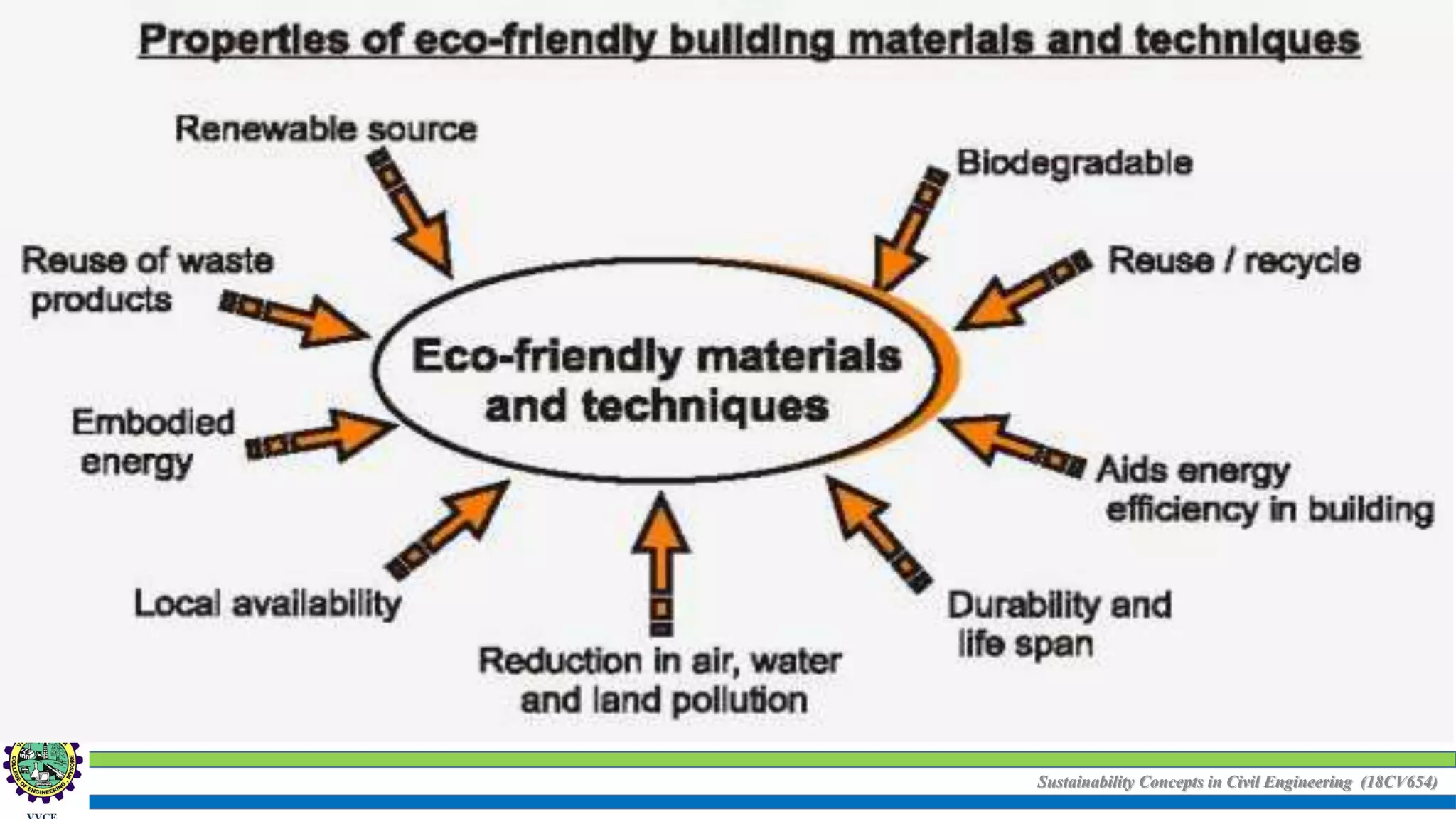
• Materials for building construction
• Material selection for sustainable buildings design,
• Energy-efficient building design,
• Passive solar design technique,
• Thermal storage strategies sustainable transport
Sustainability Concepts in Civil Engineering (18CV654)
Basic concepts of sustainable habitat
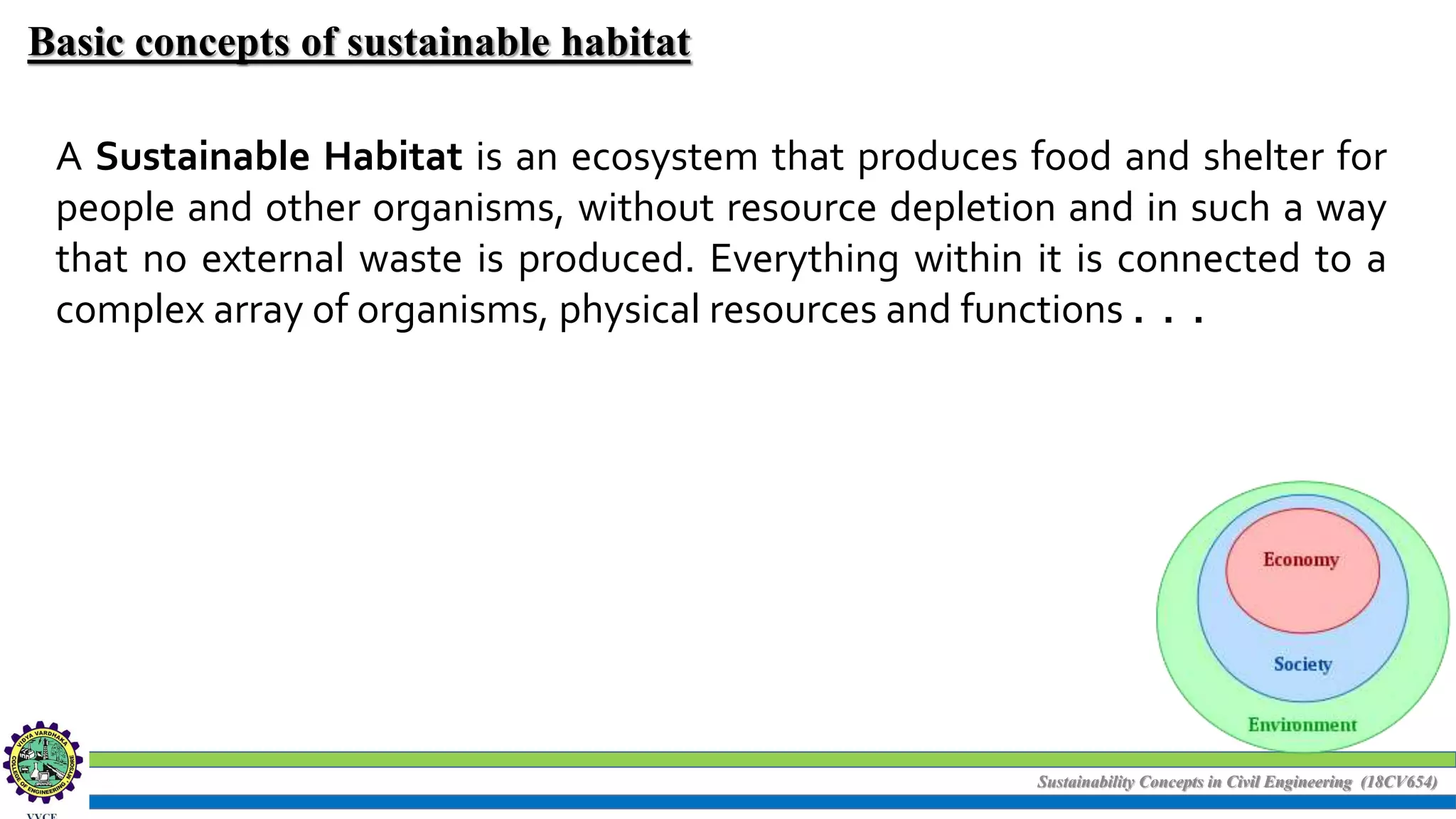
A Sustainable Habitat is an ecosystem that produces food and shelter for
people and other organisms, without resource depletion and in such a way
that no external waste is produced. Everything within it is connected to a
complex array of organisms, physical resources and functions . . .
Sustainability Concepts in Civil Engineering (18CV654)
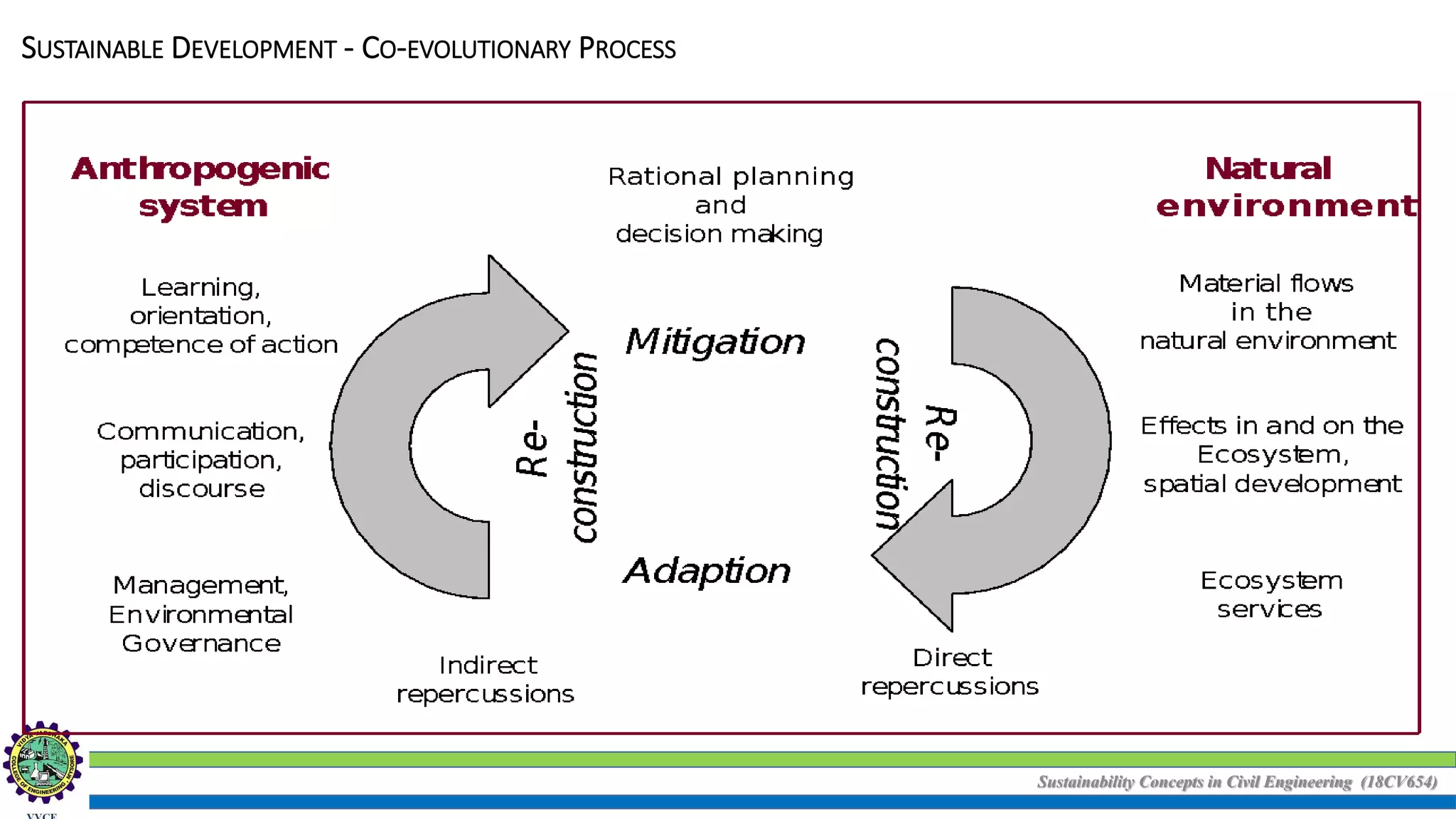
SUSTAINABLE DEVELOPMENT - CO-EVOLUTIONARY PROCESS
Sustainability Concepts in Civil Engineering (18CV654)
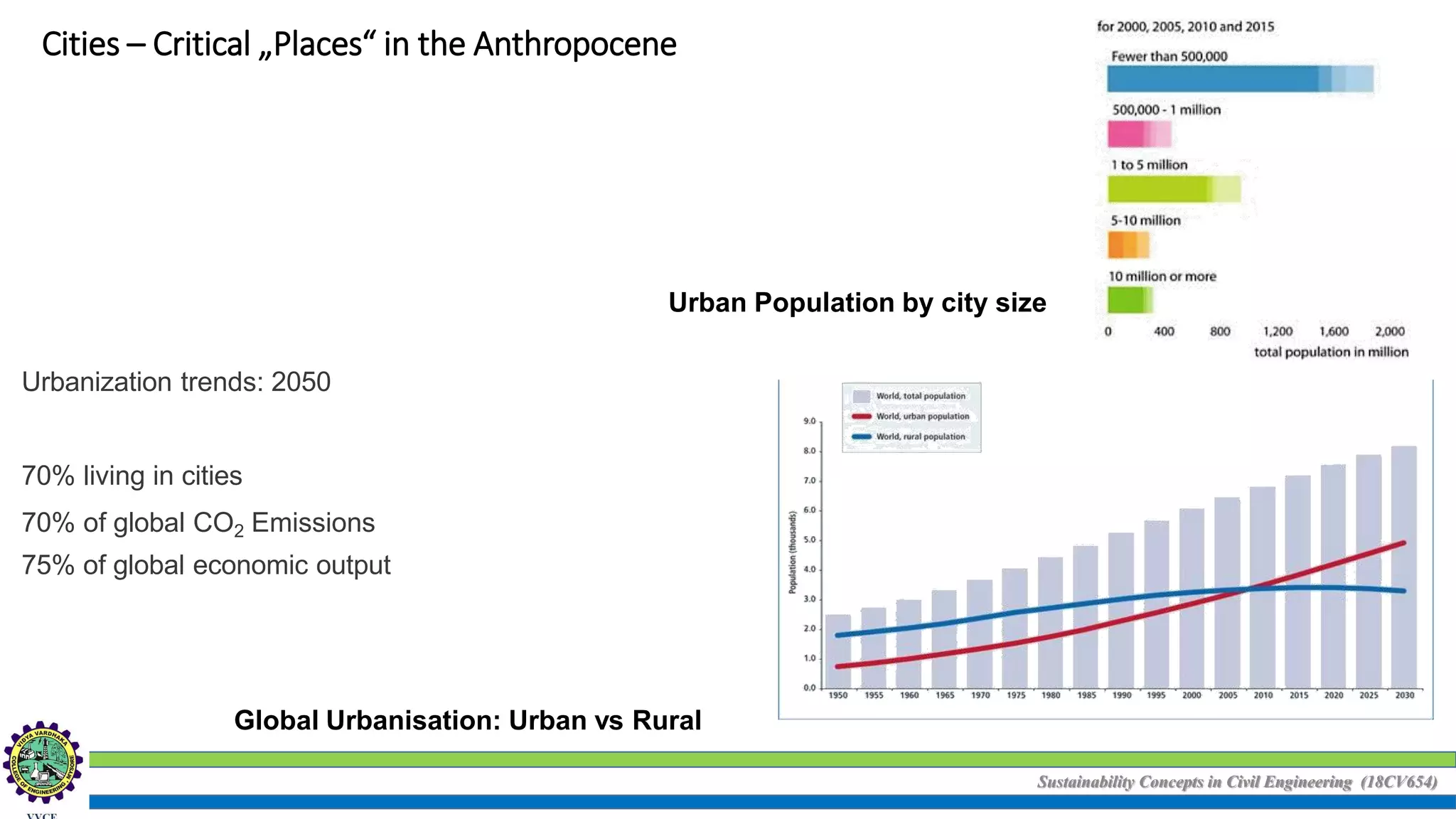
Urbanization trends: 2050
70% living in cities
70% of global CO2 Emissions
75% of global economic output
Global Urbanisation: Urban vs Rural
Urban Population by city size
Cities – Critical „Places“ in the Anthropocene
Sustainability Concepts in Civil Engineering (18CV654)
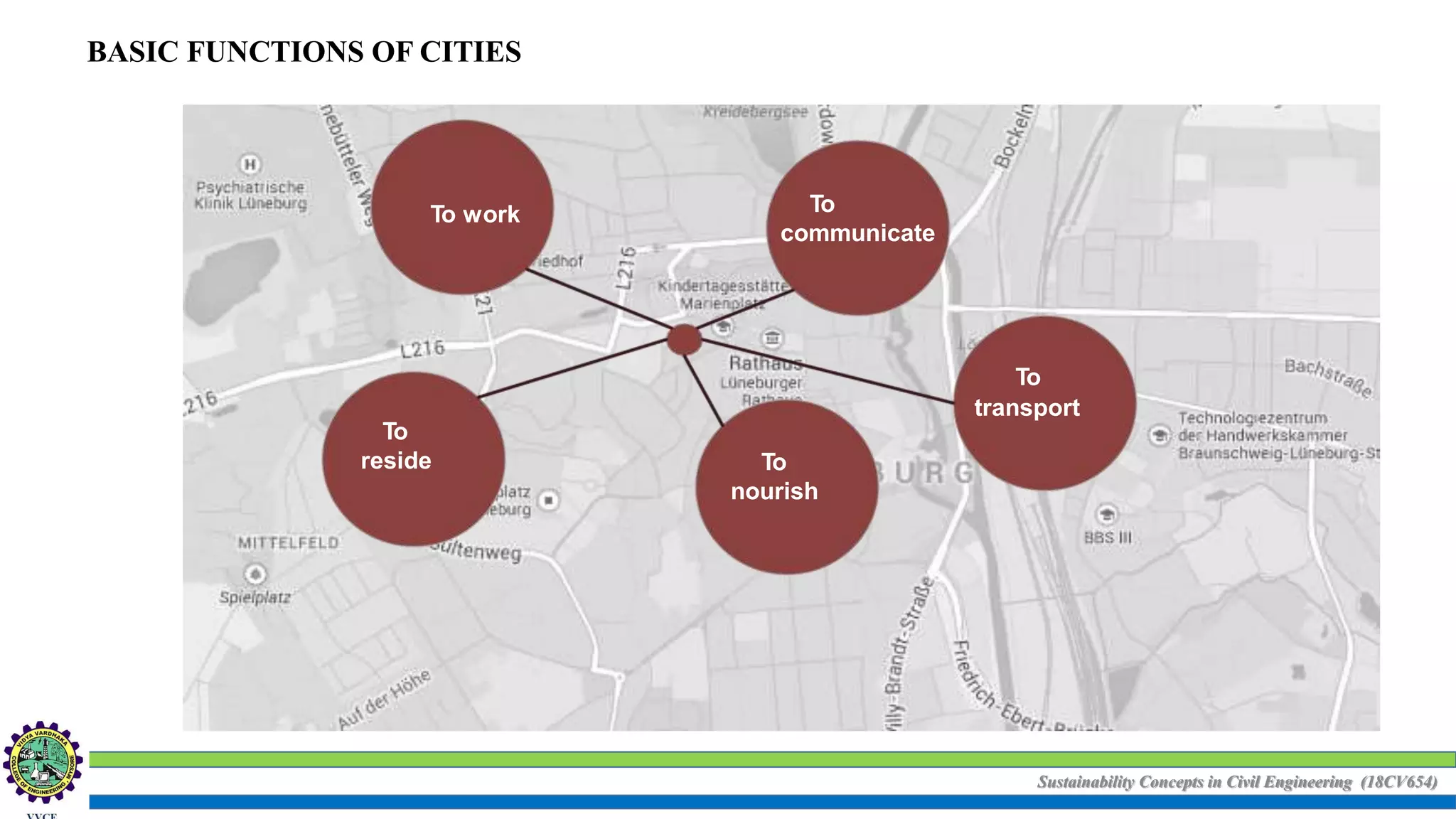
BASIC FUNCTIONS OF CITIES
To work
To
reside To
nourish
To
communicate
To
transport
Sustainability Concepts in Civil Engineering (18CV654)
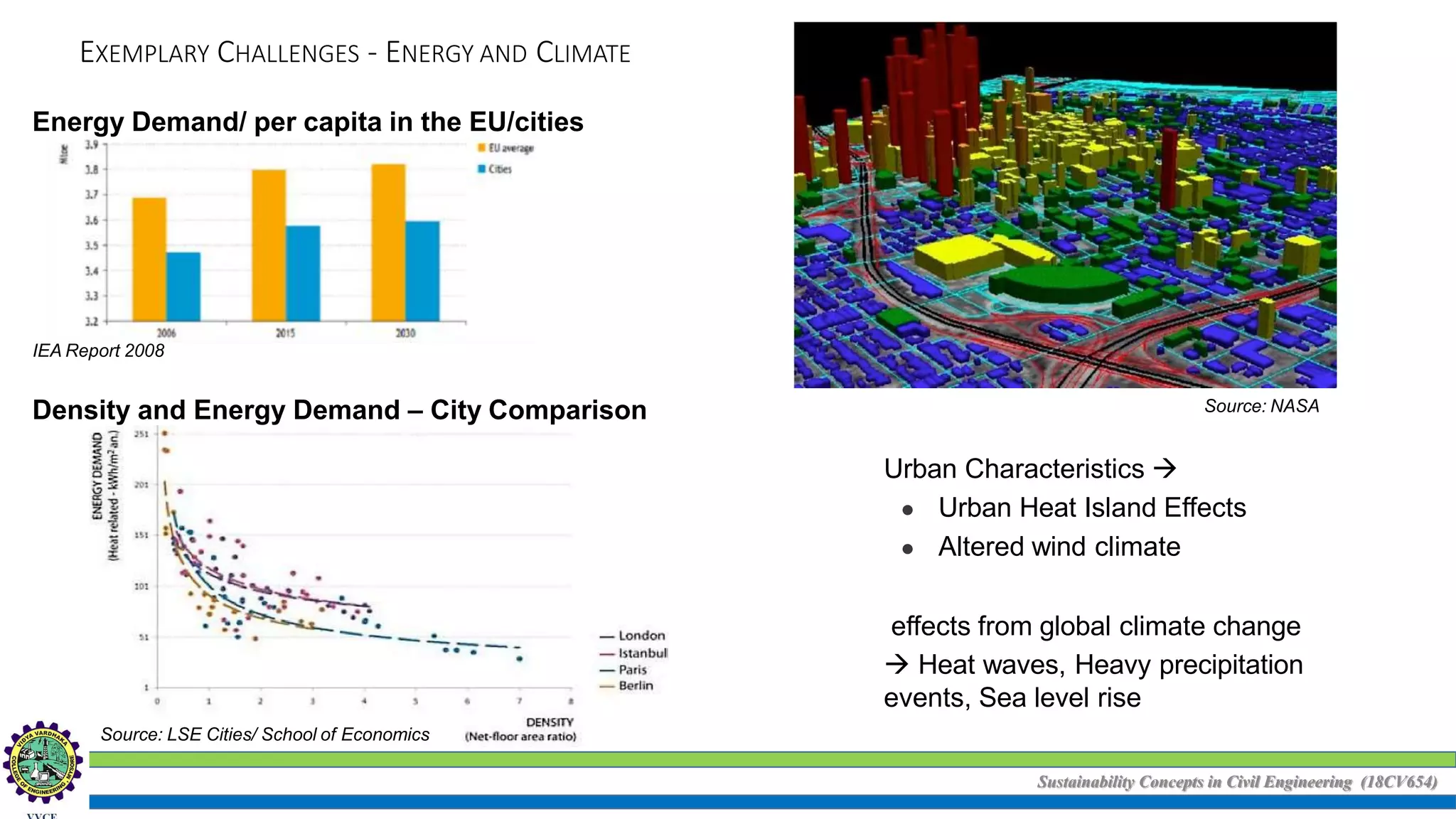
EXEMPLARY CHALLENGES - ENERGY AND CLIMATE
Urban Characteristics 
● Urban Heat Island Effects
● Altered wind climate
effects from global climate change
 Heat waves, Heavy precipitation
events, Sea level rise
Source: LSE Cities/ School of Economics
IEA Report 2008
Source: NASA
Density and Energy Demand – City Comparison
Energy Demand/ per capita in the EU/cities
Sustainability Concepts in Civil Engineering (18CV654)
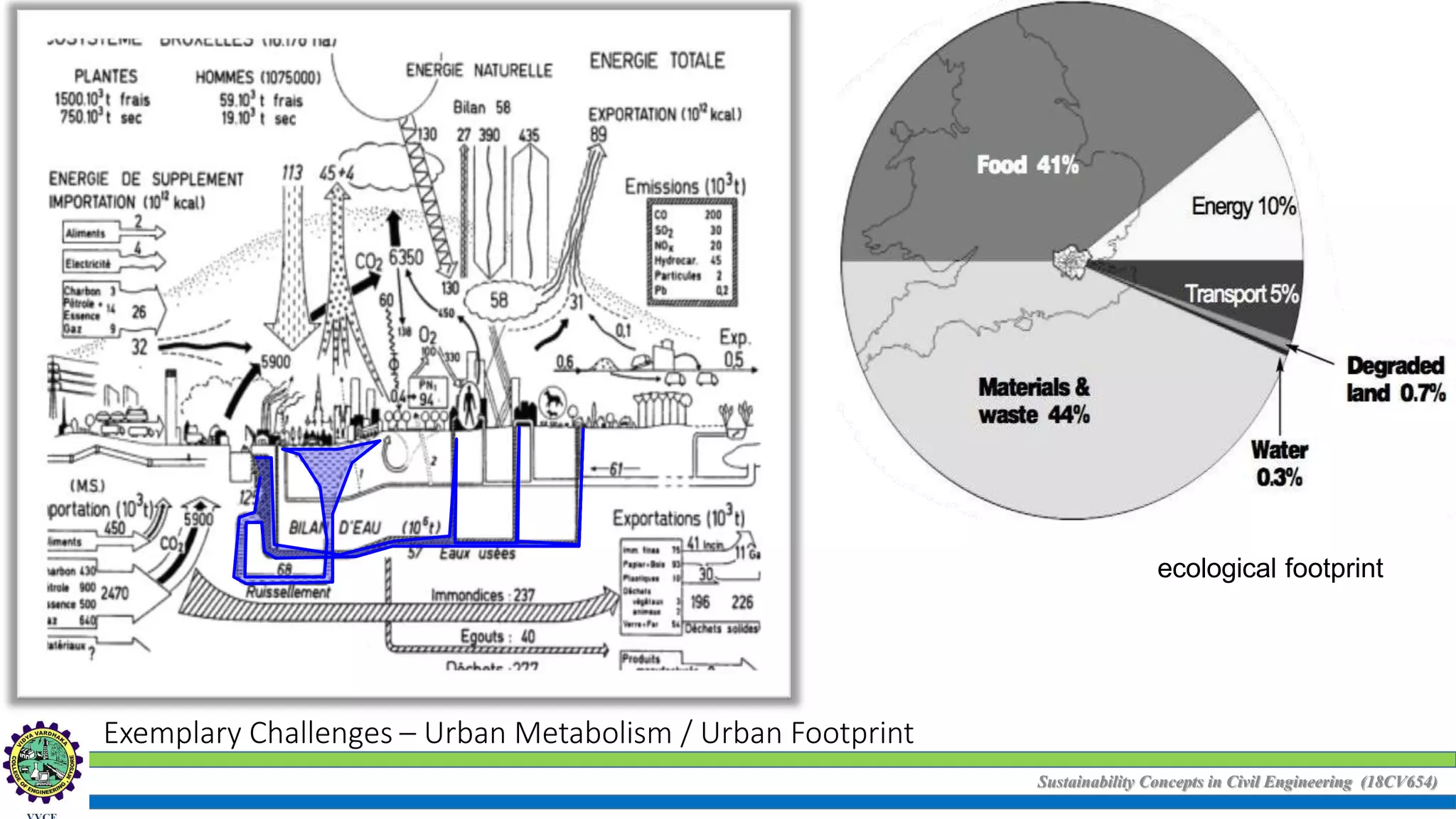
ecological footprint
Exemplary Challenges – Urban Metabolism / Urban Footprint
Sustainability Concepts in Civil Engineering (18CV654)
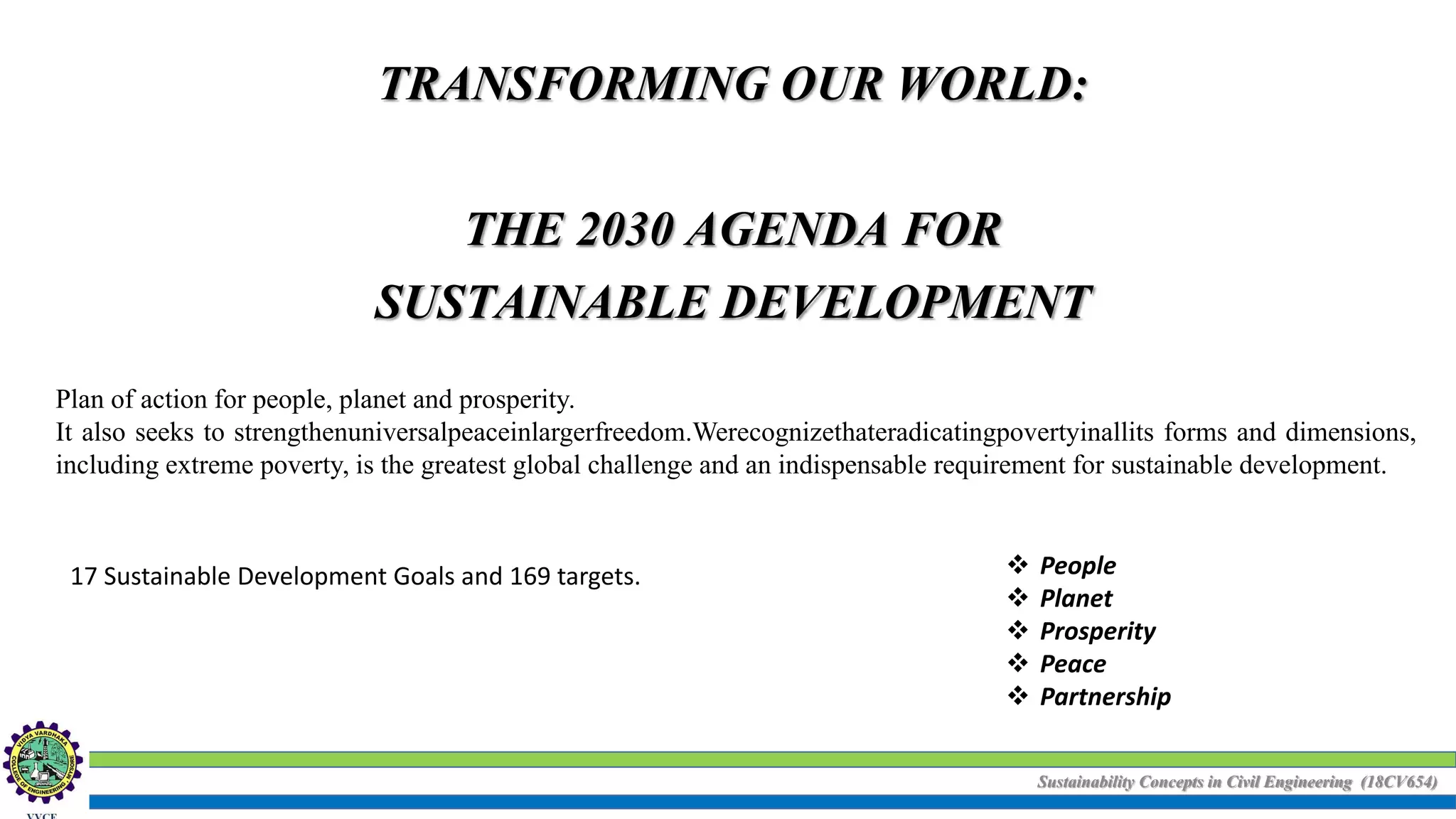
TRANSFORMING OUR WORLD:
THE 2030 AGENDA FOR
SUSTAINABLE DEVELOPMENT
Plan of action for people, planet and prosperity.
It also seeks to strengthenuniversalpeaceinlargerfreedom.Werecognizethateradicatingpovertyinallits forms and dimensions,
including extreme poverty, is the greatest global challenge and an indispensable requirement for sustainable development.
17 Sustainable Development Goals and 169 targets.  People
 Planet
 Prosperity
 Peace
 Partnership
Sustainability Concepts in Civil Engineering (18CV654)
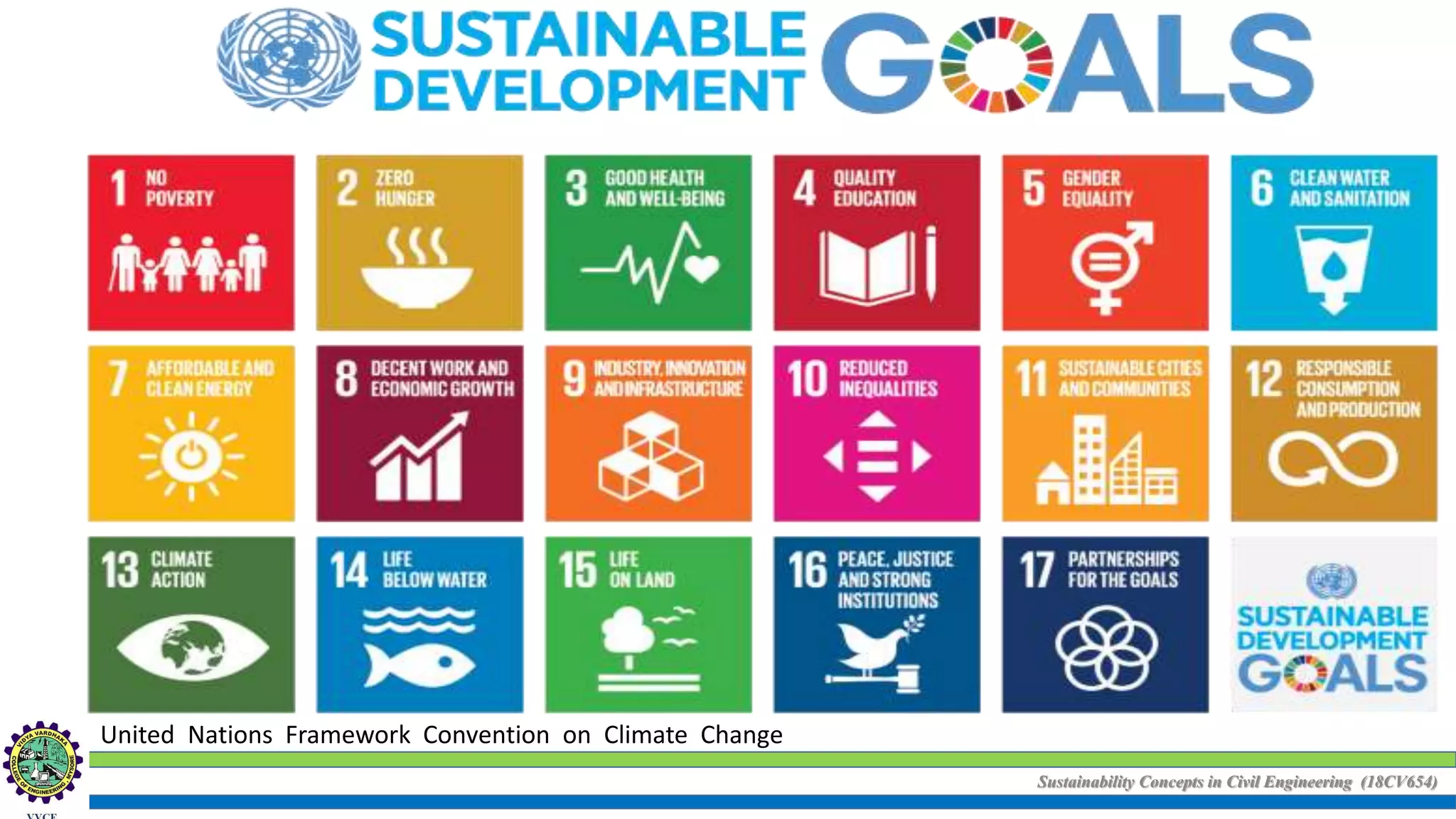
United Nations Framework Convention on Climate Change
Sustainability Concepts in Civil Engineering (18CV654)
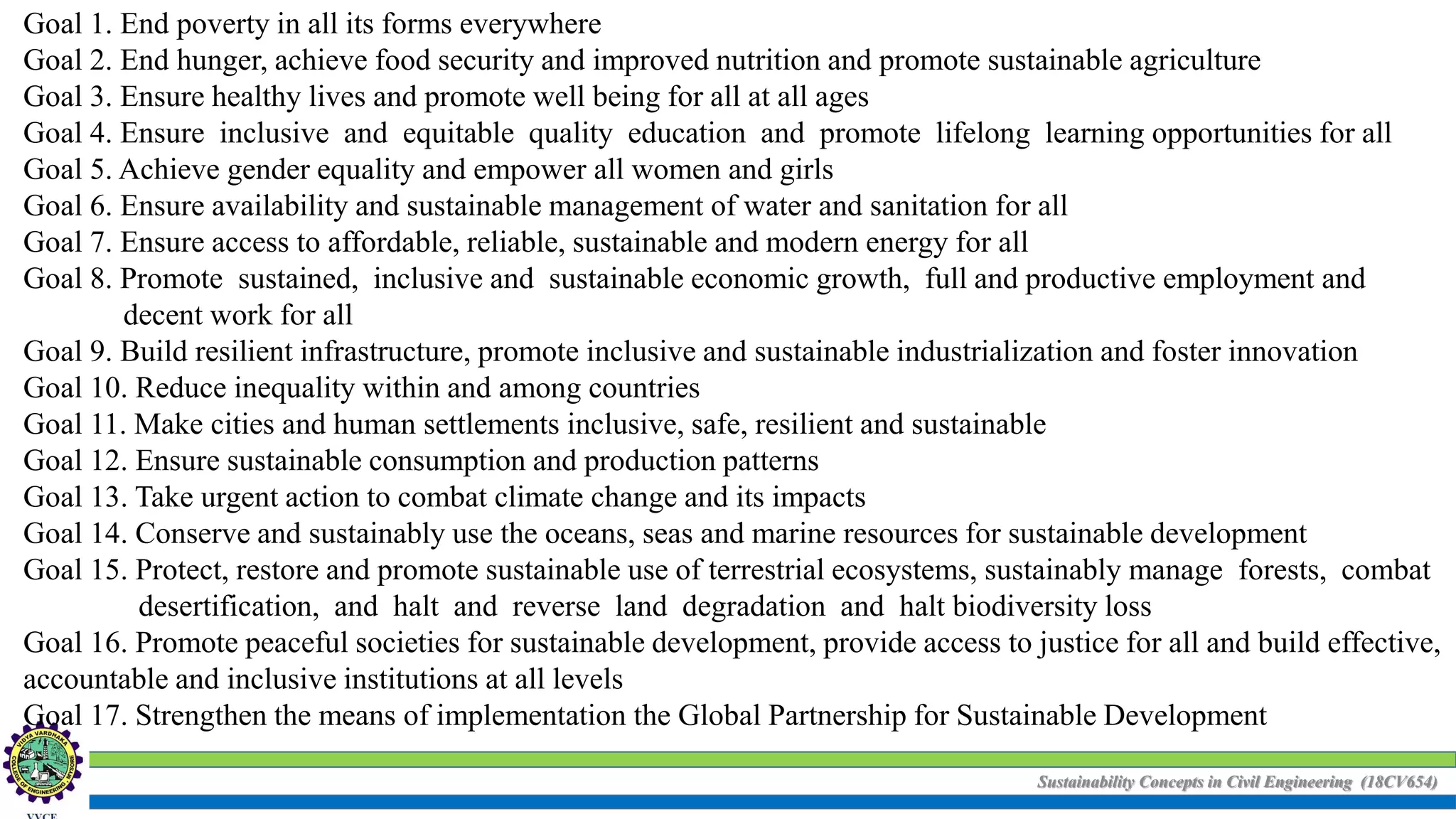
Goal 1. End poverty in all its forms everywhere
Goal 2. End hunger, achieve food security and improved nutrition and promote sustainable agriculture
Goal 3. Ensure healthy lives and promote well being for all at all ages
Goal 4. Ensure inclusive and equitable quality education and promote lifelong learning opportunities for all
Goal 5. Achieve gender equality and empower all women and girls
Goal 6. Ensure availability and sustainable management of water and sanitation for all
Goal 7. Ensure access to affordable, reliable, sustainable and modern energy for all
Goal 8. Promote sustained, inclusive and sustainable economic growth, full and productive employment and
decent work for all
Goal 9. Build resilient infrastructure, promote inclusive and sustainable industrialization and foster innovation
Goal 10. Reduce inequality within and among countries
Goal 11. Make cities and human settlements inclusive, safe, resilient and sustainable
Goal 12. Ensure sustainable consumption and production patterns
Goal 13. Take urgent action to combat climate change and its impacts
Goal 14. Conserve and sustainably use the oceans, seas and marine resources for sustainable development
Goal 15. Protect, restore and promote sustainable use of terrestrial ecosystems, sustainably manage forests, combat
desertification, and halt and reverse land degradation and halt biodiversity loss
Goal 16. Promote peaceful societies for sustainable development, provide access to justice for all and build effective,
accountable and inclusive institutions at all levels
Goal 17. Strengthen the means of implementation the Global Partnership for Sustainable Development
Sustainability Concepts in Civil Engineering (18CV654)
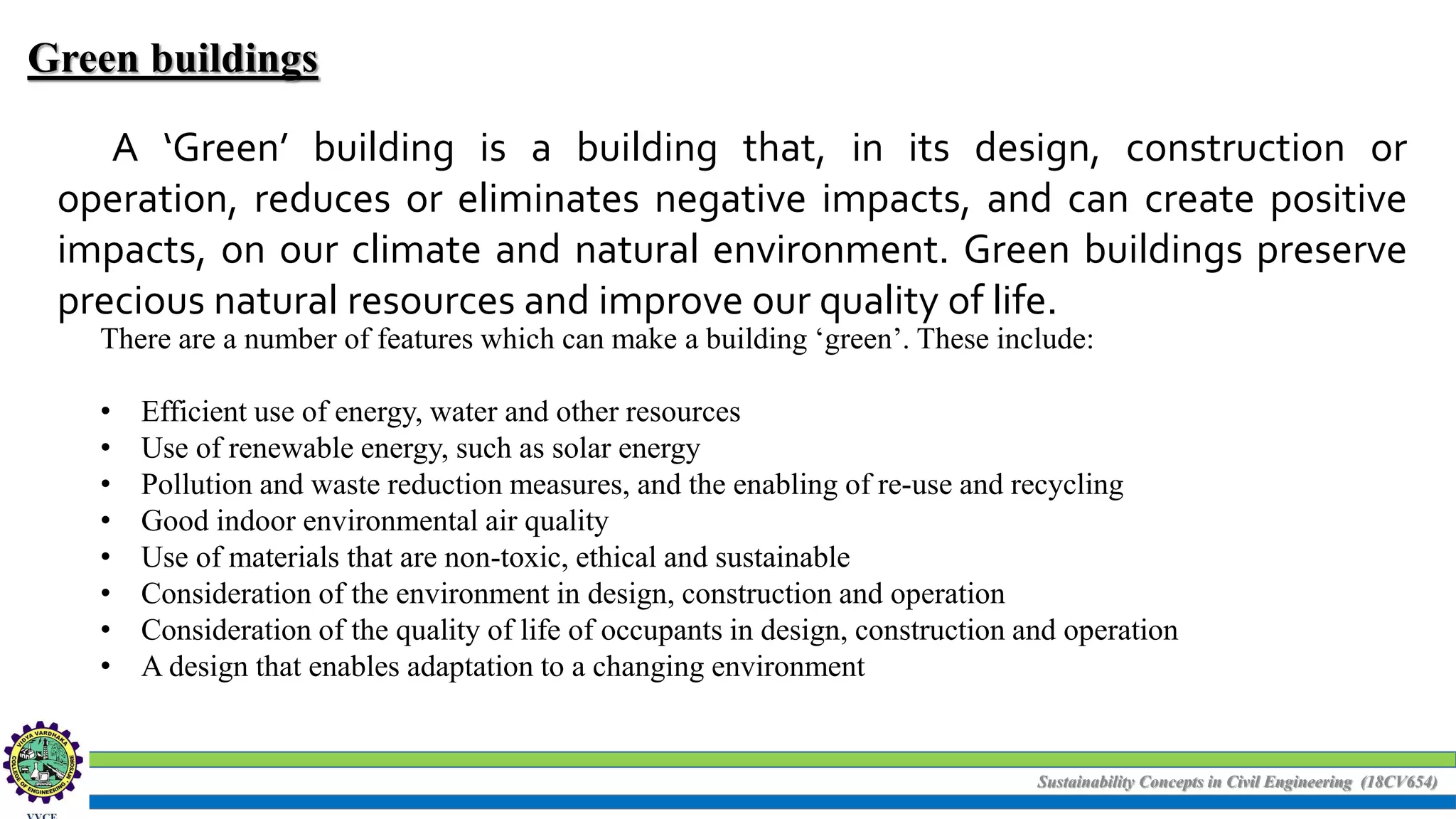
Green buildings
A ‘Green’ building is a building that, in its design, construction or
operation, reduces or eliminates negative impacts, and can create positive
impacts, on our climate and natural environment. Green buildings preserve
precious natural resources and improve our quality of life.
There are a number of features which can make a building ‘green’. These include:
• Efficient use of energy, water and other resources
• Use of renewable energy, such as solar energy
• Pollution and waste reduction measures, and the enabling of re-use and recycling
• Good indoor environmental air quality
• Use of materials that are non-toxic, ethical and sustainable
• Consideration of the environment in design, construction and operation
• Consideration of the quality of life of occupants in design, construction and operation
• A design that enables adaptation to a changing environment
Sustainability Concepts in Civil Engineering (18CV654)
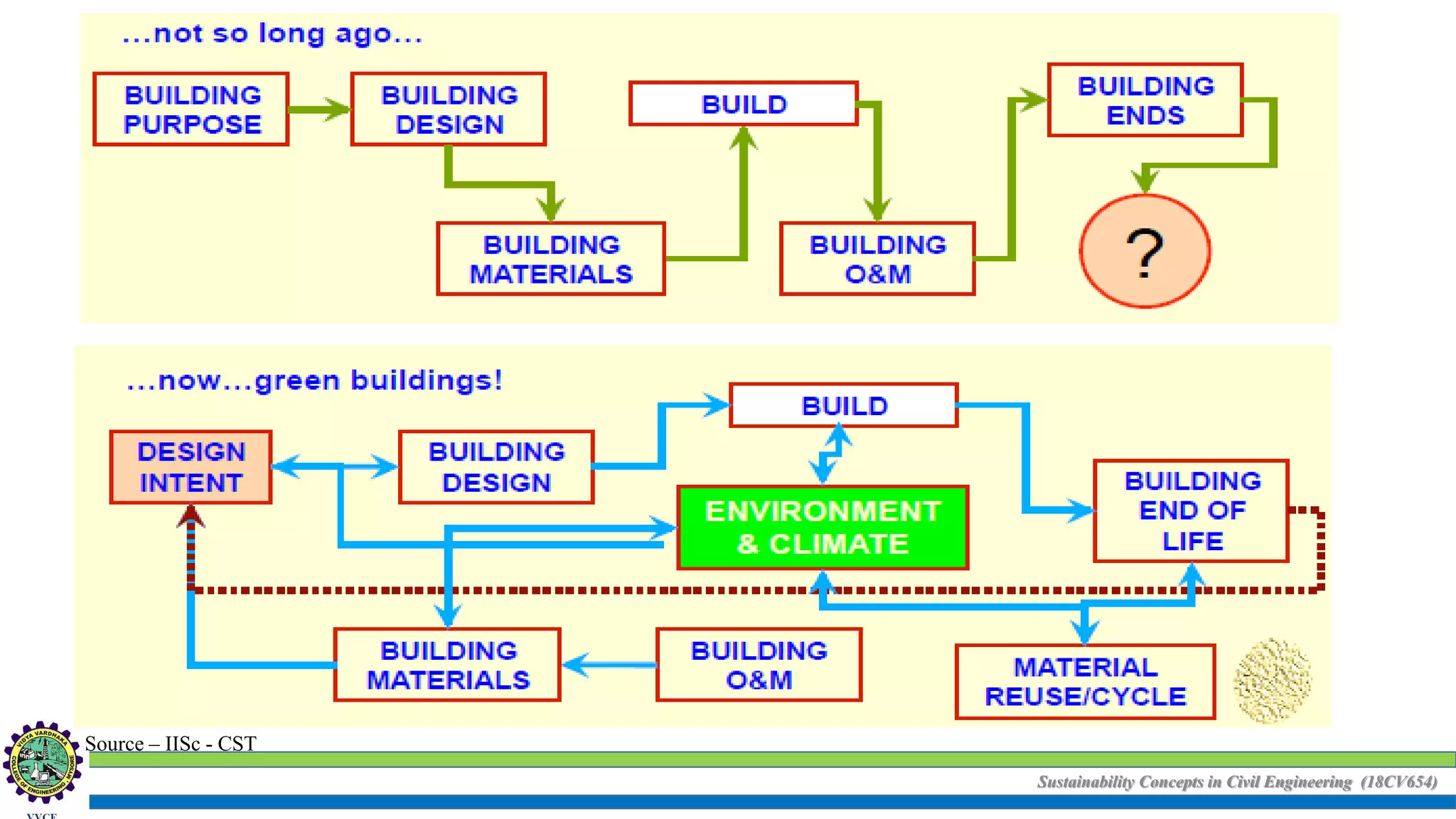
Source – IISc - CST
Sustainability Concepts in Civil Engineering (18CV654)
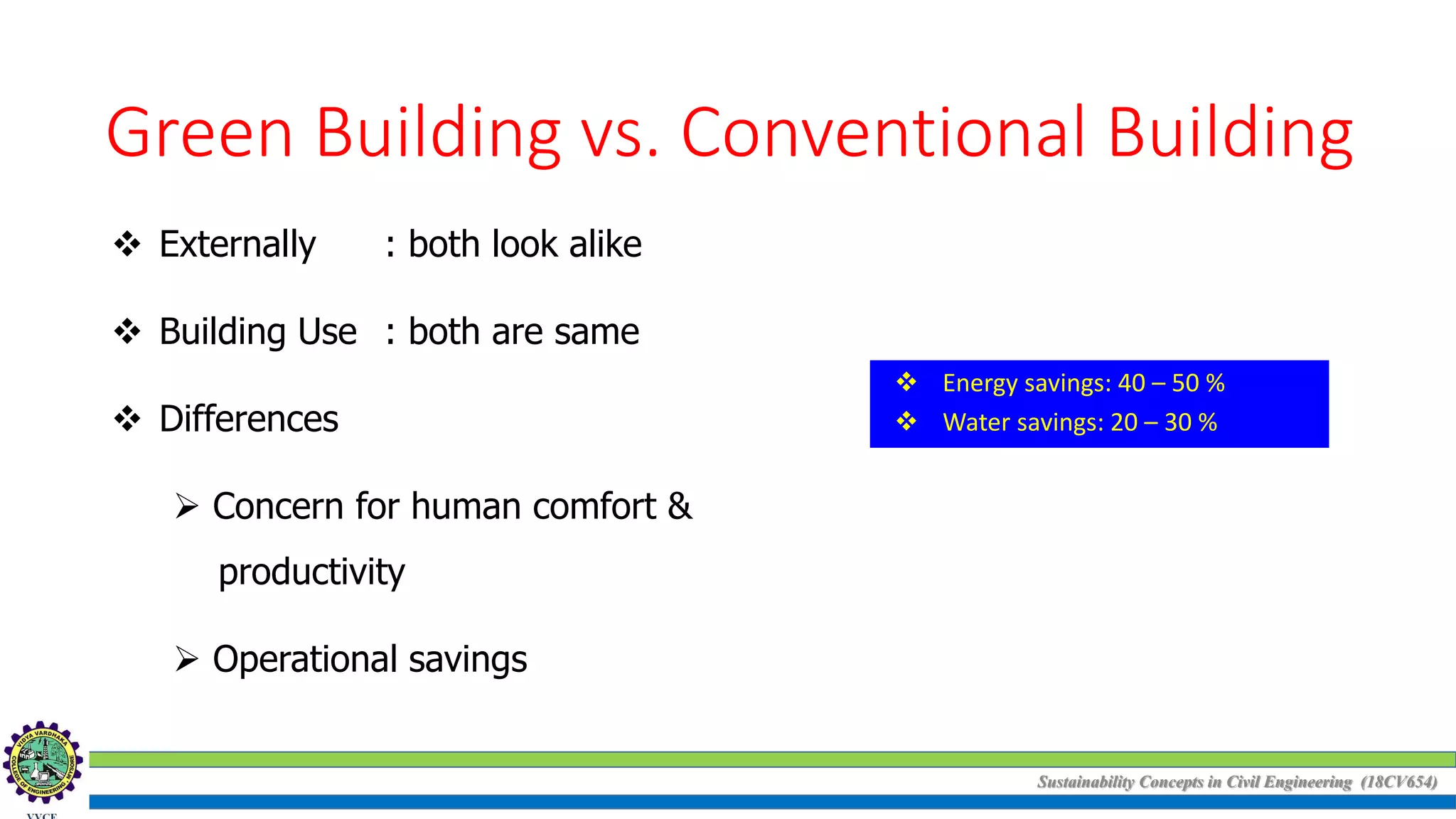
Green Building vs. Conventional Building
 Externally : both look alike
 Building Use : both are same
 Differences
 Concern for human comfort &
productivity
 Operational savings
 Energy savings: 40 – 50 %
 Water savings: 20 – 30 %
Sustainability Concepts in Civil Engineering (18CV654)
Do Green Building Cost More?
YES . . .
* “Initial investment is more . . . “
With buyback period of 5 - 20 years
Sustainability Concepts in Civil Engineering (18CV654)
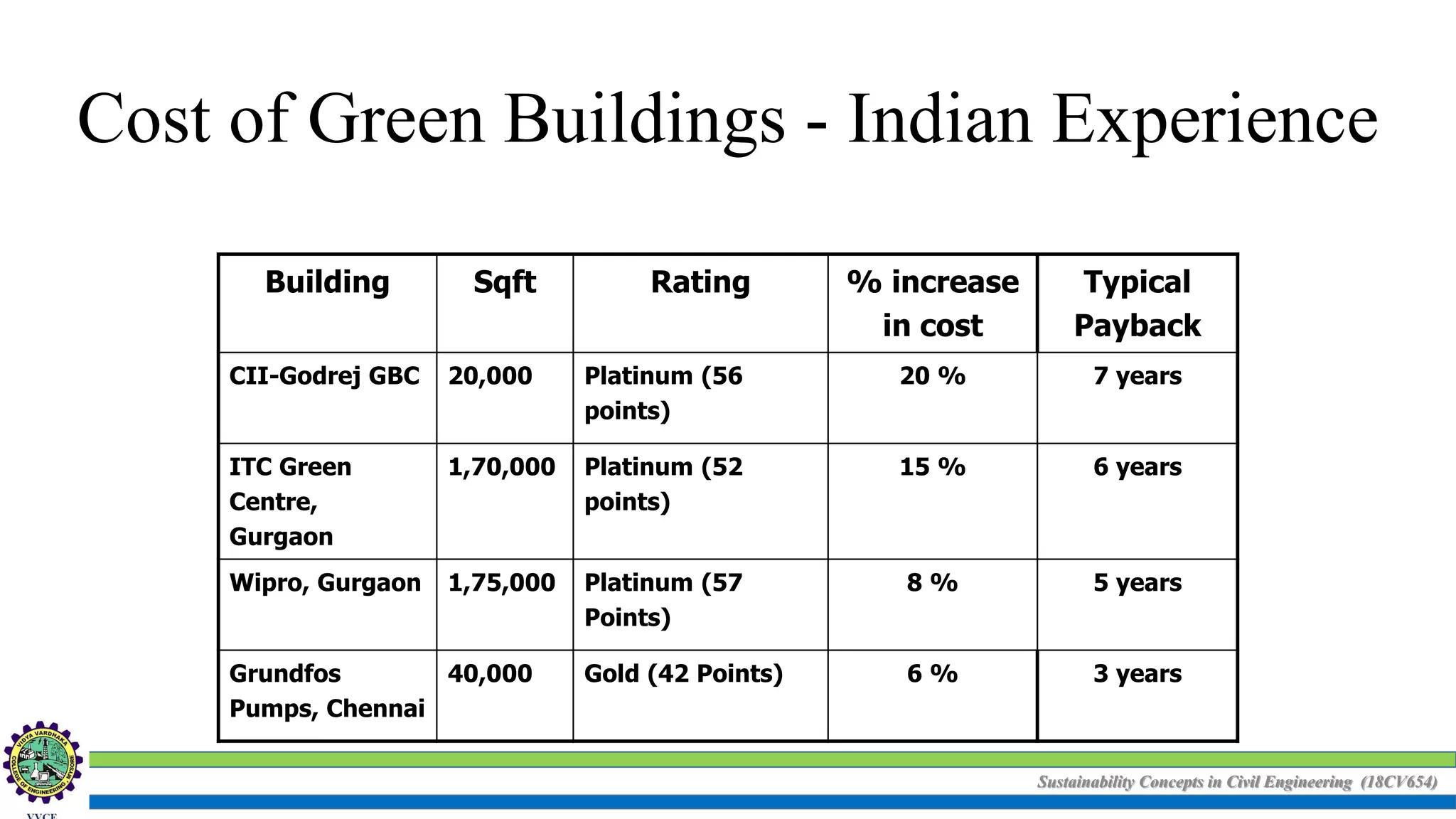
Cost of Green Buildings - Indian Experience
Building Sqft Rating % increase
in cost
Typical
Payback
CII-Godrej GBC 20,000 Platinum (56
points)
20 % 7 years
ITC Green
Centre,
Gurgaon
1,70,000 Platinum (52
points)
15 % 6 years
Wipro, Gurgaon 1,75,000 Platinum (57
Points)
8 % 5 years
Grundfos
Pumps, Chennai
40,000 Gold (42 Points) 6 % 3 years
Sustainability Concepts in Civil Engineering (18CV654)
Green building certification - IGBC certification
What is LEED?
Leadership in Energy & Environmental Design
Rating of buildings by USGBC
Sustainability Concepts in Civil Engineering (18CV654)
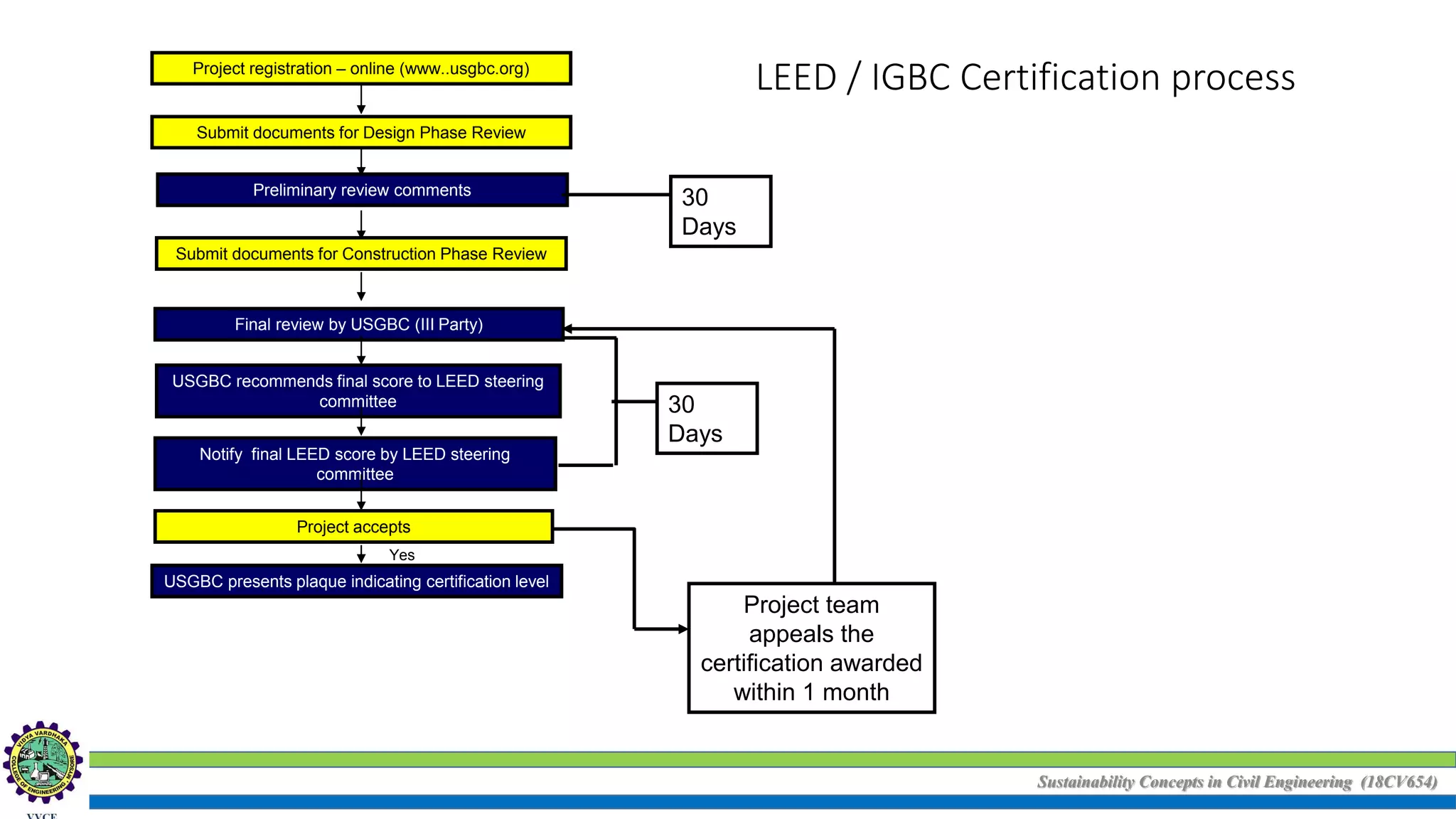
LEED / IGBC Certification process
30
Days
Project team
appeals the
certification awarded
within 1 month
Project registration – online (www..usgbc.org)
Preliminary review comments
Final review by USGBC (III Party)
USGBC recommends final score to LEED steering
committee
Notify final LEED score by LEED steering
committee
Project accepts
USGBC presents plaque indicating certification level
Yes
Submit documents for Design Phase Review
Submit documents for Construction Phase Review
30
Days
Sustainability Concepts in Civil Engineering (18CV654)
Green building certification GRIHA
https://www.grihaindia.org/
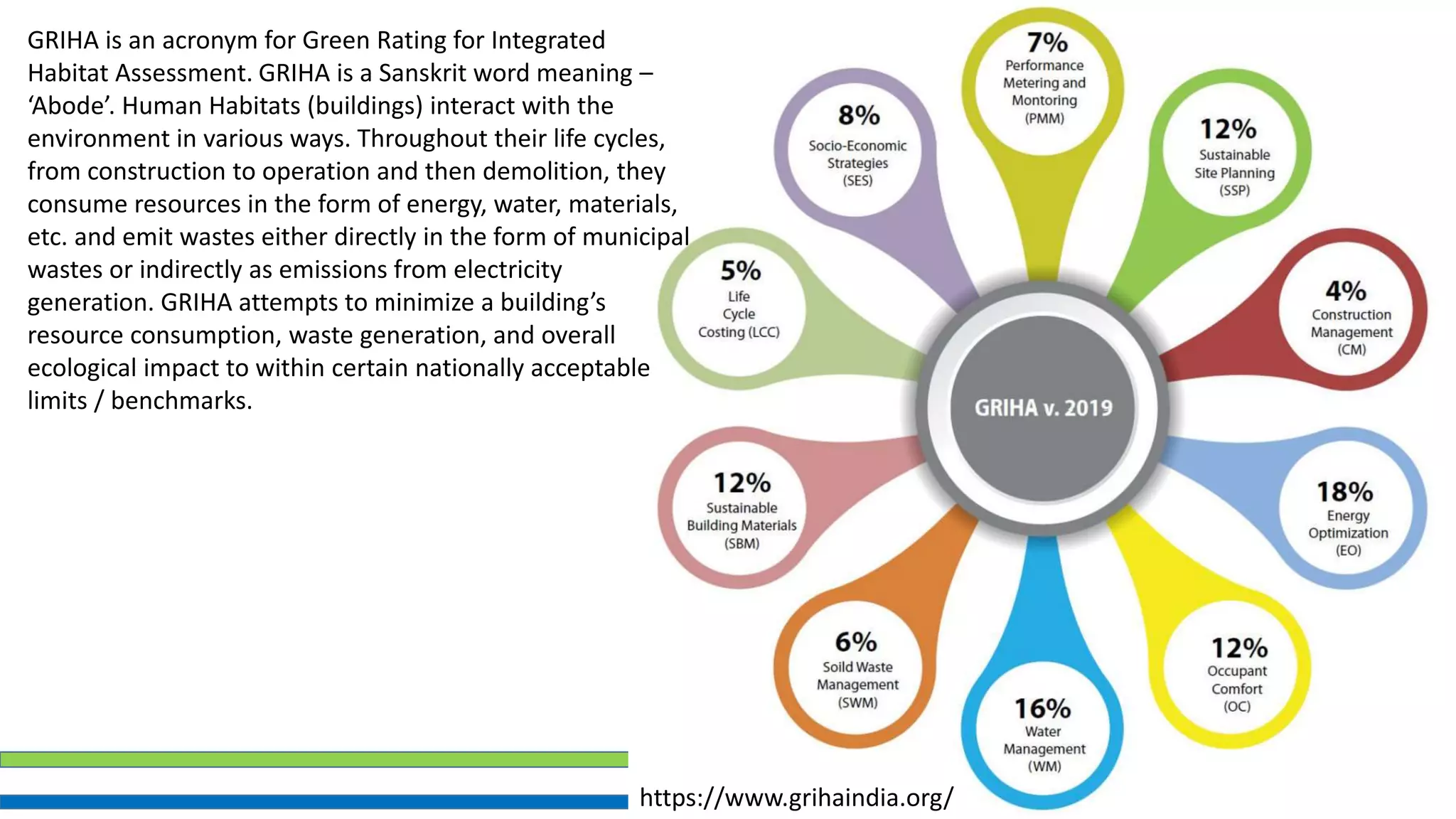
GRIHA is an acronym for Green Rating for Integrated
Habitat Assessment. GRIHA is a Sanskrit word meaning –
‘Abode’. Human Habitats (buildings) interact with the
environment in various ways. Throughout their life cycles,
from construction to operation and then demolition, they
consume resources in the form of energy, water, materials,
etc. and emit wastes either directly in the form of municipal
wastes or indirectly as emissions from electricity
generation. GRIHA attempts to minimize a building’s
resource consumption, waste generation, and overall
ecological impact to within certain nationally acceptable
limits / benchmarks.
Sustainability Concepts in Civil Engineering (18CV654)
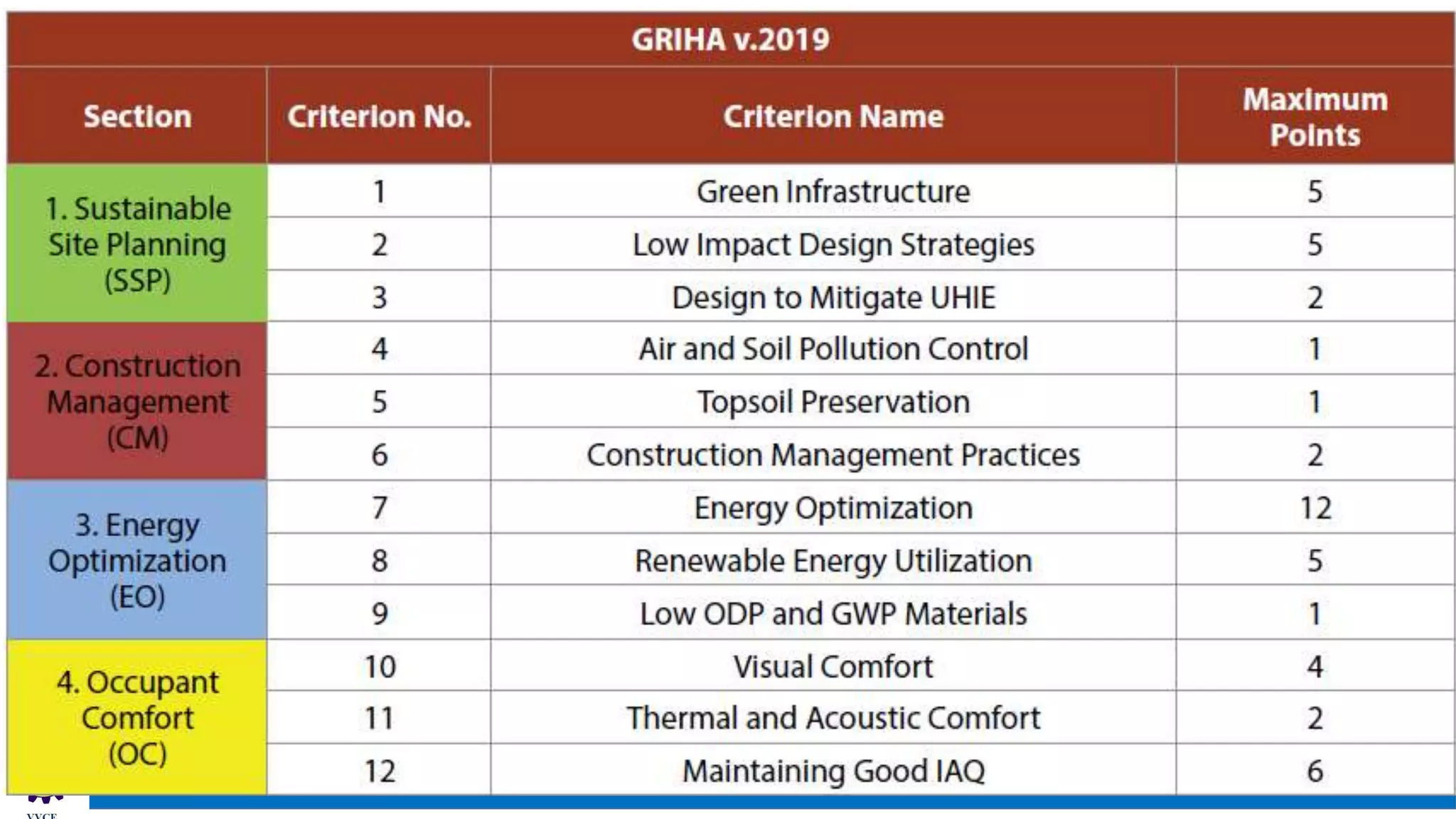
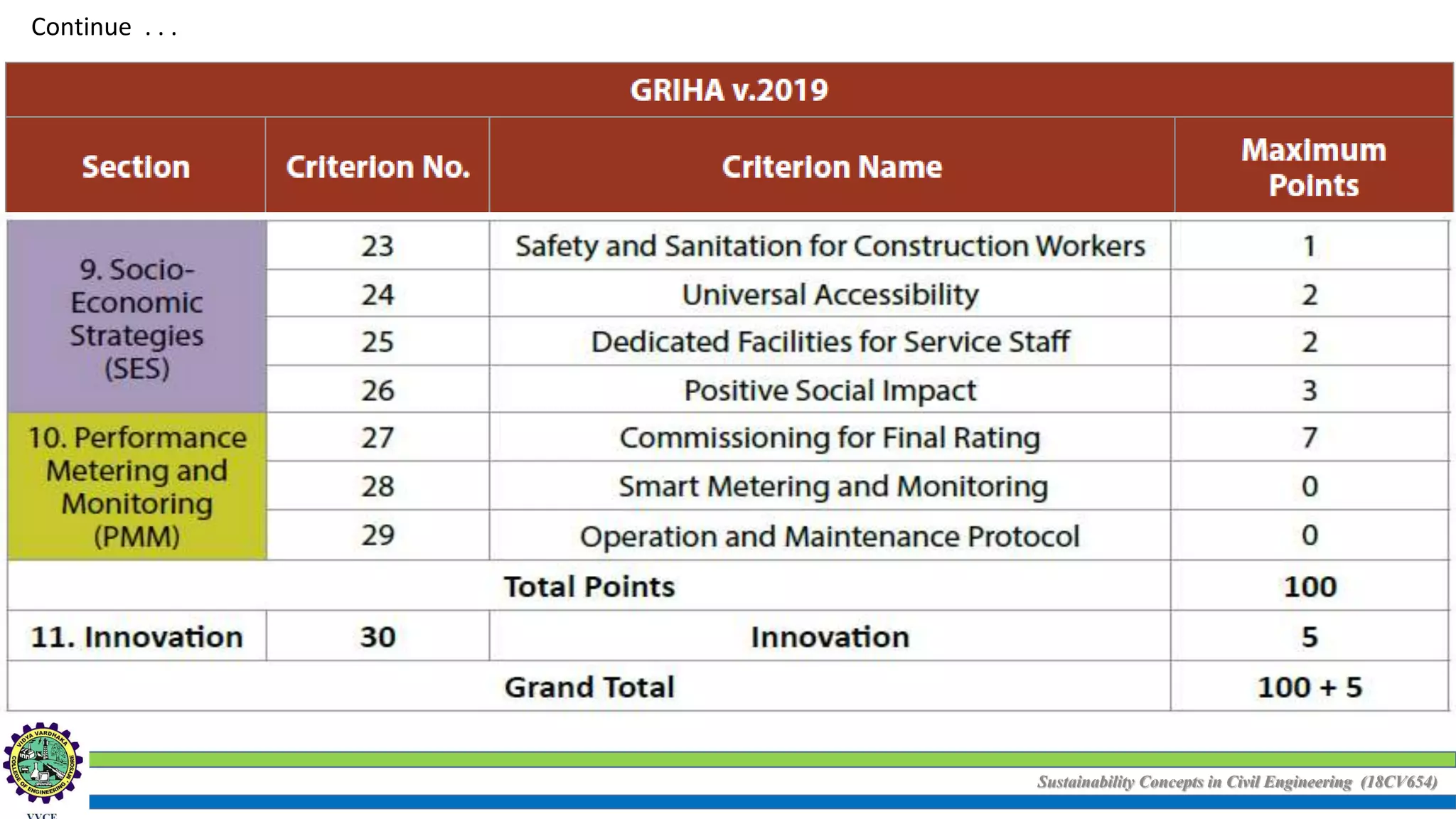
Continue . . .
Sustainability Concepts in Civil Engineering (18CV654)
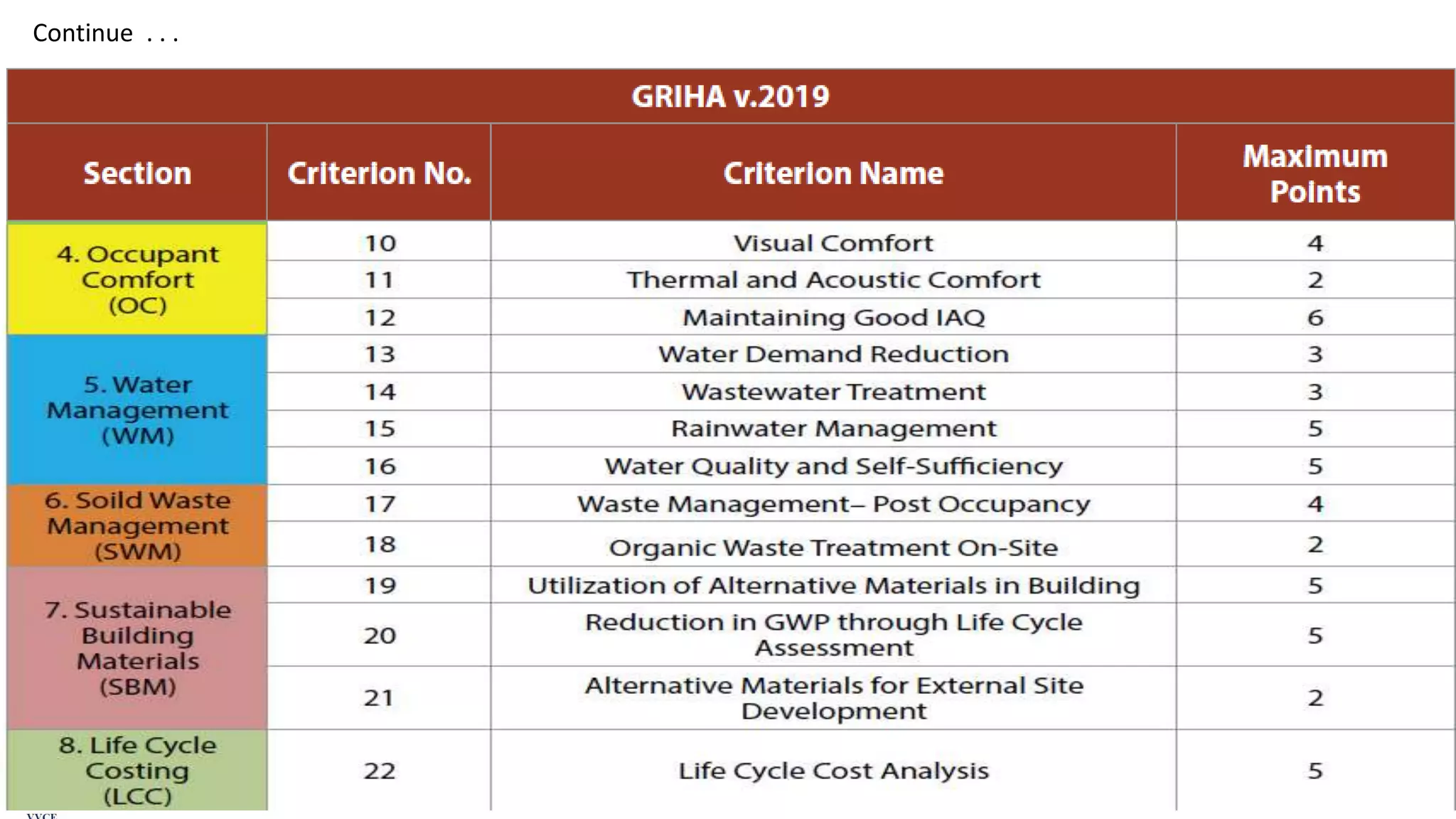
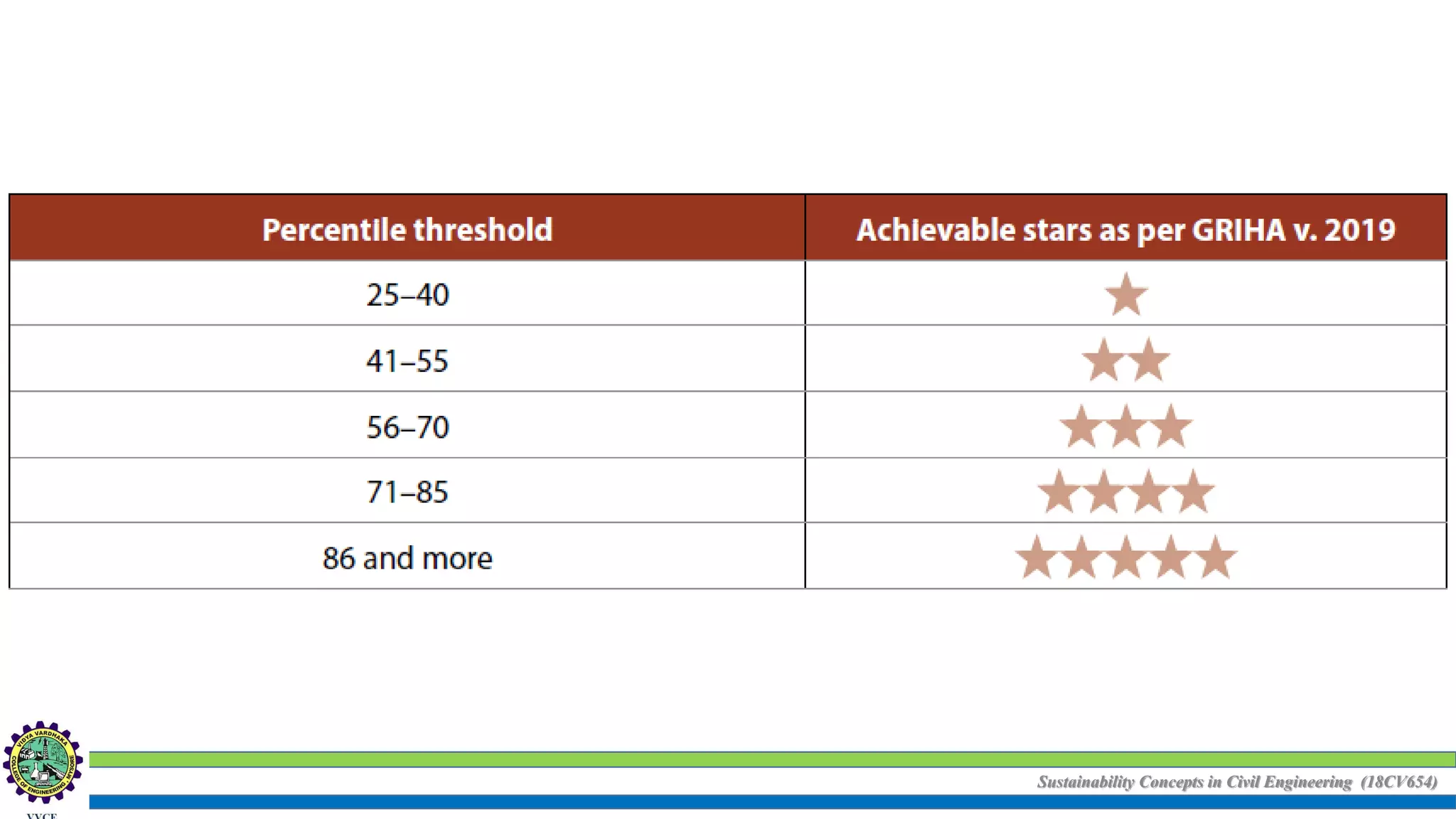
Continue . . .
Sustainability Concepts in Civil Engineering (18CV654)
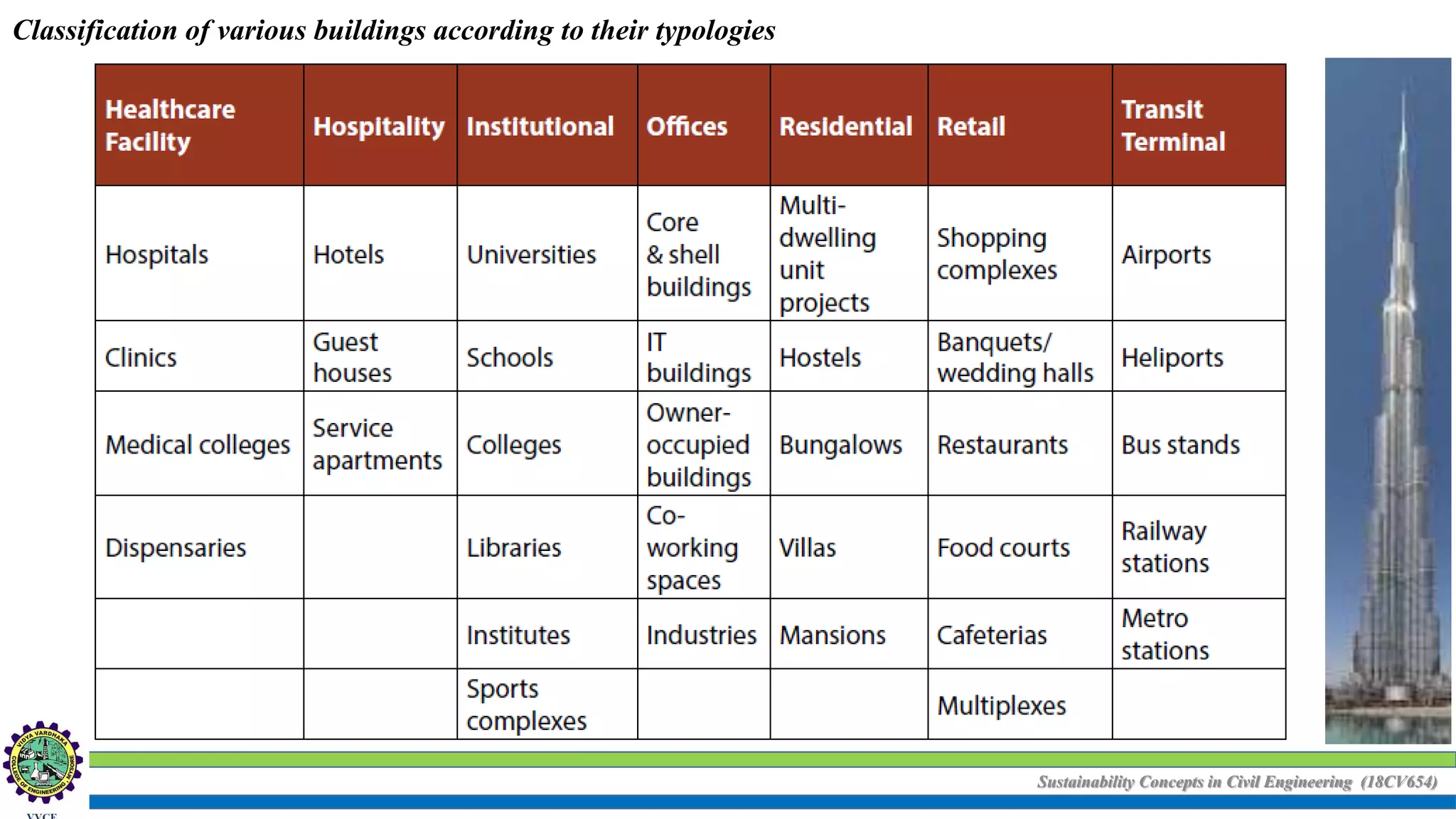
Classification of various buildings according to their typologies
Sustainability Concepts in Civil Engineering (18CV654)
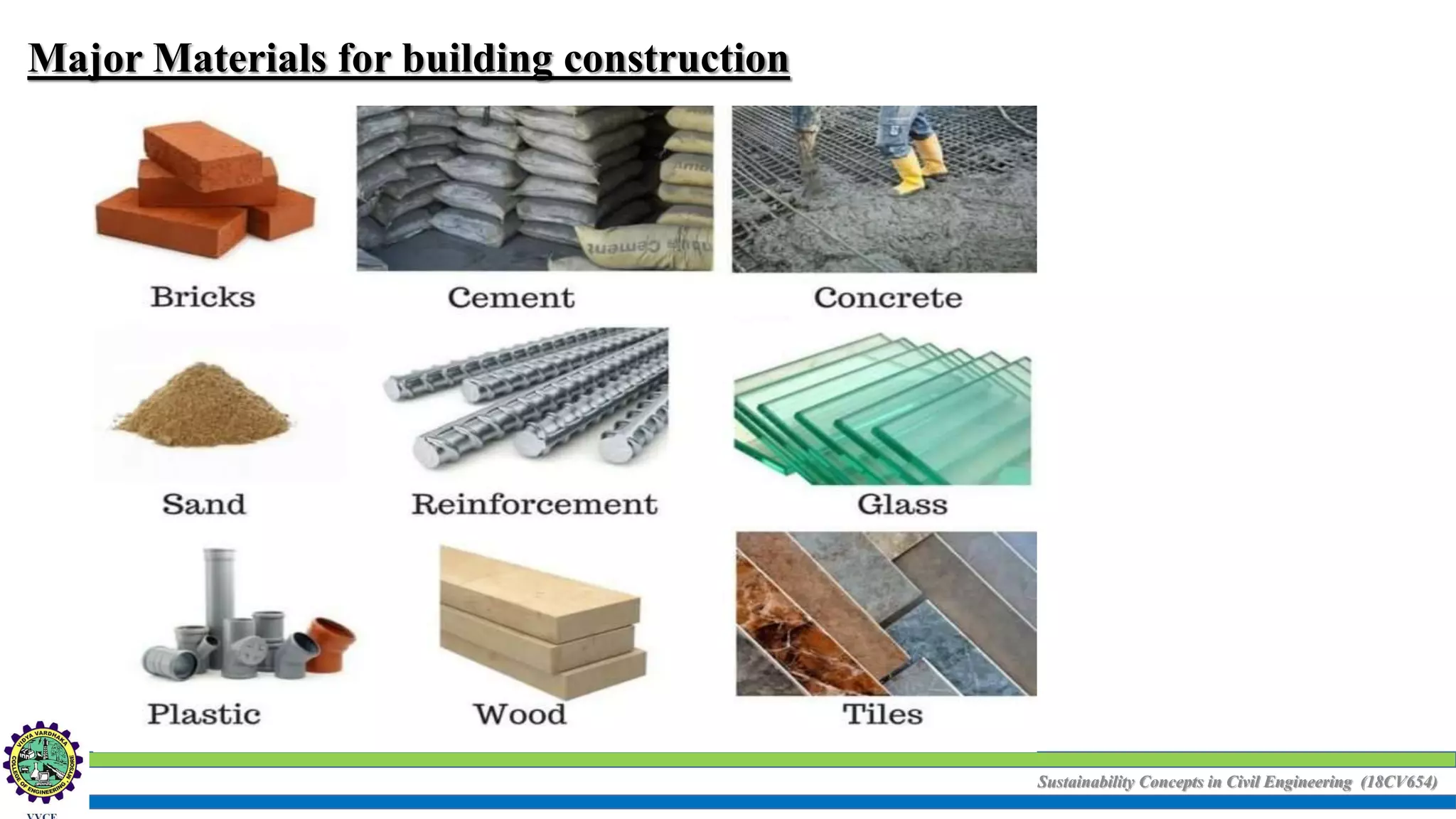
Major Materials for building construction
Sustainability Concepts in Civil Engineering (18CV654)
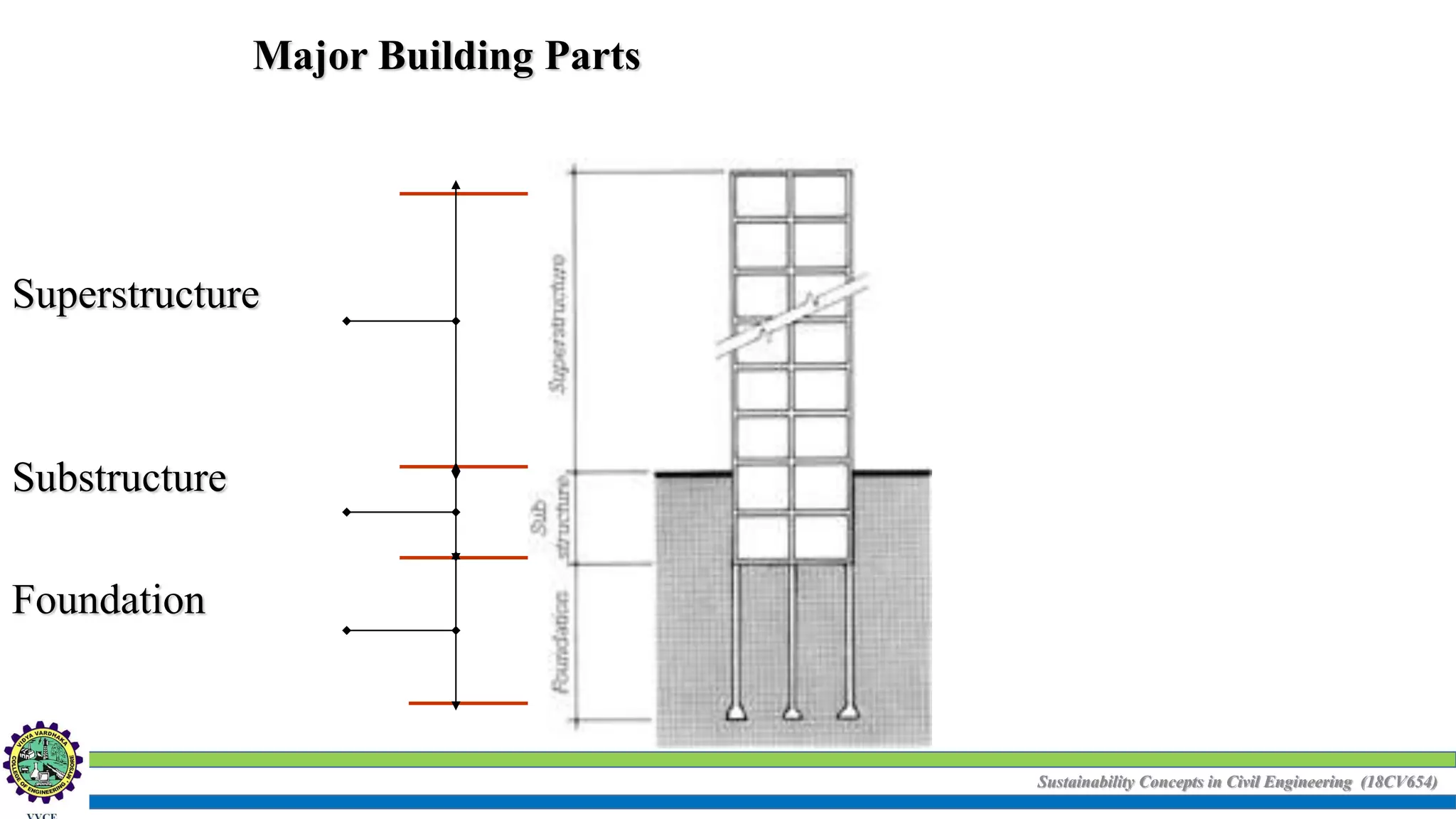
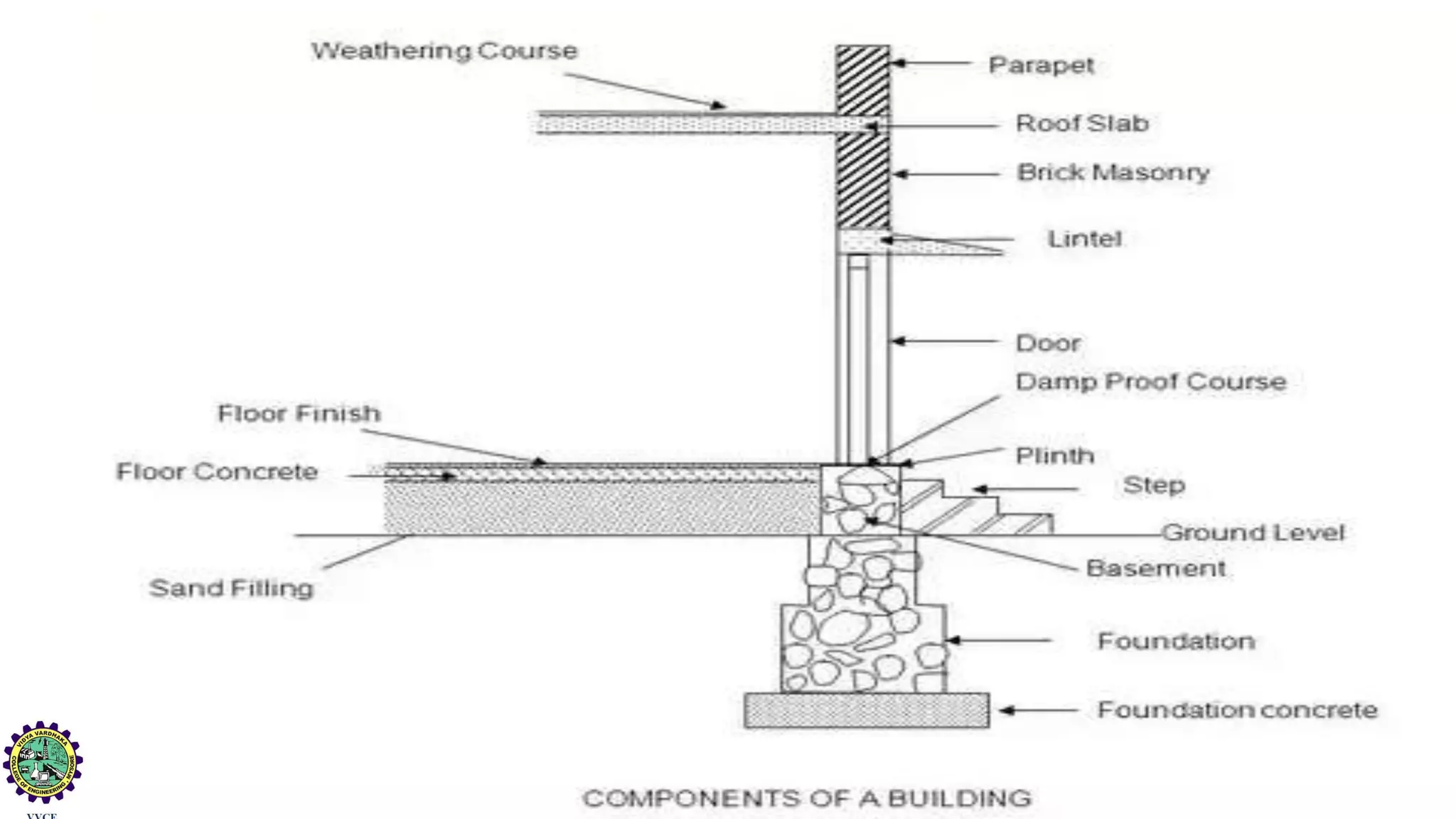
Major Building Parts
Superstructure
Substructure
Foundation
Sustainability Concepts in Civil Engineering (18CV654)
‘Portland’ cement et al
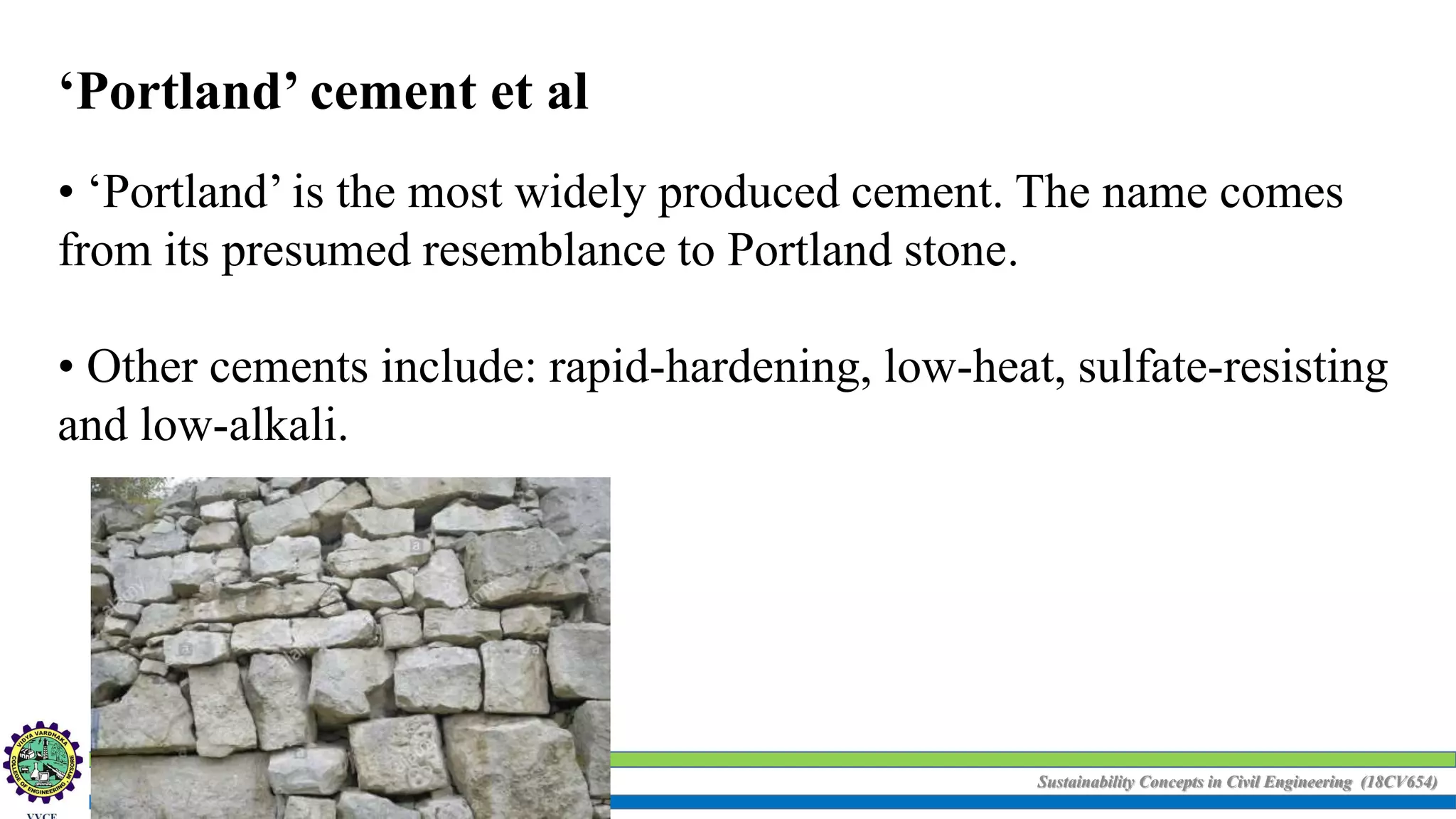
• ‘Portland’ is the most widely produced cement. The name comes
from its presumed resemblance to Portland stone.
• Other cements include: rapid-hardening, low-heat, sulfate-resisting
and low-alkali.
Sustainability Concepts in Civil Engineering (18CV654)
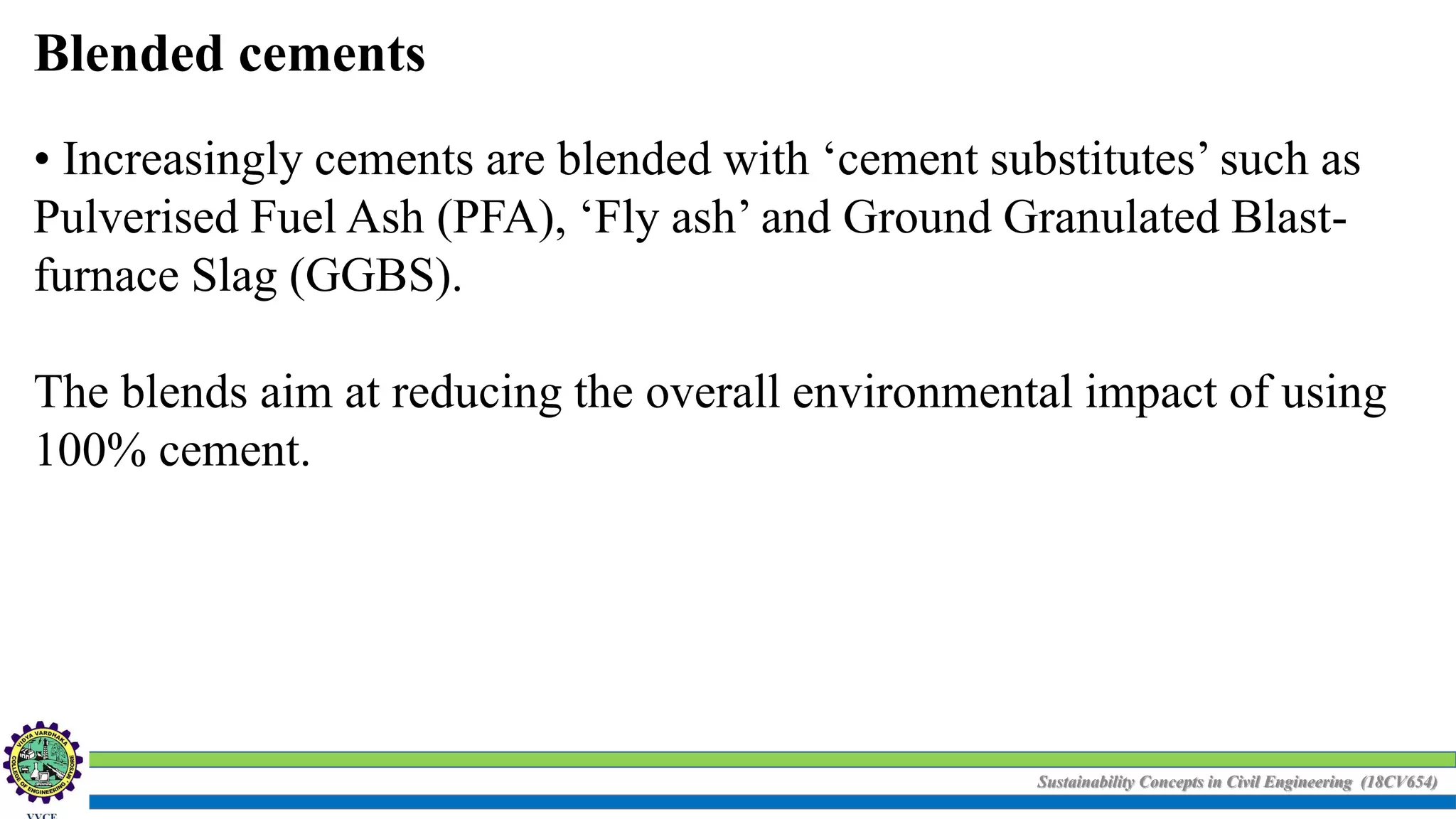
Blended cements
• Increasingly cements are blended with ‘cement substitutes’ such as
Pulverised Fuel Ash (PFA), ‘Fly ash’ and Ground Granulated Blast-
furnace Slag (GGBS).
The blends aim at reducing the overall environmental impact of using
100% cement.
Sustainability Concepts in Civil Engineering (18CV654)
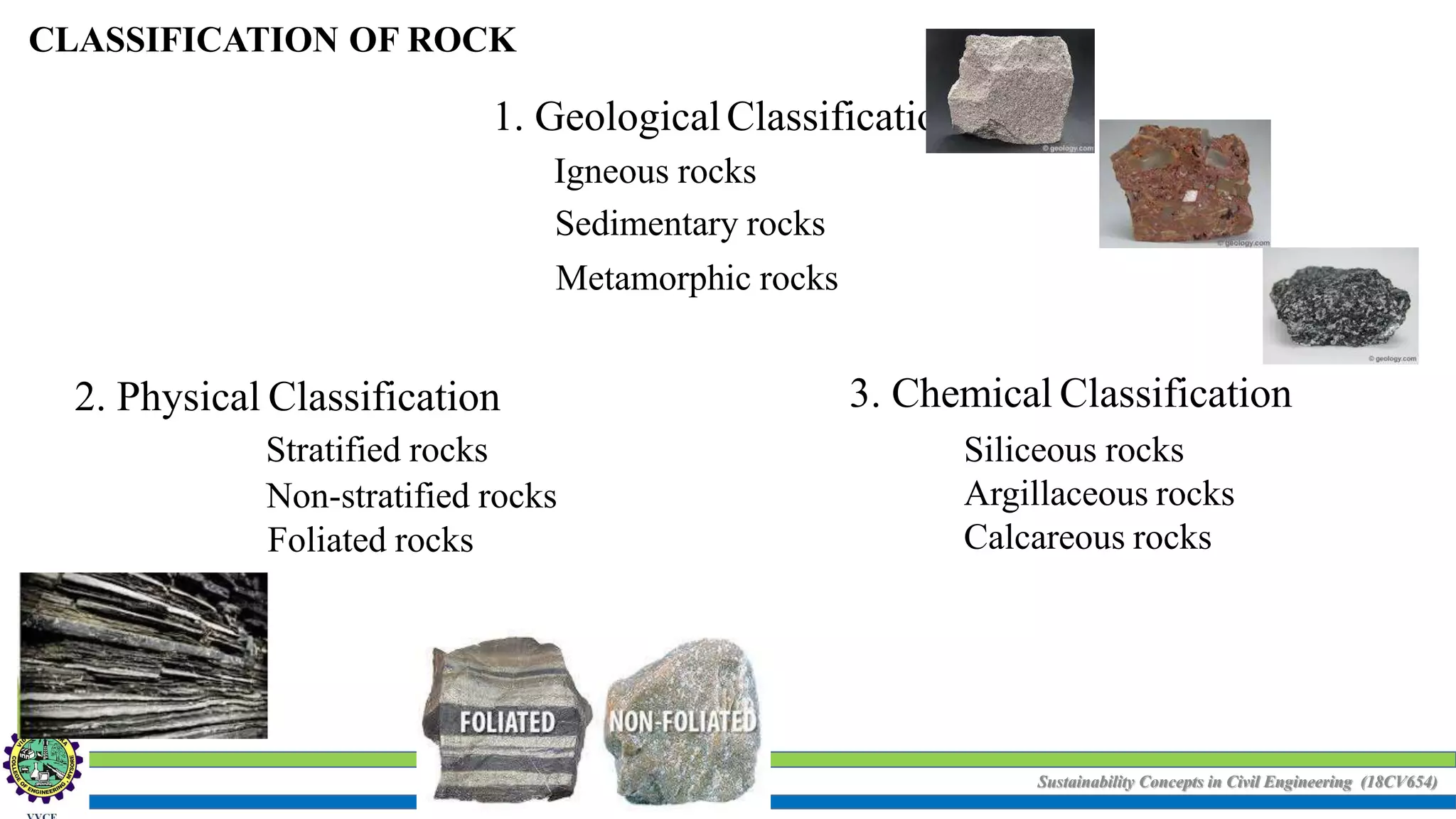
1. GeologicalClassification
Igneous rocks
2. Physical Classification
Stratified rocks
3. Chemical Classification
Siliceous rocks
Argillaceous rocks
Calcareous rocks
CLASSIFICATION OF ROCK
Sedimentary rocks
Metamorphic rocks
Non-stratified rocks
Foliated rocks
Sustainability Concepts in Civil Engineering (18CV654)
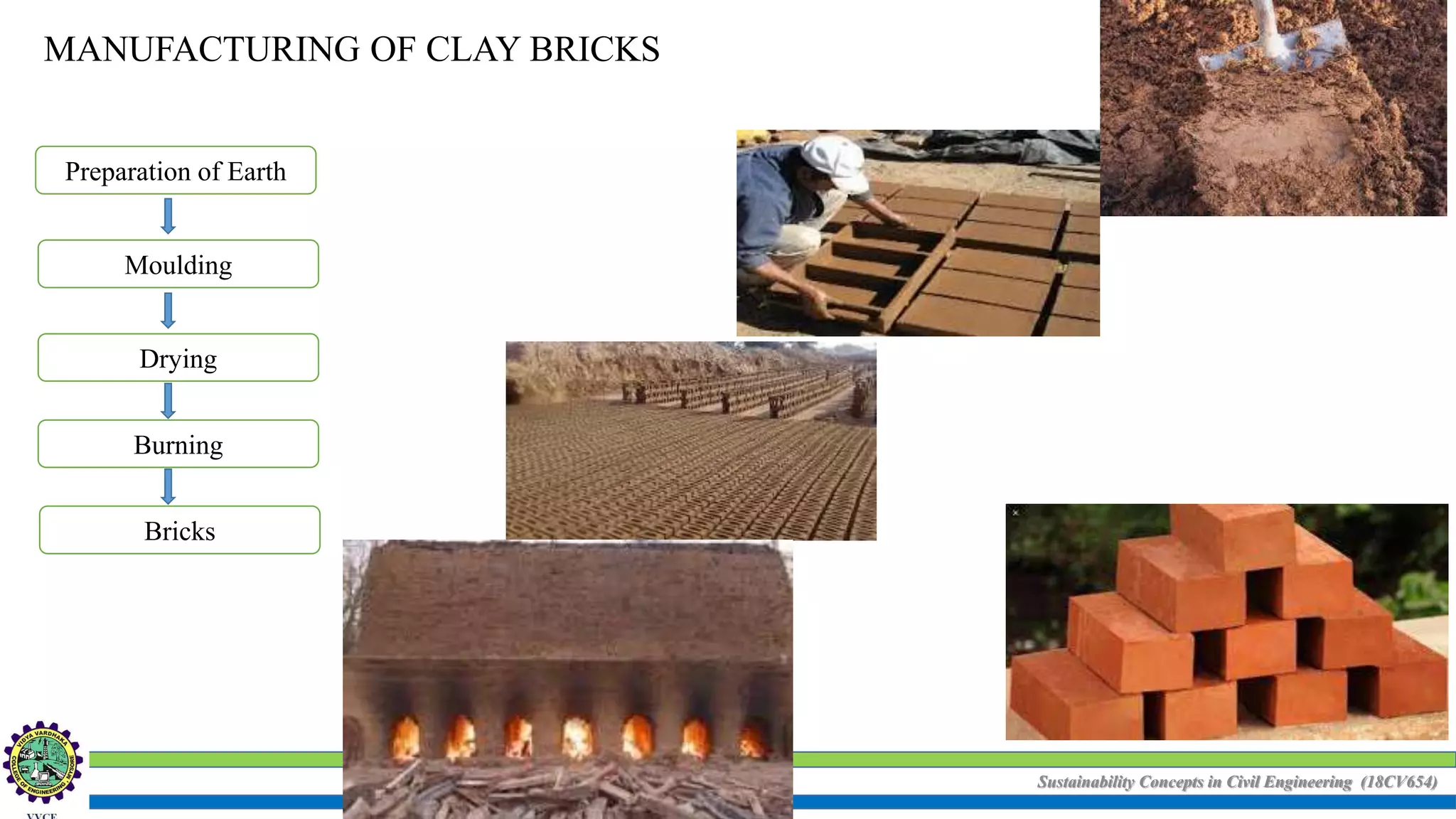
MANUFACTURING OF CLAY BRICKS
Preparation of Earth
Moulding
Drying
Burning
Bricks
Sustainability Concepts in Civil Engineering (18CV654)
BUILDING MATERIALS & CONSTRUCTION - 18CV34
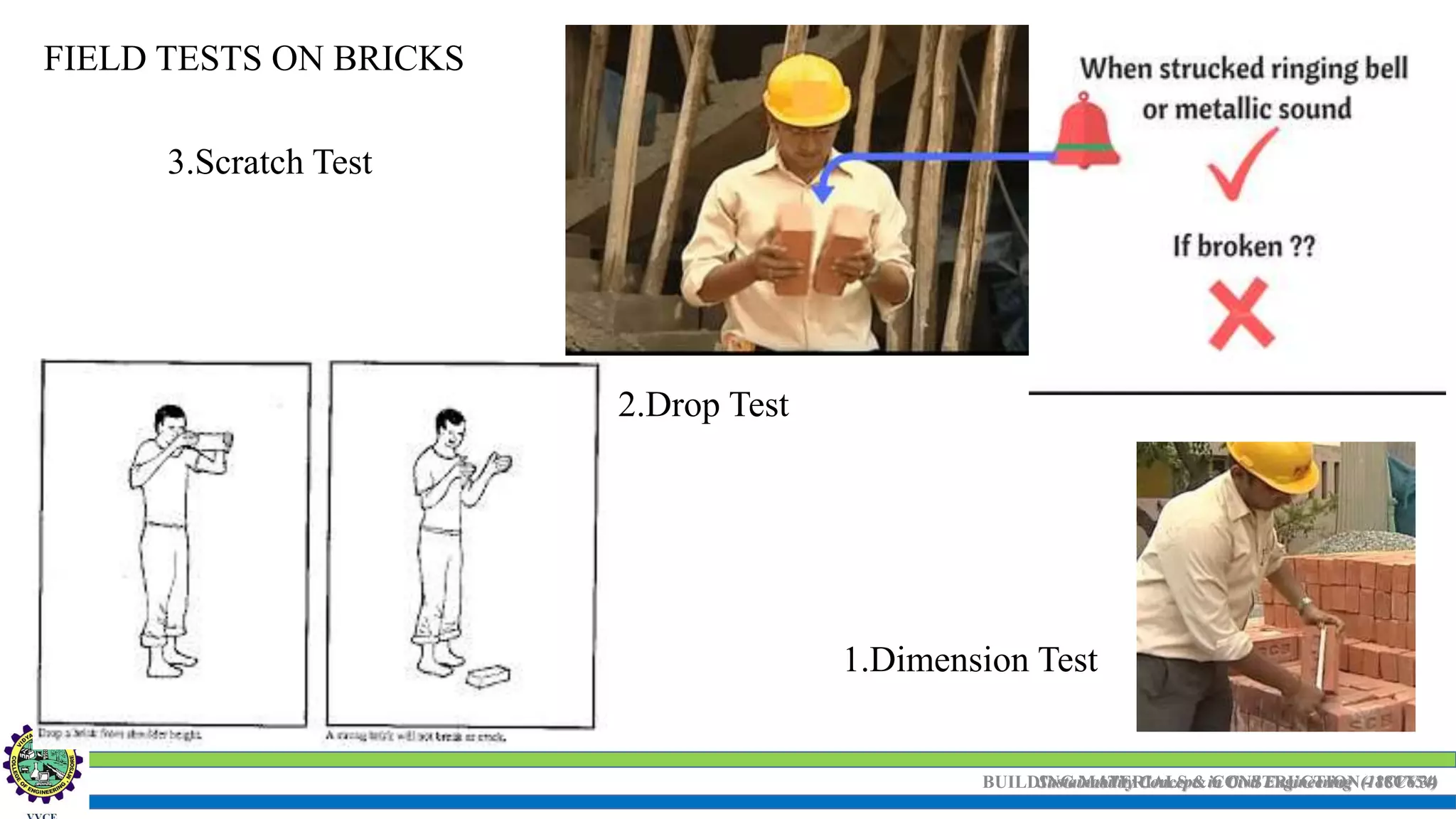
FIELD TESTS ON BRICKS
3.Scratch Test
2.Drop Test
1.Dimension Test
Sustainability Concepts in Civil Engineering (18CV654)
LABORATORY TESTS ON BRICKS
1.Absorption test on bricks
2.compressive strength test on bricks
3.shape and size test on bricks
4.color test of bricks
5.Efflorescence test on bricks.
Sustainability Concepts in Civil Engineering (18CV654)
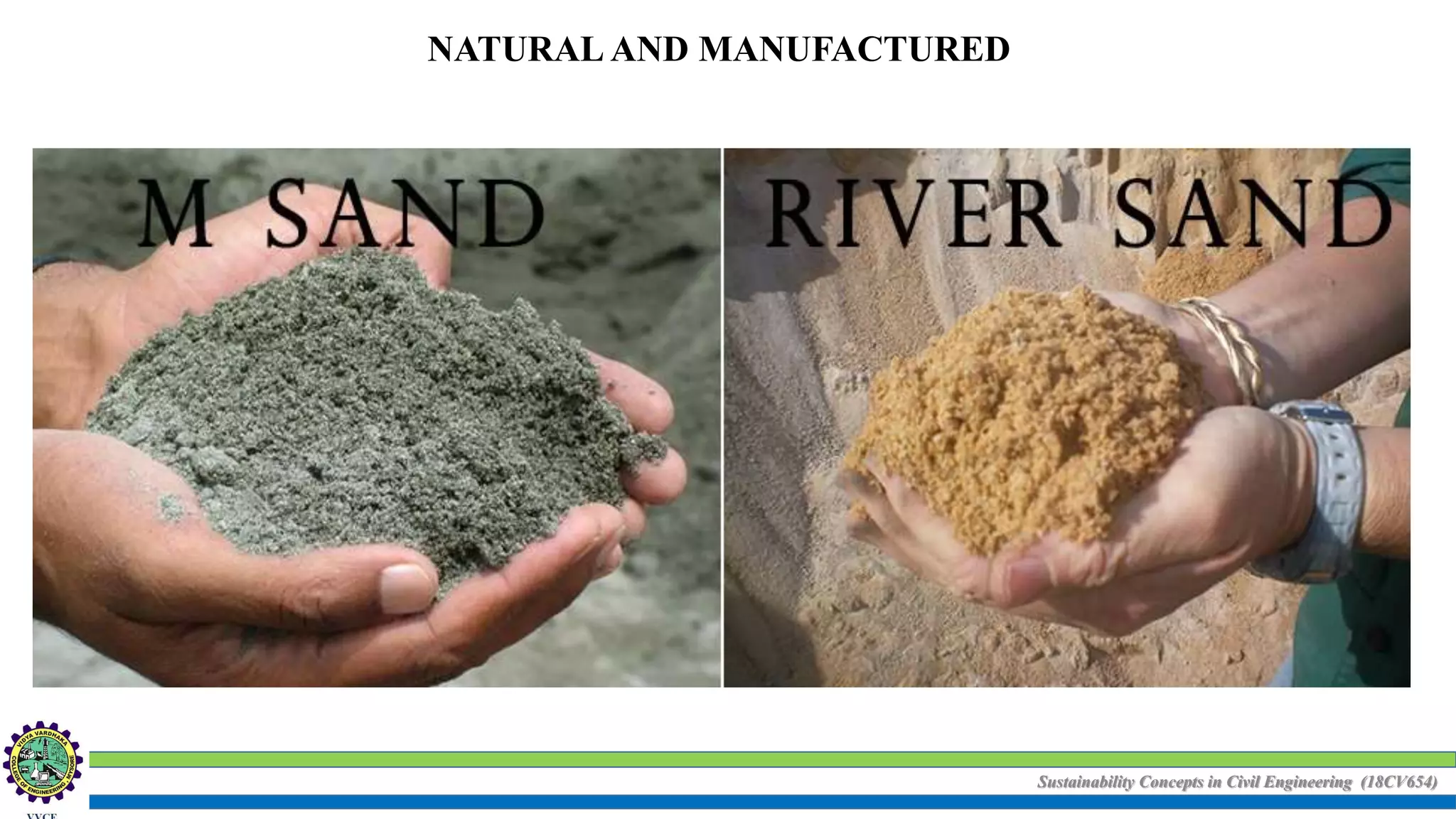
NATURAL AND MANUFACTURED
Sustainability Concepts in Civil Engineering (18CV654)
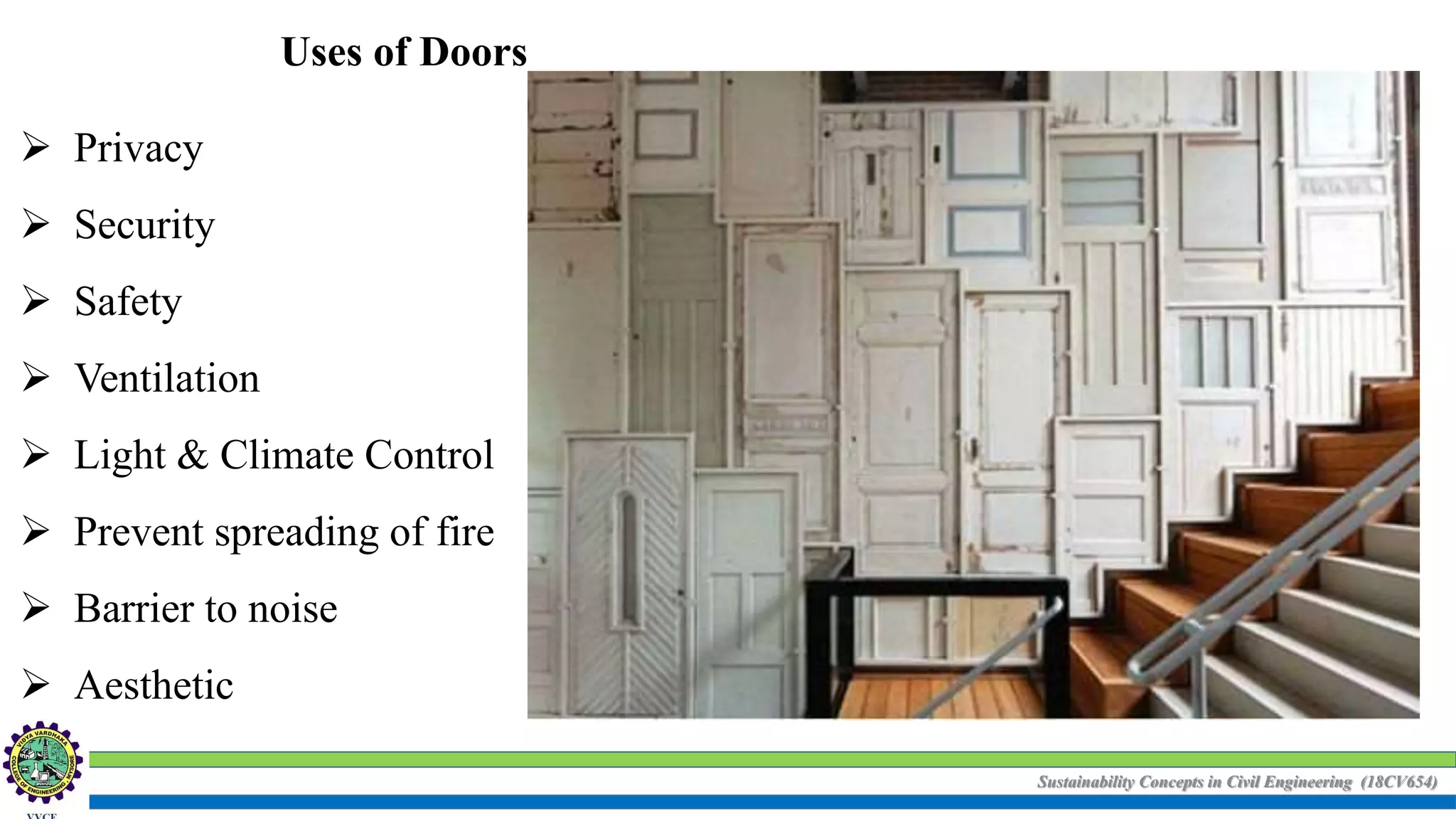
 Privacy
 Security
 Safety
 Ventilation
 Light & Climate Control
 Prevent spreading of fire
 Barrier to noise
 Aesthetic
Uses of Doors
Sustainability Concepts in Civil Engineering (18CV654)
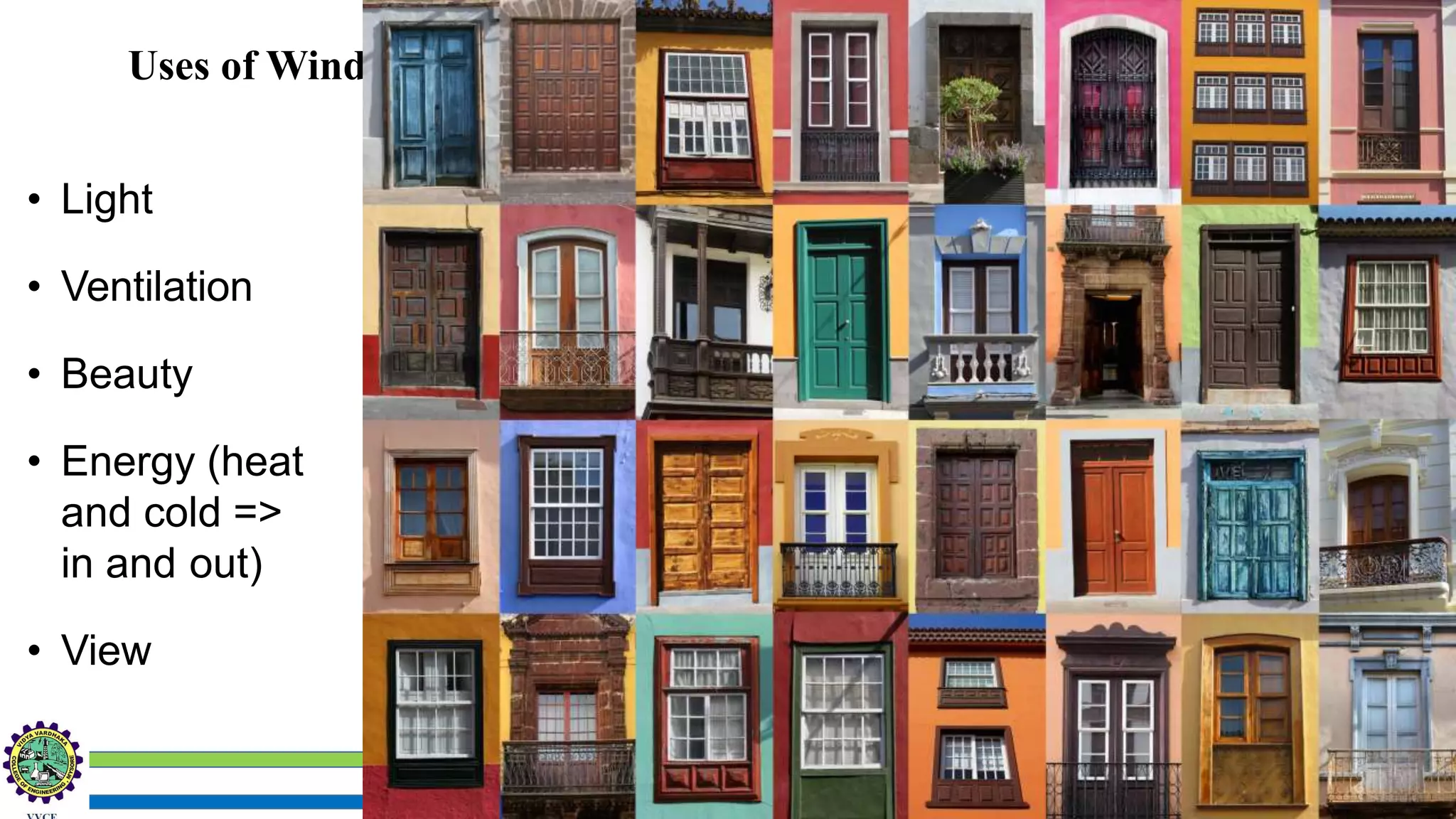
• Light
• Ventilation
• Beauty
• Energy (heat
and cold =>
in and out)
• View
Uses of Windows
Sustainability Concepts in Civil Engineering (18CV654)
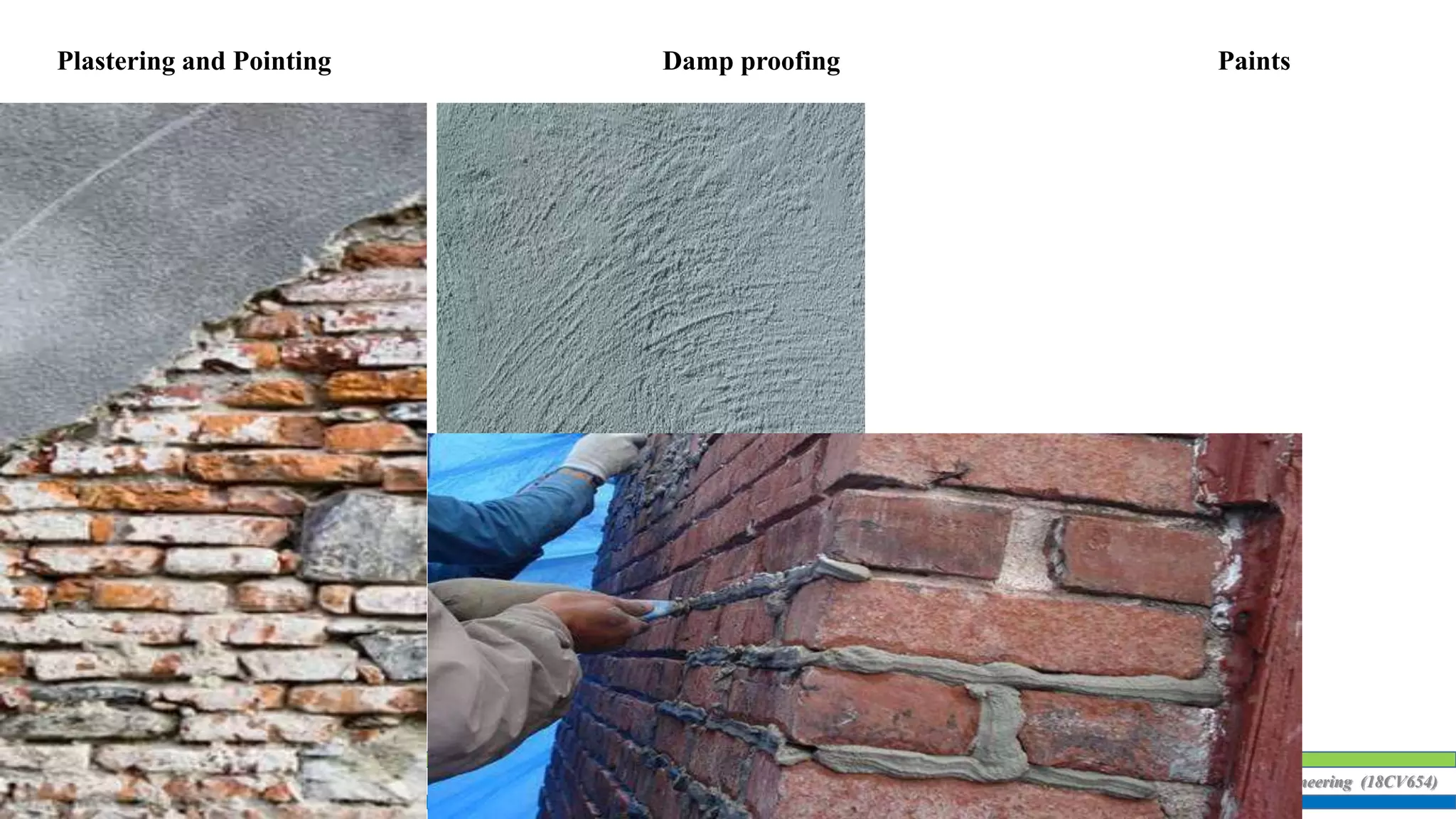
Plastering and Pointing Damp proofing Paints
Sustainability Concepts in Civil Engineering (18CV654)
Material selection for sustainable buildings design
Sustainability Concepts in Civil Engineering (18CV654)
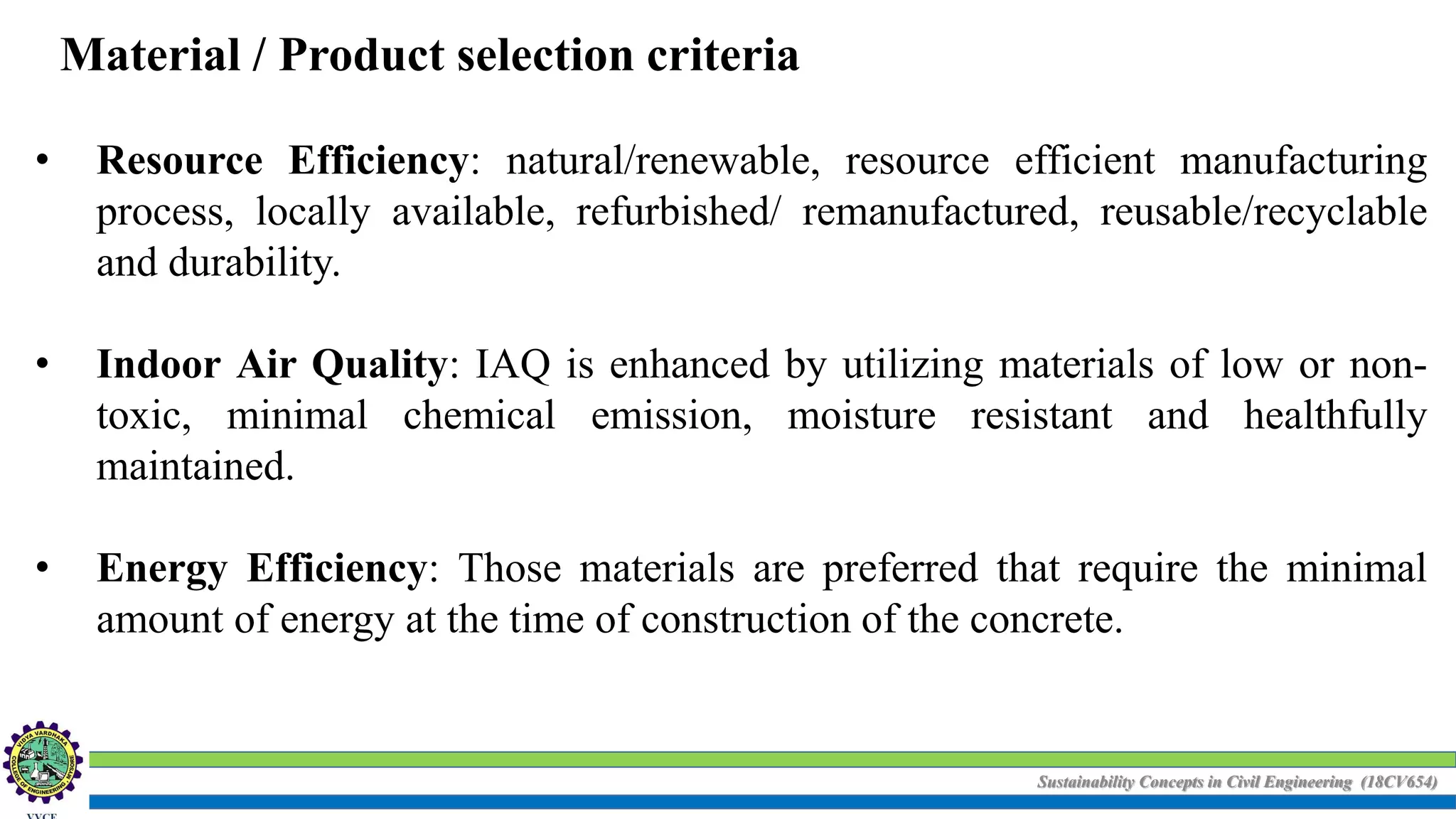
Material / Product selection criteria
• Resource Efficiency: natural/renewable, resource efficient manufacturing
process, locally available, refurbished/ remanufactured, reusable/recyclable
and durability.
• Indoor Air Quality: IAQ is enhanced by utilizing materials of low or non-
toxic, minimal chemical emission, moisture resistant and healthfully
maintained.
• Energy Efficiency: Those materials are preferred that require the minimal
amount of energy at the time of construction of the concrete.
Sustainability Concepts in Civil Engineering (18CV654)
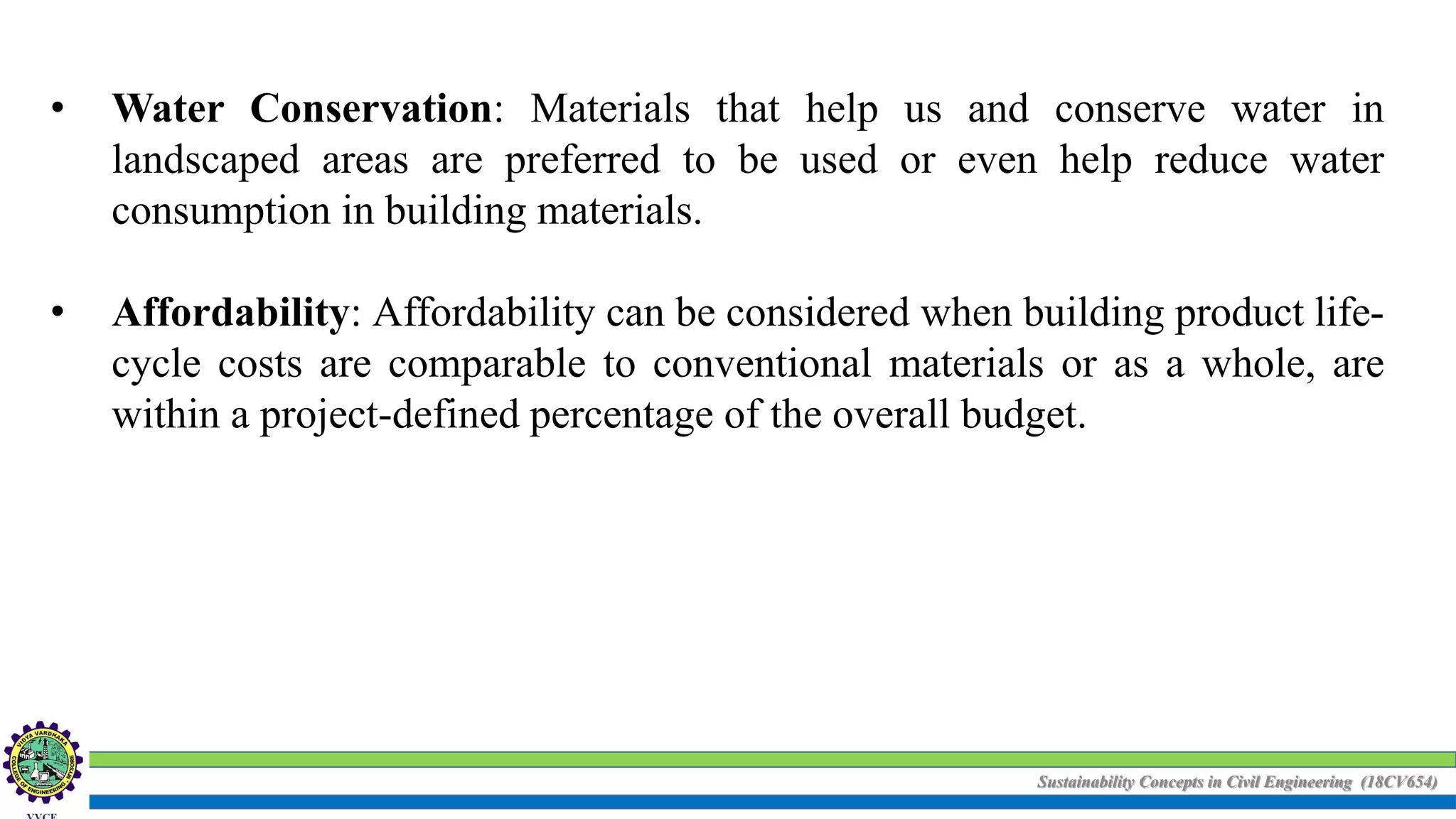
• Water Conservation: Materials that help us and conserve water in
landscaped areas are preferred to be used or even help reduce water
consumption in building materials.
• Affordability: Affordability can be considered when building product life-
cycle costs are comparable to conventional materials or as a whole, are
within a project-defined percentage of the overall budget.
Sustainability Concepts in Civil Engineering (18CV654)
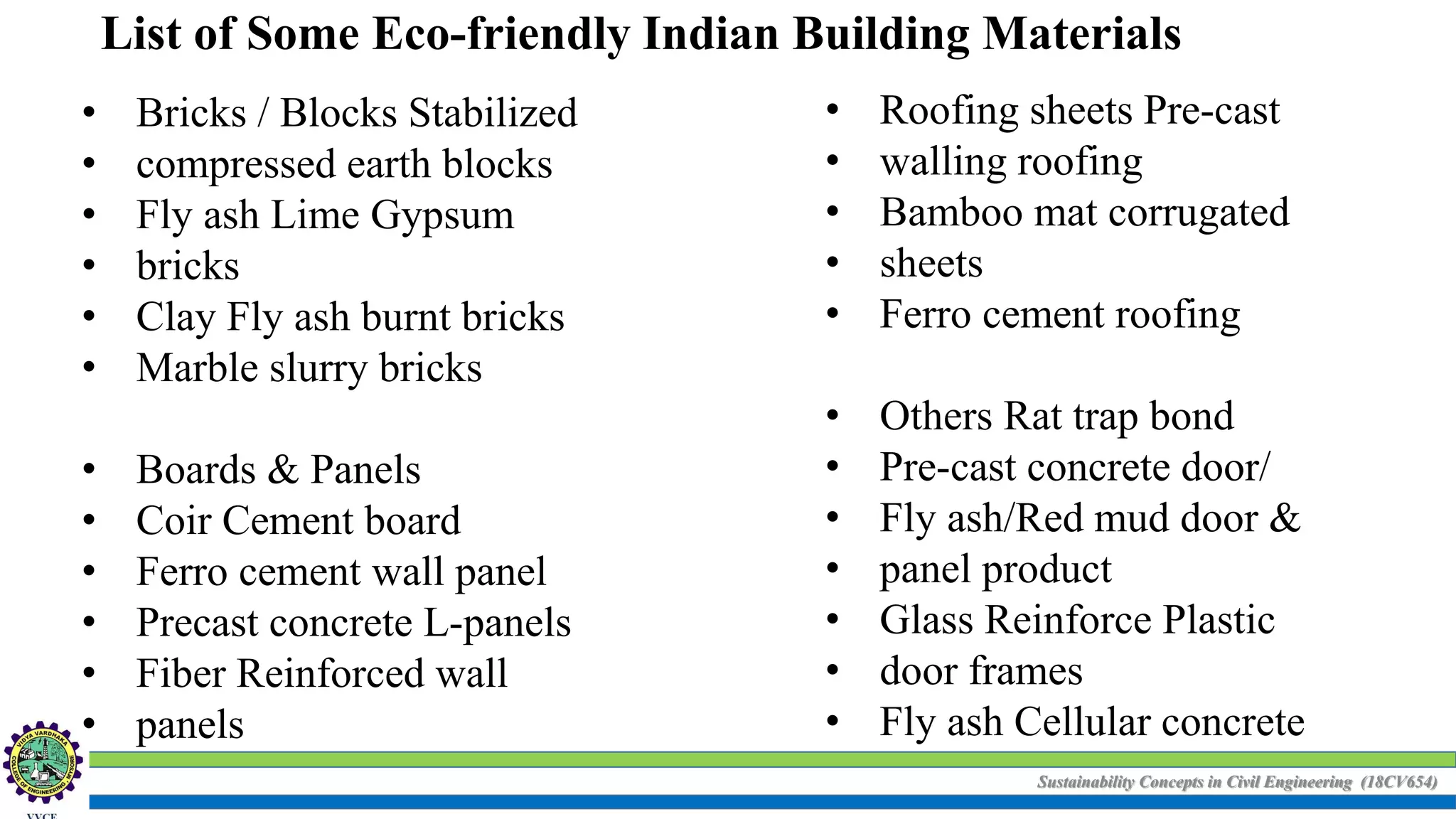
• Bricks / Blocks Stabilized
• compressed earth blocks
• Fly ash Lime Gypsum
• bricks
• Clay Fly ash burnt bricks
• Marble slurry bricks
• Boards & Panels
• Coir Cement board
• Ferro cement wall panel
• Precast concrete L-panels
• Fiber Reinforced wall
• panels
• Roofing sheets Pre-cast
• walling roofing
• Bamboo mat corrugated
• sheets
• Ferro cement roofing
• Others Rat trap bond
• Pre-cast concrete door/
• Fly ash/Red mud door &
• panel product
• Glass Reinforce Plastic
• door frames
• Fly ash Cellular concrete
List of Some Eco-friendly Indian Building Materials
Sustainability Concepts in Civil Engineering (18CV654)
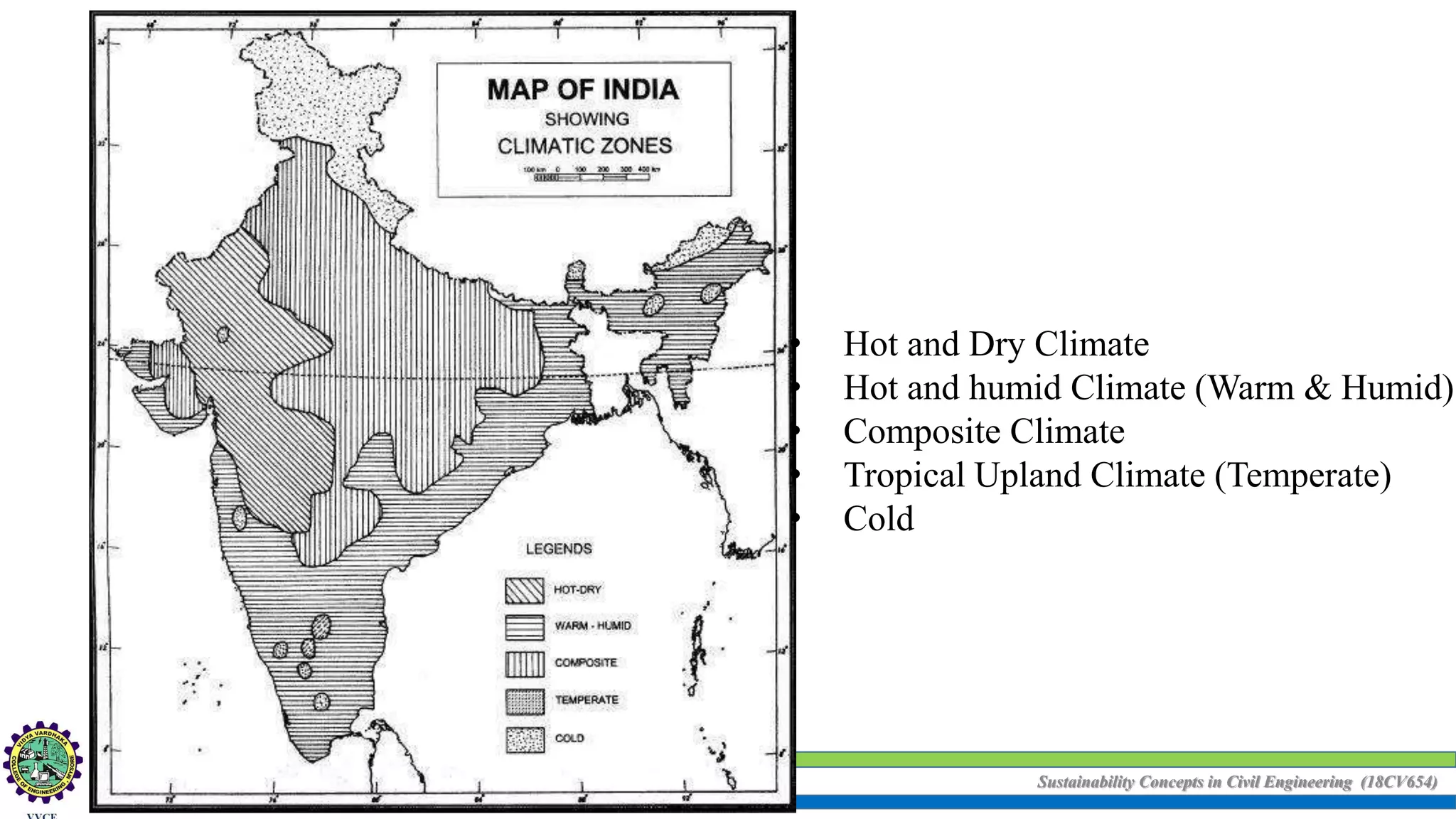
• Hot and Dry Climate
• Hot and humid Climate (Warm & Humid)
• Composite Climate
• Tropical Upland Climate (Temperate)
• Cold
Sustainability Concepts in Civil Engineering (18CV654)
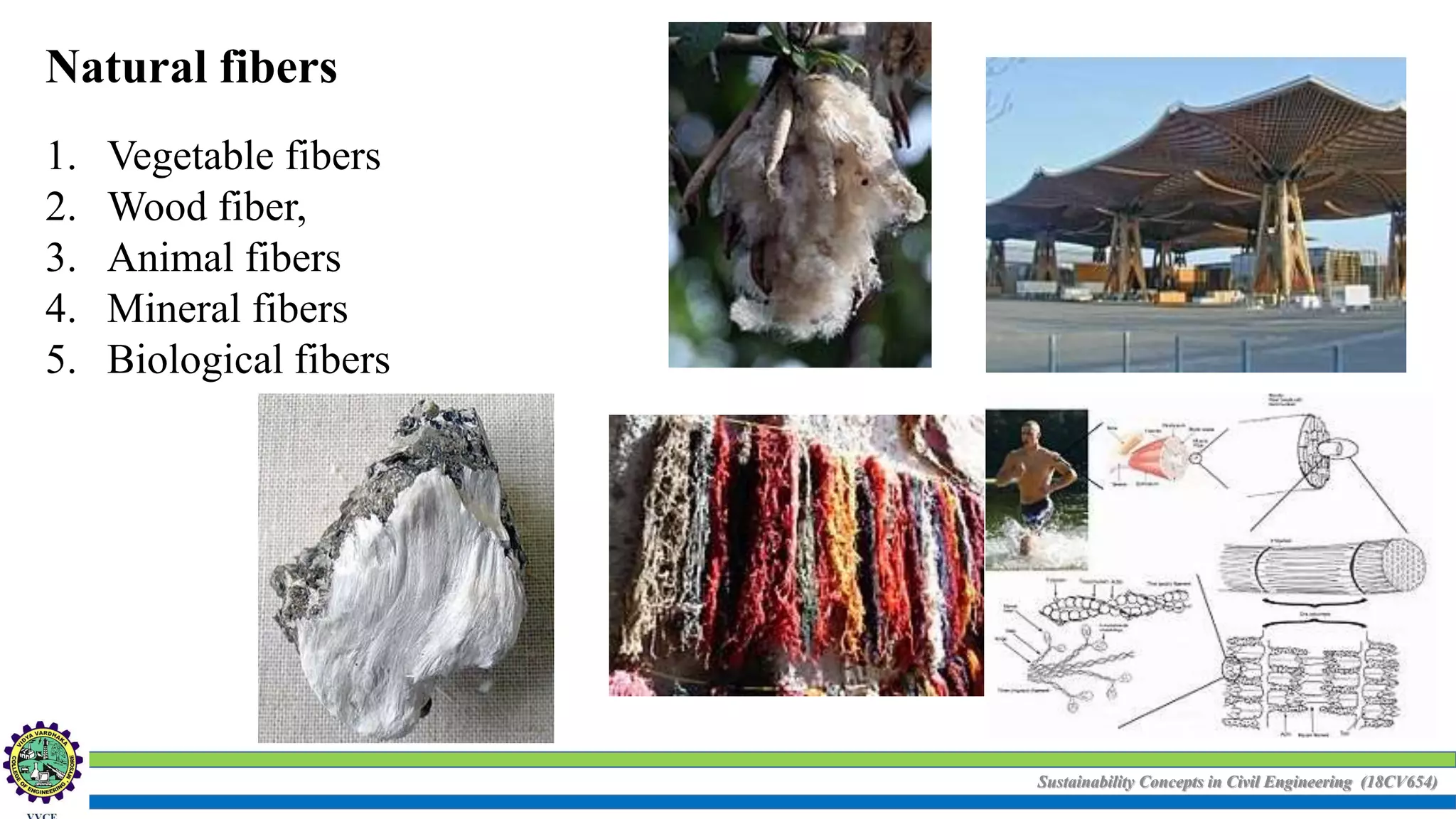
Natural fibers
1. Vegetable fibers
2. Wood fiber,
3. Animal fibers
4. Mineral fibers
5. Biological fibers
Sustainability Concepts in Civil Engineering (18CV654)
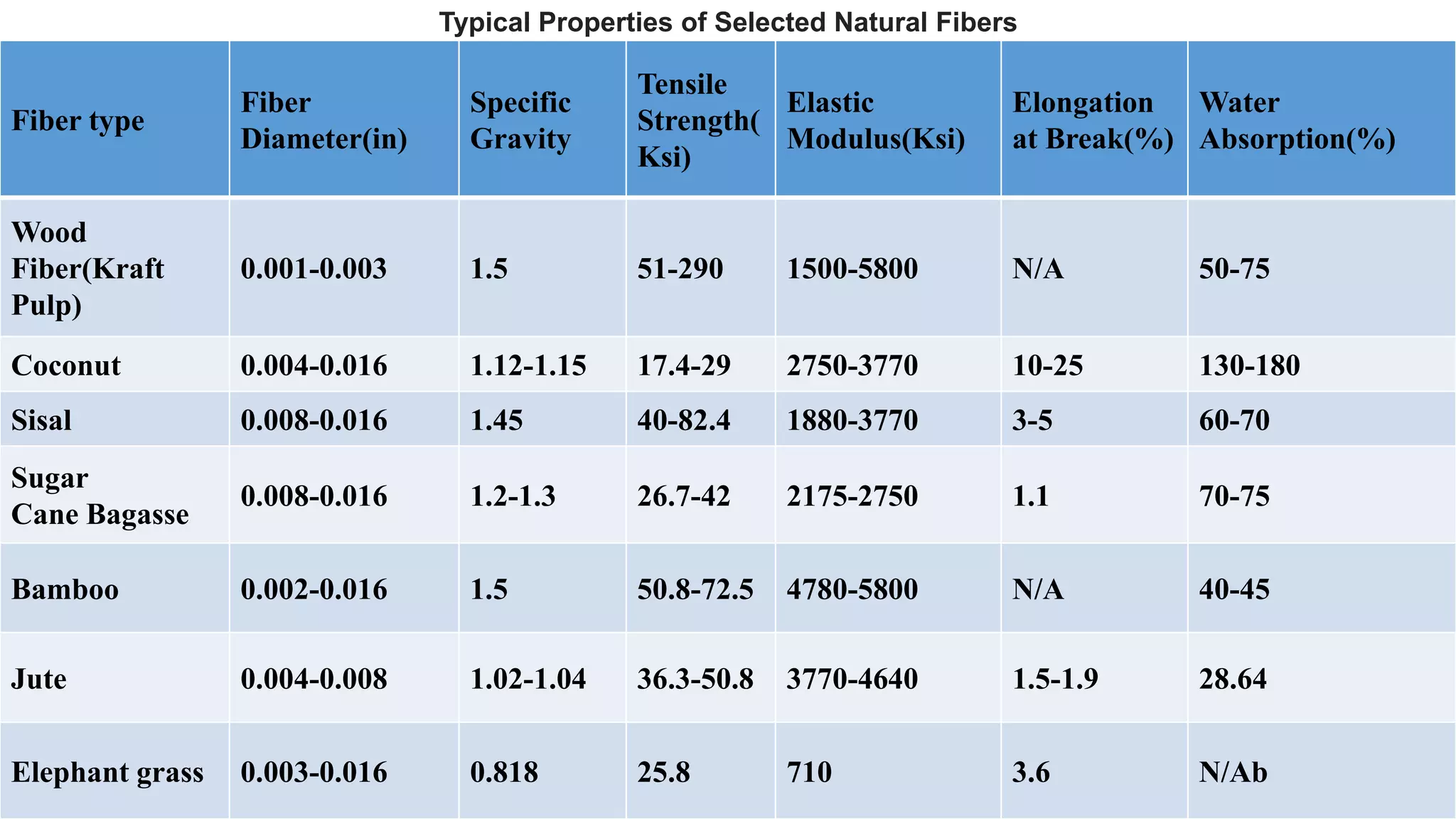
Typical Properties of Selected Natural Fibers
Fiber type
Fiber
Diameter(in)
Specific
Gravity
Tensile
Strength(
Ksi)
Elastic
Modulus(Ksi)
Elongation
at Break(%)
Water
Absorption(%)
Wood
Fiber(Kraft
Pulp)
0.001-0.003 1.5 51-290 1500-5800 N/A 50-75
Coconut 0.004-0.016 1.12-1.15 17.4-29 2750-3770 10-25 130-180
Sisal 0.008-0.016 1.45 40-82.4 1880-3770 3-5 60-70
Sugar
Cane Bagasse
0.008-0.016 1.2-1.3 26.7-42 2175-2750 1.1 70-75
Bamboo 0.002-0.016 1.5 50.8-72.5 4780-5800 N/A 40-45
Jute 0.004-0.008 1.02-1.04 36.3-50.8 3770-4640 1.5-1.9 28.64
Elephant grass 0.003-0.016 0.818 25.8 710 3.6 N/Ab
Sustainability Concepts in Civil Engineering (18CV654)
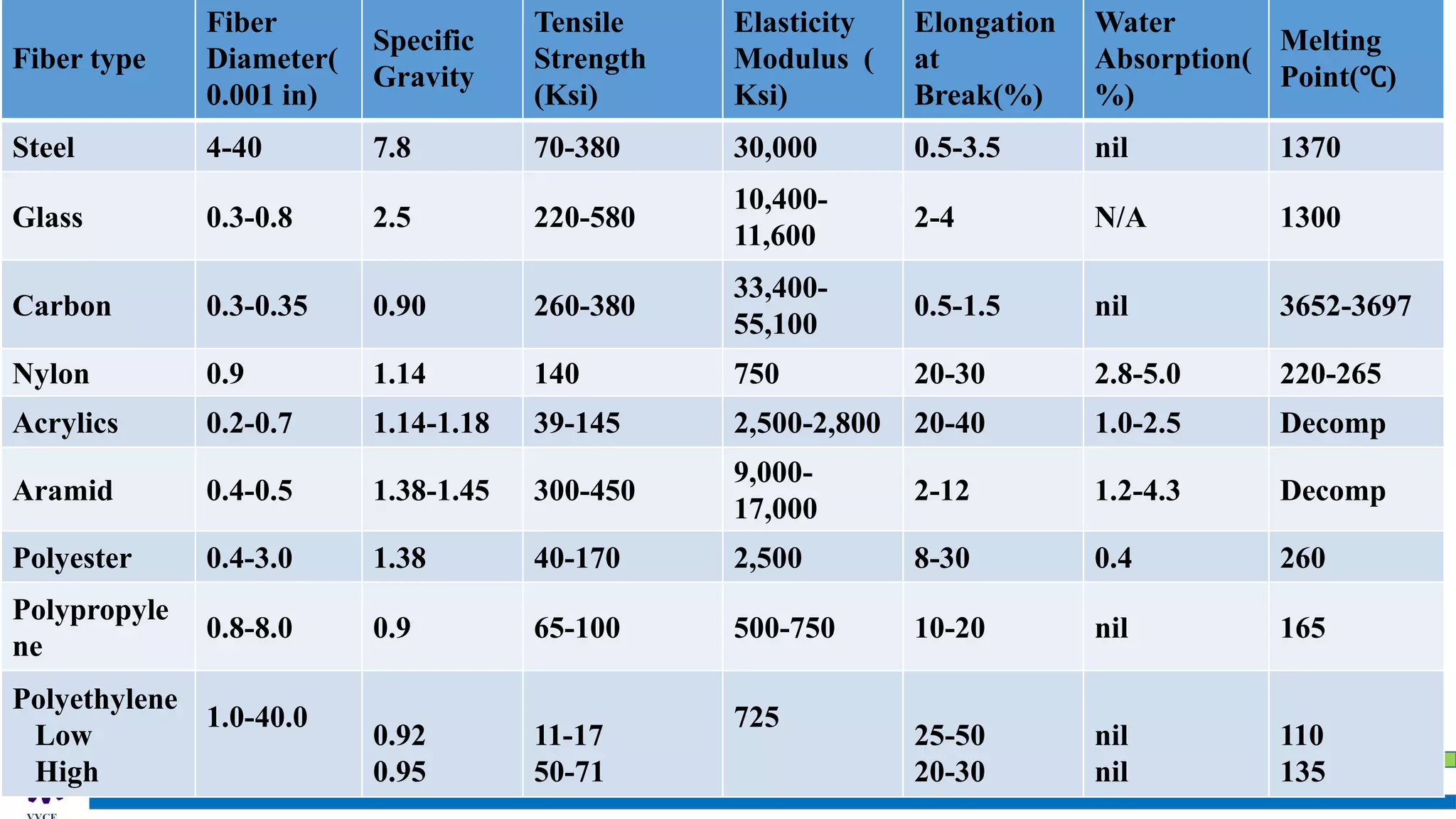
Fiber type
Fiber
Diameter(
0.001 in)
Specific
Gravity
Tensile
Strength
(Ksi)
Elasticity
Modulus (
Ksi)
Elongation
at
Break(%)
Water
Absorption(
%)
Melting
Point(℃)
Steel 4-40 7.8 70-380 30,000 0.5-3.5 nil 1370
Glass 0.3-0.8 2.5 220-580
10,400-
11,600
2-4 N/A 1300
Carbon 0.3-0.35 0.90 260-380
33,400-
55,100
0.5-1.5 nil 3652-3697
Nylon 0.9 1.14 140 750 20-30 2.8-5.0 220-265
Acrylics 0.2-0.7 1.14-1.18 39-145 2,500-2,800 20-40 1.0-2.5 Decomp
Aramid 0.4-0.5 1.38-1.45 300-450
9,000-
17,000
2-12 1.2-4.3 Decomp
Polyester 0.4-3.0 1.38 40-170 2,500 8-30 0.4 260
Polypropyle
ne
0.8-8.0 0.9 65-100 500-750 10-20 nil 165
Polyethylene
Low
High
1.0-40.0
0.92
0.95
11-17
50-71
725
25-50
20-30
nil
nil
110
135
Sustainability Concepts in Civil Engineering (18CV654)
ENERGY-EFFICIENT BUILDING DESIGN
Sustainability Concepts in Civil Engineering (18CV654)
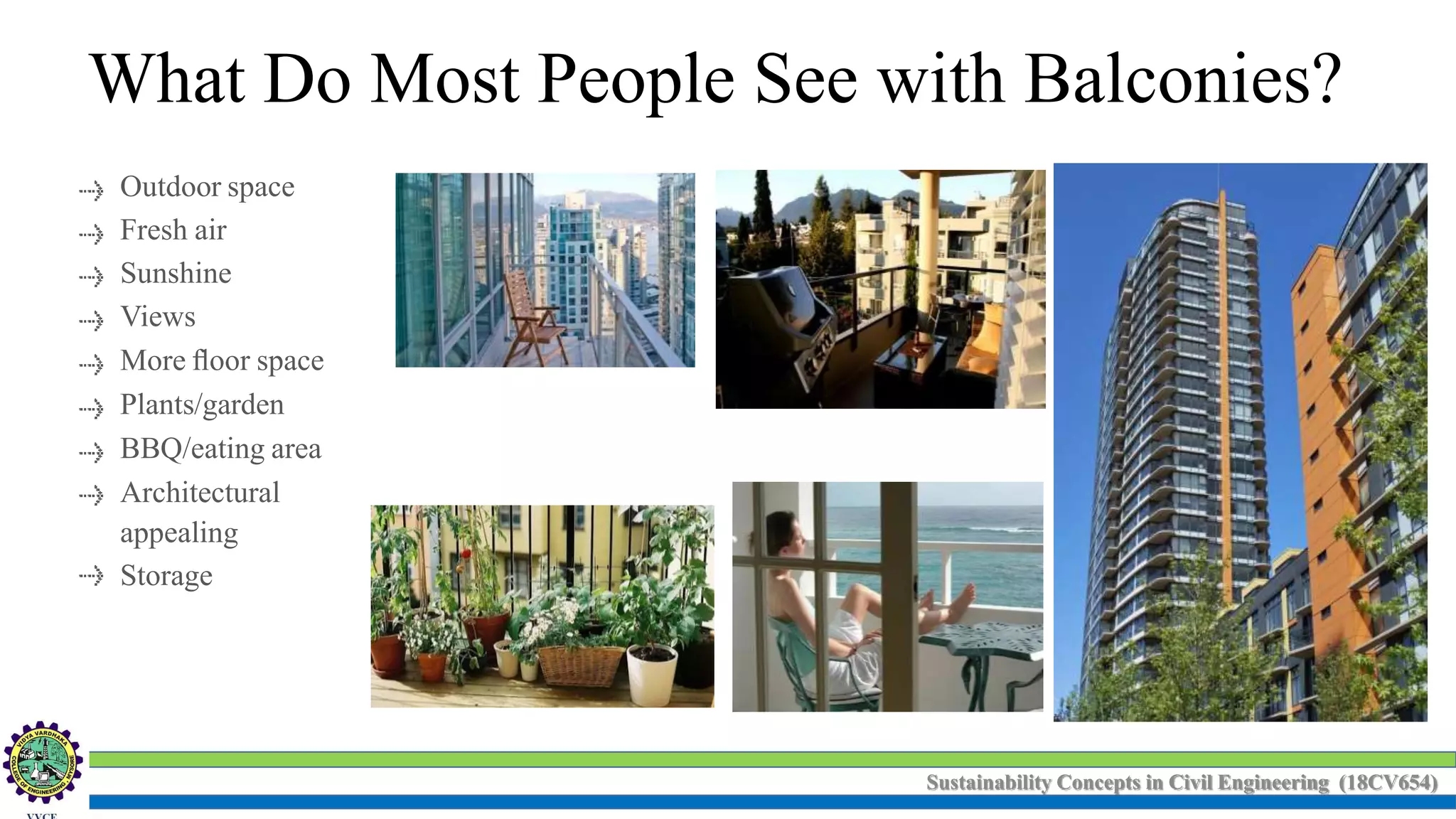
Outdoor space
Fresh air
Sunshine
Views
More floor space
Plants/garden
BBQ/eating area
Architectural
appealing
Storage
What Do Most People See with Balconies?
Sustainability Concepts in Civil Engineering (18CV654)
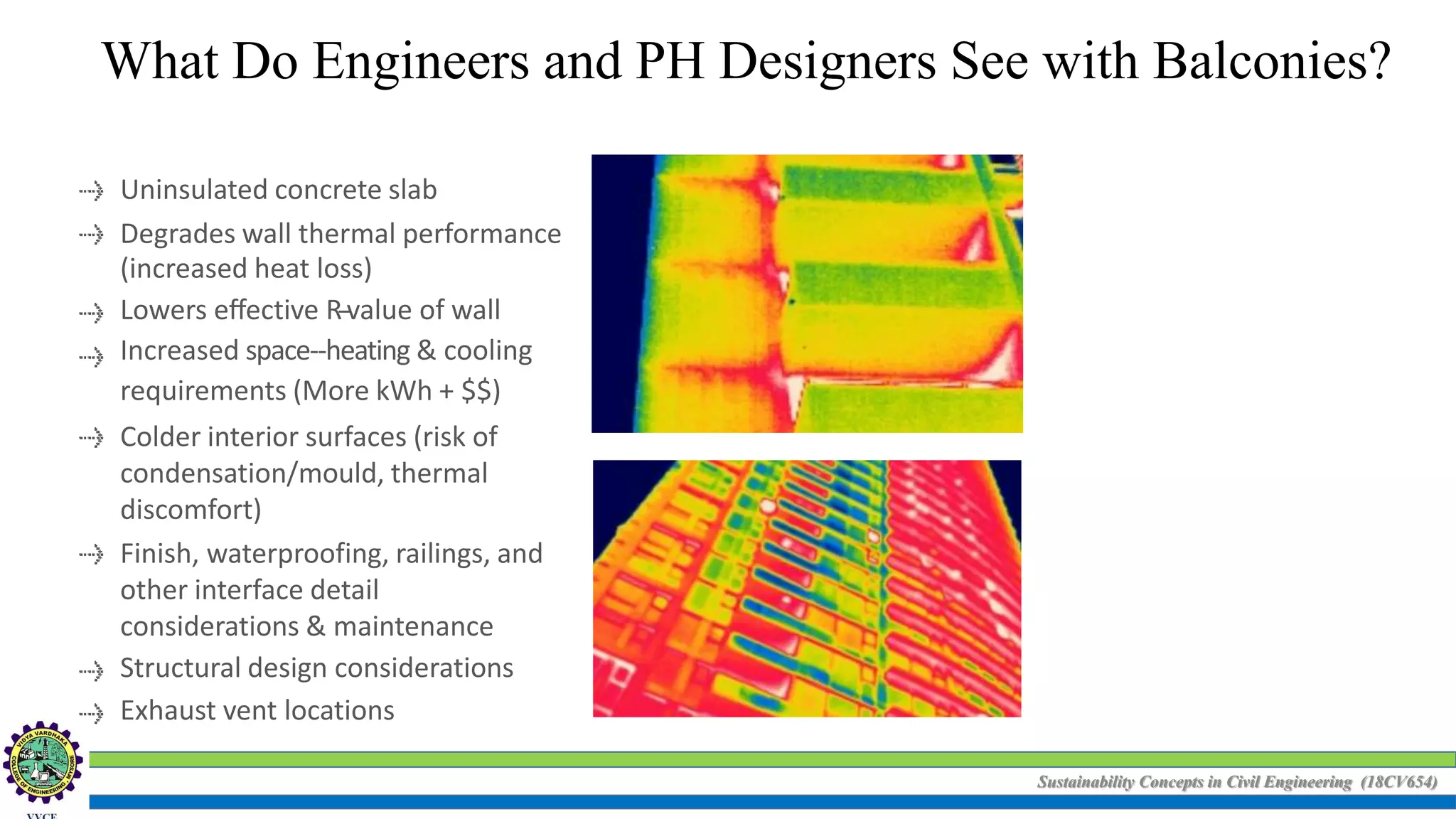
Uninsulated concrete slab
Degrades wall thermal performance
(increased heat loss)
Lowers effective R-‐value of wall
Increased space-‐heating & cooling
requirements (More kWh + $$)
Colder interior surfaces (risk of
condensation/mould, thermal
discomfort)
Finish, waterproofing, railings, and
other interface detail
considerations & maintenance
Structural design considerations
Exhaust vent locations
What Do Engineers and PH Designers See with Balconies?
Sustainability Concepts in Civil Engineering (18CV654)
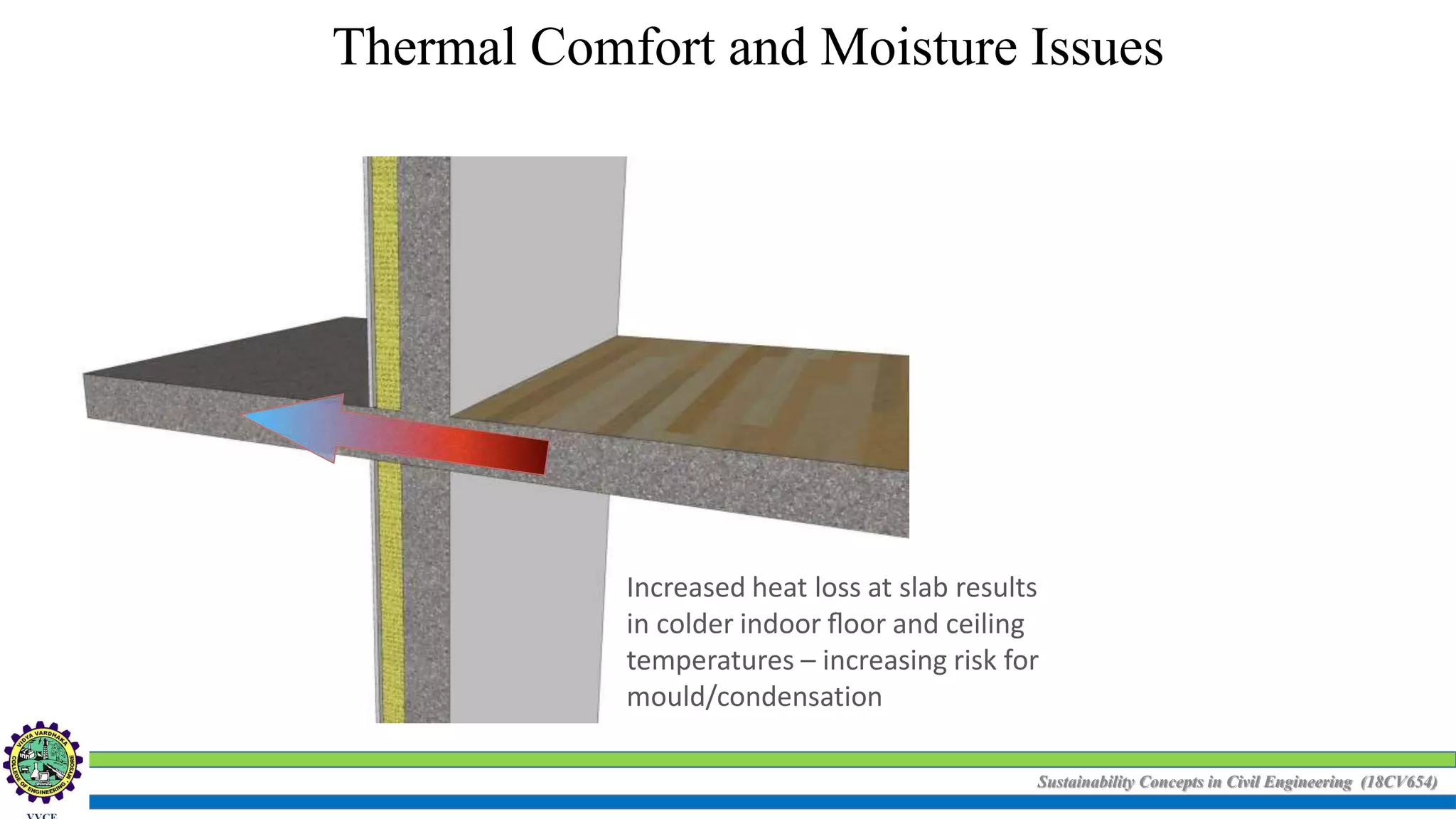
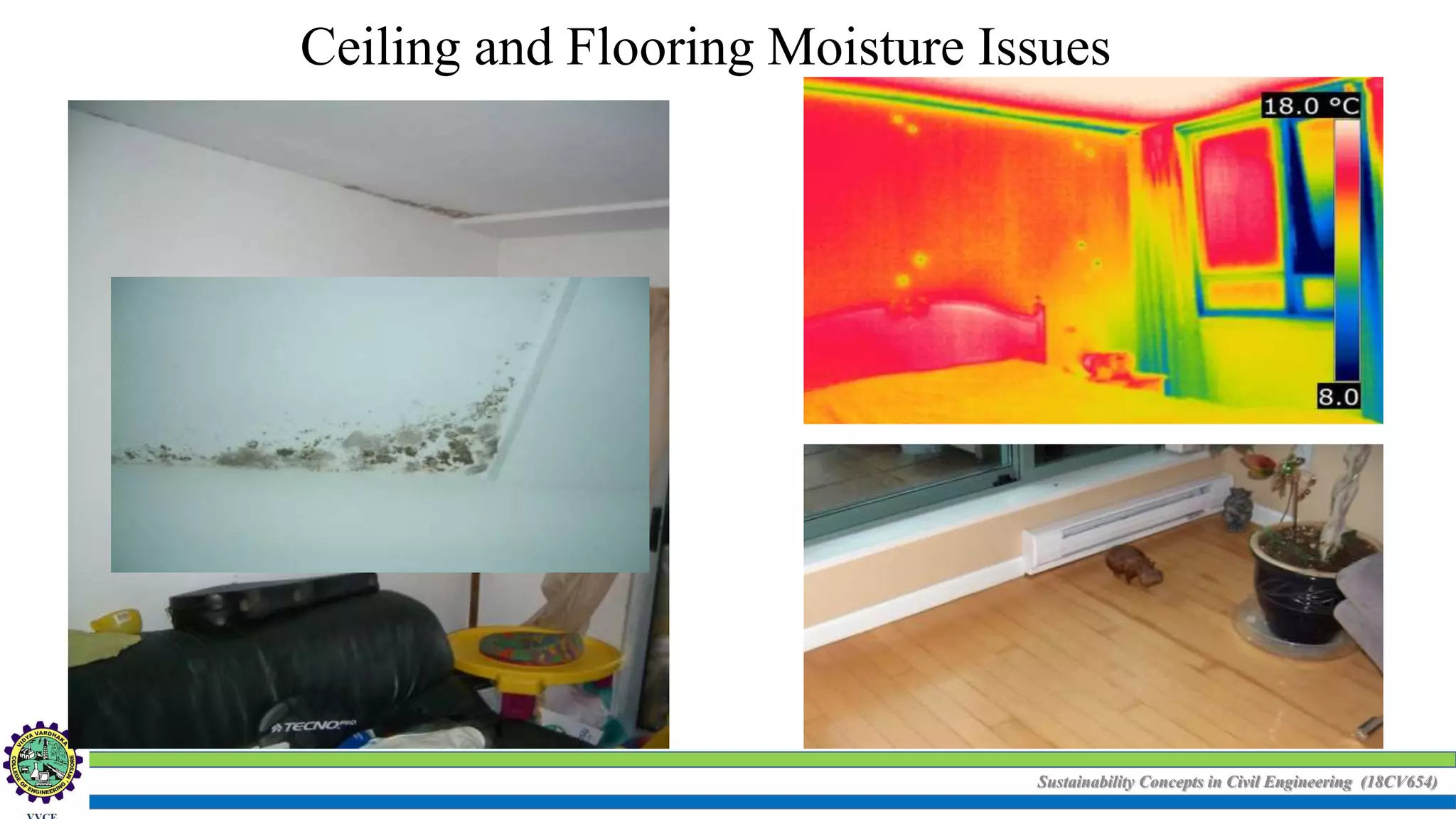
Thermal Comfort and Moisture Issues
Increased heat loss at slab results
in colder indoor floor and ceiling
temperatures – increasing risk for
mould/condensation
Sustainability Concepts in Civil Engineering (18CV654)
Ceiling and Flooring Moisture Issues
Sustainability Concepts in Civil Engineering (18CV654)
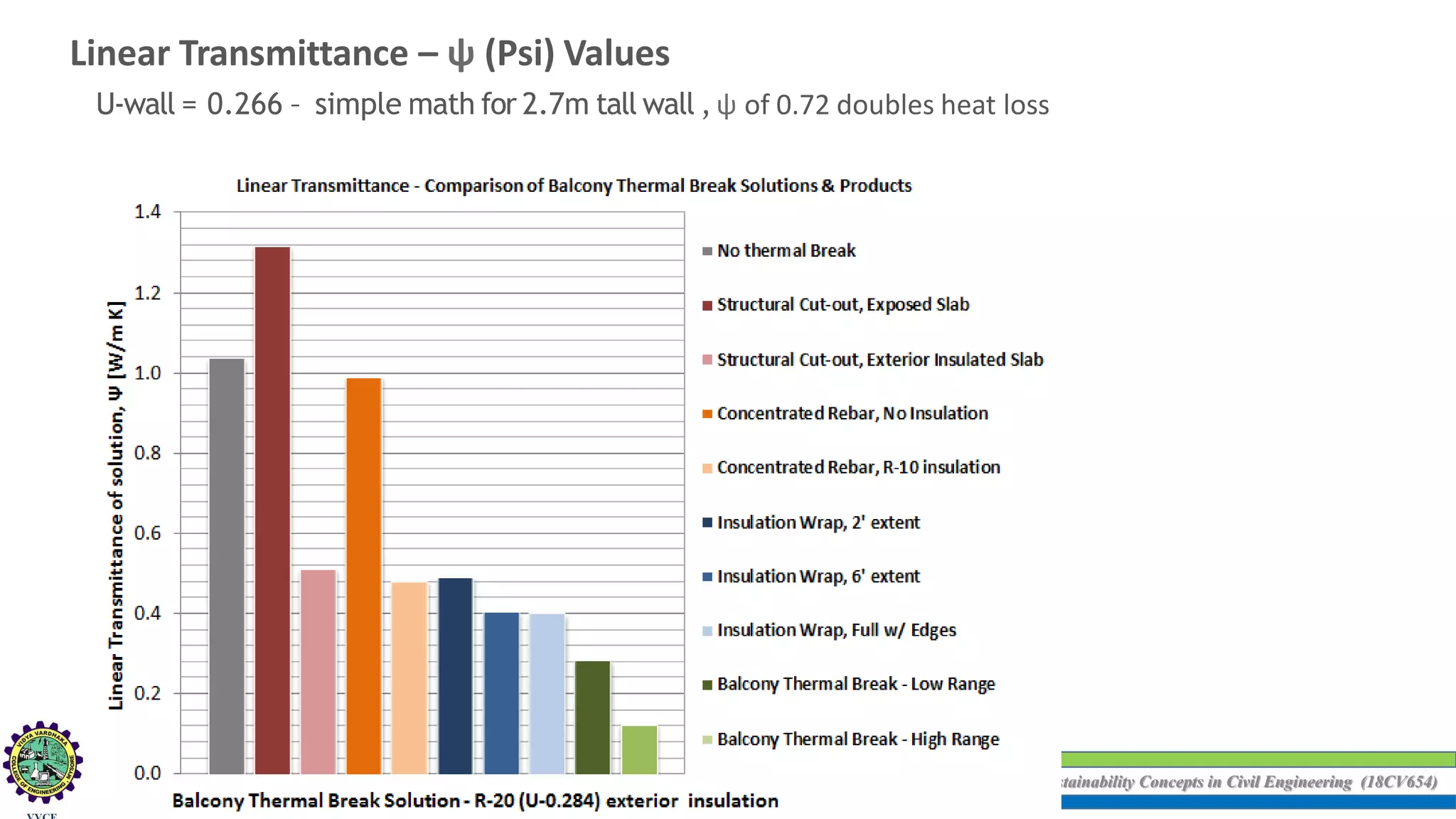
Linear Transmittance – ψ (Psi) Values
U-wall = 0.266 – simple math for 2.7m tall wall ,ψ of 0.72 doubles heat loss
Sustainability Concepts in Civil Engineering (18CV654)
ENERGY CONSUMPTION BY THE BUILDING
Demand for energy is increasing fast day by day and is likely to increase in tune with
industrialization/ urbanization. The building sector being one of the largest consumers of energy,
has gained prominence over the past few decades.
• 45% of total global energy is used in heating, cooling and lighting of building.
• 5% energy is used in building construction.
• Energy used for air conditioning of commercial buildings accounts for 32% of the total energy
consumption.
• Energy consumption patterns can be substantially reduced by energy conserving measures,
particularly during the phase of building design.
• Space heating load can be reduced by about 50%.
Sustainability Concepts in Civil Engineering (18CV654)
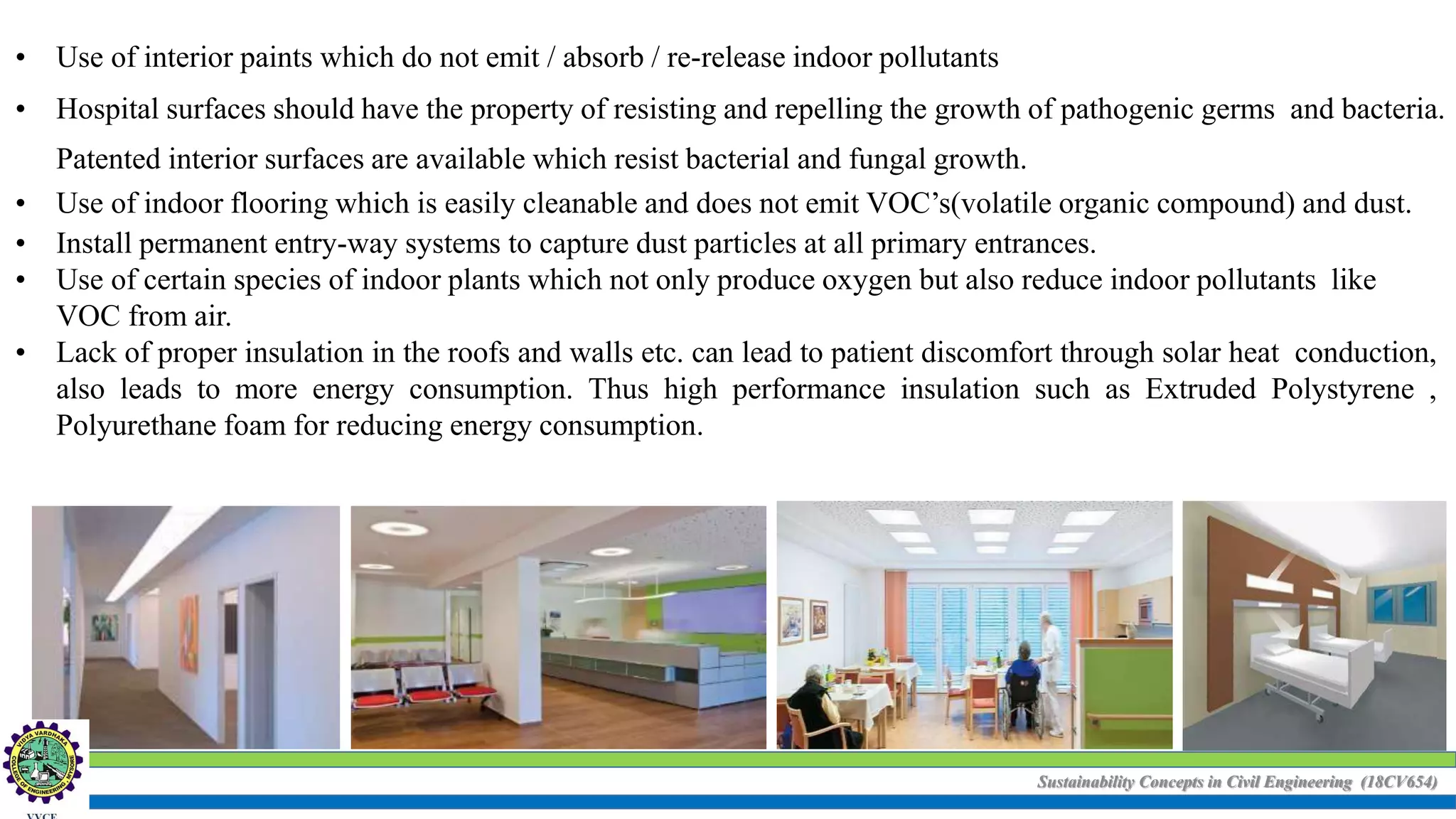
• Use of interior paints which do not emit / absorb / re-release indoor pollutants
• Hospital surfaces should have the property of resisting and repelling the growth of pathogenic germs and bacteria.
Patented interior surfaces are available which resist bacterial and fungal growth.
• Use of indoor flooring which is easily cleanable and does not emit VOC’s(volatile organic compound) and dust.
• Install permanent entry-way systems to capture dust particles at all primary entrances.
• Use of certain species of indoor plants which not only produce oxygen but also reduce indoor pollutants like
VOC from air.
• Lack of proper insulation in the roofs and walls etc. can lead to patient discomfort through solar heat conduction,
also leads to more energy consumption. Thus high performance insulation such as Extruded Polystyrene ,
Polyurethane foam for reducing energy consumption.
Sustainability Concepts in Civil Engineering (18CV654)
PERFORMANCE, EFFICIENCY, COMFORT (PEC)
Three core values applied to lighting in healthcare
PERFORMANCE:
To provide an optimal lighting solution. In hospitals, clinics and care homes, this can lead to less fatigue,
quicker reactions and task completion with fewer mistakes resulting in higher standards of care.
EFFICIENCY:
Efficiency is concerned with the energy consumption, economics and practical aspects of a
lighting installation. Lighting products are carefully engineered and manufactured to produce
practical, easy to maintain solutions that consume the least possible power and provide long-life,
trouble- free solutions.
COMFORT:
The ability to give people satisfaction and stimulation. Lighting influences concentration and mood.
Comfort is concerned with atmosphere, reassurance, and in the healthcare environment, the well-being of
the patient.
Sustainability Concepts in Civil Engineering (18CV654)
GUIDELINES for ENERGY EFFICIENCY
Energy saving measures can play a significant role for lowering energy consumption for environmental
protection.
Energy consumption is responsible for CO2 emissions to the atmosphere, that contribute to the
“greenhouse effect”. An important parameter for energy saving in the buildings sector is the high
efficiency of the energy infrastructures, which requires excellent quality of the relevant equipment
installed, as well as the compliance with all the requirements
In order to maximize the energy efficiency of a building -based on the capabilities of the existing shell
and infrastructure, and minimize the need of any reconstruction or energy saving measures should be
adopted.
An energy management programme for a building or group of buildings
usually include:
• Identification of the adequate targets for energy consumption
• Feasibility and implementation of new energy technologies
• Identifying the adequate funding for energy projects
• Monitoring of the construction of energy applications
• Monitoring of the efficiency during their operation.
Sustainability Concepts in Civil Engineering (18CV654)
ENERGY SAVING POTENTIAL
One of the main building types with a great potential to apply measures of energy saving is the
hospitals.
Below, some of the most important reasons why hospitals consume lot of energy and some simple
ways to reduce their energy consumption are mentioned.
1) 24hour operation (lighting, heating, air condition, electricity consumption)- The non-stop
function of the hospitals is an important factor why there is such a big energy
consumption.
2) Lighting- Lighting is a sector with great energy saving potential. These could result in a 50%
reduction in energy
consumption.
3) Heating- Consuming gas for heating is a big percentage of the overall energy consumption.
Sustainability Concepts in Civil Engineering (18CV654)
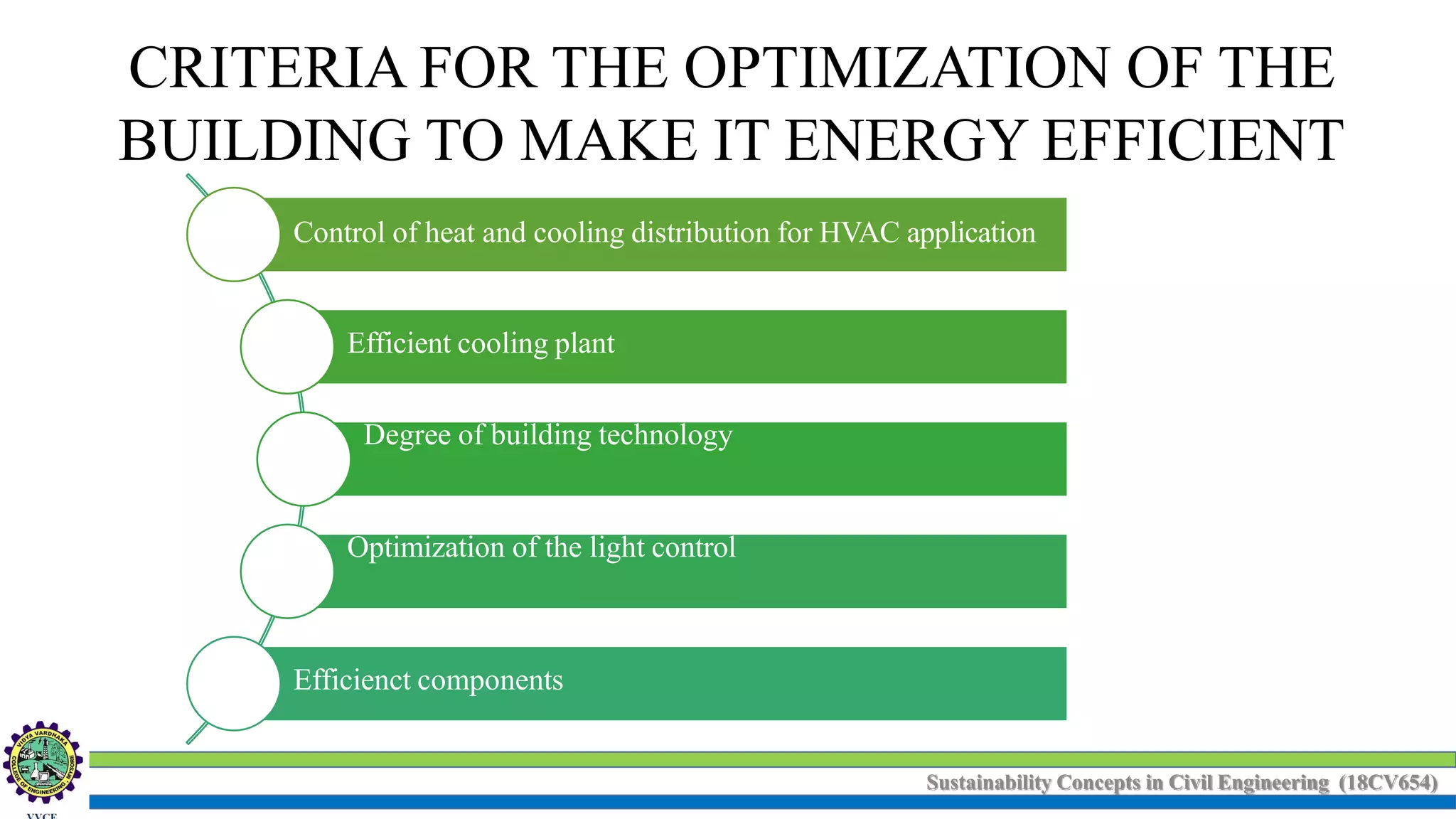
CRITERIA FOR THE OPTIMIZATION OF THE
BUILDING TO MAKE IT ENERGY EFFICIENT
Control of heat and cooling distribution for HVAC application
.
Efficient cooling plant
Degree of building technology
Optimization of the light control
Efficienct components
Sustainability Concepts in Civil Engineering (18CV654)
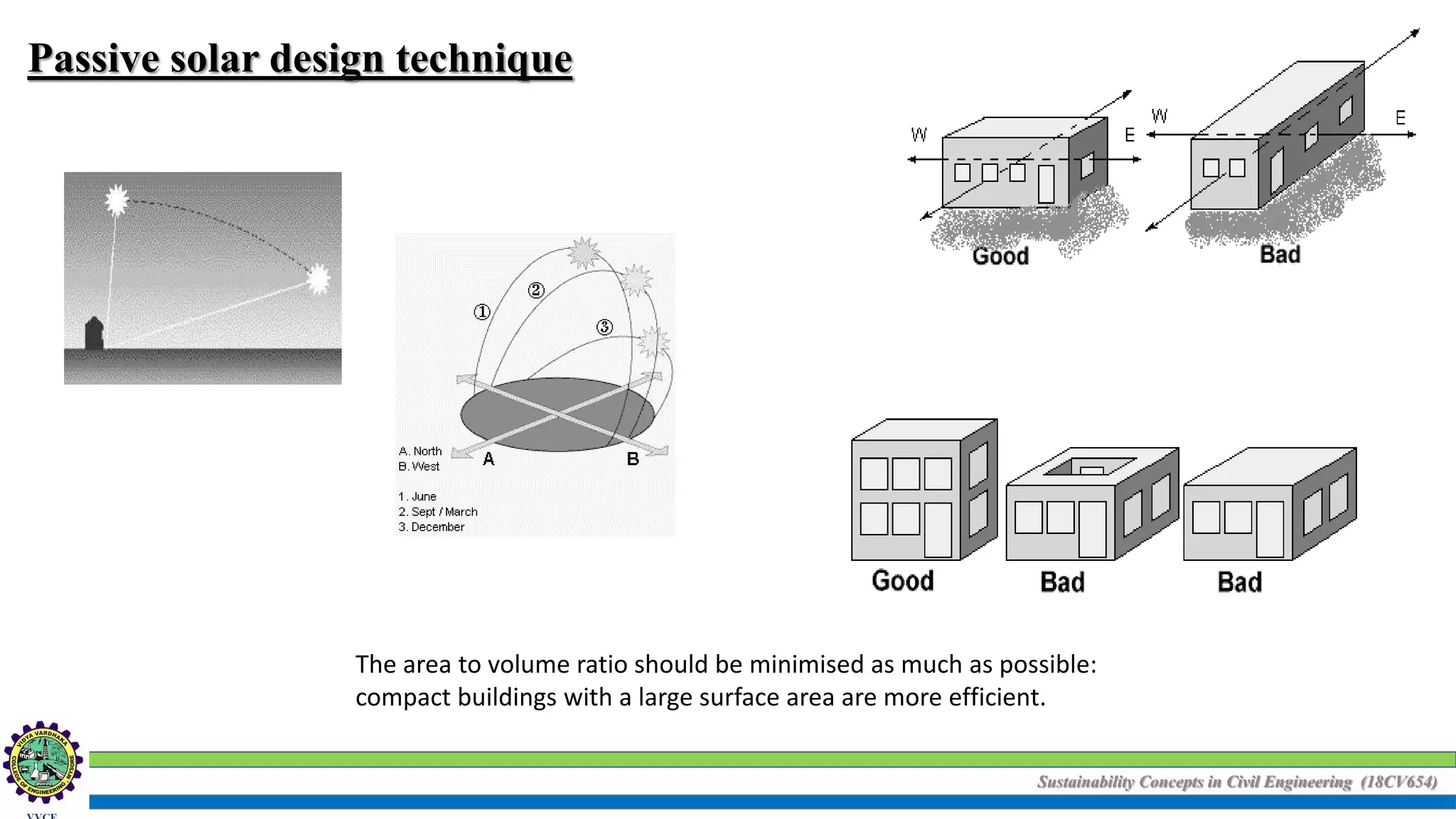
Passive solar design technique
The area to volume ratio should be minimised as much as possible:
compact buildings with a large surface area are more efficient.
Sustainability Concepts in Civil Engineering (18CV654)
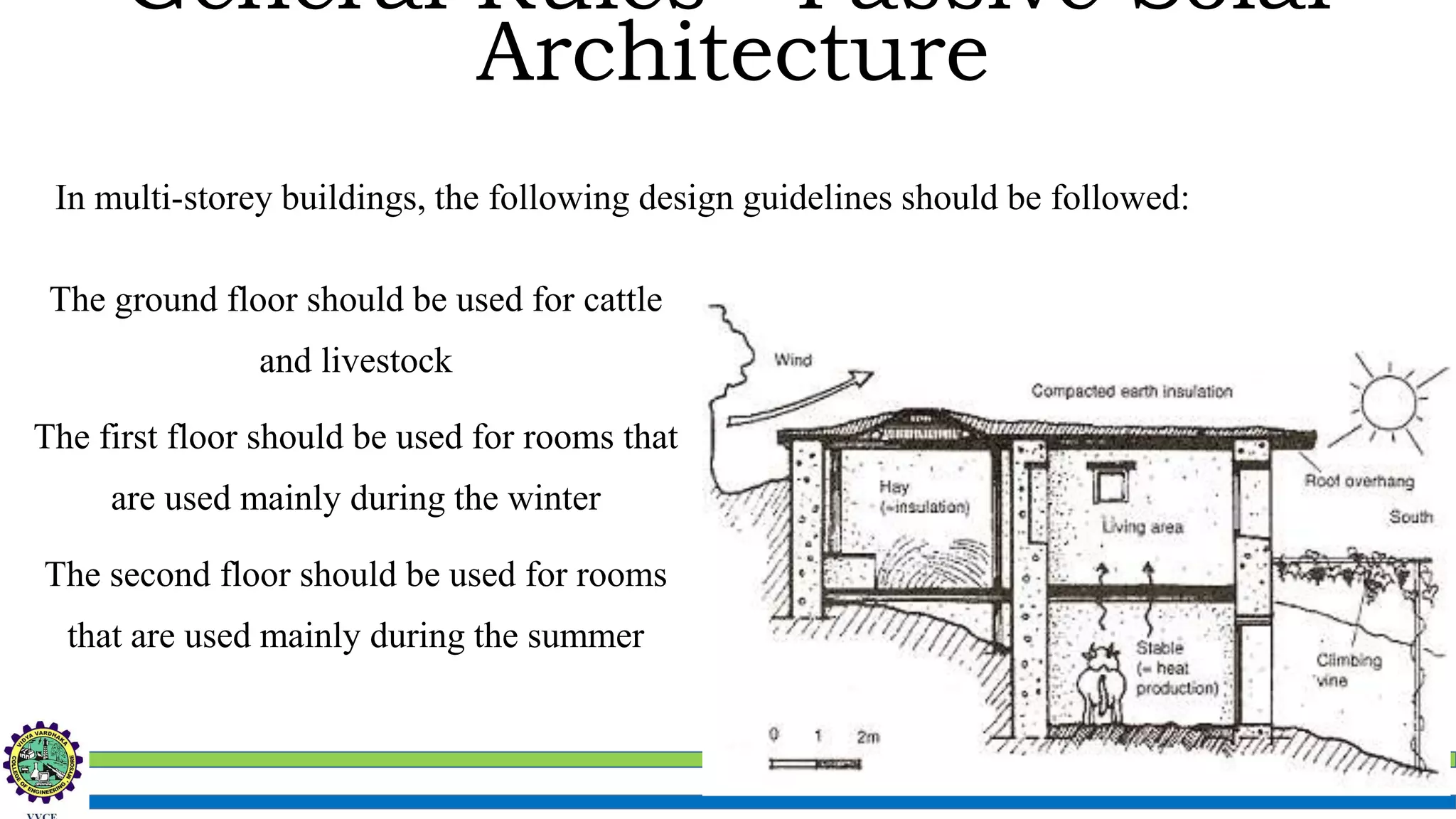
General Rules - Passive Solar
Architecture
The ground floor should be used for cattle
and livestock
The first floor should be used for rooms that
are used mainly during the winter
The second floor should be used for rooms
that are used mainly during the summer
In multi-storey buildings, the following design guidelines should be followed:
Sustainability Concepts in Civil Engineering (18CV654)
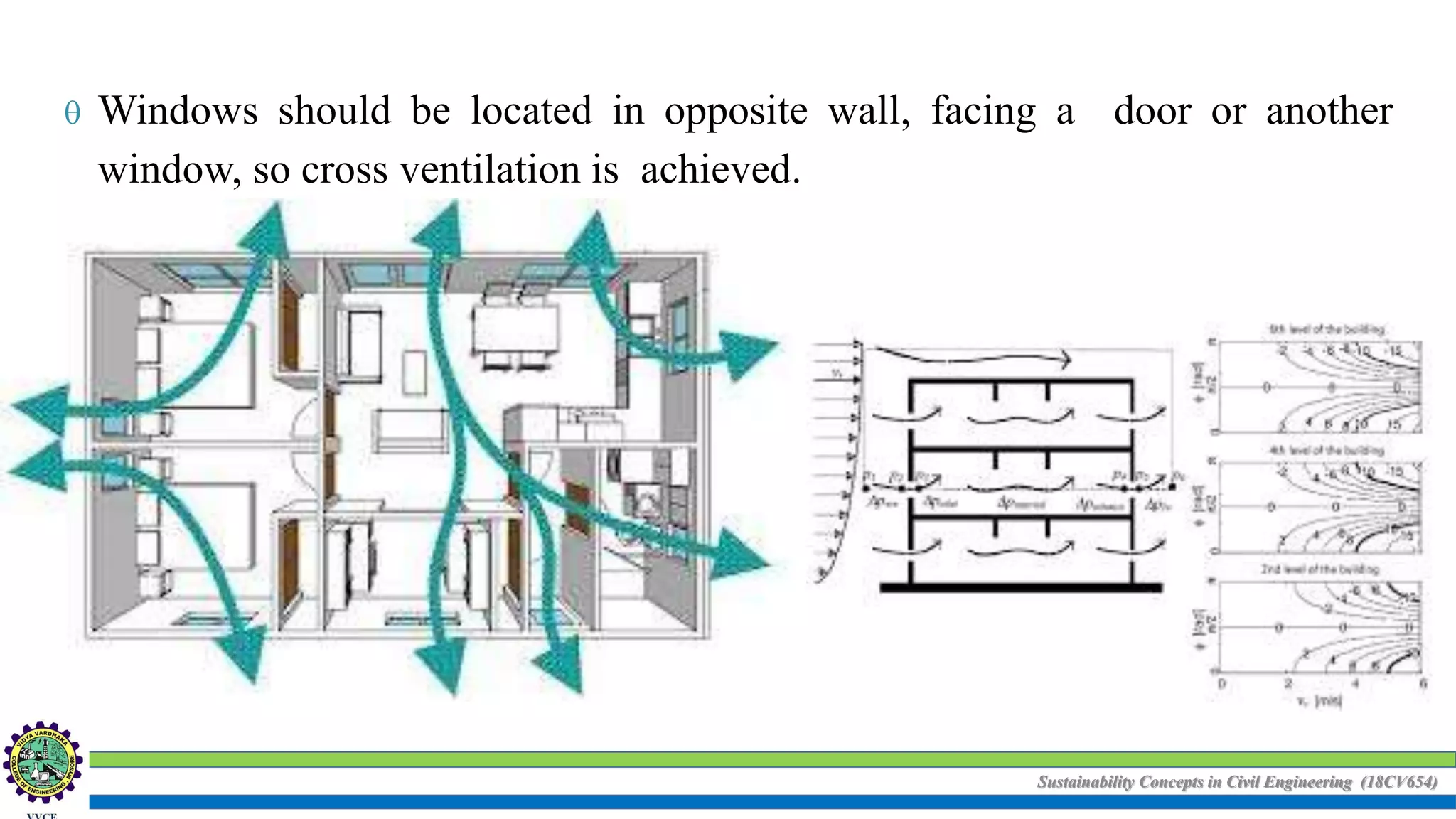
 Windows should be located in opposite wall, facing a door or another
window, so cross ventilation is achieved.
Sustainability Concepts in Civil Engineering (18CV654)
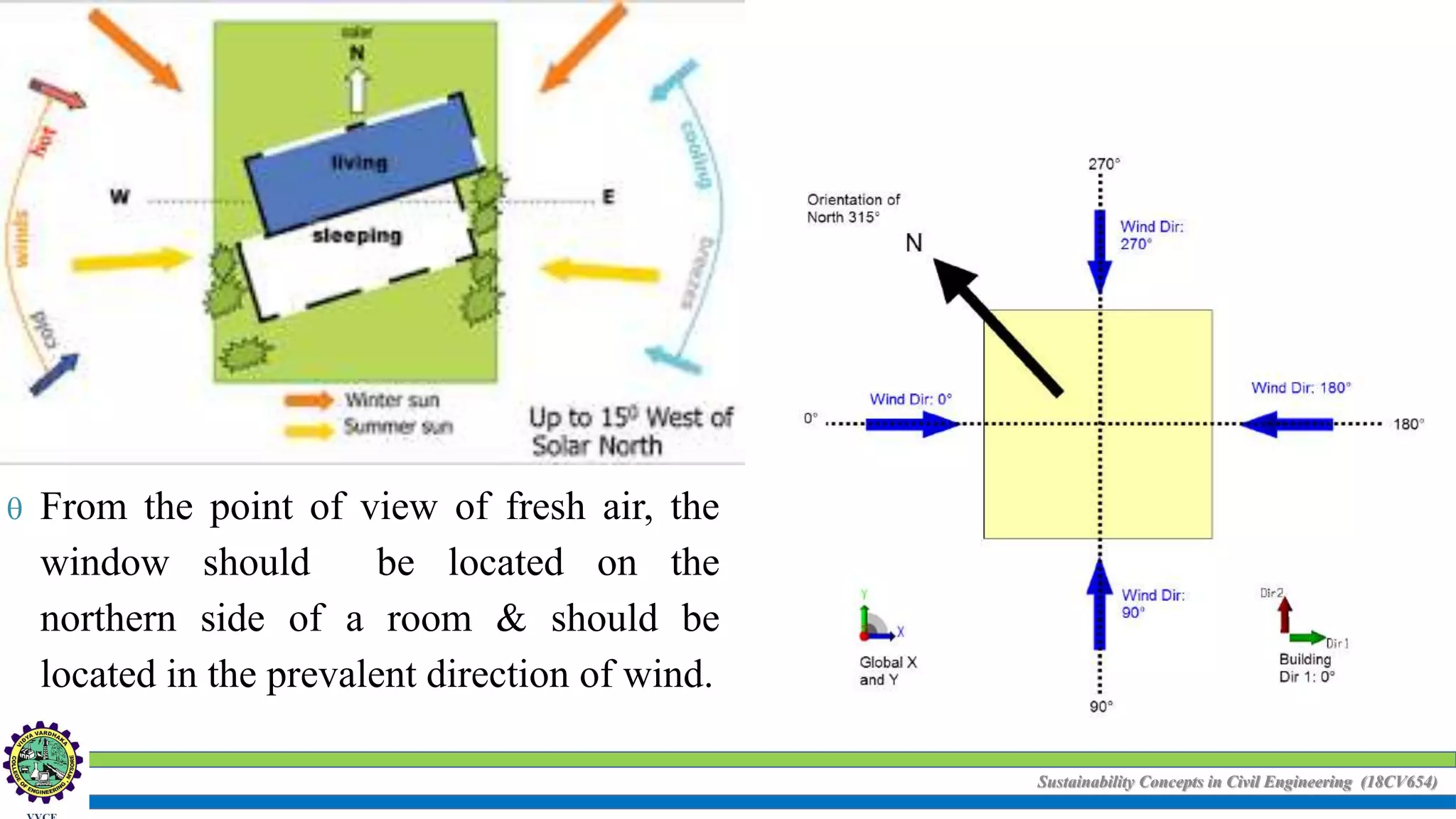
 From the point of view of fresh air, the
window should be located on the
northern side of a room & should be
located in the prevalent direction of wind.
Sustainability Concepts in Civil Engineering (18CV654)
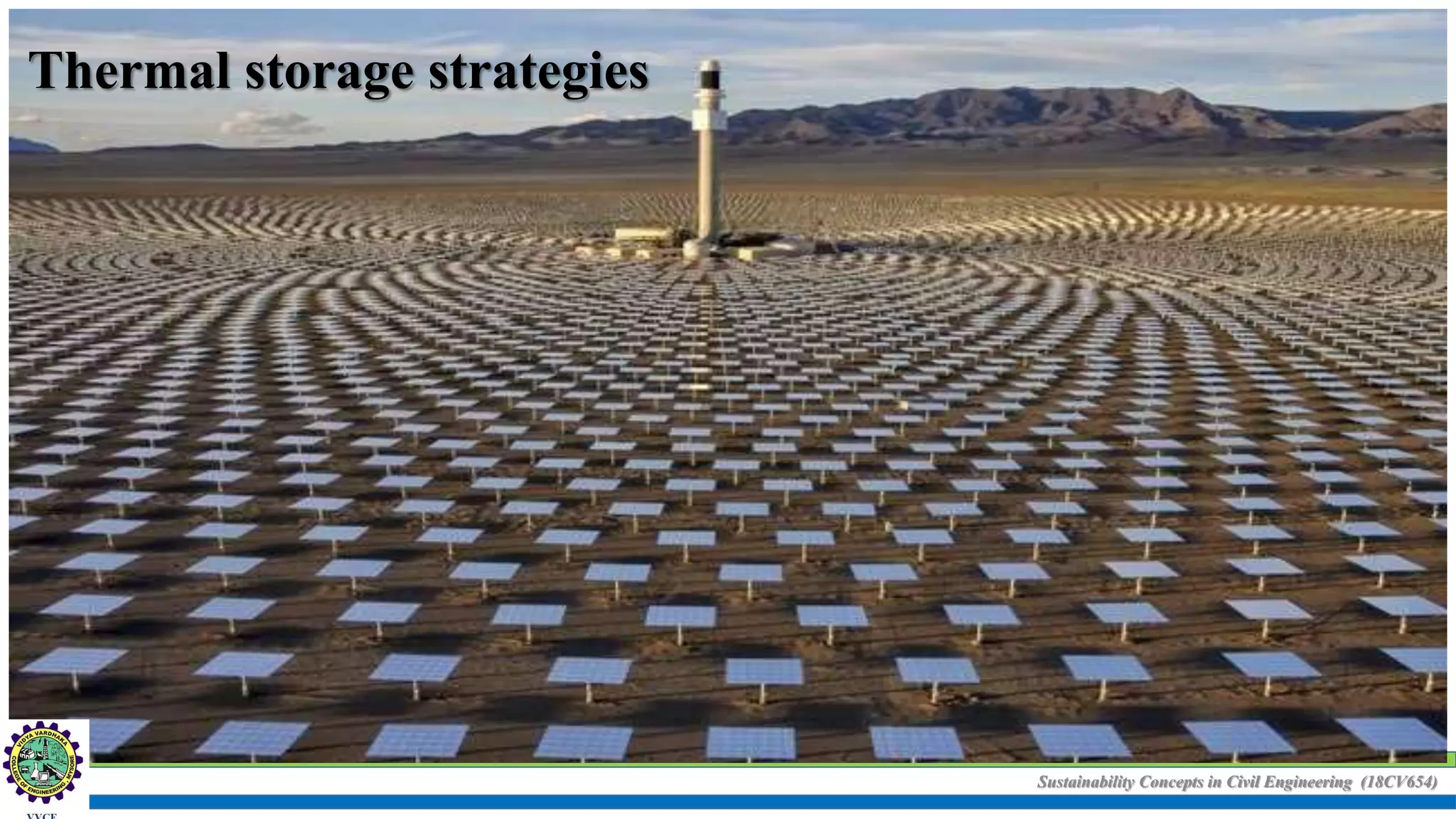
Thermal storage strategies
Sustainability Concepts in Civil Engineering (18CV654)
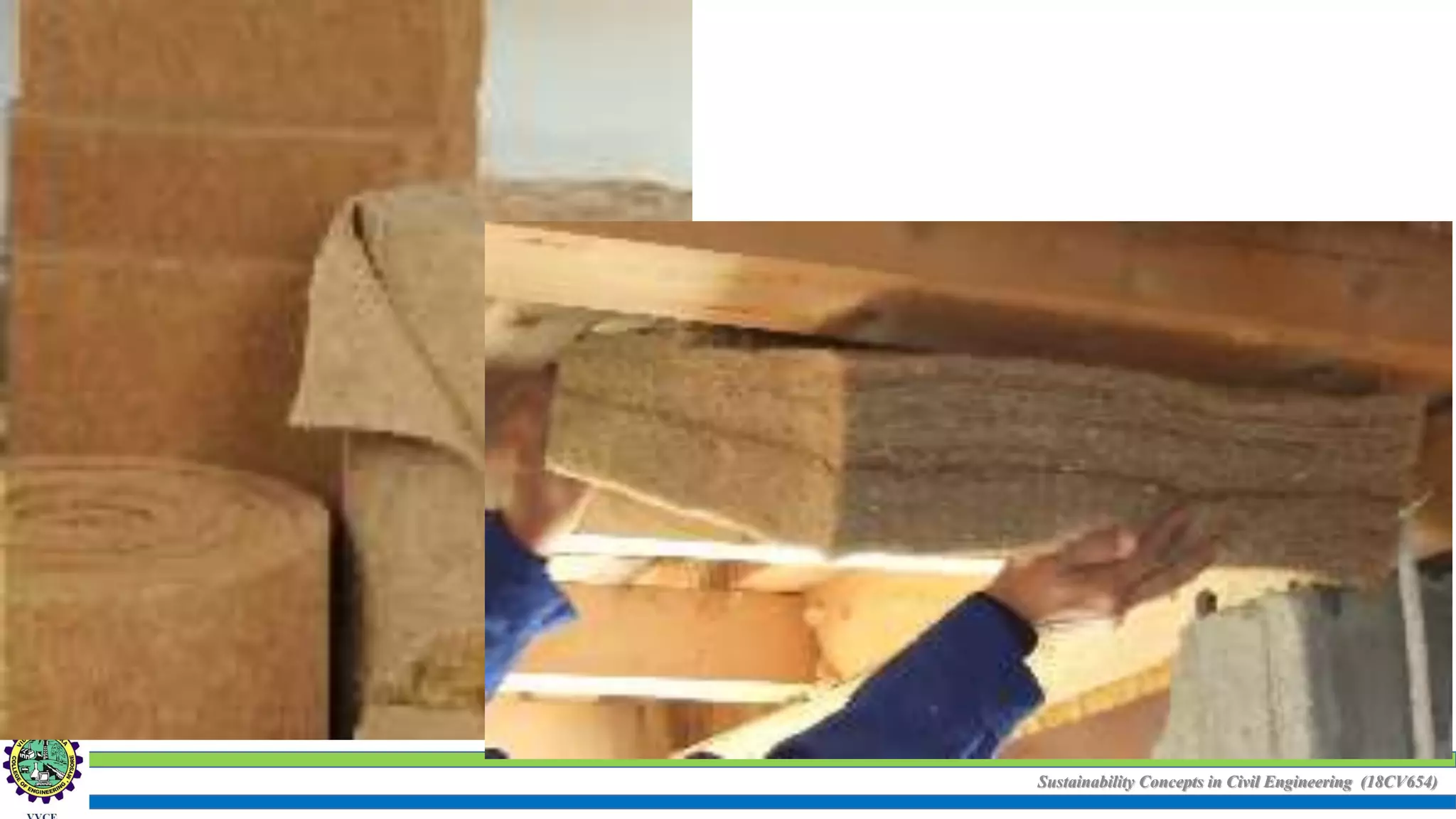
Thermal insulating materials using agricultural waste and
natural products
From an ecological point of view, thermal insulating materials are high energy
consumers.
Their high embodied energy is compensated by the advantage that by their use in
construction, the required operational energy is significantly reduced.
The saved energy contributes to the reduction of polluting environmental factors.
Thermal insulating materials based on agricultural products and waste have a clear
advantage over traditional thermal insulating materials due to the low embodied
energy.
Sustainability Concepts in Civil Engineering (18CV654)
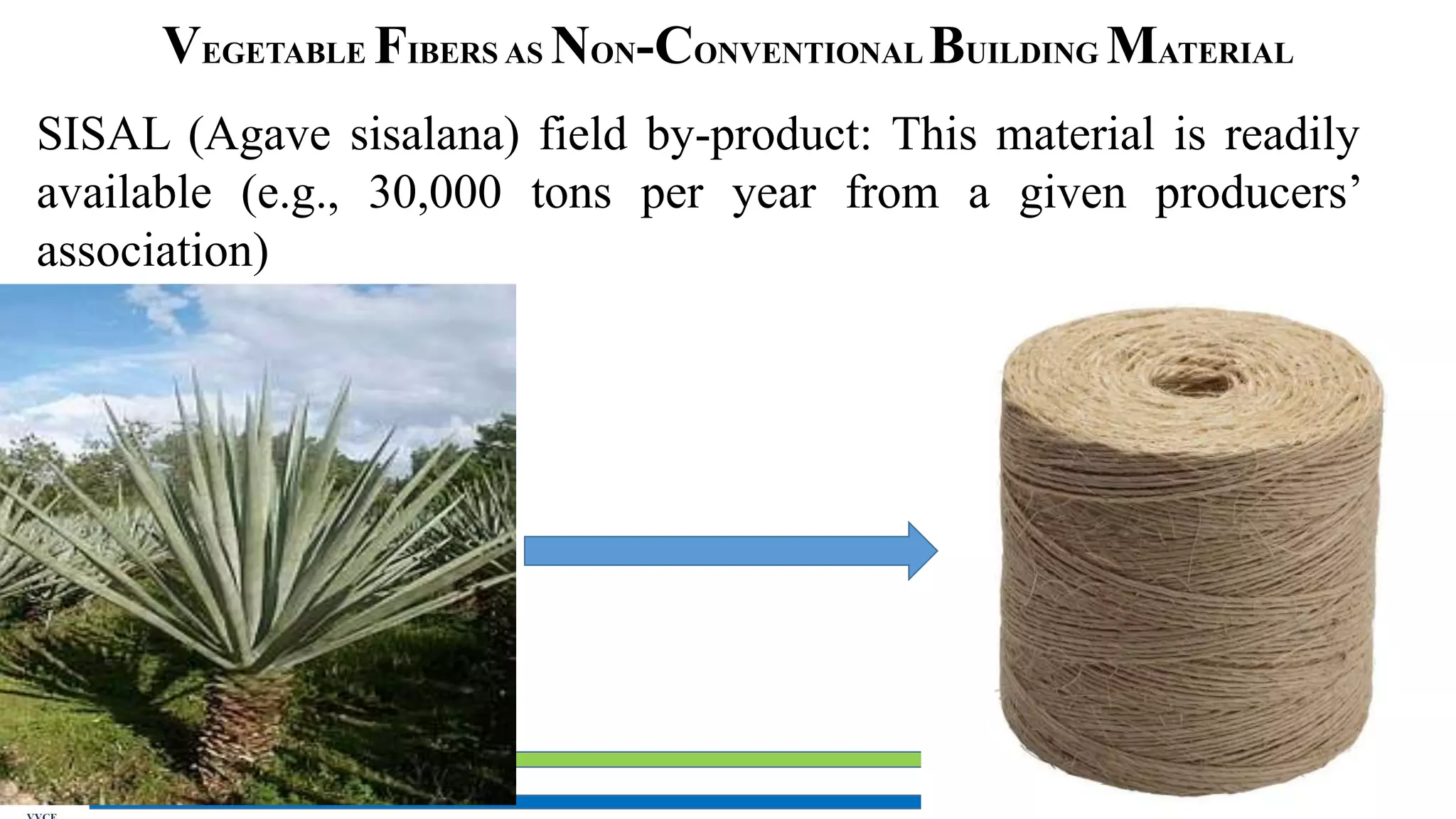
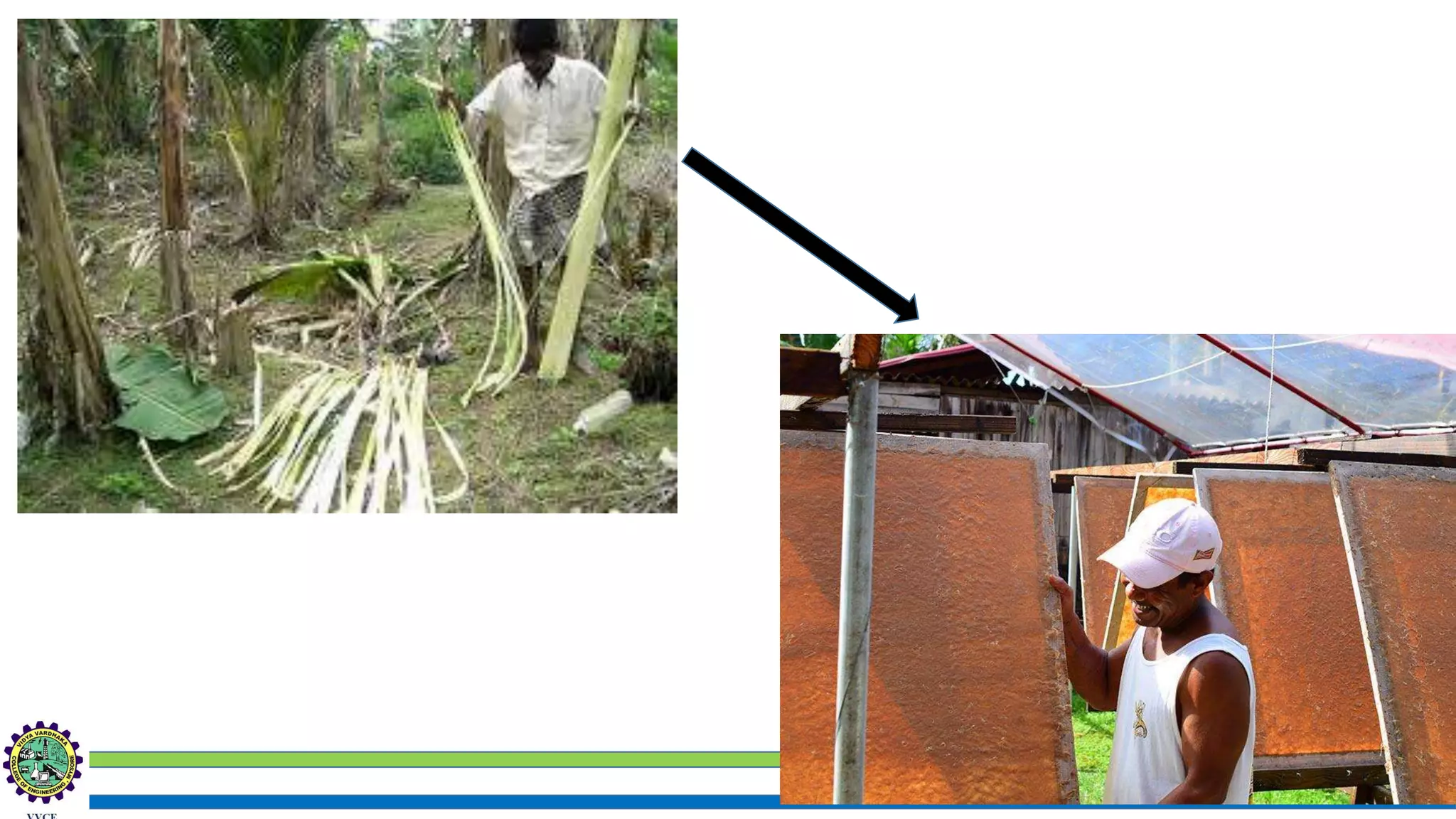
VEGETABLE FIBERS AS NON-CONVENTIONAL BUILDING MATERIAL
SISAL (Agave sisalana) field by-product: This material is readily
available (e.g., 30,000 tons per year from a given producers’
association)
Sustainability Concepts in Civil Engineering (18CV654)
Faculty - Mr. ABHILASH B.L
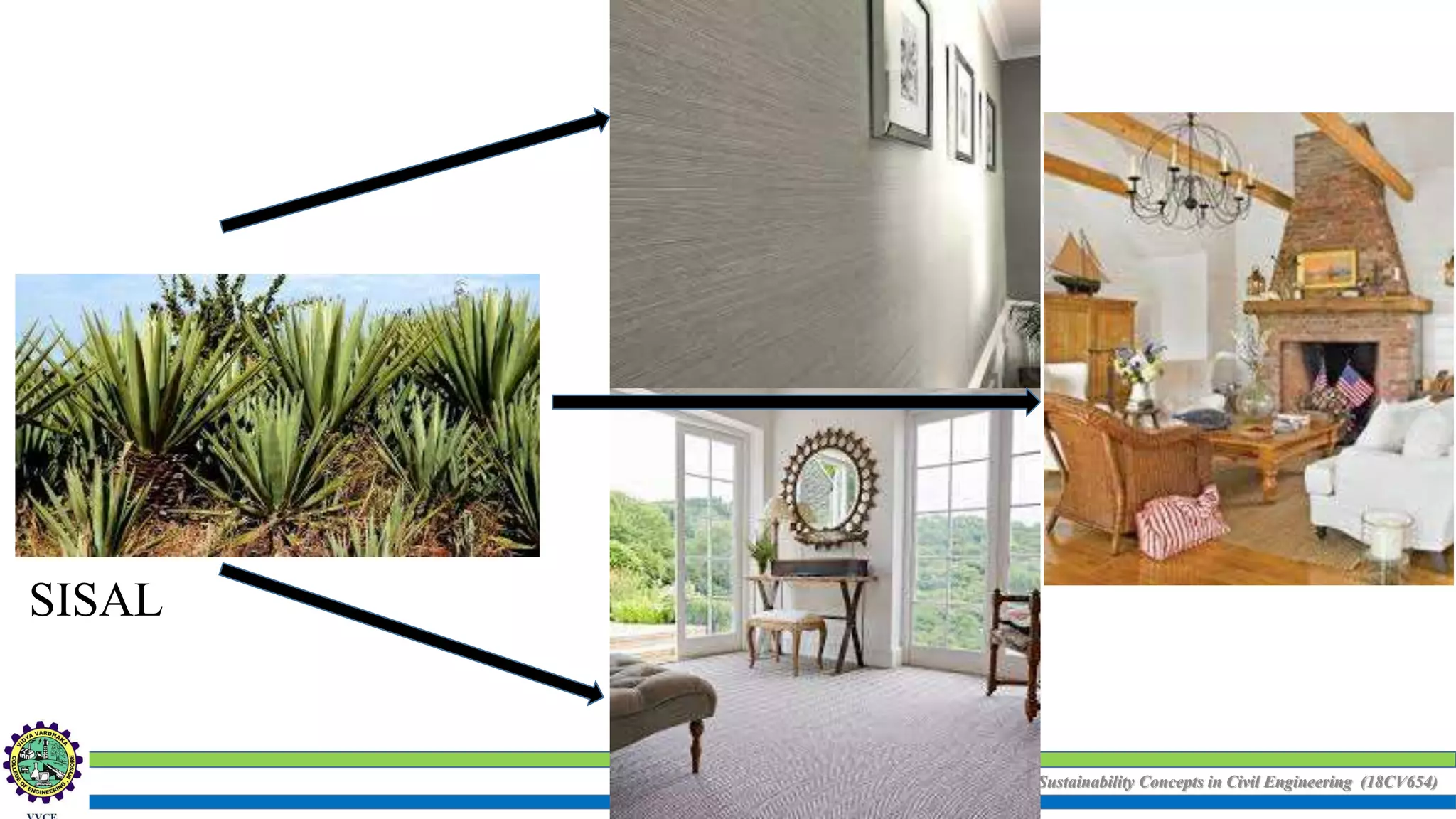
SISAL
Sustainability Concepts in Civil Engineering (18CV654)
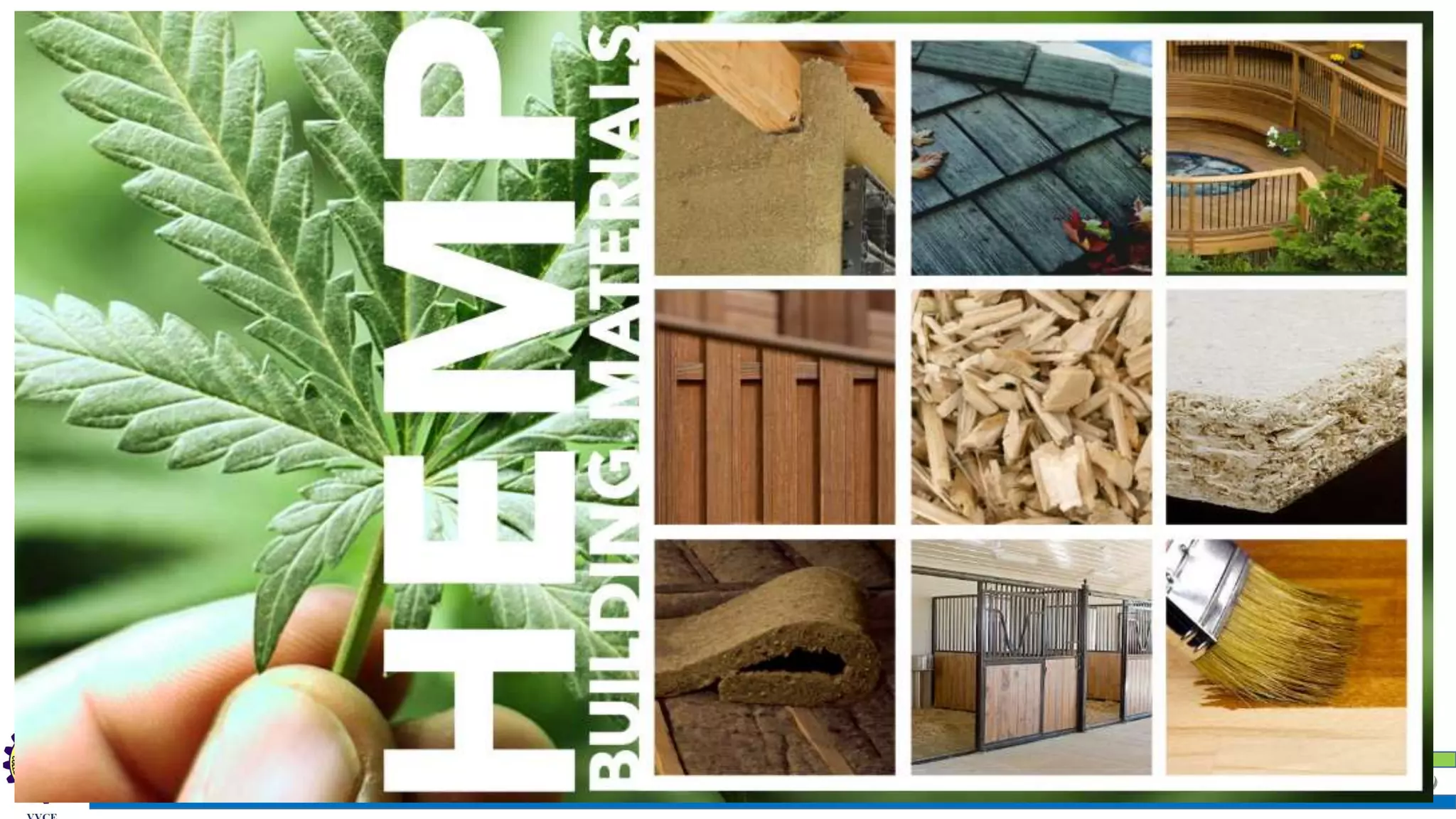
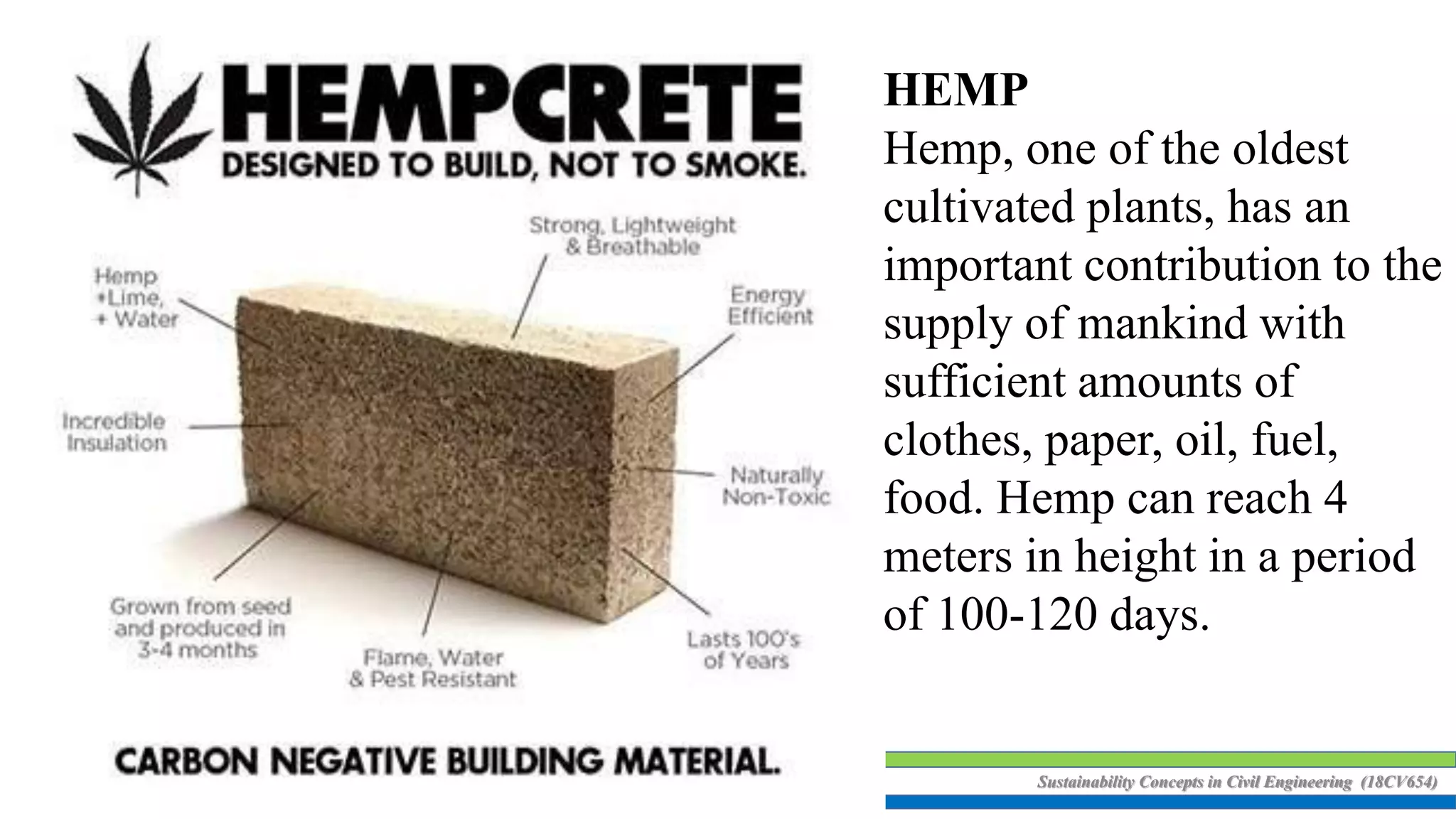
HEMP
Hemp, one of the oldest
cultivated plants, has an
important contribution to the
supply of mankind with
sufficient amounts of
clothes, paper, oil, fuel,
food. Hemp can reach 4
meters in height in a period
of 100-120 days.
Sustainability Concepts in Civil Engineering (18CV654)
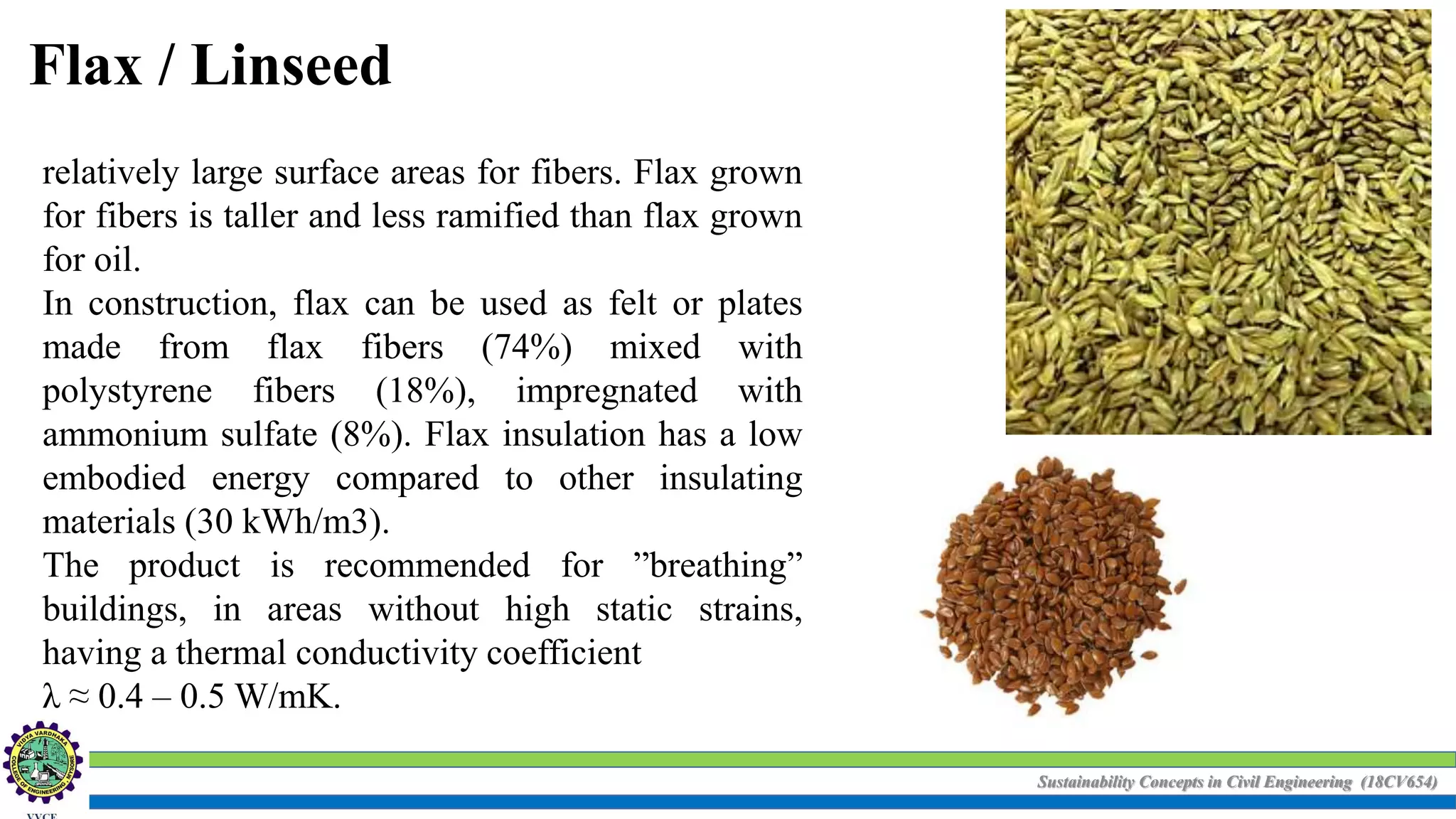
Flax / Linseed
relatively large surface areas for fibers. Flax grown
for fibers is taller and less ramified than flax grown
for oil.
In construction, flax can be used as felt or plates
made from flax fibers (74%) mixed with
polystyrene fibers (18%), impregnated with
ammonium sulfate (8%). Flax insulation has a low
embodied energy compared to other insulating
materials (30 kWh/m3).
The product is recommended for ”breathing”
buildings, in areas without high static strains,
having a thermal conductivity coefficient
λ ≈ 0.4 – 0.5 W/mK.
Sustainability Concepts in Civil Engineering (18CV654)
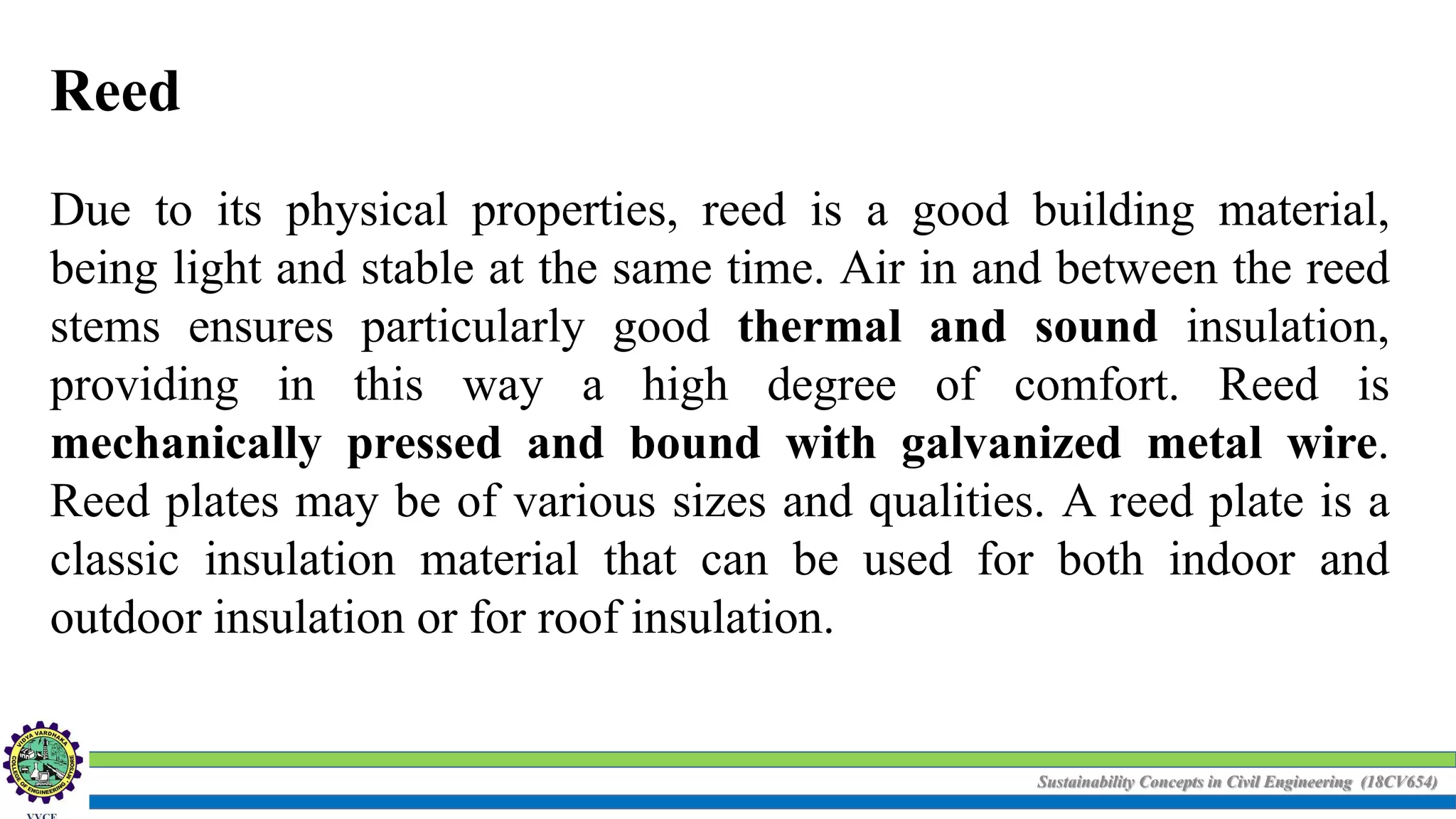
Reed
Due to its physical properties, reed is a good building material,
being light and stable at the same time. Air in and between the reed
stems ensures particularly good thermal and sound insulation,
providing in this way a high degree of comfort. Reed is
mechanically pressed and bound with galvanized metal wire.
Reed plates may be of various sizes and qualities. A reed plate is a
classic insulation material that can be used for both indoor and
outdoor insulation or for roof insulation.
Sustainability Concepts in Civil Engineering (18CV654)
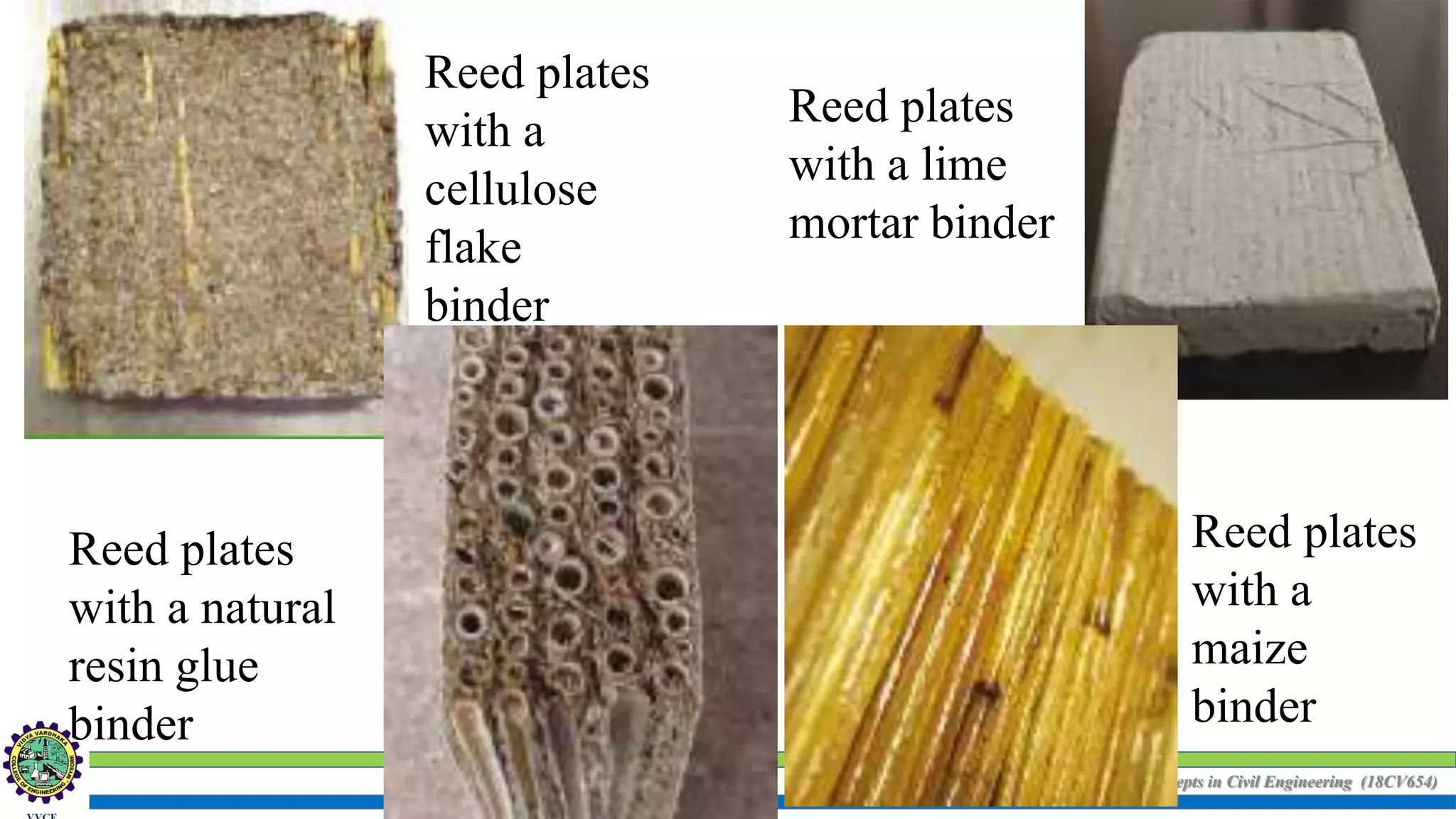
Reed plates
with a
cellulose
flake
binder
Reed plates
with a natural
resin glue
binder
Reed plates
with a
maize
binder
Reed plates
with a lime
mortar binder
Sustainability Concepts in Civil Engineering (18CV654)
Expanded cork
Cork is a natural material obtained from the cork oak.
Cork boards are products obtained through the natural
agglomeration of granules in their own resin and can be
used in any environment and climate conditions.
The expanded cork board is a material with very good
thermal insulating and acoustic properties
It is stable during stretching and compression (elastic),
antibacterial (not allowing for the development of fungi,
mold), antiallergenic, fire resistant, durable and it does
not absorb water through capillarity. The density of
expanded cork boards is 110- 120 kg/m³, and their
thermal conductivity coefficient is 0.037 – 0.040 W/m K
[7].
Sustainability Concepts in Civil Engineering (18CV654)
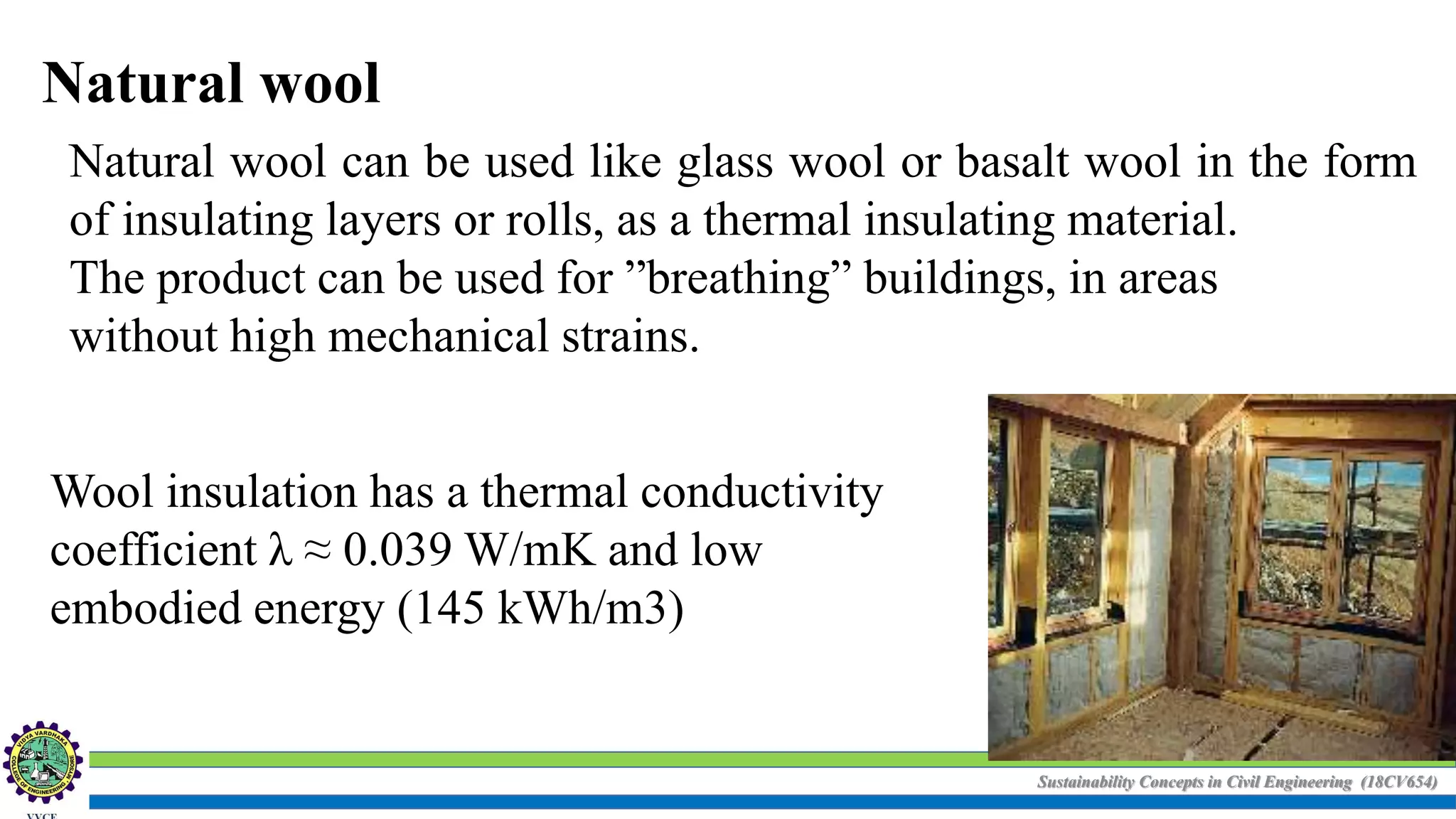
Natural wool
Natural wool can be used like glass wool or basalt wool in the form
of insulating layers or rolls, as a thermal insulating material.
The product can be used for ”breathing” buildings, in areas
without high mechanical strains.
Wool insulation has a thermal conductivity
coefficient λ ≈ 0.039 W/mK and low
embodied energy (145 kWh/m3)
Sustainability Concepts in Civil Engineering (18CV654)
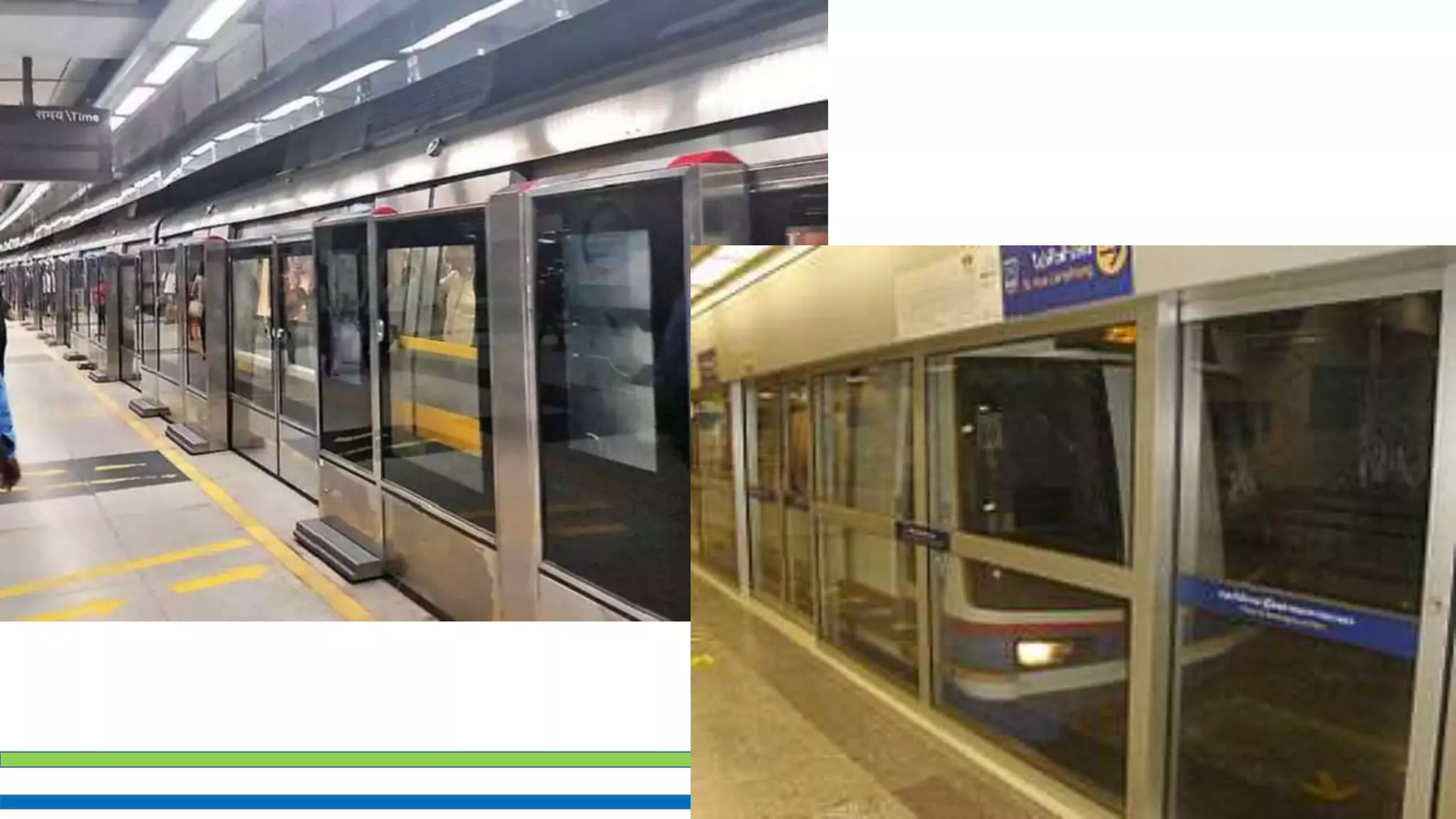
By applying the green concepts in the design, construction & operation,
the following additional benefits are
• Reduced dependency on private vehicles thereby minimizing the
environmental impacts associated with the use of fossil fuels
• Integration with other modes of public transport thereby enhancing
connectivity
• Enhanced station accessibility to improve first & last mile connectivity
and achieve maximum ridership
• Maximise resource efficiency
• Increased environmental awareness among commuters
• Enhanced commuting experience
Sustainability Concepts in Civil Engineering (18CV654)
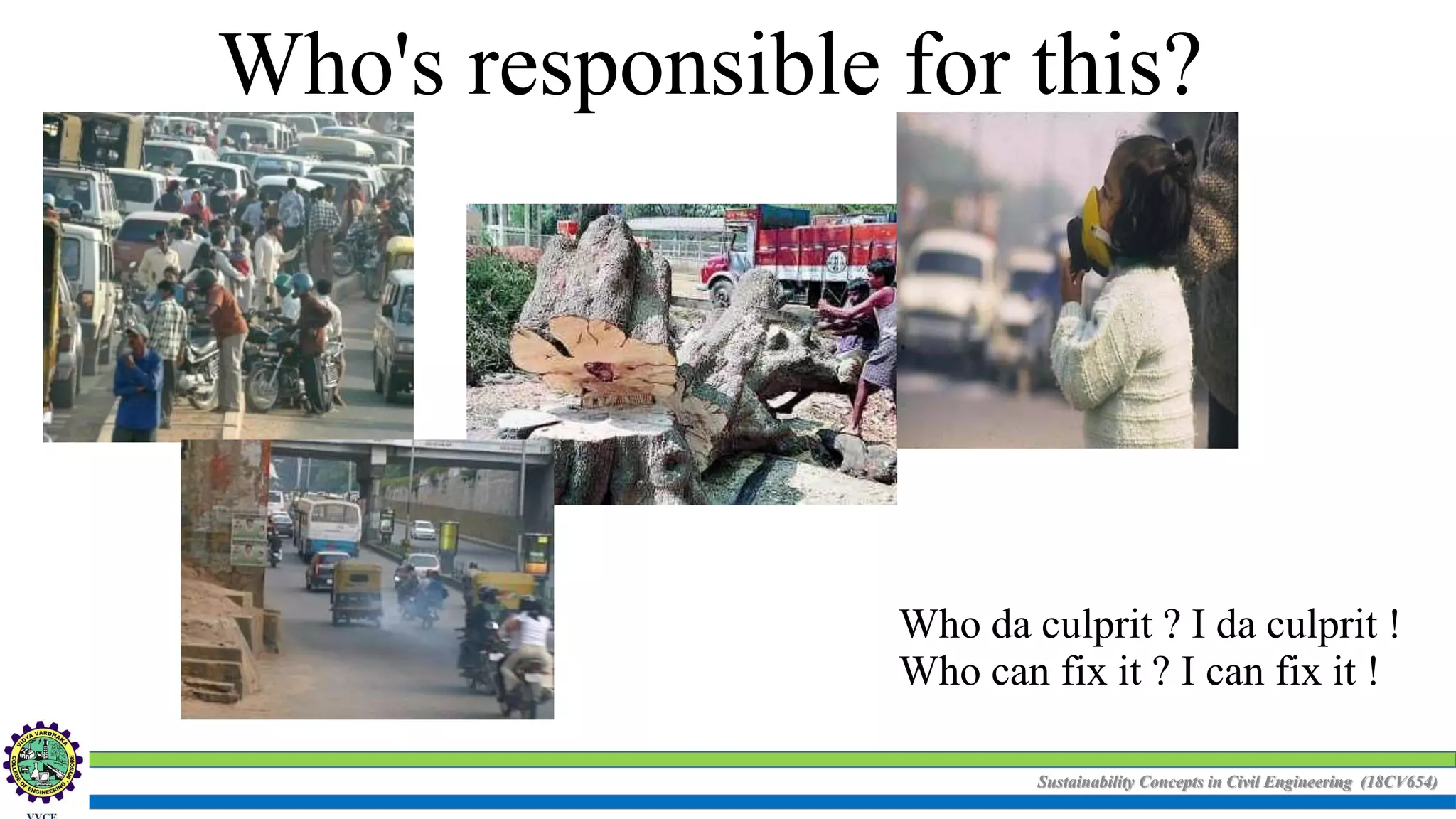
Who's responsible for this?
Who da culprit ? I da culprit !
Who can fix it ? I can fix it !
Sustainability Concepts in Civil Engineering (18CV654)
What cycling has done
Hot legs
Athletic heart – Increase in heart rate.
Improved lung capacity – better than most people.
High physical stamina.
No Monday morning blues.
Sustainability Concepts in Civil Engineering (18CV654)
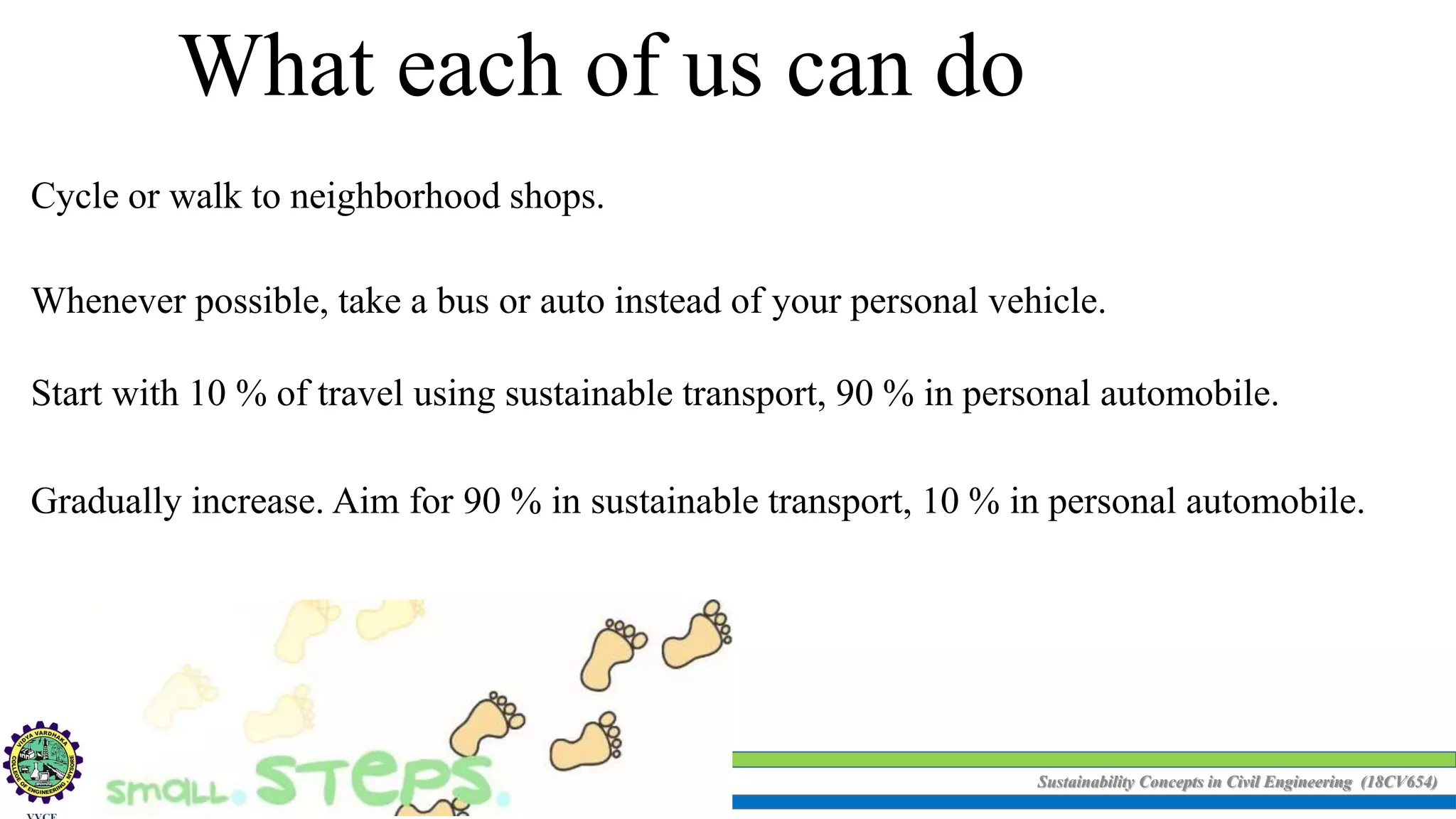
What each of us can do
Cycle or walk to neighborhood shops.
Whenever possible, take a bus or auto instead of your personal vehicle.
Start with 10 % of travel using sustainable transport, 90 % in personal automobile.
Gradually increase. Aim for 90 % in sustainable transport, 10 % in personal automobile.
Sustainability Concepts in Civil Engineering (18CV654)
Do whatever little you can , towards
sustainable transport.
Don't do nothing just because
you cannot do everything.

Sustainability concepts in Civil Engineering - Module-3

  • 1.
    Sustainability Concepts inCivil Engineering (18CV654) ABHILASH B.L. M.Tech, IGBC-AP. Assistant Professor Dept. of Civil Engineering Vidyavardhaka College of Engineering Mysuru – 570002. Sustainability Concepts in Civil Engineering (18CV654)
  • 2.
    Sustainability Concepts inCivil Engineering (18CV654) Module 3 - Sustainable Design • Basic concepts of sustainable habitat, • Green buildings • Green building certification GRIHA • IGBC certification for buildings, • Materials for building construction • Material selection for sustainable buildings design, • Energy-efficient building design, • Passive solar design technique, • Thermal storage strategies sustainable transport
  • 3.
    Sustainability Concepts inCivil Engineering (18CV654) Basic concepts of sustainable habitat A Sustainable Habitat is an ecosystem that produces food and shelter for people and other organisms, without resource depletion and in such a way that no external waste is produced. Everything within it is connected to a complex array of organisms, physical resources and functions . . .
  • 4.
    Sustainability Concepts inCivil Engineering (18CV654) SUSTAINABLE DEVELOPMENT - CO-EVOLUTIONARY PROCESS
  • 5.
    Sustainability Concepts inCivil Engineering (18CV654) Urbanization trends: 2050 70% living in cities 70% of global CO2 Emissions 75% of global economic output Global Urbanisation: Urban vs Rural Urban Population by city size Cities – Critical „Places“ in the Anthropocene
  • 6.
    Sustainability Concepts inCivil Engineering (18CV654) BASIC FUNCTIONS OF CITIES To work To reside To nourish To communicate To transport
  • 7.
    Sustainability Concepts inCivil Engineering (18CV654) EXEMPLARY CHALLENGES - ENERGY AND CLIMATE Urban Characteristics  ● Urban Heat Island Effects ● Altered wind climate effects from global climate change  Heat waves, Heavy precipitation events, Sea level rise Source: LSE Cities/ School of Economics IEA Report 2008 Source: NASA Density and Energy Demand – City Comparison Energy Demand/ per capita in the EU/cities
  • 8.
    Sustainability Concepts inCivil Engineering (18CV654) ecological footprint Exemplary Challenges – Urban Metabolism / Urban Footprint
  • 9.
    Sustainability Concepts inCivil Engineering (18CV654) TRANSFORMING OUR WORLD: THE 2030 AGENDA FOR SUSTAINABLE DEVELOPMENT Plan of action for people, planet and prosperity. It also seeks to strengthenuniversalpeaceinlargerfreedom.Werecognizethateradicatingpovertyinallits forms and dimensions, including extreme poverty, is the greatest global challenge and an indispensable requirement for sustainable development. 17 Sustainable Development Goals and 169 targets.  People  Planet  Prosperity  Peace  Partnership
  • 10.
    Sustainability Concepts inCivil Engineering (18CV654) United Nations Framework Convention on Climate Change
  • 11.
    Sustainability Concepts inCivil Engineering (18CV654) Goal 1. End poverty in all its forms everywhere Goal 2. End hunger, achieve food security and improved nutrition and promote sustainable agriculture Goal 3. Ensure healthy lives and promote well being for all at all ages Goal 4. Ensure inclusive and equitable quality education and promote lifelong learning opportunities for all Goal 5. Achieve gender equality and empower all women and girls Goal 6. Ensure availability and sustainable management of water and sanitation for all Goal 7. Ensure access to affordable, reliable, sustainable and modern energy for all Goal 8. Promote sustained, inclusive and sustainable economic growth, full and productive employment and decent work for all Goal 9. Build resilient infrastructure, promote inclusive and sustainable industrialization and foster innovation Goal 10. Reduce inequality within and among countries Goal 11. Make cities and human settlements inclusive, safe, resilient and sustainable Goal 12. Ensure sustainable consumption and production patterns Goal 13. Take urgent action to combat climate change and its impacts Goal 14. Conserve and sustainably use the oceans, seas and marine resources for sustainable development Goal 15. Protect, restore and promote sustainable use of terrestrial ecosystems, sustainably manage forests, combat desertification, and halt and reverse land degradation and halt biodiversity loss Goal 16. Promote peaceful societies for sustainable development, provide access to justice for all and build effective, accountable and inclusive institutions at all levels Goal 17. Strengthen the means of implementation the Global Partnership for Sustainable Development
  • 12.
    Sustainability Concepts inCivil Engineering (18CV654) Green buildings A ‘Green’ building is a building that, in its design, construction or operation, reduces or eliminates negative impacts, and can create positive impacts, on our climate and natural environment. Green buildings preserve precious natural resources and improve our quality of life. There are a number of features which can make a building ‘green’. These include: • Efficient use of energy, water and other resources • Use of renewable energy, such as solar energy • Pollution and waste reduction measures, and the enabling of re-use and recycling • Good indoor environmental air quality • Use of materials that are non-toxic, ethical and sustainable • Consideration of the environment in design, construction and operation • Consideration of the quality of life of occupants in design, construction and operation • A design that enables adaptation to a changing environment
  • 13.
    Sustainability Concepts inCivil Engineering (18CV654) Source – IISc - CST
  • 14.
    Sustainability Concepts inCivil Engineering (18CV654) Green Building vs. Conventional Building  Externally : both look alike  Building Use : both are same  Differences  Concern for human comfort & productivity  Operational savings  Energy savings: 40 – 50 %  Water savings: 20 – 30 %
  • 15.
    Sustainability Concepts inCivil Engineering (18CV654) Do Green Building Cost More? YES . . . * “Initial investment is more . . . “ With buyback period of 5 - 20 years
  • 16.
    Sustainability Concepts inCivil Engineering (18CV654) Cost of Green Buildings - Indian Experience Building Sqft Rating % increase in cost Typical Payback CII-Godrej GBC 20,000 Platinum (56 points) 20 % 7 years ITC Green Centre, Gurgaon 1,70,000 Platinum (52 points) 15 % 6 years Wipro, Gurgaon 1,75,000 Platinum (57 Points) 8 % 5 years Grundfos Pumps, Chennai 40,000 Gold (42 Points) 6 % 3 years
  • 17.
    Sustainability Concepts inCivil Engineering (18CV654)
  • 18.
    Sustainability Concepts inCivil Engineering (18CV654) Green building certification - IGBC certification What is LEED? Leadership in Energy & Environmental Design Rating of buildings by USGBC
  • 19.
    Sustainability Concepts inCivil Engineering (18CV654) LEED / IGBC Certification process 30 Days Project team appeals the certification awarded within 1 month Project registration – online (www..usgbc.org) Preliminary review comments Final review by USGBC (III Party) USGBC recommends final score to LEED steering committee Notify final LEED score by LEED steering committee Project accepts USGBC presents plaque indicating certification level Yes Submit documents for Design Phase Review Submit documents for Construction Phase Review 30 Days
  • 20.
    Sustainability Concepts inCivil Engineering (18CV654)
  • 21.
    Sustainability Concepts inCivil Engineering (18CV654)
  • 22.
    Sustainability Concepts inCivil Engineering (18CV654)
  • 23.
    Sustainability Concepts inCivil Engineering (18CV654)
  • 24.
    Sustainability Concepts inCivil Engineering (18CV654)
  • 25.
    Sustainability Concepts inCivil Engineering (18CV654)
  • 26.
    Sustainability Concepts inCivil Engineering (18CV654)
  • 27.
    Sustainability Concepts inCivil Engineering (18CV654) Green building certification GRIHA
  • 28.
    https://www.grihaindia.org/ GRIHA is anacronym for Green Rating for Integrated Habitat Assessment. GRIHA is a Sanskrit word meaning – ‘Abode’. Human Habitats (buildings) interact with the environment in various ways. Throughout their life cycles, from construction to operation and then demolition, they consume resources in the form of energy, water, materials, etc. and emit wastes either directly in the form of municipal wastes or indirectly as emissions from electricity generation. GRIHA attempts to minimize a building’s resource consumption, waste generation, and overall ecological impact to within certain nationally acceptable limits / benchmarks.
  • 30.
    Sustainability Concepts inCivil Engineering (18CV654)
  • 31.
    Sustainability Concepts inCivil Engineering (18CV654) Continue . . .
  • 32.
    Sustainability Concepts inCivil Engineering (18CV654) Continue . . .
  • 33.
    Sustainability Concepts inCivil Engineering (18CV654)
  • 34.
    Sustainability Concepts inCivil Engineering (18CV654) Classification of various buildings according to their typologies
  • 35.
    Sustainability Concepts inCivil Engineering (18CV654) Major Materials for building construction
  • 36.
    Sustainability Concepts inCivil Engineering (18CV654) Major Building Parts Superstructure Substructure Foundation
  • 37.
    Sustainability Concepts inCivil Engineering (18CV654)
  • 38.
    Sustainability Concepts inCivil Engineering (18CV654)
  • 39.
    Sustainability Concepts inCivil Engineering (18CV654) ‘Portland’ cement et al • ‘Portland’ is the most widely produced cement. The name comes from its presumed resemblance to Portland stone. • Other cements include: rapid-hardening, low-heat, sulfate-resisting and low-alkali.
  • 40.
    Sustainability Concepts inCivil Engineering (18CV654) Blended cements • Increasingly cements are blended with ‘cement substitutes’ such as Pulverised Fuel Ash (PFA), ‘Fly ash’ and Ground Granulated Blast- furnace Slag (GGBS). The blends aim at reducing the overall environmental impact of using 100% cement.
  • 41.
    Sustainability Concepts inCivil Engineering (18CV654) 1. GeologicalClassification Igneous rocks 2. Physical Classification Stratified rocks 3. Chemical Classification Siliceous rocks Argillaceous rocks Calcareous rocks CLASSIFICATION OF ROCK Sedimentary rocks Metamorphic rocks Non-stratified rocks Foliated rocks
  • 42.
    Sustainability Concepts inCivil Engineering (18CV654) MANUFACTURING OF CLAY BRICKS Preparation of Earth Moulding Drying Burning Bricks
  • 43.
    Sustainability Concepts inCivil Engineering (18CV654) BUILDING MATERIALS & CONSTRUCTION - 18CV34 FIELD TESTS ON BRICKS 3.Scratch Test 2.Drop Test 1.Dimension Test
  • 44.
    Sustainability Concepts inCivil Engineering (18CV654) LABORATORY TESTS ON BRICKS 1.Absorption test on bricks 2.compressive strength test on bricks 3.shape and size test on bricks 4.color test of bricks 5.Efflorescence test on bricks.
  • 45.
    Sustainability Concepts inCivil Engineering (18CV654) NATURAL AND MANUFACTURED
  • 46.
    Sustainability Concepts inCivil Engineering (18CV654)
  • 47.
    Sustainability Concepts inCivil Engineering (18CV654)  Privacy  Security  Safety  Ventilation  Light & Climate Control  Prevent spreading of fire  Barrier to noise  Aesthetic Uses of Doors
  • 48.
    Sustainability Concepts inCivil Engineering (18CV654) • Light • Ventilation • Beauty • Energy (heat and cold => in and out) • View Uses of Windows
  • 49.
    Sustainability Concepts inCivil Engineering (18CV654) Plastering and Pointing Damp proofing Paints
  • 50.
    Sustainability Concepts inCivil Engineering (18CV654) Material selection for sustainable buildings design
  • 51.
    Sustainability Concepts inCivil Engineering (18CV654) Material / Product selection criteria • Resource Efficiency: natural/renewable, resource efficient manufacturing process, locally available, refurbished/ remanufactured, reusable/recyclable and durability. • Indoor Air Quality: IAQ is enhanced by utilizing materials of low or non- toxic, minimal chemical emission, moisture resistant and healthfully maintained. • Energy Efficiency: Those materials are preferred that require the minimal amount of energy at the time of construction of the concrete.
  • 52.
    Sustainability Concepts inCivil Engineering (18CV654) • Water Conservation: Materials that help us and conserve water in landscaped areas are preferred to be used or even help reduce water consumption in building materials. • Affordability: Affordability can be considered when building product life- cycle costs are comparable to conventional materials or as a whole, are within a project-defined percentage of the overall budget.
  • 53.
    Sustainability Concepts inCivil Engineering (18CV654) • Bricks / Blocks Stabilized • compressed earth blocks • Fly ash Lime Gypsum • bricks • Clay Fly ash burnt bricks • Marble slurry bricks • Boards & Panels • Coir Cement board • Ferro cement wall panel • Precast concrete L-panels • Fiber Reinforced wall • panels • Roofing sheets Pre-cast • walling roofing • Bamboo mat corrugated • sheets • Ferro cement roofing • Others Rat trap bond • Pre-cast concrete door/ • Fly ash/Red mud door & • panel product • Glass Reinforce Plastic • door frames • Fly ash Cellular concrete List of Some Eco-friendly Indian Building Materials
  • 54.
    Sustainability Concepts inCivil Engineering (18CV654) • Hot and Dry Climate • Hot and humid Climate (Warm & Humid) • Composite Climate • Tropical Upland Climate (Temperate) • Cold
  • 55.
    Sustainability Concepts inCivil Engineering (18CV654) Natural fibers 1. Vegetable fibers 2. Wood fiber, 3. Animal fibers 4. Mineral fibers 5. Biological fibers
  • 56.
    Sustainability Concepts inCivil Engineering (18CV654)
  • 57.
    Sustainability Concepts inCivil Engineering (18CV654) Typical Properties of Selected Natural Fibers Fiber type Fiber Diameter(in) Specific Gravity Tensile Strength( Ksi) Elastic Modulus(Ksi) Elongation at Break(%) Water Absorption(%) Wood Fiber(Kraft Pulp) 0.001-0.003 1.5 51-290 1500-5800 N/A 50-75 Coconut 0.004-0.016 1.12-1.15 17.4-29 2750-3770 10-25 130-180 Sisal 0.008-0.016 1.45 40-82.4 1880-3770 3-5 60-70 Sugar Cane Bagasse 0.008-0.016 1.2-1.3 26.7-42 2175-2750 1.1 70-75 Bamboo 0.002-0.016 1.5 50.8-72.5 4780-5800 N/A 40-45 Jute 0.004-0.008 1.02-1.04 36.3-50.8 3770-4640 1.5-1.9 28.64 Elephant grass 0.003-0.016 0.818 25.8 710 3.6 N/Ab
  • 58.
    Sustainability Concepts inCivil Engineering (18CV654) Fiber type Fiber Diameter( 0.001 in) Specific Gravity Tensile Strength (Ksi) Elasticity Modulus ( Ksi) Elongation at Break(%) Water Absorption( %) Melting Point(℃) Steel 4-40 7.8 70-380 30,000 0.5-3.5 nil 1370 Glass 0.3-0.8 2.5 220-580 10,400- 11,600 2-4 N/A 1300 Carbon 0.3-0.35 0.90 260-380 33,400- 55,100 0.5-1.5 nil 3652-3697 Nylon 0.9 1.14 140 750 20-30 2.8-5.0 220-265 Acrylics 0.2-0.7 1.14-1.18 39-145 2,500-2,800 20-40 1.0-2.5 Decomp Aramid 0.4-0.5 1.38-1.45 300-450 9,000- 17,000 2-12 1.2-4.3 Decomp Polyester 0.4-3.0 1.38 40-170 2,500 8-30 0.4 260 Polypropyle ne 0.8-8.0 0.9 65-100 500-750 10-20 nil 165 Polyethylene Low High 1.0-40.0 0.92 0.95 11-17 50-71 725 25-50 20-30 nil nil 110 135
  • 59.
    Sustainability Concepts inCivil Engineering (18CV654)
  • 60.
    Sustainability Concepts inCivil Engineering (18CV654)
  • 61.
    Sustainability Concepts inCivil Engineering (18CV654)
  • 62.
    Sustainability Concepts inCivil Engineering (18CV654)
  • 63.
    Sustainability Concepts inCivil Engineering (18CV654)
  • 64.
    Sustainability Concepts inCivil Engineering (18CV654)
  • 65.
    Sustainability Concepts inCivil Engineering (18CV654)
  • 66.
    Sustainability Concepts inCivil Engineering (18CV654)
  • 67.
    Sustainability Concepts inCivil Engineering (18CV654)
  • 68.
    Sustainability Concepts inCivil Engineering (18CV654)
  • 69.
    Sustainability Concepts inCivil Engineering (18CV654)
  • 70.
    Sustainability Concepts inCivil Engineering (18CV654)
  • 71.
    Sustainability Concepts inCivil Engineering (18CV654)
  • 72.
    Sustainability Concepts inCivil Engineering (18CV654)
  • 73.
    Sustainability Concepts inCivil Engineering (18CV654) ENERGY-EFFICIENT BUILDING DESIGN
  • 74.
    Sustainability Concepts inCivil Engineering (18CV654) Outdoor space Fresh air Sunshine Views More floor space Plants/garden BBQ/eating area Architectural appealing Storage What Do Most People See with Balconies?
  • 75.
    Sustainability Concepts inCivil Engineering (18CV654) Uninsulated concrete slab Degrades wall thermal performance (increased heat loss) Lowers effective R-‐value of wall Increased space-‐heating & cooling requirements (More kWh + $$) Colder interior surfaces (risk of condensation/mould, thermal discomfort) Finish, waterproofing, railings, and other interface detail considerations & maintenance Structural design considerations Exhaust vent locations What Do Engineers and PH Designers See with Balconies?
  • 76.
    Sustainability Concepts inCivil Engineering (18CV654) Thermal Comfort and Moisture Issues Increased heat loss at slab results in colder indoor floor and ceiling temperatures – increasing risk for mould/condensation
  • 77.
    Sustainability Concepts inCivil Engineering (18CV654) Ceiling and Flooring Moisture Issues
  • 78.
    Sustainability Concepts inCivil Engineering (18CV654) Linear Transmittance – ψ (Psi) Values U-wall = 0.266 – simple math for 2.7m tall wall ,ψ of 0.72 doubles heat loss
  • 79.
    Sustainability Concepts inCivil Engineering (18CV654) ENERGY CONSUMPTION BY THE BUILDING Demand for energy is increasing fast day by day and is likely to increase in tune with industrialization/ urbanization. The building sector being one of the largest consumers of energy, has gained prominence over the past few decades. • 45% of total global energy is used in heating, cooling and lighting of building. • 5% energy is used in building construction. • Energy used for air conditioning of commercial buildings accounts for 32% of the total energy consumption. • Energy consumption patterns can be substantially reduced by energy conserving measures, particularly during the phase of building design. • Space heating load can be reduced by about 50%.
  • 80.
    Sustainability Concepts inCivil Engineering (18CV654) • Use of interior paints which do not emit / absorb / re-release indoor pollutants • Hospital surfaces should have the property of resisting and repelling the growth of pathogenic germs and bacteria. Patented interior surfaces are available which resist bacterial and fungal growth. • Use of indoor flooring which is easily cleanable and does not emit VOC’s(volatile organic compound) and dust. • Install permanent entry-way systems to capture dust particles at all primary entrances. • Use of certain species of indoor plants which not only produce oxygen but also reduce indoor pollutants like VOC from air. • Lack of proper insulation in the roofs and walls etc. can lead to patient discomfort through solar heat conduction, also leads to more energy consumption. Thus high performance insulation such as Extruded Polystyrene , Polyurethane foam for reducing energy consumption.
  • 81.
    Sustainability Concepts inCivil Engineering (18CV654) PERFORMANCE, EFFICIENCY, COMFORT (PEC) Three core values applied to lighting in healthcare PERFORMANCE: To provide an optimal lighting solution. In hospitals, clinics and care homes, this can lead to less fatigue, quicker reactions and task completion with fewer mistakes resulting in higher standards of care. EFFICIENCY: Efficiency is concerned with the energy consumption, economics and practical aspects of a lighting installation. Lighting products are carefully engineered and manufactured to produce practical, easy to maintain solutions that consume the least possible power and provide long-life, trouble- free solutions. COMFORT: The ability to give people satisfaction and stimulation. Lighting influences concentration and mood. Comfort is concerned with atmosphere, reassurance, and in the healthcare environment, the well-being of the patient.
  • 82.
    Sustainability Concepts inCivil Engineering (18CV654) GUIDELINES for ENERGY EFFICIENCY Energy saving measures can play a significant role for lowering energy consumption for environmental protection. Energy consumption is responsible for CO2 emissions to the atmosphere, that contribute to the “greenhouse effect”. An important parameter for energy saving in the buildings sector is the high efficiency of the energy infrastructures, which requires excellent quality of the relevant equipment installed, as well as the compliance with all the requirements In order to maximize the energy efficiency of a building -based on the capabilities of the existing shell and infrastructure, and minimize the need of any reconstruction or energy saving measures should be adopted. An energy management programme for a building or group of buildings usually include: • Identification of the adequate targets for energy consumption • Feasibility and implementation of new energy technologies • Identifying the adequate funding for energy projects • Monitoring of the construction of energy applications • Monitoring of the efficiency during their operation.
  • 83.
    Sustainability Concepts inCivil Engineering (18CV654) ENERGY SAVING POTENTIAL One of the main building types with a great potential to apply measures of energy saving is the hospitals. Below, some of the most important reasons why hospitals consume lot of energy and some simple ways to reduce their energy consumption are mentioned. 1) 24hour operation (lighting, heating, air condition, electricity consumption)- The non-stop function of the hospitals is an important factor why there is such a big energy consumption. 2) Lighting- Lighting is a sector with great energy saving potential. These could result in a 50% reduction in energy consumption. 3) Heating- Consuming gas for heating is a big percentage of the overall energy consumption.
  • 84.
    Sustainability Concepts inCivil Engineering (18CV654) CRITERIA FOR THE OPTIMIZATION OF THE BUILDING TO MAKE IT ENERGY EFFICIENT Control of heat and cooling distribution for HVAC application . Efficient cooling plant Degree of building technology Optimization of the light control Efficienct components
  • 85.
    Sustainability Concepts inCivil Engineering (18CV654) Passive solar design technique The area to volume ratio should be minimised as much as possible: compact buildings with a large surface area are more efficient.
  • 86.
    Sustainability Concepts inCivil Engineering (18CV654) General Rules - Passive Solar Architecture The ground floor should be used for cattle and livestock The first floor should be used for rooms that are used mainly during the winter The second floor should be used for rooms that are used mainly during the summer In multi-storey buildings, the following design guidelines should be followed:
  • 87.
    Sustainability Concepts inCivil Engineering (18CV654)  Windows should be located in opposite wall, facing a door or another window, so cross ventilation is achieved.
  • 88.
    Sustainability Concepts inCivil Engineering (18CV654)  From the point of view of fresh air, the window should be located on the northern side of a room & should be located in the prevalent direction of wind.
  • 89.
    Sustainability Concepts inCivil Engineering (18CV654) Thermal storage strategies
  • 90.
    Sustainability Concepts inCivil Engineering (18CV654) Thermal insulating materials using agricultural waste and natural products From an ecological point of view, thermal insulating materials are high energy consumers. Their high embodied energy is compensated by the advantage that by their use in construction, the required operational energy is significantly reduced. The saved energy contributes to the reduction of polluting environmental factors. Thermal insulating materials based on agricultural products and waste have a clear advantage over traditional thermal insulating materials due to the low embodied energy.
  • 91.
    Sustainability Concepts inCivil Engineering (18CV654) VEGETABLE FIBERS AS NON-CONVENTIONAL BUILDING MATERIAL SISAL (Agave sisalana) field by-product: This material is readily available (e.g., 30,000 tons per year from a given producers’ association)
  • 92.
    Sustainability Concepts inCivil Engineering (18CV654) Faculty - Mr. ABHILASH B.L SISAL
  • 93.
    Sustainability Concepts inCivil Engineering (18CV654)
  • 94.
    Sustainability Concepts inCivil Engineering (18CV654)
  • 95.
    Sustainability Concepts inCivil Engineering (18CV654) HEMP Hemp, one of the oldest cultivated plants, has an important contribution to the supply of mankind with sufficient amounts of clothes, paper, oil, fuel, food. Hemp can reach 4 meters in height in a period of 100-120 days.
  • 96.
    Sustainability Concepts inCivil Engineering (18CV654)
  • 97.
    Sustainability Concepts inCivil Engineering (18CV654) Flax / Linseed relatively large surface areas for fibers. Flax grown for fibers is taller and less ramified than flax grown for oil. In construction, flax can be used as felt or plates made from flax fibers (74%) mixed with polystyrene fibers (18%), impregnated with ammonium sulfate (8%). Flax insulation has a low embodied energy compared to other insulating materials (30 kWh/m3). The product is recommended for ”breathing” buildings, in areas without high static strains, having a thermal conductivity coefficient λ ≈ 0.4 – 0.5 W/mK.
  • 98.
    Sustainability Concepts inCivil Engineering (18CV654) Reed Due to its physical properties, reed is a good building material, being light and stable at the same time. Air in and between the reed stems ensures particularly good thermal and sound insulation, providing in this way a high degree of comfort. Reed is mechanically pressed and bound with galvanized metal wire. Reed plates may be of various sizes and qualities. A reed plate is a classic insulation material that can be used for both indoor and outdoor insulation or for roof insulation.
  • 99.
    Sustainability Concepts inCivil Engineering (18CV654) Reed plates with a cellulose flake binder Reed plates with a natural resin glue binder Reed plates with a maize binder Reed plates with a lime mortar binder
  • 100.
    Sustainability Concepts inCivil Engineering (18CV654) Expanded cork Cork is a natural material obtained from the cork oak. Cork boards are products obtained through the natural agglomeration of granules in their own resin and can be used in any environment and climate conditions. The expanded cork board is a material with very good thermal insulating and acoustic properties It is stable during stretching and compression (elastic), antibacterial (not allowing for the development of fungi, mold), antiallergenic, fire resistant, durable and it does not absorb water through capillarity. The density of expanded cork boards is 110- 120 kg/m³, and their thermal conductivity coefficient is 0.037 – 0.040 W/m K [7].
  • 101.
    Sustainability Concepts inCivil Engineering (18CV654) Natural wool Natural wool can be used like glass wool or basalt wool in the form of insulating layers or rolls, as a thermal insulating material. The product can be used for ”breathing” buildings, in areas without high mechanical strains. Wool insulation has a thermal conductivity coefficient λ ≈ 0.039 W/mK and low embodied energy (145 kWh/m3)
  • 102.
    Sustainability Concepts inCivil Engineering (18CV654)
  • 103.
    Sustainability Concepts inCivil Engineering (18CV654)
  • 104.
    Sustainability Concepts inCivil Engineering (18CV654)
  • 106.
    Sustainability Concepts inCivil Engineering (18CV654) By applying the green concepts in the design, construction & operation, the following additional benefits are • Reduced dependency on private vehicles thereby minimizing the environmental impacts associated with the use of fossil fuels • Integration with other modes of public transport thereby enhancing connectivity • Enhanced station accessibility to improve first & last mile connectivity and achieve maximum ridership • Maximise resource efficiency • Increased environmental awareness among commuters • Enhanced commuting experience
  • 107.
    Sustainability Concepts inCivil Engineering (18CV654) Who's responsible for this? Who da culprit ? I da culprit ! Who can fix it ? I can fix it !
  • 108.
    Sustainability Concepts inCivil Engineering (18CV654) What cycling has done Hot legs Athletic heart – Increase in heart rate. Improved lung capacity – better than most people. High physical stamina. No Monday morning blues.
  • 109.
    Sustainability Concepts inCivil Engineering (18CV654) What each of us can do Cycle or walk to neighborhood shops. Whenever possible, take a bus or auto instead of your personal vehicle. Start with 10 % of travel using sustainable transport, 90 % in personal automobile. Gradually increase. Aim for 90 % in sustainable transport, 10 % in personal automobile.
  • 110.
    Sustainability Concepts inCivil Engineering (18CV654) Do whatever little you can , towards sustainable transport. Don't do nothing just because you cannot do everything.