Citric acid cycle
ABHIRAM KRISHNAN P
I MSC ZOOLOGY
CUK
Pyruvate dehrdrogenase for the connecting
link between Krebs cycle & Glycolysis
 Under anaerobic conditions, the pyruvate is converted into lactate or ethanol, depending
on the organism.
 Under aerobic conditions, the pyruvate is transported into mitochondria by a specific
carrier protein embedded in the mitochondrial membrane.
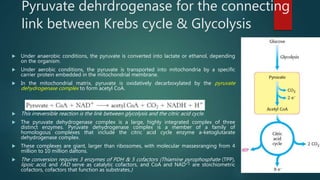
 In the mitochondrial matrix, pyruvate is oxidatively decarboxylated by the pyruvate
dehydrogenase complex to form acetyl CoA.
 This irreversible reaction is the link between glycolysis and the citric acid cycle.
 The pyruvate dehydrogenase complex is a large, highly integrated complex of three
distinct enzymes. Pyruvate dehydrogenase complex is a member of a family of
homologous complexes that include the citric acid cycle enzyme a-ketoglutarate
dehydrogenase complex.
 These complexes are giant, larger than ribosomes, with molecular massesranging from 4
million to 10 million daltons.
 The conversion requires 3 enzymes of PDH & 5 cofactors (Thiamine pyrophosphate (TPP),
lipoic acid, and FAD serve as catalytic cofactors, and CoA and NAD+1 are stoichiometric
cofactors, cofactors that function as substrates.)
 The conversion of pyruvate into acetyl CoA consists of three steps: Decarboxylation, oxidation, and
transfer of the resultant acetyl group to CoA.
1. Decarboxylation; Decarboxylation. Pyruvate combines with TPP and is then decarboxylated to yield hydroxyethyl-
TPP. reaction is catalyzed by the pyruvate dehydrogenase component (E1) of the multienzyme complex. TPP is the
prosthetic group of the pyruvate dehydrogenase component.
2. Oxidation; The hydroxyethyl group attached to TPP is oxidized to form an acetyl group while being simultaneously
transferred to lipoamide, a derivative of lipoic acid that is linked to the side chain of a lysine residue by an amide
linkage. This reaction, also catalyzed by the pyruvate dehydrogenase component E1, yields acetyllipoamide.
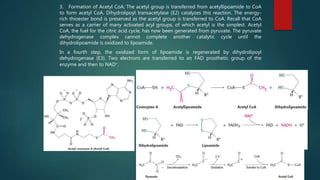
3. Formation of Acetyl CoA; The acetyl group is transferred from acetyllipoamide to CoA
to form acetyl CoA. Dihydrolipoyl transacetylase (E2) catalyzes this reaction. The energy-
rich thioester bond is preserved as the acetyl group is transferred to CoA. Recall that CoA
serves as a carrier of many activated acyl groups, of which acetyl is the simplest. Acetyl
CoA, the fuel for the citric acid cycle, has now been generated from pyruvate. The pyruvate
dehydrogenase complex cannot complete another catalytic cycle until the
dihydrolipoamide is oxidized to lipoamide.
In a fourth step, the oxidized form of lipoamide is regenerated by dihydrolipoyl
dehydrogenase (E3). Two electrons are transferred to an FAD prosthetic group of the
enzyme and then to NAD+.
 The conversion of pyruvate into acetyl CoA by the pyruvate dehydrogenase complex is the link
between glycolysis and cellular respiration because acetyl CoA is the fuel for the citric acid cycle.
Indeed, all fuels are ultimately metabolized to acetyl CoA or components of the citric acid cycle.
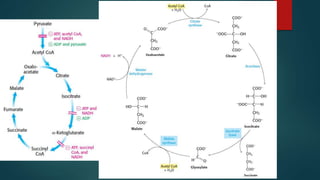
1.Citrate synthase forms citrate from oxaloacetate and acetyl coenzyme A
The citric acid cycle begins with the condensation of a four-carbon unit, Oxaloacetate,
Oxaloacetate, and a two-carbon unit, the acetyl group of acetyl CoA. Oxaloacetate reacts with acetyl CoA
and H2O to yield citrate and CoA.
2. Citrate is isomerized into isocitrate
citrate is isomerized into isocitrate to enable the six-carbon unit to undergo
oxidative decarboxylation. The isomerization of citrate is accomplished by a dehydration step
followed by a hydration step. The result is an interchange of an H and an OH. The enzyme catalyzing
both steps is called aconitase because cis-aconitate is an intermediate.
3. Isocitrate is oxidized and decarboxylated to alpha-ketoglutarate
The oxidative decarboxylation of isocitrate is catalyzed by isocitrate dehydrogenase. The
intermediate in this reaction is oxalosuccinate, an unstable β-ketoacid. The rate of formation of a-
ketoglutarate is important in determining the overall rate of the cycle. This oxidation generates the
first high-transfer-potential electron carrier, NADH, in the cycle.
4. Succinyl coenzyme A is formed by the oxidative decarboxylation of alpha-
ketoglutarate
The conversion of isocitrate into a-ketoglutarate is followed by a second
oxidative decarboxylation reaction, the formation of succinyl CoA from α-ketoglutarate.
This reaction is catalyzed by the α-ketoglutarate dehydrogenase complex, an organized
assembly of three kinds of enzymes that is homologous to the pyruvate dehydrogenase
complex.
In fact, the oxidative decarboxylation of a-ketoglutarate closely resembles that of
pyruvate, also an a-ketoacid.
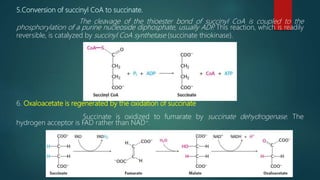
5.Conversion of succinyl CoA to succinate.
The cleavage of the thioester bond of succinyl CoA is coupled to the
phosphorylation of a purine nucleoside diphosphate, usually ADP. This reaction, which is readily
reversible, is catalyzed by succinyl CoA synthetase (succinate thiokinase).
6. Oxaloacetate is regenerated by the oxidation of succinate
Succinate is oxidized to fumarate by succinate dehydrogenase. The
hydrogen acceptor is FAD rather than NAD+.
malate is oxidized to form oxaloacetate. This reaction is catalyzed
by malate dehydrogenase, and NAD+ is again the hydrogen acceptor.
THANK YOU

Citric acid cycle

  • 1.
    Citric acid cycle ABHIRAMKRISHNAN P I MSC ZOOLOGY CUK
  • 2.
    Pyruvate dehrdrogenase forthe connecting link between Krebs cycle & Glycolysis  Under anaerobic conditions, the pyruvate is converted into lactate or ethanol, depending on the organism.  Under aerobic conditions, the pyruvate is transported into mitochondria by a specific carrier protein embedded in the mitochondrial membrane.  In the mitochondrial matrix, pyruvate is oxidatively decarboxylated by the pyruvate dehydrogenase complex to form acetyl CoA.  This irreversible reaction is the link between glycolysis and the citric acid cycle.  The pyruvate dehydrogenase complex is a large, highly integrated complex of three distinct enzymes. Pyruvate dehydrogenase complex is a member of a family of homologous complexes that include the citric acid cycle enzyme a-ketoglutarate dehydrogenase complex.  These complexes are giant, larger than ribosomes, with molecular massesranging from 4 million to 10 million daltons.  The conversion requires 3 enzymes of PDH & 5 cofactors (Thiamine pyrophosphate (TPP), lipoic acid, and FAD serve as catalytic cofactors, and CoA and NAD+1 are stoichiometric cofactors, cofactors that function as substrates.)
  • 3.
     The conversionof pyruvate into acetyl CoA consists of three steps: Decarboxylation, oxidation, and transfer of the resultant acetyl group to CoA. 1. Decarboxylation; Decarboxylation. Pyruvate combines with TPP and is then decarboxylated to yield hydroxyethyl- TPP. reaction is catalyzed by the pyruvate dehydrogenase component (E1) of the multienzyme complex. TPP is the prosthetic group of the pyruvate dehydrogenase component. 2. Oxidation; The hydroxyethyl group attached to TPP is oxidized to form an acetyl group while being simultaneously transferred to lipoamide, a derivative of lipoic acid that is linked to the side chain of a lysine residue by an amide linkage. This reaction, also catalyzed by the pyruvate dehydrogenase component E1, yields acetyllipoamide.
  • 4.
    3. Formation ofAcetyl CoA; The acetyl group is transferred from acetyllipoamide to CoA to form acetyl CoA. Dihydrolipoyl transacetylase (E2) catalyzes this reaction. The energy- rich thioester bond is preserved as the acetyl group is transferred to CoA. Recall that CoA serves as a carrier of many activated acyl groups, of which acetyl is the simplest. Acetyl CoA, the fuel for the citric acid cycle, has now been generated from pyruvate. The pyruvate dehydrogenase complex cannot complete another catalytic cycle until the dihydrolipoamide is oxidized to lipoamide. In a fourth step, the oxidized form of lipoamide is regenerated by dihydrolipoyl dehydrogenase (E3). Two electrons are transferred to an FAD prosthetic group of the enzyme and then to NAD+.
  • 5.
     The conversionof pyruvate into acetyl CoA by the pyruvate dehydrogenase complex is the link between glycolysis and cellular respiration because acetyl CoA is the fuel for the citric acid cycle. Indeed, all fuels are ultimately metabolized to acetyl CoA or components of the citric acid cycle. 1.Citrate synthase forms citrate from oxaloacetate and acetyl coenzyme A The citric acid cycle begins with the condensation of a four-carbon unit, Oxaloacetate, Oxaloacetate, and a two-carbon unit, the acetyl group of acetyl CoA. Oxaloacetate reacts with acetyl CoA and H2O to yield citrate and CoA. 2. Citrate is isomerized into isocitrate citrate is isomerized into isocitrate to enable the six-carbon unit to undergo oxidative decarboxylation. The isomerization of citrate is accomplished by a dehydration step followed by a hydration step. The result is an interchange of an H and an OH. The enzyme catalyzing both steps is called aconitase because cis-aconitate is an intermediate.
  • 6.
    3. Isocitrate isoxidized and decarboxylated to alpha-ketoglutarate The oxidative decarboxylation of isocitrate is catalyzed by isocitrate dehydrogenase. The intermediate in this reaction is oxalosuccinate, an unstable β-ketoacid. The rate of formation of a- ketoglutarate is important in determining the overall rate of the cycle. This oxidation generates the first high-transfer-potential electron carrier, NADH, in the cycle.
  • 7.
    4. Succinyl coenzymeA is formed by the oxidative decarboxylation of alpha- ketoglutarate The conversion of isocitrate into a-ketoglutarate is followed by a second oxidative decarboxylation reaction, the formation of succinyl CoA from α-ketoglutarate. This reaction is catalyzed by the α-ketoglutarate dehydrogenase complex, an organized assembly of three kinds of enzymes that is homologous to the pyruvate dehydrogenase complex. In fact, the oxidative decarboxylation of a-ketoglutarate closely resembles that of pyruvate, also an a-ketoacid.
  • 8.
    5.Conversion of succinylCoA to succinate. The cleavage of the thioester bond of succinyl CoA is coupled to the phosphorylation of a purine nucleoside diphosphate, usually ADP. This reaction, which is readily reversible, is catalyzed by succinyl CoA synthetase (succinate thiokinase). 6. Oxaloacetate is regenerated by the oxidation of succinate Succinate is oxidized to fumarate by succinate dehydrogenase. The hydrogen acceptor is FAD rather than NAD+.
  • 9.
    malate is oxidizedto form oxaloacetate. This reaction is catalyzed by malate dehydrogenase, and NAD+ is again the hydrogen acceptor.
  • 12.