INTRODUCTION
It is series of reaction in mitochondria which
catabolized the oxidation of acetyl coA and
H2O. Citric acid cycle is most important
metabolic pathway for energy supply to the
body. About 60-70% ATP is synthesized in
kreb’s cycle. It is final common oxidative
pathway for carbohydrate, fat and aminoacid.
Enzymes of TCA cycle are located in
mitochondria.
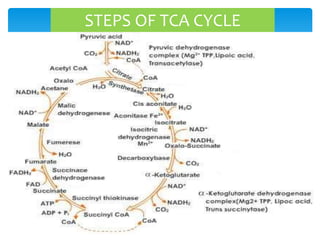
STEPS OF TCA CYCLE
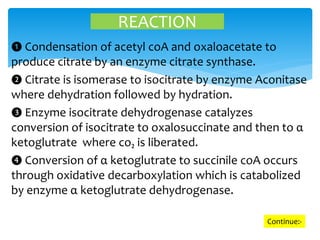
❶ Condensation of acetyl coA and oxaloacetate to
produce citrate by an enzyme citrate synthase.
❷ Citrate is isomerase to isocitrate by enzyme Aconitase
where dehydration followed by hydration.
❸ Enzyme isocitrate dehydrogenase catalyzes
conversion of isocitrate to oxalosuccinate and then to α
ketoglutrate where co₂ is liberated.
❹ Conversion of α ketoglutrate to succinile coA occurs
through oxidative decarboxylation which is catabolized
by enzyme α ketoglutrate dehydrogenase.
REACTION
Continue:-
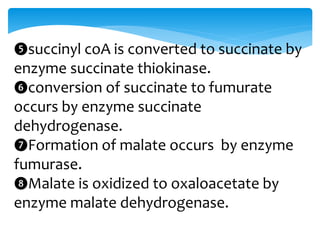
❺succinyl coA is converted to succinate by
enzyme succinate thiokinase.
❻conversion of succinate to fumurate
occurs by enzyme succinate
dehydrogenase.
❼Formation of malate occurs by enzyme
fumurase.
❽Malate is oxidized to oxaloacetate by
enzyme malate dehydrogenase.
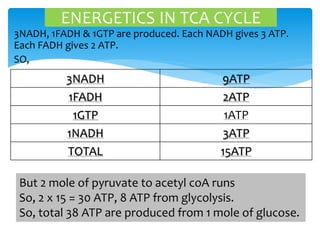
3NADH, 1FADH & 1GTP are produced. Each NADH gives 3 ATP.
Each FADH gives 2 ATP.
SO,
ENERGETICS IN TCA CYCLE
3NADH 9ATP
1FADH 2ATP
1GTP 1ATP
1NADH 3ATP
TOTAL 15ATP
But 2 mole of pyruvate to acetyl coA runs
So, 2 x 15 = 30 ATP, 8 ATP from glycolysis.
So, total 38 ATP are produced from 1 mole of glucose.

TCA cycle

  • 1.
    INTRODUCTION It is seriesof reaction in mitochondria which catabolized the oxidation of acetyl coA and H2O. Citric acid cycle is most important metabolic pathway for energy supply to the body. About 60-70% ATP is synthesized in kreb’s cycle. It is final common oxidative pathway for carbohydrate, fat and aminoacid. Enzymes of TCA cycle are located in mitochondria.
  • 2.
  • 3.
    ❶ Condensation ofacetyl coA and oxaloacetate to produce citrate by an enzyme citrate synthase. ❷ Citrate is isomerase to isocitrate by enzyme Aconitase where dehydration followed by hydration. ❸ Enzyme isocitrate dehydrogenase catalyzes conversion of isocitrate to oxalosuccinate and then to α ketoglutrate where co₂ is liberated. ❹ Conversion of α ketoglutrate to succinile coA occurs through oxidative decarboxylation which is catabolized by enzyme α ketoglutrate dehydrogenase. REACTION Continue:-
  • 4.
    ❺succinyl coA isconverted to succinate by enzyme succinate thiokinase. ❻conversion of succinate to fumurate occurs by enzyme succinate dehydrogenase. ❼Formation of malate occurs by enzyme fumurase. ❽Malate is oxidized to oxaloacetate by enzyme malate dehydrogenase.
  • 5.
    3NADH, 1FADH &1GTP are produced. Each NADH gives 3 ATP. Each FADH gives 2 ATP. SO, ENERGETICS IN TCA CYCLE 3NADH 9ATP 1FADH 2ATP 1GTP 1ATP 1NADH 3ATP TOTAL 15ATP But 2 mole of pyruvate to acetyl coA runs So, 2 x 15 = 30 ATP, 8 ATP from glycolysis. So, total 38 ATP are produced from 1 mole of glucose.

Editor's Notes

  • #6 But 2 mol of pyruvate to acyl