Citation
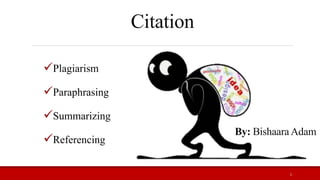
Plagiarism
Paraphrasing
Summarizing
Referencing
By: Bishaara Adam
1
Plagiarism
Plagiarism is the act of stealing
someone else's work and attempting
to pass it off as your own.
This can apply to anything, from
images to videos, music or songs,
even ideas.
2
 Give proper credit when using a source in your
paper.
Acknowledge the author of the original work
you have used whether you summarize or
paraphrase.
 Use quotation marks if you are taking
something directly from the information source.
Avoiding Plagiarism
3
 To paraphrase is to say the same
thing in another way, using your
own words.
 We can successfully paraphrase
by using a combination of
techniques.
Paraphrasing
4
Paraphrasing Techniques
 Change to synonyms - replace the original words with words
that mean the same.
 When you can’t find a synonym, replace the original word with a
definition.
 Interpret meaning, identify the underlying
meaning of a statement.
 Change transitions.
5
Summarizing means to restate the
main points of a source in your own
words.
Again, you must cite the source.
Summarizing
6
Read the original text several times till you understand the meaning very clearly.
Without looking at the source, jot down in points
whatever you have understood from the text.
Rewrite the material using your own words, but without
changing the meaning.
Compare with the original to ensure that you have used as
few words from it as possible.
Keep your summary short.
Cite the source.
Summarizing Techniques
7
 Referencing is a standardized method of
formatting the information sources you have
used in your assignments or written work.
 Any given referencing style serves two
purposes:
•acknowledges the source
•allows the reader to trace the source.
Referencing
8

Citation

  • 1.
  • 2.
    Plagiarism Plagiarism is theact of stealing someone else's work and attempting to pass it off as your own. This can apply to anything, from images to videos, music or songs, even ideas. 2
  • 3.
     Give propercredit when using a source in your paper. Acknowledge the author of the original work you have used whether you summarize or paraphrase.  Use quotation marks if you are taking something directly from the information source. Avoiding Plagiarism 3
  • 4.
     To paraphraseis to say the same thing in another way, using your own words.  We can successfully paraphrase by using a combination of techniques. Paraphrasing 4
  • 5.
    Paraphrasing Techniques  Changeto synonyms - replace the original words with words that mean the same.  When you can’t find a synonym, replace the original word with a definition.  Interpret meaning, identify the underlying meaning of a statement.  Change transitions. 5
  • 6.
    Summarizing means torestate the main points of a source in your own words. Again, you must cite the source. Summarizing 6
  • 7.
    Read the originaltext several times till you understand the meaning very clearly. Without looking at the source, jot down in points whatever you have understood from the text. Rewrite the material using your own words, but without changing the meaning. Compare with the original to ensure that you have used as few words from it as possible. Keep your summary short. Cite the source. Summarizing Techniques 7
  • 8.
     Referencing isa standardized method of formatting the information sources you have used in your assignments or written work.  Any given referencing style serves two purposes: •acknowledges the source •allows the reader to trace the source. Referencing 8