By: Husain Baaqel
ENC 1102
Kyle Stedman
Writing an Essay
The most important factors to consider when writing
an essay are a proper introduction and conclusion.
These two paragraphs are the backbone of the essay.
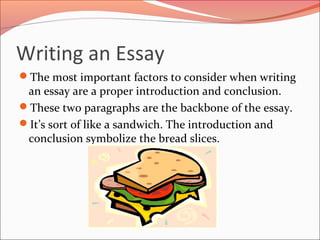
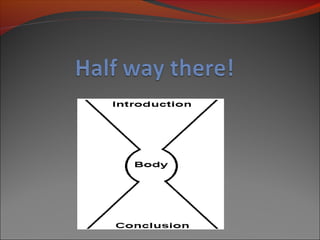
It’s sort of like a sandwich. The introduction and
conclusion symbolize the bread slices.
The Introduction!
First impressions are very important.
The first sentence of a paper sets the stage for a
lasting opinion.1
The start of the introduction should always grab the
reader’s attention.
When starting the introduction, do NOT blatantly
announce the purpose of the essay.2
Example: In this paper, I will….
1: Quoted from Grace Fleming’s “How to Write a Strong Introduction”
2: Adapted from- Things NOT to do in an introductory paragraph.
Introduction Guidelines
When writing an introduction, important concepts to
keep in mind are:
Clearly state the subject being dealt with
State the narrow topic the paper is focusing on
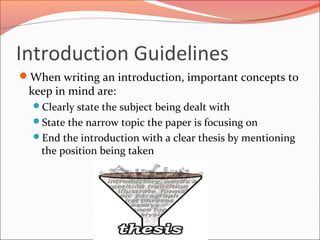
End the introduction with a clear thesis by mentioning
the position being taken
The Dreaded Thesis Statement!
Coming up with a proper thesis statement can be
difficult.
To make this process simpler follow these simple
rules3
:
Make the thesis statement narrow, specific and clear
Do NOT promise any analysis or review on the topic
Try to find a specific argument to defend
Yes!: I will argue that the use of marijuana should be
legalized.
No!!: I wish to review the pros of making marijuana
legal.
3: Quoted from “How to write a structured essay”
Wrapping It Up
The conclusion provides the writer one last chance to
persuade the reader.
It should contain the restated thesis and a summary
of the main points.
The most important thing to remember is that the
conclusion should “convey a sense of completeness
and closure as well as a sense of the lingering
possibilities of the topic.”4
4: Harvard’s website on Writing a Conclusion
A Conclusion Should NOT…
Be a simple summary of the essay
Contain an apology for your position on the
argument
Allow readers the chance to question your stance on
the topic
Do not undercut your authority by using phrases such
as: “This is just one approach..” “It seems like…”
Begin with: “in conclusion,” “to conclude,” or “in
summary”5
5: Harvard's Website on Writing a Conclusion
In the end…
Using these simple
tips will help you
create effective
introduction and
conclusion
paragraphs which
will make your
essay flow.
"A Proper Introduction: Things NOT to do in an introductory paragraph." The Guide to
Grammar and Writing. Capital Community College Foundation. 29 Apr 2009
<http://grammar.ccc.commnet.edu/GRAMMAR/intros.htm>.
Bellanca, Pat. "Ending The Essay: Conclusions." Writing Center. 1998. Harvard University.
29 Apr 2009
<http://www.fas.harvard.edu/~wricntr/documents/Conclusions.html>.
Fleming, Grace. "The Introductory Paragraph: Start With a Great First Sentence."
About.com. 29 Apr 2009
<http://homeworktips.about.com/od/paperassignments/a/introsentence.htm>.
"How to Write a Structured Essay." EastChance.com. 2000. 29 Apr 2009
<http://www.eastchance.com/howto/struct_es.asp>.

How to: Write an Introduction and Closing Paragraph

  • 1.
    By: Husain Baaqel ENC1102 Kyle Stedman
  • 2.
    Writing an Essay Themost important factors to consider when writing an essay are a proper introduction and conclusion. These two paragraphs are the backbone of the essay. It’s sort of like a sandwich. The introduction and conclusion symbolize the bread slices.
  • 3.
    The Introduction! First impressionsare very important. The first sentence of a paper sets the stage for a lasting opinion.1 The start of the introduction should always grab the reader’s attention. When starting the introduction, do NOT blatantly announce the purpose of the essay.2 Example: In this paper, I will…. 1: Quoted from Grace Fleming’s “How to Write a Strong Introduction” 2: Adapted from- Things NOT to do in an introductory paragraph.
  • 4.
    Introduction Guidelines When writingan introduction, important concepts to keep in mind are: Clearly state the subject being dealt with State the narrow topic the paper is focusing on End the introduction with a clear thesis by mentioning the position being taken
  • 5.
    The Dreaded ThesisStatement! Coming up with a proper thesis statement can be difficult. To make this process simpler follow these simple rules3 : Make the thesis statement narrow, specific and clear Do NOT promise any analysis or review on the topic Try to find a specific argument to defend Yes!: I will argue that the use of marijuana should be legalized. No!!: I wish to review the pros of making marijuana legal. 3: Quoted from “How to write a structured essay”
  • 7.
    Wrapping It Up Theconclusion provides the writer one last chance to persuade the reader. It should contain the restated thesis and a summary of the main points. The most important thing to remember is that the conclusion should “convey a sense of completeness and closure as well as a sense of the lingering possibilities of the topic.”4 4: Harvard’s website on Writing a Conclusion
  • 8.
    A Conclusion ShouldNOT… Be a simple summary of the essay Contain an apology for your position on the argument Allow readers the chance to question your stance on the topic Do not undercut your authority by using phrases such as: “This is just one approach..” “It seems like…” Begin with: “in conclusion,” “to conclude,” or “in summary”5 5: Harvard's Website on Writing a Conclusion
  • 9.
    In the end… Usingthese simple tips will help you create effective introduction and conclusion paragraphs which will make your essay flow.
  • 10.
    "A Proper Introduction:Things NOT to do in an introductory paragraph." The Guide to Grammar and Writing. Capital Community College Foundation. 29 Apr 2009 <http://grammar.ccc.commnet.edu/GRAMMAR/intros.htm>. Bellanca, Pat. "Ending The Essay: Conclusions." Writing Center. 1998. Harvard University. 29 Apr 2009 <http://www.fas.harvard.edu/~wricntr/documents/Conclusions.html>. Fleming, Grace. "The Introductory Paragraph: Start With a Great First Sentence." About.com. 29 Apr 2009 <http://homeworktips.about.com/od/paperassignments/a/introsentence.htm>. "How to Write a Structured Essay." EastChance.com. 2000. 29 Apr 2009 <http://www.eastchance.com/howto/struct_es.asp>.