Quoting, Paraphrasing, and
      Summarizing
       WHAT IS THE DIFFERENCE
     BETWEEN THE THREE WAYS OF
        INCORPORATING OTHER
    WRITERS' WORK INTO YOUR OWN
              WRITING?
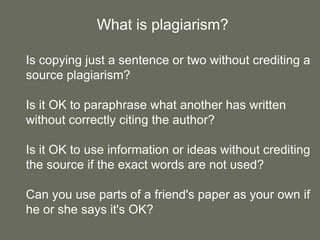
What is plagiarism?

Is copying just a sentence or two without crediting a
source plagiarism?

Is it OK to paraphrase what another has written
without correctly citing the author?

Is it OK to use information or ideas without crediting
the source if the exact words are not used?

Can you use parts of a friend's paper as your own if
he or she says it's OK?
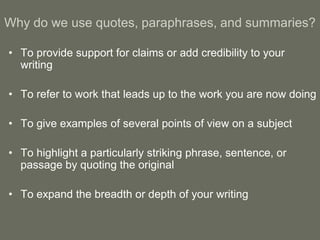
Why do we use quotes, paraphrases, and summaries?

• To provide support for claims or add credibility to your
  writing

• To refer to work that leads up to the work you are now doing

• To give examples of several points of view on a subject

• To highlight a particularly striking phrase, sentence, or
  passage by quoting the original

• To expand the breadth or depth of your writing
QUOTING
• Quotations must…

  – Be identical to the original

  – Use a narrow segment of the source

  – Match the source document word for word

  – Be attributed to the original author
PARAPHRASING
• Involves putting a passage from source
  material into your own words

• Paraphrased material must also be
  attributed to the source

• A paraphrase is usually shorter than the
  original passage
SUMMARIZING
• Involves putting the main idea(s) into your
  own words, including only the main points

• Summaries must also be attributed to the
  source

• Summaries are significantly shorter than
  the original and give a broad overview of
  the source material
Six Steps to Effective Paraphrasing
1. Reread the original passage until you
   understand its full meaning. You can’t
   paraphrase what you don’t understand.

2. Set the original aside, and write your
   paraphrase on a note card.

3. Jot down a few words below your paraphrase to
   remind you later how you envision using this
   material. At the top of the note card, write a key
   word or phrase to indicate the subject of your
   paraphrase.
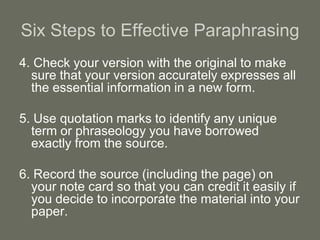
Six Steps to Effective Paraphrasing
4. Check your version with the original to make
  sure that your version accurately expresses all
  the essential information in a new form.

5. Use quotation marks to identify any unique
  term or phraseology you have borrowed
  exactly from the source.

6. Record the source (including the page) on
  your note card so that you can credit it easily if
  you decide to incorporate the material into your
  paper.
Original Passage:
  Students frequently overuse direct quotation in taking notes, and as a result
     they overuse quotations in the final [research] paper. Probably only about
     10% of your final manuscript should appear as directly quoted matter.
     Therefore, you should strive to limit the amount of exact transcribing of
     source material while taking notes.
  Lester, James D. Writing Research Papers. 2nd ed. (1976): 4647.
     A Legitimate Paraphrase:                     An Acceptable Summary:
In research papers students often          Students should take just a few notes in
    quote excessively, failing to          direct quotation from sources to help
    keep quoted material down to a
    desirable level. Since the             minimize the amount of quoted material
    problem usually originates             in a research paper (Lester 4647).
    during note taking, it is essential
    to minimize the material
    recorded verbatim (Lester
    4647).
                                 A Plagiarized Version:
  Students often use too many direct quotations when they take notes, resulting
      in too many of them in the final research paper. In fact, probably only
      about 10% of the final copy should consist of directly quoted material. So it
      is important to limit the amount of source material copied while taking
      notes.

Quoting paraphrasing and summarizing

  • 1.
    Quoting, Paraphrasing, and Summarizing WHAT IS THE DIFFERENCE BETWEEN THE THREE WAYS OF INCORPORATING OTHER WRITERS' WORK INTO YOUR OWN WRITING?
  • 2.
    What is plagiarism? Iscopying just a sentence or two without crediting a source plagiarism? Is it OK to paraphrase what another has written without correctly citing the author? Is it OK to use information or ideas without crediting the source if the exact words are not used? Can you use parts of a friend's paper as your own if he or she says it's OK?
  • 3.
    Why do weuse quotes, paraphrases, and summaries? • To provide support for claims or add credibility to your writing • To refer to work that leads up to the work you are now doing • To give examples of several points of view on a subject • To highlight a particularly striking phrase, sentence, or passage by quoting the original • To expand the breadth or depth of your writing
  • 4.
    QUOTING • Quotations must… – Be identical to the original – Use a narrow segment of the source – Match the source document word for word – Be attributed to the original author
  • 5.
    PARAPHRASING • Involves puttinga passage from source material into your own words • Paraphrased material must also be attributed to the source • A paraphrase is usually shorter than the original passage
  • 6.
    SUMMARIZING • Involves puttingthe main idea(s) into your own words, including only the main points • Summaries must also be attributed to the source • Summaries are significantly shorter than the original and give a broad overview of the source material
  • 7.
    Six Steps toEffective Paraphrasing 1. Reread the original passage until you understand its full meaning. You can’t paraphrase what you don’t understand. 2. Set the original aside, and write your paraphrase on a note card. 3. Jot down a few words below your paraphrase to remind you later how you envision using this material. At the top of the note card, write a key word or phrase to indicate the subject of your paraphrase.
  • 8.
    Six Steps toEffective Paraphrasing 4. Check your version with the original to make sure that your version accurately expresses all the essential information in a new form. 5. Use quotation marks to identify any unique term or phraseology you have borrowed exactly from the source. 6. Record the source (including the page) on your note card so that you can credit it easily if you decide to incorporate the material into your paper.
  • 9.
    Original Passage: Students frequently overuse direct quotation in taking notes, and as a result they overuse quotations in the final [research] paper. Probably only about 10% of your final manuscript should appear as directly quoted matter. Therefore, you should strive to limit the amount of exact transcribing of source material while taking notes. Lester, James D. Writing Research Papers. 2nd ed. (1976): 4647. A Legitimate Paraphrase: An Acceptable Summary: In research papers students often Students should take just a few notes in quote excessively, failing to direct quotation from sources to help keep quoted material down to a desirable level. Since the minimize the amount of quoted material problem usually originates in a research paper (Lester 4647). during note taking, it is essential to minimize the material recorded verbatim (Lester 4647). A Plagiarized Version: Students often use too many direct quotations when they take notes, resulting in too many of them in the final research paper. In fact, probably only about 10% of the final copy should consist of directly quoted material. So it is important to limit the amount of source material copied while taking notes.