Prepared By.
Mohammed Jasir PV
Asst. Professor
MIIMS, Puthanangadi
9605 69 32 66
Writing
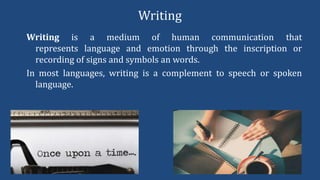
Writing is a medium of human communication that
represents language and emotion through the inscription or
recording of signs and symbols an words.
In most languages, writing is a complement to speech or spoken
language.
Technical Writing
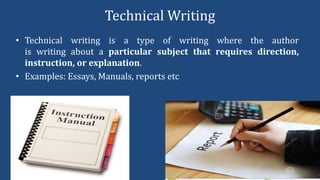
• Technical writing is a type of writing where the author
is writing about a particular subject that requires direction,
instruction, or explanation.
• Examples: Essays, Manuals, reports etc
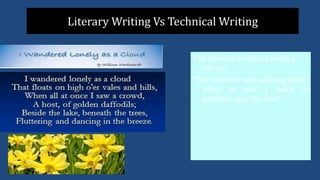
Literary Writing Vs Technical Writing
The poem in technical writing
can be:
“The narrator was walking alone,
when he saw a patch of
daffodils near the lake”
Letter
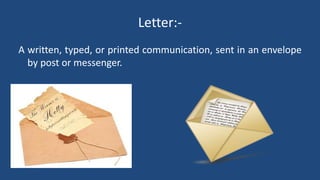
Letter:-
A written, typed, or printed communication, sent in an envelope
by post or messenger.
Points to Be noted in Letter Writing
• In the correct Format
• Short and to the point
• Relevant
• Free of any grammatical or spelling mistakes.
• Polite even if you are complaining
• Well Presented
Formal Letter Vs Informal Letter
The main difference between a formal letter and an informal letter is their
purpose:
• A formal letter is written for professional (official and business)
communication , written in the formal language with a specific format for
business or official purpose
Eg:-a letter of enquiry, a letter of request, or a letter of complaint.
• An informal letter is used for personal communication. Informal letters
are letters we write to friends and relatives. There is no strict format to write an
informal letter.
Types Of Letters
• Business letters are primarily informational with no personal content
Eg: Sales letter, Order Letter, Termination Letter
• Formal letter- based on context there may be personal content
Eg: letter from Principal to congratulate a student who scored high marks in an exam
• Semi Official Letter:
Formal letters b/n persons with same rank/position. Salutation will be Dear Mr. John.
Short and not quoted in official communications
Business Letters
• A business letter is a special class formal letter from one company to another,
or between such organizations and their customers, clients and other external
parties.
• The overall style of letter depends on the relationship between the parties
concerned
• Even today, they are very useful because it produces a permanent record, they
are confidential, formal and delivers persuasive, well-considered messages.
Elements in Formal Letters
 Includes the company’s logo / symbol / name, address, ZIP, telephone number, fax
number, email address and website of the company.
 Printed at the top center/left or the right side.
• SENDER’S ADDRESS:
It is usually given in the letter head,
but if there is none,
the Sender’s Name, Address and
Contact details can be typed.
 Include a reference line to identify a file or case number, invoice
number or any other internal identifying information, if your
company requires one.
 Some companies have specific reference codes that they place either
in a reference line below the date, or at the very bottom of the letter.
Eg: CUMI/HR/PW/12/15
Ref:No.ACSM/GM/304/2016
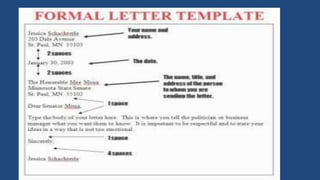
Date consists of the date, name of the month and the year.
If the letter sheet includes a letterhead, type the date from 2 to 3 lines under the
letterhead, else type it under the return address.
Never send a letter without a date.
The date is written in two styles.
The British Method (ordinal numbers) : 4th July, 2012
The American Method (cardinal numbers) : July 4, 2012
Never write like 7-2-12 or 7/2/12 because it shows that the writer is careless
or in a great hurry.
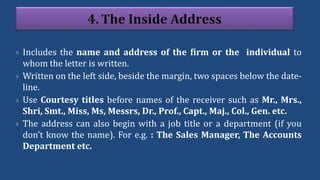
 Includes the name and address of the firm or the individual to
whom the letter is written.
 Written on the left side, beside the margin, two spaces below the date-
line.
 Use Courtesy titles before names of the receiver such as Mr., Mrs.,
Shri, Smt., Miss, Ms, Messrs, Dr., Prof., Capt., Maj., Col., Gen. etc.
 The address can also begin with a job title or a department (if you
don’t know the name). For e.g. : The Sales Manager, The Accounts
Department etc.
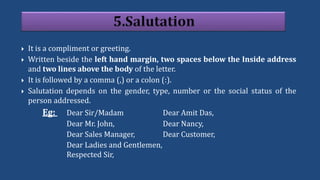
 It is a compliment or greeting.
 Written beside the left hand margin, two spaces below the Inside address
and two lines above the body of the letter.
 It is followed by a comma (,) or a colon (:).
 Salutation depends on the gender, type, number or the social status of the
person addressed.
Eg: Dear Sir/Madam Dear Amit Das,
Dear Mr. John, Dear Nancy,
Dear Sales Manager, Dear Customer,
Dear Ladies and Gentlemen,
Respected Sir,
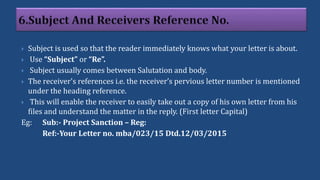
 Subject is used so that the reader immediately knows what your letter is about.
 Use “Subject” or “Re”.
 Subject usually comes between Salutation and body.
 The receiver's references i.e. the receiver’s pervious letter number is mentioned
under the heading reference.
 This will enable the receiver to easily take out a copy of his own letter from his
files and understand the matter in the reply. (First letter Capital)
Eg: Sub:- Project Sanction – Reg:
Ref:-Your Letter no. mba/023/15 Dtd.12/03/2015
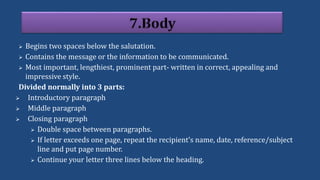
 Begins two spaces below the salutation.
 Contains the message or the information to be communicated.
 Most important, lengthiest, prominent part- written in correct, appealing and
impressive style.
Divided normally into 3 parts:
 Introductory paragraph
 Middle paragraph
 Closing paragraph
 Double space between paragraphs.
 If letter exceeds one page, repeat the recipient's name, date, reference/subject
line and put page number.
 Continue your letter three lines below the heading.
 It is written two spaces below the last line of the body.
 It is a polite way of saying “ Good bye”.
 It depends on the tone and degree of formality.
Formal: Respectfully yours, Sincerely, Yours Faithfully (Dear Mr. Ramesh)
Yours Truly (Dear Sir/Madam)
Informal: Cordially yours, Warm Regards, Best wishes, Thanks and
Regards
Written double space below the complimentary close.
 First comes Signature (pen written). Sign your first and last name.
 Second line - type written name.
 Third line - business title.
The signature acts as proof.
 This line tells the reader to look in the envelope for more.
 Write Enc./Encl./Enclosure below the signature block.
e.g. : Enclosure
Enclosures: 3
Enclosures : Check #231 for $500
 If you don't enclose anything, skip it.
 When other people are to receive a copy of the same letter,
their names are noted either by their ranks or by alphabetically.
 Written just below the reference initials or the enclosure
whichever is last.
 Type “cc” before the names if sending a “carbon copy(to)” and
“pc” for photocopy (to).
CC: Jim Blue, Jennifer Louis
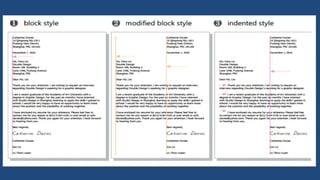
1. BLOCK
 Each line of every part begins at the left margin.
 At least one line space between each part.
 Time saving and beautiful to look at, also American style.
2. SEMI BLOCK/MODIFIED BLOCK
 Some parts are typed in block method and other parts are indented.
 Return address, date, closing and signature start just to the right of the center of
the page or may be flush with the right margin.
 Most widely followed method in our country specially in govt. offices.
3. INDENT
 New paragraphs begin about 1.5 centimeters to the right of
the left margin.
 This style is also known as Hanging style.
 This method consumes a lot of time, looks shabby , therefore
out of practice.
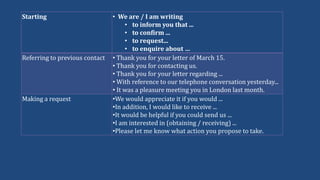
Starting • We are / I am writing
• to inform you that ...
• to confirm ...
• to request...
• to enquire about …
Referring to previous contact • Thank you for your letter of March 15.
• Thank you for contacting us.
• Thank you for your letter regarding ...
• With reference to our telephone conversation yesterday...
• It was a pleasure meeting you in London last month.
Making a request •We would appreciate it if you would ...
•In addition, I would like to receive ...
•It would be helpful if you could send us ...
•I am interested in (obtaining / receiving) ...
•Please let me know what action you propose to take.
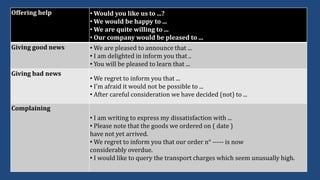
Offering help • Would you like us to ...?
• We would be happy to ...
• We are quite willing to ...
• Our company would be pleased to ...
Giving good news • We are pleased to announce that ...
• I am delighted in inform you that ..
• You will be pleased to learn that ...
Giving bad news
• We regret to inform you that ...
• I'm afraid it would not be possible to ...
• After careful consideration we have decided (not) to ...
Complaining
• I am writing to express my dissatisfaction with ...
• Please note that the goods we ordered on ( date )
have not yet arrived.
• We regret to inform you that our order n° ----- is now
considerably overdue.
• I would like to query the transport charges which seem unusually high.
Writing - Letter Writing

Writing - Letter Writing

  • 1.
    Prepared By. Mohammed JasirPV Asst. Professor MIIMS, Puthanangadi 9605 69 32 66
  • 2.
    Writing Writing is amedium of human communication that represents language and emotion through the inscription or recording of signs and symbols an words. In most languages, writing is a complement to speech or spoken language.
  • 3.
    Technical Writing • Technicalwriting is a type of writing where the author is writing about a particular subject that requires direction, instruction, or explanation. • Examples: Essays, Manuals, reports etc
  • 4.
    Literary Writing VsTechnical Writing The poem in technical writing can be: “The narrator was walking alone, when he saw a patch of daffodils near the lake”
  • 5.
  • 6.
    Letter:- A written, typed,or printed communication, sent in an envelope by post or messenger.
  • 7.
    Points to Benoted in Letter Writing • In the correct Format • Short and to the point • Relevant • Free of any grammatical or spelling mistakes. • Polite even if you are complaining • Well Presented
  • 8.
    Formal Letter VsInformal Letter The main difference between a formal letter and an informal letter is their purpose: • A formal letter is written for professional (official and business) communication , written in the formal language with a specific format for business or official purpose Eg:-a letter of enquiry, a letter of request, or a letter of complaint. • An informal letter is used for personal communication. Informal letters are letters we write to friends and relatives. There is no strict format to write an informal letter.
  • 9.
    Types Of Letters •Business letters are primarily informational with no personal content Eg: Sales letter, Order Letter, Termination Letter • Formal letter- based on context there may be personal content Eg: letter from Principal to congratulate a student who scored high marks in an exam • Semi Official Letter: Formal letters b/n persons with same rank/position. Salutation will be Dear Mr. John. Short and not quoted in official communications
  • 10.
    Business Letters • Abusiness letter is a special class formal letter from one company to another, or between such organizations and their customers, clients and other external parties. • The overall style of letter depends on the relationship between the parties concerned • Even today, they are very useful because it produces a permanent record, they are confidential, formal and delivers persuasive, well-considered messages.
  • 11.
    Elements in FormalLetters  Includes the company’s logo / symbol / name, address, ZIP, telephone number, fax number, email address and website of the company.  Printed at the top center/left or the right side. • SENDER’S ADDRESS: It is usually given in the letter head, but if there is none, the Sender’s Name, Address and Contact details can be typed.
  • 12.
     Include areference line to identify a file or case number, invoice number or any other internal identifying information, if your company requires one.  Some companies have specific reference codes that they place either in a reference line below the date, or at the very bottom of the letter. Eg: CUMI/HR/PW/12/15 Ref:No.ACSM/GM/304/2016
  • 13.
    Date consists ofthe date, name of the month and the year. If the letter sheet includes a letterhead, type the date from 2 to 3 lines under the letterhead, else type it under the return address. Never send a letter without a date. The date is written in two styles. The British Method (ordinal numbers) : 4th July, 2012 The American Method (cardinal numbers) : July 4, 2012 Never write like 7-2-12 or 7/2/12 because it shows that the writer is careless or in a great hurry.
  • 14.
     Includes thename and address of the firm or the individual to whom the letter is written.  Written on the left side, beside the margin, two spaces below the date- line.  Use Courtesy titles before names of the receiver such as Mr., Mrs., Shri, Smt., Miss, Ms, Messrs, Dr., Prof., Capt., Maj., Col., Gen. etc.  The address can also begin with a job title or a department (if you don’t know the name). For e.g. : The Sales Manager, The Accounts Department etc.
  • 15.
     It isa compliment or greeting.  Written beside the left hand margin, two spaces below the Inside address and two lines above the body of the letter.  It is followed by a comma (,) or a colon (:).  Salutation depends on the gender, type, number or the social status of the person addressed. Eg: Dear Sir/Madam Dear Amit Das, Dear Mr. John, Dear Nancy, Dear Sales Manager, Dear Customer, Dear Ladies and Gentlemen, Respected Sir,
  • 16.
     Subject isused so that the reader immediately knows what your letter is about.  Use “Subject” or “Re”.  Subject usually comes between Salutation and body.  The receiver's references i.e. the receiver’s pervious letter number is mentioned under the heading reference.  This will enable the receiver to easily take out a copy of his own letter from his files and understand the matter in the reply. (First letter Capital) Eg: Sub:- Project Sanction – Reg: Ref:-Your Letter no. mba/023/15 Dtd.12/03/2015
  • 17.
     Begins twospaces below the salutation.  Contains the message or the information to be communicated.  Most important, lengthiest, prominent part- written in correct, appealing and impressive style. Divided normally into 3 parts:  Introductory paragraph  Middle paragraph  Closing paragraph  Double space between paragraphs.  If letter exceeds one page, repeat the recipient's name, date, reference/subject line and put page number.  Continue your letter three lines below the heading.
  • 18.
     It iswritten two spaces below the last line of the body.  It is a polite way of saying “ Good bye”.  It depends on the tone and degree of formality. Formal: Respectfully yours, Sincerely, Yours Faithfully (Dear Mr. Ramesh) Yours Truly (Dear Sir/Madam) Informal: Cordially yours, Warm Regards, Best wishes, Thanks and Regards
  • 19.
    Written double spacebelow the complimentary close.  First comes Signature (pen written). Sign your first and last name.  Second line - type written name.  Third line - business title. The signature acts as proof.
  • 20.
     This linetells the reader to look in the envelope for more.  Write Enc./Encl./Enclosure below the signature block. e.g. : Enclosure Enclosures: 3 Enclosures : Check #231 for $500  If you don't enclose anything, skip it.
  • 21.
     When otherpeople are to receive a copy of the same letter, their names are noted either by their ranks or by alphabetically.  Written just below the reference initials or the enclosure whichever is last.  Type “cc” before the names if sending a “carbon copy(to)” and “pc” for photocopy (to). CC: Jim Blue, Jennifer Louis
  • 22.
    1. BLOCK  Eachline of every part begins at the left margin.  At least one line space between each part.  Time saving and beautiful to look at, also American style. 2. SEMI BLOCK/MODIFIED BLOCK  Some parts are typed in block method and other parts are indented.  Return address, date, closing and signature start just to the right of the center of the page or may be flush with the right margin.  Most widely followed method in our country specially in govt. offices.
  • 23.
    3. INDENT  Newparagraphs begin about 1.5 centimeters to the right of the left margin.  This style is also known as Hanging style.  This method consumes a lot of time, looks shabby , therefore out of practice.
  • 26.
    Starting • Weare / I am writing • to inform you that ... • to confirm ... • to request... • to enquire about … Referring to previous contact • Thank you for your letter of March 15. • Thank you for contacting us. • Thank you for your letter regarding ... • With reference to our telephone conversation yesterday... • It was a pleasure meeting you in London last month. Making a request •We would appreciate it if you would ... •In addition, I would like to receive ... •It would be helpful if you could send us ... •I am interested in (obtaining / receiving) ... •Please let me know what action you propose to take.
  • 27.
    Offering help •Would you like us to ...? • We would be happy to ... • We are quite willing to ... • Our company would be pleased to ... Giving good news • We are pleased to announce that ... • I am delighted in inform you that .. • You will be pleased to learn that ... Giving bad news • We regret to inform you that ... • I'm afraid it would not be possible to ... • After careful consideration we have decided (not) to ... Complaining • I am writing to express my dissatisfaction with ... • Please note that the goods we ordered on ( date ) have not yet arrived. • We regret to inform you that our order n° ----- is now considerably overdue. • I would like to query the transport charges which seem unusually high.