PRACTICE TEACHING LESSON
MATHEMATICS VI
EXPLICIT TEACHING
November 21, 2017
OBJECTIVES CONTENT LEARNING RESOURCES PROCEDURE REMARKS REFLECTION
A. CONTENT STANDARDS
Demonstrates understanding of
sequence in forming a rule,
expression and equation.
B. PERFORMANCE STANDARDS
Apply knowledge of sequence,
expressions and equations.
C. LEARNING COMPETENCIES
Formulate the rule in finding the
Nth term using different strategies
(looking for a pattern, guessing and
checking, working backwards).
PATTERNS AND
SEQUENCE
* Formulating the rule
in finding the Nth term
using different
strategies (looking for a
pattern, guessing and
checking, working
backwards).
A. Referrences:
1. Teacher’s Guide pp.
21st Century Mathletes pp.
77-81
CG Math 6
LG Math 6
2. Learner’s Material pp.
21st
century Mathletes pp.
200-209
3. Textbook pp.
Math for life pp.233-237
4. Additional Materials
From Learning Resources
(LR) Portal
5. Other Learning Resources
Indoor and outdoor real
objects, pictures, videos,
laptop, TV, Charts
A. Reviewing previous lesson
or presenting the new
lesson:
1. Having a drill on skip
counting by 5, 6, 8,
and 10.
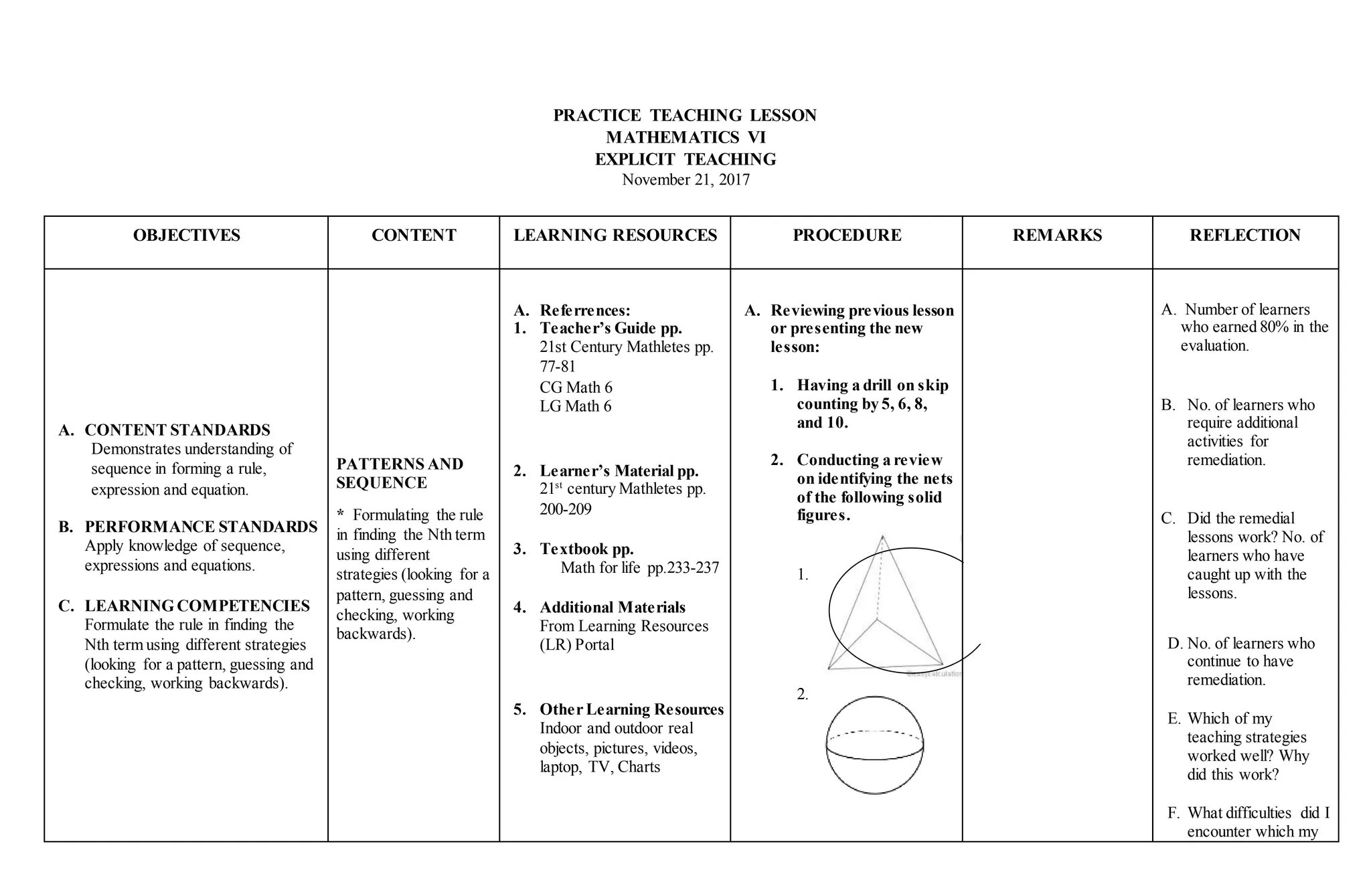
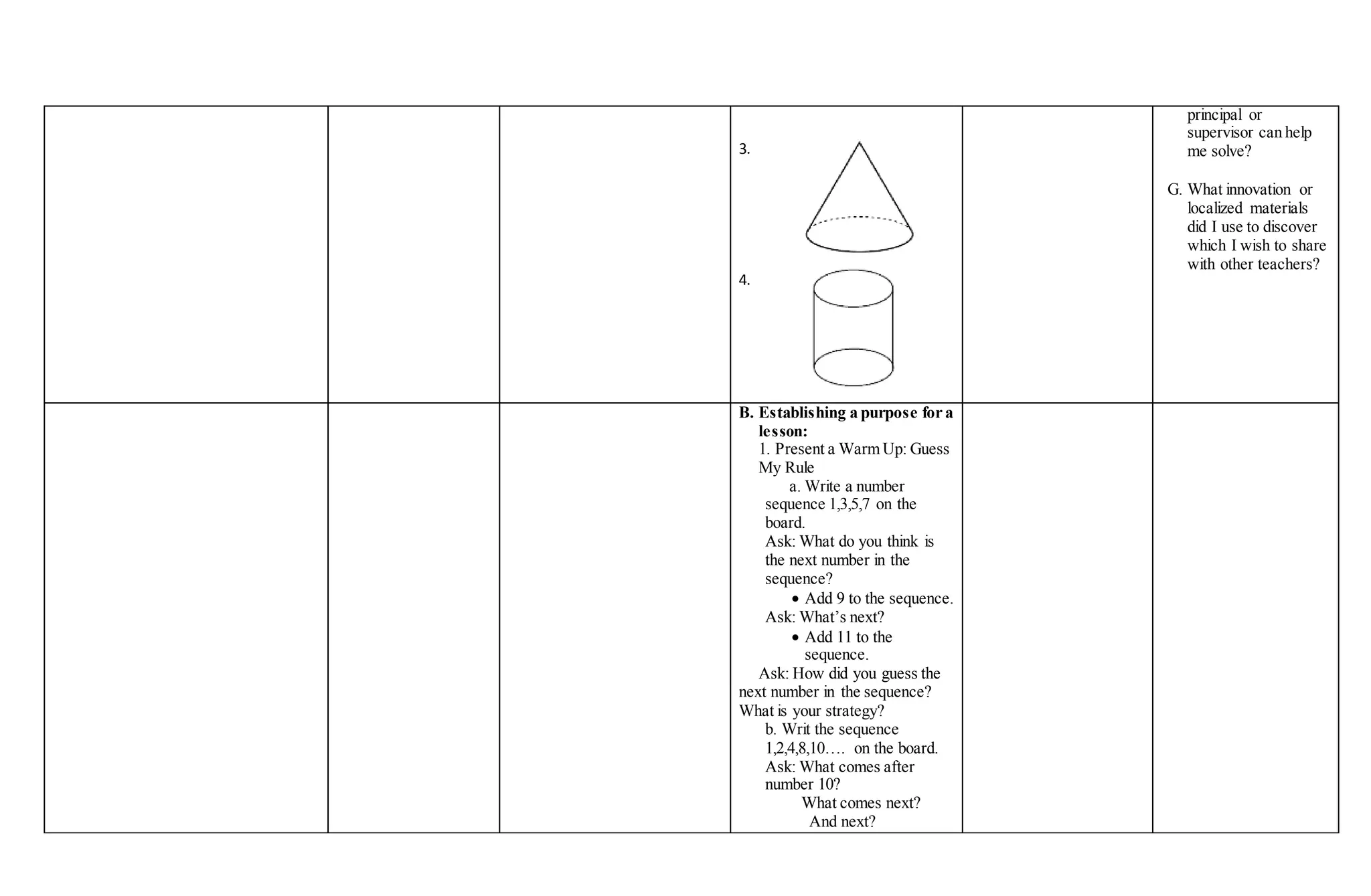
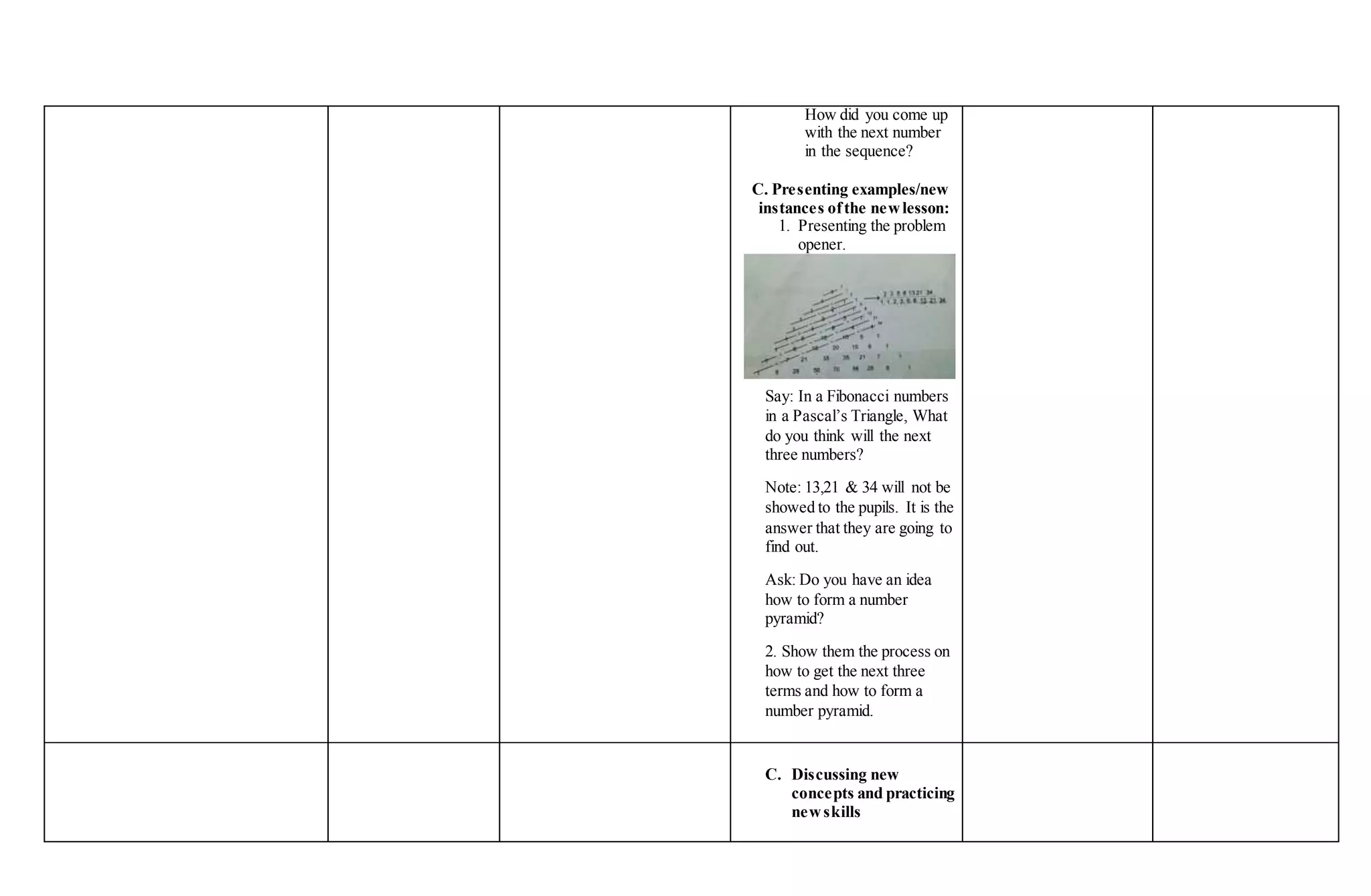
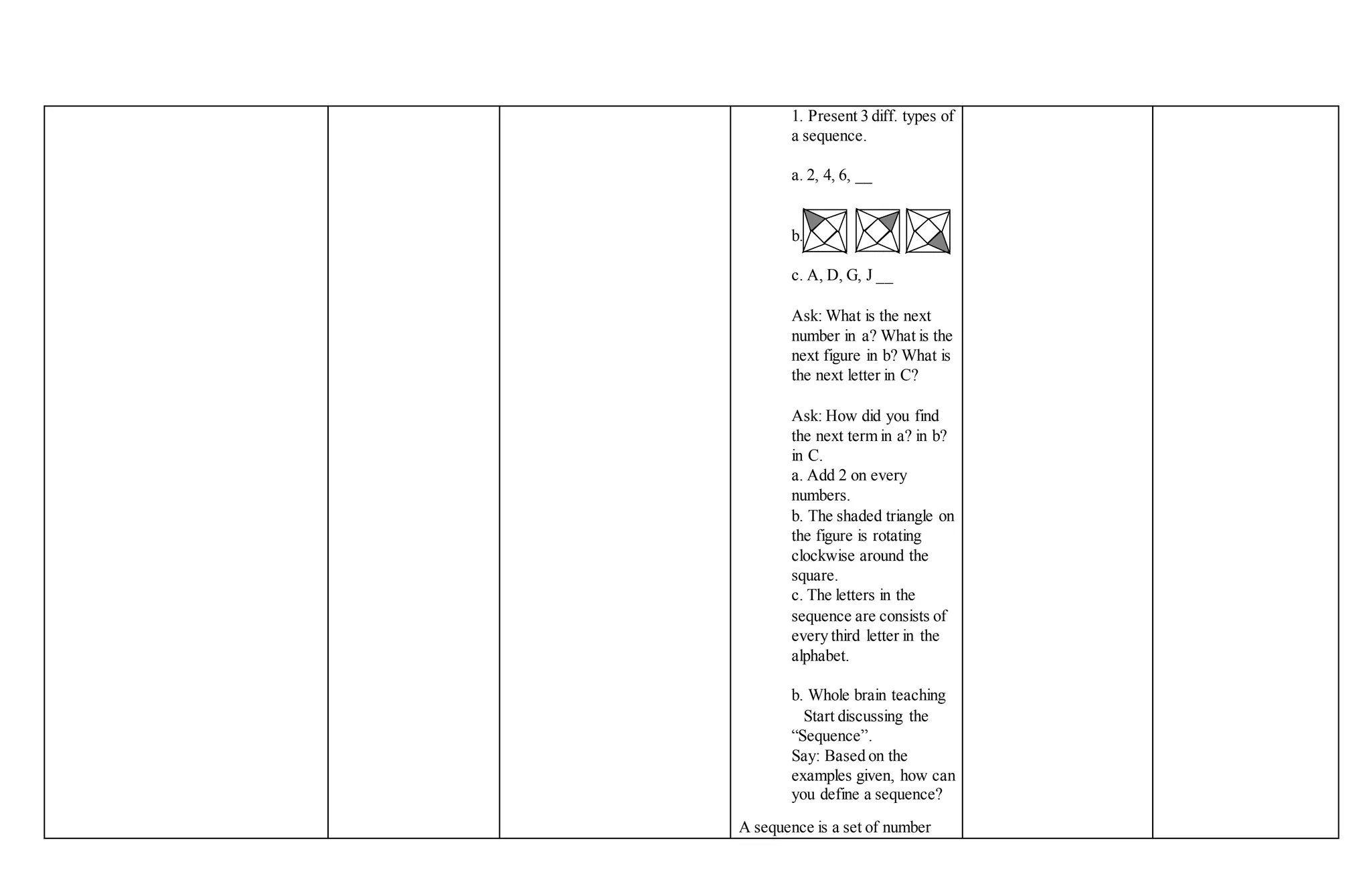
2. Conducting a review
on identifying the nets
of the following solid
figures.
1.
2.
A. Number of learners
who earned 80% in the
evaluation.
B. No. of learners who
require additional
activities for
remediation.
C. Did the remedial
lessons work? No. of
learners who have
caught up with the
lessons.
D. No. of learners who
continue to have
remediation.
E. Which of my
teaching strategies
worked well? Why
did this work?
F. What difficulties did I
encounter which my
3.
4.
principal or
supervisor can help
me solve?
G. What innovation or
localized materials
did I use to discover
which I wish to share
with other teachers?
B. Establishing a purpose for a
lesson:
1. Present a Warm Up: Guess
My Rule
a. Write a number
sequence 1,3,5,7 on the
board.
Ask: What do you think is
the next number in the
sequence?
 Add 9 to the sequence.
Ask: What’s next?
 Add 11 to the
sequence.
Ask: How did you guess the
next number in the sequence?
What is your strategy?
b. Writ the sequence
1,2,4,8,10…. on the board.
Ask: What comes after
number 10?
What comes next?
And next?
How did you come up
with the next number
in the sequence?
C. Presenting examples/new
instances ofthe newlesson:
1. Presenting the problem
opener.
Say: In a Fibonacci numbers
in a Pascal’s Triangle, What
do you think will the next
three numbers?
Note: 13,21 & 34 will not be
showed to the pupils. It is the
answer that they are going to
find out.
Ask: Do you have an idea
how to form a number
pyramid?
2. Show them the process on
how to get the next three
terms and how to form a
number pyramid.
C. Discussing new
concepts and practicing
newskills
1. Present 3 diff. types of
a sequence.
a. 2, 4, 6, __
b.
c. A, D, G, J __
Ask: What is the next
number in a? What is the
next figure in b? What is
the next letter in C?
Ask: How did you find
the next term in a? in b?
in C.
a. Add 2 on every
numbers.
b. The shaded triangle on
the figure is rotating
clockwise around the
square.
c. The letters in the
sequence are consists of
every third letter in the
alphabet.
b. Whole brain teaching
Start discussing the
“Sequence”.
Say: Based on the
examples given, how can
you define a sequence?
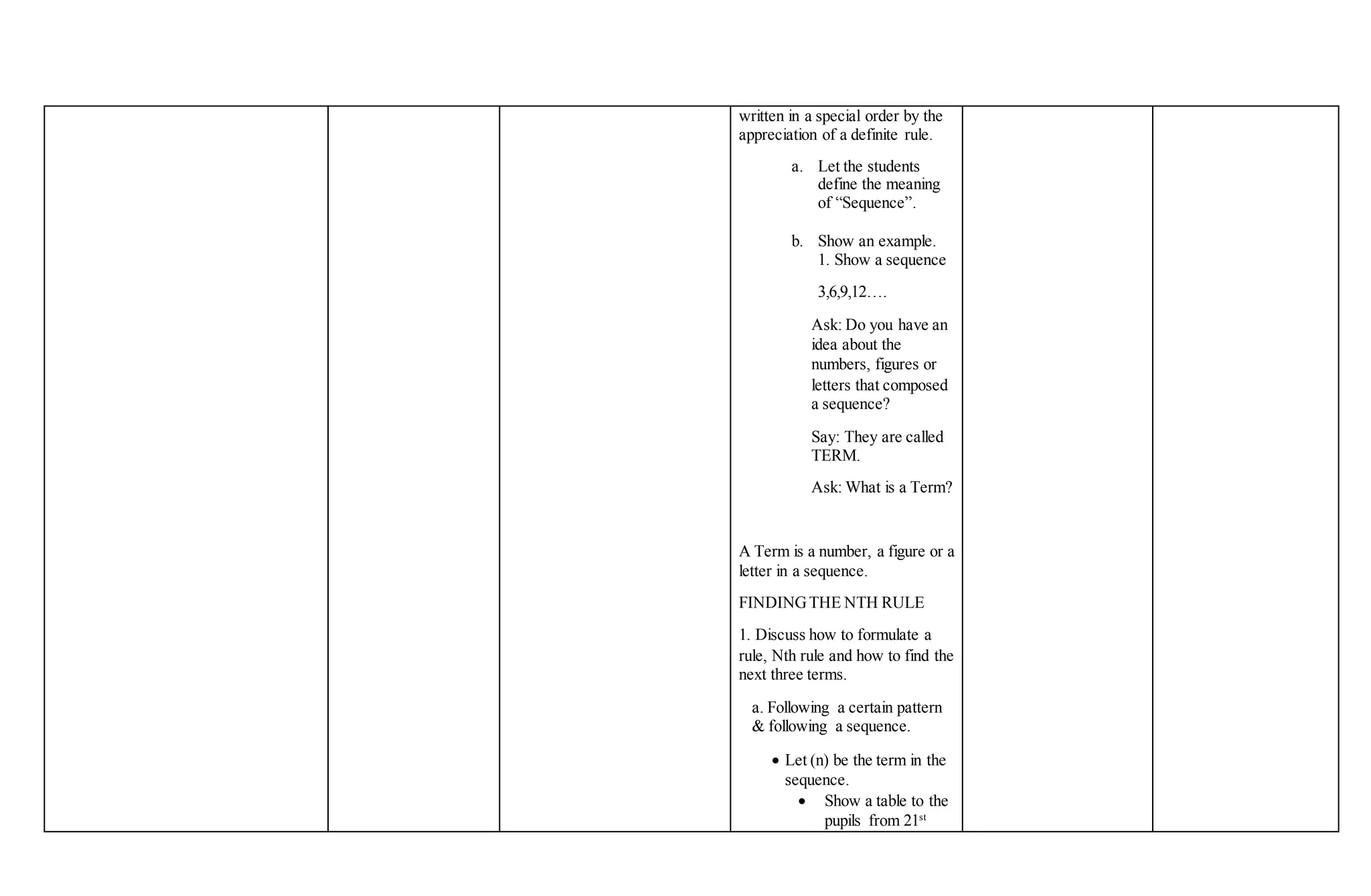
A sequence is a set of number
written in a special order by the
appreciation of a definite rule.
a. Let the students
define the meaning
of “Sequence”.
b. Show an example.
1. Show a sequence
3,6,9,12….
Ask: Do you have an
idea about the
numbers, figures or
letters that composed
a sequence?
Say: They are called
TERM.
Ask: What is a Term?
A Term is a number, a figure or a
letter in a sequence.
FINDINGTHE NTH RULE
1. Discuss how to formulate a
rule, Nth rule and how to find the
next three terms.
a. Following a certain pattern
& following a sequence.
 Let (n) be the term in the
sequence.
 Show a table to the
pupils from 21st
Century Mathletes
Textbook pp.215-
217.
b. Guess and Check: Use of
counting numbers.
 Let (n) be the counting
numbers.
c. Guess and check
Exercises:
Every year,Mang Ramon’s
kinalabaw mango tree produces
2 more kilos than the previous
years. If 25 kg. were harvested in
year 2012, how many kilos will
it produce in 2017? What is the
total number of kilos of mangoes
that the tree produce from 2012-
2017? Formulate the nth rule.
What is asked?
-The number of kilos of
mangoes the tree will produce
in 2017.
-The total number of kilos of
mangoes the tree will produce
from year 2012-2017.
-Formulate the nth rule
What are given?
25 kilos in 2012 (starting year)
2 more kilos of mangoes more
than a year
Solution:
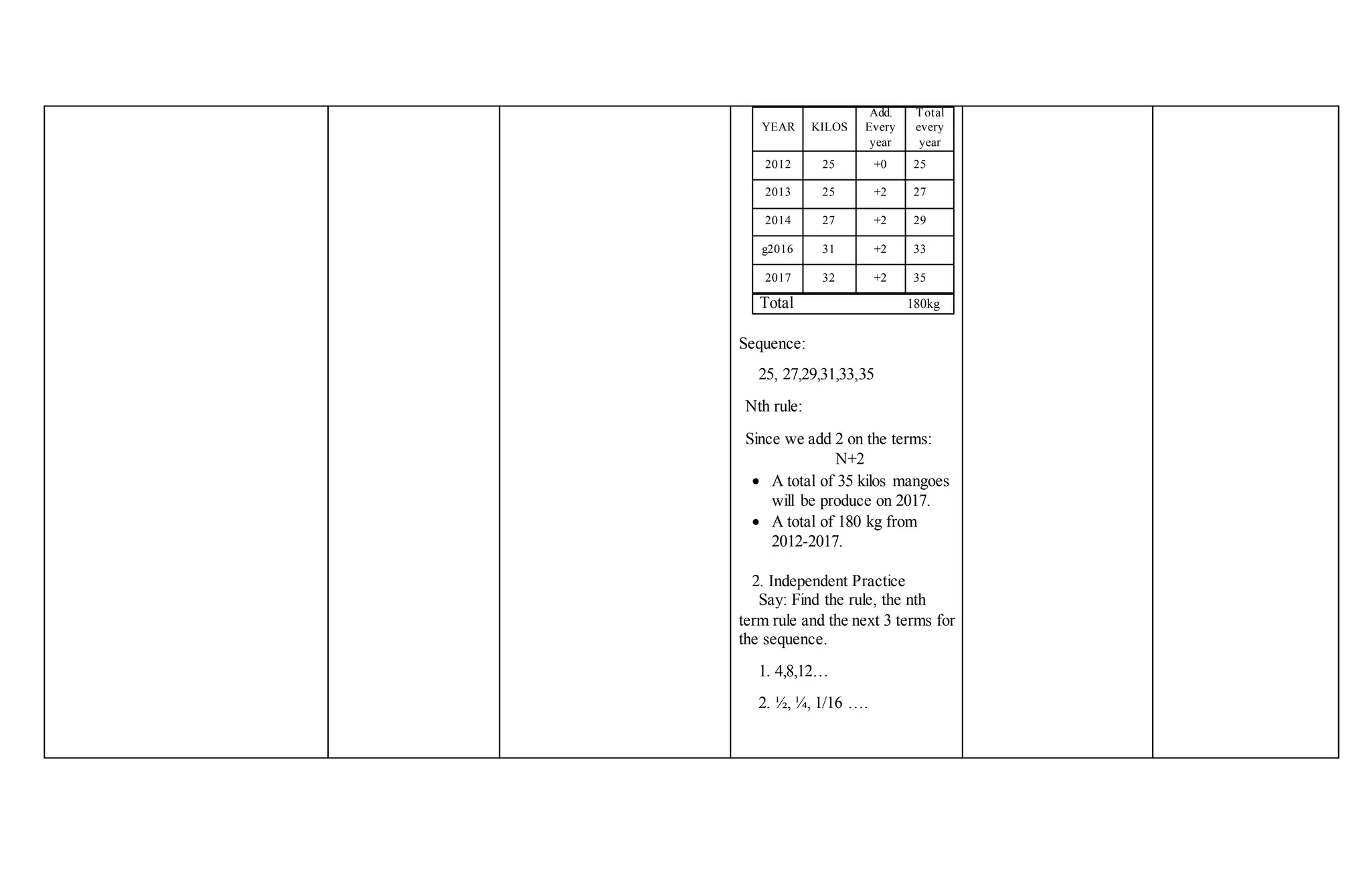
YEAR KILOS
Add.
Every
year
Total
every
year
2012 25 +0 25
2013 25 +2 27
2014 27 +2 29
g2016 31 +2 33
2017 32 +2 35
Total 180kg
Sequence:
25, 27,29,31,33,35
Nth rule:
Since we add 2 on the terms:
N+2
 A total of 35 kilos mangoes
will be produce on 2017.
 A total of 180 kg from
2012-2017.
2. Independent Practice
Say: Find the rule, the nth
term rule and the next 3 terms for
the sequence.
1. 4,8,12…
2. ½, ¼, 1/16 ….
G. Findingpractical
applicationsof concepts indaily
living.
1. Have a group workactivity.
Quizz bowl
Direction:Everygroupwill
be givena cardboard
and a chalk.The pupils
will answerthe
questionsprovidedby
the teacher.Each group
will be givenn10seconds
to finishanswering.If
done,Each groupmust
raise the cardboard
once the teachergives
the signal.The group
that has the correct
answerwill have 1point
and the group whowill
earnthe mostof the
pointswill be declared
as the winner.
1. Findthe nextthree temsof
thissequence:
8, 12, 16,20…
 24, 28,32
2. What is the nth rule of the
sequence:
2/10, 2/8, 2/6, 2/4…
 2
n-2
3. Findthe fifthtermof the
sequence:
Y1
, Y2
, Y3
…
 Y5
4. What is the rule of the
sequence:
2,4,6,8,10
 Add2 startingat two
and endat 10;
multiplesof two.
5. Simonhas P500.00 inhis
wallet.He spendsP32.00
each dayfor snacks.How
much moneydidSimonhave
after5 days?
 P340.00
H. Generalization
What is a Sequence?
How can we formulate athe
rule infindingthe nthterm
rule.
J. Evaluating Learning
Direction:Find the Rule, The
nth term rule and the
nextthree terms.
1. x, 2x, 3x…
Prepared and Demonstrated by: APRIL ROSE ANIN, Student Teacher
Checked by:
EMILYN D. ESCAMILLA – T – III
Cooperating Teacher
2. 5, 10, 15, 20…
3. 2/3, 2/6, 2/12…
4. 60, 50, 40…
J. Additional activitiesfor
application
Direction:Find the Sequence
and The nth term rule.
A frogis at the bottomof a 12 m
hole.Duringthe day,itclimbed
up 3 m at daybut sliddown1 m
at night.How manydayswill it
take for the frog to climbupthe
hole?

Sequencing (Formulating the nth term rule) Explicit lesson plan grade VI

  • 1.
    PRACTICE TEACHING LESSON MATHEMATICSVI EXPLICIT TEACHING November 21, 2017 OBJECTIVES CONTENT LEARNING RESOURCES PROCEDURE REMARKS REFLECTION A. CONTENT STANDARDS Demonstrates understanding of sequence in forming a rule, expression and equation. B. PERFORMANCE STANDARDS Apply knowledge of sequence, expressions and equations. C. LEARNING COMPETENCIES Formulate the rule in finding the Nth term using different strategies (looking for a pattern, guessing and checking, working backwards). PATTERNS AND SEQUENCE * Formulating the rule in finding the Nth term using different strategies (looking for a pattern, guessing and checking, working backwards). A. Referrences: 1. Teacher’s Guide pp. 21st Century Mathletes pp. 77-81 CG Math 6 LG Math 6 2. Learner’s Material pp. 21st century Mathletes pp. 200-209 3. Textbook pp. Math for life pp.233-237 4. Additional Materials From Learning Resources (LR) Portal 5. Other Learning Resources Indoor and outdoor real objects, pictures, videos, laptop, TV, Charts A. Reviewing previous lesson or presenting the new lesson: 1. Having a drill on skip counting by 5, 6, 8, and 10. 2. Conducting a review on identifying the nets of the following solid figures. 1. 2. A. Number of learners who earned 80% in the evaluation. B. No. of learners who require additional activities for remediation. C. Did the remedial lessons work? No. of learners who have caught up with the lessons. D. No. of learners who continue to have remediation. E. Which of my teaching strategies worked well? Why did this work? F. What difficulties did I encounter which my
  • 2.
    3. 4. principal or supervisor canhelp me solve? G. What innovation or localized materials did I use to discover which I wish to share with other teachers? B. Establishing a purpose for a lesson: 1. Present a Warm Up: Guess My Rule a. Write a number sequence 1,3,5,7 on the board. Ask: What do you think is the next number in the sequence?  Add 9 to the sequence. Ask: What’s next?  Add 11 to the sequence. Ask: How did you guess the next number in the sequence? What is your strategy? b. Writ the sequence 1,2,4,8,10…. on the board. Ask: What comes after number 10? What comes next? And next?
  • 3.
    How did youcome up with the next number in the sequence? C. Presenting examples/new instances ofthe newlesson: 1. Presenting the problem opener. Say: In a Fibonacci numbers in a Pascal’s Triangle, What do you think will the next three numbers? Note: 13,21 & 34 will not be showed to the pupils. It is the answer that they are going to find out. Ask: Do you have an idea how to form a number pyramid? 2. Show them the process on how to get the next three terms and how to form a number pyramid. C. Discussing new concepts and practicing newskills
  • 4.
    1. Present 3diff. types of a sequence. a. 2, 4, 6, __ b. c. A, D, G, J __ Ask: What is the next number in a? What is the next figure in b? What is the next letter in C? Ask: How did you find the next term in a? in b? in C. a. Add 2 on every numbers. b. The shaded triangle on the figure is rotating clockwise around the square. c. The letters in the sequence are consists of every third letter in the alphabet. b. Whole brain teaching Start discussing the “Sequence”. Say: Based on the examples given, how can you define a sequence? A sequence is a set of number
  • 5.
    written in aspecial order by the appreciation of a definite rule. a. Let the students define the meaning of “Sequence”. b. Show an example. 1. Show a sequence 3,6,9,12…. Ask: Do you have an idea about the numbers, figures or letters that composed a sequence? Say: They are called TERM. Ask: What is a Term? A Term is a number, a figure or a letter in a sequence. FINDINGTHE NTH RULE 1. Discuss how to formulate a rule, Nth rule and how to find the next three terms. a. Following a certain pattern & following a sequence.  Let (n) be the term in the sequence.  Show a table to the pupils from 21st
  • 6.
    Century Mathletes Textbook pp.215- 217. b.Guess and Check: Use of counting numbers.  Let (n) be the counting numbers. c. Guess and check Exercises: Every year,Mang Ramon’s kinalabaw mango tree produces 2 more kilos than the previous years. If 25 kg. were harvested in year 2012, how many kilos will it produce in 2017? What is the total number of kilos of mangoes that the tree produce from 2012- 2017? Formulate the nth rule. What is asked? -The number of kilos of mangoes the tree will produce in 2017. -The total number of kilos of mangoes the tree will produce from year 2012-2017. -Formulate the nth rule What are given? 25 kilos in 2012 (starting year) 2 more kilos of mangoes more than a year Solution:
  • 7.
    YEAR KILOS Add. Every year Total every year 2012 25+0 25 2013 25 +2 27 2014 27 +2 29 g2016 31 +2 33 2017 32 +2 35 Total 180kg Sequence: 25, 27,29,31,33,35 Nth rule: Since we add 2 on the terms: N+2  A total of 35 kilos mangoes will be produce on 2017.  A total of 180 kg from 2012-2017. 2. Independent Practice Say: Find the rule, the nth term rule and the next 3 terms for the sequence. 1. 4,8,12… 2. ½, ¼, 1/16 ….
  • 8.
    G. Findingpractical applicationsof conceptsindaily living. 1. Have a group workactivity. Quizz bowl Direction:Everygroupwill be givena cardboard and a chalk.The pupils will answerthe questionsprovidedby the teacher.Each group will be givenn10seconds to finishanswering.If done,Each groupmust raise the cardboard once the teachergives the signal.The group that has the correct answerwill have 1point and the group whowill earnthe mostof the pointswill be declared as the winner. 1. Findthe nextthree temsof thissequence: 8, 12, 16,20…  24, 28,32 2. What is the nth rule of the sequence: 2/10, 2/8, 2/6, 2/4…  2 n-2 3. Findthe fifthtermof the
  • 9.
    sequence: Y1 , Y2 , Y3 … Y5 4. What is the rule of the sequence: 2,4,6,8,10  Add2 startingat two and endat 10; multiplesof two. 5. Simonhas P500.00 inhis wallet.He spendsP32.00 each dayfor snacks.How much moneydidSimonhave after5 days?  P340.00 H. Generalization What is a Sequence? How can we formulate athe rule infindingthe nthterm rule. J. Evaluating Learning Direction:Find the Rule, The nth term rule and the nextthree terms. 1. x, 2x, 3x…
  • 10.
    Prepared and Demonstratedby: APRIL ROSE ANIN, Student Teacher Checked by: EMILYN D. ESCAMILLA – T – III Cooperating Teacher 2. 5, 10, 15, 20… 3. 2/3, 2/6, 2/12… 4. 60, 50, 40… J. Additional activitiesfor application Direction:Find the Sequence and The nth term rule. A frogis at the bottomof a 12 m hole.Duringthe day,itclimbed up 3 m at daybut sliddown1 m at night.How manydayswill it take for the frog to climbupthe hole?