By- MISS AAFREEN SHAIKH (JAMNER DIST JALGAON)
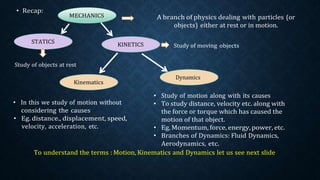
dealing with particles (or
at rest or in motion.
objects
• In this we study of motion without
considering the causes
• Eg. distance., displacement, speed,
velocity, acceleration, etc.
• Study of motion along with its causes
• To study distance, velocity etc. along with
the force or torque which has caused the
motion of that object.
• Eg.Momentum, force, energy,power, etc.
• Branches of Dynamics: Fluid Dynamics,
Aerodynamics, etc.
To understand the terms : Motion, Kinematics and Dynamics let us see next slide
Dynamics
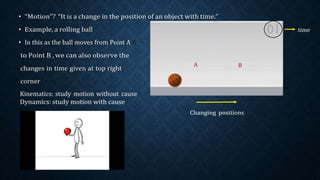
• “Motion”? “It is a change in the position of an object with time.”
• Example, a rolling ball
• In this as the ball moves from Point A
to Point B , we can also observe the
time
changes in time given at top right
corner
Kinematics: study motion without cause
Dynamics: study motion with cause
A B
Changing positions
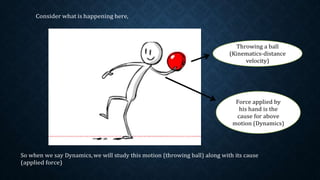
Consider what is happening here,
Force applied by
his hand is the
cause for above
motion (Dynamics)
So when we say Dynamics, we will study this motion (throwing ball) along with its cause
(applied force)
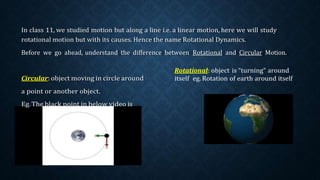
in circular motion
Rotational: object is “turning” around
itself eg. Rotation of earth around itself
Before we go ahead, understand the difference between Rotational and Circular Motion.
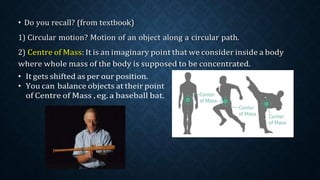
• Do you recall? (from textbook)
1) Circular motion? Motion of an object along a circular path.
2) Centre of Mass: It is an imaginary point that we consider inside a body
where whole mass of the body is supposed to be concentrated.
• It gets shifted as per our position.
• You can balance objects at their point
of Centre of Mass , eg. a baseball bat.
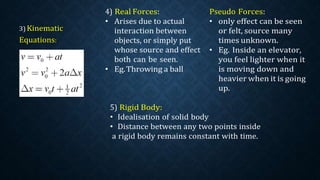
4) Real Forces:
• Arises due to actual
interaction between
objects, or simply put
whose source and effect
both can be seen.
• Eg.Throwing a ball
Pseudo Forces:
• only effect can be seen
or felt, source many
times unknown.
• Eg. Inside an elevator,
you feel lighter when it
is moving down and
heavier when it is going
up.
5) Rigid Body:
• Idealisation of solid body
• Distance between any two points inside
a rigid body remains constant with time.
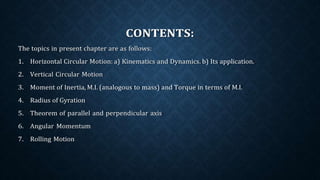
CONTENTS:
The topics in present chapter are as follows:
1. Horizontal Circular Motion: a) Kinematics and Dynamics. b) Its application.
2. Vertical Circular Motion
3. Moment of Inertia, M.I. (analogous to mass) and Torque in terms of M.I.
4. Radius of Gyration
5. Theorem of parallel and perpendicular axis
6. Angular Momentum
7. Rolling Motion
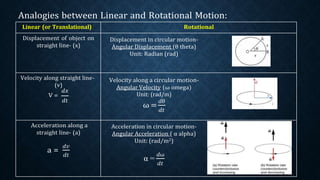
Analogies between Linear and Rotational Motion:
Linear (or Translational) Rotational
Displacement of object on
straight line- (x)
Displacement in circular motion-
Angular Displacement (θ theta)
Unit: Radian (rad)
Velocity along straight line-
(v)
𝑑𝑥
V =
𝑑𝑡
Velocity along a circular motion-
Angular Velocity (ω omega)
Unit: (rad/m)
ω =
𝑑θ
𝑑𝑡
Acceleration along a
straight line- (a)
a =
𝑑𝑣
𝑑𝑡
Acceleration in circular motion-
Angular Acceleration ( α alpha)
Unit: (rad/m2)
α =
𝑑ω
𝑑𝑡
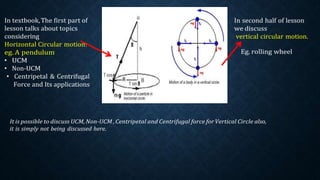
In textbook,The first part of
lesson talks about topics
considering
Horizontal Circular motion:
eg. A pendulum
• UCM
• Non-UCM
• Centripetal & Centrifugal
Force and Its applications
In second half of lesson
we discuss
vertical circular motion.
Eg. rolling wheel
It is possible to discuss UCM,Non-UCM ,Centripetal and Centrifugal force forVertical Circle also,
it is simply not being discussed here.
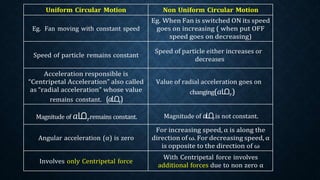
Uniform Circular Motion Non Uniform Circular Motion
Eg. Fan moving with constant speed
Eg. When Fan is switched ON its speed
goes on increasing ( when put OFF
speed goes on decreasing)
Speed of particle remains constant
Speed of particle either increases or
decreases
Acceleration responsible is
“Centripetal Acceleration” also called
as “radial acceleration” whose value
remains constant. (𝑎ഥ𝑟)
Value of radial acceleration goes on
changing(𝑎ഥ𝑟)
Magnitude of 𝑎ഥ𝑟remains constant. Magnitude of 𝑎ഥ𝑟is not constant.
Angular acceleration (α) is zero
For increasing speed, α is along the
direction of ω. For decreasing speed, α
is opposite to the direction of ω
Involves only Centripetal force
With Centripetal force involves
additional forces due to non zero α
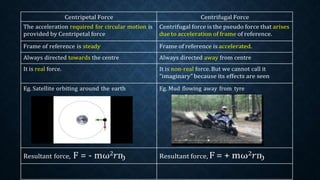
Centripetal Force Centrifugal Force
The acceleration required for circular motion is
provided by Centripetal force
Centrifugal force is the pseudo force that arises
due to acceleration of frame of reference.
Frame of reference is steady Frame of reference is accelerated.
Always directed towards the centre Always directed away from centre
It is real force. It is non-real force. But we cannot call it
“imaginary” because its effects are seen
Eg. Satellite orbiting around the earth Eg. Mud flowing away from tyre
Resultant force, F = - mω2𝑟ҧ Resultant force, F = + mω2𝑟ҧ
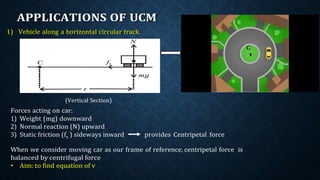
(Vertical Section)
Forces acting on car:
1) Weight (mg) downward
2) Normal reaction (N) upward
3) Static friction (fs ) sideways inward provides Centripetal force
When we consider moving car as our frame of reference, centripetal force is
balanced by centrifugal force
• Aim: to find equation of v
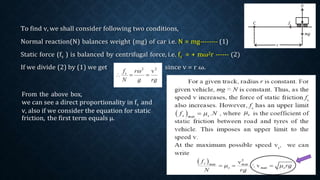
To find v, we shall consider following two conditions,
Normal reaction(N) balances weight (mg) of car i.e. N = mg-------- (1)
Static force (fs ) is balanced by centrifugal force, i.e. fs = + mω2r ------ (2)
If we divide (2) by (1) we get since v = r ω.
From the above box,
we can see a direct proportionality in fs and
v, also if we consider the equation for static
friction, the first term equals μ.
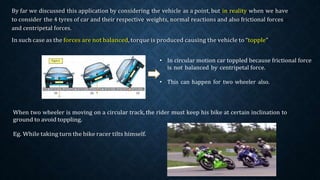
• In circular motion car toppled because frictional force
is not balanced by centripetal force.
• This can happen for two wheeler also.
When two wheeler is moving on a circular track, the rider must keep his bike at certain inclination to
ground to avoid toppling.
Eg. While taking turn the bike racer tilts himself.
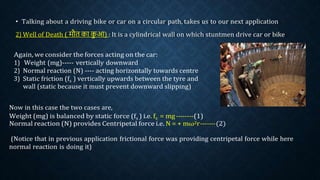
• Talking about a driving bike or car on a circular path, takes us to our next application
2) Well of Death ( मौत का क
ु आ) : It is a cylindrical wall on which stuntmen drive car or bike
Again, we consider the forces acting on the car:
1) Weight (mg)----- vertically downward
2) Normal reaction (N) ---- acting horizontally towards centre
3) Static friction (fs ) vertically upwards between the tyre and
wall (static because it must prevent downward slipping)
Now in this case the two cases are,
Weight (mg) is balanced by static force (fs ) i.e. fs = mg--------(1)
Normal reaction (N) provides Centripetal force i.e. N = + mω2r-------(2)
(Notice that in previous application frictional force was providing centripetal force while here
normal reaction is doing it)
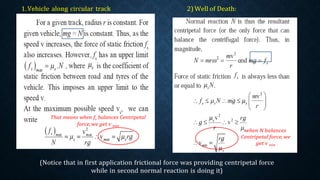
1.Vehicle along circular track 2) Well of Death:
(Notice that in first application frictional force was providing centripetal force
while in second normal reaction is doing it)
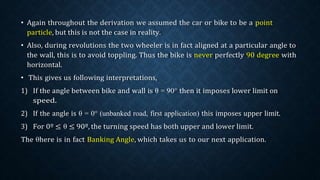
• Again throughout the derivation we assumed the car or bike to be a point
particle, but this is not the case in reality.
• Also, during revolutions the two wheeler is in fact aligned at a particular angle to
the wall, this is to avoid toppling. Thus the bike is never perfectly 90 degree with
horizontal.
• This gives us following interpretations,
1) If the angle between bike and wall is θ = 90° then it imposes lower limit on
speed.
2) If the angle is θ = 0° (unbanked road, first application) this imposes upper limit.
3) For 0º ≤ θ ≤ 90º, the turning speed has both upper and lower limit.
The θhere is in fact Banking Angle, which takes us to our next application.
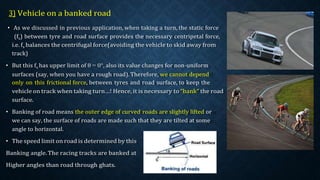
3) Vehicle on a banked road
• As we discussed in previous application, when taking a turn, the static force
(fs) between tyre and road surface provides the necessary centripetal force,
i.e. fs balances the centrifugal force(avoiding the vehicle to skid away from
track)
• But this fs has upper limit of θ = 0°, also its value changes for non-uniform
surfaces (say, when you have a rough road). Therefore, we cannot depend
only on this frictional force, between tyres and road surface, to keep the
vehicle on track when taking turn…! Hence, it is necessary to “bank” the road
surface.
• Banking of road means the outer edge of curved roads are slightly lifted or
we can say, the surface of roads are made such that they are tilted at some
angle to horizontal.
• The speed limit on road is determined by this
Banking angle.The racing tracks are banked at
Higher angles than road through ghats.
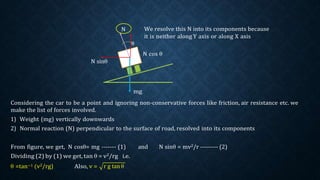
N We resolve this N into its components because
it is neither along Y axis or along X axis
θ
N cos θ
N sinθ
mg
Considering the car to be a point and ignoring non-conservative forces like friction, air resistance etc. we
make the list of forces involved.
1) Weight (mg) vertically downwards
2) Normal reaction (N) perpendicular to the surface of road, resolved into its components
From figure, we get, N cosθ= mg ------- (1) and N sinθ = mv2/r --------- (2)
Dividing (2) by (1) we get, tan θ = v2/rg i.e.
θ =tan−1 (v2/rg) Also, v = r g tanθ
• CASES:
1) Most Safe Speed:
The equation v = r g tan θ gives us the value of most safe speed on any road ( not minimum or
maximum speed)
2) Banking Angle:
This helps us in designing a road and is given by θ =tan−1 (v2/rg)
3) Speed limits:
When started this discussion we ignored the forces due to friction, but in reality we have to consider
them, therefore our formula for v slightly changes.
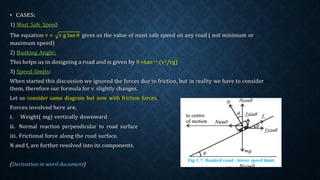
Let us consider same diagram but now with friction forces.
Forces involved here are,
i. Weight( mg) vertically downward
ii. Normal reaction perpendicular to road surface
iii. Frictional force along the road surface.
N and fs are further resolved into its components.
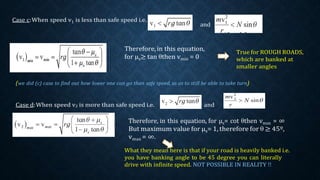
Case c:When speed v1 is less than safe speed i.e.
and
Therefore, in this equation,
for μs≥ tan θthen vmin = 0
True for ROUGH ROADS,
which are banked at
smaller angles
(we did (c) case to find out how lower one can go than safe speed, so as to still be able to take turn)
Case d:When speed v2 is more than safe speed i.e. and
Therefore, in this equation, for μs= cot θthen vmax = ∞
But maximum value for μs= 1, therefore for θ ≥ 45º,
vmax = ∞.
What they mean here is that if your road is heavily banked i.e.
you have banking angle to be 45 degree you can literally
drive with infinite speed. NOT POSSIBLE IN REALITY !!
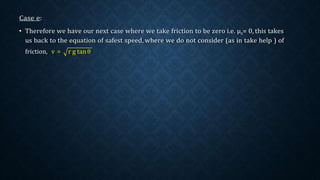
friction, v = r g tan θ

Rotational-Dynamics-ppt1.pdf HSC PHYSICS CHAPTER 1 Rotational-Dynamics PART-1

  • 1.
    By- MISS AAFREENSHAIKH (JAMNER DIST JALGAON)
  • 2.
    dealing with particles(or at rest or in motion. objects • In this we study of motion without considering the causes • Eg. distance., displacement, speed, velocity, acceleration, etc. • Study of motion along with its causes • To study distance, velocity etc. along with the force or torque which has caused the motion of that object. • Eg.Momentum, force, energy,power, etc. • Branches of Dynamics: Fluid Dynamics, Aerodynamics, etc. To understand the terms : Motion, Kinematics and Dynamics let us see next slide Dynamics
  • 3.
    • “Motion”? “Itis a change in the position of an object with time.” • Example, a rolling ball • In this as the ball moves from Point A to Point B , we can also observe the time changes in time given at top right corner Kinematics: study motion without cause Dynamics: study motion with cause A B Changing positions
  • 4.
    Consider what ishappening here, Force applied by his hand is the cause for above motion (Dynamics) So when we say Dynamics, we will study this motion (throwing ball) along with its cause (applied force)
  • 5.
    in circular motion Rotational:object is “turning” around itself eg. Rotation of earth around itself Before we go ahead, understand the difference between Rotational and Circular Motion.
  • 6.
    • Do yourecall? (from textbook) 1) Circular motion? Motion of an object along a circular path. 2) Centre of Mass: It is an imaginary point that we consider inside a body where whole mass of the body is supposed to be concentrated. • It gets shifted as per our position. • You can balance objects at their point of Centre of Mass , eg. a baseball bat.
  • 7.
    4) Real Forces: •Arises due to actual interaction between objects, or simply put whose source and effect both can be seen. • Eg.Throwing a ball Pseudo Forces: • only effect can be seen or felt, source many times unknown. • Eg. Inside an elevator, you feel lighter when it is moving down and heavier when it is going up. 5) Rigid Body: • Idealisation of solid body • Distance between any two points inside a rigid body remains constant with time.
  • 8.
    CONTENTS: The topics inpresent chapter are as follows: 1. Horizontal Circular Motion: a) Kinematics and Dynamics. b) Its application. 2. Vertical Circular Motion 3. Moment of Inertia, M.I. (analogous to mass) and Torque in terms of M.I. 4. Radius of Gyration 5. Theorem of parallel and perpendicular axis 6. Angular Momentum 7. Rolling Motion
  • 9.
    Analogies between Linearand Rotational Motion: Linear (or Translational) Rotational Displacement of object on straight line- (x) Displacement in circular motion- Angular Displacement (θ theta) Unit: Radian (rad) Velocity along straight line- (v) 𝑑𝑥 V = 𝑑𝑡 Velocity along a circular motion- Angular Velocity (ω omega) Unit: (rad/m) ω = 𝑑θ 𝑑𝑡 Acceleration along a straight line- (a) a = 𝑑𝑣 𝑑𝑡 Acceleration in circular motion- Angular Acceleration ( α alpha) Unit: (rad/m2) α = 𝑑ω 𝑑𝑡
  • 10.
    In textbook,The firstpart of lesson talks about topics considering Horizontal Circular motion: eg. A pendulum • UCM • Non-UCM • Centripetal & Centrifugal Force and Its applications In second half of lesson we discuss vertical circular motion. Eg. rolling wheel It is possible to discuss UCM,Non-UCM ,Centripetal and Centrifugal force forVertical Circle also, it is simply not being discussed here.
  • 11.
    Uniform Circular MotionNon Uniform Circular Motion Eg. Fan moving with constant speed Eg. When Fan is switched ON its speed goes on increasing ( when put OFF speed goes on decreasing) Speed of particle remains constant Speed of particle either increases or decreases Acceleration responsible is “Centripetal Acceleration” also called as “radial acceleration” whose value remains constant. (𝑎ഥ𝑟) Value of radial acceleration goes on changing(𝑎ഥ𝑟) Magnitude of 𝑎ഥ𝑟remains constant. Magnitude of 𝑎ഥ𝑟is not constant. Angular acceleration (α) is zero For increasing speed, α is along the direction of ω. For decreasing speed, α is opposite to the direction of ω Involves only Centripetal force With Centripetal force involves additional forces due to non zero α
  • 12.
    Centripetal Force CentrifugalForce The acceleration required for circular motion is provided by Centripetal force Centrifugal force is the pseudo force that arises due to acceleration of frame of reference. Frame of reference is steady Frame of reference is accelerated. Always directed towards the centre Always directed away from centre It is real force. It is non-real force. But we cannot call it “imaginary” because its effects are seen Eg. Satellite orbiting around the earth Eg. Mud flowing away from tyre Resultant force, F = - mω2𝑟ҧ Resultant force, F = + mω2𝑟ҧ
  • 13.
    (Vertical Section) Forces actingon car: 1) Weight (mg) downward 2) Normal reaction (N) upward 3) Static friction (fs ) sideways inward provides Centripetal force When we consider moving car as our frame of reference, centripetal force is balanced by centrifugal force • Aim: to find equation of v
  • 14.
    To find v,we shall consider following two conditions, Normal reaction(N) balances weight (mg) of car i.e. N = mg-------- (1) Static force (fs ) is balanced by centrifugal force, i.e. fs = + mω2r ------ (2) If we divide (2) by (1) we get since v = r ω. From the above box, we can see a direct proportionality in fs and v, also if we consider the equation for static friction, the first term equals μ.
  • 15.
    • In circularmotion car toppled because frictional force is not balanced by centripetal force. • This can happen for two wheeler also. When two wheeler is moving on a circular track, the rider must keep his bike at certain inclination to ground to avoid toppling. Eg. While taking turn the bike racer tilts himself.
  • 16.
    • Talking abouta driving bike or car on a circular path, takes us to our next application 2) Well of Death ( मौत का क ु आ) : It is a cylindrical wall on which stuntmen drive car or bike Again, we consider the forces acting on the car: 1) Weight (mg)----- vertically downward 2) Normal reaction (N) ---- acting horizontally towards centre 3) Static friction (fs ) vertically upwards between the tyre and wall (static because it must prevent downward slipping) Now in this case the two cases are, Weight (mg) is balanced by static force (fs ) i.e. fs = mg--------(1) Normal reaction (N) provides Centripetal force i.e. N = + mω2r-------(2) (Notice that in previous application frictional force was providing centripetal force while here normal reaction is doing it)
  • 17.
    1.Vehicle along circulartrack 2) Well of Death: (Notice that in first application frictional force was providing centripetal force while in second normal reaction is doing it)
  • 18.
    • Again throughoutthe derivation we assumed the car or bike to be a point particle, but this is not the case in reality. • Also, during revolutions the two wheeler is in fact aligned at a particular angle to the wall, this is to avoid toppling. Thus the bike is never perfectly 90 degree with horizontal. • This gives us following interpretations, 1) If the angle between bike and wall is θ = 90° then it imposes lower limit on speed. 2) If the angle is θ = 0° (unbanked road, first application) this imposes upper limit. 3) For 0º ≤ θ ≤ 90º, the turning speed has both upper and lower limit. The θhere is in fact Banking Angle, which takes us to our next application.
  • 19.
    3) Vehicle ona banked road • As we discussed in previous application, when taking a turn, the static force (fs) between tyre and road surface provides the necessary centripetal force, i.e. fs balances the centrifugal force(avoiding the vehicle to skid away from track) • But this fs has upper limit of θ = 0°, also its value changes for non-uniform surfaces (say, when you have a rough road). Therefore, we cannot depend only on this frictional force, between tyres and road surface, to keep the vehicle on track when taking turn…! Hence, it is necessary to “bank” the road surface. • Banking of road means the outer edge of curved roads are slightly lifted or we can say, the surface of roads are made such that they are tilted at some angle to horizontal. • The speed limit on road is determined by this Banking angle.The racing tracks are banked at Higher angles than road through ghats.
  • 20.
    N We resolvethis N into its components because it is neither along Y axis or along X axis θ N cos θ N sinθ mg Considering the car to be a point and ignoring non-conservative forces like friction, air resistance etc. we make the list of forces involved. 1) Weight (mg) vertically downwards 2) Normal reaction (N) perpendicular to the surface of road, resolved into its components From figure, we get, N cosθ= mg ------- (1) and N sinθ = mv2/r --------- (2) Dividing (2) by (1) we get, tan θ = v2/rg i.e. θ =tan−1 (v2/rg) Also, v = r g tanθ
  • 21.
    • CASES: 1) MostSafe Speed: The equation v = r g tan θ gives us the value of most safe speed on any road ( not minimum or maximum speed) 2) Banking Angle: This helps us in designing a road and is given by θ =tan−1 (v2/rg) 3) Speed limits: When started this discussion we ignored the forces due to friction, but in reality we have to consider them, therefore our formula for v slightly changes. Let us consider same diagram but now with friction forces. Forces involved here are, i. Weight( mg) vertically downward ii. Normal reaction perpendicular to road surface iii. Frictional force along the road surface. N and fs are further resolved into its components.
  • 22.
    Case c:When speedv1 is less than safe speed i.e. and Therefore, in this equation, for μs≥ tan θthen vmin = 0 True for ROUGH ROADS, which are banked at smaller angles (we did (c) case to find out how lower one can go than safe speed, so as to still be able to take turn) Case d:When speed v2 is more than safe speed i.e. and Therefore, in this equation, for μs= cot θthen vmax = ∞ But maximum value for μs= 1, therefore for θ ≥ 45º, vmax = ∞. What they mean here is that if your road is heavily banked i.e. you have banking angle to be 45 degree you can literally drive with infinite speed. NOT POSSIBLE IN REALITY !!
  • 23.
    friction, v =r g tan θ