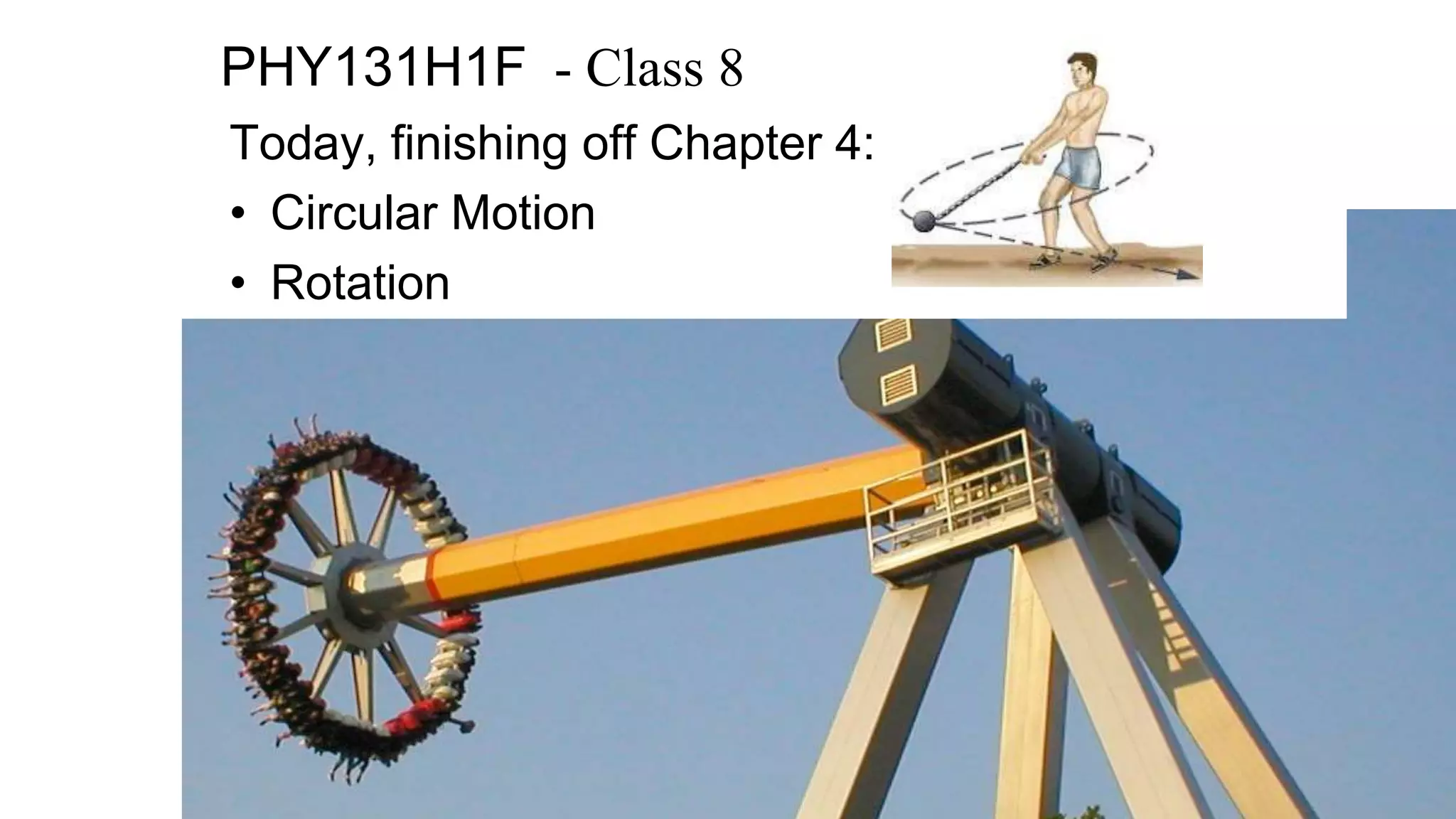
PHY131H1F - Class 8
Today, finishing off Chapter 4:
• Circular Motion
• Rotation
Angular Notation: it’s all Greek to me!
θ is an angle, and the S.I. unit of angle is radians. (NOT degrees!)
The time derivative of θ is ω.
What are the S.I. units of ω ?
A. m/s2
B. rad / s
C. N/m
D. rad
E. rad /s2



dt
d
Clicker Question
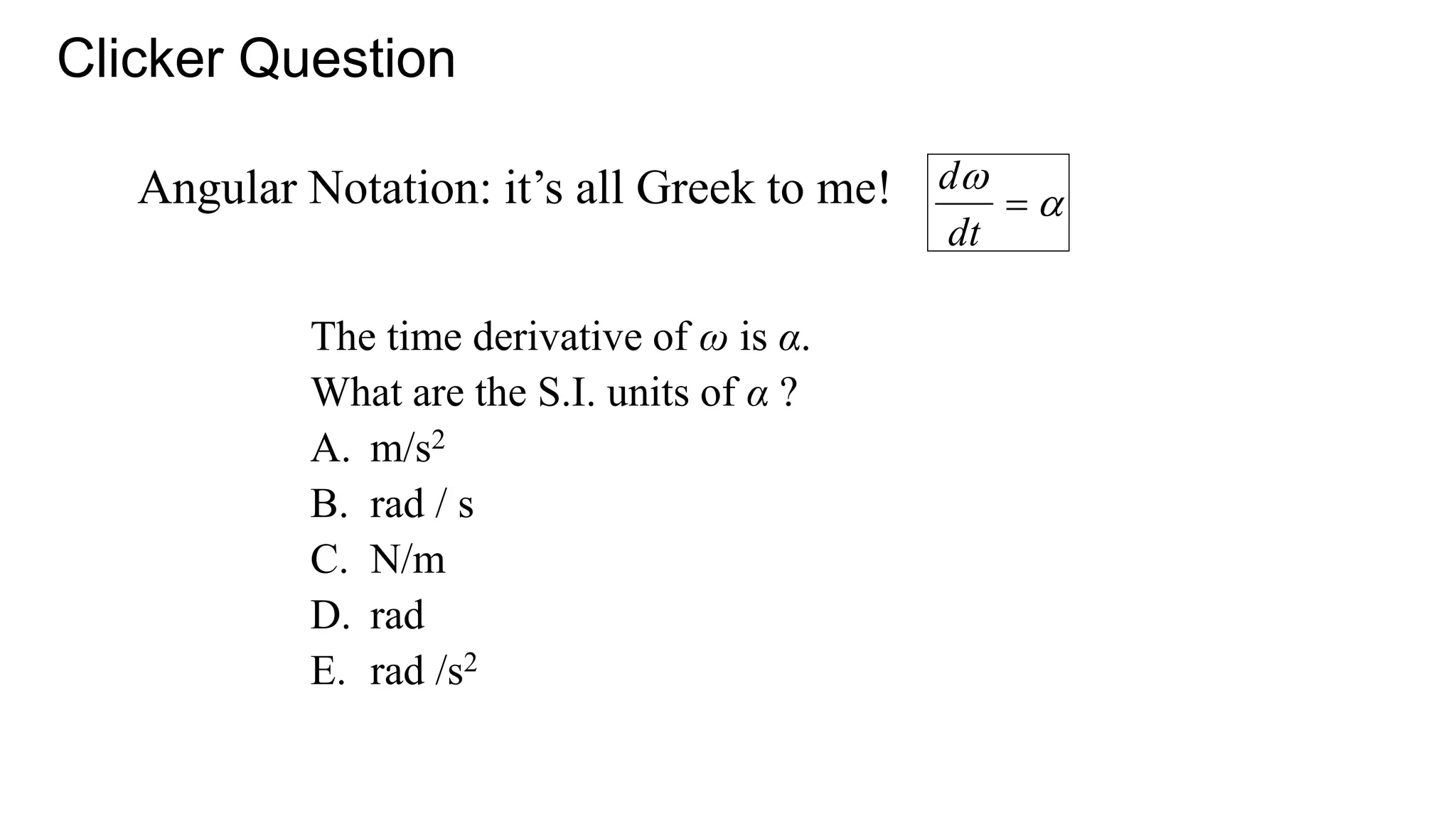
Angular Notation: it’s all Greek to me!
The time derivative of ω is α.
What are the S.I. units of α ?
A. m/s2
B. rad / s
C. N/m
D. rad
E. rad /s2

d
dt
 
Clicker Question
Last day at the end of class I asked:
• Consider a wheel that is rotating, and speeding
up.
• Is a point on the edge of the wheel accelerating
toward the centre? [Yes, it must have a centre-
pointing component in order to stay on the circular
path!]
• Is this point accelerating in the forward direction?
[Yes, it must have a forward component in order to
speed up!]
• Or is it doing both? [Yes – the actual acceleration
vector is on a diagonal!]
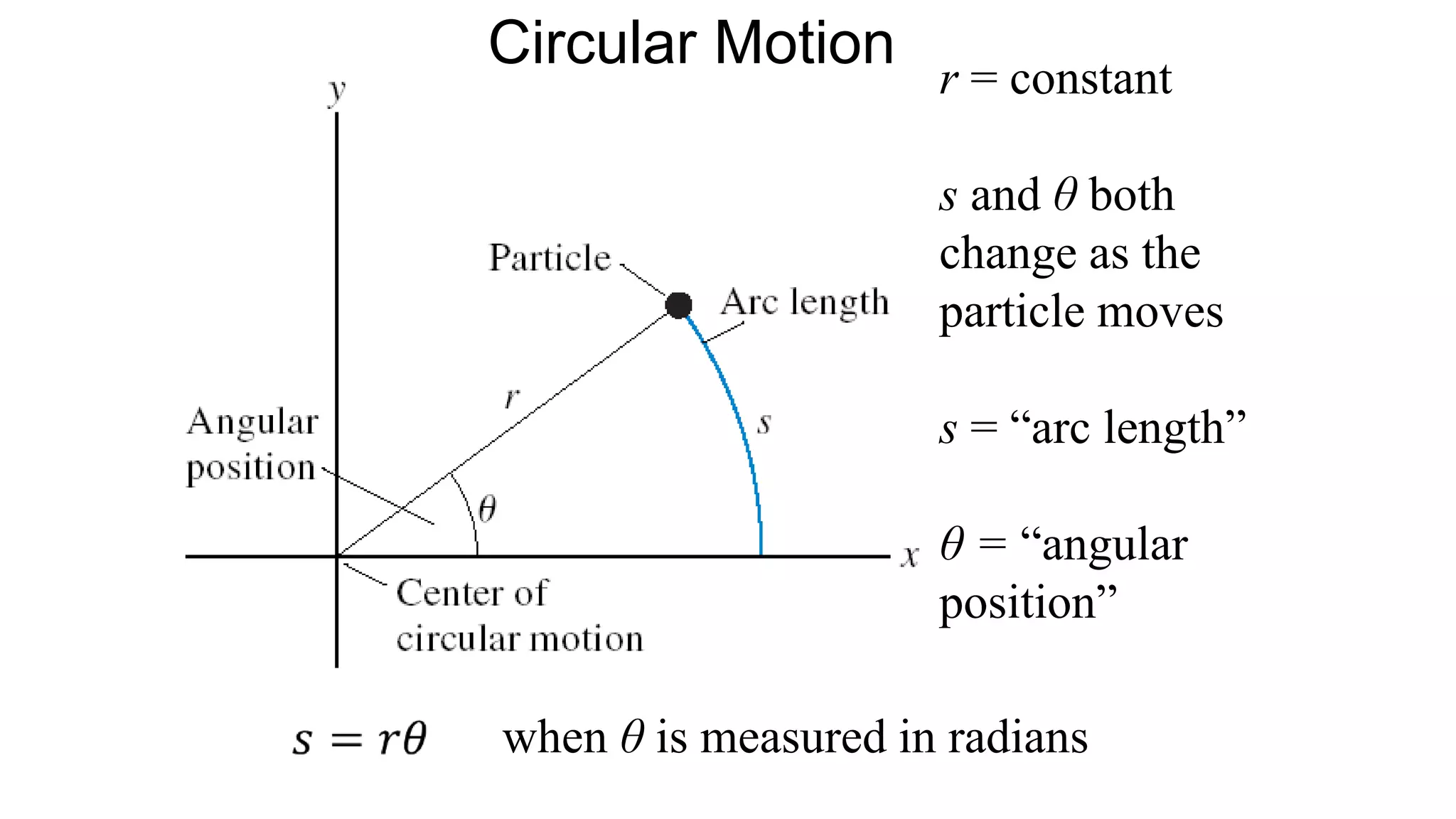
Circular Motion r = constant
s and θ both
change as the
particle moves
s = “arc length”
θ = “angular
position”
when θ is measured in radians
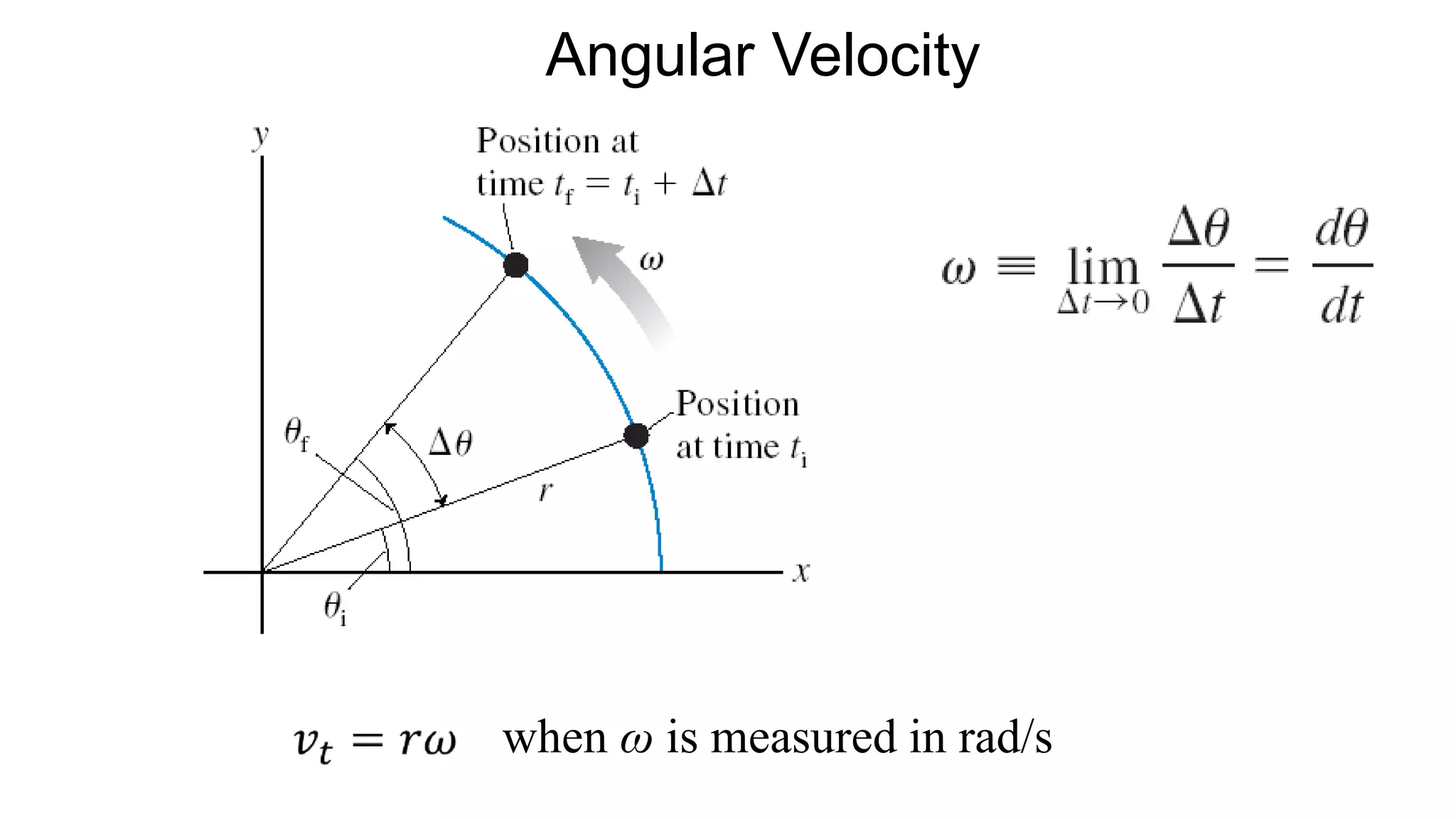
Angular Velocity
when ω is measured in rad/s
Special case of circular motion:
Uniform Circular Motion
Tangential velocity is
constantly changing
direction
Tangential speed is
constant
where T = Period [s]
A carnival has a Ferris wheel
where some seats are located
halfway between the center
and the outside rim. Compared
with the seats on the outside
rim, the inner cars have
A. Smaller angular speed and greater tangential speed
B. Greater angular speed and smaller tangential speed
C. The same angular speed and smaller tangential speed
D. Smaller angular speed and the same tangential speed
E. The same angular speed and the same tangential speed
Clicker Question
Demo and Discussion
Question
A ball rolls in a horizontal
circular track (shown from
above). Which arrow best
represents the ball’s path after
it leaves the track?
Clicker Question
Centripetal Acceleration
A bike wheel of diameter 1.0 m turns 20
times per second. What is the
magnitude of the centripetal acceleration
of a yellow dot on the rim?
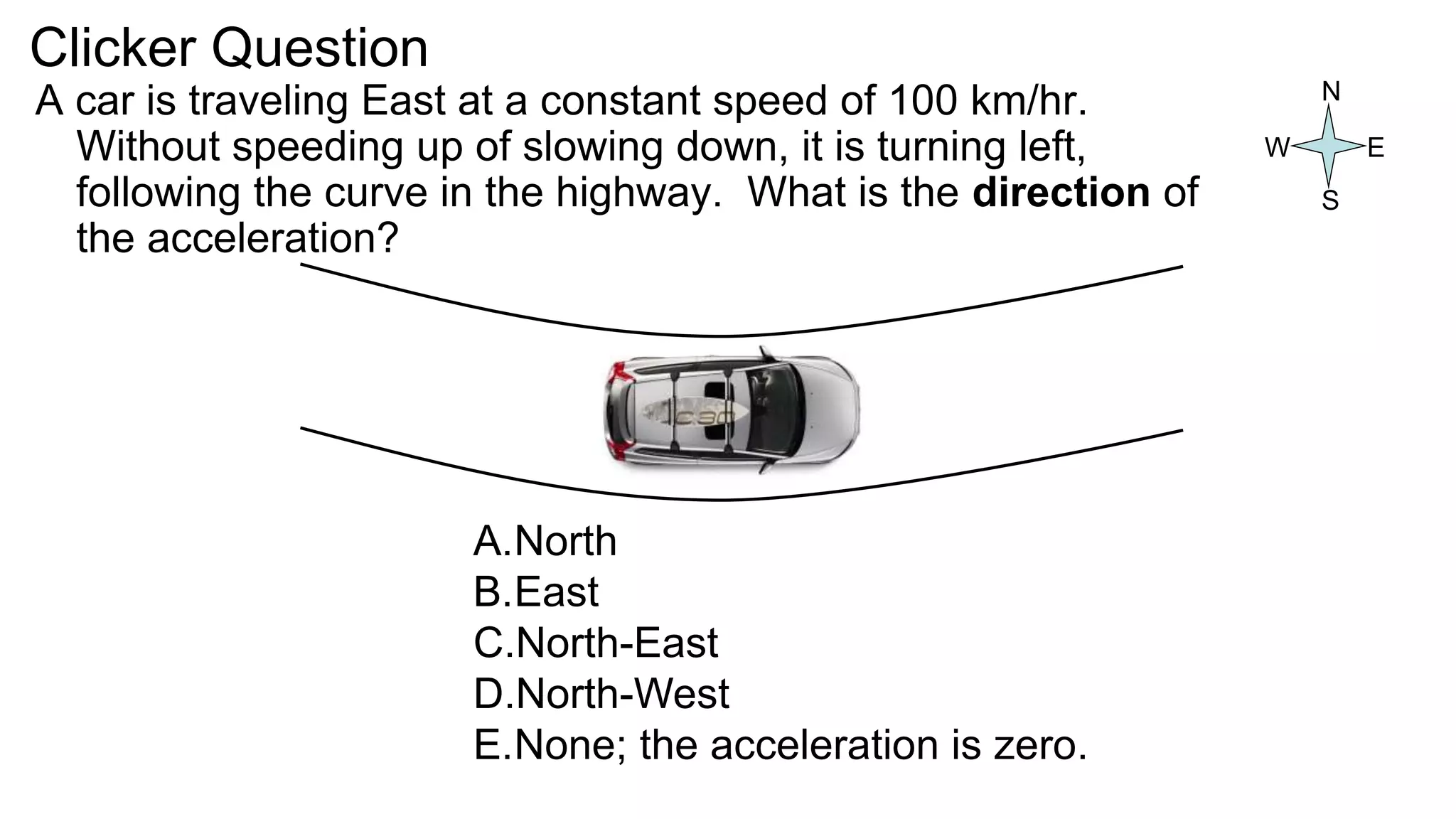
A car is traveling East at a constant speed of 100 km/hr.
Without speeding up of slowing down, it is turning left,
following the curve in the highway. What is the direction of
the acceleration?
N
A.North
B.East
C.North-East
D.North-West
E.None; the acceleration is zero.
E
S
W
Clicker Question
Determines the
Tangential
acceleration,
NOT centripetal
acceleration!
Summary of definitions:
• θ is angular position.
The S.I. Unit is
radians, where 2π
radians = 360°.
• s is the path length
along the curve: s = θr
when θ is in [rad].
• ω is angular velocity.
The S.I. Unit is rad/sec.
• vt is the tangential
speed: vt = ωr when ω
is in [rad/s].
• α is angular
acceleration. The S.I.
Unit is rad/sec2.
• at is the tangential
acceleration: at = αr
when α is in [rad/s2].
Nonuniform Circular Motion
• Any object traveling along a curved path has
centripetal acceleration, equal to v2/r.
• If, as it is traveling in a circle, it is speeding up or
slowing down, it also has tangential
acceleration, equal to rα
• The total acceleration is the vector sum of these
two perpendicular components
The 4 Equations of Constant
Linear Acceleration, a:
𝑣𝑓 = 𝑣𝑖 + 𝑎𝑡
𝑥𝑓 = 𝑥𝑖 + 𝑣𝑖𝑡 +
1
2
𝑎𝑡2
𝑣𝑓
2
= 𝑣𝑖
2
+ 2𝑎(𝑥𝑓 − 𝑥𝑖)
𝑥𝑓 = 𝑥𝑖 +
𝑣𝑖 + 𝑣𝑓
2
𝑡
𝜔𝑓 = 𝜔𝑖 + 𝛼𝑡
𝜃𝑓 = 𝜃𝑖 + 𝜔𝑖𝑡 +
1
2
𝛼𝑡2
𝜔𝑓
2
= 𝜔𝑖
2
+ 2𝛼(𝜃𝑓 − 𝜃𝑖)
𝜃𝑓 = 𝜃𝑖 +
𝜔𝑖 + 𝜔𝑓
2
𝑡
The 4 Equations of Constant
Angular Acceleration, α:
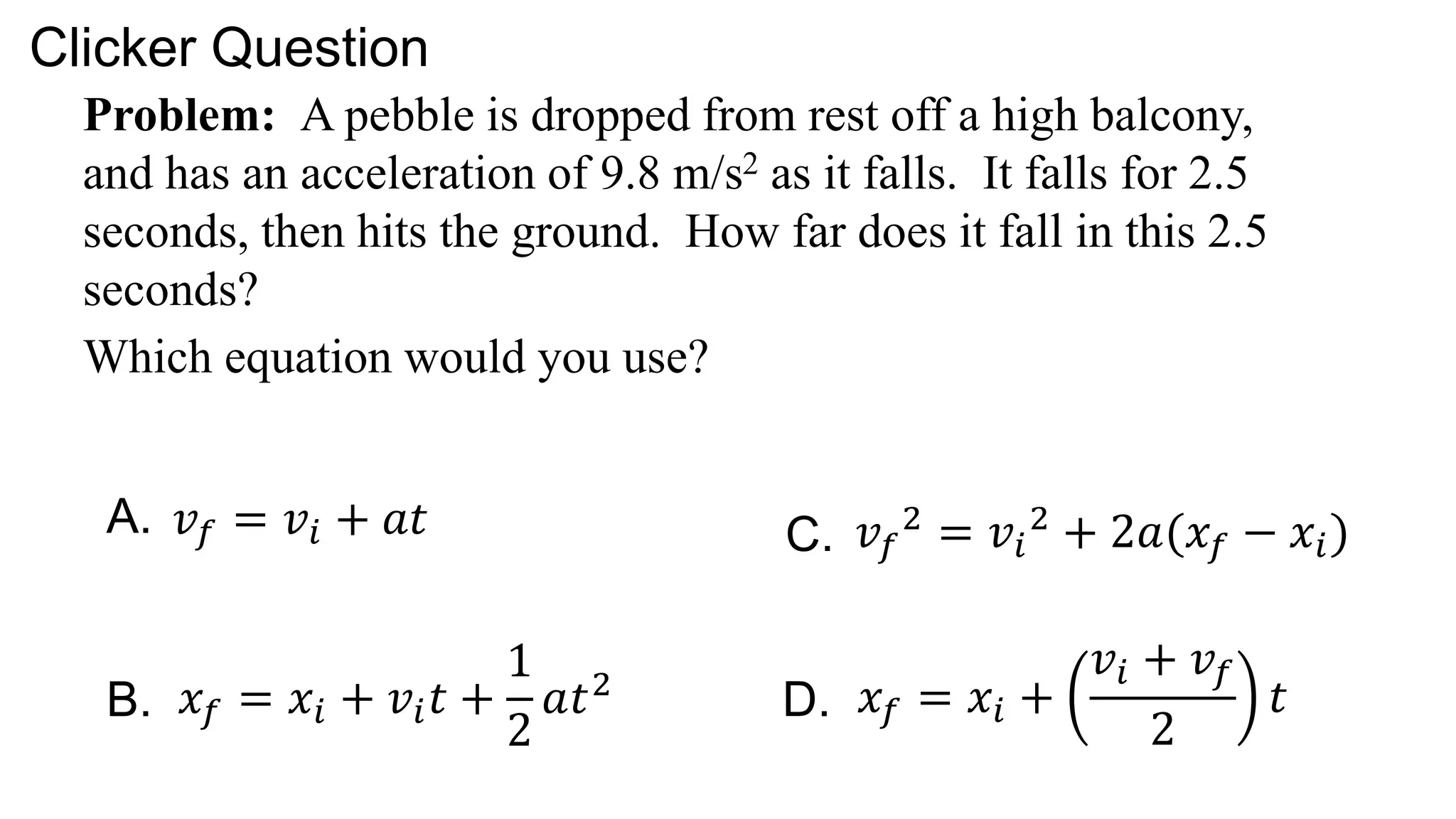
Problem: A pebble is dropped from rest off a high balcony,
and has an acceleration of 9.8 m/s2 as it falls. It falls for 2.5
seconds, then hits the ground. How far does it fall in this 2.5
seconds?
Which equation would you use?
Clicker Question
𝑣𝑓 = 𝑣𝑖 + 𝑎𝑡
𝑥𝑓 = 𝑥𝑖 + 𝑣𝑖𝑡 +
1
2
𝑎𝑡2
𝑣𝑓
2
= 𝑣𝑖
2
+ 2𝑎(𝑥𝑓 − 𝑥𝑖)
𝑥𝑓 = 𝑥𝑖 +
𝑣𝑖 + 𝑣𝑓
2
𝑡
A.
B.
C.
D.
Problem: A centrifuge loaded with two test-tubes starts from
rest, and has an angular acceleration of 150 rad/s2 as it spins up.
It speeds up with this angular acceleration for 2.5 seconds, then
it has reached its maximum spin rate. How many times has it
rotated in this 2.5 seconds?
Which equation would you use?
Clicker Question
A.
B.
C.
D.
𝜔𝑓 = 𝜔𝑖 + 𝛼𝑡
𝜃𝑓 = 𝜃𝑖 + 𝜔𝑖𝑡 +
1
2
𝛼𝑡2
𝜔𝑓
2
= 𝜔𝑖
2
+ 2𝛼(𝜃𝑓 − 𝜃𝑖)
𝜃𝑓 = 𝜃𝑖 +
𝜔𝑖 + 𝜔𝑓
2
𝑡
Example.
• A fan is spinning at 30 rad/s, and
suddenly starts slowing down.
• It’s angular acceleration as it slows is
10 rad/s2.
• How long does it take to stop spinning?
Example.
• A fan is spinning at 30 rad/s, and
suddenly starts slowing down.
• It’s maximum angular acceleration as it
slows is 10 rad/s2.
• What is the minimum angle that it must
turn as it stops?
• How many revolutions is this?
The fan blade is slowing down. What are the signs of ω and α?
[Let’s define, as Knight often does, positive to be counter-
clockwise.]
 is positive and  is positive.
B.  is negative and  is positive.
C.  is positive and  is negative.
D.  is negative and  is negative.
Clicker Question
Moving on to Chapters 5 and 6..
• Up until now, we have been studying
kinematics, a description of HOW things
move and how to describe this.
• In Chapter 5 we begin to study WHY
things move the way they do: This is
dynamics, which includes the important
concepts of Force and Energy.
Before Class 9 on Monday
• Please read Chapter 5 of Knight.
• Don’t forget the pre-class quiz due Mon. at 8am.
• Something to think about: A paperback novel has
a mass of 0.3 kg and slides at a constant velocity.
A physics textbook has a mass of 3.0 kg, and
slides at the same constant velocity. How does
the net force on the textbook compare to the net
force on the novel?

rotation ppt

  • 1.
    PHY131H1F - Class8 Today, finishing off Chapter 4: • Circular Motion • Rotation
  • 2.
    Angular Notation: it’sall Greek to me! θ is an angle, and the S.I. unit of angle is radians. (NOT degrees!) The time derivative of θ is ω. What are the S.I. units of ω ? A. m/s2 B. rad / s C. N/m D. rad E. rad /s2    dt d Clicker Question
  • 3.
    Angular Notation: it’sall Greek to me! The time derivative of ω is α. What are the S.I. units of α ? A. m/s2 B. rad / s C. N/m D. rad E. rad /s2  d dt   Clicker Question
  • 4.
    Last day atthe end of class I asked: • Consider a wheel that is rotating, and speeding up. • Is a point on the edge of the wheel accelerating toward the centre? [Yes, it must have a centre- pointing component in order to stay on the circular path!] • Is this point accelerating in the forward direction? [Yes, it must have a forward component in order to speed up!] • Or is it doing both? [Yes – the actual acceleration vector is on a diagonal!]
  • 5.
    Circular Motion r= constant s and θ both change as the particle moves s = “arc length” θ = “angular position” when θ is measured in radians
  • 6.
    Angular Velocity when ωis measured in rad/s
  • 7.
    Special case ofcircular motion: Uniform Circular Motion Tangential velocity is constantly changing direction Tangential speed is constant where T = Period [s]
  • 8.
    A carnival hasa Ferris wheel where some seats are located halfway between the center and the outside rim. Compared with the seats on the outside rim, the inner cars have A. Smaller angular speed and greater tangential speed B. Greater angular speed and smaller tangential speed C. The same angular speed and smaller tangential speed D. Smaller angular speed and the same tangential speed E. The same angular speed and the same tangential speed Clicker Question
  • 9.
    Demo and Discussion Question Aball rolls in a horizontal circular track (shown from above). Which arrow best represents the ball’s path after it leaves the track? Clicker Question
  • 10.
  • 11.
    Centripetal Acceleration A bikewheel of diameter 1.0 m turns 20 times per second. What is the magnitude of the centripetal acceleration of a yellow dot on the rim?
  • 12.
    A car istraveling East at a constant speed of 100 km/hr. Without speeding up of slowing down, it is turning left, following the curve in the highway. What is the direction of the acceleration? N A.North B.East C.North-East D.North-West E.None; the acceleration is zero. E S W Clicker Question
  • 13.
  • 14.
    Summary of definitions: •θ is angular position. The S.I. Unit is radians, where 2π radians = 360°. • s is the path length along the curve: s = θr when θ is in [rad]. • ω is angular velocity. The S.I. Unit is rad/sec. • vt is the tangential speed: vt = ωr when ω is in [rad/s]. • α is angular acceleration. The S.I. Unit is rad/sec2. • at is the tangential acceleration: at = αr when α is in [rad/s2].
  • 15.
    Nonuniform Circular Motion •Any object traveling along a curved path has centripetal acceleration, equal to v2/r. • If, as it is traveling in a circle, it is speeding up or slowing down, it also has tangential acceleration, equal to rα • The total acceleration is the vector sum of these two perpendicular components
  • 16.
    The 4 Equationsof Constant Linear Acceleration, a: 𝑣𝑓 = 𝑣𝑖 + 𝑎𝑡 𝑥𝑓 = 𝑥𝑖 + 𝑣𝑖𝑡 + 1 2 𝑎𝑡2 𝑣𝑓 2 = 𝑣𝑖 2 + 2𝑎(𝑥𝑓 − 𝑥𝑖) 𝑥𝑓 = 𝑥𝑖 + 𝑣𝑖 + 𝑣𝑓 2 𝑡 𝜔𝑓 = 𝜔𝑖 + 𝛼𝑡 𝜃𝑓 = 𝜃𝑖 + 𝜔𝑖𝑡 + 1 2 𝛼𝑡2 𝜔𝑓 2 = 𝜔𝑖 2 + 2𝛼(𝜃𝑓 − 𝜃𝑖) 𝜃𝑓 = 𝜃𝑖 + 𝜔𝑖 + 𝜔𝑓 2 𝑡 The 4 Equations of Constant Angular Acceleration, α:
  • 17.
    Problem: A pebbleis dropped from rest off a high balcony, and has an acceleration of 9.8 m/s2 as it falls. It falls for 2.5 seconds, then hits the ground. How far does it fall in this 2.5 seconds? Which equation would you use? Clicker Question 𝑣𝑓 = 𝑣𝑖 + 𝑎𝑡 𝑥𝑓 = 𝑥𝑖 + 𝑣𝑖𝑡 + 1 2 𝑎𝑡2 𝑣𝑓 2 = 𝑣𝑖 2 + 2𝑎(𝑥𝑓 − 𝑥𝑖) 𝑥𝑓 = 𝑥𝑖 + 𝑣𝑖 + 𝑣𝑓 2 𝑡 A. B. C. D.
  • 18.
    Problem: A centrifugeloaded with two test-tubes starts from rest, and has an angular acceleration of 150 rad/s2 as it spins up. It speeds up with this angular acceleration for 2.5 seconds, then it has reached its maximum spin rate. How many times has it rotated in this 2.5 seconds? Which equation would you use? Clicker Question A. B. C. D. 𝜔𝑓 = 𝜔𝑖 + 𝛼𝑡 𝜃𝑓 = 𝜃𝑖 + 𝜔𝑖𝑡 + 1 2 𝛼𝑡2 𝜔𝑓 2 = 𝜔𝑖 2 + 2𝛼(𝜃𝑓 − 𝜃𝑖) 𝜃𝑓 = 𝜃𝑖 + 𝜔𝑖 + 𝜔𝑓 2 𝑡
  • 19.
    Example. • A fanis spinning at 30 rad/s, and suddenly starts slowing down. • It’s angular acceleration as it slows is 10 rad/s2. • How long does it take to stop spinning?
  • 20.
    Example. • A fanis spinning at 30 rad/s, and suddenly starts slowing down. • It’s maximum angular acceleration as it slows is 10 rad/s2. • What is the minimum angle that it must turn as it stops? • How many revolutions is this?
  • 21.
    The fan bladeis slowing down. What are the signs of ω and α? [Let’s define, as Knight often does, positive to be counter- clockwise.]  is positive and  is positive. B.  is negative and  is positive. C.  is positive and  is negative. D.  is negative and  is negative. Clicker Question
  • 22.
    Moving on toChapters 5 and 6.. • Up until now, we have been studying kinematics, a description of HOW things move and how to describe this. • In Chapter 5 we begin to study WHY things move the way they do: This is dynamics, which includes the important concepts of Force and Energy.
  • 23.
    Before Class 9on Monday • Please read Chapter 5 of Knight. • Don’t forget the pre-class quiz due Mon. at 8am. • Something to think about: A paperback novel has a mass of 0.3 kg and slides at a constant velocity. A physics textbook has a mass of 3.0 kg, and slides at the same constant velocity. How does the net force on the textbook compare to the net force on the novel?