A PRESENTION BY
ABDULLAHI NAZIFI ABDULLAHI
(MS bioengineering student )
AT CYPRUS INTERNATIONAL
UNIVERSITY (CIU)
2014
 Introduction
 Flotation principal and process description
 Flotation Biological System
 Operational Difficulties and Remedy
 summary
 Conclusions
 References
 Flotation process (sometimes called flotation
separation) is a method of separation widely used
in the wastewater treatment and mineral
processing industries.
 Activated sludge consists of biological flocs that
are matrices of microorganisms, nonliving
organics, and inorganic substances.
 The microorganisms include bacteria, fungi,
protozoa, rotifers , viruses, and higher forms of
animals such as insect larvae, worms, and
crustacean.
 Dissolved air flotation is mainly used to float
suspended and colloidal solids by decreasing their
apparent density.
 The flotation system consists of eight major
components: Influent feed pump, air supply,
pressurizing pump , air dissolving tube(retention
tank),friction valve, flotation chamber , spiral
scoop, and effluent extraction pipe.
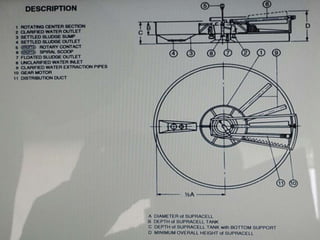
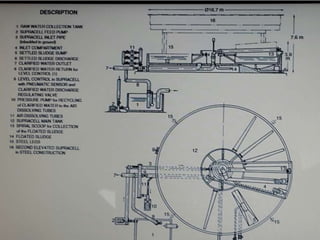
 Figures1 and 2 show a single cell and a double
cell, respectively, of high rate dissolved air flotation
clarifiers.
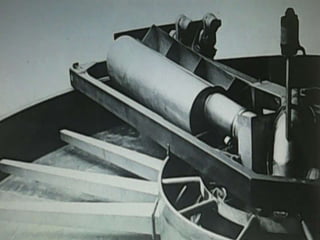
 The inlet, outlet, and sludge removal mechanisms
are contained in the central rotating section.
 In this section the spiral scoop rotate around the
tank at a speed synchronized with the flow.
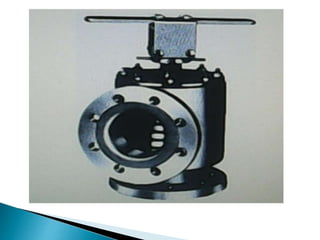
 Unclarified water, first passing through an air
dissolving tube and a friction valve, is released
through a rotary joint in the center of the tank.
 It then passes into the distribution duct that moves
backward with the same velocity as the forward
incoming water.
 The settling and the flotation processes take place
in the quiescent state in the flotation chamber.
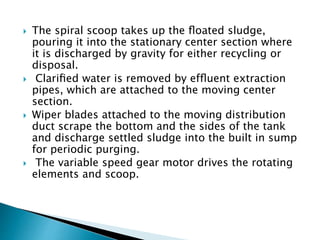
 The spiral scoop takes up the floated sludge,
pouring it into the stationary center section where
it is discharged by gravity for either recycling or
disposal.
 Clarified water is removed by effluent extraction
pipes, which are attached to the moving center
section.
 Wiper blades attached to the moving distribution
duct scrape the bottom and the sides of the tank
and discharge settled sludge into the built in sump
for periodic purging.
 The variable speed gear motor drives the rotating
elements and scoop.
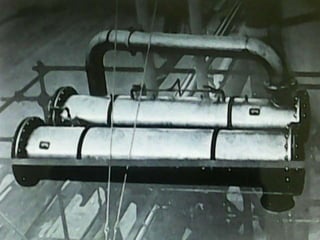
Air dissolving tube
 Activated sludge is a continuous flow biological
treatment process characterized by the suspension
of aerobic microorganisms, maintained in a
relatively homogeneous state by the mixing and
turbulence induced by aeration.
 The microorganisms oxidize soluble and colloidal
organics to CO2 and H2O in the presence of
molecular oxygen.
 The process is generally but not always , preceded
by a primary sedimentation clarifier.
 The mixture of microorganisms and wastewater
formed in the aeration basins, called mixed liquor,
is transferred to gravity clarifiers for liquid solid
separation.
 The major portion of the microorganisms settling
out in the clarifiers can be recycled to the aeration
basins to be mixed with incoming wastewater,
while the excess, which constitutes the waste
sludge, is sent to the sludge handling facilities .
 The rate and concentration of activated sludge
returned to the aeration basins determines the
mixed liquor suspended solids (MLSS) level
developed and maintained in the basins.
 During the oxidation process, a certain amount of
the organic material is synthesized into new cells
 some of which then undergoes auto-oxidation
(self-oxidation, or endogenous respiration) in the
aeration basins, the remainder forming net growth
or excess sludge.
 Oxygen is required in the process to support the
oxidation and synthesis reactions.
 Volatile compounds are driven off to a certain
extent in the aeration process.
 Metals will also be partially removed and
accumulated in the sludge.
 Activated sludge systems are classified as high
rate, conventional, or extended aeration (low rate)
based on the organic loading.
 In the conventional activated sludge plant, the
wastewater is commonly aerated for a period of 4–
8h (based on average daily flow) in a plug flow
hydraulic mode.
 Either surface or submerged aeration systems can
be employed to transfer oxygen from air to
wastewater.
 The most common operational difficulties
encountered in the conventional activated sludge
treatment plant are rising sludge and bulking
sludge, resulting in high suspended solids and 5-
day BOD in the plant effluent.
 The common cause of rising sludge is biological
denitrification, in which nitrites and nitrates in the
wastewater are converted to nitrogen gas.
 When enough nitrogen gas is formed and trapped
in the sludge mass, the sludge in the conventional
secondary sedimentation clarifier becomes buoyant
and floats to the surface.
 This phenomenon is called biological flotation.
 Rising sludge can also be caused by internal solids
overloading and hydraulic overloading to
secondary sedimentation.
 Poor sedimentation clarifier design and operation
in terms of flow-through velocity, weir design, etc.
are also possible causes.
 Sludge bulking is another phenomenon that often
occurs in activated sludge plants whereby the
sludge occupies excessive volumes and will not
settle rapidly.
 There are two principal types of sludge bulking
problems:
 (a) The growth of filamentous organisms
 (b) The formation of swelling biological flocs
through the addition of bound water to the cells to
the extent that their density is reduced
 Possible causes of sludge bulking include the
following:
 (a) Absence of certain necessary trace elements in
wastewater
 (b) Wide fluctuations in wastewater pH
 (c) Limited dissolved oxygen in the aeration tank
 (d) Inadequate food-to-microorganism ratio (F/M)
 (e) Inadequate mean cell residence time (θc)
 (f) Inadequate return sludge pumping rate
 (g) Internal plant overloading
 (h) Poor sedimentation clarifier operation The
problems of sludge rising and sludge bulking,
when serious, cannot be overcome easily.
 If rising and bulking conditions continue to persist
after all the aforementioned factors have been
checked, a critical investigation of the behavior of
aeration basin and secondary sedimentation
clarifier should be made.
 It is very possible that the design is at fault, and
either changes or expansions must be made in the
facilities.
 In summary, although the present conventional
activated sludge process has been in use for many
decades, there is still a lot of room for
improvement.
 One big area of weakness of the conventional
process is the secondary sedimentation clarifier,
which gives low consistency sludge, shocks the
living biota by holding them for long periods in
anaerobic conditions, and has problems of sludge
rising and sludge bulking.
 The use of a high rate dissolved air flotation unit
in series before the final sedimentation clarifier
eliminates these deficiencies.
 The net results are lower solids loading to the
existing sedimentation clarifier, higher hydraulic
capacity and retention time of aeration tank, easier
concentration of waste sludge, more active recycled
sludge, better effluent quality and lower
wastewater treatment costs.
 Besides, there will be no sludge rising or sludge
bulking problems
 The flotation cell is a high rate DAF clarifier.
 The unit has minimum volume (less than 16in.
water depth), low cost and flexibility in application
due to its small size.
 It has been very successfully applied for in-
process and secondary flotation in industrial and
municipal applications.
 The flotation cell has the following advantages
when used to separate biological solids from
activated sludge mixed liquor:
 (a) Sludge consistency for the floated biological
sludge is about three times higher than
comparable settled sludge.
 This fact has been recognized for years in the use
of flotation in thickening wastewater sludges.
 (b) The floated sludge is an aerobic. There is far
less kill of the biological community due to
anaerobic shock.
 This has been demonstrated in field comparisons
using both floated and settled sludges.
 (c) The aerobic floated sludge is returned to the
aeration basin in 8–15min instead of several
hours for the conventional activated sludge
process using secondary sedimentation clarifier.
 (d) Clarified water from a properly operated and
sized flotation unit is comparable in quality to
settled effluent.
 This has been demonstrated in field pilot trials.
Where a settling unit already exists in the
treatment process, the practice is to undersize
the flotation cell and install it in series with the
existing settling unit.
 The flotation cell is then the workhorse or
“harvester” and the settling unit is the final
“polisher” for the effluent.
 The problems of high solids loading, high hydraulic
loading, sludge rising, and/or sludge bulking in
existing conventional activated sludge treatment
plant can then be eliminated.
 (e) The small size of the flotation cell greatly
simplifies the issues involved in the upgrading of
existing wastewater treatment plants.
 (f) Capital cost of flotation cells is lower than the
cost for conventional sedimentation clarifiers or
comparable basin expansion.
 (g) Stainless steel and prefabricated construction
increase the economic feasibility of flotation cells.
THANK YOU ALL
 Anonymous (1975) First full scale flotation plant in United
Kingdom. Water Waste Treat 108
 Beer C, Wang LK (1978) Activated sludge systems using
nitrate respiration – design considerations. J Water Pollut
Control Fed 50(9):2120–2131
 Judd S (ed) (2002) Process science and engineering for
water and wastewater treatment. IWA Publishing, London
 Krofta M, Wang LK, Barris D, Janas J (1981)Treatment of
Pittsfield raw water for drinking water production by
innovative process systems. Technical report No. PB82-
118795, U.S. Department of Commerce, National Technical
Information Service, Spring field, VA, 87 pp
 Metcalf & Eddy, Inc., (2003) Wastewater engineering
treatment and reuse, 4th edn. McGraw Hill, New York
 Wang LK, Pereira NC, Hung YT, Sham mas NK (eds)
(2009) Biological treatment processes. The Humana
Press, Totowa, NJ, 818 pp
 Wang LK, Poon CPC, Wang MHS (1977) Control tests
and kinetics of activated sludge process. Water Air
Soil Pollut 8:315–351
 Wang LK, Shammas NK, HungYT (eds)(2007) Biosolids
treatment processes. The Humana Press, Totowa, NJ,
820 pp
 Wang LK, Wang MHS (1974) Removal of organic
pollutants by adsorptive bubble separation
processes. In: Earth environment and resources
conference digest of technical papers. 1, IEEE Cat. No.
74 CH0876-3EQC,pp 56–57
 Wang LK, Wang MHS, Poon CP, Bergenthal J (1978)
Chemistry of nitrification-denitrification process. J
Environ Sci 12:23–28

Flotation presentation

  • 1.
    A PRESENTION BY ABDULLAHINAZIFI ABDULLAHI (MS bioengineering student ) AT CYPRUS INTERNATIONAL UNIVERSITY (CIU) 2014
  • 2.
     Introduction  Flotationprincipal and process description  Flotation Biological System  Operational Difficulties and Remedy  summary  Conclusions  References
  • 3.
     Flotation process(sometimes called flotation separation) is a method of separation widely used in the wastewater treatment and mineral processing industries.  Activated sludge consists of biological flocs that are matrices of microorganisms, nonliving organics, and inorganic substances.  The microorganisms include bacteria, fungi, protozoa, rotifers , viruses, and higher forms of animals such as insect larvae, worms, and crustacean.
  • 4.
     Dissolved airflotation is mainly used to float suspended and colloidal solids by decreasing their apparent density.  The flotation system consists of eight major components: Influent feed pump, air supply, pressurizing pump , air dissolving tube(retention tank),friction valve, flotation chamber , spiral scoop, and effluent extraction pipe.  Figures1 and 2 show a single cell and a double cell, respectively, of high rate dissolved air flotation clarifiers.
  • 7.
     The inlet,outlet, and sludge removal mechanisms are contained in the central rotating section.  In this section the spiral scoop rotate around the tank at a speed synchronized with the flow.  Unclarified water, first passing through an air dissolving tube and a friction valve, is released through a rotary joint in the center of the tank.  It then passes into the distribution duct that moves backward with the same velocity as the forward incoming water.  The settling and the flotation processes take place in the quiescent state in the flotation chamber.
  • 8.
     The spiralscoop takes up the floated sludge, pouring it into the stationary center section where it is discharged by gravity for either recycling or disposal.  Clarified water is removed by effluent extraction pipes, which are attached to the moving center section.  Wiper blades attached to the moving distribution duct scrape the bottom and the sides of the tank and discharge settled sludge into the built in sump for periodic purging.  The variable speed gear motor drives the rotating elements and scoop.
  • 9.
  • 12.
     Activated sludgeis a continuous flow biological treatment process characterized by the suspension of aerobic microorganisms, maintained in a relatively homogeneous state by the mixing and turbulence induced by aeration.  The microorganisms oxidize soluble and colloidal organics to CO2 and H2O in the presence of molecular oxygen.  The process is generally but not always , preceded by a primary sedimentation clarifier.
  • 13.
     The mixtureof microorganisms and wastewater formed in the aeration basins, called mixed liquor, is transferred to gravity clarifiers for liquid solid separation.  The major portion of the microorganisms settling out in the clarifiers can be recycled to the aeration basins to be mixed with incoming wastewater, while the excess, which constitutes the waste sludge, is sent to the sludge handling facilities .  The rate and concentration of activated sludge returned to the aeration basins determines the mixed liquor suspended solids (MLSS) level developed and maintained in the basins.
  • 14.
     During theoxidation process, a certain amount of the organic material is synthesized into new cells  some of which then undergoes auto-oxidation (self-oxidation, or endogenous respiration) in the aeration basins, the remainder forming net growth or excess sludge.  Oxygen is required in the process to support the oxidation and synthesis reactions.  Volatile compounds are driven off to a certain extent in the aeration process.  Metals will also be partially removed and accumulated in the sludge.
  • 15.
     Activated sludgesystems are classified as high rate, conventional, or extended aeration (low rate) based on the organic loading.  In the conventional activated sludge plant, the wastewater is commonly aerated for a period of 4– 8h (based on average daily flow) in a plug flow hydraulic mode.  Either surface or submerged aeration systems can be employed to transfer oxygen from air to wastewater.
  • 16.
     The mostcommon operational difficulties encountered in the conventional activated sludge treatment plant are rising sludge and bulking sludge, resulting in high suspended solids and 5- day BOD in the plant effluent.  The common cause of rising sludge is biological denitrification, in which nitrites and nitrates in the wastewater are converted to nitrogen gas.  When enough nitrogen gas is formed and trapped in the sludge mass, the sludge in the conventional secondary sedimentation clarifier becomes buoyant and floats to the surface.
  • 17.
     This phenomenonis called biological flotation.  Rising sludge can also be caused by internal solids overloading and hydraulic overloading to secondary sedimentation.  Poor sedimentation clarifier design and operation in terms of flow-through velocity, weir design, etc. are also possible causes.  Sludge bulking is another phenomenon that often occurs in activated sludge plants whereby the sludge occupies excessive volumes and will not settle rapidly.
  • 18.
     There aretwo principal types of sludge bulking problems:  (a) The growth of filamentous organisms  (b) The formation of swelling biological flocs through the addition of bound water to the cells to the extent that their density is reduced  Possible causes of sludge bulking include the following:  (a) Absence of certain necessary trace elements in wastewater
  • 19.
     (b) Widefluctuations in wastewater pH  (c) Limited dissolved oxygen in the aeration tank  (d) Inadequate food-to-microorganism ratio (F/M)  (e) Inadequate mean cell residence time (θc)  (f) Inadequate return sludge pumping rate  (g) Internal plant overloading  (h) Poor sedimentation clarifier operation The problems of sludge rising and sludge bulking, when serious, cannot be overcome easily.
  • 20.
     If risingand bulking conditions continue to persist after all the aforementioned factors have been checked, a critical investigation of the behavior of aeration basin and secondary sedimentation clarifier should be made.  It is very possible that the design is at fault, and either changes or expansions must be made in the facilities.
  • 21.
     In summary,although the present conventional activated sludge process has been in use for many decades, there is still a lot of room for improvement.  One big area of weakness of the conventional process is the secondary sedimentation clarifier, which gives low consistency sludge, shocks the living biota by holding them for long periods in anaerobic conditions, and has problems of sludge rising and sludge bulking.
  • 22.
     The useof a high rate dissolved air flotation unit in series before the final sedimentation clarifier eliminates these deficiencies.  The net results are lower solids loading to the existing sedimentation clarifier, higher hydraulic capacity and retention time of aeration tank, easier concentration of waste sludge, more active recycled sludge, better effluent quality and lower wastewater treatment costs.  Besides, there will be no sludge rising or sludge bulking problems
  • 23.
     The flotationcell is a high rate DAF clarifier.  The unit has minimum volume (less than 16in. water depth), low cost and flexibility in application due to its small size.  It has been very successfully applied for in- process and secondary flotation in industrial and municipal applications.  The flotation cell has the following advantages when used to separate biological solids from activated sludge mixed liquor:
  • 24.
     (a) Sludgeconsistency for the floated biological sludge is about three times higher than comparable settled sludge.  This fact has been recognized for years in the use of flotation in thickening wastewater sludges.  (b) The floated sludge is an aerobic. There is far less kill of the biological community due to anaerobic shock.  This has been demonstrated in field comparisons using both floated and settled sludges.
  • 25.
     (c) Theaerobic floated sludge is returned to the aeration basin in 8–15min instead of several hours for the conventional activated sludge process using secondary sedimentation clarifier.  (d) Clarified water from a properly operated and sized flotation unit is comparable in quality to settled effluent.  This has been demonstrated in field pilot trials. Where a settling unit already exists in the treatment process, the practice is to undersize the flotation cell and install it in series with the existing settling unit.  The flotation cell is then the workhorse or “harvester” and the settling unit is the final “polisher” for the effluent.
  • 26.
     The problemsof high solids loading, high hydraulic loading, sludge rising, and/or sludge bulking in existing conventional activated sludge treatment plant can then be eliminated.  (e) The small size of the flotation cell greatly simplifies the issues involved in the upgrading of existing wastewater treatment plants.  (f) Capital cost of flotation cells is lower than the cost for conventional sedimentation clarifiers or comparable basin expansion.  (g) Stainless steel and prefabricated construction increase the economic feasibility of flotation cells.
  • 27.
  • 28.
     Anonymous (1975)First full scale flotation plant in United Kingdom. Water Waste Treat 108  Beer C, Wang LK (1978) Activated sludge systems using nitrate respiration – design considerations. J Water Pollut Control Fed 50(9):2120–2131  Judd S (ed) (2002) Process science and engineering for water and wastewater treatment. IWA Publishing, London  Krofta M, Wang LK, Barris D, Janas J (1981)Treatment of Pittsfield raw water for drinking water production by innovative process systems. Technical report No. PB82- 118795, U.S. Department of Commerce, National Technical Information Service, Spring field, VA, 87 pp  Metcalf & Eddy, Inc., (2003) Wastewater engineering treatment and reuse, 4th edn. McGraw Hill, New York
  • 29.
     Wang LK,Pereira NC, Hung YT, Sham mas NK (eds) (2009) Biological treatment processes. The Humana Press, Totowa, NJ, 818 pp  Wang LK, Poon CPC, Wang MHS (1977) Control tests and kinetics of activated sludge process. Water Air Soil Pollut 8:315–351  Wang LK, Shammas NK, HungYT (eds)(2007) Biosolids treatment processes. The Humana Press, Totowa, NJ, 820 pp  Wang LK, Wang MHS (1974) Removal of organic pollutants by adsorptive bubble separation processes. In: Earth environment and resources conference digest of technical papers. 1, IEEE Cat. No. 74 CH0876-3EQC,pp 56–57  Wang LK, Wang MHS, Poon CP, Bergenthal J (1978) Chemistry of nitrification-denitrification process. J Environ Sci 12:23–28