Circuit switching:
It is a transmission mode that involves setting up a dedicated end to end
connection.
Example:
Circuit switching is commonly used in telephone system.
When a call is made from one telephone to another, switches within the telephone
exchanges create a continuous wire circuit between the two telephones, for as long as the call
lasts.
It is connection oriented.
No delay in data flow.
Circuit switching principal:
A connection between the ingoing and outgoing segments of the transmission path is
established on demand, for the exclusive use of a pair of end users - until explicitly released
Packet switching:
Packet switching is a transmission process in which data is broken into perfect-sized
blocks for fast and efficient transfer via different network devices.
In which message is broken into packets for transmission.
Individual packets take different router to reach the destination.
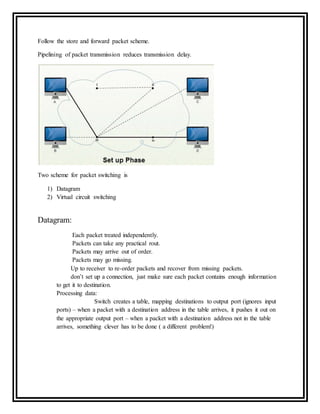
Follow the store and forward packet scheme.
Pipelining of packet transmission reduces transmission delay.
Two scheme for packet switching is
1) Datagram
2) Virtual circuit switching
Datagram:
Each packet treated independently.
Packets can take any practical rout.
Packets may arrive out of order.
Packets may go missing.
Up to receiver to re-order packets and recover from missing packets.
don’t set up a connection, just make sure each packet contains enough information
to get it to destination.
Processing data:
Switch creates a table, mapping destinations to output port (ignores input
ports) – when a packet with a destination address in the table arrives, it pushes it out on
the appropriate output port – when a packet with a destination address not in the table
arrives, something clever has to be done ( a different problem!)
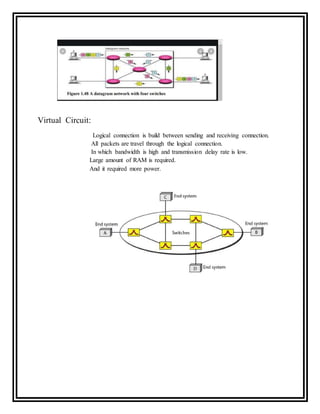
Virtual Circuit:
Logical connection is build between sending and receiving connection.
All packets are travel through the logical connection.
In which bandwidth is high and transmission delay rate is low.
Large amount of RAM is required.
And it required more power.

Circuit switching

  • 1.
    Circuit switching: It isa transmission mode that involves setting up a dedicated end to end connection. Example: Circuit switching is commonly used in telephone system. When a call is made from one telephone to another, switches within the telephone exchanges create a continuous wire circuit between the two telephones, for as long as the call lasts. It is connection oriented. No delay in data flow. Circuit switching principal: A connection between the ingoing and outgoing segments of the transmission path is established on demand, for the exclusive use of a pair of end users - until explicitly released Packet switching: Packet switching is a transmission process in which data is broken into perfect-sized blocks for fast and efficient transfer via different network devices. In which message is broken into packets for transmission. Individual packets take different router to reach the destination.
  • 2.
    Follow the storeand forward packet scheme. Pipelining of packet transmission reduces transmission delay. Two scheme for packet switching is 1) Datagram 2) Virtual circuit switching Datagram: Each packet treated independently. Packets can take any practical rout. Packets may arrive out of order. Packets may go missing. Up to receiver to re-order packets and recover from missing packets. don’t set up a connection, just make sure each packet contains enough information to get it to destination. Processing data: Switch creates a table, mapping destinations to output port (ignores input ports) – when a packet with a destination address in the table arrives, it pushes it out on the appropriate output port – when a packet with a destination address not in the table arrives, something clever has to be done ( a different problem!)
  • 3.
    Virtual Circuit: Logical connectionis build between sending and receiving connection. All packets are travel through the logical connection. In which bandwidth is high and transmission delay rate is low. Large amount of RAM is required. And it required more power.