COMPUTER NETWORK
SWITCHING
DIVYANSH THAKUR
IIIT UNA
SWITCHED NETWORKS
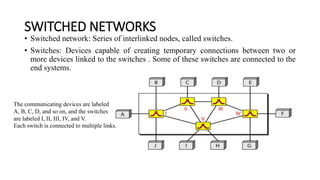
• Switched network: Series of interlinked nodes, called switches.
• Switches: Devices capable of creating temporary connections between two or
more devices linked to the switches . Some of these switches are connected to the
end systems.
The communicating devices are labeled
A, B, C, D, and so on, and the switches
are labeled I, II, III, IV, and V.
Each switch is connected to multiple links.
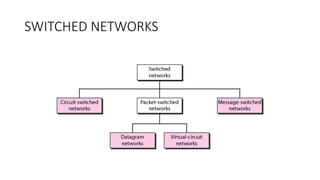
SWITCHED NETWORKS
CIRCUIT-SWITCHED NETWORKS
• A circuit switched network consists of a set of switches connected by physical
links.
• A connection between 2 stations is a dedicated path made of one or more links.
• However each connection uses only one dedicated channel on each link.
• Three phases are need to communicate two parties or multiple parties
1. Connection setup: Means creating dedicated channels between the switches.
2. Data transfer: After the establishment of the dedicated circuit (channels), the
two parties can transfer data
3. Connection teardown: When one of the parties needs to disconnect, a signal is
sent to each switch to release the resources.
A TRIVIAL CIRCUIT SWITCHED NETWORK
Example : when system A needs to connect to system M:
• A sends a setup request that includes the address of system
M, to switch I.
• Switch I finds a channel between itself and switch IV. Switch
I then sends the request to switch IV, which finds a dedicated
channel between itself and switch III.
• Switch III informs system M of system A's intention at this
time.
• An acknowledgment from system M needs to be sent in the
opposite direction to system A.
• After system A receives this acknowledgment the
connection established
CIRCUIT-SWITCHED NETWORK
• Circuit switching takes place at the physical layer.
• Data transferred between the two stations are not packetized. The data are a
continuous flow sent by the source station and received by the destination station.
• There is no addressing involved during data transfer. Of course, there is end-to-
end addressing used during the setup phase.
• circuit-switched networks are not so efficient as the resources are allocated during
the entire duration of the connection.
• These resources are unavailable to other connections.
PACKET SWITCHED NETWORK
• Messages need to be divided into packets.
• Size of the packet is determined by the network and the governing protocol.
• no resource reservation, but allocated on demand.
• The allocation is done first come, first served based.
• When a switch receives a packets , the packet must wait if there are other packets
being processed, this lack of reservation may create delay
DATAGRAM NETWORKS
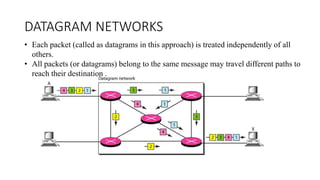
• Each packet (called as datagrams in this approach) is treated independently of all
others.
• All packets (or datagrams) belong to the same message may travel different paths to
reach their destination .
• Datagram Switching is done at the network layer.
• This approach can cause the datagrams of a transmission to arrive at their
destination out of order with different delays between the packets.
• Packets may also be lost or dropped because of a lack of resources.
• In most protocols, it is the responsibility of an upper-layer protocol to reorder the
datagrams or ask for lost datagrams before passing them on to the application.
• The datagram networks are referred to connectionless networks. There are no
setup or teardown phases.
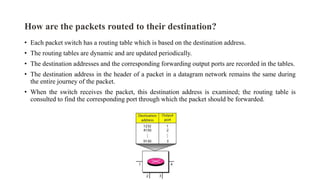
How are the packets routed to their destination?
• Each packet switch has a routing table which is based on the destination address.
• The routing tables are dynamic and are updated periodically.
• The destination addresses and the corresponding forwarding output ports are recorded in the tables.
• The destination address in the header of a packet in a datagram network remains the same during
the entire journey of the packet.
• When the switch receives the packet, this destination address is examined; the routing table is
consulted to find the corresponding port through which the packet should be forwarded.
• Efficiency is Better than that of a circuit-switched network.
• Resources are allocated only when there are packets to be transferred. If a source
sends a packet and there is a delay of a few minutes before another packet can be
sent, the resources can be reallocated during these minutes for other packets from
other sources.
• Switching in the Internet is done by using the datagram approach to packet
switching at the network layer
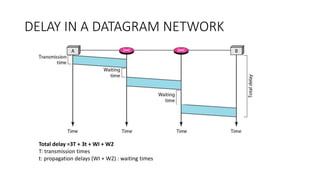
DELAY IN A DATAGRAM NETWORK
Total delay =3T + 3t + WI + W2
T: transmission times
t: propagation delays (WI + W2) : waiting times
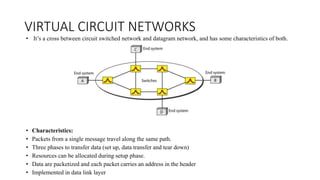
VIRTUAL CIRCUIT NETWORKS
• It’s a cross between circuit switched network and datagram network, and has some characteristics of both.
• Characteristics:
• Packets from a single message travel along the same path.
• Three phases to transfer data (set up, data transfer and tear down)
• Resources can be allocated during setup phase.
• Data are packetized and each packet carries an address in the header
• Implemented in data link layer
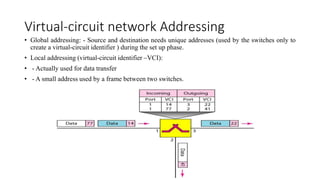
Virtual-circuit network Addressing
• Global addressing: - Source and destination needs unique addresses (used by the switches only to
create a virtual-circuit identifier ) during the set up phase.
• Local addressing (virtual-circuit identifier –VCI):
• - Actually used for data transfer
• - A small address used by a frame between two switches.
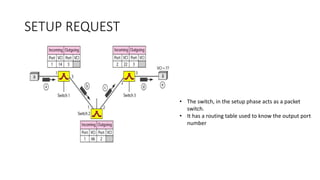
SETUP REQUEST
• The switch, in the setup phase acts as a packet
switch.
• It has a routing table used to know the output port
number
Setup acknowledgement
• When Destination B receives the up frame , and it is ready
to receive frames from A, it assign a VCI (in this case :77).
• This VCI lets the destination know that the frames comes
from A not other sources.
Data Transfer and Tear down Phase
• After sending all frames, a special frame is send to
end the connection.
• Destination B responds with a teardown
confirmation frame
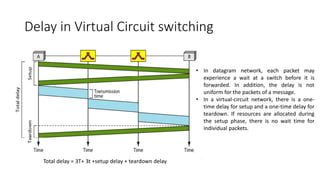
Delay in Virtual Circuit switching
Total delay = 3T+ 3t +setup delay + teardown delay
• In datagram network, each packet may
experience a wait at a switch before it is
forwarded. In addition, the delay is not
uniform for the packets of a message.
• In a virtual-circuit network, there is a one-
time delay for setup and a one-time delay for
teardown. If resources are allocated during
the setup phase, there is no wait time for
individual packets.

Computer network switching

  • 1.
  • 2.
    SWITCHED NETWORKS • Switchednetwork: Series of interlinked nodes, called switches. • Switches: Devices capable of creating temporary connections between two or more devices linked to the switches . Some of these switches are connected to the end systems. The communicating devices are labeled A, B, C, D, and so on, and the switches are labeled I, II, III, IV, and V. Each switch is connected to multiple links.
  • 3.
  • 4.
    CIRCUIT-SWITCHED NETWORKS • Acircuit switched network consists of a set of switches connected by physical links. • A connection between 2 stations is a dedicated path made of one or more links. • However each connection uses only one dedicated channel on each link. • Three phases are need to communicate two parties or multiple parties 1. Connection setup: Means creating dedicated channels between the switches. 2. Data transfer: After the establishment of the dedicated circuit (channels), the two parties can transfer data 3. Connection teardown: When one of the parties needs to disconnect, a signal is sent to each switch to release the resources.
  • 5.
    A TRIVIAL CIRCUITSWITCHED NETWORK Example : when system A needs to connect to system M: • A sends a setup request that includes the address of system M, to switch I. • Switch I finds a channel between itself and switch IV. Switch I then sends the request to switch IV, which finds a dedicated channel between itself and switch III. • Switch III informs system M of system A's intention at this time. • An acknowledgment from system M needs to be sent in the opposite direction to system A. • After system A receives this acknowledgment the connection established
  • 6.
    CIRCUIT-SWITCHED NETWORK • Circuitswitching takes place at the physical layer. • Data transferred between the two stations are not packetized. The data are a continuous flow sent by the source station and received by the destination station. • There is no addressing involved during data transfer. Of course, there is end-to- end addressing used during the setup phase. • circuit-switched networks are not so efficient as the resources are allocated during the entire duration of the connection. • These resources are unavailable to other connections.
  • 7.
    PACKET SWITCHED NETWORK •Messages need to be divided into packets. • Size of the packet is determined by the network and the governing protocol. • no resource reservation, but allocated on demand. • The allocation is done first come, first served based. • When a switch receives a packets , the packet must wait if there are other packets being processed, this lack of reservation may create delay
  • 8.
    DATAGRAM NETWORKS • Eachpacket (called as datagrams in this approach) is treated independently of all others. • All packets (or datagrams) belong to the same message may travel different paths to reach their destination .
  • 9.
    • Datagram Switchingis done at the network layer. • This approach can cause the datagrams of a transmission to arrive at their destination out of order with different delays between the packets. • Packets may also be lost or dropped because of a lack of resources. • In most protocols, it is the responsibility of an upper-layer protocol to reorder the datagrams or ask for lost datagrams before passing them on to the application. • The datagram networks are referred to connectionless networks. There are no setup or teardown phases.
  • 10.
    How are thepackets routed to their destination? • Each packet switch has a routing table which is based on the destination address. • The routing tables are dynamic and are updated periodically. • The destination addresses and the corresponding forwarding output ports are recorded in the tables. • The destination address in the header of a packet in a datagram network remains the same during the entire journey of the packet. • When the switch receives the packet, this destination address is examined; the routing table is consulted to find the corresponding port through which the packet should be forwarded.
  • 11.
    • Efficiency isBetter than that of a circuit-switched network. • Resources are allocated only when there are packets to be transferred. If a source sends a packet and there is a delay of a few minutes before another packet can be sent, the resources can be reallocated during these minutes for other packets from other sources. • Switching in the Internet is done by using the datagram approach to packet switching at the network layer
  • 12.
    DELAY IN ADATAGRAM NETWORK Total delay =3T + 3t + WI + W2 T: transmission times t: propagation delays (WI + W2) : waiting times
  • 13.
    VIRTUAL CIRCUIT NETWORKS •It’s a cross between circuit switched network and datagram network, and has some characteristics of both. • Characteristics: • Packets from a single message travel along the same path. • Three phases to transfer data (set up, data transfer and tear down) • Resources can be allocated during setup phase. • Data are packetized and each packet carries an address in the header • Implemented in data link layer
  • 14.
    Virtual-circuit network Addressing •Global addressing: - Source and destination needs unique addresses (used by the switches only to create a virtual-circuit identifier ) during the set up phase. • Local addressing (virtual-circuit identifier –VCI): • - Actually used for data transfer • - A small address used by a frame between two switches.
  • 15.
    SETUP REQUEST • Theswitch, in the setup phase acts as a packet switch. • It has a routing table used to know the output port number
  • 16.
    Setup acknowledgement • WhenDestination B receives the up frame , and it is ready to receive frames from A, it assign a VCI (in this case :77). • This VCI lets the destination know that the frames comes from A not other sources.
  • 17.
    Data Transfer andTear down Phase • After sending all frames, a special frame is send to end the connection. • Destination B responds with a teardown confirmation frame
  • 18.
    Delay in VirtualCircuit switching Total delay = 3T+ 3t +setup delay + teardown delay • In datagram network, each packet may experience a wait at a switch before it is forwarded. In addition, the delay is not uniform for the packets of a message. • In a virtual-circuit network, there is a one- time delay for setup and a one-time delay for teardown. If resources are allocated during the setup phase, there is no wait time for individual packets.