PAPER NAME : COMPUTER NETWORKS
STAFF NAME : MISS.S.MANIMOZHI MCA,M.Phil,PHD.,
CLASS : III BCA A
SEMESTER : VI
UNIT : III
TOPIC : PACKET SWITCHING
 Networks are used to interconnect many devices.
 We have checked with Local Area Networks.
 Now, wide area networks
 Since the invention of the telephone, circuit switching has been
the dominant technology for voice communications.
 Since 1970, packet switching has evolved substantially for
digital data communications. It was designed to provide a
more efficient facility than circuit switching for bursty data
traffic.
 Two types of packet switching:
 Datagram (such as today’s Internet)
 Virtual circuit (such as Frame Relay, ATM)
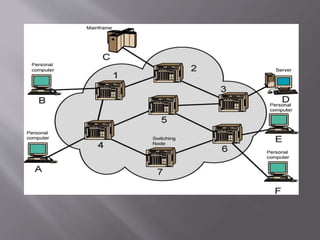
 Long detachment broadcast between stations (called
“end campaign”) is usually done over a set of
connections of switching nodes.
 Switching nodes do not concern with satisfied of
information. Their rationale is to have the resources for
a switching flair that will move the data from node to
nodule during they accomplish their goal(the end
device.
 A gathering of nodes and relatives forms a
communications network.
 In a switched infrastructure set of connections report
inward bound the network from a station are running
scared to the goal by being switched from node to node.
 Nodes may attach to additional nodes, or to
some stations.
 set of connections is frequently partly
connected
 However, several neglected relatives are enviable for
reliability.
 Two unlike switching technologies
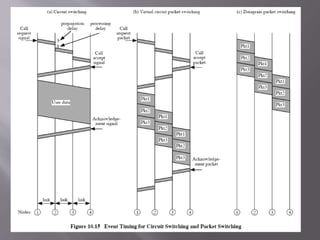
 Circuit switch
 Packet switch
 Incompetence
 Direct capacity is dedicated for the whole duration of a correlation
 If no data, capacity is wasted
 Delay
 Long initial delay: circuit establishment takes time
 Low data delay: after the circuit institution in sequence is
transmit at a fixed data rate with no setback other than the
transmission delay.
 The delay at each node is insignificant.
 Residential for voice traffic (public phone network) but can
also applied to information traffic.
 For voice connections, the resulting circuit will enjoy a elevated
percentage of operation because most of the time one party or the
other is talking.
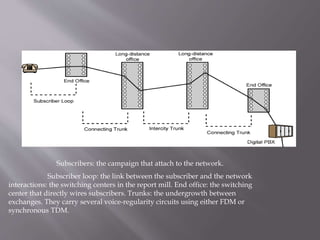
Subscribers: the campaign that attach to the network.
Subscriber loop: the link between the subscriber and the network
interactions: the switching centers in the report mill. End office: the switching
center that directly wires subscribers. Trunks: the undergrowth between
exchanges. They carry several voice-regularity circuits using either FDM or
synchronous TDM.
 Predicament of course switching
 designed for voice overhaul
 Resources dedicated to a finicky call
 For information communication, much of the
occasion the connection is idle (say, web browsing)
 information rate is preset
 Both ends must operate at the same rate during the
total stage of relation.
 Packet switching is intended to tackle these
troubles.
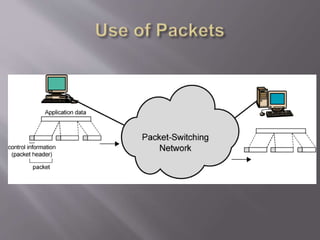
 information are transmit in short packets
 classically at the order of 1000 bytes
 Longer messages are split into sequence of packets
 Each packet contain a segment of user information plus some
control info
 Control info contain at least
 Routing (addressing) info, so as to be routed to the planned
objective.
 Recall the content of an IP subtitle!
 store and forward
 On each switching node, packets are received, stored
momentarily (buffered) and agreed on to the next node.
 A station break long communication into
packet.
 Packets are sent out to the system successively,
one at a occasion
 How will the system switch this torrent of
packet as it challenge to direction them through
the network and transport them to the
intended objective?
 Two approach
 Datagram approach
 Virtual circuit approach
 every one packet is treated discretely with no
position to packet that have departed before.
 Each node choose the next node on a packet’s path.
 Packets can take any potential direction.
 Packets may land at the receiver out of order.
 packet may go missing.
 It is up to the head put to rearrange packets
and accept up from missing carton
 Example: Internet
 In practical route, a preplanned route is
established before any packets are sent, then all
packets follow the same route.
 Each packet contains a practical route
identifier in its place of objective attend to and
each node on the pre conventional route knows
where to forward such packets.
 The node need not make a navigation decision for
each pack.
 Example: X.25, Frame Relay, ATM
14
 implicit circuit
 System can provide sequencing (packets arrive at the same
order) and error control (retransmission between two nodes).
 Packets are frontward more speedily
 Based on the virtual circuit identifier
 No navigation decisions to make
 Less unswerving
 If a node fails, all fundamental circuits that pass through that node
fail.
 Datagram
 No call complex phase
 Good for burs T v data, such as Web application
 More plastic
 If a node fails, packet may find an interchange route
 Routing can be used to avoid congested parts of the system
16
CONCLUSION
A router in fact is a switch that create
association between an participation and production
port and an electrical switch connect the input to the
production to the liveliness flow .

packet switching

  • 1.
    PAPER NAME :COMPUTER NETWORKS STAFF NAME : MISS.S.MANIMOZHI MCA,M.Phil,PHD., CLASS : III BCA A SEMESTER : VI UNIT : III TOPIC : PACKET SWITCHING
  • 3.
     Networks areused to interconnect many devices.  We have checked with Local Area Networks.  Now, wide area networks  Since the invention of the telephone, circuit switching has been the dominant technology for voice communications.  Since 1970, packet switching has evolved substantially for digital data communications. It was designed to provide a more efficient facility than circuit switching for bursty data traffic.  Two types of packet switching:  Datagram (such as today’s Internet)  Virtual circuit (such as Frame Relay, ATM)
  • 4.
     Long detachmentbroadcast between stations (called “end campaign”) is usually done over a set of connections of switching nodes.  Switching nodes do not concern with satisfied of information. Their rationale is to have the resources for a switching flair that will move the data from node to nodule during they accomplish their goal(the end device.  A gathering of nodes and relatives forms a communications network.  In a switched infrastructure set of connections report inward bound the network from a station are running scared to the goal by being switched from node to node.
  • 6.
     Nodes mayattach to additional nodes, or to some stations.  set of connections is frequently partly connected  However, several neglected relatives are enviable for reliability.  Two unlike switching technologies  Circuit switch  Packet switch
  • 7.
     Incompetence  Directcapacity is dedicated for the whole duration of a correlation  If no data, capacity is wasted  Delay  Long initial delay: circuit establishment takes time  Low data delay: after the circuit institution in sequence is transmit at a fixed data rate with no setback other than the transmission delay.  The delay at each node is insignificant.  Residential for voice traffic (public phone network) but can also applied to information traffic.  For voice connections, the resulting circuit will enjoy a elevated percentage of operation because most of the time one party or the other is talking.
  • 8.
    Subscribers: the campaignthat attach to the network. Subscriber loop: the link between the subscriber and the network interactions: the switching centers in the report mill. End office: the switching center that directly wires subscribers. Trunks: the undergrowth between exchanges. They carry several voice-regularity circuits using either FDM or synchronous TDM.
  • 9.
     Predicament ofcourse switching  designed for voice overhaul  Resources dedicated to a finicky call  For information communication, much of the occasion the connection is idle (say, web browsing)  information rate is preset  Both ends must operate at the same rate during the total stage of relation.  Packet switching is intended to tackle these troubles.
  • 10.
     information aretransmit in short packets  classically at the order of 1000 bytes  Longer messages are split into sequence of packets  Each packet contain a segment of user information plus some control info  Control info contain at least  Routing (addressing) info, so as to be routed to the planned objective.  Recall the content of an IP subtitle!  store and forward  On each switching node, packets are received, stored momentarily (buffered) and agreed on to the next node.
  • 12.
     A stationbreak long communication into packet.  Packets are sent out to the system successively, one at a occasion  How will the system switch this torrent of packet as it challenge to direction them through the network and transport them to the intended objective?  Two approach  Datagram approach  Virtual circuit approach
  • 13.
     every onepacket is treated discretely with no position to packet that have departed before.  Each node choose the next node on a packet’s path.  Packets can take any potential direction.  Packets may land at the receiver out of order.  packet may go missing.  It is up to the head put to rearrange packets and accept up from missing carton  Example: Internet
  • 14.
     In practicalroute, a preplanned route is established before any packets are sent, then all packets follow the same route.  Each packet contains a practical route identifier in its place of objective attend to and each node on the pre conventional route knows where to forward such packets.  The node need not make a navigation decision for each pack.  Example: X.25, Frame Relay, ATM 14
  • 16.
     implicit circuit System can provide sequencing (packets arrive at the same order) and error control (retransmission between two nodes).  Packets are frontward more speedily  Based on the virtual circuit identifier  No navigation decisions to make  Less unswerving  If a node fails, all fundamental circuits that pass through that node fail.  Datagram  No call complex phase  Good for burs T v data, such as Web application  More plastic  If a node fails, packet may find an interchange route  Routing can be used to avoid congested parts of the system 16
  • 17.
    CONCLUSION A router infact is a switch that create association between an participation and production port and an electrical switch connect the input to the production to the liveliness flow .