Switching
CIRCUIT-SWITCHED NETWORK
1
Lets Start with
Switching
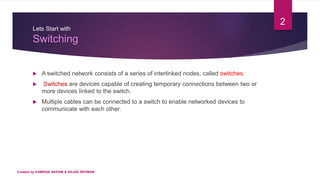
 A switched network consists of a series of interlinked nodes, called switches.
 Switches are devices capable of creating temporary connections between two or
more devices linked to the switch.
 Multiple cables can be connected to a switch to enable networked devices to
communicate with each other.
2
Created by KAMRAN AKRAM & ASJAD REHMAN
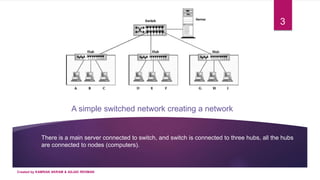
A simple switched network creating a network
There is a main server connected to switch, and switch is connected to three hubs, all the hubs
are connected to nodes (computers).
3
Created by KAMRAN AKRAM & ASJAD REHMAN
Working of a SWITCH
Created by KAMRAN AKRAM & ASJAD REHMAN
4
Before we go further, we
must take a look at how a
switch works
HUB vs SWITCH
Created by KAMRAN AKRAM & ASJAD REHMAN
5
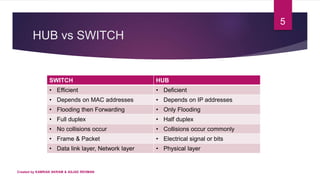
SWITCH HUB
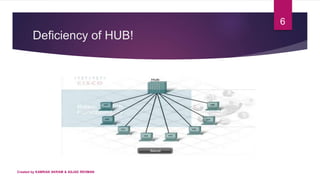
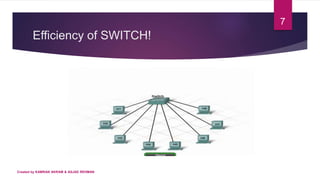
• Efficient • Deficient
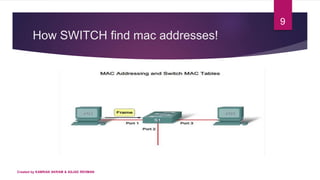
• Depends on MAC addresses • Depends on IP addresses
• Flooding then Forwarding • Only Flooding
• Full duplex • Half duplex
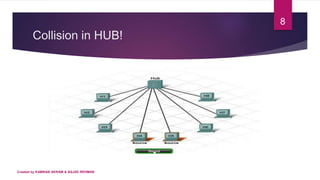
• No collisions occur • Collisions occur commonly
• Frame & Packet • Electrical signal or bits
• Data link layer, Network layer • Physical layer
Deficiency of HUB!
Created by KAMRAN AKRAM & ASJAD REHMAN
6
Efficiency of SWITCH!
Created by KAMRAN AKRAM & ASJAD REHMAN
7
Collision in HUB!
Created by KAMRAN AKRAM & ASJAD REHMAN
8
How SWITCH find mac addresses!
Created by KAMRAN AKRAM & ASJAD REHMAN
9
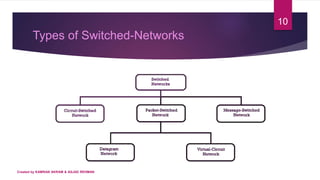
Types of Switched-Networks
10
Created by KAMRAN AKRAM & ASJAD REHMAN
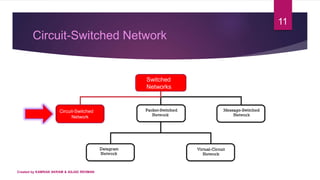
Circuit-Switched Network
11
Circuit-Switched
Network
Switched
Networks
Created by KAMRAN AKRAM & ASJAD REHMAN
Circuit-Switched Network
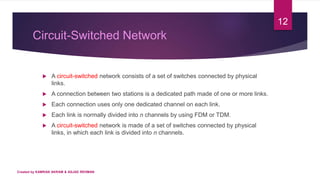
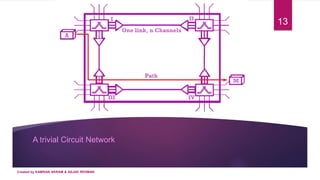
 A circuit-switched network consists of a set of switches connected by physical
links.
 A connection between two stations is a dedicated path made of one or more links.
 Each connection uses only one dedicated channel on each link.
 Each link is normally divided into n channels by using FDM or TDM.
 A circuit-switched network is made of a set of switches connected by physical
links, in which each link is divided into n channels.
12
Created by KAMRAN AKRAM & ASJAD REHMAN
A trivial Circuit Network
13
Created by KAMRAN AKRAM & ASJAD REHMAN
Lets discuss more about Circuit-Switched Network
 The end systems, such as computers or telephones, are directly connected to a
switch.
 When end system A needs to communicate with end system M, system A needs
to request a connection to M that must be accepted by all switches as well as by
M itself. This is called the Setup phase.
 After the establishment of the dedicated circuit (channels), the two parties can
transfer data. This is called Data Transfer Phase.
 When one of the parties needs to disconnect, a signal is sent to each switch to
release the resources. This is called Tear down Phase.
14
Created by KAMRAN AKRAM & ASJAD REHMAN
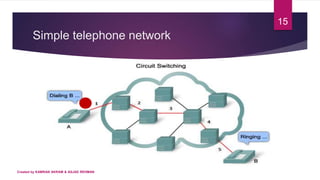
Simple telephone network
Created by KAMRAN AKRAM & ASJAD REHMAN
15
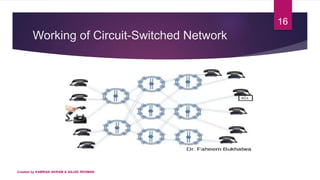
Working of Circuit-Switched Network
Created by KAMRAN AKRAM & ASJAD REHMAN
16
Efficiency
Created by KAMRAN AKRAM & ASJAD REHMAN
17
 Circuit-switched networks are not as efficient as the other two types of networks
because resources are allocated during the entire duration of the connection.
These resources are unavailable to other connections.
 In a telephone network, people normally terminate the communication when they
have finished their conversation. However, in computer networks, a computer can
be connected to another computer even if there is no activity for a long time. In
this case, allowing resources to be dedicated means that other connections are
deprived.
Delay
 Circuit-switched network normally has low efficiency, the delay in this type of
network is minimal. During data transfer the data are not delayed at each switch,
the resources are allocated for the duration of the connection.
Created by KAMRAN AKRAM & ASJAD REHMAN
18
Kamran Akram
Asjad Rehman
Credits

Circuit switch network

  • 1.
  • 2.
    Lets Start with Switching A switched network consists of a series of interlinked nodes, called switches.  Switches are devices capable of creating temporary connections between two or more devices linked to the switch.  Multiple cables can be connected to a switch to enable networked devices to communicate with each other. 2 Created by KAMRAN AKRAM & ASJAD REHMAN
  • 3.
    A simple switchednetwork creating a network There is a main server connected to switch, and switch is connected to three hubs, all the hubs are connected to nodes (computers). 3 Created by KAMRAN AKRAM & ASJAD REHMAN
  • 4.
    Working of aSWITCH Created by KAMRAN AKRAM & ASJAD REHMAN 4 Before we go further, we must take a look at how a switch works
  • 5.
    HUB vs SWITCH Createdby KAMRAN AKRAM & ASJAD REHMAN 5 SWITCH HUB • Efficient • Deficient • Depends on MAC addresses • Depends on IP addresses • Flooding then Forwarding • Only Flooding • Full duplex • Half duplex • No collisions occur • Collisions occur commonly • Frame & Packet • Electrical signal or bits • Data link layer, Network layer • Physical layer
  • 6.
    Deficiency of HUB! Createdby KAMRAN AKRAM & ASJAD REHMAN 6
  • 7.
    Efficiency of SWITCH! Createdby KAMRAN AKRAM & ASJAD REHMAN 7
  • 8.
    Collision in HUB! Createdby KAMRAN AKRAM & ASJAD REHMAN 8
  • 9.
    How SWITCH findmac addresses! Created by KAMRAN AKRAM & ASJAD REHMAN 9
  • 10.
    Types of Switched-Networks 10 Createdby KAMRAN AKRAM & ASJAD REHMAN
  • 11.
  • 12.
    Circuit-Switched Network  Acircuit-switched network consists of a set of switches connected by physical links.  A connection between two stations is a dedicated path made of one or more links.  Each connection uses only one dedicated channel on each link.  Each link is normally divided into n channels by using FDM or TDM.  A circuit-switched network is made of a set of switches connected by physical links, in which each link is divided into n channels. 12 Created by KAMRAN AKRAM & ASJAD REHMAN
  • 13.
    A trivial CircuitNetwork 13 Created by KAMRAN AKRAM & ASJAD REHMAN
  • 14.
    Lets discuss moreabout Circuit-Switched Network  The end systems, such as computers or telephones, are directly connected to a switch.  When end system A needs to communicate with end system M, system A needs to request a connection to M that must be accepted by all switches as well as by M itself. This is called the Setup phase.  After the establishment of the dedicated circuit (channels), the two parties can transfer data. This is called Data Transfer Phase.  When one of the parties needs to disconnect, a signal is sent to each switch to release the resources. This is called Tear down Phase. 14 Created by KAMRAN AKRAM & ASJAD REHMAN
  • 15.
    Simple telephone network Createdby KAMRAN AKRAM & ASJAD REHMAN 15
  • 16.
    Working of Circuit-SwitchedNetwork Created by KAMRAN AKRAM & ASJAD REHMAN 16
  • 17.
    Efficiency Created by KAMRANAKRAM & ASJAD REHMAN 17  Circuit-switched networks are not as efficient as the other two types of networks because resources are allocated during the entire duration of the connection. These resources are unavailable to other connections.  In a telephone network, people normally terminate the communication when they have finished their conversation. However, in computer networks, a computer can be connected to another computer even if there is no activity for a long time. In this case, allowing resources to be dedicated means that other connections are deprived.
  • 18.
    Delay  Circuit-switched networknormally has low efficiency, the delay in this type of network is minimal. During data transfer the data are not delayed at each switch, the resources are allocated for the duration of the connection. Created by KAMRAN AKRAM & ASJAD REHMAN 18
  • 19.