1
1
Lecture 9
Abdisalam Issa-Salwe
Thames Valley University
Information systems and
Organisational Change
Abdisalam Issa-Salwe, Thames Valley University
2
Change Management and IT
 Change management is the process of
assisting individuals and organisations
passing from an old way of doing things to a
new way of doing things.
 Information Technology can be both a cause
of a major change in doing business and a
response to them
2
Abdisalam Issa-Salwe, Thames Valley University
3
Change Management and IT (cont…)
 A new system is more than just the hardware
and the software;
 It is also the people and organisational
considerations
 Significant new systems require cultural
change
 People are often willing to change, but they
resist being changed
Abdisalam Issa-Salwe, Thames Valley University
4
Project and IT
 A project is affected by a number of
factors:
 Quality of system required, in terms of
basic system requirements
 Time, both to complete the project,
and in terms of the opportunity cost of
time spent on this project which could
be spend on others
 Costs and resources allocated to the
project
3
Abdisalam Issa-Salwe, Thames Valley University
5
User resistance
 People might be resistance of change.
Three types of user resistance:
 People oriented:User is caused by factors
internal to the user as individual or as a
group. For example, user may need not
to disrupt their current work practice and
social groupings
 System oriented: User-resistance is
caused by factors inherent in the new
system and functionality. For example, a
poorly designed user-interface will
generate user-resistance.
Abdisalam Issa-Salwe, Thames Valley University
6
User resistance (cont…)
 Interaction: User-resistance is
caused by the interaction of people
and the system. For example, the
system may be well-designed but
its implementation will cause
organisational changes that users
resist, e.g.. Reduce change of
bonuses, redundancies,
monotonous work
4
Abdisalam Issa-Salwe, Thames Valley University
7
Problem occurring when implement IS
 Problem that occur when
implementing a new information
system can be usually be traced to
deficiencies in the development
process. Some of these are:
 Analysis:
 the problem the system is intended to
solve is not fully understood.
 User inadequately consulted
Abdisalam Issa-Salwe, Thames Valley University
8
Problem occurring when implement IS (cont…)
 Design:
 Insufficient user input
 Lack of flexibility
 Failure to perform organisational impact
analysis
 Programming:
 Insufficient time and money allocated to
programming
 Programmer supplied with incomplete or
inaccurate specification
 The logic of the program misunderstood
5
Abdisalam Issa-Salwe, Thames Valley University
9
 Testing:
 Insufficient time and money allocated to
testing
 Failure to develop an organised testing plan
 Insufficient user involvement
 User management do not review and sign-off
results of testing
 Conversion:
 Insufficient time and money allocated to data
conversion
 Insufficient checking between old and new file
 Process is rushed to compensate for time
overruns elsewhere
Problem occurring when implement IS (cont…)
Abdisalam Issa-Salwe, Thames Valley University
10
IT and change (cont…)
 Most research seems to indicate
that the major cause of information
systems failure is inadequate user
involvement
 Users need to be involved in the
development process at all stages –
including system design
6
Abdisalam Issa-Salwe, Thames Valley University
11
IT and change (cont…)
 Other common cause of dissatisfaction
with information systems
 If IS mangers are technicians, not mangers,
technical ability for IS staff is no guarantee of
management skills
 Poor or non-existing planning is recipe for
disaster:
 Unrealistic deadlines would be identified
much earlier if a proper planning process
was undertaken.
 A lack of monitoring and controlling:
 Users change their requirements,
resulting in costly changes to the system
as it is being developed
Abdisalam Issa-Salwe, Thames Valley University
12
IT Role in Change
 IT can play a significant role as an
enabler in the change management
process
 In some circumstance IT may be
the driving force or trigger of
organisational change
 Even when IT is not significant
factor in the actual change, it can
play an important part in the
change management process
7
Abdisalam Issa-Salwe, Thames Valley University
13
IT Role in Change (cont…)
 The type of products or services
that are made and and sold,
 i.e., Internet service
 The way in which products are
made:
 The use of automation and computer
aided design and manufacture, e.i.
Computer Integrated Manufacturing
(CIM)
 CIM changed the methods and cost
profiles of many manufacturing process
Abdisalam Issa-Salwe, Thames Valley University
14
IT Role in Change (cont…)
 The way in which employees are
mobilised:
 Computerisation encourages de-laying of
organisational hierarchies and greater
workforce empowerment and skills.
 Using technology frequently requires change
in working methods
 The way in which services are provided:
 High-street banks encourage customers to use
‘hole-in-the-wall’ cash dispensers, or telephone
or Internet banking
 Most large shops now user computerised Point
of Sale Terminals at cash desks.
 Many companies use e-commerce selling
products and services over the Internet
8
Abdisalam Issa-Salwe, Thames Valley University
15
IT Role in Change (cont…)
 IT acts as an enabling technology:
 IT can produce dramatic changes in individual
businesses and whole industries. For example,
competition in the airline industry has
intensified due to information systems that
allow easy fare comparisons and booking
 Communication and coordination:
 Coordination is essential when introducing
change
 IT can facilitate this through the use of e-mail,
project management software, an internet, etc
Abdisalam Issa-Salwe, Thames Valley University
16
IT Role in Change (cont…)
 Source of unity and structure:
 In times of restructuring, IS can be a
visible sign of the new situation. For
example, an organisation-wide network
perhaps with an intranet provides
evidence of and encourages acceptance
of the new situation
9
Abdisalam Issa-Salwe, Thames Valley University
17
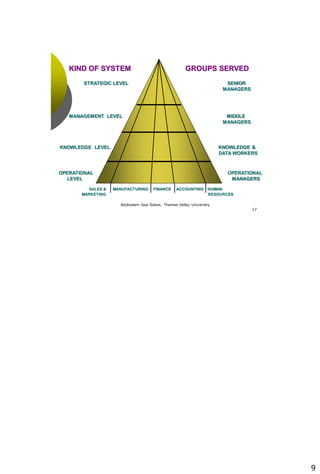
DATA WORKERS
KIND OF SYSTEM GROUPS SERVED
STRATEGIC LEVEL SENIOR
MANAGERS
MANAGEMENT LEVEL MIDDLE
MANAGERS
OPERATIONAL OPERATIONAL
LEVEL MANAGERS
KNOWLEDGE LEVEL KNOWLEDGE &
SALES & MANUFACTURING FINANCE ACCOUNTING HUMAN
RESOURCESMARKETING

CIMA- Lecture10(Information systems and Organisational Change)

  • 1.
    1 1 Lecture 9 Abdisalam Issa-Salwe ThamesValley University Information systems and Organisational Change Abdisalam Issa-Salwe, Thames Valley University 2 Change Management and IT  Change management is the process of assisting individuals and organisations passing from an old way of doing things to a new way of doing things.  Information Technology can be both a cause of a major change in doing business and a response to them
  • 2.
    2 Abdisalam Issa-Salwe, ThamesValley University 3 Change Management and IT (cont…)  A new system is more than just the hardware and the software;  It is also the people and organisational considerations  Significant new systems require cultural change  People are often willing to change, but they resist being changed Abdisalam Issa-Salwe, Thames Valley University 4 Project and IT  A project is affected by a number of factors:  Quality of system required, in terms of basic system requirements  Time, both to complete the project, and in terms of the opportunity cost of time spent on this project which could be spend on others  Costs and resources allocated to the project
  • 3.
    3 Abdisalam Issa-Salwe, ThamesValley University 5 User resistance  People might be resistance of change. Three types of user resistance:  People oriented:User is caused by factors internal to the user as individual or as a group. For example, user may need not to disrupt their current work practice and social groupings  System oriented: User-resistance is caused by factors inherent in the new system and functionality. For example, a poorly designed user-interface will generate user-resistance. Abdisalam Issa-Salwe, Thames Valley University 6 User resistance (cont…)  Interaction: User-resistance is caused by the interaction of people and the system. For example, the system may be well-designed but its implementation will cause organisational changes that users resist, e.g.. Reduce change of bonuses, redundancies, monotonous work
  • 4.
    4 Abdisalam Issa-Salwe, ThamesValley University 7 Problem occurring when implement IS  Problem that occur when implementing a new information system can be usually be traced to deficiencies in the development process. Some of these are:  Analysis:  the problem the system is intended to solve is not fully understood.  User inadequately consulted Abdisalam Issa-Salwe, Thames Valley University 8 Problem occurring when implement IS (cont…)  Design:  Insufficient user input  Lack of flexibility  Failure to perform organisational impact analysis  Programming:  Insufficient time and money allocated to programming  Programmer supplied with incomplete or inaccurate specification  The logic of the program misunderstood
  • 5.
    5 Abdisalam Issa-Salwe, ThamesValley University 9  Testing:  Insufficient time and money allocated to testing  Failure to develop an organised testing plan  Insufficient user involvement  User management do not review and sign-off results of testing  Conversion:  Insufficient time and money allocated to data conversion  Insufficient checking between old and new file  Process is rushed to compensate for time overruns elsewhere Problem occurring when implement IS (cont…) Abdisalam Issa-Salwe, Thames Valley University 10 IT and change (cont…)  Most research seems to indicate that the major cause of information systems failure is inadequate user involvement  Users need to be involved in the development process at all stages – including system design
  • 6.
    6 Abdisalam Issa-Salwe, ThamesValley University 11 IT and change (cont…)  Other common cause of dissatisfaction with information systems  If IS mangers are technicians, not mangers, technical ability for IS staff is no guarantee of management skills  Poor or non-existing planning is recipe for disaster:  Unrealistic deadlines would be identified much earlier if a proper planning process was undertaken.  A lack of monitoring and controlling:  Users change their requirements, resulting in costly changes to the system as it is being developed Abdisalam Issa-Salwe, Thames Valley University 12 IT Role in Change  IT can play a significant role as an enabler in the change management process  In some circumstance IT may be the driving force or trigger of organisational change  Even when IT is not significant factor in the actual change, it can play an important part in the change management process
  • 7.
    7 Abdisalam Issa-Salwe, ThamesValley University 13 IT Role in Change (cont…)  The type of products or services that are made and and sold,  i.e., Internet service  The way in which products are made:  The use of automation and computer aided design and manufacture, e.i. Computer Integrated Manufacturing (CIM)  CIM changed the methods and cost profiles of many manufacturing process Abdisalam Issa-Salwe, Thames Valley University 14 IT Role in Change (cont…)  The way in which employees are mobilised:  Computerisation encourages de-laying of organisational hierarchies and greater workforce empowerment and skills.  Using technology frequently requires change in working methods  The way in which services are provided:  High-street banks encourage customers to use ‘hole-in-the-wall’ cash dispensers, or telephone or Internet banking  Most large shops now user computerised Point of Sale Terminals at cash desks.  Many companies use e-commerce selling products and services over the Internet
  • 8.
    8 Abdisalam Issa-Salwe, ThamesValley University 15 IT Role in Change (cont…)  IT acts as an enabling technology:  IT can produce dramatic changes in individual businesses and whole industries. For example, competition in the airline industry has intensified due to information systems that allow easy fare comparisons and booking  Communication and coordination:  Coordination is essential when introducing change  IT can facilitate this through the use of e-mail, project management software, an internet, etc Abdisalam Issa-Salwe, Thames Valley University 16 IT Role in Change (cont…)  Source of unity and structure:  In times of restructuring, IS can be a visible sign of the new situation. For example, an organisation-wide network perhaps with an intranet provides evidence of and encourages acceptance of the new situation
  • 9.
    9 Abdisalam Issa-Salwe, ThamesValley University 17 DATA WORKERS KIND OF SYSTEM GROUPS SERVED STRATEGIC LEVEL SENIOR MANAGERS MANAGEMENT LEVEL MIDDLE MANAGERS OPERATIONAL OPERATIONAL LEVEL MANAGERS KNOWLEDGE LEVEL KNOWLEDGE & SALES & MANUFACTURING FINANCE ACCOUNTING HUMAN RESOURCESMARKETING