Information Technology
(IT)
QSB2413 Management Science
Introduction
• Although an abundance of information is
available to assist organizational decision makers,
high-quality information is necessary for good
decision making.
• High-quality information provides knowledge
about past and current conditions in the
organization. (understanding)
• The acquisition, processing, maintenance and
distribution of this information involve
information systems and information technology
(IT).
Information Technology (IT)
• New technologies are evolving and existing
technologies are expanding, this is having a
impact on organization and society.
• The interaction between people and
computers is growing rapidly.
• At the organizational level, an ever-increasing
number of activities relying on these human-
machine interactions. (such as payroll
processing, inventory monitoring)
Information Technology (IT)
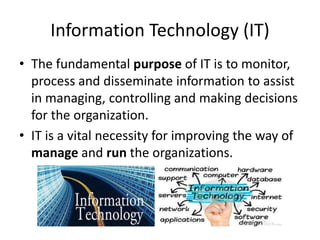
• The fundamental purpose of IT is to monitor,
process and disseminate information to assist
in managing, controlling and making decisions
for the organization.
• IT is a vital necessity for improving the way of
manage and run the organizations.
Information Technology (IT)
• Today, businesses are using information to gain
an competitive advantage over their competitors.
• Organizations must provide high-quality service
to customers by defining what they want, when
they want it and where they want it.
• Organizations that can satisfy these requirements
will enhance the organization’s ability to meet
those requirements.
Information Technology (IT)
• Gaining knowledge through information is the
role of information technology in today’s
information-based businesses.
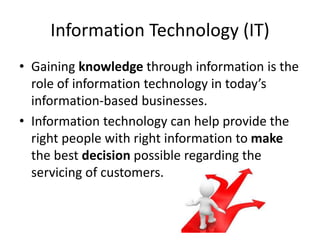
• Information technology can help provide the
right people with right information to make
the best decision possible regarding the
servicing of customers.
The changing Business Environment
• The world has seen several changes in recent years
that have altered the business environment.
• The emergence and strengthening of the global
economy, the transformation of many industrial
economies to knowledge-based and information-
based service economies, profound changes in the
hierarchical structure of many organizations.
• The emergence of technology-driven innovation like
the virtual workplace, telecommunicating and
electronic commerce.
• Each of these phenomena is impacted by or reliant
upon IT.
Foundations of Information Systems
• Information systems provide a systematic
approach for collecting, processing,
maintaining and distributing information
throughout an organization.
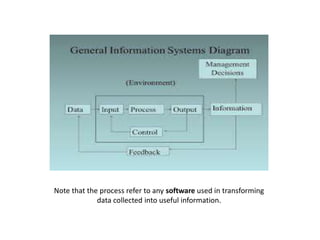
• A general system consists of five basic
components: inputs, processing, outputs,
procedures for providing feedback to the
system and controlling the system.
Note that the process refer to any software used in transforming
data collected into useful information.
Development of High-Quality
Information System
• Most information systems are developed
through a systematic process in which system
design specialist and programmers collaborate
with the end users.
• End users are all the people who will use and
interact with the information system,
particularly the decision makers in the
organization.
Investigation
• The initial phase in the development of an
information system is systems investigation. The
organization determines whether a problem or
opportunity exists that an information system
can address.
• For example, the calculation of materials being
used in a construction project.
• Once an organization ascertains that an
information system is both appropriate and
feasible, it develops a plan for managing the
project.
Systems Analysis
• Once the plan has been devised and approved
by the management, the second phase called
systems analysis begins.
• The purpose of system analysis is to develop
the functional requirements for the
information system.
• Concentrating what needs to be done to
provide the desired information.
Systems Analysis
• This phase begins with an examination and analysis of
the current systems in use, an assessment of the
organizational environment and a detailed assessment
of the information needs of the end users.
• The system designers develop a set of functional
requirements, or a detailed description of the
necessary functional performance capabilities of the
information system.
• These requirements focus on the type of information
that decision makers need, the response times the
users will need and the format, frequency and volume
of information that should be produced and
distributed.
Systems Design
• Phase 3 is the system design phase.
• The designers identify the hardware, software,
people and data resources that will be needed
and describe the information products that
will be produced to satisfy the functional
requirements specified in system analysis.
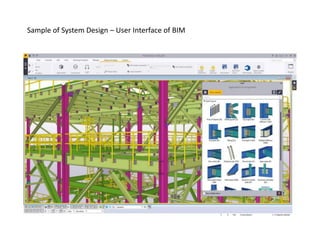
• Such as user interface, or the point of
interaction between the people and the
information, is designed in this phase.
Sample of System Design – User Interface of BIM
Systems Design
• The data, attributes and structures, and the
relationships among the various data
elements are created.
• These data will ultimately become the input
for the database.
• Finally, the software system – the various
computer programs and procedures is
designed.
System Implementation
• Once the analysis and design phases have
been completed, systems implementation can
begin.
• The outcome of this phase will be an
operational system.
• The hardware and software that will be
incorporated into the new information system
are developed or acquired.
System Maintenance
• The final phase in the development of an
information system is systems maintenance.
• New hardware may be added to the system to
address new needs or to replace older
equipment.
• Software updates – new versions with added
capabilities often become available.
• Users may discover additional things that need to
be added, better ways of doing things and
possibly areas that can be removed from the
system.
Information Versus Data
• Data are the raw facts or details that represent
some type of transaction or activity within an
organization.
• When raw data are transformed into a
meaningful and useful form for a specific
purpose, the result is information.
• In data processing, the data are aggregated and
organized, manipulated through analysis and
placed in a proper context for evaluation and use
by the end user.
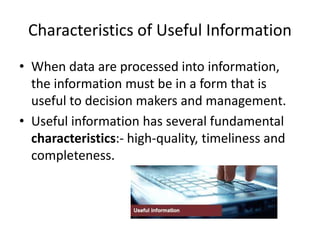
Characteristics of Useful Information
• When data are processed into information,
the information must be in a form that is
useful to decision makers and management.
• Useful information has several fundamental
characteristics:- high-quality, timeliness and
completeness.
Summary
• Information Technology (IT) will have impact on
management efficiency, social relationships
and the structure within an organization.
• Efficiency will improve only when the
organization and the decision-making process
are reassessed and redesigned to take
advantage of the capabilities of the technology.
• When information systems are used to
enhance communication between people in
the organization, there is a social impact.

MS Lecture 9 information technology

  • 1.
  • 2.
    Introduction • Although anabundance of information is available to assist organizational decision makers, high-quality information is necessary for good decision making. • High-quality information provides knowledge about past and current conditions in the organization. (understanding) • The acquisition, processing, maintenance and distribution of this information involve information systems and information technology (IT).
  • 3.
    Information Technology (IT) •New technologies are evolving and existing technologies are expanding, this is having a impact on organization and society. • The interaction between people and computers is growing rapidly. • At the organizational level, an ever-increasing number of activities relying on these human- machine interactions. (such as payroll processing, inventory monitoring)
  • 4.
    Information Technology (IT) •The fundamental purpose of IT is to monitor, process and disseminate information to assist in managing, controlling and making decisions for the organization. • IT is a vital necessity for improving the way of manage and run the organizations.
  • 5.
    Information Technology (IT) •Today, businesses are using information to gain an competitive advantage over their competitors. • Organizations must provide high-quality service to customers by defining what they want, when they want it and where they want it. • Organizations that can satisfy these requirements will enhance the organization’s ability to meet those requirements.
  • 6.
    Information Technology (IT) •Gaining knowledge through information is the role of information technology in today’s information-based businesses. • Information technology can help provide the right people with right information to make the best decision possible regarding the servicing of customers.
  • 7.
    The changing BusinessEnvironment • The world has seen several changes in recent years that have altered the business environment. • The emergence and strengthening of the global economy, the transformation of many industrial economies to knowledge-based and information- based service economies, profound changes in the hierarchical structure of many organizations. • The emergence of technology-driven innovation like the virtual workplace, telecommunicating and electronic commerce. • Each of these phenomena is impacted by or reliant upon IT.
  • 8.
    Foundations of InformationSystems • Information systems provide a systematic approach for collecting, processing, maintaining and distributing information throughout an organization. • A general system consists of five basic components: inputs, processing, outputs, procedures for providing feedback to the system and controlling the system.
  • 9.
    Note that theprocess refer to any software used in transforming data collected into useful information.
  • 10.
    Development of High-Quality InformationSystem • Most information systems are developed through a systematic process in which system design specialist and programmers collaborate with the end users. • End users are all the people who will use and interact with the information system, particularly the decision makers in the organization.
  • 11.
    Investigation • The initialphase in the development of an information system is systems investigation. The organization determines whether a problem or opportunity exists that an information system can address. • For example, the calculation of materials being used in a construction project. • Once an organization ascertains that an information system is both appropriate and feasible, it develops a plan for managing the project.
  • 12.
    Systems Analysis • Oncethe plan has been devised and approved by the management, the second phase called systems analysis begins. • The purpose of system analysis is to develop the functional requirements for the information system. • Concentrating what needs to be done to provide the desired information.
  • 13.
    Systems Analysis • Thisphase begins with an examination and analysis of the current systems in use, an assessment of the organizational environment and a detailed assessment of the information needs of the end users. • The system designers develop a set of functional requirements, or a detailed description of the necessary functional performance capabilities of the information system. • These requirements focus on the type of information that decision makers need, the response times the users will need and the format, frequency and volume of information that should be produced and distributed.
  • 14.
    Systems Design • Phase3 is the system design phase. • The designers identify the hardware, software, people and data resources that will be needed and describe the information products that will be produced to satisfy the functional requirements specified in system analysis. • Such as user interface, or the point of interaction between the people and the information, is designed in this phase.
  • 15.
    Sample of SystemDesign – User Interface of BIM
  • 16.
    Systems Design • Thedata, attributes and structures, and the relationships among the various data elements are created. • These data will ultimately become the input for the database. • Finally, the software system – the various computer programs and procedures is designed.
  • 17.
    System Implementation • Oncethe analysis and design phases have been completed, systems implementation can begin. • The outcome of this phase will be an operational system. • The hardware and software that will be incorporated into the new information system are developed or acquired.
  • 18.
    System Maintenance • Thefinal phase in the development of an information system is systems maintenance. • New hardware may be added to the system to address new needs or to replace older equipment. • Software updates – new versions with added capabilities often become available. • Users may discover additional things that need to be added, better ways of doing things and possibly areas that can be removed from the system.
  • 19.
    Information Versus Data •Data are the raw facts or details that represent some type of transaction or activity within an organization. • When raw data are transformed into a meaningful and useful form for a specific purpose, the result is information. • In data processing, the data are aggregated and organized, manipulated through analysis and placed in a proper context for evaluation and use by the end user.
  • 20.
    Characteristics of UsefulInformation • When data are processed into information, the information must be in a form that is useful to decision makers and management. • Useful information has several fundamental characteristics:- high-quality, timeliness and completeness.
  • 21.
    Summary • Information Technology(IT) will have impact on management efficiency, social relationships and the structure within an organization. • Efficiency will improve only when the organization and the decision-making process are reassessed and redesigned to take advantage of the capabilities of the technology. • When information systems are used to enhance communication between people in the organization, there is a social impact.